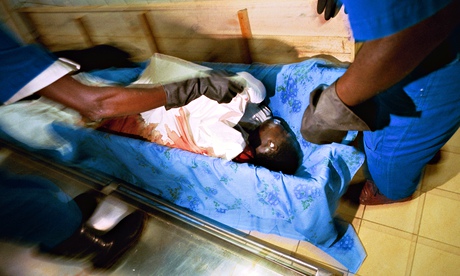
An Aids victim at Kigali morgue in Rwanda. Photograph: Sean Smith for the Guardian
Antiretroviral drugs have been an astounding good results story, reprieving folks with HIV from the brink of death and making it possible for them to dwell a total and healthier existence. But despite the fact that the roll-out across the globe has saved lives and removed the distressing photos of wasted Aids victims from our Television screens, authorities know the medicines will not finish the epidemic. The hunt is on for a cure, but it is proving difficult.
Antiretroviral drug therapy suppresses the virus to such low ranges that people with HIV are no longer infectious, but it can’t get rid of it. The virus has survived virtually almost everything that has been experimented with so far to eradicate it. It evolves swiftly and efficiently if not entirely suppressed – if someone forgets to take their tablets or runs out, for instance – and gets resistant to the triple-drug regimen the patient is on. A new mixture is required. Some people – for instance those born to mothers with HIV years ago – ahead of we had drugs to cease transmission at birth, have been via many.
“Some folks in their late teens and early 20s have been by way of every thing,” mentioned Jane Anderson, an HIV advisor at Homerton hospital in east London. “They have been by means of masses of medicines.” Thankfully, the organizations preserve creating new versions of the old ones, but there are no new courses of drugs coming along.
“At the second it’s Ok, but they have nonetheless not acquired huge alternatives waiting all around the corner,” she stated.
Campaigners and HIV scientists speak of treatment method as prevention. Studies have now proved that individuals on antiretroviral treatment are not infectious. It has also been proven that taking the drugs can protect an uninfected partner of somebody with HIV. It follows that getting drugs to more people will assist avoid HIV as effectively as deal with it.
But drugs are even now a stop-gap, infections are rising everywhere and the target now of the scientists and medical professionals in the Global Aids Society, the foremost professional HIV organisation in the world, is to uncover some type of cure – either total or what they get in touch with practical – which would involve permanent suppression of the virus in the entire body. The efficiency of HIV, nonetheless, helps make it a formidable foe.
The gene treatment trial at the University of Pennsylvania is probably to cause some excitement between the scientific community that is searching for new approaches to tackle the virus, right after many failures, particularly in vaccine growth.
The researchers appear to have found potentially a new way to suppress the virus, which includes priming the body’s personal immune system to preserve it at bay.
This is not a remedy, as it stands, but could be another selection for people sentenced to a lifetime of medication. But it will also educate scientists much more about the behaviour of HIV and suggest new methods to assault it.
So far, the only man or woman thought to have been “cured” is Timothy Brown, an American originally identified as the Berlin patient. Brown, who was HIV-constructive, had bone-marrow transplants in Germany in 2007 to remedy leukaemia. His medical doctor had the foresight to use stem cells from a donor who had a genetic mutation that seems to block HIV from coming into human cells.
But hopes that bone-marrow transplants per se may possibly clear the virus have been dashed last December. Two individuals, acknowledged as the Boston individuals, who have been HIV-positive and acquired bone-marrow transplants had been originally considered to be virus-free. They had no detectable HIV in their entire body and they stopped their antiretroviral medication. But right after several weeks, the virus came back. Both are now back on medication and said to be performing effectively.
1 other recent impressive case is that of the Mississippi infant, born in Could 2010 to a female who had not witnessed a medical doctor in her pregnancy and did not know she had HIV. Dr Hannah Gay, associate professor of paediatrics at the University of Mississippi Health care Centre, who noticed the infant at thirty hrs previous, ordered exams that showed the infant had the virus and right away gave the complete three-drug remedy course.
By the time the infant was a month outdated, the virus was undetectable, but at 18 months, the mom stopped bringing the child for drug therapy. Five months later on, they returned – and exams showed the baby was HIV-cost-free and has remained that way. There is speculation that the building immune technique of a newborn could be capable of clearing the virus as an adult’s is not.
These successes are limited, but they give hope to these in the discipline that a cure is attainable – 1 day.
HIV "s efficiency helps make it a formidable foe

Hiç yorum yok:
Yorum Gönder