paralysed etiketine sahip kayıtlar gösteriliyor. Tüm kayıtları göster

11 Eylül 2016 Pazar

Paralysed, pregnant Claire Lomas finishes Great North Run in five days

A paralysed pregnant woman wearing a bionic suit has completed the Great North Run five days after she started it.


Claire Lomas, from Leicestershire, was paralysed from the chest down in a riding accident in 2007, which left her with a fractured neck, dislocated back, fractured ribs, a punctured lung and pneumonia.


The 36-year-old, who is 16 weeks pregnant, began the half-marathon, which runs from Newcastle to South Shields, on Wednesday and crossed the finish line at about 10am on Sunday.


Lomas told the Guardian that she had suffered from morning sickness during much of her training and had had to seek medical attention for sores caused by the straps of her suit. “I haven’t had much sleep. I spent the first two nights worrying that I wouldn’t be able to make it,” she said.


The former event rider was offered a place in the Great North Run after being refused an official place in the London Vitality 10k. Wearing a ReWalk robotic exoskeleton, which she raised around £50,000 to buy, Claire walked around three miles each day assisted by her husband Dan, visiting schools en route to talk to children about her battle to overcome her injuries.
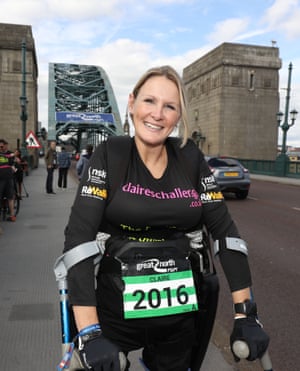


Claire Lomas on the Tyne bridge during the Great North Run.


Claire Lomas on the Tyne bridge during the Great North Run. Photograph: Owen Humphreys/PA

The ReWalk exoskeleton was developed by ReWalk Robotics in Israel to enable paraplegic people to stand upright, walk and climb stairs. Powered by a backpack battery, it relies on motion sensors to help the wearer lift their legs.


“I’ve always liked personal challenges,” she said. “I wanted to raise money because I saw a lot of people worse off than me in hospital with neck injures, who weren’t getting as much support.” To date, Lomas has raised around £560,000 for the Nicholls Spinal Injury Foundation.


Lomas, who gave birth to her first child, Maisie, in March 2011, says that staying as active as possible is good for people who have suffered spinal injuries. “It’s good for your health, anyway, whether you are [an active person] or not and then there are the mental [health] benefits to it, too,” she said.


In April 2012, she completed the London Marathon in 17 days using the robotic suit. The organisers usually require participants to finish the marathon within 24 hours, but they allowed Lomas to walk two miles a day for 17 days.


“[The Great North Run] has been the toughest by a long way,” said Lomas. “The London marathon took me 17 days and I did this in five, and it’s hilly.” Although she hasn’t calculated the total amount she has raised from the run, she estimates that it will be around £20,000.


Olympic distance-running champion Mo Farah, who finished the run in first place for the third year running, congratulated Lomas, describing her as an inspiration.


“It’s pretty amazing,” he said. “What she went through and then to finish the Great North Run. I want to congratulate her, this is what the Great North Run needs. To have the courage to be able to compete is amazing.”


Paralysed, pregnant Claire Lomas finishes Great North Run in five days

25 Haziran 2014 Çarşamba

Observe: paralysed man moves his hand using considered


An Ohio, US resident who was paralysed in a swimming accident has made history as the very first ever patient to move his injured hand making use of his personal ideas.


Ian Burkhart managed to pick up a spoon and open and near his initial right after doctors at The Ohio State University Wexner Medical Center, with researchers from Battelle, inserted a Neurobridge technology microchip into his brain.


The medical breakthrough provides hope to hundreds of thousands of accident victims and stroke sufferers of a new bionic era of motion by means of believed.


Source: Storyful / Ohio State University Wexner Healthcare Center


Observe: paralysed man moves his hand using considered

17 Haziran 2014 Salı

Longitude Prize 2014: Technology can restore motion to the paralysed

Lately I additional heart rate monitoring, speed and distance as I track my progress. All of this is developed to improve the system and recognize the influence that walking has on the body and mind. I can report that I truly feel greater each time I stroll and that the psychological lift alone that comes from returning to my upright, strolling self is sufficient to inspire me to do these sessions. But also walking in the robot has a clear influence on me physically. Right after each and every session I truly feel stretched, my toe and ankle joints straighten out, the modest involuntary spasms in my legs disappear and the pain in my back eases.


More than the last 18 months I have taken more than 300,000 actions in my exoskeleton. I have also examined a range of electrical stimulation units, including giving my robot and my body for experiment to a team led by UCLA’s Dr Reggie Edgerton. And we have currently learnt so significantly at this intersection exactly where guy and machine meet. As Reggie stated – perhaps is not about mechanising people, but rather about humanising the machines.


I think that these technologies are a catalyst for collaboration among physiologists, technologists and scientists to build therapies that heal the many wounds of paralysis that are left unspoken.


These wounds are hidden behind the apparent lack of movement and mobility. Paralysis also benefits in a remarkable reduction of overall health, independence and dignity. Most do not know that, as effectively as loss of motion, people with spinal cord injuries usually can not truly feel, usually lose sexual perform and the capability to have a family without IVF. Our life expectancy is lowered. We get rid of standard bladder and bowel perform and have to attempt to live and work with the continuous management of this on our minds.


We drop connections to the brain, which interferes with people factors that keep us alive. Neuropathic discomfort and uncontrollable spasms are frequent. Day in and day out these are the factors that exhaust even the most established.


The Longitude Prize supplies the opportunity to secure some extended awaited victories in excess of paralysis for the hundreds of thousands of paralysed people worldwide. I hope that it will encourage collaboration to fast track scientists’ hunches into trials and from trials on to the checklist of options open to those who, like me, are suffering the results of paralysis. It is a human crisis requiring collaboration across geographical, organisational and intellectual boundaries. With a substantial mixed energy absolutely we have to be in a position to assist the human physique to recover it desires to work, it is smart, it just demands some aid to do it. So, I reside in hope for the paralysis local community, that we will get to a level in which technological innovation is element of a variety of therapies, component of a remedy which combines physical exercise, robotics, technologies, pharmacology and biological interventions. And, much more particularly I hope that we can rapidly turn hope of a cure into reality.


LONGITUDE PRIZE 2014


The Longitude Prize provides a £10 million prize for an innovation that will solve one of the main troubles of our time. And we can all support to determine which of six themes the prize ought to concentrate on. The 6 difficulties are:


• To assist men and women with dementia reside independently for longer


• To help prevent the rise of resistance to antibiotics


• To help us to be ready to fly with out damaging the environment


• To support make certain absolutely everyone has nutritious, sustainable foods


• To help restore motion to individuals with paralysis


• To aid ensure every person can have access to protected and clean water


You can vote for the challenge you believe the Longitude Prize need to pursue at bbc.co.united kingdom/horizon. Voting closes at 7.10pm on June 25 2014. The winning challenge will be announced on June 25 and will become the concentrate of the £10 million prize fund. The Longitude Committee will then finalise the criteria for how to win the prize, and from September ideas can be submitted. The Longitude Prize will run for five years, or right up until the prize is won.


Longitude Prize 2014: Technology can restore motion to the paralysed

20 Mayıs 2014 Salı

How manage was restored to paralysed hand


There is currently no cure for upper limb paralysis, the place there has been damage to the nerves which send messages to the muscle tissue from the brain, such as takes place right after a stroke or spinal damage.


Nonetheless, researchers at Newcastle University have been ready to demonstrate the re-animation of a monkey’s paralysed hand for the first time by stimulating the spinal cord.


By making use of electronic stimulation, they have been ready to make the brain’s impulses reach a paralysed hand and carry out a wanted action, such as a grasping movement.


Using this latest study, scientists hope to generate an implant inside five years, which could cure paralysis for stroke sufferers.


How manage was restored to paralysed hand

How control was restored to paralysed hand


There is currently no cure for upper limb paralysis, where there has been damage to the nerves which send messages to the muscles from the brain, such as happens after a stroke or spinal injury.


However, researchers at Newcastle University have been able to demonstrate the re-animation of a monkey’s paralysed hand for the first time by stimulating the spinal cord.


By using electronic stimulation, they have been able to make the brain’s impulses reach a paralysed hand and perform a desired action, such as a grasping motion.


Using this latest research, scientists hope to produce an implant within five years, which could cure paralysis for stroke sufferers.


How control was restored to paralysed hand

8 Nisan 2014 Salı

Spine implant helps paralysed guys move legs


In a new examine published in the journal Brain, researchers gave an update on Rob Summers, of Portland, Oregon, the initial to attempt the therapy, and described profitable benefits for all three of the other men who have tried it. All had been paralysed from beneath the neck or chest for at least two many years from a spinal cord injury.


The study’s lead writer, Claudia Angeli of the Kentucky Spinal Cord Research Center at the University of Louisville, mentioned she believes the device’s zapping of the spinal cord assists it to obtain basic commands from the brain, by way of circuitry that some medical professionals had assumed was beyond fix soon after extreme paralysis.


Dustin Shillcox, 29, of Green River, Wyoming, was significantly injured in a auto crash in 2010. Final 12 months, he had the electrical gadget surgically implanted in his decrease back in Kentucky. 5 days later, he wiggled his toes and moved 1 of his feet for the initial time.


“It was really interesting and emotional,” mentioned Shillcox. “It brought me a lot of hope.”


Shillcox now practices moving his legs for about an hour a day at house in addition to treatment sessions in the lab, sometimes wearing a Superman T-shirt for inspiration. He stated it has given him a lot more self-assurance and he feels more comfy going out.


“The future is really thrilling for folks with spinal cord injuries,” he explained.


Professionals say it really is a promising development but warn the experimental therapy is not a cure. When the implanted gadget is activated, the guys can wiggle their toes, lift their legs and stand briefly. But they aren’t able to stroll and nonetheless use wheelchairs to get about.


The new examine was paid for by the US National Institutes of Wellness, the Christopher and Dana Reeve Basis and others.


Sources: University of Louisville/ AP


Spine implant helps paralysed guys move legs