Henry etiketine sahip kayıtlar gösteriliyor. Tüm kayıtları göster

20 Nisan 2017 Perşembe

Serena Williams’s pregnant victory reminds us how amazing women’s bodies are | Natasha Henry

The news that Serena Williams won the Australian Open final while eight weeks pregnant has sent the world into a frenzy. Some evidently still think that women are the fairer sex, the weaker and the less capable of the two genders.


Believe me when I say we are far from fragile.


Williams is not the first elite athlete to compete during a pregnancy, but she is definitely the most prominent, given her recent win, defeating her big sister Venus. Triumphing 6-4, 6-4 in the final, she didn’t drop a single set on her way to lifting the trophy. I’ll repeat that: not a single set.


Now rumoured to be about 20 weeks – about halfway through a normal pregnancy – she will regain her place as world No 1 next week. That place at the top of women’s tennis will be held for her if she returns to competition within 12 months of giving birth, as per the Women’s Tennis Association special ranking rule.


Bryan Armen Graham (@BryanAGraham)

Serena’s snap suggests that she won the Australian Open without dropping a set while pregnant. pic.twitter.com/ltPndJRJBq


April 19, 2017


As much as I could pontificate about Williams’s achievements as a supreme athlete, role model and beautiful woman of colour all day, I just want to thank her for reminding us how amazing women’s bodies can be – particularly in an era when we are constantly peppered with examples of how they aren’t good enough, how we should alter them or how they should look.


While in the first trimester, the 35-year-old played tennis at the highest level in sweltering conditions. And as if her physical exertions weren’t enough, she also had to deal with the emotional stress of playing against her big sister.
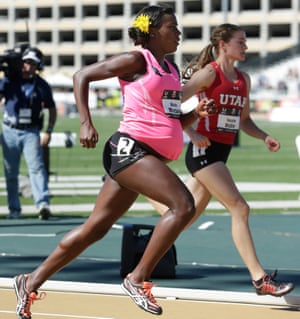


Alysia Montaño, left, who at 34 weeks pregnant, competes in the 800m


‘Who can forget the picture of Alysia Montaño running the 800m while 34 weeks pregnant?’ Photograph: Rich Pedroncelli/AP

But as GP Dr Matt Piccaver told me: “In general, physical activity during any stage of life, including pregnancy, is a good idea. Serena Williams is an elite athlete, and has overcome a number of significant health challenges in her career. The human body is an amazing thing, and Serena proves that we are more robust than we think.”


Should she return to the tour and go on to win a grand slam, she will follow in the footsteps of Kim Clijsters, who won the US Open 18 months after giving birth to her daughter.


Jessica Ennis-Hill, Paula Radcliffe, Katie Chapman and Victoria Azarenka have all returned to compete at the top level in their respective sports after having children. And who can forget the picture of Alysia Montaño running the 800m while 34 weeks pregnant with her daughter?


Obviously every pregnancy is different, as is every woman’s relationship with fertility; but don’t the revelations of the last 24 hours remind you to consider what your body can do?


Like Serena Williams said: “You just have to prove to yourself that you can go out there and be the best that you can be and not prove anything to anyone.”


Maybe we should listen to her and just embrace our strength, our fabulousness and our beauty a bit more, as well as each other’s.


Serena Williams’s pregnant victory reminds us how amazing women’s bodies are | Natasha Henry

17 Aralık 2016 Cumartesi

Heimlich maneuver inventor Dr Henry Heimlich dies at 96

The surgeon who created the life-saving Heimlich maneuver for choking victims has died. Dr Henry Heimlich died early on Saturday at Christ Hospital in Cincinnati. He was 96. His son Phil said he suffered a heart attack earlier in the week.


Heimlich was director of surgery at Jewish Hospital in Cincinnati in 1974 when he devised the treatment for choking victims that made his name a household word.


Rescuers using the procedure abruptly squeeze a victim’s abdomen, pushing in and above the navel with the fist to create a flow of air from the lungs. That flow of air then can push objects out of the windpipe and prevent suffocation.


The Wilmington, Delaware native estimated the maneuver had saved the lives of thousands of choking victims in the US alone.


In May this year it was reported that he had used the maneuver to save the life of another resident of his retirement home. Reports subsequently emerged of a previous use of the maneuver, in 2000.


Of his aid to Patty Ris, 87, in May, Heimlich said: ““I did the Heimlich Manoeuvre – of course. She was going to die if she wasn’t treated. I did it, and a piece of food with some bone in it flew out of her mouth.”


Ris told the Cincinnati Enquirer she wrote Heimlich a note, saying: “God put me in this seat next to you.”


Much of Heimlich’s 2014 autobiography focuses on the maneuver. In a February 2014 interview he said that in 1972, thousands of deaths reported annually from choking prompted him to seek a solution.


During the next two years he led a team of researchers, successfully testing the technique by putting a tube with a balloon at one end down an anesthetized dog’s airway until the animal choked. He then used the maneuver to force the dog to expel the obstruction.


The maneuver was adopted by public health authorities, airlines and restaurant associations, and Heimlich appeared on The Tonight Show Starring Johnny Carson and The Today Show.


His views on how the maneuver should be used and on other innovations put him at odds with some in the health field. He said his memoir was an effort to preserve his technique.


“I know the maneuver saves lives, and I want it to be used and remembered,” he said. “I felt I had to have it down in print so the public will have the correct information.”


The maneuver has continued to make headlines. Clint Eastwood was attending a golf event in Monterey, California in 2014 when the then-83-year-old actor saw the tournament director choking on a piece of cheese. Eastwood successfully performed the technique.


“The best thing about it is that it allows anyone to save a life,” Heimlich said.


Heimlich said the maneuver was very effective when used correctly, but he did not approve of American Red Cross guidelines calling for back blows followed by abdominal thrusts in choking cases that do not involve infants or unconscious victims.


Red Cross officials said evidence showed using multiple methods can be more effective, but Heimlich said blows can drive obstructions deeper into a windpipe. The American Heart Association backs abdominal thrusts.


Neither organization supported Heimlich’s view that using the maneuver to remove water from the lungs could save drowning victims. They recommend CPR.


Heimlich was proud of some of his other innovations, such as a chest drain valve credited by some with saving soldiers and civilians during the Vietnam war. But he drew sharp criticism for his theory that injecting patients with a curable form of malaria could trigger immunity in patients with the HIV virus that causes Aids.


Medical experts have said injecting patients with malaria would be dangerous and have criticized Heimlich for conducting studies involving malariotherapy on HIV patients in China.


Heimlich mostly brushed off his critics.


“I’ll be the first to admit that a number of my ideas are controversial and in some ways unorthodox,” Heimlich said. “But I have enough guts to know that when I am right, it will come about as the thing to do, even if others do the wrong thing for a time.”


One of his most vocal critics was his younger son, Peter Heimlich, who split with his father years ago over a personal rift and initially circulated anonymous criticisms of his father before openly speaking out against him online and in media interviews.


Peter Heimlich has called many of his father’s theories dangerous and spent years challenging many of his claims. Dr Heimlich maintained that his relationship with his son was a family matter refused to comment on it to the media.


Heimlich attended Cornell University undergraduate and medical schools and interned at Boston City Hospital. During the second world war, the US navy sent him to north-west China in 1942 to treat Chinese and American forces behind Japanese lines in the Gobi Desert.


Beginning in the 1950s, he held staff surgeon positions at New York’s Metropolitan Hospital and Montefiore Hospital and Medical Center. He later was an attending surgeon on the staffs at Jewish and Deaconess hospitals in Cincinnati and a researcher at his nonprofit Heimlich Institute.


Heimlich’s wife Jane, daughter of the late dance teacher Arthur Murray, died in November 2012. He is survived by two sons and two daughters.


Phil Heimlich said a private family service and burial was planned soon. The family hoped to arrange a public memorial, he added, that would give his father’s friends and admirers a chance to pay their respects.


Heimlich maneuver inventor Dr Henry Heimlich dies at 96