Landscape etiketine sahip kayıtlar gösteriliyor. Tüm kayıtları göster

5 Mayıs 2017 Cuma

Mountains of the mind: "I’ve become part of the landscape and it’s become part of me"

We begin in darkness and head up towards the light. It is that time just before the dawn when it’s neither day nor night. Down near Lake Coniston, I can hear an owl and a curlew calling, both claiming the hour for themselves. “I like to come this early,” says Sion. “There’s no one else around. I can’t handle crowds. I get confused.”


It’s 4.30am and I am with Sion Jair, 67, and his partner, Wendy Kolbe, 63, and we are heading up the Old Man of Coniston, an 803-metre Lake District fell noted for its sharp ascent and great panoramas of southern lakeland. Or at least we hope so: there are some clouds massing in the east.


For Sion, this has become a daily ritual, adopted seven years ago when a visit to the doctor changed his life for ever. “I had been feeling permanently tired, and suffering some memory problems. It meant I couldn’t get out walking, you see, and when I can’t walk, I really shut down.”


After tests, the doctor diagnosed chronic anaemia from vitamin B12 deficiency. Injections usually sort that out, but Sion reacted badly to the shots and, without them, was given three years to live. Determined not to give in, he set about walking in earnest, covering around 10 miles a day. “Eventually, it worked. I reckon it cured me of the chronic fatigue,” he says.


But there was another blow. The anaemia had been masking signs of dementia. Given the particular type of condition he was suffering from, he was warned that he could expect periods of total memory loss, mood swings and eventually the inability to look after himself. Sion had become one of the estimated 25 million people worldwide suffering this progressive neurodegenerative disease, as feared now as the Black Death was in its day.


“It was quite scary,” says Sion, adding, in something of an understatement. “I didn’t like the idea.”
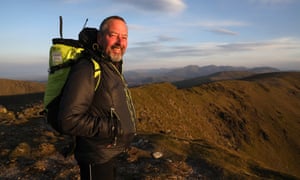


Sion Jair walking up the Old Man of Coniston


‘When I can’t walk, I really shut down’ … Sion Jair walking up the Old Man of Coniston. Photograph: Kevin Rushby

Sion’s response was typical of him: he walked even more. Not just the Old Man, but other fells, too: Scafell Pike, Helvellyn, Blencathra, Dollywaggon Pike – all the greats. “I’ve done them so often, I know them blindfolded.” And all this he did without any technological intermediaries, smartphone or GPS – just the steady rhythm of his feet. On one occasion he did 12 peaks and 28 miles in 22 hours, raising cash for his three favourite charities: the Alzheimer’s Society, Mountain Rescue and the Great North Air Ambulance. He also walked in Wales – he walked the Snowdon horseshoe more than 200 times – and Scotland, but it was in Coniston that he found his walking mantra. I suppose you could call it his Coniston Old Man-tra.


“I come twice a day sometimes. I know every part of the path, and lots of individual stones. I’ve done it more than 5,000 times, and hope to do it long into my illness. But I don’t call myself a walker – not at all – this is me. Me and the Lakes. I found a place where I fit in – I’ve become part of the landscape and it’s become part of me. It’s a kind of symbiosis.”


That is what fascinates me about Sion. His walking has embedded him in the Lakeland landscape and made him happy, despite the dementia. Like the Herdwick sheep grazing the hillsides, he has become hefted to the fell.


Walking, of course, is as familiar and mundane as breathing. Most of us do it all the time, and have done probably ever since the proto-human Sahelanthropus tchadensis walked across what is now the Djurab desert in Chad six or seven million years ago. The bones found there in 2001 are currently the oldest evidence for bipedalism, although that species was probably still a tree-climber, too. It was not until Homo erectus, a couple of million years ago, that two-legged locomotion finally became the method of travel that defines humans.


The act of walking, however, has come a long way since it was just about peeking over the elephant grass and carrying a big stick. It can take on a greater purpose and meaning than simply propelling yourself along. Think of the times you have walked a good distance and then looked back and marvelled at how far you’ve travelled. There is something magical and energising about gazing back over the ridges of misty fells, or even how many Tube stations you have passed. Great thinkers and writers, from Aristotle to Lakeland’s own William Wordsworth, have sworn by the power of walking. There is no possibility of cheating, no first-class option. When we walk, we are all equal. “Shank’s pony” is a great leveller. Perhaps that’s why we choose to protest by walking. A group protest march on foot carries the message that something is wrong with the outside world and needs to be put right. In that way, I think, Sion’s walking is a kind of solo protest march against an inner problem, his dementia. It’s his way of tackling it and refusing to surrender without a fight.


We are starting to climb more steeply now, and the track is a treacherous scree of loose, flat stones that make dull, hollow noises when kicked. “It’s hard,” he says, “talking and climbing.” But that doesn’t stop him. When we pass an abandoned slate quarry halfway up the mountain, he tells me how he once moved a wooden beam that was threatening to fall on some unsuspecting hikers. Beside that beam is some rusting winding gear. Perhaps it’s that – the metal wreckage of a former life – that triggers something in his head, because next thing he is telling me a childhood story from the 1950s. “I was out shopping with my mum and two RAF jet fighters collided overhead. I remember watching the fuselage of one jet smash into some houses. When we got home, our house had been hit, too. There was a big crack in the gable end.”


As if on cue, the sun breaks over the low bank of cloud and instantly spreads a fiery glow across the fell ridges and summits. Is this how it works, I wonder – walking triggers memories, then somehow they get tangled into the walk itself? Are the fells listening?
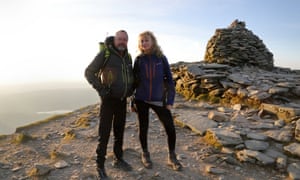


walkers Sion Jair and Wendy Kolbe on the summit of the Old Man of Coniston


‘I do believe the walking is holding the dementia at bay a bit’ … Sion and Wendy on the summit of the Old Man. Photograph: Kevin Rushby

Sion is certainly an entertaining companion, and has an impish sense of humour. He is also a quick walker. He had said, at the bottom of the hill: “No one passes me on the fells.” By now I could understand why. With short, rapid strides, he gets into a rhythm and does not stop. Wendy is left behind, and I have to concentrate hard just to keep pace with him. His energy and power are astonishing.


Behind us the landscape begins to unfurl: the silver streaks of Lakes Windermere and Coniston, the silver eyes of Low Water and Levers Water. “It might get a bit windy here,” says Sion, and sure enough, within a few strides a cold blast comes roaring up the col, biting at us, and suggesting another story.


“Back in the late 60s and early 70s, I was a biker,” he says, chuckling. “I had long hair and rode a BSA Royal Star. One time me and a mate rode down to London from Birmingham on it – both of us with hair all down our backs. That was in the days when you didn’t have to wear a helmet, and of course we didn’t.” He stops to wipe away a tear that the wind has tugged from his eye. “When we stopped at a service station, we both got off the bike and immediately fell over. Our hair had got knotted together by the wind. It was crazy. I remember bystanders killing themselves laughing. We had to cut it with a knife.”


I ask if these kind of stories come back to him at other times – when just sitting at home in an armchair, for example.


“No. My mind shuts down and I get depressed. I need to walk, then it comes.”


Sion is walking his stories out, using the rhythm and swing of his legs to oxygenate his memory, triggering recollections. With dementia, he tells me, there is very little help in that difficult period between diagnosis and the dreaded moment when the sufferer can no longer cope. This is his self-administered treatment.


I ask about his past. Had he always lived in Cumbria? “I was in Birmingham for many years. I lived beside the M6 at Spaghetti Junction for 14 years.” Recent studies have suggested a link between pollution and dementia. Was there anything good about that? He grins. “I miss the sound of the birds coughing.”


He had gone through some bad times: redundancy, divorce and homelessness, but later he managed to get a housing association flat next to the notorious road intersection. The smell of diesel was ever-present. He was already struggling with chronic fatigue, and a doctor recommended he get away to somewhere with cleaner air – perhaps in the mountains. It was then that he recalled a teenage visit to an Outward Bound course in the Lakes. He telephoned a housing association in Cumbria and asked to do a swap. When they offered a place he took it immediately. He laughs. “They said: ‘Don’t you want to see it?’ I said: ‘No, that won’t be necessary.’”
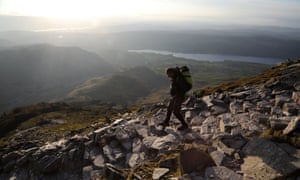


Sion Jair on the descent back to Coniston.


‘No one passes me on the fells’ … Sion Jair on the descent back to Coniston. Photograph: Kevin Rushby

When he arrived in Ulverston, he looked out the front window and in the distance saw the Old Man, the fell that looms over Coniston village. The next day, he went up it. “I’ve always walked a lot. When I was going through divorce and redundancy, I walked to deal with my problems.”


As we reach the final summit ridge, he instinctively turns away from the wind and leads us to a place of shelter, then dons a thicker jacket. “We’ll not stop long at the top – it’s going to be too cold.” And that reminds him. “A lot of people come out now with GPS, but in cold weather the batteries don’t last as long. They forget that.” He doesn’t believe GPS helps. “It takes away skills like timing, pacing and contour-reading – skills that bring a feel for the landscape.” And beyond that, “I reckon they prevent people from building memories of places and routes, gathering all that knowledge and experience into a useful mental map.” This is something that is particularly significant for a dementia sufferer, and the evidence bears him out.


Soon after GPS first appeared in civil navigation, around the turn of the millennium, academics began noticing its adverse effect on mental maps, even damaging spatial awareness. In 2008 a Japanese researcher, Toru Ishikawa, showed that subjects given GPS rather than paper maps made more errors and travelled further. Other studies confirmed this and similar findings. No wonder there has been a spate of books on traditional navigational methods, such as John Huth’s The Lost Art of Finding Our Way, and Tristan Gooley’s The Walker’s Guide to Outdoor Clues & Signs. One area of the brain long thought to be associated with mental map-building is the hippocampus. Unsurprisingly perhaps, London cabbies who have done the Knowledge have been found to have larger hippocampus volumes. It is known that people with reduced hippocampus volumes are at a greater risk of developing conditions such as dementia. The science suggests that Sion is absolutely right in treating himself with large doses of mental map-building.


At the summit, we brace ourselves against the icy blast and gaze around. Wendy comes up and joins us. Sion names the fells and lakes. Northwards to Fairfield, Wetherlam and Scafell Pike; east to Low Water, the Coniston Fells and the Pennines. He has walked all these ridges, and knows every path and tarn. Not wanting that knowledge to be wasted, he and Wendy have started a not-for-profit venture to teach navigational skills using traditional map-and-compass methods. “We try to give people the confidence to be out here alone,” says Wendy.


It had seemed like a joke when I had asked Sion if there was anything he missed about Spaghetti Junction, but now I ask if there have been any benefits to his diagnosis of dementia. He laughs. “I can never remember who lent me money.” But then he thinks, his eyes twinkling. “You know, I think there is. I’ve learned to live every day as it comes. I do believe the walking is holding the dementia at bay a bit. And I’m up here in all weather, even Christmas Day. I love it. I’ve tuned in to the Lakes, and they’ve tuned in to me.”


Mountains of the mind: "I’ve become part of the landscape and it’s become part of me"

31 Mart 2014 Pazartesi

Reinventing Investment: The Funding Landscape Of Lifestyle Science Shifts For Excellent

The legal landscape and demands for a existence sciences business to fundraise in the US are a nightmare, to place it gently. Suggestions changed recently with the Jumpstart Our Company Startups (JOBS) Act, and the sheer number of investment strategies for a daily life science startup executive to realize and pursue are staggering.  Or, as Life Science Nation (LSN) Founder Dennis Ford puts it, “When I started my company, I invested 18 months traveling all around the planet going to tons of investor conferences, but actual traders had been nowhere to be found. The VCs in this room just couldn’t get any returns and no longer have the cash we want.”


Making use of that premise, he set out on a mission to reinvent the way traders and entrepreneurs share data, negotiate, and now, how the markets themselves function. The premise is primarily based on fit. Altering the preexisting shotgun technique for raising capital to a much more productive model. 


According to those in the field, the future of lifestyle science investment is not the phase two and three ventures of the previous. Translational and early-stage funding are the locations where actual value is located, and where the US investment globe is headed no matter whether traders are prepared or not.


bioe.2013.15-F1

LSN Shifts To Early-Stage Investment Models


Connecting Merchandise, Solutions And Capital


At LSN’s most latest Redefining Early Stage Investments Conference (RESI), as a lot of as 10 diverse categories of daily life science investors have been showcased and their respective early stage investment strategies were presented and debated. Mr. Ford asserts, “Each of the classes of early stage daily life science investor has its own character. Loved ones offices, virtual Pharma’s, and patient groups all have their very own cause for investing, and the fundraising scientist/CEO ought to understand the nuances of each and every investor kind. 


The goal of the conference setting was not only to give lifestyle science firms a space to connect and produce dialogue with likely investors, but also educate everybody in the ecosystem by introducing new gamers and approaches. The workshops and panels at RESI ranged from How to Value Your Startup to Commercialization of Academic Technologies to investor debates centered on rare ailments and how orphan indications can influence investment choices.


There is a true want for a RESI like conference, that to date has gone greatly unmet in accordance to Susanna Ling, Director of Company and Program Improvement at EBD Group. “While the monetary markets have improved in the biopharmaceutical sector in the previous 12 months, there is still a powerful want for funding of early-stage organizations and analysis. It is very good to see high quality investment options matched by a diversity of investors with the flexibility to participate in new sorts of economic models” she says.


A new function of the RESI conference was the RESI Challenge where 32 picked organizations were provided area on the exhibit hall floor to pitch their businesses to investors who voted with “RESI money”. Mr. Ford was delighted to announce that three female CEO’s took first, 2nd and third spot.


New Roles In Investing


Ms. Ling even more contends that, “The increasing function of venture philanthropists, family offices, and public/private partnerships is helping to bridge the funding gap of progressive analysis that can go onto entice far more conventional capital at a later stage of growth.”


Even though a number of investment approaches presented at RESI had been standard strategies wrapped in new verbiage, most have been disruptive to standard science investment. For example, Greg Simon, CEO of Poliwogg who attended his 2nd RESI Conference, says that, “each yr a better percentage of attendees get that this is the finish of the previous investment methods and the starting of the new. There is a lot a lot more cash offered for the 97% that VCs really don’t appear at alternatively of the 3% that VCs normally seem at.”


The premise of their function at Poliwogg, is to generate platforms and metrics to let men and women invest in emerging firms in a number of approaches by producing the cost of entry go down.


RESI Conference 2014, Boston, MA. Photo Credit: Lavinia G. Lowerre

RESI Conference 2014, Boston, MA. Photograph Credit score: Lavinia G. Lowerre


A Fresh Take On The Old


Previously pulling collectively financing from the ever-expanding sorts of capital obtainable was generating an previously complicated and time-consuming fundraising approach far more so. Mr. Ford’s organization LSN also curates an early stage daily life science investor database. His company covers these new investor classes by way of one-on-1 interviews with his analysis staff, then publishing investor profiles that are effortlessly searched by fundraising clientele. The traders are keen to participate since by declaring their interest to the LSN researcher he can get entrepreneurs that meet investment criteria.


Reinventing Investment: The Funding Landscape Of Lifestyle Science Shifts For Excellent

4 Mart 2014 Salı

The Flow Landscape: The Gateways To Ultimate Functionality

Above 150 years of investigation has shown that movement states—defined as an “optimal state of consciousness where we truly feel our ideal and perform our best”—are the secret to greatest human performance, an concept presented in my most recent book. The ideal instance of this comes from the planet of action and journey sports, exactly where, in the previous couple of decades, best athletes have used movement to accelerate functionality more rapidly and farther than at any other time in the 150,000 year history of our species. In this evolutionary eye blink, a lot more unattainable feats have been achieved than ever prior to.


Nevertheless, regardless of these triumphs, these athletes do not have a monopoly on flow. Far from it. The state is ubiquitous. It demonstrates us anywhere, in anyone, offered specific first circumstances are met. And that’s my bigger point. Latest advances in biotechnology enable us to use these athletes and their not possible feats as case studies. We can now decode what they’re carrying out to harness flow so efficiently and apply this expertise across all domains in society.


To give you a sense of all of this—and as a way of celebrating the release of the book—I’m providing readers of this website a sneak peak at a previously unreleased excerpt from RISE. in it, you will meet legendary kayaker Doug Ammons, explore one particular of those aforementioned extremely hard feats, then transition into a section area detailing all those non-athletic components of society exactly where flow is previously making an impact and the explanation why finding out from these athletes is so critical to our potential.


Doug Ammons and the Stikine


It was a single of the most hazardous experiments ever run and it was run in silence. Doug Ammons informed no a single ahead of time. The editor of a number of distinct science journals, Ammons did not inform his colleagues. He did not inform his wife, nor his children, nor his friends. Absolutely not his close friends. “They would have advised me I was committing suicide,” recounts Ammons, “that I was on a death journey. They wouldn’t have understood.”


How could they comprehend? This wasn’t about dissecting frogs or sequencing DNA or even, splitting the atom. This was about real transformation. Ammons needed to transform himself into a drop of water. He was betting his daily life on the probability.


Ammons is a correct polymath. He holds degrees in math, physics and psychology, is a classical guitarist, karate black belt, productive business guy, acclaimed writer, respected philosopher, and, with out question, one of the most revered kayakers in background. In 2000, Outdoors Magazine made a list of the ten biggest adventurers because 1900, with their key criteria being “their achievements completely altered the landscape of adventure.” Ammons is amount 7.


Whitewater-smart, his achievements contain in excess of 50 initial descents, a sizable variety of solo expeditions and a handful of, um, much more peculiar trips. On a variety of occasions, Ammons has paddled Class V (professional only) rivers with out a paddle hand-paddling as they get in touch with it. A lot of people believe of hand-paddling as a stunt, and solo-paddling—especially on a huge river—as suicide. To Ammons, as he explains in his guide Whitewater Philosophy, each are a type of analysis: “Perhaps the most stunning experience in kayaking is movement. There isn’t any other sport that demands this kind of intimacy with nature, moving in harmony with the power and intricacy of the river, and whitewater kayaking is the preeminent movement sport. When you paddle, well, there is the feeling that you are pouring oneself appropriate into and by way of the river, with no distractions at all, you can weave oneself correct into the present. Soloing is the open door for comprehending how close to the river you can be.”


Ammons desire for river intimacy is rooted in an even greater desire: the deep ache to participate in the basic elements of creation: elemental powers, eons of time. “Adventure sports form a present day Tao,” he after informed reporters, “allowing us to consider element in the extremely forces that sculpted and shaped the globe all around us.” And it was this desire for primal participation that initial drew Ammons to the wilds of Upper British Columbia, to one particular of the last excellent strategies, to the Grand Canyon of the Stikine.


The Stikine has been described as 1 of the world’s forgotten wonders, but it is unlikely to turn into a tourist attraction anytime quickly. The climate is cold and gray on a excellent day, downright indicate on a poor. The surrounding wilderness covers an location twice the size of France, with a human population numbering in the low thousands. Grizzly bears, meanwhile, are everywhere.


However the wildlife and wildlands are just sideshow sights. The canyon is the true display: a vast gorge carved by a ferocious torrent, some 60 miles of colossal Class V+ whitewater: 25 “Holy Mother of God” rapids, 100s of smaller sized tortures, and a popularity as the Himalaya of expedition kayaking.


In his essay “A Quick Historical past of the Stikine,” Ammons agrees:


This is not a regular river run, not even by the standards of very skilled class V kayakers.  The rapids are dominated by compressional turbulence, incredibly huge holes, closed out characteristics, and monstrous slabs of water that you stick to like fly paper as you try out to make your moves.  It’s an ominous and magnificent canyon, above one thousand feet deep and in some areas so narrow that a helicopter can barely slip through. You are exposed to rockfall although scouting and even in your boat.  It is not the Zambezi, there is no warmth in the glacial water or the generally blustery fall climate. The movement is between 8000 to twenty,000 cfs at lower water and amounts can alter as much as ten feet in a day.  Numerous sections are from 60 to more than 120 feet per mile, and as any large water paddler is aware of, when you combine steep and narrow with plenty of water, you are speaking the actual shit.  Attempts are made at minimal water in the early fall, and there’s the really true likelihood of a freeze or snow, which has took place to two diverse teams.  For 70 % of the canyon, it is quite difficult or utterly unattainable to climb out, with vertical walls on the two sides rising straight out of the river.  If you do have to bail and climb out, as has occurred to eight teams, it is easy to get misplaced up on the plateau and completely achievable to get killed by the wildlife…. This isn’t California. It’s the god-damned Canadian wilderness.


It was paddler Rob Lesser who 1st spotted the Stikine on a journey up to Alaska. This was 1977. He charted a plane for an over-flight. The walls had been so steep, the canyon so deep, there wasn’t considerably to see. What he saw looked foreboding. Lesser labeled rapids “Killer Falls I” and “Killer II” and the like. And he liked. 4 years later on, Lesser returned with a staff of exceptionally skilled kayakers and a helicopter for assistance. They managed about 60 % of the canyon. One member of their group, John Wasson, virtually drowned along the way. They named the quick after him (Wasson’s Hole) they named yet another “The Hole That Ate Chicago.”  It was just that type of river.


Lesser came back in 1985, this time with legendary boaters Bob McDougall and Lars Holbeck, and yet another helicopter. The chopper ferried supplies, abetted portages, and served as a protection blanket must items go sideways. But there was no sideways. The trio pulled it off, completing a milestone very first descent down the complete of the Stikine.


In 1989, Lessor and McDougall returned, with Doug Ammons as their third. This time no helicopter. The team was attempting the very first self-supported expedition by way of the canyon. It was a big bet. With no a chopper in tow, if they acquired into difficulties, the closest assist was easily a mountain selection away.


This being the Stikine, they quickly acquired into difficulty.


7 miles into the trip was Entry Falls, the 1st of the river’s major rapids. Doug McDougall went first, trying a conservative sneaker route all around the boil. So considerably for conservative. He acquired swallowed, smashed, slammed, cartwheeled, washing-machined, window-shaded, and then—arguably the worst death trap a kayaker can encounter—pinned beneath an undercut rock. About to black out, McDougall saw a glimmer of light, clawed upward, acquired swept sideways, slapped a handhold, and, by some means, managed to propel himself into an eddy. His kayak was extended gone.


The Flow Landscape: The Gateways To Ultimate Functionality