mind etiketine sahip kayıtlar gösteriliyor. Tüm kayıtları göster

6 Mayıs 2017 Cumartesi

"Disabled in the body, not the mind or heart": surviving polio in Nigeria – video

Unable to complete his education after contracting polio as a child, Aminu was determined not to become a beggar on the streets of Kano in north-west Nigeria. His solution was to design a bike that restored his mobility. Now he produces dozens of them, employing fellow polio survivors and helping to transform lives


"Disabled in the body, not the mind or heart": surviving polio in Nigeria – video

5 Mayıs 2017 Cuma

Mountains of the mind: "I’ve become part of the landscape and it’s become part of me"

We begin in darkness and head up towards the light. It is that time just before the dawn when it’s neither day nor night. Down near Lake Coniston, I can hear an owl and a curlew calling, both claiming the hour for themselves. “I like to come this early,” says Sion. “There’s no one else around. I can’t handle crowds. I get confused.”


It’s 4.30am and I am with Sion Jair, 67, and his partner, Wendy Kolbe, 63, and we are heading up the Old Man of Coniston, an 803-metre Lake District fell noted for its sharp ascent and great panoramas of southern lakeland. Or at least we hope so: there are some clouds massing in the east.


For Sion, this has become a daily ritual, adopted seven years ago when a visit to the doctor changed his life for ever. “I had been feeling permanently tired, and suffering some memory problems. It meant I couldn’t get out walking, you see, and when I can’t walk, I really shut down.”


After tests, the doctor diagnosed chronic anaemia from vitamin B12 deficiency. Injections usually sort that out, but Sion reacted badly to the shots and, without them, was given three years to live. Determined not to give in, he set about walking in earnest, covering around 10 miles a day. “Eventually, it worked. I reckon it cured me of the chronic fatigue,” he says.


But there was another blow. The anaemia had been masking signs of dementia. Given the particular type of condition he was suffering from, he was warned that he could expect periods of total memory loss, mood swings and eventually the inability to look after himself. Sion had become one of the estimated 25 million people worldwide suffering this progressive neurodegenerative disease, as feared now as the Black Death was in its day.


“It was quite scary,” says Sion, adding, in something of an understatement. “I didn’t like the idea.”


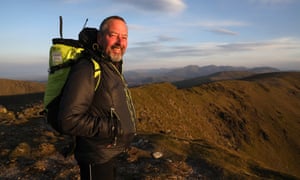
Sion Jair walking up the Old Man of Coniston


‘When I can’t walk, I really shut down’ … Sion Jair walking up the Old Man of Coniston. Photograph: Kevin Rushby

Sion’s response was typical of him: he walked even more. Not just the Old Man, but other fells, too: Scafell Pike, Helvellyn, Blencathra, Dollywaggon Pike – all the greats. “I’ve done them so often, I know them blindfolded.” And all this he did without any technological intermediaries, smartphone or GPS – just the steady rhythm of his feet. On one occasion he did 12 peaks and 28 miles in 22 hours, raising cash for his three favourite charities: the Alzheimer’s Society, Mountain Rescue and the Great North Air Ambulance. He also walked in Wales – he walked the Snowdon horseshoe more than 200 times – and Scotland, but it was in Coniston that he found his walking mantra. I suppose you could call it his Coniston Old Man-tra.


“I come twice a day sometimes. I know every part of the path, and lots of individual stones. I’ve done it more than 5,000 times, and hope to do it long into my illness. But I don’t call myself a walker – not at all – this is me. Me and the Lakes. I found a place where I fit in – I’ve become part of the landscape and it’s become part of me. It’s a kind of symbiosis.”


That is what fascinates me about Sion. His walking has embedded him in the Lakeland landscape and made him happy, despite the dementia. Like the Herdwick sheep grazing the hillsides, he has become hefted to the fell.


Walking, of course, is as familiar and mundane as breathing. Most of us do it all the time, and have done probably ever since the proto-human Sahelanthropus tchadensis walked across what is now the Djurab desert in Chad six or seven million years ago. The bones found there in 2001 are currently the oldest evidence for bipedalism, although that species was probably still a tree-climber, too. It was not until Homo erectus, a couple of million years ago, that two-legged locomotion finally became the method of travel that defines humans.


The act of walking, however, has come a long way since it was just about peeking over the elephant grass and carrying a big stick. It can take on a greater purpose and meaning than simply propelling yourself along. Think of the times you have walked a good distance and then looked back and marvelled at how far you’ve travelled. There is something magical and energising about gazing back over the ridges of misty fells, or even how many Tube stations you have passed. Great thinkers and writers, from Aristotle to Lakeland’s own William Wordsworth, have sworn by the power of walking. There is no possibility of cheating, no first-class option. When we walk, we are all equal. “Shank’s pony” is a great leveller. Perhaps that’s why we choose to protest by walking. A group protest march on foot carries the message that something is wrong with the outside world and needs to be put right. In that way, I think, Sion’s walking is a kind of solo protest march against an inner problem, his dementia. It’s his way of tackling it and refusing to surrender without a fight.


We are starting to climb more steeply now, and the track is a treacherous scree of loose, flat stones that make dull, hollow noises when kicked. “It’s hard,” he says, “talking and climbing.” But that doesn’t stop him. When we pass an abandoned slate quarry halfway up the mountain, he tells me how he once moved a wooden beam that was threatening to fall on some unsuspecting hikers. Beside that beam is some rusting winding gear. Perhaps it’s that – the metal wreckage of a former life – that triggers something in his head, because next thing he is telling me a childhood story from the 1950s. “I was out shopping with my mum and two RAF jet fighters collided overhead. I remember watching the fuselage of one jet smash into some houses. When we got home, our house had been hit, too. There was a big crack in the gable end.”


As if on cue, the sun breaks over the low bank of cloud and instantly spreads a fiery glow across the fell ridges and summits. Is this how it works, I wonder – walking triggers memories, then somehow they get tangled into the walk itself? Are the fells listening?


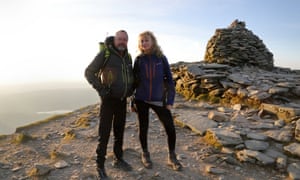
walkers Sion Jair and Wendy Kolbe on the summit of the Old Man of Coniston


‘I do believe the walking is holding the dementia at bay a bit’ … Sion and Wendy on the summit of the Old Man. Photograph: Kevin Rushby

Sion is certainly an entertaining companion, and has an impish sense of humour. He is also a quick walker. He had said, at the bottom of the hill: “No one passes me on the fells.” By now I could understand why. With short, rapid strides, he gets into a rhythm and does not stop. Wendy is left behind, and I have to concentrate hard just to keep pace with him. His energy and power are astonishing.


Behind us the landscape begins to unfurl: the silver streaks of Lakes Windermere and Coniston, the silver eyes of Low Water and Levers Water. “It might get a bit windy here,” says Sion, and sure enough, within a few strides a cold blast comes roaring up the col, biting at us, and suggesting another story.


“Back in the late 60s and early 70s, I was a biker,” he says, chuckling. “I had long hair and rode a BSA Royal Star. One time me and a mate rode down to London from Birmingham on it – both of us with hair all down our backs. That was in the days when you didn’t have to wear a helmet, and of course we didn’t.” He stops to wipe away a tear that the wind has tugged from his eye. “When we stopped at a service station, we both got off the bike and immediately fell over. Our hair had got knotted together by the wind. It was crazy. I remember bystanders killing themselves laughing. We had to cut it with a knife.”


I ask if these kind of stories come back to him at other times – when just sitting at home in an armchair, for example.


“No. My mind shuts down and I get depressed. I need to walk, then it comes.”


Sion is walking his stories out, using the rhythm and swing of his legs to oxygenate his memory, triggering recollections. With dementia, he tells me, there is very little help in that difficult period between diagnosis and the dreaded moment when the sufferer can no longer cope. This is his self-administered treatment.


I ask about his past. Had he always lived in Cumbria? “I was in Birmingham for many years. I lived beside the M6 at Spaghetti Junction for 14 years.” Recent studies have suggested a link between pollution and dementia. Was there anything good about that? He grins. “I miss the sound of the birds coughing.”


He had gone through some bad times: redundancy, divorce and homelessness, but later he managed to get a housing association flat next to the notorious road intersection. The smell of diesel was ever-present. He was already struggling with chronic fatigue, and a doctor recommended he get away to somewhere with cleaner air – perhaps in the mountains. It was then that he recalled a teenage visit to an Outward Bound course in the Lakes. He telephoned a housing association in Cumbria and asked to do a swap. When they offered a place he took it immediately. He laughs. “They said: ‘Don’t you want to see it?’ I said: ‘No, that won’t be necessary.’”


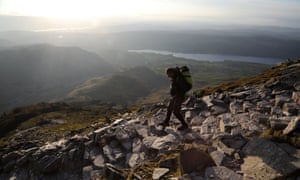
Sion Jair on the descent back to Coniston.


‘No one passes me on the fells’ … Sion Jair on the descent back to Coniston. Photograph: Kevin Rushby

When he arrived in Ulverston, he looked out the front window and in the distance saw the Old Man, the fell that looms over Coniston village. The next day, he went up it. “I’ve always walked a lot. When I was going through divorce and redundancy, I walked to deal with my problems.”


As we reach the final summit ridge, he instinctively turns away from the wind and leads us to a place of shelter, then dons a thicker jacket. “We’ll not stop long at the top – it’s going to be too cold.” And that reminds him. “A lot of people come out now with GPS, but in cold weather the batteries don’t last as long. They forget that.” He doesn’t believe GPS helps. “It takes away skills like timing, pacing and contour-reading – skills that bring a feel for the landscape.” And beyond that, “I reckon they prevent people from building memories of places and routes, gathering all that knowledge and experience into a useful mental map.” This is something that is particularly significant for a dementia sufferer, and the evidence bears him out.


Soon after GPS first appeared in civil navigation, around the turn of the millennium, academics began noticing its adverse effect on mental maps, even damaging spatial awareness. In 2008 a Japanese researcher, Toru Ishikawa, showed that subjects given GPS rather than paper maps made more errors and travelled further. Other studies confirmed this and similar findings. No wonder there has been a spate of books on traditional navigational methods, such as John Huth’s The Lost Art of Finding Our Way, and Tristan Gooley’s The Walker’s Guide to Outdoor Clues & Signs. One area of the brain long thought to be associated with mental map-building is the hippocampus. Unsurprisingly perhaps, London cabbies who have done the Knowledge have been found to have larger hippocampus volumes. It is known that people with reduced hippocampus volumes are at a greater risk of developing conditions such as dementia. The science suggests that Sion is absolutely right in treating himself with large doses of mental map-building.


At the summit, we brace ourselves against the icy blast and gaze around. Wendy comes up and joins us. Sion names the fells and lakes. Northwards to Fairfield, Wetherlam and Scafell Pike; east to Low Water, the Coniston Fells and the Pennines. He has walked all these ridges, and knows every path and tarn. Not wanting that knowledge to be wasted, he and Wendy have started a not-for-profit venture to teach navigational skills using traditional map-and-compass methods. “We try to give people the confidence to be out here alone,” says Wendy.


It had seemed like a joke when I had asked Sion if there was anything he missed about Spaghetti Junction, but now I ask if there have been any benefits to his diagnosis of dementia. He laughs. “I can never remember who lent me money.” But then he thinks, his eyes twinkling. “You know, I think there is. I’ve learned to live every day as it comes. I do believe the walking is holding the dementia at bay a bit. And I’m up here in all weather, even Christmas Day. I love it. I’ve tuned in to the Lakes, and they’ve tuned in to me.”


Mountains of the mind: "I’ve become part of the landscape and it’s become part of me"

30 Ocak 2017 Pazartesi

Never mind America, access to abortion is a "nightmare" for many Australians | Van Badham

It was unsurprising to American women that their new president moved so swiftly to limit women’s access to reproductive autonomy. Less than a week into his regime, President Trump has reinstated a Ronald Reagan policy known as the “global gag rule”.


Abortion wars are, of course, a visible hallmark of American politics, where denying a woman’s right to choose has long been used as a wedge by Republicans to chip white voters away from supporting Democrat candidates. But while a thumping majority of Australians support women’s abortion rights – around 80%, according to reliable polls – the gap between what we say we believe in here and what we legislate is larger than many would imagine.


The danger of balance-of-power politics in our own system of government has made women’s bodies expendable to the politics of placating crossbenchers. Australia even implemented a “global gag” rule of its own when the former Liberal prime minister John Howard did a deal with conservative Catholic senator from Tasmania, Brian Harradine in 1996. Only when Obama overturned a Bush-era gag in 2009 did Labor’s Rudd government finally get around to rescinding Howard and Harradine’s work.


There’s an issue of restriction that also hits closer to home. For a pro-choice country, Australia’s provision of abortion is limited by a hodge-podge of clashing jurisdictional legislation and some old-fashioned under resourcing.


It may surprise many Australians to learn that even though the ACT, Tasmania and Victoria have recently passed legislation that prevents anti-choice activists harassing women around health clinics, only the ACT allows women to access safe, legal abortion-on-demand at any time.


Victoria and Tasmania both provide conditional services based on length of gestation; and South Australia, Western Australia and the Northern Territory make it legal only with certain caveats. In New South Wales and Queensland, abortion remains in the criminal code.


It’s a position both defiant of popular opinion – in Queensland, four out of five voters support abortion rights – and reality. The Australian family planning organisation, Children by Choice, cites studies that half of Australian pregnancies are unplanned, and lists the complex reasons that compromise women’s access to effective contraception (beyond the very real possibility, too, of simple contraceptive failure): lack of agency in relationships, lack of information about contraception, lack of access to it in isolated or rural areas, cost, privacy concerns, cultural dislocation, effects of alcohol or drugs, the imposition of a medical practitioner’s beliefs. Violent relationships. Forced sex. Coercion.


But these considerations have not been enough to either rewrite the law or improve present circumstances in New South Wales, where campaigner Claire Pullen from Our Bodies, Our Choices NSW is one of many agitating for a realisation of rights. Although provision is made for women to access abortion if medical professionals and/or a court determine a pregnancy poses “serious harm” to the woman in question, there are, says Pullen, three barriers to access that remain in the way. “The first one is the legal barrier,” she says, “Since court rulings on this issue in the 1970s, no one’s been charged or convicted with administering or purveying an abortion. But you only need one activist police commissioner for that to end … and we’re due for a whole new set of police commissioners here.”


What this means is women seeking terminations are obliged into seeking referrals, as well as administrative and physical access to clinics that will perform surgical procedures. “The second barrier is geography,” Pullen explains, “Vast swathes of regional New South Wales have no accessible local services – at the one regional clinic in Albury, women patients have been subjected to notorious levels of harassment by anti-choice picketers.”


The third barrier, she says, is resourcing. “There are no public hospitals that officially offer abortion services in this state,” says Pullen, “there are only private clinics. New South Wales has some of the biggest public hospitals in Australia, with excellent ob/gyn doctors and services, but as they don’t get public funds to perform abortions, they’re more or less obliged to refer patients to the Marie Stopes clinic across the road.”


It’s not the only obstruction women face for meeting their healthcare needs. “We could also consider the stigma, the stalking and the public harassment that women endure when they’re accessing these services as a fourth barrier,” says Pullen. “Women outside clinics often face a line of people with graphic and inaccurate signs – they’re handed plastic foetuses by protestors, told they are going to hell and shouted at by fanatics. We don’t have an exclusion zone bill like they do in Victoria, although Penny Sharpe in the NSW upper house is fighting to get one through.”


The situation is similarly dire in Queensland, says Kate Marsh, the spokesperson for Children by Choice in Queensland. The geography of that enormous state combines with its archaic legislation to seriously limit women’s access to abortion providers, whether surgical or medicinal. “The understanding about when abortion is lawful is based only on case law,” says Marsh. “Because there’s no judicial definition of ‘serious harm’, many doctors are understandably reluctant to become involved in providing termination of pregnancy.”


If it seems crazy that the abortion pill – which accounts for almost 100% of abortions in Norway, and two-thirds in the UK, is only used in 23% of Australian terminations – legal restrictions explain why. “For medical abortions – which is the use of the abortion pill – you can only legally access those services if you’re before nine weeks gestation,” says Marsh of present Queensland law. “And outside of [Queensland’s] south east corner, there are only two providers of surgical abortions – in Rockhampton and Townsville.”


This isn’t just bad news for women in Cairns, or the state’s vast west, explains Marsh. “The services in Rockhampton and Townsville only operate one day a fortnight, because they fly doctors up from Brisbane and sometimes from interstate, depending on who is available.


“Even for women who identify their pregnancy early, to be able to confirm it with a doctor, access an ultrasound – and some of these women in remote communities have to travel just to get an ultrasound – and then wait for an available appointment at a clinic, that can push women past the point of the gestational cut-offs imposed at those clinics, which is 15 weeks. There are a couple of clinics (in the south east) that go up to 17 weeks, and there is one clinic on the Gold Coast that goes up to 19 weeks. After that, you’re flying to Melbourne.”


What this means for rural, isolated or Aboriginal and Torres Strait Islander women in remote communities is not only dangerous, but medically, physically, existentially disempowering. “It’s very much dependent on your local hospital, the individual personnel who staff that hospital and who you talk to when you get there,” says Marsh. “We have women who have been pregnant as a result of sexual assault, whose local hospital has refused to accept a referral from their GP to assess them.”


While Children by Choice fundraises to provide access to transport for women in these situations, their resources and their scope to help all who need it is limited. Beyond what her organisation can provide, receiving help, says Marsh, is a “postcode lottery” of geographical and economic privilege.


“Queensland health told a parliamentary inquiry last year that just under 300 abortions were performed in public hospitals in 2015 – and the figure for private clinics that same year was around 11,000,” says Marsh, “Women who live in metro areas and who have money, a credit card, or have friends and family to support them – they can get an abortion, no problem. But people who are disadvantaged, or who very young, may not have friends and family they can call on, women in remote areas or women experiencing violence – it’s a different situation.”


“It sounds like a nightmare,” I say to her when she tells me this.


“It is,” she says, “It is a nightmare.”


Never mind America, access to abortion is a "nightmare" for many Australians | Van Badham

17 Aralık 2016 Cumartesi

5 Daily Brain Exercises For A Healthy Mind And Life

The improvement of health and life in general is achieved by regular exercise and a healthy diet. However, physical exercise tends to be far more emphasized and this leads to mental exercises being overlooked. Engaging in exercises that address each cognitive function of the brain is a good place to start when maintaining a healthy mind.


Memory


Memory loss is very noticeable. Trying to recall something and constantly forgetting is frustrating. Spending a few minute listening to an unfamiliar song and memorizing the lyrics is a good way to keep your brain occupied. Brushing your teeth in the morning with the non-dominant hand, dressing in the dark are also challenging activities that can be done as they help build new associations between different neuron connections of the brain.


Attention


Improving focus enables increased productivity. The brain gets distracted easily and loses focus especially if subjected to a constant routine. To stimulate the brain, change the morning routine and take different routes to work or school. This forces the brain to pay attention as the sequence of events is unfamiliar.


Language


Fluency, grammatical skills and vocabulary can be improved constantly. To challenge the brain, read material that differs from your normal area of interest. For example, reading the sports column instead of the usual business column exposes you to new words, and with the help of a dictionary, you can understand the context and practice in its use.


Visual-Spatial


Our interaction with the environment is largely through the eyes. To challenge the brain, take a mental note of where several items are located in a room and after leaving the room, recall where the objects were. After two hours, note down the objects and location to determine your retention level.


Executive function


Decision making is a fundamental skill. With video games, progression to the next level is wholly based on the real time decisions made. Play a video game and record your progress till you reach the end of the game.


Brain exercises cannot be used as a substitute to a healthy lifestyle but are a great complement, and with new dementia diagnoses every 4 seconds, all efforts must be put into keeping the brain healthy and sharp. It’s important to flex our brain power the older we get. As you implement these tips into your daily life, they will become habitual and second nature to you.


Meghan Belnap is a freelance writer who enjoys spending time with her family. She loves being in the outdoors and exploring new opportunities whenever they arise. Hydration and a healthy diet are essential to maintaining a healthy brain, as recommended by Billings Clinic. Meghan finds happiness in researching new topics that help to expand her horizons. You can often find her buried in a good book or out looking for an adventure.


5 Daily Brain Exercises For A Healthy Mind And Life

30 Ağustos 2016 Salı

Mind your language; they"re not "bed blockers" but older people

The NHS is faced with a rising tide of demand for care combined with a tight rein on both NHS and social care finances. The impact of these pressures is seen across the health and care system. It manifests itself obviously in delayed transfers out of hospitals.


Year on year these delays are rising, with more people staying in hospital when they don’t need to be there. It has an impact on the care of some of the frailest and most vulnerable people and is the subject of continued attention from the media, healthcare regulators and politicians.


When media and commentators discuss this issue it’s only a matter of time before a certain horrible term is used – “bed blocker”.


The phrase “blocked bed” originated in the UK in the late 50s, driven by hospital clinicians’ concerns about a lack of beds. Its use grew between 1961 and 1967, when the elderly population increased by 14% while bed numbers remained static. In 1986 “bed blocking” made its first appearance in a British Medical Journal headline. Although it was not accepted as a medical term, by the 90s it was being widely used by health economists as a marker of inefficiency.


The term persists to this day, despite many efforts to move away from it, such as the Department of Health’s redefinition of delayed discharge and delayed transfer in April 2001.


Surely the time has come to remember to whom bed blocking is referring. These “blockers” are often older people, who are frail and vulnerable and who would like nothing more than to return home to their families. The phrase “bed blocker” puts all the emphasis, and blame, on the individual. The reality is that it is the system that has failed to move quickly enough to put together the right package of care to enable the person in the bed to return home.


Language matters. How we talk about people reflects how we treat them and, in the health service, how we engage them in the care they receive. When we stop talking about people as people and instead use the language of the system (units, targets, blockers) we risk undermining the compassionate care the health service was created for and has delivered for almost 70 years.


I rarely hear anyone who works in the health and care sector use this phrase. Those working with and caring for people see the individual. They know their individual stories and what matters to them.


There is a quiet revolution under way in the NHS. It’s increasingly recognised that people should no longer be seen as passive recipients of their care but as participants in both the decision making process and the care they experience.


This is the right thing to do and what people want. But it is also a response to people’s changing health needs. With more and more people managing long-term conditions, sometimes more than one at a time, the old “patch ‘em up, ship ‘em out” approach is a thing of the past. The health service needs to work with people to manage their own care, and this means understanding their individual circumstances, wants and needs. To do this well also means looking beyond the health service towards their family life and other institutions like local government, schools and community groups.


The NHS Confederation brought together experts from across health and care to form a commission on improving urgent care for older people. In Sheffield, new processes discharge many more patients home, to be assessed there rather than in a mock environment in the ward. A saving of more than 30,000 bed days was recorded there over the first year and people report better experiences of care.


North east London foundation trust and the London Ambulance Service have together provided a home-based emergency assessment and care package for people who fall, resulting in only one in 20 recipients being admitted to hospital within 48 hours. There are similar examples in Derbyshire, Oldham, Greater Manchester, Norfolk, Aintree and right across the country.


The NHS has a way to go in making sure these examples make up a default approach. But the term “bed blocking” is unhelpful and arguably one of the most inappropriate terms in the healthcare lexicon. Let’s consign it to the dustbin and focus on what we know works both for the individual and the health and care system.


Join the Healthcare Professionals Network to read more pieces like this. And follow us on Twitter (@GdnHealthcare) to keep up with the latest healthcare news and views.


Mind your language; they"re not "bed blockers" but older people

16 Ağustos 2015 Pazar

12 Ağustos 2014 Salı

Robin Williams And The Dark Side Of The Comedic Mind


It’s no secret that creativity and psychological illness are intimately connected – the death of Robin Williams yesterday was, possibly, a unhappy testament to that truth. Williams was arguably a single of the best examples of the two extraordinary creativity and the darker sides of that sort of genius: Serious depression and drug addiction. Amongst his numerous skills, Williams was well-known for his capacity to draw striking and hilarious connections between subjects – and to flit back and forth in between them – at thoughts-blowing speeds. A.O Scott in The New York Times writes, “The only thing quicker than his mouth was his mind, which was capable of breathtaking leaps of totally free-associative absurdity.”


So why are creativity – such as comedy – and mental illness so intertwined? Like any imaginative occupation – writer, musician, and artist – the answer may possibly be that the comedian’s brain may well be wired a small bit in a different way to get started with.


In interviews, Williams was quite open about his battles with cocaine and alcohol, which he famously gave up in the 1980s. He said in a Folks magazine interview in 1988, that cocaine “was a spot to hide. Most people get hyper on coke. It slowed me down.” Soon after being sober for a lot more than 20 many years, Williams relapsed into drinking in 2004 soon after his excellent buddy Christopher Reeve, with whom he’d attended Julliard, died. He checked himself into an addiction facility in 2006 to help him with his alcohol addiction. In 2009, Williams had heart surgery, which is stated to have affected him deeply. Earlier this yr, he went back into remedy, to “finetune” his sobriety.


It’s hard to know what Williams’ inner dialogue was like, but it was, undoubtedly, a dark one at times. “You’re standing at a precipice and you seem down, there is a voice and it is a tiny quiet voice that goes, ‘Jump,’” Williams said in an interview with Diane Sawyer in 2006. “The identical voice that goes, ‘Just one.’ … And the concept of ‘just one’ for an individual who has no tolerance for it, that is not the likelihood.”


The Dark Side of the Comedic Mind


That comedians can have extreme dark sides underneath their humor is one more well-identified reality. A examine earlier this yr in the British Journal of Psychiatry identified a robust connection between comedic prowess and, if not precisely psychosis, some thing close to it. The authors wished to see if comedy fell into the identical category of other types of creativity, lengthy imagined to be both solution of mental illness, or an escape from it. “Being creative – writing, composing, painting and getting humorous – might therefore be an outlet,” they publish, “an escape from the pain of depression. The poet and writer Antonin Artaud, who himself experienced critical psychological illness, wrote, ‘No a single has ever written, painted or sculpted, modeled, built or invented except practically to get out of hell.’”


The authors had 523 comedians from the U.S., Britain, and Australia, total personality exams, and identified a stronger probability for schizotypy – the propensity for psychotic character traits, without full-blown psychosis – as properly as traits that may possibly blur into manic-depressive disorder. Most fascinating was that comedians, compared to typical old actors, had traits of the two introverts and extroverts, which the authors say could “combine synergistically to facilitate comedic overall performance.”


Comedians’ brains are continually combing their reservoir of expertise to arrive at unexpected – and as a result comical – connections and commentary on daily life. A single comedian in the examine likened the comedic brain to a large-velocity Google search: “Comedians train their brains to believe in wide associative patterns. This relates to joke writing, the place the word ‘bicycle’ brings up a image of a bicycle in the mind of a noncomedian, but for the comedian it’s like working a search on the Internet—everything relevant pops up, from photos of unwanted fat people riding bicycles naked and obtaining chafed to the fact that Lance Armstrong has only one particular testicle.”


Williams wasn’t the only comedian to examine the dark dialogue inside of. The review also recalls the now-renowned quote by Stephen Fry, host of the BBC quiz show QI. He talked candidly about his very own second-to-minute double-reality: “There are instances when I’m doing QI and I’m going ‘ha ha, yeah, yeah,’ and inside I’m going ‘I want to fucking die. I… want… to… fucking… die.’”


For Williams, his demons were not so hidden, and many have pointed out that the sadness was noticeable in his crystal blue eyes. “Mr. Williams spoke about this himself,” says Constance Scharff, PhD, Senior Addiction Analysis Fellow and Director of Addiction Investigation, at California therapy center Cliffside Malibu. “He had spoken too about how occasionally it is crucial to be funny when you are speaking about genuinely unpleasant topics. Humor can be a device to obfuscate discomfort. How many comedians have we watched die from addiction (accidental overdose) or suicide? Occasionally people make us laugh so we can not see how considerably they hurt.”


The Inventive, Addictive Brain


The brains of some of us are undeniably, and genetically, predisposed to addiction. For higher-powered businesspeople and “creatives” alike, there would seem to be a distinct tendency for chemical dependence. It is not that the one particular prospects to the other – basically that the traits coexist, maybe sharing a fundamental wiring that ups the odds for the two.


“I’ve read through reports stating that about fifty-% of addicts also have a co-happening psychological disorder, this kind of as depression or anxiety,” says Richard Taite, founder and CEO, Cliffside Malibu. “In our expertise, the percentage is significantly higher. All around three out of four of our clients have issues with addiction and a co-taking place disorder. With the most innovative people, we can count on co-happening issues in almost all of them.”


But yet again, a single is not always a trigger for the other. And there’s something to be explained for the extremely-sensitive person theory – that some of us could just be much more in tune with the globe, comedy and tragedy alike. “I really don’t believe that artistic talent – and I imply this in the broadest sense of acting, music, writing, visual arts, dance, and so on. – is causative of these difficulties of addiction, depression or suicidal thoughts,” says Taite. “Rather, I think that individuals who are imaginative have an empathy for and sensitivity to the globe that enables them to come to feel things deeply. I believe Mr. Williams could deeply feel and encounter the ache in the world, the discomfort in his daily life – and among those who orient towards depression – both creativity and addiction are ways out, techniques to truly feel and to truly feel if not much more hopeful, at least less unhappy.”


A Sad Ending to A Wealthy Existence


Article following article will tell you that support could have been there for the 34,000 individuals who commit suicide every single yr. This is largely true. The irony, of program, is that extreme depression can prevent a person from believing that treatment could assist.


Robin Williams And The Dark Side Of The Comedic Mind

27 Haziran 2014 Cuma

9 things to bear in mind just before changing the planet with a malaria vaccine

A Sudanese refugee sits outside her hut on a rainy afternoon at the Yida refugee camp

Malaria tranmission peaks during and just after rainy season. Photograph: Paula Bronstein/Getty Photographs


Lode Schuerman, director of global healthcare affairs, GlaxoSmithKline (GSK), Rixensart, Belgium, @GSK


Governments ought to prepare for implementing vaccine programmes up coming yr: GSK and its partners have been operating for three decades to build a vaccine towards malaria. This year, GSK intends to submit a regulatory application to the European Medicines Agency for RTS,S – our malaria vaccine candidate. If the needed public overall health info, such as security and efficacy information from the phase III programme, is deemed satisfactory, WHO has indicated that a policy recommendation for the RTS,S malaria vaccine candidate is attainable as early as 2015, paving the way for selections by African nations with regards to huge-scale implementation of the vaccine by way of their nationwide immunisation programmes.


The vaccine needs to be accessible for totally free: When it comes to enabling entry to a malaria vaccine, we think that no child ought to be deprived of a malaria vaccine because their mothers and fathers can not afford it. If countries choose to employ the vaccine, it need to attain these who require it most: youngsters residing in malaria endemic areas in Africa.


Two issues want to happen so that cost will not be a barrier to access. 1st, in most African countries existing childhood vaccines are presented to children for totally free. We hope that this would also apply for a malaria vaccine. Second, funding mechanisms exist right now to guarantee that childhood vaccines are manufactured accessible to African communities, with restricted fiscal contributions from the countries, thanks to Gavi assistance. We hope that related mechanisms will be put in location for a malaria vaccine. Gavi has presently indicated that there is a reasonable situation to help the vaccine, presented it is approved by regulators, the WHO and individual nations.


Partnership is essential for tackling this arduous process: Malaria, HIV and TB are considered 3 of the most hard targets for vaccine improvement. Malaria vaccines also suffered from a lack of investment in product growth since the chance of failure is large and the economic returns are lower. This is why the PDP (product advancement partnership) model is so crucial assistance of organisations like the Gates Basis and engagement of partners like GSK is critical to our long term good results.


Rethink financing: The notion of money currently being manufactured offered primarily based on a long term return on investment, such as a reduce burden of condition and hence lowered healthcare costs, has been talked about, but this variety of mechanism is nevertheless extremely considerably in its infancy even in industrialised countries.


Do not overlook about Asia: Despite the fact that malaria incidence is still high in Africa, we cannot ignore the malaria endemic areas in Asia. A lot more than 70% of instances are asymptomatic and only possible to detect due to energetic surveillance. To move from handle to elimination methods even in lower endemic places in which there is large asymptomatic situations, vaccine is the only alternative for malaria eradication along with other present interventions


Barry Dyer, regional manager of medical data &amp analysis, Global SOS, London, Uk, @DrBazUK


Vaccines must be integrated into a nationwide campaign: Any candidate vaccine is going to have to be integrated into the national immunisation campaign so that the target population can be appropriately followed up, specifically for multi-dose regimens and booster doses. With a lot of malaria endemic countries facing serious limitations in the variety of health specialists, the communication of vaccine benefit to at-threat populations will no doubt rest on the shoulders of individuals presently delivering vaccines towards other infectious diseases. This is especially true for individuals in far more remote spots.


Mobile phones can spread the message: The prevalence of mobile phones in sub-Saharan Africa has currently been utilized to very good impact using SMS to talk the occasions and availability of vaccination stations in rural communities. I believe that GSK has partnered with Vodafone and other individuals in earlier programmes to improve vaccination uptake.


We never have the vaccine yet: I propose that if we had a malaria vaccine that displays 90-one hundred% protection, it would be launched globally in nations that are endemic for malaria. Lets not neglect that we do not have such a vaccine yet.


We can eradicate malaria, but we want investment: From a biomedical research point of view, it will be most important to uncover a malaria vaccine candidate that displays quite substantial efficacy towards malaria infection. This will avoid disease and death and also transmission. This kind of a vaccine is the most important instrument to eradicate malaria. History has shown that infectious ailments can be brought to extinction with vaccines (for example smallpox). Investment in research and advancement of a malaria vaccine stays critically important.


Read through the total Q&ampA here.


Go through a lot more stories like this:


Melinda Gates on the 9 gamers shifting the vaccine game


Vaccine growth: pondering out of the cold box


DIY biotech: how to build oneself a low-price malaria detector


Join the local community of global development professionals and specialists. Turn into a GDPN member to get a lot more stories like this direct to your inbox


9 things to bear in mind just before changing the planet with a malaria vaccine

26 Mart 2014 Çarşamba

Kristin Hallenga: "Cancer had never crossed my mind, not for a second"

Six months later, obtaining returned from travelling in China, Kristin was going through ache in her breast, so went back to her physician. He told her to come off the contraceptive pill, which she did, but her mother urged her to request for a referral to a breast clinic. There, she was told to wait three weeks for her hormones to settle prior to receiving tested.


“In that time, I woke up with a blood-stained T-shirt,” remembers Kristin. “By the time it was identified, the cancer was avocado-sized. One week later on, soon after I’d had exams on my bones and organs, they advised me it was secondary, because it had spread to my spine.”


Kristin broke the information to her twin – “the hardest conversation I’ve ever had to have” – and virtually instantly commenced treatment method: chemotherapy to shrink the cancer, followed by a mastectomy.


“Cancer had in no way crossed my thoughts, not even for a single second,” she says. “It obviously came as a shock to the doctors simply because I was 1 of the youngest sufferers they’d noticed, but I really do not know why, because medically it is one thing that they know can occur.” However her cancer is not hereditary, Kristin’s doctors knew that her grandmother had had breast cancer at the age of 30 – but didn’t suggest that this may well be a risk issue. “She lived right up until she was 75 so it wasn’t one thing I brought up straight away or one thing they centered on,” she explains. “When my consultant informed me the diagnosis, he mentioned, ‘We were a bit worried about your grandmother having it so youthful,’ but that was news to me. I did not know they have been anxious.”


Grappling with cancer at such a young age, Kristin quickly grew to become conscious of the lack of assistance – and, crucially, information – for other folks in her place. During her 1st round of chemotherapy, with Maren’s aid, she set up CoppaFeel!, a breast cancer awareness charity, which aims to raise the profile of the condition and get teens and twentysomethings checking their breasts.


It started with fundraising at a festival and, over five many years, has grow to be one particular of Britain’s most widely supported brings about. Kristin was awarded the Pride of Britain award in 2009, and her searing story has been manufactured into a documentary, Kris: Dying to Live, which will be shown on BBC 3.


Kristin’s message – there is no this kind of thing as “too younger for cancer” – has taken on certain significance these previous handful of weeks. Sophie Jones’s death stunned the nation, but she was not the initial to encounter such an unjust fate. Ahead of her, there was 23-yr-previous Mercedes Curnow from Cornwall, who died in 2011 of cervical cancer, which went undetected right after she was refused exams. There was Stephanie Knight, 21, from Hertfordshire, who died of bone cancer last yr Diane Stevens, 18, from Reading through, who died of breast cancer in 2001. And, of program, Jade Goody, the 27-12 months-previous actuality Television star, who died in 2009 from cervical cancer – and whose death sparked a surge in demand for smear exams.


According to the ONS, 7 13- to 24-yr-olds are diagnosed with cancer each day in the United kingdom, totalling two,214 amongst 2008 and 2010. Shockingly, cancer is the most typical health care result in of death in youthful individuals – however all also often we hear tales of fatally late diagnoses. “One in three of us get it,” says Kristin. “From a young age, we learn to cross the street, to brush our teeth – so why are not we studying about a disease that we’re much more than likely to get in our lives?”


Modifying attitudes in the direction of younger people and cancer, nonetheless, is no easy feat. CoppaFeel! – with its irreverent humour and eye-catching publicity stunts (flashmobs, Tube advertisements, festival stalls) – is making headway by speaking to youngsters in a language they recognize. The up coming step, Kristin believes, is focusing on colleges and to this finish she has founded Rethink Cancer, an initiative aiming to get training about all types of cancer integrated into the curriculum. “We want to train teachers as effectively as college students,” she says. “Getting young individuals to be mindful of the signs of cancer, to commence being aware of their very own bodies, is a habit they ought to discover when they are youthful.”


What about the medical occupation? Sophie’s family have explained they really feel allow down by the NHS and Kristin agrees that smear tests should be supplied earlier. “I was particularly unlucky with my GP, just like Sophie,” she says. “Her story is horrendous since she was turned down – and I believe anyone with signs and symptoms ought to be examined. But I have been very mindful not to slate the health-related occupation because that doesn’t carry us anything at all. Receiving stories like Sophie’s, and mine, out there for physicians to study and say, ‘I must listen to my younger patients,’ is significantly far more advantageous.”


Does she blame her doctor for not selecting up her cancer earlier? “I feel blame at several individuals,” she says. “I really do not necessarily want to blame myself, due to the fact there was practically nothing telling me that cancer could happen. I want I’d had somebody like me standing in front of me at college, or university it may possibly have been a set off level in that I could have gone to the GP sooner.”


Since she has been diagnosed, she adds, referral practices have transformed – so underneath-30s are no longer automatically classed as “non-urgent” patients. “I could have been waiting up to ten weeks for a scan. So that’s a good modify.”


All the even though, Kristin’s battle against cancer continues – though you wouldn’t know it to appear at her, a smiling, pretty blonde with a wide, carefree smile. Since her diagnosis, her cancer has spread to her liver and, most not too long ago, to her brain. She has lost 1 breast and her hair to chemotherapy. She has appointments at Charing Cross hospital every single month, and will take painkillers daily. “Cancer is sort of my lifestyle these days,” she says. “I really do not genuinely feel about the future. I’ve never ever been 1 of these men and women who program, even just before the cancer. I’m just enjoying living, taking it all in, week by week.”


Tomorrow is Sophie Jones’s funeral. For now, Kristin will maintain on fighting the battle that she misplaced.


‘Kris: Dying to Live’ is on BBC Three on March 26 at 9pm


Kristin Hallenga: "Cancer had never crossed my mind, not for a second"

19 Mart 2014 Çarşamba

Rejuvenate Your Mind and Physique with Colloidal Gold

Several folks know about colloidal silver and its verified germicidal and antibacterial properties. Colloidal gold, on the other hand, is not fairly as effectively-identified. This is unfortunate, since this clear, tasteless colloid – which is produced from tiny gold particles suspended in water – supplies us with similarly extraordinary well being positive aspects. Whereas colloidal silver cleanses our bodies of microbes and bacteria, nevertheless, colloidal gold has a different purpose: it improves our psychological faculties and rejuvenates our bodies.


Improves cognitive perform – In accordance to a review by Dr. Joel Dill and Souhaila McReynolds for the Journal of Frontier Sciences, subjects who ingested thirty milligrams per day of colloidal gold over a a single-month period seasoned noticeable improvements in IQ. Sadly, the research also showed that the subjects’ IQ levels returned to their regular levels amongst one-3 months after they stopped taking it. As a result, if you want to take colloidal gold to increase your intelligence, you’ll want to consider it on an uninterrupted, prolonged-phrase basis.


Boosts mood – Colloidal gold can help increase the moods of individuals who suffer from low vibrational states such as depression, sadness, anxiousness, and aggravation. If you endure from these states and find that less costly and much more accessible all-natural mood boosters such as St. John’s wort and cacao don’t support you, think about taking 15-thirty milligrams of colloidal gold per day for four weeks and see regardless of whether it aids.


Anti-inflammatory properties – According to a research by Dr. Man Abraham and Dr. Peter Himmel for a 1997 edition of the Journal of Dietary and Environmental Medicine, patients who had been handled for ache with colloidal gold reported suffering much less than those who obtained the placebo. Colloidal gold can also ease the swelling brought on by inflammatory circumstances like rheumatism, arthritis, tendinitis, and bursitis.


Rejuvenates the body – Taking colloidal gold in excess of an extended period has a tremendously positive affect on our overall wellness. Firstly, it can rejuvenate our glands and regulate our temperature, resulting in fewer chills, hot flushes, night sweats, and other temperature-based mostly conditions. Secondly, it can stimulate our nerves, therefore reducing nerve pressure. Thirdly, it functions as an aphrodisiac that can alleviate impotency and enhance our sexual well being. For these factors, colloidal gold is also acknowledged to improve longevity.


Because colloidal gold has a totally diverse function to colloidal silver, some individuals decide on to use them both. This is perfectly fine considering that silver and gold do not conflict, and are non-toxic. It is a great thought, nonetheless, to consider them individually rather than mixed collectively. As with a lot of supplements, it is greatest to start taking modest quantities of the colloid 1st (e.g. one teaspoon’s well worth) and see how your entire body reacts to it. Metal allergy symptoms are not typical, but they do exist.


Michael Ravensthorpe is an independent author whose analysis interests include nutrition, substitute medication, and bushcraft. He is the creator of the internet site, Spiritfoods, by way of which he promotes the world’s healthiest foods.


Rejuvenate Your Mind and Physique with Colloidal Gold

27 Şubat 2014 Perşembe

Bear in mind The Alamo

Every person in life typically encounters some kind of “Alamo”. For me, living in Hawaii and viewing the biotech business pay out off the politicians, is totally disgusting.


By now, we all know about the 47 million dollar Proposition 37 Alamo in California to defeat labeling. The biotech industry did what they do very best – lie and deceive even though the significant foods businesses maintained their use of low-cost, poisoned, GMOs in their meals.


What was alarming is that most of the key food businesses bought out natural organizations so they can have the best of the two worlds.


It is up to us, the exploited masses to make a statement. That statement being, “We will boycott your products at all costs”. There is nothing at all that hurts a materialistic businessman far more that diminishing sales.


Not getting their items may well take a bit of sacrifice, but they do care about us. They only care about the money in our pockets. Wouldn’t it wonderful to see their revenue and stocks go down. Speak about instilling outrageous paranoia.


To do that, you want to know who and what to boycott. Get the following list with you when you shop at natural meals shops or standard supermarkets. Print it out and mail it to buddies and household or electronic mail it to every one particular of your contacts.


1st and foremost, never ever purchase goods created of soy, corn or cotton if they do not say organic or non-GMO. Also, beware of organic chocolate bars that merely record, soy lecithin. There are firms that use natural soy leciin. Secondly, by no means acquire a merchandise with canola oil, regardless of whether it is labeled natural or not. It is all GMO.


The checklist will be broken down amongst All-natural Food and SUPERMARKET and will list the Firm and then their Brand Title Items.


All-natural Food items:


COCA COLA
Odwalla, Truthful Tea, Simply Orange and other Merely juices.


CONAGRA
Alexia, Lightlife.


DEAN Food items
Alta Dena, Horizon Organic, Silk.


General MILLS
Cascadian Farms, Larabar, Muir Glen.


KELLOGG
Gardenburger, Kashi, Morning Star.


KRAFT
Back to Nature


PEPSICO
Izze, Naked.


Wealthy Items
French Meadow Bakery Merchandise


SMUCKERS
R.W. Knudsen, Santa Cruz Organic.


SUPERMARKET:


ABBOTT NUTRITION
Similac, Make certain, Glucema, EAS, EleCare, Jevity, Metabolic, Nepro, Optimental, Osmolite, Oxepa, Pedialyte, Perative, Pivot, Polycose, ProMed, Promote, Pulmocare, Suplena, Survanta, twoCal, ZonePerfect.


BIMBO BAKERIES, USA
Sara Lee, Arnold, Entennmann’s, Thomas’, Ball Park (buns), Bimbo, Boboli, Brownberry, Francisco, Frienhoffer, Mrs. Bairds, oroweat, Stroehamann, Tia Rose.


BUMBLE BEE Meals
Bumble Bee brands, King Oscar, Brunswick, Beachcliff.


CAMPBELL SOUP Company
Campbell soups, Tempo, Pepperidge Farm, Prego, Swanson, V8.


CARGILL
Truvia All-natural Sweetener, Shady Brooks Farms turkey, Diamond Crystal Salt, Liza oils and dressings, Nature Fresh oil, Peter’s Chocolate, Wilbur Chocolate, Honeysuckle White turkey, Sterling Silver premium, Rumba meats, Great Nature port.


COCA-COLA
Boca Burger, Dasani, Evian, Smartwater, Dr. Pepper, Just juice, Nestea, Vitaminenergy, Powerade, Minute Created juices to go, Capri-Sun, 5 Alive.


CONAGRA
Chef Boyardee, Banquest, Egg Beaters, Healthful Selection, Hunt’s, Snack Pack, Reddi-whip, Wesson, Pam, Hebrew Nationwide, David Seeds, Kid Cuisine, Marie Callender’s, Orville Redenbacher’s, Slim Jim.


DEAN Foods
Silk, Garelick, Lehigh Valley, Tuscan, Swiss, Shenandoah’s, Reiter, Meadow Gold, Robinson Dairy, Alta Dena, Swiss Premium, TruMoo, Alpro.


DEL MONTE
Del Monte brand canned foods.


DOLE
Dole brand canned fruit.


FAIRBAULT Meals
S&ampW brand


General MILLS
Betty Crocker, Bisquick, Gold Medal, Good Earth, Haagen Daz, Pillsbury, Yoplait, Cheerios, Cinnamon Toast Crunch, Fiber One particular, Lucky Charms, Nature Valley, Hamburger Helper.


GODIVA CHOCOLATIER
Godiva chocolates.


GOYA
Goya brand


HEINZ
Heinz ketchup, Classico, Orelda, SmartOnes, T.G.I. Friday’s, ABC, Golden Circle, Wattie’s, Lea &amp Perrins, Nurture.


HERO
Hero brand nectars and fruit preserves.


HERSHEY
All chocolates, Almond Joy, Reese’s Mounds, Kit Kat, York, Twizzlers.


HORMEL
Spam, Farmer John, Valley Fresh, Not So Sloppy Joe, Herbox, Saags, Lloyds, Jennie-O, Dinty Moore, Chi-Chi’s, Di-Lusso, Stagg Chili, World Food.


Home-AUTRY MILLS
Residence-Autry sauces (cocktail, honey mustard, tartar, Bold &amp Zesty Dippin’ Sauce) chicken, pork, seafood breading hushpuppy, biscuit, cornbread, and corn meal mixes onion ring coating mix.


IDAHOAN Food items
Instant mashed potatoes, hash browns, and casseroles.


INVENTURE Food items (SNAK)
Jamba Juice, Burger King, T.G.I. Friday’s, Nathan’s Renowned Hotdogs, Rader Farms, Poore Brothers, Tato Skins, Braids Pretzels, Bob’s Texas fashion.


KELLOGG
All cereals, Cheez-It, Renowned Amos, Specific-K, Pringles, Austin, Mother’s Cookies, Carr’s, Gardenburger, Worthington, Chip’s Deluxe Cookies, Pop-Tarts, Eggo.


KNOUSE Food items
Lucky Leaf, Mussleman’s, Apple Time, Lincoln, Knouse Foods Service.


KRAFT Food items
A-1 Steak Sauce, Alpen Gold, Cadbury, Capri Sun, Cheeze Whiz, Chips Ahoy!, Great Whip, Cracker Barrel, Crystal Light, Dentyne, Basic Products, Gevalia, Honey Maid, Halls, Jell=O, Kraft, Kool-Assist, Oscar Meyer Maxwell House, miracle Whip, Nabisco, Newtons, Nilla, Nutter Butter, Oreo, Philadelphia, Planters, Ritz, Stove Best, Tang, Toblerone, Trident, Triscuit, Velveeta, Wheat Thins.


LAND O’ LAKES
Butter, Saute Express, cheese spreads &amp margarine, eggs, half &amp half, whipping cream, cocoa &amp cappuccino mixes, sour cream, milk.


MARS
Wrigley’s, Uncle Ben’s, Flavia, Klix, Aterra Coffee Roasters, Brilliant Tea Organization, CocoaVia, Seramis, Wisdom Panel, Dolmio, Ebly, MasterFoods, Raris, Royco, Suzi Wan, Winterfresh, Starburst, Skittles, Orbit, LifeSavers, Eclipse, Altoids, Dove, three Musketeers, Combos, M&ampM’s, MilkyWay, Twix, Snickers, Kudos, Galex, Pedigree puppy meals, Whiscas cat foods.


McCAIN Meals
Anchor, Babycakes, Brew City, Chef Sensations, Flavorlasts, Golden Crip, Harvest Splendor, Moore’s, Ovations, Redstone Canyon, Smiles, Sweet Classics, Taste Travelers.


McCORMICK
McCormic herbs and spices, seasoning mixes, extracts and meals colors, Grill Mates, seafood breading, batters, sauces and rubs.


MORTON SALT
Morton seasonings (e.g. Season-All), meat curing, sea salts, and Rust Raze products.


NESTLE
Carnation, DiGiormo, Scorching Pockets, Lean Cuisine, Abuelita, Nestle Toll Home, Nestle Toll Residence, La Lechera, Libby’s Pumpkin, one hundred Grand, Infant Ruthm Bottle Caps, Butterfinger, Skinny Cow, Crunch, Wonka, Nips, Nescafe, Coffee-mate, Taster’s Decision, JuicyJuice, Nesquik, Dreyer’s, Drumstick, Edy’s, Haagen-dazs Push-up, Buitoni, California Pizza Kitchen, Lean Pockets, Stouffer’s, Tombstone.


OCEAN SPRAY
Juices, juice drinks, Craisins, cranberry sauce, fruit snacks.


PEPSICO
Pepsi Cola, Frito Lay, Tropicana, Quaker, Gatorade, Izze, Mountain Dew, AMP Power, Seattle’s Ideal Coffee, Tazo iced teas, SoBe, Aquafina, Brisk, Lipton, Propel Zero, Miss Vickie’s, Sabra hummus, Sunchips.


PINNACLE Meals GROUPS
Bird’s Eye, Armour, Duncan Hines, Aunt Jemima, Mrs. Butterworth’s, Hungry-Guy, Lender’s, Snyder’s,
Husman’s.


REILLY Foods
Blue Plate, Bonus Blend, Carroll Shelby’s Chili, CDM, French Market, JFG, La Martinique, Luzianne, Old Dutch Dressing, Presto, Swans Down, Consider Me Sauces, Wick Fowler’s Chili.


SARA LEE
Sara Lee desserts, Sunbeam, Hillshire Farms, Ball Park Franks, Jimmy Dean, deli d’Italia, deli Perfect, Galileo, Homiman’s, Java Coast, Kahn’s, Mr. Turkey, Natreen, Pizza d’Oro, Pickwick, Sara Lee deli, Steamers, Sunbeam.


SMITHFIELD
Smoked hams, fresh pork, bacon, sausage, lunchmeat, Lean Generation, Recipe Prepared.


SMUCKERS
Crisco, Dunkin’ Donuts, Folgers, jif, Adam’s Peanut Butter, Café Bustelo, Crosse &amp Blackwell, Dickinson’s Dutch Woman, Eagle Brand, Hungry Jack, Kava, Knott’s Berry Farm, Medaglia D’Oro, MillStone, None This kind of, Pillsbury, Smucker’s jams &amp jellys, Recharge, Red River, Smucker’s Toppings, Smucker’s Uncrustables, Whitelily.


SUNNY DELIGHT
SunnyD, BienD, EnchanceD, Restricted.


TREETOP
Treetop Juices


UNILEVER
Ben &amp Jerry’s ice cream


WELCH’S
Welch’s juices and products.


Let’s display them all that we resent getting “Sanduskied”. Commit your funds wisely.


By now most of you are probably aware of the reality that a California state Senator lately launched a bill to label genetically modified food items in California.


The bill, in spite of being sponsored by a broad-primarily based coalition of sixteen environmental, consumer, foods groups and small companies, will undoubtedly encounter insane opposition from the pesticide companies and shit food makers and sellers.


Labeling foods is a clear and affordable way to give us a likelihood. Even these corrupt meals companies regularly update their labels to contain dietary details. This is just a single a lot more simple piece of the pie.


But these businesses want to purchase the least expensive crap they can get and gouge their rates.


This new bill is a bit a lot more deeper than the tip of the iceberg and it is up to every and everybody of us to get behind and assistance each and every state that introduces a labeling bill.


In closing, I leave you with one thing short and sweet.


Remember THE ALAMO!


Aloha!


About Hesh:


I have been doing a weekly radio display in Honolulu considering that 1981 called “Health Talk”.


In 2007 I was “forced” to get a Masters degree in Nutrition because of all the doctors that would contact in asking for my credentials. They do not get in touch with in any longer.


Going to www.healthtalkhawaii.com permits you, among other things, to pay attention to the exhibits. I am an activist. In addition, I espouse an organic vegan diet for optimum health.


I am strongly opposed to GMOs, vaccines, processed foods, MSG, aspartame, fluoridation and every thing else that the pimps (Big pHarma, Monsanto and the massive meals companies) and the hookers (the physicians, the government companies, the public wellness officials, and the mainstream media) thrust upon us, the tricks.


Right after getting vaccinated with the DTP vaccine as a kid I produced asthma. Soon after taking the natural sulfur crystals (they are harvested from the pine trees in Louisiana) in November of 2008 for 3 days my asthma reversed and has not come back in 5 many years.


Twenty two instances, so far, of autism have been reversed, as has cancer, Alzheimer’s and Parkinson’s disease, osteoarthritis, joint soreness, astigmatism, and gum condition.


There are numerous instances of increased sexual action, hefty metal and radiation elimination, parasite elimination, free of charge radicals elimination, more quickly athletic recovery time, increased blood circulation, lowered inflammation, resistance to getting the flu, reduction of wrinkles, allergy reduction, decreased PMS and regular monthly time period soreness, nausea, migraines, erectile dysfunction, ALS, and so much a lot more.


And it is only achievable due to the fact of the oxygen the sulfur crystals release that floods the cells of the body.


The sulfur, as proven by the University of Southampton in England, permits the entire body to generate vitamin B12 and the vital amino acids. You can discover out much more about this incredible nutrient also on my web site – www.healthtalkhawaii.com -.


My guide, “A Sane Diet plan For An Insane World”, which has been published. and can be viewed at www.asanediet.com., will describe merely why what you consume, for the most part, is made to keep you in a state of declining overall health.


I have recently discovered a merchandise – Zeal – that consists of 42 super-food items that do wonderful factors for the immune method, as well as weight loss programs and more. To discover out much more about it go to substantial.zealforlife, or call or e mail me.


HESH GOLDSTEIN, MSNUTRI
“Health Talk” Moderator, K-108 Radio
P.O. Box 240783
Honolulu, Hawaii 96824-0783
(808) 258-1177
www.healthtalkhawaii.com
www.asanediet.com
heshgoldstein@gmail.com


Bear in mind The Alamo

10 Şubat 2014 Pazartesi

Nicely, Never ever Mind Then: To "Ease The Transition To A thirty-Hour Week," Obamacare Employer Mandate Delayed Yet again

Last July, just prior to the Independence Day holiday, the White House quietly announced that it was delaying Obamacare’s employer mandate—the law’s requirement that medium and massive businesses sponsor health insurance coverage for every single worker—until 2015. It turned out to be the first of dozens of unilateral choices by the Obama administration to ignore the law that Congress passed in 2010. But the story doesn’t end there. Yesterday, the Treasury Division announced that it would be further delaying the employer mandate. At this level, it’s worth pondering if the employer mandate will ever get impact, and what this will imply for other important portions of the law.


White Residence helps make a hash of the employer mandate…


As a reminder, Part 1513 of the Inexpensive Care Act—which adds Area 4980H to the Internal Revenue Code—requires that all “large employers” offer you coverage to all of their total-time workers, or face steep fines. “Large employers” are defined as these with 50 or more full-time-equivalent employees. (For a thorough explanation of the employer mandate, and how it incentivizes organizations to provide “unaffordable” coverage to their workers, read this write-up from last Might.)


The statutory text of the ACA is quite clear as to the efficient date of the employer mandate. “The amendments produced by this segment shall apply to months beginning after December 31, 2013,” concludes Section 1513.


employer-mandate-effective-date


So significantly for that. Final July, the administration delayed the mandate by another year. Yesterday they delayed it for yet another twelve months—until the beginning of 2016—for organizations with amongst 50 and a hundred staff. The delay is meant to “ease the transition to a thirty-hour [function] week,” in accordance to a senior Treasury official, provided that the employer mandate counts as “full-time” anyone functioning 30 hours or more per week.


For organizations with far more than a hundred workers, the mandate will go into result in 2015, but businesses will only “need to provide coverage to 70 percent of their full-time staff in 2015 and 95 % in 2016 and beyond.”


The last rules are right here. “Questions and answers” on the administration’s actions are here. A “fact sheet” from the Treasury Division is here. It’s far from clear how the administration legally justifies its blatant disregard for the law as written, but they came up with some thing final time, and will probably do so yet again.


…Which also can make a hash of exchange subsidies, individual mandate


When the administration delayed the employer mandate the first time close to, I wrote that it would have “far-reaching implications for the personal insurance market.” I mentioned that “more people will want to enroll in Obamacare’s subsidized insurance exchanges” as a result of the delay, accelerating the unwinding of the employer-sponsored insurance program. Firms will smell blood in the water, and push for an indefinite delay of the mandate. Right after all, the 2016 election will be just around the corner.


That is typically a excellent policy end result.  A lot more individuals must acquire insurance on their personal, alternatively of being dependent on their employer for coverage. Indeed, I’m with Ezra Klein, who tweeted last July that “the employer mandate is undesirable policy and ought to be eliminated. But the unilateral way the [White Property] is doing it isn’t good.”


But here’s the factor. You are only eligible for subsidized coverage on the Obamacare exchanges if your employer hasn’t supplied you “affordable” coverage. But what occurs if your employer doesn’t have to report no matter whether it has offered you coverage? Then the administration has to depend on the “honor system” to figure out no matter whether or not you are eligible for subsidies.


My colleague Robert Guide has noted that delaying the employer mandate also messes up the personal mandate, simply because you can only enforce the personal mandate if employers report regardless of whether or not you’ve accepted their offer of wellness coverage.


Finish the charade and repeal the employer mandate


We ought to merely repeal the employer mandate. It is a enormous drag on employing, because the mandate increases the cost of employing someone (because on top of wages, you now have to pay out for his costly, government-accredited insurance coverage strategy). The House of Representatives has presently proposed a bill to repeal the provision, and it would be very easy for the Senate to do so as well.


But the Obama administration doesn’t want to do factors the previous-fashioned way, by really passing a law by means of Congress. The President fears that by opening the Affordable Care Act to legislative adjustments, a lot of a lot more elements of the law could get repealed or modified by Congress. So, rather he simply chooses to ignore the law. It is up to the public to hold him accountable.


*    *    *


Go through AVIK’S NEW Guide, How Medicaid Fails the Bad (Experience, 2013), available at Amazon and other key merchants. Follow @Avik on Twitter, Google+, and YouTube, and The Apothecary on Facebook. Or, sign up to acquire a weekly e-mail digest of articles from The Apothecary.


INVESTORS’ NOTE: The greatest publicly-traded gamers in Obamacare’s wellness insurance exchanges are Aetna (NYSE:AET), Humana (NYSE:HUM), Cigna (NYSE:CI), Molina (NYSE:MOH), WellPoint (NYSE:WLP), and Centene (NYSE:CNC), in purchase of the amount of uninsured exchange-eligible Americans for whom their strategies are offered.


Nicely, Never ever Mind Then: To "Ease The Transition To A thirty-Hour Week," Obamacare Employer Mandate Delayed Yet again

2 Şubat 2014 Pazar

So how frequently does he have sex on his mind?

This imbalance implies that we ought to assume guys to be a lot more motivated to have intercourse, says Dr Fleischman, and girls to be choosy about their partner. It’s one thing we discover elsewhere in the animal kingdom – and, intriguingly, when the parental roles are reversed, so are sexual habits. “Male sea horses get pregnant, for example. And they have a tendency to be choosy, since they bear the larger cost.”


And it is not a Just So story, which evolutionary psychology is sometimes accused of. In a single review of the literature, “not one particular review located that ladies consider about intercourse much more than guys,” says Dr Fleischman. One trial, published in the Journal of Sex Study, located that males think about intercourse – on typical – 34 occasions a day, in contrast with women’s 19. Dr Fleischman mentions yet another that put the figures a lot reduced – about once a day for males, when every a number of days for females – but regularly, the findings are that males believe about sex far more than women do. “Men have more intrusive thoughts, also – it’s more difficult for them to ignore ideas about sex,” she says.


It’s not just pondering about it. Typically, men’s sexual activity is constrained by how often girls will consent to sex – but there is a normal experiment that shows what would take place if it was restricted by how usually males consent. That normal experiment is, of program, the lifestyles of gay guys. “If you seem at gay guys and girls,” says Fleischman, “you’ll see that gay guys have a lot more partners than gay females do.” Having to gain consent from a guy is a far reduced bar to clear, she says, than gaining consent from a female.


This could be since of some basic distinction amongst gay guys and straight males, other than their sexual preference – but it doesn’t seem to be to be. “If you have two men, and they have the very same intercourse drive, but one particular is constrained in how considerably sex he has by guys, and the other is limited by women, one is going to have a lot more intercourse than the other,” says Fleischman, adding with a laugh: “My boyfriend always says, ‘I wish I was gay. It’d be so significantly easier’.”


It appears, then, that the “sex-mad man” and “cuddle-hungry woman” stereotypes are broadly accurate.


And so they are – but we must be cautious with them. Stereotypes are helpful since they typically give us great data about groups, says Prof Nicholas Epley, a University of Chicago psychologist and writer of Mindwise: How we recognize what other folks consider, feel, feel and want. “You’ve learnt that tigers are harmful,” he says. “You see a tiger, you’d be rightly scared, even though this specific tiger may well not assault you. If you see a beaver, you are not. Your stereotypes of tigers and beavers are operating admirably in that predicament.”


Our stereotypes of groups of men and women generally level us in the correct direction as properly. “We find out items about groups of people. We discover issues about conservatives and liberals, and football players and professors, and males and females,” says Prof Epley, and individuals factors are usually, broadly, right. These stereotypes are about what separates groups, not what unites them.


“The stereotypes are about the factors that make men and women apparently diverse from each other. A single is a lot more interdependent, 1 is much more independent. 1 is a lot more sociable, the other a lot more competitive.” And one particular is more sexually rapacious than the other.


But focusing on the distinctions exaggerates individuals differences. All of the over stereotypes have a degree of truth – but the result is far much less pronounced than we picture it to be. For instance, the review pointed out over found that guys think about intercourse 34 instances a day. That is really a good deal – about twice every single waking hour. But it is not every single 7 seconds, as myth has it, and girls apparently consider about it rather often themselves. And, as Prof Epley factors out, the groups “men” and “women” will overlap. Dr Fleischman agrees: “The guys who consider about intercourse the least will feel about intercourse much less than the girls who think about sex the most.”


And, yet again, it is not just thinking about it. There are plenty of scenarios in which females may seek out casual intercourse, or sex outside their partnership, “maybe to get far better genes than their mate has, or maybe to get standing, or perhaps to get resources”, says Dr Fleischman. (I must anxiety that this is not a conscious factor we’re talking about evolutionarily productive methods, not deliberate calculation.) It’s certainly difficult to get great statistics on how often men and women cheat on their spouses, but evidence of human infidelity can be identified in one more, unexpected place: gorilla testicles.


Male gorillas have modest testes, since even however they have massive harems of females, people females only mate with one particular male, so there is no “sperm competition”. Chimpanzee females, by contrast, mate with a number of males in their group when receptive, and males have quite huge testes, so that they can get much more sperm into every female and maximise their chances of currently being a father. “Human males have testes smaller sized than individuals of chimps, which prospects folks to say we’re less promiscuous than chimps, which is correct,” says Dr Fleischman – but our testes are much more substantial than people of a gorilla.


Equally, there are plenty of scenarios in which it tends to make evolutionary sense for guys to be less intercourse-obsessed: “If you are a smaller sized male, the very best approach may well be for you to be a good dad. In general, it’s a lot more adaptive for males to be motivated for sex, and for girls to be much more coy, but the stereotype is definitely overstated,” Dr Fleischman says.


Jon Snow may possibly be correct, to an extent – several men most likely do feel about intercourse with each lady they meet, and most men feel about sex far more than most girls. But the variation among the sexes is less than we envision. If we assume that each man we meet is intercourse-mad and every lady uninterested, then we’ll get it wrong with embarrassing regularity.


We could consider men are from Mars and women are from Venus, but as Prof Epley puts it: “The reality is much more like men are from Iowa and ladies are from Illinois.”


So how frequently does he have sex on his mind?

20 Ocak 2014 Pazartesi

From Sherlock to The Bridge, it is mind in excess of matter

This may possibly go some way to explaining why, when the nation settles down on Saturday evenings to observe The Bridge on BBC Four, it is actress Sofia Helin’s faultless portrayal of Swedish detective Saga Noren that can make it so compelling. Blonde, lovely with an intriguingly scarred encounter, tight leather trousers and a 1977 Porsche, Saga is methodical, driven, obsessed with detail and clearly brilliant at her work. But it’s clear from her inability to go through emotions or pick up on social cues that she’s very definitely on the autistic spectrum.


One particular traditional moment came recently when she flatly informed an orphaned 13-12 months-outdated boy, Linus, that yes, it was a telephone phone from him that brought about the suicide of his brother and sole living relative. Later on she returned to see Linus and clarified that the death was not his fault, as his brother was, in fact, murdered.


In any individual else, her explanation would have been motivated by sympathy. Saga, nonetheless, saw only the want for factual correctness consequently, when the boy jumped up and embraced her tightly, she froze.


What is fascinating about the functionality is that Saga’s detachment does not make her unlikable, just unknowable. Yes, she lacks empathy and her furrowed brow as she attempts to attempt to realize the – to her – completely unfathomable unspoken guidelines that govern human interactions is downright heart-rending.


But when her extraordinary genius fires off in each and every direction, it is extremely hard not to truly feel admiration for her intellect and, maybe, even a brief stab of envy at the freedom from workplace politics her condition confers. She can display a sexual freedom, too – perhaps going some way to make clear why she has grow to be one thing of a sex symbol.


“Anything that assists to improve awareness about autism is to be welcomed,” says Jolanta Lasota, chief executive of the charity Ambitious about Autism. “But it has to be balanced by portraying individuals on distinct elements of the spectrum as the saying goes, ‘If you have met 1 person with autism, you’ve – met one individual with autism.’ No two men and women are alike.”


Yet what The Bridge, Sherlock and Homeland do have in typical is that they feature outsiders who really don’t conform to the narrow norms of what is usually presented in television drama. Certainly, when Sherlock, Benedict Cumberbatch’s self-confessed “high functioning sociopath”, engages in flights of convoluted logic, leaving an astonished Dr Watson trailing in his intellectual wake, it’s challenging not to truly feel sorry for Martin Freeman’s bog-regular “normal” character.


What’s clear is that there is a public appetite for the kind of hard characters who aren’t quickly lovable or simple to realize. Sherlock’s recognition is worldwide, with even a café devoted to the detective opening in Shanghai.


“I know a 19-12 months-outdated woman, who is extremely brilliant and has Asperger’s syndrome, who is completely taken with Sherlock because she identifies so closely with him,” says Charlotte Moore, mother of two adult sons, Sam and George, who are severely autistic. “There is a possible problem in portraying any ‘type’ of individual with a problem as men and women inevitably consider that they are all the same, but autism is a very personal issue. Right after Rain Guy came out, folks would continuously ask me, ‘So, what incredible gift do your sons have?’ All I could say was, ‘Do “not sleeping” or “running away” count?’”


Ah, Rain Man. The 1988 film starring Dustin Hoffman as the institutionalised Raymond Babbitt and Tom Cruise as his estranged brother, Charlie, marked a watershed in the spotlight it shed on autism. Or at least one type of autism the savant.


Charlie, who very first uses Raymond’s excellent recall expertise to beat the home at Vegas by counting cards in blackjack, gradually grows protective towards him, prior to genuinely starting to really like him. It won multiple Oscars, but was the two feted and slated by those concerned in the field of autism. Some argued that it promoted a higher awareness of the demands and abilities of autistic folks, other folks countered that it presented an inaccurate, simplistic stereotype.


Similarly, their portrayal right now can increase considerations. “Sherlock has made getting diverse seem to be ‘cool’, which is excellent, but yet again there’s a danger that folks will now assume anybody on the spectrum is bound to have crime-solving skills,” says Moore, who has written a book, George &amp Sam, about her life with the boys.


Nor is this a trend confined to the little display. Mark Haddon’s prizewinning novel, The Curious Incident of the Dog in the Evening Time, which tells the story of a boy with an unidentified “personality disorder”, is continuing its profitable stage run in the West Finish, soon after a brief interlude when the theatre roof collapsed.


Don’t forget, too, the 2005 novel Really Loud and Amazingly Near by Jonathan Safran Foer, subsequently created into a movie starring Tom Hanks and Sandra Bullock. It is narrated by nine-yr-previous Oskar Schell, who is susceptible to obsessions and finds creating friends his very own age difficult. Despite the fact that undiagnosed as autistic, the implication is that he is on the spectrum and Oskar is mindful that his brain is wired differently.


It is this type of inner conflict that assists lend better light and shade to characters. Certainly in Homeland, CIA officer Carrie Mathison’s behaviour – at times restrained and constructive, sometimes impulsive and destructive – is dictated to an huge degree by her bipolar disorder. The actress Claire Danes did in depth research into the sickness, reading books and meeting sufferers, in order to replicate the “agitated euphoria” associated with the problem.


A fiercely assured character, Carrie helps make for a frustrating anti-heroine, but there’s a truthfulness and a believability about everything she does, which keeps us (if only just) on her side, even when she knowingly exploits her sexuality.


By contrast, in The Bridge, when Saga talks about sex, it is obviously in terms of her bodily wants rather than any expression of affection. But we see her poring more than textbooks in an attempt to boost her interpersonal skills so that the relationship with her live-in boyfriend won’t founder.


No wonder we’re intrigued. These are no cookie-cutter characters. “Detective fiction remains so common partly since it moves with the instances, and refreshes itself,” says Esther Sonnet. “Audiences are quite sophisticated and they want protagonists who curiosity and intrigue with no alienating.”


It’s a tall purchase – but an escalating variety of dramas are managing to pull it off.


From Sherlock to The Bridge, it is mind in excess of matter