Damian Hopley knows from bitter experience that being a professional athlete can exact a heavy price on the mind as well as the body. Rugby players have always been in harm’s way and Hopley discovered this as a young man 20 years ago. Playing at centre for English Premiership rugby team Wasps, he won what looked like the first three of many England caps in 1995. Rugby union had just stopped being an amateur sport and the Cambridge graduate had given up his job in the City to ride this first wave of professionalism, but Hopley found himself in troubled waters.
In 1996, playing for England at the Hong Kong Sevens, Hopley injured his knee. He saw a surgeon but he injured the knee again and nine operations and two reconstructions later his professional career was over before it had really begun. “The hardest thing is the huge dent in your self-esteem and purpose and realising that you are not a rugby player. It was like a bereavement. Your sense of worth goes out of the window. I didn’t belong any more. Your personal life then goes into freefall because you become so self-obsessed. I had a girlfriend at the time and she walked out on me. Quite rightly, because I would have been a nightmare to live with.”
At 27, Hopley began working in the media and tried to get his life back on track. He met other sportsmen including the former Coventry City footballer David Busst and the former Gloucestershire and England cricketer David “Syd” Lawrence, whose careers had also been cut short by gruesome injuries. Meeting them, Hopley says, helped give him a fresh sense of perspective.
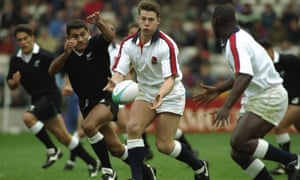
Damien Hopley (centre) in action for England against New Zealand at World Cup Sevens match in 1993. Photograph: Mike, Hewitt/ALLSPORT
In the summer of 1998 Hopley set up the Rugby Players’ Association (RPA). “I was pissed off with the way I had been treated and that was the catalyst,” he says. There was initial opposition from the RFU and some club owners so Hopley began his project without being paid. But today, he runs an organisation that has about 700 current professional players, both men and women, and about 400 former players on its books.
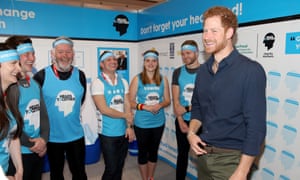
Outside the sport, the perception of elite rugby players is one of steely alpha males, but the reality is often different. Several players have talked about their battles with depression, linked to the end of a career in the sport. The RPA has a new campaign, Lift the Weight, which includes a 24-hour counselling service. With chilling timing the initiative was launched in the week that Dan Vickerman, a recently retired Australia lock, was found dead at his home in Sydney. The 37-year-old had taken his own life.
Lift the Weight aims to encourage men – and not just elite rugby players – to talk about the issues. “Once people get to share the stories of their frailties it makes all the difference,” says Hopley. “Jonny Wilkinson, for instance, has been very frank about his demons.”
Turning the corner into my mother-in-law’s street some years ago, it hit me. Michael’s car wasn’t there. Which meant Michael wasn’t there. And Michael wasn’t there because he was gone and none of us would ever see him again. We wouldn’t hear him laugh, we would never again be the butt of his jokes and none of us would share again in his generosity.
The moment of that dreadful realisation came back last week, reading Prince Harry’s comments about mental health and his battle with bereavement. Although our circumstances couldn’t be more different – my issues manifested themselves on a north Manchester council estate, rather than in a royal residence – the feelings of loss and subsequent pain will have been very similar.
We used to gather at Michael’s mam’s to watch United on television. It was always a happy family get-together, where brews and gags flowed, with the crowd noise from the television acting as a backing track to the pantomime taking over the living room. And Michael was always at the centre of it.
Parking that day, I had to stay in the car to stop myself from crying. For the previous month or so I hadn’t allowed any emotion in. I couldn’t. I had been concentrating on organising the funeral and getting legal advice on what would happen to his “assets”. I’d had to search his home for an eclectic array of items – from bank statements to a T-shirt my wife had bought him for a birthday.
I had flashbacks to when I entered his house in the days after his death. I’d drawn the short straw, as his closest friends were too upset to go back to the house after they had found him dead. Refusing to believe he was gone, his best friend had attempted to hold Michael, screaming at him to wake up. On the wall opposite, Michael had written in black marker pen: “I’M SORRY!”
My father-in-law accompanied me on that visit, as we stepped over hundreds of unopened letters littering Michael’s hallway. Stubbed-out cigarettes covered the floor. My father-in-law, a man’s man from a notoriously tough area of Manchester, sobbed on my shoulder and stammered: “Our Michael … Dear God …”
I wouldn’t allow my father-in-law upstairs as I had a rough idea of the scene that would greet me as I stepped on to the landing. The means for his suicide had not been cleared away and that message on the wall was jumping out like a neon sign.
‘As Prince Harry has proved, it doesn’t matter what your background or circumstances, mental illness can hit anyone.’ Photograph: Chris Jackson/Getty Images
Searching his belongings, I found evidence that his benefits had been sanctioned, due to him missing one appointment. The bastards had cut his every means of financial support because he had failed to attend one meeting. He hadn’t wanted to claim dole. He had worked most of his life, as a fitter, but he couldn’t stick being patronised by people who were less intelligent than him, so he gave up job after job.
His depression was a big part of this. But still he didn’t get help. However much we all tried to engage him, he shrugged us off. He only went to the doctor to discuss his problems when the dole office required proof he had a mental illness. They still wanted him to take unpaid work.
In the spare room, there was a pile of CVs aimed at charities to secure this “free labour” imposed by the benefits system. I found a certificate from the Open University. He had achieved a first-class honours degree in applied mathematics and he’d never told any of us. We knew he was doing a course, but he was bashful about it. In marking his work, his tutors were glowing in their predictions of a bright future that never came. In a drawer by his bed I found pictures of family, of past loves and happy times he had spent travelling the world.
He had no money left. Since the dole had cut him off, he was relying on a credit card to buy food. Too proud to ask for help, the alarm bells rang in the week before his death when he accepted a tenner from his mam. Previously he would never accept a pint from anyone, never mind money.
He told us he was depressed one Christmas after an uncharacteristic outburst. It was a shock as he was your typical Manchester “lad” in his mid-40s – tough, hard-working, streetwise and the life and soul of any social situation from parties to ordering a McDonald’s breakfast.
Despite our best efforts, we couldn’t help him. It haunts us daily. My wife and I had spoken during the week of his death about doing a Tesco shop for him, to make sure he was eating. Life got in the way.
Instead, I took the phone call that will forever crush me. Michael’s mam, my mother-in-law, rang our landline, which was a sign something was amiss, and tearfully delivered the news that Michael had taken his own life. While my wife was still half asleep, standing in our kitchen, her dad broke down as he told her the devastating news.
Conversely, I began to think practically. I needed to make all the arrangements to make it easier for the family. I didn’t grieve for one second.
This was all stored away in my head. I had never spoken about any of it, as his family and wide circle of friends were collectively distraught and I didn’t want to make it worse.
No stranger to bereavement – on the last count I had lost 12 close friends and family members by the age of 35 – I’d endured so much loss that I had become blasé about death. This was not healthy. At least this parked emotion was starting to reveal itself months later, even if I must have looked deranged, shaking and tearful in a car outside my mother-in-law’s.
At that point I made the decision to seek help. After braving a trip to the doctor, which in itself was an ordeal of self-loathing, I was put in touch with a service run by Greater Manchester Mental Health NHS foundation trust in Salford, where I lived.
There was a waiting list, one experience I doubt Harry shared with me, and the days dragged as I battled to keep myself together for the sake of my family. Although I was more accepting of mental health issues than Michael had been, like many men I had never been comfortable talking about anything even semi-serious regarding feelings and emotions.
My first session with a therapist was painful for both of us. She was lovely, reassuring and patient, but I believed I was ungrateful to feel depressed when I had a lovely family, a job, my own home and my physical health. I also thought death was part and parcel of life, so common had it been for me.
My therapist was clearly shocked by my dismissive outlook and she told me it was no wonder I was experiencing depression. It was the first time in my life that someone had told me that I had every right to feel bad. She told me there was a reason for it all and it wasn’t punishment for anything. Until that moment I thought I was weak, spoiled and selfish for feeling down, when so many other people in the world had nothing.
Those sessions and my therapist’s kindness fundamentally changed my life. After this treatment, I went on a Recovery Academy course, also run by GMMH, which allowed me to converse with other people with depression and feel humbled by their inspiring stories of survival.
I became open about my depression. I still take medication, but now I am happy to talk about it and that helps. I have even ended up working in mental health, as I wanted to help others and prevent other families going through what we had endured.
Before engaging in the help available through the NHS, I had been unable to write about Michael’s death. I tried so many times. I just couldn’t do it. But facing up to my need for help allowed my mind to become freer and I was finally able to put pen to paper, which has served a therapeutic role in itself.
Whenever I am at my mother-in-law’s now, I look up to the wall above the dining table, where she has a framed picture of Michael from our wedding day. I look up and I wink to him and thank him for the time we spent together.
We will always miss him, but his experience can act as an example of the importance of getting help. Our family’s resilience shows there is hope, if only we seek assistance. As Harry has proved, it doesn’t matter what your background or circumstances: mental illness can hit anyone.
In the UK, The Samaritans can be contacted on 116 123. In the US, the National Suicide Prevention Hotline is 1-800-273-8255. In Australia, the crisis support service Lifeline is on 13 11 14. Hotlines in other countries can be found here
I have had depression and anxiety, mainly depression, on and off since I was a teenager. After dealing with it for 10 years I had a particularly bad winter when I was working almost 24-hour shifts at work.
I went to visit my aunt overseas because I got a few weeks’ sick leave. I thought I’ll go, I’ll decompress, but while I was there I got sicker and sicker.
The GP there prescribed something called Lyrica [an anti-seizure medication also known as pregabalin]. I don’t know whether that had anything to do with it, but I went into a psychotic episode – I thought I was going to be deported, I had a lot of paranoia.
I suddenly started getting very, very anxious – and took an overdose. That landed me in hospital. I was a voluntary patient but I think I would have been forced if I wasn’t voluntary.
I was there for a really long time – a couple of months. I saw a lot of people come and leave and I wasn’t really able to do anything. They had an ECT [electroconvulsive therapy]clinic downstairs and the psychiatrist kept on suggesting it.
Eventually it came to the point where they had tried all these medications that weren’t working and I was an absolute nightmare – I was really difficult and I couldn’t do anything. After being really reluctant I finally gave in. I thought either I am going to die this way, or ECT might help. My aunt was like: “Well, we have tried everything else.”
They scheduled it super quick. We said yes on Friday and they scheduled it for Monday, then they did it three times a week for two weeks.
At first I was worried because of the image you get from the horror films of people being strapped up and electrocuted. Then I learned a little more about it, although I couldn’t do any reading on my own because I was so anxious – I couldn’t even cope with the phone. But I talked to my aunt who put it in really simple terms and talked about all the side-effects.
The thing that scared me the most was the memory loss. I went to an elite university and I really pride myself on my brain, so I was worried. Was this going to make me stupid? But I reached the point when I said: “Well, I don’t care if I am stupid. If I’m stupid and happy it’ll be fine.” So that is what made me go for it, even though I had a very bad perception of it.
The doctors talked me through the entire process. I had never been under general anaesthetic before and because I was anxious and paranoid about not being in control of my body, that was something I was really afraid of. I agreed to do it if my aunt could be in the room – but she wasn’t allowed in the room when they gave the electric shock because it is so traumatic for loved ones.
Before the ECT, they showed me the equipment and said: “The amount of electricity we are putting through your brain is enough to light a lightbulb for a second.” I was thinking: “How is that going to do anything? It can’t be much worse than licking a battery.”
After the first session all the nurses said: “You are so much calmer. I think this is really working. This is really good.” I thought: “I don’t know what you are talking about. I am still super-anxious and I hate my life.”
But looking back, the change happened almost immediately. After the first week I had hoped that I was going to leave the hospital and by the end of the sixth session, after two weeks, I was ready to get on with my life.
I had problems though – mainly short-term memory. I compensated for that by using a journal. Whatever my therapist advised, I’d write down and look over every day and try to do it. But I constantly found myself being told that I had already just told people something I had said. I had to monitor my medication very carefully. The memory issue went away in the course of the month. The benefit of ECT stayed for about six months and I needed to keep taking medication to prevent a relapse. But it didn’t work.
I was hospitalised again – this time in the UK.
I really wanted ECT. But they said the memory effects can be worse if you do it again and again and at that point I wasn’t psychotic. It is much harder to reach someone once they are psychotic because you can’t really rationalise with them, whereas I did what people told me to do, so that drastic measure of ECT wasn’t really necessary. But as soon as I mentioned ECT to any medical practitioner in the UK they said: “Oh my God, seriously?” The only semi-positive reaction I had from one of my GPs was: “Wow, how was that? I have never met anyone who had it.” He wasn’t judgmental, just really surprised and fascinated. In hindsight, I don’t think ECT was the right thing to do.
Sometime later I relapsed again. This time I had ECT on the NHS. They then diagnosed me as bipolar.
After I first had ECT I was really freaking out about whether I was going to tell people. But because of my short-term memory problems I was forgetting who I had told what and it was getting really stressful. It got to the point where I was anxious to meet people because I was wondering: “How much do they know? What do I say?” Which is why I put it up on Facebook, because that way everyone knows the same thing. But I am quite reluctant to tell people that I had psychosis. Because although mental health issues are more accepted and depression is quite common, psychosis is like really crazy. Taking medication is more accepted now, going to therapy is more accepted, but ECT … I think people think of One Flew Over the Cuckoo’s Nest.
There is definitely a lot of concrete evidence of ECT working. My aunt was absolutely floored by the results and she talked to the nurses and they said: “It is almost like a miracle but we see it every week.”
Let us not get out hopes up. Public Health England is in a very difficult position. Faced with unprecedented levels of obesity and diabetes, with a nation that keeps getting fatter and sicker, the agency clearly has to act. The obesity and diabetes epidemics represent a “slow-motion disaster,” as Margaret Chan, director general of the World Health Organisation, phrased it. So inaction is unacceptable.
Yet virtually everything PHE does now is likely to be either too little – unlikely to have any meaningful effect on the prevalence of obesity and diabetes – or too much, in that the industries that may indeed be responsible for the problem are likely to fight it. While the Treasury develops a levy for sugary soft drinks, PHE hopes to induce the producers of sugary foods to reduce the sugar in their products by 20%. If they can reformulate the product, all the better. If not, they should shrink the size of the product itself.
Commendable as PHE’s initiative is, reasons to be pessimistic abound. The programme is based on the idea that sugar does its damage to the body and to children merely through the calories it contains. As such there’s nothing particularly unique – either toxic or addictive – about sugar, as I and others have been arguing. We just consume too much of it.
Guidelines say children should have a maximum of 24-30g of sugar per day – a third of what they’re actually consuming
On the one hand, it’s hard to win a legal battle with an industry when the best you can argue is that we like their products a little too much for our own good. Some rigorous research targeted at answering the question of whether sugar has toxic qualities independent of its calories would help enormously here, even if it took years to complete.
On the other hand is the simple question of how much we can expect a 20% reduction in sugar to help. Will it curb the epidemics? Avert the slow-motion disaster? PHE predicts that this voluntary sugar reduction program will result in 200,000 fewer tonnes of sugar consumed in 2020 than are consumed today, and so 20% fewer overweight children as well. As Ernest Hemingway’s Jake Barnes might have put it in The Sun Also Rises, “isn’t it pretty to think so?”
Even if a 20% reduction in sugar consumption is achieved in three years (and that alone may be unprecedented) it pales in comparison to what health officials imply is necessary to get children eating healthier. UK guidelines now suggest that children should be consuming a maximum of 24-30g of sugar per day – six to seven sugar cubes. Even less for kids under six. According to a recent PHE survey, that’s one-third of what they’re actually consuming (much of which apparently comes in the morning as part of what their parents think of as a healthy breakfast).
So now, assuming industry goes along with this voluntary programme, and assuming that kids don’t respond to smaller portions or sugar-reduced formulations by eating more, both of which are possible, what’s the chance that we’ll see a significant curbing of the epidemics, even if the 20% goal is reached?
Let’s use cigarettes and lung cancer as our pedagogical example, confident, as we are, that cigarettes cause lung cancer. Cigarette consumption in the UK peaked in the mid-1970s when half of all men smoked and over 40% of women. Together they averaged 17 cigarettes a day. Now let’s imagine that we didn’t get those smokers to quit, but we managed to cut their consumption by 20%. Instead of 17 cigarettes a day, they’re averaging 14.
Would we expect to see a decrease in lung cancer prevalence? Would we expect that the lung cancer epidemic would be curbed at all, let alone within a few years of peak consumption? I would wager that even the PHE authorities would acknowledge that such a change would have little effect. Reasons here, too, would abound. Among them that it takes lung cancer risk 20 years to return to baseline after the smoker quits. So these 14-a-day smokers would still be at high risk, albeit perhaps not quite as high.
Indeed, in the US, per capita smoking began to decline in the mid-1960s, immediately after the surgeon general’s landmark Report on Smoking and Health. Lung cancer rates stopped rising only 30 years later. By then, per capita consumption had dropped by almost 50%. More importantly, when it comes to cigarettes, public health authorities don’t target the number of cigarettes smoked, but the number of smokers. Cut that number significantly, as we did, and lung cancer rates fall.
We see an overweight child with a chocolate bar and our tendency is to think that the chocolate bar is the proximate cause. Get rid of that chocolate bar, or shrink it in size, and we have a child who never gets overweight to begin with. But these epidemics of obesity and diabetes have been in the works since the late 19th century, cooking along, quite likely passed down from sugar-eating mothers to their children even in the womb. If so, our kids are getting fatter not just because they’re eating sugar, but because they’re programmed – epigenetically, in the scientific lingo – before they’re even born.
This epidemic has deep roots and may require drastic action to curb. That PHE is acting is admirable. But maybe we should treat this like cigarettes: aim to curb the number of sugar consumers, rather than the amount of sugar they consume. It will still take time to see an effect, but the odds of success will rise.
Claudia Wright has filler injected into her lips every two months to plump them out, and is having them done again in two weeks. “I want them to look big,” she says. She likes them best the day after the procedure, when they are still swollen. When they settle – lip enhancements are supposed to last up to 18 months – it makes her want to book another appointment.
Wright, who is 24, is open about the procedure on her beauty blog and Instagram account. “I like the fake look,” she says. “I’ve got bleached blond hair, I have long eyelashes. I like that look, I’m not trying to look natural. I’m so open about everything I’ve had done, I don’t think it’s an issue.”
She started having lip enhancements when she was 21. Her mum, she says, recently told her that her top lip looked like a rubber dinghy “and that if I carry on getting it done no one will take me seriously. She’s really against them.” But women her own age have told her they love them and ask where she gets them done. “If anything, I’m getting a little bit more each time I go now because I want them to look more full. I did want just a full top lip but now I want both of them looking really full.”
The British Association of Aesthetic Plastic Surgeons (Baaps) recently released its annual figures showing a 40% drop in the number of cosmetic surgery procedures performed by its members, the lowest for nearly a decade. After years of steady rises, it came as a bit of a surprise. The economy and job insecurity was blamed – cosmetic surgery is expensive, after all.
The truth – says former president Rajiv Grover, who compiles the annual audit– is a bit more nuanced. Baaps only represents about 40% of cosmetic surgeons and he suspects that, with the wealth of information online (including many dedicated cosmetic surgery forums), people are researching experts and choosing a specialist, rather than a general cosmetic surgeon. They are going to a breast surgeon for breast augmentation or an ear, nose and throat surgeon for a nose job – surgeons who practise a bit of cosmetic surgery on the side, but aren’t members of Baaps, and so don’t get included in the figures.
But he accepts there may be a drop in surgery overall (if not by 40%). Surgeons are reporting a reduction in the number of procedures a patient has at one time. Before, he says, someone might come “to have some liposuction of saddlebags, as well as having some skin removed from their lower tummy and maybe some breast surgery, [but] now they’re just having one of those things done. That’s where I think uncertainty in the economy will have come into it.” Crucially, though, he says, “there is a rise in what you can have done without surgery. If people don’t have the time to spend two weeks off work recovering from a facelift and want a little bit of improvement, they can have whatever is on offer without downtime.”
The sheer number of non-surgical procedures is dizzying, and ever-growing. Botox is now so well established that it celebrates its 15th anniversary as an FDA-approved cosmetic treatment this month, but you can also have your face lasered and peels applied to improve skin texture, and ultrasound therapies to tighten. You can have tiny threads, that gradually absorb into the body, put in your face during your lunch break to hoick it up, and filler put into your cheeks. Soon, people will be able to have fat-melting injections for their double chins. At-home treatments are also increasing – you can get home laser hair removal and microneedling devices (rollers with tiny spikes that prick the skin and are supposed to encourage collagen production). One DIY trend that emerged last year was dermaplaning – using a scalpel to shave a layer of skin cells and hair, from the face for a supersmooth, airbrushed effect.
“A significant proportion [of patients] say they’ve come to me because they don’t want surgery yet or they want to try to prevent it from happening at all,” says Dr Frances Prenna Jones, whose clinic in Mayfair offers a wide range of treatments. “Twenty years ago your only option was surgery – now there are machines, injectables and so much more you can do. A lot of the time, it is replacing the need to have surgery done.”
Machines using lasers or LEDs “work deeper down within the muscle to make new collagen and elastin to give that nice infrastructure, and tightening effect”. Previously, loose skin was cut away and tightened. Now it is plumped up with injectable filler. Volume replacement is what has really changed in the last few years, says Prenna Jones. “Even three years ago, people would say, ‘I am not having filler, there’s no way.’ Now that people understand what it really means – that you don’t have to have puffed-up lips or puffed-up cheekbones. When I look at the amount of filler I was doing three years ago and the amount I’m doing now, that’s definitely on the rise.”
The cost of the treatments hasn’t come down spectacularly, so she doesn’t think that is driving popularity; it’s more the fact it is becoming normalised. “Now I think women accept that it is part of their monthly budget, the same as doing their hair.”
The use of more intense beauty treatments – such as teeth whitening and HD brows, where eyebrows are dyed, waxed and shaped – has accelerated in the past few years. “It is becoming increasingly normalised to have more done [to meet] what we think of as quite basic beauty standards,” says Heather Widdows, professor of global ethics at the University of Birmingham and author of the forthcoming book Perfect Me. “It doesn’t feel like a big hurdle to go from getting your hair done to Shellac-ing your nails to Botoxing.” There is less stigma, she says. “I think Botox, to use one example, is now being seen as routine maintenance, and that’s a very different scenario from 10 years ago.”
Kylie Jenner is famous for her lips, which have been filled. Photograph: Steve Granitz/WireImage
What is driving the change can’t be attributed to one thing, she says. “We live in a more virtual and visual culture. We look at images differently, we have HD and computer technology that means we see flaws in skin we didn’t see before. And more people we know have had non-surgical procedures.”
Surveys about body image, she says, routinely show an epidemic of unhappiness about appearance. The rise of more “normal” women (ie, not supermodels) who become YouTube and Instagram stars should, in theory, mean wider and more democratic standards for beauty, but in reality it is their “normalness” that has changed the idea of what normal is, particularly when it is accompanied by heavy makeup and invasive procedures. “It puts pressure on all women to feel they have to look like that,” says Widdows.
What is striking, says the Guardian’s beauty writer Sali Hughes, is the number of much younger women seeking to alter their face. Contouring makeup, where different shades “shape” the face, is “predominantly a young woman’s trend and it’s fuelled by celebrities, but the celebrities who fuel it as a trend also have surgery and non-surgical procedures, so it’s a triple-pronged attack. It just so happens that young women can only afford the contouring part. It really exists to look good in pictures.” But the more disturbing thing, she says, is how many young people want, or are having, non-surgical procedures. She recently met an 18-year-old at an event who told her all her friends want fillers and lips like Kylie Jenner (the youngest of the Kardashians, who had lip-filler injections) for their birthdays. “They want their parents to pay for fillers for them.”
The aim, she says, is not to look natural. “They’re mimicking a surgical look or at least a heavily injected look that celebrities wear. I think young people are much less interested in pretending that this is what nature gave them than we perhaps assume. Where you would once hear actors in their 40s and 50s completely denying non-surgical procedures, and I quite understand why, even though I don’t think they should, young people don’t have that anxiety about non-surgical.”
Dr Tijion Esho, founder of the Esho clinics in London and Newcastle, says there has been a culture change. “One big thing now is people start earlier,” he says. Before, people would not consider these treatments until they were in their mid-40s. “Now women in their mid-20s are very aware of the ageing process and are already doing things to halt it early. The non-surgical treatments are improving more and more. It doesn’t mean non-surgical will ever replace the knife – there is a limitation to what non-surgical can do – but, in many areas, people can get improvements that are satisfactory.”
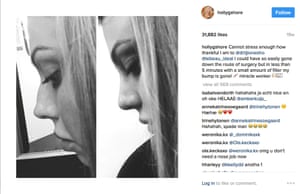
Fillers have changed everything, Esho says. He can use fillers to improve the shape of someone’s nose – a cheaper, less permanent version of a nose job without the need for general anaesthetic – for instance. In February one patient, Holly Hagan, the 24-year-old star of the reality series Geordie Shore, posted pictures on Instagram of some filler she had to change the shape of her nose and chin.
Dr Tijon Esho also shaped Holly Hagan’s nose with just fillers. Photograph: Instagram
‘When we’re doing fillers in young people we have to be very careful, from an ethical standpoint,” he says. “Legally, it does concern me because there is no law to say what age someone has to be to undergo fillers. Someone could treat a 16-year-old, but ethically that is wrong.” The non-surgical industry is unregulated and anyone can set themselves up as a practitioner with no training. Botox is prescription-only and people should be seen by a prescriber – a doctor, dentist, nurse or pharmacist – but that doesn’t always happen, which is why beauty therapists can offer it cheaply in salons.
Has the look that young patients are after changed? There is a growing minority, Esho says, “where there is an evolution in what we perceive as beauty”. Some bring in Instagram pictures where they have been heavily filtered, and skin and faces are flawless, and say they want to look like that. “It has almost gone full circle. Initially, when surgery and non-surgical aesthetics were available, it was the treatment of the rich. It was a statement to have it done so people wanted to let you know. Then there was a transition where people didn’t want others to know, it became more natural, understated. Now, it has gone back, but because now the services are more accessible, it’s more obvious. And social media has made it more noticeable.” His most popular treatment is providing lip filler, which accounts for about 70% of his work.
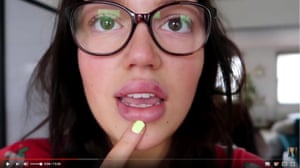
On YouTube, you can find numerous videos of vloggers who have posted about their lip fillers. Gabriella Lindley, a beauty vlogger, has had more than 360,000 views of hers; another video she put up, entitled “My Lip Filler NIGHTMARE” in which she talks about how her lips went lumpy, has had more than 314,000 views.
Vlogger Gabriella Lindley’s My Lip Filler NIGHTMARE! Photograph: YouTube
Jessica Balkay, 22, researched lip fillers on YouTube before getting her lips done for the first time. “I wanted to get it done as I just didn’t like the shape of the sides of my lips and wanted a fuller top lip.” She said it has made her “really happy. I love makeup and taking selfies and having my lips looking fuller just made me feel happier with my appearance.”
She is planning to have a few more injections to build up the size and shape, then plans to go every six months for top-ups. “I think in my generation it is becoming a lot more normalised to have non-surgical procedures,” she says. “I don’t see the issue with that as long as people research reputable places and are doing it for themselves, not to please others. I don’t want to look like anyone else but myself, but I want to be a prettier version of myself.”
Where will it end? Widdows sighs. She thinks the use of non-surgical, but still invasive, procedures are likely to become commonplace. “Doing nothing gets harder and we have to wait and see whether Botox becomes ‘required’, like [people consider] visible body-hair removal or hair dyeing. That’s the way it’s moving.”
Hughes is a bit more optimistic, particularly where much younger women are concerned. “The only glimmer of light in the whole sorry picture is that at least non-surgical procedures are not lasting, so one hopes that young people outgrow them in the same way that I outgrew lightning bolts drawn down my face.”
Anonymous I am once again in the mental health treatment sausage machine. Plucking up courage to approach a GP to admit defeat, being shoved on drugs to stop me topping myself, told that there’s a huge, long waiting list for treatment, the false hope of a “gateway worker” assessment followed by another interminable wait of undefined length. Then I know I will have my allocated batch of treatment before being deemed “fixed” and dispatched back to the world again. I am sick and tired of the roundabout. I suggested that instead of this system, once a mental health patient has had their allocation of therapy, they should remain on the books, so when they feel themselves slipping back down, they can call up for a booster session instead of having to go through the whole rigmarole again.
I’ve just quit my job of six years because, following a disclosure to my new boss that I have bipolar tendencies she proceeded to bully me into submission. She had absolutely no understanding of how to get the best out of (a very talented) employee who has mental health issues. I was stopped from working at home, an important aspect to being able to manage my condition. I had unreasonable targets imposed, with no support offered to go about achieving them. My job was chopped and changed, hours cut and autonomy removed. I have been pushed back to the brink of suicide and had to go on antidepressants to simply survive.
Anonymous From September 2015 until December 2016, while I waited for an NHS referral, I was so ill I didn’t know how to cope and resorted to self harming. These aren’t all of my scars, but they’re the ones no one ever sees; so it’s easy to think they’re not there. One year of my life, and I will have to be reminded of it forever.
Cat, 24, South Yorkshire People often mistake bipolar disorder as your mood rapidly changing from up to down. It’s not like that. That would be my other illness, borderline personality disorder (BPD) or as my psychiatrist put it, emotionally unstable personality disorder. It’s complicated telling people you have both bipolar disorder and BPD, as they both involve intense mood swings. Well, that’s when I do tell people – social anxiety sort of puts a brick wall between me and people. BPD makes your mood change within seconds and it is a strong mood swing. Like fire, it can destroy you and those around you. With bipolar, the mood swing sort of creeps up on you. It’s when the mood gets high (mania) or low (depression) that it becomes destructive.
Every day it feels like I must wear a mask, however, hiding never did me any good with these illnesses. It just becomes more of a shock to those around you when the symptoms start to leak through. Even as I write this, it’s hard to concentrate, thoughts and emotions are saying one thing, while that one bit of mind that tells you “everything will be ok”, is telling me to push on.
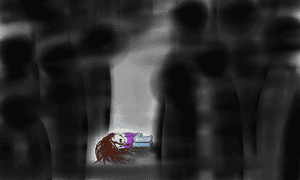
The rendition of a darker moment. A painting of a depression experience by Cat, South Yorkshire
I’ll admit when I’ve been at my lowest I’ve done things I’ve regretted. The overdose, which sent me into hospital, was one of the things. I know there’s a stigma around psychiatric hospitals, but I did meet people who it’s worked for. When I was admitted into hospital the first time, I had psychosis – a female voice was constantly screaming in pain in my head. I don’t even bother to count how many times a year I have to go through this. Medication helps keep me in some control, especially with the manic side. I prefer the manic side to the depression side. Mania brings with it the thought that you’re this amazing person, who can do anything, someone who deserves to be with people. The bad side of mania is that loss of control. Nights become sleepless and the thoughts running through your head won’t stop. Every time you try to grab one, it just slips through your fingers. Health and safety also goes out the window.
I managed to get through my art degree. I have to remind myself that I’m more than my diagnosis, but with the right help and support it does become a lot easier.
In the UK, the Samaritans can be contacted on 116 123. In the US, the National Suicide Prevention Hotline is 1-800-273-8255. In Australia, the crisis support service Lifeline is on 13 11 14.
I have coeliac disease, the autoimmune condition which means that if I eat gluten – which is found in wheat, rye or barley, and many common foods – my body starts to attack itself. There is no cure for this lifelong condition, which affects one in every 100 people in the UK, and the only option is to eat a gluten-free diet.
Under current national prescribing guidelines I can receive up to 14 items – such as a loaf of bread, box of pasta, or packet of spaghetti – on prescription every month. I never claim everything I might be entitled to, but I do usually get a few items a month. In order to access this list, I pay £104 a year for a pre-payment prescription.
For many people, this is the only way they can afford to access gluten-free products. But under new plans announced on Tuesday by NHS England’s chief executive Simon Stevens, the NHS plans to stop this provision, as well as travel vaccinations and some drugs that are available over the counter. Stevens has said they need to tackle some of the waste in the system, with £114m being spent each year, “on medicine for upset tummies, haemorrhoids, travel sickness, indigestion, and that’s before you get to the £22m-plus on gluten-free that you can also now get at Morrisons, Lidl or Tescos.”
As Stevens says, gluten-free products have become much more widely available in recent years. But for many people, the cost of these products can be prohibitive.
Gluten-free spaghetti in my local Sainsbury’s is £1.35, whereas basic spaghetti is just 40p. Nestlé gluten-free cornflakes are £2.20 while own-brand cornflakes are £1 for 500g. A gluten-free loaf of bread can be as much as £3 – and is often much smaller than a normal one. To me the idea that bread should be considered a luxury is pretty ridiculous. Stevens notes that gluten-free digestive biscuits are also available, but the NHS’s own prescription guidelines state that these are only available in exceptional circumstances anyway – why not just tighten up the list of products instead of throwing it away altogether?
I am lucky; I will be able to absorb this extra cost into my household budget, but for others this will be impossible. Without the prescriptions, many won’t be able to follow their GP’s nutritional advice – and that could have serious consequences for their health. People with coeliac disease who don’t go on a gluten-free diet are at increased risk of conditions including anaemia, osteoporosis and bowel cancer. Obviously, this is especially serious for people who are elderly, vulnerable or suffer from other illnesses.
In recent years giving up gluten has become associated, generally, with being a faddy eater. This is absolutely not the case for those with coeliac disease; if I eat gluten by accident it has a serious and immediate impact on my health. But I think the association of gluten-free foods with celebrity diets may actually be keeping the prices high, and is leading to perceptions that this is a lifestyle choice, rather than the debilitating condition that it can be if not managed properly. Being a coeliac or gluten intolerant isn’t just something that happens to wealthier people who can live off avocados and courgetti spaghetti, whatever some might suggest.
People are more aware of the condition today, but that does not mean they necessarily take it seriously or understand it fully. In restaurants, for example, there are more gluten-free choices these days, but people also often assume this is a preference, not a necessity. I always check what I eat with the staff, but have been “gluten poisoned” many times because people think: “Oh, a bit of gluten doesn’t matter.”
People need appropriate and affordable options or they just won’t be able to take care of themselves. This shortsighted move, which is only making minimal savings, could lead to further stress on NHS budgets when people develop complications and related diseases. I recognise the need to make savings but, like many current policies, this will hit the people who can least afford it the hardest.
Is there a better way to judge who should live where and what belonging to a country really means? Something more enlightened than the permanent residency form that has provoked so much criticism recently. Sadly, a neuroscientific approach to how language marks you out as a recent arrival is unlikely to be any more forgiving. Although very young children respond equally to all languages, infants raised in a Japanese-only environment start to lose the ability to distinguish ‘l’ and ‘r’ sounds between six and 12 months old. English-speaking children get better at making the distinction.
Even if you learn a second language to a very high standard, you’ll never speak it like a native unless you were exposed to it by around the age of eight. This is mirrored by brain scans. Languages you learn after eight go into a subtly different area of the brain to those acquired earlier.
None of this suggests that we should include MRI scans in nationality tests. But it does show how hard we must work to implement modern and enlightened standards to determine who gets to live where.
Listen to this week’s podcast at theguardian.com/lifeandstyle/series/neuroscientist-explains
Imagine this. You’ve suffered a debilitating mental illness, you’re admitted to hospital and, after weeks or months of treatment, you’re finally deemed stable enough to go home. Only, you can’t – the home you need in the community is not available.
As a psychiatrist, this is a situation I and many others around the country encounter almost daily. Even when patients are ready to leave hospital, a notable number don’t have the specialist supported housing they need to take that step.
Currently, around 60,000 people in England live in specialist mental health supported accommodation. They are there because of the severity of their condition, their level of vulnerability and their complex needs, which often include requiring support for everyday activities. Supported housing offers them the freedom to live as independently as possible, while also reducing their use of hospital beds, both in the mental health sector and in the acute, physical health sector.
With the right support from housing care staff alongside secondary mental health care rehabilitation and recovery services, many can and do achieve stability. Along with this, the opportunities to re-engage with family, education, work and their community are more within reach.
Without such provision, many people become stuck in highly restrictive, costly and more institutionalised care, such as hospital wards and care homes. These are often at great distances from their families and communities and require even more public funding. Supported housing provides that crucial interim step for those who need it, between hospital or residential care home, to people moving into their own flats with support coming in. This also often means the difference between living and staying well in the community, to becoming unwell again and requiring yet another hospital admission.
Money can be spent more efficiently when people are in the right setting for their level of need
Providers of supported housing for vulnerable people, including those with mental health conditions, have clearly communicated that the government’s proposed changes to how supported housing is funded will result in the closure of such services. Yet there does not appear to be a viable alternative for those most in need. Providers of supported housing have already been closing accommodation across England and halting the development of new, much needed provision.
The effects are already being seen on acute psychiatric wards, with increasing levels of delayed discharges, resulting in fewer available beds for those requiring acute emergency admission and an increasing number of people being sent hundreds of miles from home.
It has also been found that those who are sent far away for treatment are more likely to take their own lives upon returning home than those who are admitted to hospitals close to them.
The adequate provision of supported housing locally is crucial for many national policies and strategies to be realised. These include the five year forward view for mental health, the Crisp commission on acute adult psychiatric care and transforming care for people with learning disabilities, which all state the central importance of specialist supported housing to aid people’s recovery and to enable successful community living.
The health and social care system is made up of so many parts. The lack of a joined-up policy results in unintended consequences for patients, their families, services, commissioners who pay for care and society as a whole.
Money can be spent more efficiently when people are in the right setting for their level of need. For this to work, a system-wide approach across health and social care with adequate resources at each level, including supported housing, is vital. Especially for those whose lives depend on it.
If health regulators would fund a more joined-up way of working, then every person could receive the right care and support, in the right place, at the right time.
Dr Sri Kalidindi is head of the rehabilitation & social psychiatry faculty at the Royal College of Psychiatrists• Comments will be opened later
Like everyone else in the world, my blood ran cold when I heard that we are now expected to eat 10 portions of fruit and vegetables every day. That is double the previous recommended amount, and even that required too much effort for my liking. Oh, sure, the effects of 10 a day sound miraculous – researchers claim that it would decrease our chance of heart disease by 24%, stroke by 33% and cancer by 13% – but it sounds a bit much, doesn’t it?
Perhaps not. “We wanted to investigate how much fruit and vegetables you need to eat to gain the maximum protection against disease, and premature death. Our results suggest that although five portions of fruit and vegetables is good, 10 a day is even better,” said Imperial College’s Dr Dagfinn Aune, lead author of the research.
What does it mean exactly? It’s 10 servings of 80g portions – so three tablespoons of peas, or one pear, say, is a single portion. So, is it do-able?
A YouGov poll from 2012 reported that only one in five of us manage to hit five portions a day, let alone 10. Brave pioneer that I am, I decided to find out over the course of a long weekend, before Guardian cook Felicity Cloake judged my efforts and offered some suggestions of how better to hit my goal.
Friday Breakfast
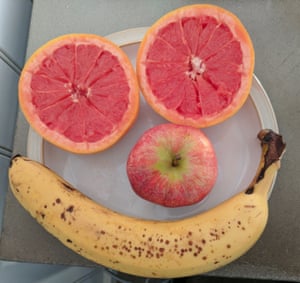
My breakfast usually consists of horrifyingly sugary cereal, to provide me with the artificial jolt of energy required to see me through the morning. Today, however, I eat a grapefruit, a banana and an apple. Better yet, a whole grapefruit counts as two portions. Still, it’s 7.30am, and I’ve already almost hit half of my daily quota. In your face, science. I’m going to live for ever.
Except I’m not, obviously, because as Harley Street dietitian and sports nutritionist Raquel Britzke points out, favouring fruit over vegetables has problems of its own. “Both give you carbohydrates, vitamins, minerals, and fibre,” she says. “But fruits tend to have more carbs, and consequently more sugar, than vegetables. If you have a slow metabolism or are trying to lose weight, I recommend eating seven portions of veggies and three portions of fruit.” Great.
A happy start to the experiment. Photograph: Stuart Heritage
Lunch
G2 sends a photographer to my house, to show the world what I look like when I’m near some vegetables. Inadvertently, my lunch becomes all the things that the photographer tells me to put into my mouth. This ends up being an apple, a banana and two different carrots.
Dinner
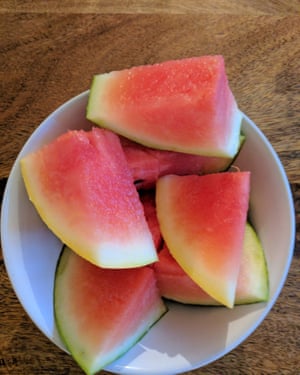
On a normal day, my meal of chicken and potatoes would have been entirely vegetable-free but, knowing that I now have a target to hit, I pile up a mound of cherry tomatoes on the side and work through those as well. It’s not quite the advice I was given by another nutritionist, Laura Thomas, who suggested that all meals should consist of at least 50% vegetables, but it’s a start. A bowl of watermelon for pudding and I’ve easily hit my 10.
Total intake: 10 portions.
Felicity’s verdict
Stuart has immediately discovered the easy part of fruit and veg consumption: the fruit bit. Australians are told fruit should make up just two of their recommended seven portions a day because of its effect on blood sugar – and he has got through 60g of sugar for breakfast alone. Although our own government seems to take the view that any fresh produce is better than the traditional British diet of Jammie Dodgers, it might be wise to swap some of this fruit for avocado on toast or a mushroom omelette occasionally, and save the sweet stuff for pudding later in the day.
Saturday Breakfast
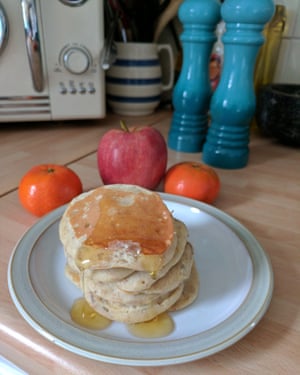
Now that I have a toddler who can shout the word “pancakes” in a vaguely threatening manner, Saturday breakfast is always a rigidly enforced stack of banana pancakes. The good news: one stack has a whole banana in it. The bad news: it also has eggs and flour in it, which fill me up much more than just a banana would. However, I still manage to heroically force down an apple and two satsumas as well. Four portions, done and dusted by 8am. I am the best.
Saturday breakfast: banana pancakes and fruit. Photograph: Stuart Heritage
Except, wait. After checking the NHS website, I realise that a satsuma only counts as half a portion, which knocks me back down to three. Undaunted, I eat two more satsumas to boost me back up, which means that I’ve now eaten four satsumas in a row for breakfast. This is no way for a man to live.
Snack
I put my son down for a morning nap and, because of this stupid challenge, think: “What a perfect opportunity to eat an entire raw carrot.” It has been years since I last ate an entire raw carrot, and now I see why. Raw carrots are rubbish – all chew and no reward. The carrot takes a thousand years to eat. It takes so long that my son wakes up before I finish, and I have to put the rest of it in my pocket for later. All this work, trying to sneak in a vegetable whenever I have a moment of downtime, is starting to make me feel less like a person and more like a sentient composter.
Lunch
A bowl of chicken-and-vegetable soup (which counts as a portion, according to the label), and two portions of grapes. Two portions of grapes is 28 grapes, which I count out one by one like some sort of shivering Victorian waif. What have I become?
Later, while running errands, the wind begins. There is a good three-minute stretch where a brand-new fart pops out of my trousers with every step I take. This is new. So much for science; I worry that if everyone eats 10 portions of fruit and veg a day, we’ll all end up dead from methane inhalation.
Dinner
Meatballs and pasta and tomato sauce (homemade, so it counts) and another big bowl of watermelon. I’ve hit my 10 portions again, and I only had to accidentally fumigate one shop to do it.
Total intake: 10 portions.
Felicity’s verdict
Banana pancakes are a painless way to get fruit into children; top with berries to add an extra portion, and ring the changes with cheesy courgette or crispy carrot fritters occasionally. Equally, at this time of year, when salads feel a bit punishing, soup is a lifesaver: minestrone will happily absorb any old odds and ends you have in the fridge. You can also add finely chopped veg to meatballs and burgers (grated carrot or finely chopped spinach are good candidates) – and, of course, if Stuart ever finishes that sugary watermelon, he could always knock up a chocolate beetroot or parsnip-and-orange cake as an after-dinner treat.
A bountiful breakfast. Photograph: Stuart Heritage
Sunday Breakfast
The plan was to have a nice, big, healthy breakfast and then head out as a family to a fancy event in London. However, a combination of train cancellations, a sick wife and barely any sleep means that breakfast now consists of a chocolate chip cookie that I made with my son yesterday. The cookie has a glacé cherry on it. Glacé cherries apparently do not count towards your 10 a day. This feels like an oversight on the part of the NHS.
Lunch
Post-event, with my wife home unwell, my son and I find ourselves in the nightmarish epicentre of tourist hellscape London. Thomas’s advice for eating out is this: “Ordering vegetable sides is a good option, but you could also think about replacing one of your protein foods with beans – they can count as one portion per day. Trying to get more vegetarian meals in, too, will make it much easier, and this is consistent with the advice to cut back on red and processed meat.”
However, this is an emergency; I just want to survive today. Lunch ends up being something that can be eaten quickly at the nearest possible kid-friendly place: a burger and chips from Giraffe. (Chips don’t count as a portion, by the way. I checked.) I could have ordered vegetables but, after yesterday’s carrot debacle, I realise that I would still be there chewing on it now if I had. Knowing what a failure today has become, and remembering that Thomas said they count, I order a smoothie. At least that’s something.
On the train home, I distract my son and, when he isn’t looking, eat some of the snacks I bought for him. I manage six grapes and a third of a satsuma, which is about two-thirds of a portion in total. Still counts, though.
Basically watermelon is terrible for you. Photograph: Stuart Heritage
Dinner
Poor marital communication means that we end up eating chips again in the evening. On the plus side, we also have baked beans. Half a can of baked beans equals one portion of vegetables, and for one beautiful moment I toy with the idea of getting back on track by gorging myself on a multipack. However, the NHS guidance points out that anything over half a can still only counts as one portion, because they “don’t give the same mixture of vitamins, minerals and other nutrients as fruit and vegetables”. This, it dawns on me, also applies to my doubled-up portions of grapefuit, apple and banana on Friday. I check the NHS’s five a day website and it explains that “to get the maximum benefits, you need to eat different types of fruit and vegetables”. Stupid NHS. This isn’t why I pay my taxes.
More watermelon for pudding, but this doesn’t really make up for anything, especially since Britzke has decided to single out watermelon as one of the worst fruits to eat, thanks to its high glycemic index. Nutritionally, today has been a disaster.
Total intake: 3.66 portions.
Felicity’s verdict
The problem with fruit and vegetables is that they tend to take more preparation than merely opening a packet (or, in Stuart’s case, the biscuit tin), so it’s a good idea to keep carrot sticks or broccoli florets handy for those moments when you don’t have time to faff about with cooking, ideally with a pot of something delicious to dip them into so you don’t lose the will to live and reach for the crisps instead. In fact, like many healthy eating regimes, fitting more fruit and veg into your diet is much easier with a bit of forward planning. Stock up on frozen veg, tins of beans and pulses, and jars of fruit to add to meals when the salad drawer is bare. Also remember that although the potato is cruelly classed, by the powers that be, as a starchy food rather than a vegetable by the powers that be, the sweet potato is not – and it makes seriously delicious chips. Just saying, Stuart.
MONDAY Breakfast
Yesterday broke me. Carting a kid about for a day is stressful enough as it is, and fretting about hitting a seemingly arbitrary vegetable target just added another level of anxiety to proceedings. So, today, screw it. I’m just going to eat like normal. And, hey, if it kills me, it kills me. Breakfast is a leftover grapefruit. Happy now?
This only soups up the tally by one. Photograph: Stuart Heritage
Snack
An apple. If we’re being honest, it’s an apple and two Cadbury Creme Eggs. But we’re only counting the fruit and vegetables I eat, not any of my other disgusting dietary habits. Still, that’s two portions so far.
Lunch
More chicken-and-vegetable soup. That makes three portions of fruit and veg. If these were the bad old days, back when we were all gormless knuckle-draggers who only thought we needed to eat five portions a day to be healthy, I’d have been laughing. God, I miss the bad old days.
Dinner
I make shepherd’s pie. It contains two tins of tomatoes, two onions, two carrots, a leek that I had lying around and some frozen peas. If I’ve done my maths right, divided by five, I think this works out at three portions a person. Add in the requisite bowl of watermelon at the end and that’s four portions.
Total intake: seven portions.
Felicity’s verdict
In just four days, Stuart’s achieved fruit and veg enlightenment: the secret to eating more is to incorporate them into your ordinary diet, rather than hoping you’ll magically turn into the kind of person who enjoys snacking on raw kale. Adding extra portions to stews, curries, ragus and the like makes it feel a lot less like eating rabbit food than munching on a raw carrot – next time he could try mixing some celeriac into the mash on top of his shepherd’s pie, too. And don’t worry if some days are better than others: if beans on toast and an apple are the best you can manage, it’s still better than nothing. Even if you do have a Creme Egg on the side.
Total four-day intake: 30.66/40 portions
(If you let me have the doubled-up fruit and veg, which you shouldn’t, but hey.)
Without really trying, I’ve come tantalisingly close to the target. It hasn’t made me too farty. It hasn’t caused me any stress. So perhaps this is the secret here: you should just eat as many portions of fruit and vegetables as you can without letting it take over your life. If it goes belly-up for a day – which it will, because there is more to life than endlessly chewing on foliage – then that’s not a big deal. After all, what’s the point of living longer if it’s just going to make you uptight, unhappy and flatulent? Quit whining, science. I’m doing fine.