Harry etiketine sahip kayıtlar gösteriliyor. Tüm kayıtları göster

23 Nisan 2017 Pazar

We’re worlds apart, but like Harry I had to face up to depression

Turning the corner into my mother-in-law’s street some years ago, it hit me. Michael’s car wasn’t there. Which meant Michael wasn’t there. And Michael wasn’t there because he was gone and none of us would ever see him again. We wouldn’t hear him laugh, we would never again be the butt of his jokes and none of us would share again in his generosity.


The moment of that dreadful realisation came back last week, reading Prince Harry’s comments about mental health and his battle with bereavement. Although our circumstances couldn’t be more different – my issues manifested themselves on a north Manchester council estate, rather than in a royal residence – the feelings of loss and subsequent pain will have been very similar.


We used to gather at Michael’s mam’s to watch United on television. It was always a happy family get-together, where brews and gags flowed, with the crowd noise from the television acting as a backing track to the pantomime taking over the living room. And Michael was always at the centre of it.


Parking that day, I had to stay in the car to stop myself from crying. For the previous month or so I hadn’t allowed any emotion in. I couldn’t. I had been concentrating on organising the funeral and getting legal advice on what would happen to his “assets”. I’d had to search his home for an eclectic array of items – from bank statements to a T-shirt my wife had bought him for a birthday.


I had flashbacks to when I entered his house in the days after his death. I’d drawn the short straw, as his closest friends were too upset to go back to the house after they had found him dead. Refusing to believe he was gone, his best friend had attempted to hold Michael, screaming at him to wake up. On the wall opposite, Michael had written in black marker pen: “I’M SORRY!”


My father-in-law accompanied me on that visit, as we stepped over hundreds of unopened letters littering Michael’s hallway. Stubbed-out cigarettes covered the floor. My father-in-law, a man’s man from a notoriously tough area of Manchester, sobbed on my shoulder and stammered: “Our Michael … Dear God …”


I wouldn’t allow my father-in-law upstairs as I had a rough idea of the scene that would greet me as I stepped on to the landing. The means for his suicide had not been cleared away and that message on the wall was jumping out like a neon sign.
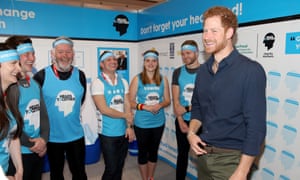


Prince Harry


‘As Prince Harry has proved, it doesn’t matter what your background or circumstances, mental illness can hit anyone.’ Photograph: Chris Jackson/Getty Images

Searching his belongings, I found evidence that his benefits had been sanctioned, due to him missing one appointment. The bastards had cut his every means of financial support because he had failed to attend one meeting. He hadn’t wanted to claim dole. He had worked most of his life, as a fitter, but he couldn’t stick being patronised by people who were less intelligent than him, so he gave up job after job.


His depression was a big part of this. But still he didn’t get help. However much we all tried to engage him, he shrugged us off. He only went to the doctor to discuss his problems when the dole office required proof he had a mental illness. They still wanted him to take unpaid work.


In the spare room, there was a pile of CVs aimed at charities to secure this “free labour” imposed by the benefits system. I found a certificate from the Open University. He had achieved a first-class honours degree in applied mathematics and he’d never told any of us. We knew he was doing a course, but he was bashful about it. In marking his work, his tutors were glowing in their predictions of a bright future that never came. In a drawer by his bed I found pictures of family, of past loves and happy times he had spent travelling the world.


He had no money left. Since the dole had cut him off, he was relying on a credit card to buy food. Too proud to ask for help, the alarm bells rang in the week before his death when he accepted a tenner from his mam. Previously he would never accept a pint from anyone, never mind money.


He told us he was depressed one Christmas after an uncharacteristic outburst. It was a shock as he was your typical Manchester “lad” in his mid-40s – tough, hard-working, streetwise and the life and soul of any social situation from parties to ordering a McDonald’s breakfast.


Despite our best efforts, we couldn’t help him. It haunts us daily. My wife and I had spoken during the week of his death about doing a Tesco shop for him, to make sure he was eating. Life got in the way.


Instead, I took the phone call that will forever crush me. Michael’s mam, my mother-in-law, rang our landline, which was a sign something was amiss, and tearfully delivered the news that Michael had taken his own life. While my wife was still half asleep, standing in our kitchen, her dad broke down as he told her the devastating news.


Conversely, I began to think practically. I needed to make all the arrangements to make it easier for the family. I didn’t grieve for one second.


This was all stored away in my head. I had never spoken about any of it, as his family and wide circle of friends were collectively distraught and I didn’t want to make it worse.


No stranger to bereavement – on the last count I had lost 12 close friends and family members by the age of 35 – I’d endured so much loss that I had become blasé about death. This was not healthy. At least this parked emotion was starting to reveal itself months later, even if I must have looked deranged, shaking and tearful in a car outside my mother-in-law’s.


At that point I made the decision to seek help. After braving a trip to the doctor, which in itself was an ordeal of self-loathing, I was put in touch with a service run by Greater Manchester Mental Health NHS foundation trust in Salford, where I lived.


There was a waiting list, one experience I doubt Harry shared with me, and the days dragged as I battled to keep myself together for the sake of my family. Although I was more accepting of mental health issues than Michael had been, like many men I had never been comfortable talking about anything even semi-serious regarding feelings and emotions.


My first session with a therapist was painful for both of us. She was lovely, reassuring and patient, but I believed I was ungrateful to feel depressed when I had a lovely family, a job, my own home and my physical health. I also thought death was part and parcel of life, so common had it been for me.


My therapist was clearly shocked by my dismissive outlook and she told me it was no wonder I was experiencing depression. It was the first time in my life that someone had told me that I had every right to feel bad. She told me there was a reason for it all and it wasn’t punishment for anything. Until that moment I thought I was weak, spoiled and selfish for feeling down, when so many other people in the world had nothing.


Those sessions and my therapist’s kindness fundamentally changed my life. After this treatment, I went on a Recovery Academy course, also run by GMMH, which allowed me to converse with other people with depression and feel humbled by their inspiring stories of survival.


I became open about my depression. I still take medication, but now I am happy to talk about it and that helps. I have even ended up working in mental health, as I wanted to help others and prevent other families going through what we had endured.


Before engaging in the help available through the NHS, I had been unable to write about Michael’s death. I tried so many times. I just couldn’t do it. But facing up to my need for help allowed my mind to become freer and I was finally able to put pen to paper, which has served a therapeutic role in itself.


Whenever I am at my mother-in-law’s now, I look up to the wall above the dining table, where she has a framed picture of Michael from our wedding day. I look up and I wink to him and thank him for the time we spent together.


We will always miss him, but his experience can act as an example of the importance of getting help. Our family’s resilience shows there is hope, if only we seek assistance. As Harry has proved, it doesn’t matter what your background or circumstances: mental illness can hit anyone.


In the UK, The Samaritans can be contacted on 116 123. In the US, the National Suicide Prevention Hotline is 1-800-273-8255. In Australia, the crisis support service Lifeline is on 13 11 14. Hotlines in other countries can be found here


We’re worlds apart, but like Harry I had to face up to depression

21 Nisan 2017 Cuma

Prince Harry, mental health and the need for a more caring society | Letters

In my view, those who try to come up with totalising explanations of mental health are misguided (Letters, 20 April). It’s neither purely social nor purely individualistic, though effective help should start from actually listening to and honouring the individual case. Often in practice it does not, and I would agree with Professor Read that a biogenetic medical model is generally inappropriate and can actually be damaging. It also goes radically unacknowledged that there are various different types of bereavement, some of which are far more traumatic than others, and are not directly comparable. The effects of traumatic sudden bereavement experienced in childhood or adolescence can last for years and ultimately for a lifetime, as the princes have now highlighted. It is known that this type of bereavement can sometimes result in lasting shock followed by delayed grief years later, yet there is often little or no acknowledgment readily available, never mind any effective support.


On top of this, and especially in a culture of competition, the bereaved are often subjected to cutting comments, judgments and dismissals. Sometimes these are from those who claim to know what it’s like because their grandparent or cat has died, while sometimes they are from people in medical or authority positions whose callous judgmental ignorance can be devastating. Why does it require the intervention of princes to highlight the issue? At least they get taken seriously.
LE Collier
Cheltenham, Gloucestershire


It seems to me that a potential key to improving psychological provision for common human grief and misery (Freud’s term) is not only more better-trained, organised professionals, but also a more compassionate and empathic caring society attuned to the emotional needs of others. Where many families are so economically impoverished, they barely have the inner resources, strength and resilience left to attend to each other’s mental pain and suffering. What chance this election gives us all an opportunity to change our minds about the material hardship and distress we are causing those most in need of help, so they can move on?
Ya’ir Z Klein
London


Keith Farman asks whether bereavement is a mental illness. Before answering, note that Harry says he suffered from denying grief when his mother died, not from the grief itself. While grief is a normal reaction to loss that cannot be blamed on others or self, its first stage is usually denial, which may help deal with events following the loss and which I believe is an illness. However, as confidence recovers, fear should subside and a second stage of grief usually occurs when the rage or fear roused by the loss is normally expressed. This is not evidence of mental illness. Alison Sesi says children cannot yet express their feelings effectively. This should not be so. But they may not experience grief but the simpler hate, sadness, anxiety or rage. I suggest that when our species acquired verbal language, most societies came to believe in gods and devils. Though later religions used these to help sustain laws and customs, they do not exist. So mental illness has long been endemic.
George Talbot
Watford, Hertfordshire


Professor Samuels never misses an opportunity to take a swipe at the evidence-based psychological therapy now available on the NHS. Prince Harry is at liberty to choose whatever sort of therapy he wishes and his comments, which seek to normalise and reduce the stigma attached to mental health problems, are very welcome. We don’t know what sort of therapy Prince Harry had, but scientific evidence suggests that had he attended eight to 12 sessions of cognitive behavioural therapy (CBT) at his local GP surgery for the traumatic bereavement he experienced, the outcome would have been a good one.
Hal Westergaard
(Cognitive behavioural therapist), Bath  


It was with interest that I read Andrew Molodynski’s comments regarding ECT as a useful option for treatment resistant major depressive disorder (Shock treatment on increase again in NHS, 18 April). I have experienced this horrible illness along with anorexia for a number of years. I underwent a significant number of ECT treatments. Apart from some short-term memory loss, it is painless, and one is unconscious for a very short period. For me it was life-saving. I don’t  think I would be alive today without it. If the need arose I would willingly have it again. Although medical treatments may help the many symptoms of severe depression, it frequently returns time and time again.


The causes of this life-altering illness need to be untangled if treatments are to succeed. This is where psychologists/psychotherapy may have the answers. In an underfunded and understaffed mental health service, therapy can be difficult to access. I have been one of the fortunate ones. Let no one underestimate the distress of severe depression on the individual and their loved ones, and the challenges it presents to mental health staff. ECT is an important life-saving treatment for people like myself.
Sheila Cook
London


Join the debate – email guardian.letters@theguardian.com


Read more Guardian letters – click here to visit gu.com/letters


Prince Harry, mental health and the need for a more caring society | Letters

19 Nisan 2017 Çarşamba

Princes William and Harry break mental health taboos for a new generation | Simon Wessely

Big boys don’t cry, so I was told as a child. But has that always been the case? Nelson’s captains as they made their slow way towards the French fleet at Cape Trafalgar certainly didn’t think so. Many had wept when first shown the battle plan. Tears were not unmanly – far from it. Nelson’s captains were “men of feeling”, part of the culture of sensibility. And this wasn’t just an affectation of the gentry: jolly Jack Tar wasn’t always jolly, and wept buckets on numerous occasions captured in contemporary accounts.


Politicians such as Edmund Burke and Charles James Fox were also liable to burst into tears in moments of high parliamentary emotion, as shown in many satirical drawings. As Thomas Dixon describes in his splendid Weeping Britannia: Portrait of a Nation in Tears, it was not until the Victorian era that stoicism replaced sensibility, and the cult of the “stiff upper lip” was born. And it wasn’t even British – the phrase had been popular in the United States for several decades before it first made an appearance over here.


Now Princes William and Harry have called for the end of the British stiff upper lip culture. And there is much to welcome in this, even if theirs is by no means the first such call – John Lennon being an early advocate in 1970, reminding people that “men hurt” and the therapeutic value of tears. We know for example when dealing with grief and bereavement that repressing memories, not talking about the death of a loved one or avoiding reminders for a long period of time can sometimes prolong grief and its consequences and make things even more complex.


Our own research has shown that after traumatic tours of duty many people in the services find sharing difficult experiences with their mates, and to a lesser extent their families, immensely helpful. Likewise, the vast majority of those living in London during the 7 July 2005 terrorist bombs said that they dealt with their feelings of anxiety and upset by talking a great deal to friends, relatives and colleagues.


[embedded content]

But equally, we have also shown that this should be done at a time and a place of your choosing, and preferably to someone who knows you, or is at least part of your social circle and network. At other times, most particularly in the immediate aftermath of trauma, exhortations that it is “better out than in”, as happened with the vogue for what was known as single-session psychological debriefing, not only failed to reduce distress; it often made it worse. Sometimes it is better to talk about family and football until the person is ready for something more difficult.


There is no correct way to deal with trauma and grief – and we should never forget that most people most of the time cope with horrendous adversity without any help beyond their own social networks. People are more resilient than professionals think.


Everybody deals with trauma and grief in their own way, and that’s how it should be. These are painful, sometimes gut-wrenchingly painful, experiences, but eventually it will happen to all, and we should not be, and are not, in the business of pathologising a normal experience. Talking to others at your own time and pace is one way to deal with this, but not the only one.


However, sometimes the pain never eases, and perhaps people will slip into depression, unusual behaviours, or alcohol. Then the evidence does show that it is good to talk, and continued avoidance or repression can just perpetuate suffering. And sometimes it is OK to talk to what Prince Harry called a “shrink”. I think I prefer myself to be called a psychiatrist, but frankly, it doesn’t really matter what we are called so long as people feel able to get the help they need.


So there can be no doubt that having such high-profile young figures as princes William and Harry talking about mental health and their experiences of it can only be a good thing. They belong to a generation that definitely “gets” mental health much more than my generation did. There is nothing intrinsically wrong with having that much parodied and perhaps slightly mythical “stiff upper lip”, but lips sometimes need to be unbuttoned, especially in times of trouble.


So when I saw Prince Harry come to King’s College London last month and interview three ex-service personnel who had experienced significant mental health problems as a result of their experiences of war, it was clear he was speaking from the heart as much as he was appealing to the head. He’s a powerful role model and has a reach that we can only dream of.


Similarly, his brother means what he says when he talks of ending the taboo around talking about important issues such as anxiety, saying how in the past that has been seen as a sign of “weakness”, and how touring schools with his wife Catherine has inspired them. He said that seeing children talk about some “quite difficult subjects in a really clear and emotionally articulate way” had given him hope that things were changing and “there is a generation coming up who find it normal to talk openly about their emotions”. Indeed so. No, it’s not rocket science. No, it won’t eradicate all mental disorders and no, it won’t work for everyone. But it’s a good place to start.


Princes William and Harry break mental health taboos for a new generation | Simon Wessely

Prince Harry shows how NHS psychiatric services could move on | Letters

While experts are right to congratulate Prince Harry (Harry praised for telling of ‘chaos’ over Diana’s death, 18 April), and call for more spending on mental health, there is an elephant in the room. Mental health services are dominated by an outdated, simplistic medical model of distress that is rather at odds with the prince’s views. While he makes the obvious link between painful life events and mental health difficulties, our services are still telling distressed people that they have illnesses, like major depressive disorder, caused by chemical imbalances – an unsubstantiated drug company creation – and by inferior genes that make them more vulnerable than others to depression, anxiety, psychosis etc.


Unlike Harry’s psychosocial approach, this socially blind bio-genetic model actually increases prejudice, by using stigmatising labels and exaggerating differences. It has also led to over 62m prescriptions of antidepressants annually in England, at a cost of about £800m a day to the NHS. Our children too are being labelled and drugged at an equally alarming rate. Time for psychiatric services to move on from the failed diagnose-and-medicate approach and start asking us what happened to us, and what we actually need.
Professor John Read
University of East London


Is bereavement a mental illness? Does grief require medical treatment? It is a profound mistake to treat such essential aspects of the human condition, and our responses to them, as purely personal “in-the-mind” medical crises, evidence of “ill-health”.


It is the overwhelming assault of our culture on our sense of personal space, time to be, not just to do; that generates much of the distress. The shame and stigma won’t be removed from this distress until we realise that it is not simply an individual, personal illness – though sometimes it becomes that – but a social, cultural malaise that will be deepened, not alleviated, by pills or sometimes misdirected talk therapies.
Keith Farman
St Albans, Hertfordshire


Although Prince Harry’s revelations have rightly been praised by mental health experts, it would be helpful to focus on the particular issues surrounding those of us who have been bereaved in childhood.


First, the adults around us do not know how to approach us; second, we are commonly isolated in terms of the experience within our peer group; third, we have not yet developed the means to express our feelings effectively to the adult world around us. Add to that the “scorched earth of English repression”, as Richard Beard so brilliantly described it (Family, 8 April), and the fact that you miss out on natural processes in relationships that are part of growing into adulthood, and you may well finish up with a toxic foundation of anger within you.


Those bereaved in childhood have been widely misunderstood and ignored; the prince’s remarks allow us at least to start a debate as to how we should treat this most vulnerable group.
Alison Sesi
Billericay, Essex


Suzanne Moore writes (Harry got help. Many others deserve it too, 18 April) that no one touched the two young princes during their mother’s funeral service. But why would anyone want to display public emotion, knowing that columnists were looking down on them? The family she saw that day was no different to other families who do not show their emotions at a funeral. Many people, frozen in grief, cognitive processing and exhaustion, are paralysed when it comes to being on display while they deconstruct and reconstruct what is in the coffin in front of them.


One message of the royals’ Heads Together campaign is not to judge other people, because you don’t know their circumstances.
Miriam Fitzpatrick
Dublin, Ireland


Prince Harry is fortunate to have had what is increasingly being called “real therapy”, meaning in-depth and enjoying a trusted relationship with the “shrink” (to use his word). This kind of private practice therapy has almost completely vanished from the NHS and the public sector because all funding is being sucked up by the Improving Access to Psychological Therapies scheme. In this manualised and medicalised state therapy system, with economic rather than psychological goals, it takes a long time and much judgmental evaluation before a few get even cognitive behavioural therapy. We can be pretty sure that CBT is not what was offered to the prince.


It is time for the Department of Health to acknowledge that the old-style psychotherapy and counselling did a lot of good, and that it is still possible to restore it.
Professor Andrew Samuels
Centre for Psychoanalytic Studies, University of Essex


Boxer


Non-contact boxing can help people with mental health issues, says Martin Bisp. Photograph: VisitBritain/Getty Images

I read, with interest and admiration, Prince Harry’s comments regarding how boxing helped him (Report, 18 April). This is something we, at Empire Fighting Chance, already know. We have had massive success with our own non-contact boxing programme for people with mental health issues, often engaging those that traditional services fail.


My co-founder and I have spoken at numerous all-party parliamentary groups about how it is possible to help those most in need by offering something different. However, there seems a real reluctance to invest in and integrate credible, community-based programmes.


Yet everyone can benefit from a community intervention: treatments are not class, race or postcode dependent. Deprivation is a huge factor for poor mental health and the poorer you are the less likely you are to know about or access services. Having something based in your community, provided by a name you know and trust, works. People are not embarrassed to attend – in our case they are proud to say they are going to the boxing gym. Once in it, they train like everyone else, they are not “on display” in some sterile leisure centre, so we get better results.


Finally in a time where funding is hard to come by, budgets are stretched and the health service is under tremendous pressure, we must recognise the role within that sports-led community projects can offer and look to innovate delivery. Resourcing them adequately appears to make sense from a business and, much more importantly, human angle.
Martin Bisp
Chief executive officer, Empire Fighting Chance


Today’s underfunded NHS is unlikely to increase access to the support needed by those processing emotional trauma. I and many others, in UK and internationally, have found help from co-counselling, a peer-support system that, after a 40-hour training course, gives access to lifelong listening support that is comfortable with emotions. Pills and professionals have their place, but, as Harry said, listening is more helpful than advice for working through emotional issues that are an inherent part of being human.
Jean Brant
Birmingham


Join the debate – email guardian.letters@theguardian.com


Read more Guardian letters – click here to visit gu.com/letters


Prince Harry shows how NHS psychiatric services could move on | Letters

17 Nisan 2017 Pazartesi

Prince Harry grief revelations draw praise from mental health experts

Mental health experts have praised Prince Harry for revealing that he sought counselling after 20 years of bottling up his grief over his mother’s death.


The prince said he had suppressed his emotions after losing his mother, Princess Diana, when he was 12. He took up boxing to help cope with feelings of aggression before finally seeking counselling.


“I have probably been very close to a complete breakdown on numerous occasions when all sorts of grief and all sorts of lies and misconceptions and everything are coming to you from every angle,” he said in an interview with the Telegraph.


Sir Simon Wessely, the president of the Royal College of Psychiatrists, said the prince had achieved more in terms of communicating mental health issues in a 25-minute interview than he had in a 25-year career.


“He has a reach across the world that people like me can only dream – he will have communicated in a way that I have been working all my life to achieve,” he said.


Wessely said grief – “though raw, painful and uncomfortable” – should not be viewed as a mental health problem and, for some, coping with it in silence could be the right approach.


“It’s not rocket science, and we should be wary of applying an orthodox approach to the individual experience of grief,” he said. “However there are times when prolonged grief can become a barrier, preventing us from moving on in life, and then it can become a problem which may perhaps need help.”


Marjorie Wallace, founder of the mental health charity Sane, said: “It’s done more good than many many campaigns. It’s given a message of hope that feelings left for too long can become malignant – but that it is never too late to seek help.”


Paul Farmer, chief executive of the Mind, said the interview would have a huge impact. “It’s inspiring to see Prince Harry speaking out about his experiences. It shows how far we have come in changing public attitudes to mental health that someone so high-profile can open up about something so difficult and personal,” he said.


“We know that this will have a huge impact on people who are still struggling in silence with their mental health – every time someone in the public eye speaks up we know that it encourages ordinary members of the public to do the same.


“Prince Harry speaking so candidly is a true turning point that shows that as a society we must no longer adopt a ‘stiff upper lip’ attitude and that we need to talk openly about mental health, something that affects us all directly.”


Sue Baker, director of the Time to Change mental health charity, said research showed that speaking out helps overturn stigma.


“Prince Harry sharing his experiences of mental health issues and the counselling he sought as a result of losing his mother will have helped change attitudes, not just at home but also overseas. It was a dream of mine 20 years ago that we’d see the royal family join sports people, music stars, politicians and business leaders as well as everyday people in sharing their mental health experiences in all sorts of communities,” she said.


On Twitter there was admiration for the prince for breaking the stigma over speaking of mental health and bereavement. Chuka Umunna, the former Labour shadow cabinet member, tweeted:


Chuka Umunna (@ChukaUmunna)

1/2 Big big respect to Prince Harry for opening up about his mental health and grief https://t.co/zXE3mZmyPm


April 17, 2017


Chuka Umunna (@ChukaUmunna)

2/2 Losing a parent so young is v.tough. I lost my Dad at 13 -doing so in the public eye wld have been harder still https://t.co/zXE3mZmyPm


April 17, 2017


Bryony Gordon, who interviewed the prince, told the BBC: “To hear someone of his profile talking so candidly about the stuff in his head, it’s a watershed moment, it’s so important.”


Gordon, who has had mental health problems, said if when she first became ill aged 12, a member of “the most famous family in the world” had spoken about it, the ensuing decades might have been very different.


“He has taken something massively negative and he’s turning it into a positive,” she said.


Prince Harry grief revelations draw praise from mental health experts

24 Şubat 2017 Cuma

Don’t dread old age. I’m 94, and I won’t spend my last years in fear of the Tories | Harry Leslie Smith

I have lived a very long time. Tomorrow, it will be exactly 94 years ago that a midwife with a love of harsh gin and rolled cigarettes delivered me into my mother’s tired, working-class arms. Neither the midwife nor my mother would have expected me to live to almost 100 because my ancestors had lived in poverty for as long as there was recorded history in Yorkshire.


Nowadays, when wealth is considered wisdom, too often old age is derided, disrespected or feared, perhaps because it is the last stage in our human journey before death. But in this era of Trump and Brexit, ignoring the assets of knowledge that are acquired over a long life could be as lethal as disregarding a dead canary in a coal mine.


I have been living on borrowed time since my birth in Barnsley all those years ago: I survived both the depression and the second world war. Even in advanced old age, because I walked free of those two events, I feel like a man who beat all the odds in a high-stakes casino. It’s why I’ve embraced each season of my life with both joy and wonderment because I know our time on Earth is a brief interlude between nonexistence.


Still, many people persist in thinking that old age is the end of one’s usefulness or purpose, which could explain why the news that women in South Korea can expect to live into their 90s has been badly received. Some fear the indignity that old age may bring, or the dependence it may cause because of physical or mental impairment. On occasion I too worry that before death sets in on me that it may rob me of the elements that make me who I am. But ultimately, having experienced the profound indignity of extreme poverty during the 1930s and the sheer terror of war in the 1940s, I know that life must be battled until the bitter end.


Eternity is just around the corner for me but I don’t fear my death. I only regret that death will end my dance to the music of time, no matter how slow the waltz has become to allow me keep up. I know that my physical wellbeing and dignity may yet be affected adversely by the government’s self-created social care crisis but I will not spend either my last years or days living in fear of the Tories. I cannot because I have seen their kind before in the 1930s and 1980s and know that the only way we can beat the tyranny of austerity is through our own personal defiance.


People should not look at their approaching golden years with dread or apprehension but as perhaps one of the most significant stages in their development as a human being, even during these turbulent times. For me, old age has been a renaissance despite the tragedies of losing my beloved wife and son. It’s why the greatest error anyone can make is to assume that, because an elderly person is in a wheelchair or speaks with quiet deliberation, they have nothing important to contribute to society. It is equally important to not say to yourself if you are in the bloom of youth: “I’d rather be dead than live like that.” As long as there is sentience and an ability to be loved and show love, there is purpose to existence.


I learned a long ago time ago that there was wisdom and beauty that could be mined from the memories of those in the sunset of life. It is why as a boy I listened in rapt attention to my granddad as he lay dying from cancer and told me about his life both as soldier and miner during the reign of Queen Victoria.


All of you, when young, will make your own history: you will struggle, you will betray some and others will betray you. You will love and lose love. You will feel profound joy and deep sorrow and during all of this you will grow as an individual. That’s why it is your duty when you get old to tell the young about your odyssey across the vast ocean of your life. It is why when death does come for me – even if it mauls me with decrepitude before it takes me – I will not lament either my old age or my faded youth. They were just different times of the day when I stood in the sun and felt the warmth of life.


Don’t dread old age. I’m 94, and I won’t spend my last years in fear of the Tories | Harry Leslie Smith

30 Aralık 2016 Cuma

I have seen Britain shrouded in darkness before. Better times will come | Harry Leslie Smith

Hope is hard to find in the grey teatime light of this December, because despite all of the holiday cheer around us, darkness gathers. It has been the hardest, saddest and cruellest of years – a sour vintage which has brought to everyone’s doorstep heartache, financial worries and political unease.


Austerity seems eternal, and for many it is as if they are living within a new circle added to Dante’s inferno for the 21st century. Callous and barbarous wars in Yemen and Syria test our faith in humanity, while the unstoppable refugee crisis it produced makes us want to weep in despair for the decrepitude of our civilisation.


Hope is as absent from society today as cash is to a pauper’s wallet because a noxious populism fuelled by hate now smoulders. Everywhere we turn it feels like optimism has been eclipsed by a world we don’t want to recognise as our own. Despair is in the breath of our words because we are frightened.


But as my life has been long, I have seen Britain up against the setting sun of history before. I witnessed our country on its knees from the Great Depression; with its back to the wall and under threat of invasion by the Nazis. Over my nine decades of life, I’ve known despair but never hopelessness.


My hope for a better tomorrow for everyone in our country doesn’t come from our military victories against fascism. It doesn’t come from Churchill’s defiance or the words of present-day politicians. No: the source of hope that has carried me through decades of existence comes from the collective will of my generation in 1945 to beat our swords into ploughshares and harvest a just society through the erection of the welfare state.


My hope has always come from the humanity, kindness and intelligence that inhabits the majority of people who reside on our shores. It may seem dormant now, but it will rise again because those sparks of decency that built the NHS, gave affordable housing to each and every one of us, and provided free education to all, are in each Briton alive today – because you are the children and the grandchildren of my generation. If we did it before, then we can do it again.


The 1945 general election was called after our long and brutal war with Germany. It would decide whether our country would cling to its feudal past or accept a bold egalitarian future. I was 22, a member of the allied occupation force and stationed in Hamburg. And it was there that I cast my ballot for the first time – and it’s been a love affair with democracy ever since.


On the day I voted in that occupied city, which looked more worse for wear than Aleppo does now, sorrow could be found on every street corner because of a dead tyrant’s madness. While I queued to vote, I remember how conscious I was of both what I had endured as a boy and teenager during the Great Depression and what I’d witnessed during the war. I felt by making my mark and voting for a welfare state, I was declaring to my country, my peers and those that did not live to see that election day, that my destiny mattered regardless of my humble station in life. The hope that has kept me going all these years came from that election, when ordinary people said their lives mattered just as much as any elite class.


I have seen Britain shrouded in darkness before. Better times will come | Harry Leslie Smith

20 Eylül 2016 Salı

I remember the welfare state being built. A divided Labour cannot save it | Harry Leslie Smith

As the date for the Labour conference grows closer, like dark clouds gathering on the horizon, my thoughts are focused on the social and economic injustices from our nation’s history that helped form this party’s progressive political ideology.


Come this October it will be 90 years since my eldest sister Marion was buried in a pauper’s pit on the outskirts of Barnsley. Not a day has gone by in the intervening decades when I have not thought of her miserable death from TB in a workhouse infirmary, or her ignoble burial in a mass grave for indigents because my parents, being from the working class, were too poor to afford my sister a doctor’s care.


My sister’s tragic end came at a time when Britain was ruled by a Tory government that had unleashed austerity on the citizens of Britain. Her death, and the misery I endured from poverty in the 1930s, were caused by government indifference to the plight of working-class Britain – and that politicised me to become a pragmatic socialist. I learned during the Great Depression that there can be no middle road to social or economic justice when my family, along with millions of other British citizens, were forced to live in substandard housing or slums because the government didn’t adequately tax its most affluent citizens and corporations.


Labour must end its eternal battle between its heart and its head. Both are necessary for electoral victory


It’s why since 1945 my political ideology has been fixed in orbit around the Labour party’s commitment to social democracy. So, when I was invited to speak at the Labour conference in 2014 about what life was like in Britain before the NHS, I was honoured. I was also gratified that I was finally able to give the speech I had waited a lifetime to give about the iniquities ordinary people endure if there is no social safety network to protect them.


Since then, I have spoken all across Britain to small and large crowds about how my generation struggled to build a welfare state, and how that became a tide which raised all boats from the miseries of unharnessed capitalism. But my talks were not so much about my past as about everyone else’s future, and how the younger generations must now shoulder the responsibility to maintain and preserve my generation’s legacy, the welfare state.


But for the young to make a difference and reverse years of neoliberalism that have fragmented this society and ossified their ability to prosper, the left must unite for one purpose: to defeat conservative politics that benefits the few at the expense of the many. Those of social conscience who want a nation based upon egalitarian ideals can only accomplish this if the Labour party ends its eternal battle between its heart and its head. Both are necessary for electoral victory. The warring factions in Labour must unite in a grand alliance that includes the PLP and its 500,000 enthusiastic members, as well as the millions of voters all across these islands who want a new deal.


Make no mistake: I am a fervent supporter of Jeremy Corbyn but I will not forget or ignore how I came to speak at that Labour conference in 2014. I will always be grateful to Andy Burnham, along with Ed Miliband and his office of dedicated staffers, who asked me to speak about healthcare because they believed in an NHS that is for the people and not for the benefit of hedge funds. It’s why, having met many of the members of the PLP over the past two years in every nook and cranny of this country, I can attest to their professionalism and their dedication to social justice. But in their anguish after Brexit, I believe the PLP members erred when they tried to oust a leader who had been elected less than a year earlier. I understand their frustrations just as well as those party members who are now angry at the PLP. I can see the merits to both sides in this acrimonious battle.


That’s why this year’s conference in Liverpool will be more important than even one held right before a general election. The speeches will be a window for the British electorate to see whether Labour can tell the human stories that win elections, rather than just settling old scores.


So, for those members given the great honour of addressing conference delegates – whether they support Corbyn or Owen Smith – they must remember that history is watching them and measure their words accordingly. This is not the time nor the place for the politics of revenge, but instead a time for amity. This is the time for Labour to reaffirm its commitment to forming the next government and building a compassionate Britain, where all are welcomed. The only way to do that is to get our own house in order.


I remember the welfare state being built. A divided Labour cannot save it | Harry Leslie Smith

25 Temmuz 2016 Pazartesi

Prince Harry: I regret not talking about my mother"s death sooner

Prince Harry has said he regrets not talking sooner about how his mother’s death affected him.


The 31-year-old revealed he only began opening up three years ago about the sudden death of Diana, Princess of Wales.


Harry was hosting an event at Kensington Palace for the mental health charity Heads Together, attended by a group of high-profile sports stars who were invited to speak about their psychological problems.


The former England and Manchester United defender Rio Ferdinand, and Olympic gold medallists Victoria Pendleton and Dame Kelly Holmes were among the guests. Each was accompanied by a partner, relative or sports psychologist who had helped them through their darkest moments.


The BBC reported that Ferdinand, whose wife Rebecca Ellison died of cancer last year, asked Harry about the impact of her death on his children. Referring to the death of his own mother, Harry replied: “I really regret not ever talking about it.”


He added that he did not speak about losing his mother “for the first 28 years of my life”. Harry was 12 and his brother William 15 when Diana was killed in a car crash in Paris on 31 August 1997.


Harry added: “It’s OK to suffer, as long as you talk about it. It’s not a weakness. Weakness is having a problem and not recognising it and not solving that problem.”


Heads Together was founded by Harry and the duke and duchess of Cambridge, and it has brought together eight mental health charities and organisations to tackle the stigma around depression and other psychological problems.


Ferdinand, a father of three, said of the prince: “He’s gone through different stages in his life that my kids are going to be going towards. So to get some of his experiences is very rewarding for me and very educational in many ways.”


Harry added: “The key message here today is that everyone can suffer from mental health [issues]. Whether you’re a member of the royal family, whether you’re a soldier, whether you’re a sports star, whether you’re a team sport, individual sport, whether you’re a white van driver, whether you’re a mother, father, a child, it doesn’t really matter.”


Prince Harry: I regret not talking about my mother"s death sooner

31 Mayıs 2014 Cumartesi

Preview clip: Harry Wallop investigates junk meals advertising for Channel 4 Dispatches


The forthcoming episode of Dispatches on Channel four seems at how junk food items are marketed to shoppers in the Uk.


Presented by The Telegraph’s Harry Wallop, Tricks of the Junk Meals Company sees Harry and his colleagues invent a fake brand of large-sugar drink aimed at young children.


Armed with a bottle of the luridly-coloured Orange Beast, the programme makers go undercover and offer marketing companies the likelihood to industry the solution to children.


‘Secrets of the Junk Food Business’ on Channel 4 at 8pm on Monday 2 June


Preview clip: Harry Wallop investigates junk meals advertising for Channel 4 Dispatches

12 Mart 2014 Çarşamba

Harry Burns: "We require compassion, not judgments about poor people" | Peter Hetherington

As a youthful surgeon in Glasgow Royal Infirmary, Sir Harry Burns was so troubled by the challenges facing poorer men and women in the city that he embarked on a new occupation path. “I grew to become very interested in the way society organised itself for the greater excellent,” he recalls. “I at some point considered the time had come to cease cutting bits out (of people) and start off pondering far more creatively about carrying out one thing to quit the bits that essential to be minimize out.”


Right after 15 many years at the hospital, 5 of them as a consultant, he took a master’s degree in public well being to pursue a theme that has because dominated his specialist life: trying to make folks more healthy, in each physique and in mind, by reinforcing the social and communitarian bonds of society.


So it is probably tiny shock that Burns, 63, will retire as Scotland’s chief medical officer following month to consider up a senior professorship in international public overall health at Strathclyde University.


Medical doctors, he once recalled, are obsessed with the triggers of condition rather than the triggers of what he calls “wellness”. In a lecture, he extra: “As a medical professional at the Royal, I by no means after wrote a death certificate saying the trigger of death was residing in a horrible residence or unemployment. Folks die of molecular deaths, this kind of as proteins coagulating in arteries and creating heart attacks and strokes. However we know that poor [social] conditions lead to poor well being and premature deaths.”


So began a specialist lifestyle devoted to turning round the overall health of a Scottish nation that remains among the unhealthiest in Europe – even though successive governments, considering that political devolution in 1999, have moved with speed to introduce a smoking ban in public locations, outlaw the sale of reduce-cost alcohol, which Burns is in no doubt will have a “important influence” on public health (albeit with the drinks business tough new legislation) and, much more not too long ago, devoting an additional £500m for “preventive measures”.


Burns, thoughtful and engaging, chooses his phrases carefully, but is in no way afraid to make a strong social comment – albeit couched in the diplomacy of the public servant keen to pressure that, of program, he is not celebration political. He says forcefully that he has usually been driven by science and by evidence and, implicitly, not by ideology. “Unless of course you have evidence all you have is viewpoint,” he says. Proof tells him that the most successful societies are individuals with strong social bonds, connection and cohesion. “I’ve worked with every health minister, in some capability, considering that 1999 and they’ve all desired to do the correct point … if you current them with the evidence they are convinced and want to move the agenda forward. We’ve produced some great strides,” he says. “It really is tougher to do that in a country ten times the size.”


Yet, for outsiders, the wellness of Scotland stays a puzzle. “What we’ve seen given that 1990 is improved mortality prices amid younger men and women – the 15-45 age group – and it is a relatively recent phenomenon,” Burns explains.


In his new task, he will concentrate on well being, “wellness” creation and social exclusion at house and abroad. He is clearly nonetheless troubled by the wellness of his personal nation, and particularly that of the densely populated area of better Glasgow – an spot that will be crucial to the outcome of the independence referendum on 18 September (he declines to say how he will vote).


Burns points to research by the Glasgow Centre for Population Health (GCPH), which is learning the problem in the city. It stresses the effectively-chronicled hyperlinks in between poverty and ill-overall health and the area’s long-established large ranges of deprivation, even though adding: “These explanations do not seem to be sufficient to explain the particularly … poor overall health of Scotland … mortality prices are particularly increased those of England and Wales”


Research in 2010 showed the deprivation profiles of Glasgow, Liverpool and Manchester to be nearly identical, however premature mortality in Glasgow was thirty% greater than in the English cities.


So is there one thing in the collective psyche of Glasgow setting it apart? On the 1 hand, Burns stresses there is nothing at all inherently distinct about Scotland. But turning to the GCPH’s studies, he notes that Glaswegians are significantly less likely to go to church, join clubs, take component in community activities or to volunteer.


The causes may possibly be a lot of and varied, but he notes that 20 many years ago existence expectancy in Scotland was similar to the European regular. Considering that then, other countries have leaped ahead because, Burns observes, mortality rates in younger individuals “down the social scale” in Scotland have not declined.


He puts part of the problem down to the de-industrialisation of west-central Scotland, allied to the breakup of effectively-established communities as old tenement blocks – social centres in their very own correct – had been demolished and residents scattered to large housing schemes on Glasgow’s outskirts. “There was some thing about ‘connectedness’ that was falling apart. Skilled perform was going. Someone at the time stated ‘all these males received jobs’, but what variety of jobs? If you have been a welder in a shipyard you were somebody, but if you have been functioning in a store someplace, effectively …”


He recalls talking to a priest from Los Angeles, who was devoted to doing work with the gangs of the Californian city. He had come to observe social issues in Glasgow, and informed Burns that “connectedness” was the crucial to social cohesion. Burns quotes him enthusiastically. “What we need to have is a compassion that stands in awe at the burdens the poor have to carry, rather than stands in judgment at the way they carry it.”


The Clydeside of Burns’ formative many years was a hive of sector – shipyards, engineering works, steel-producing complexes employing tens of thousands. He recalls, with admiration, the late Jimmy Reid, a single of the leaders of the Upper Clyde Shipbuilders eight-month operate-in in 1971-72 – following a Conservative government initially refused to give the business, which had a full purchase guide, a bridging loan to safe its potential.


As a medical pupil, Burns voted for Reid – who was a SNP supporter in later on lifestyle – to turn into rector of the University of Glasgow, and vividly recalls his rectorial address, which was printed in complete in the New York Occasions.


“Jimmy Reid understood what was happening – the alienation, the cry of guys who have been victims of blind economic forces past their manage, a feeling of despair and hopelessness,” he observes thoughtfully. “Folks who do not feel in control over their lives struggle because the method does things to them – it does not function with them and assist them develop ‘wellness’ for themselves … when issues come about that alienate men and women, they get rid of that sense of management and a total selection of biological, as nicely as psychological, things take place.”


And on the referendum itself? Burns is non-committal. “No matter what takes place, I would want to proceed to make Scotland a greater location for individuals to live, expand and produce,” he says. Read through into that what you will.


Age 63.


Lives Barrhead, near Glasgow.


Household Married (wife a GP), six children.


Schooling St Aloysius’ school, Glasgow University of Glasgow, healthcare graduate University of Glasgow, master’s in public overall health.


Job From April 2014: professor of global public health, University of Strathclyde 2005-14: chief healthcare officer, Scotland 1994-2005: director of public health, Higher Glasgow Overall health Board 1990-94: medical director, Glasgow Royal Infirmary 1984-89: consultant surgeon and senior lecturer in surgical treatment, Glasgow Royal Infirmary 1974-84: surgeon at Glasgow Royal Infirmary.


Interests Cycling, operating, hill walking.


Harry Burns: "We require compassion, not judgments about poor people" | Peter Hetherington