Dispatches etiketine sahip kayıtlar gösteriliyor. Tüm kayıtları göster

31 Ekim 2016 Pazartesi

Childhood obesity: May government diluted plans, claims Dispatches

Theresa May’s government has been accused of diluting plans drawn up under David Cameron that were designed to cut Britain’s childhood obesity levels.


Restrictions on junk-food advertising and on unhealthy product placement in supermarkets were among measures cut from a draft of the government’s childhood obesity strategy when it was published in August, Channel 4’s Dispatches programme will say on Monday.


The programme says the draft, a copy of which it has seen, also contained a pledge to halve childhood obesity by 2026 to 800,000 cases. But when the full strategy was released that had been changed to a pledge to “significantly reduce” the number of chronically overweight children.


Criticising the watering down of the strategy, Jamie Oliver, the celebrity chef and healthy food campaigner, tells the programme: “Obesity is killing huge amounts of people, well before their time. This is a war. If you are worried about the thing that hurts British people the most, it ain’t Isis, right?”


He said of the published strategy: “This should go to the Trade Descriptions Act because that says an ‘action plan’ and there’s hardly any action in there. When you look at how the plan came out at midnight, next to the A-level results, while the whole of government’s on holiday, it absolutely screams out, ‘we don’t care’. I’d say it’s never too late to say I’m sorry. And, just sort of, you know, start again.”


The leaked draft, thought to date from June, numbers 37 pages, while the strategy published in August ran to just 13 pages, according to the programme.


Proposals removed included forcing restaurants, cafes and takeaways to put calorie information on menus, Dispatches says. Other plans dropped include making supermarkets remove junk food from checkouts and ends of aisles, and limiting buy-one-get-one-free and other multi-buy discounts on unhealthy foods.


The published strategy is also missing proposals for restrictions to junk-food advertising, including commercial breaks in and around popular Saturday night television programmes such as The X Factor, which were included in the draft.


Instead, May’s version emphasised the role of exercise, despite the Cameron-era draft which stated exercise “will not in itself solve childhood obesity”.


Doctors, health campaigners and politicians criticised the strategy when it was published, for not going far enough. Key elements include cutting sugar by 20% in food eaten by children and a tax on sugary drinks to raise money for school sports.


The health secretary, Jeremy Hunt, had previously said the strategy needed to be a “gamechanging” moment to tackle a “national emergency”.


James Cracknell, double Olympic gold rowing medallist and healthy eating campaigner, said of the published strategy: “The terminology – it’s about hope, would, should. A lot of it is voluntary codes, and we know that doesn’t work.”


Graham MacGregor, professor of cardiovascular medicine at the Wolfson Institute of Preventive Medicine, and chairman of Action on Sugar, told the programme: “I was gutted. I mean it was a pathetic plan. It didn’t include any restrictions on marketing or promotion or advertising to children, which is scandalous. We’ve missed a huge opportunity. We would have been the first country in the world to have a comprehensive plan for preventing obesity. We could have done it, and very sadly and very disappointingly Theresa May – for reasons best known to herself – decided not to go ahead with it.”


Writing in the Sunday Times, Oliver said: “Cameron’s strategy is 37 pages long and bravely commits to halving England’s childhood obesity levels within 10 years. May’s plan is only 13 pages long, and her voice and personal commitment do not ring true on a single one of those pages.”


He added: “After two years in the making, it took just 36 days for May to dismantle Cameron’s plan, and she has not replaced it with something better, bigger, bolder, braver or something that is even fit for purpose. What happened? Was it too big for her? Did parts of the food industry start to bite back? Nothing has changed to warrant milder action. Things have not got better, they have only got worse, especially in our most disadvantaged communities.”


A Department of Health spokesman said the government’s published strategy was groundbreaking. He said: “No other developed country has done anything as ambitious. The government has intentionally taken a careful and measured approach which will reduce obesity. We are taking bold action through the soft drinks industry levy to cut the amount of sugar consumed by young people.


“Alongside this, our restrictions on advertising and promotion are among the toughest in the world. These steps will make a real difference to help reverse a problem that has been decades in the making, but we have not ruled out further action if the right results are not seen.”


Dispatches: The Secret Plan To Save Fat Britain, is on Channel 4 at 8pm on Monday


Childhood obesity: May government diluted plans, claims Dispatches

28 Ekim 2016 Cuma

Why is it harder for women to orgasm? A hands-on episode of Vagina Dispatches

Hello!


Here’s the rub: no matter where you stroke or poke, coming can be tricky for some of us. The fact is, men are more likely to orgasm – but did you ever wonder why it’s so difficult for women? We tried to find out in episode three of our video series Vagina Dispatches, which we launched today.


Vagina Dispatches episode three: the orgasm gap

Both Mae and I have found this tricky (and so did the neuroscientist we spoke to, and the pelvic floor therapist, and the sex educator) but that doesn’t mean we can’t work at it. If you can relate, or if you tried out some of our handy tips we mention in the video we want to hear from you. Email us at vaginadispatches@theguardian.com. Don’t worry, we won’t share anything you tell us without your permission.


If you’re reading this and haven’t already signed up for the newsletter, you can do so here.


Bloody vaginas


In episode two, we talked about menstruation – or, rather, the lack thereof. We interviewed Dr Coutinho who felt that having periods is unnatural and spoke to artist Jenn Lewis, who strongly disagreed. A number of commenters were inclined to agree with Jenn, as they wrote in to tell us:


The first episode in this series was about appreciating the natural beauty of the vulva. Having a period is natural, too.


– Camille (on Facebook)


Mae and I explain in the video that we have a hormonal IUD which stops our periods. Viewers also had some valuable thoughts about this method of contraception:


I wanted to point out that there are IUDs that aren’t hormonal and don’t affect the period. I have used a copper IUD (commercial name Paragard) for years and years, I love it because it very effectively and conveniently does the job of birth control and does not change my hormonal balance in the process. Your show gives the impression that IUDs are beneficial because they affect your hormones and stop your periods, first and foremost. Because some women don’t want to tamper with their hormones, you may be discouraging them from IUD use.


It’s true. And we’re reading through all of your responses, questions, and concerns about stopping your periods – and taking them very seriously. In fact, we are compiling a list we plan to present to a doctor. So please keep them coming! Here are a few examples:


  • “I’m a pro-sex feminist and joyfully celebrate women and men who don’t want to be parents. And as a woman who had my daughters when I was 37 and 39, I feel very lucky that the plumbing still worked. Not sure it would have, if I’d stopped my period.”– Kathleen, via email

  • “I recently read a science reporter’s article about menstruation being so very helpful in removing excess iron in women’s blood that the male scientist involved in the study chose to get bloodletting every other month for a similar outcome … I wonder now if the health problems I had early in life might not have been exacerbated by the fact that I had so few periods, sometimes only two a year.”– Anonymous, via email

  • “Is there any scientific research that is been done to understand painful menstruation in women?” – Victoria from Togo, west Africa

Our colleague Aliza Aufrichtig (otherwise known as the brains behind the giant vulva wall) was especially interested in that last one. In her words:


I started having two-week-long periods accompanied by cramps so bad I couldn’t move for days. I bled heavily for 12 to 30 days at a time, often with only days of a break in between. Put another way, the average ovulating woman has bled for a total of nearly one year since the 2012 election but I’ve nearly doubled that. Added together, I’ve had my period for longer than Trump’s presidential campaign. Hard to say which is worse.


Aliza did some digging and turns out, there’s a dearth of research on painful periods.


And – even though no one has specifically asked the question – I started wondering about how your period affects your sex drive. It turns out, it does.


Please forward this message along and share episode three to help spread the genital knowledge. And if you’re enjoying this series, please support our work with a contribution or by becoming a member.


Got more? Email us at vagina.dispatches@theguardian.com. Especially about orgasms.


Sorry Mum,


Mona & Mae


Vulva Wall

We’ve got nearly 18,000 vulvas on the great wall! Photograph: Vagina Dispatches

Why is it harder for women to orgasm? A hands-on episode of Vagina Dispatches

Vagina Dispatches episode three: the orgasm gap – video

Women are less likely to orgasm than men – but is it really more difficult for women? There’s still ambiguity about what the female orgasm even is, let alone how to have one. In episode three of Vagina Dispatches, we (Mona and Mae) go into the lab with a neuroscientist who measures orgasms. Then we speak to a psychologist, a sex educator and a pelvic floor therapist to find out how we can increase our sexual pleasure, and our chances of coming


Vagina Dispatches episode three: the orgasm gap – video

23 Eylül 2016 Cuma

Vagina Dispatches: episode one - the vulva

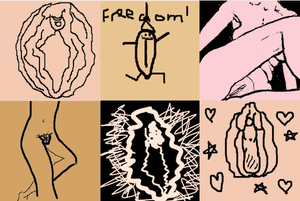
Think you know about vaginas? Think again. In the four-part series running from now through November, we find out that even the most basic of body knowledge is lacking – people still don’t understand what vaginas look like or how they function. In episode one, we build a giant vulva, then talk to a gynecologist, a labiaplasty surgeon and a trans woman, to find out what vulvas really look like.


WARNING: contains images of vulvas and strong language


If you want to get in touch with questions or comments for us, please write to vagina.dispatches@theguardian.com.


Stay tuned for episode two.


Mona & Mae


Vagina Dispatches: episode one - the vulva

31 Mayıs 2014 Cumartesi

Preview clip: Harry Wallop investigates junk meals advertising for Channel 4 Dispatches


The forthcoming episode of Dispatches on Channel four seems at how junk food items are marketed to shoppers in the Uk.


Presented by The Telegraph’s Harry Wallop, Tricks of the Junk Meals Company sees Harry and his colleagues invent a fake brand of large-sugar drink aimed at young children.


Armed with a bottle of the luridly-coloured Orange Beast, the programme makers go undercover and offer marketing companies the likelihood to industry the solution to children.


‘Secrets of the Junk Food Business’ on Channel 4 at 8pm on Monday 2 June


Preview clip: Harry Wallop investigates junk meals advertising for Channel 4 Dispatches