apart etiketine sahip kayıtlar gösteriliyor. Tüm kayıtları göster

23 Nisan 2017 Pazar

We’re worlds apart, but like Harry I had to face up to depression

Turning the corner into my mother-in-law’s street some years ago, it hit me. Michael’s car wasn’t there. Which meant Michael wasn’t there. And Michael wasn’t there because he was gone and none of us would ever see him again. We wouldn’t hear him laugh, we would never again be the butt of his jokes and none of us would share again in his generosity.


The moment of that dreadful realisation came back last week, reading Prince Harry’s comments about mental health and his battle with bereavement. Although our circumstances couldn’t be more different – my issues manifested themselves on a north Manchester council estate, rather than in a royal residence – the feelings of loss and subsequent pain will have been very similar.


We used to gather at Michael’s mam’s to watch United on television. It was always a happy family get-together, where brews and gags flowed, with the crowd noise from the television acting as a backing track to the pantomime taking over the living room. And Michael was always at the centre of it.


Parking that day, I had to stay in the car to stop myself from crying. For the previous month or so I hadn’t allowed any emotion in. I couldn’t. I had been concentrating on organising the funeral and getting legal advice on what would happen to his “assets”. I’d had to search his home for an eclectic array of items – from bank statements to a T-shirt my wife had bought him for a birthday.


I had flashbacks to when I entered his house in the days after his death. I’d drawn the short straw, as his closest friends were too upset to go back to the house after they had found him dead. Refusing to believe he was gone, his best friend had attempted to hold Michael, screaming at him to wake up. On the wall opposite, Michael had written in black marker pen: “I’M SORRY!”


My father-in-law accompanied me on that visit, as we stepped over hundreds of unopened letters littering Michael’s hallway. Stubbed-out cigarettes covered the floor. My father-in-law, a man’s man from a notoriously tough area of Manchester, sobbed on my shoulder and stammered: “Our Michael … Dear God …”


I wouldn’t allow my father-in-law upstairs as I had a rough idea of the scene that would greet me as I stepped on to the landing. The means for his suicide had not been cleared away and that message on the wall was jumping out like a neon sign.
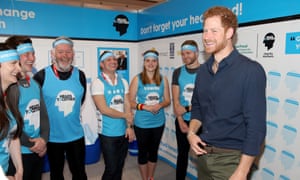


Prince Harry


‘As Prince Harry has proved, it doesn’t matter what your background or circumstances, mental illness can hit anyone.’ Photograph: Chris Jackson/Getty Images

Searching his belongings, I found evidence that his benefits had been sanctioned, due to him missing one appointment. The bastards had cut his every means of financial support because he had failed to attend one meeting. He hadn’t wanted to claim dole. He had worked most of his life, as a fitter, but he couldn’t stick being patronised by people who were less intelligent than him, so he gave up job after job.


His depression was a big part of this. But still he didn’t get help. However much we all tried to engage him, he shrugged us off. He only went to the doctor to discuss his problems when the dole office required proof he had a mental illness. They still wanted him to take unpaid work.


In the spare room, there was a pile of CVs aimed at charities to secure this “free labour” imposed by the benefits system. I found a certificate from the Open University. He had achieved a first-class honours degree in applied mathematics and he’d never told any of us. We knew he was doing a course, but he was bashful about it. In marking his work, his tutors were glowing in their predictions of a bright future that never came. In a drawer by his bed I found pictures of family, of past loves and happy times he had spent travelling the world.


He had no money left. Since the dole had cut him off, he was relying on a credit card to buy food. Too proud to ask for help, the alarm bells rang in the week before his death when he accepted a tenner from his mam. Previously he would never accept a pint from anyone, never mind money.


He told us he was depressed one Christmas after an uncharacteristic outburst. It was a shock as he was your typical Manchester “lad” in his mid-40s – tough, hard-working, streetwise and the life and soul of any social situation from parties to ordering a McDonald’s breakfast.


Despite our best efforts, we couldn’t help him. It haunts us daily. My wife and I had spoken during the week of his death about doing a Tesco shop for him, to make sure he was eating. Life got in the way.


Instead, I took the phone call that will forever crush me. Michael’s mam, my mother-in-law, rang our landline, which was a sign something was amiss, and tearfully delivered the news that Michael had taken his own life. While my wife was still half asleep, standing in our kitchen, her dad broke down as he told her the devastating news.


Conversely, I began to think practically. I needed to make all the arrangements to make it easier for the family. I didn’t grieve for one second.


This was all stored away in my head. I had never spoken about any of it, as his family and wide circle of friends were collectively distraught and I didn’t want to make it worse.


No stranger to bereavement – on the last count I had lost 12 close friends and family members by the age of 35 – I’d endured so much loss that I had become blasé about death. This was not healthy. At least this parked emotion was starting to reveal itself months later, even if I must have looked deranged, shaking and tearful in a car outside my mother-in-law’s.


At that point I made the decision to seek help. After braving a trip to the doctor, which in itself was an ordeal of self-loathing, I was put in touch with a service run by Greater Manchester Mental Health NHS foundation trust in Salford, where I lived.


There was a waiting list, one experience I doubt Harry shared with me, and the days dragged as I battled to keep myself together for the sake of my family. Although I was more accepting of mental health issues than Michael had been, like many men I had never been comfortable talking about anything even semi-serious regarding feelings and emotions.


My first session with a therapist was painful for both of us. She was lovely, reassuring and patient, but I believed I was ungrateful to feel depressed when I had a lovely family, a job, my own home and my physical health. I also thought death was part and parcel of life, so common had it been for me.


My therapist was clearly shocked by my dismissive outlook and she told me it was no wonder I was experiencing depression. It was the first time in my life that someone had told me that I had every right to feel bad. She told me there was a reason for it all and it wasn’t punishment for anything. Until that moment I thought I was weak, spoiled and selfish for feeling down, when so many other people in the world had nothing.


Those sessions and my therapist’s kindness fundamentally changed my life. After this treatment, I went on a Recovery Academy course, also run by GMMH, which allowed me to converse with other people with depression and feel humbled by their inspiring stories of survival.


I became open about my depression. I still take medication, but now I am happy to talk about it and that helps. I have even ended up working in mental health, as I wanted to help others and prevent other families going through what we had endured.


Before engaging in the help available through the NHS, I had been unable to write about Michael’s death. I tried so many times. I just couldn’t do it. But facing up to my need for help allowed my mind to become freer and I was finally able to put pen to paper, which has served a therapeutic role in itself.


Whenever I am at my mother-in-law’s now, I look up to the wall above the dining table, where she has a framed picture of Michael from our wedding day. I look up and I wink to him and thank him for the time we spent together.


We will always miss him, but his experience can act as an example of the importance of getting help. Our family’s resilience shows there is hope, if only we seek assistance. As Harry has proved, it doesn’t matter what your background or circumstances: mental illness can hit anyone.


In the UK, The Samaritans can be contacted on 116 123. In the US, the National Suicide Prevention Hotline is 1-800-273-8255. In Australia, the crisis support service Lifeline is on 13 11 14. Hotlines in other countries can be found here


We’re worlds apart, but like Harry I had to face up to depression

2 Kasım 2016 Çarşamba

Without the power of kindness, our society will fall apart | George Monbiot

If there is an irrepressible human trait it’s the determination, against all odds, to reconnect. Though governments seek to atomise and rule, we will keep finding ways to come together. Our social brains forbid any other outcome. They urge us to reach out, even when the world seems hostile.


This is the conclusion I draw from touring England over the past few weeks, talking about loneliness and mental health. Everywhere I have been so far, I’ve come across the same, double-sided story: stark failures of government offset in part by the extraordinary force of human kindness.


First the bad news: reminders of the shocking state of our mental health services. I met people who had waited a year for treatment, only to be given the wrong therapy. I heard how the thresholds for treatment are repeatedly being raised, to ration services. I met one practitioner who had been told, as a result of the cuts, to recommend computerised cognitive behaviour therapy to her patients. In other words, instead of working with a therapist, people must sit at a screen, using a programme to try to address disorders likely to have been caused or exacerbated by social isolation. Why not just write these patients a prescription instructing them to bog off and die?At least then they wouldn’t have to wait a year to be told to consult their laptops. I heard of children profoundly damaged by abuse and neglect being sent to secure accommodation – imprisoned in other words – not for their own safety, or other people’s, but because there is nowhere else for them to go.


These are not isolated cases. It is a systemic problem. There has been no child and adolescent mental health survey in this country since 2004 (though one is now planned). Snapshot studies suggest something is going badly wrong: figures published last week, for example, suggest a near quadrupling in the past 10 years of girls admitted to hospital after cutting themselves. But there are no comprehensive figures. Imagine the outcry if the government had published no national figures on childhood cancer for 12 years, and was unable to tell you whether it was rising or falling.


Of children referred for treatment for mental health disorders, 60% do not receive it. The Guardian recently published a mother’s account of how her child had been treated. Despite a severe mental health disorder, it was only after the child attempted suicide that she received the care she needed. The treatment consisted of sending her to the other end of the country: the only available bed was 300 miles from home. You don’t need to be a psychotherapist to imagine what that might do to a distressed and vulnerable child. But when the beds don’t exist, the health service has no choice. Embarrassed into a semblance of action, the coalition government promised another £250m a year for children’s mental health. It will scarcely touch the sides.


But amid the rubble of a collapsing state, I kept stumbling into something wonderful. Performing with the musician Ewan McLennan, using music and the spoken word to explore these subjects, has brought me into contact with groups that restore my faith in the human spirit.


In Leeds we ate in a cafe run by the Real Junk Food Project, whose meals are made from waste or donated food. Seeing people of all ages, from all stations of life, who had never come together before, yakking away over dinner like old friends, I realised that the project is addressing not only the waste of food but also the waste of social opportunity. Breaking bread together: this is still the best and simplest way of reconnecting.


In Sheffield I met a man creating safe spaces for people experiencing manic or psychotic episodes: using woods, allotments and – if his project gets planning permission – cobb houses like hobbit holes to create a place of comfort for those whose minds are reeling. In Durham I saw how people whose poor mental health and isolation exclude them from work are being gently introduced to the social skills and creativity that might allow them to re-engage. In Bristol I met someone from the Happy City initiative, which is finding ways to measure wellbeing and discovering the best means of enhancing it.


Across the country, groups such as the Campaign to End Loneliness, Age UK, Independent Age, Community Network, Young Minds, the Transition Network, the Network of Wellbeing and the forthcoming Jo Cox Commisssion on Loneliness are trying to provide a coherent response to the troubled times that lead to troubled minds. Everywhere I look, I see the kind of enterprise and innovation with which business is credited, but which seems to be found most often in the voluntary sector.


But what has struck me with greatest force is this. At the end of every gig, we ask people in the audience to turn to someone they don’t know and say hello. I tell them they needn’t do any more than that, but they can keep talking if they wish. On the first night I made the mistake of mentioning the idea before we had wrapped up the show. That was all it took – the conversation flared up immediately, and it was a long time before I could direct people’s attention back to the stage. After every concert the talking has continued long into the night, in the venue’s bar or the nearest pub. It’s as if people have simply been waiting for permission to speak to the strangers who surround them.


Britain, according to government figures, is the loneliness capital of Europe, but even – or perhaps especially – here, the urge to connect is overwhelming. This reattachment, I believe, holds the key to both our psychological and political transformation. Connected, engaged and happy people do not allow themselves to be trampled into the dirt. It is when we are estranged both from each other and from our political environment that we are easiest to manipulate, as the rise of demagoguery in Europe and the US seems to attest.


Neither state provision nor community action is a substitute for the other: we need both. But the more effective community groups and voluntary initiatives become, the harder it is for governments to disregard their duties. By talking together, we find our voice.


You can comment on this article and others on our Your Opinionsthread, which opens every Wednesday at 10am


Without the power of kindness, our society will fall apart | George Monbiot

12 Ekim 2016 Çarşamba

Neoliberalism is creating loneliness. That’s what’s wrenching society apart | George Monbiot

What greater indictment of a system could there be than an epidemic of mental illness? Yet plagues of anxiety, stress, depression, social phobia, eating disorders, self-harm and loneliness now strike people down all over the world. The latest, catastrophic figures for children’s mental health in England reflect a global crisis.


There are plenty of secondary reasons for this distress, but it seems to me that the underlying cause is everywhere the same: human beings, the ultrasocial mammals, whose brains are wired to respond to other people, are being peeled apart. Economic and technological change play a major role, but so does ideology. Though our wellbeing is inextricably linked to the lives of others, everywhere we are told that we will prosper through competitive self-interest and extreme individualism.


In Britain, men who have spent their entire lives in quadrangles – at school, at college, at the bar, in parliament – instruct us to stand on our own two feet. The education system becomes more brutally competitive by the year. Employment is a fight to the near-death with a multitude of other desperate people chasing ever fewer jobs. The modern overseers of the poor ascribe individual blame to economic circumstance. Endless competitions on television feed impossible aspirations as real opportunities contract.


Consumerism fills the social void. But far from curing the disease of isolation, it intensifies social comparison to the point at which, having consumed all else, we start to prey upon ourselves. Social media brings us together and drives us apart, allowing us precisely to quantify our social standing, and to see that other people have more friends and followers than we do.


As Rhiannon Lucy Cosslett has brilliantly documented, girls and young women routinely alter the photos they post to make themselves look smoother and slimmer. Some phones, using their “beauty” settings, do it for you without asking; now you can become your own thinspiration. Welcome to the post-Hobbesian dystopia: a war of everyone against themselves.


Social media brings us together and drives us apart, allowing us precisely to quantify our social standing


Is it any wonder, in these lonely inner worlds, in which touching has been replaced by retouching, that young women are drowning in mental distress? A recent survey in England suggests that one in four women between 16 and 24 have harmed themselves, and one in eight now suffer from post-traumatic stress disorder. Anxiety, depression, phobias or obsessive compulsive disorder affect 26% of women in this age group. This is what a public health crisis looks like.


If social rupture is not treated as seriously as broken limbs, it is because we cannot see it. But neuroscientists can. A series of fascinating papers suggest that social pain and physical pain are processed by the same neural circuits. This might explain why, in many languages, it is hard to describe the impact of breaking social bonds without the words we use to denote physical pain and injury. In both humans and other social mammals, social contact reduces physical pain. This is why we hug our children when they hurt themselves: affection is a powerful analgesic. Opioids relieve both physical agony and the distress of separation. Perhaps this explains the link between social isolation and drug addiction.


Experiments summarised in the journal Physiology & Behaviour last month suggest that, given a choice of physical pain or isolation, social mammals will choose the former. Capuchin monkeys starved of both food and contact for 22 hours will rejoin their companions before eating. Children who experience emotional neglect, according to some findings, suffer worse mental health consequences than children suffering both emotional neglect and physical abuse: hideous as it is, violence involves attention and contact. Self-harm is often used as an attempt to alleviate distress: another indication that physical pain is not as bad as emotional pain. As the prison system knows only too well, one of the most effective forms of torture is solitary confinement.


It is not hard to see what the evolutionary reasons for social pain might be. Survival among social mammals is greatly enhanced when they are strongly bonded with the rest of the pack. It is the isolated and marginalised animals that are most likely to be picked off by predators, or to starve. Just as physical pain protects us from physical injury, emotional pain protects us from social injury. It drives us to reconnect. But many people find this almost impossible.


It’s unsurprising that social isolation is strongly associated with depression, suicide, anxiety, insomnia, fear and the perception of threat. It’s more surprising to discover the range of physical illnesses it causes or exacerbates. Dementia, high blood pressure, heart disease, strokes, lowered resistance to viruses, even accidents are more common among chronically lonely people. Loneliness has a comparable impact on physical health to smoking 15 cigarettes a day: it appears to raise the risk of early death by 26%. This is partly because it enhances production of the stress hormone cortisol, which suppresses the immune system.


Studies in both animals and humans suggest a reason for comfort eating: isolation reduces impulse control, leading to obesity. As those at the bottom of the socioeconomic ladder are the most likely to suffer from loneliness, might this provide one of the explanations for the strong link between low economic status and obesity?


Anyone can see that something far more important than most of the issues we fret about has gone wrong. So why are we engaging in this world-eating, self-consuming frenzy of environmental destruction and social dislocation, if all it produces is unbearable pain? Should this question not burn the lips of everyone in public life?


There are some wonderful charities doing what they can to fight this tide, some of which I am going to be working with as part of my loneliness project. But for every person they reach, several others are swept past.


This does not require a policy response. It requires something much bigger: the reappraisal of an entire worldview. Of all the fantasies human beings entertain, the idea that we can go it alone is the most absurd and perhaps the most dangerous. We stand together or we fall apart.


Neoliberalism is creating loneliness. That’s what’s wrenching society apart | George Monbiot

25 Temmuz 2016 Pazartesi

I have seen death unite families and spill secrets that tear them apart

There’s a lot people don’t know about dying.


Most people are terrified of it. We don’t talk about it, and when we do it’s with hushed voices and delicate words. Most of us are blissfully ignorant until it forces us to take notice of it, whether it be because of a terminal illness, a fatal car accident or a loved one snatched from our lives. We are woefully unprepared for it. What are we supposed to do? What should we say? You never imagine it happening to you.


It is a sensitive subject, because deep down we know that it is the one thing in all our lives that is inevitable. Death does not discriminate, and it makes every single one of us equal. I was terrified of it too, but after seven years as an intensive care nurse I am familiar enough with death to be able to see it differently to most.


Death is ugly. It’s not glamorous, and most people do not close their eyes and slip away peacefully at home


Death is ugly. It’s not glamorous, and most people do not close their eyes and slip away peacefully at home in their beds, surrounded by loving family. The death I see comes with plastic tubes and cannulas shoved into oozing blood vessels, giant machines that hiss, click and shriek alarms as they mechanise the life of a human being, and a rainbow of bad smells. It comes with cheap fabric curtains, stiff white sheets and sunken, fluid-swollen skin. It comes with an unexpected phone call that drags you from your bed into cold and uncomfortable waiting rooms at 3am. Even if it is expected, it still comes with an icy shock and a deep, gut-wrenching sadness.


I have seen death unite families that haven’t spoken to each other for 10 years – arguments are forgotten, old grudges are meaningless. I have seen death spill secrets that tear families apart. I have seen a woman bring her lover to the bedside for comfort while her husband lay unconscious. I have called security for two brothers who started to fight about inheritance over the top of their dying mother’s body. I have held in my arms a young woman after her father died, who cried tears of relief at a future without his constant abuse. I have caught grown men from hitting the floor when they faint at the sight of their best mate lying unconscious on a ventilator. I have broken the ribs of patients by doing chest compressions as I am trying to resuscitate them, and not regretted a single one even if they don’t make it. One man, after several hours of stoic silence at his dying wife’s bedside, suddenly broke down in tears and told me in detail about the last time they made love before she collapsed on the way to work with a massive heart attack. I have had a chair thrown at me by the son of a woman who couldn’t be saved, even after 50 bags of blood and three hours of non-stop resuscitation. Death makes you behave in ways you didn’t realise were inside you.


Related: I am dying and I want everyone to talk about it


At 22 years old, three months after finishing my nursing degree, I withdrew the life support from my first brain-dead patient – a man only a year older than me, who was hit by a truck while he was cycling to his girlfriend’s house. I cried for four hours straight and had to be sent home early from work in a taxi because I couldn’t pull myself together enough to drive. I had no idea how to deal with my own feelings, let alone provide comfort to his family and friends. I couldn’t fathom why this particular man, with his beautiful girlfriend and his entire life ahead of him, had just died in front of me. The injustice of it haunted me for days afterward.


Not long after that, I spent three night shifts caring for an 80-year-old grandmother who had been savagely raped and beaten with a fire extinguisher in her own backyard while she was gardening. The trauma to her brain was so severe that the neurosurgeons had to remove a third of her skull to relieve the swelling. Her family was devastated, and as her condition worsened on the morning of my last night shift, they begged us to stop her life support and let her pass away unaware of the horrors that she had suffered. We did.


Dying can be an incredibly moving experience to be a part of. Only recently, I was holding the feathery hand of a 98-year-old woman as she whispered her last breath. Usually, I am a quiet presence in the background, gently adjusting sedative doses of painkillers and waiting to hand over tissues and cups of tea to teary-eyed relatives. This woman had no living family left, and had spent the last year in a nursing home without anyone for company. The nursing home told us that she had been a classical opera singer, and had worked for years in a mission hospital in Africa with her husband.


Related: This is not Casualty – in real life CPR is brutal and usually fails


Now she was comatose in intensive care, surrounded by loud machines that kept her fragile heart beating and her lungs breathing. Now it was up to me to gift her a peaceful and dignified exit from this world, after 98 years of sparkling life. It’s an honour to be present at the end of a life – especially one as long and rich as this woman’s.


Being on such intimate terms with death makes you realise that life is fleeting, fragile and unpredictable. Accepting death is terrifying, but not as terrifying as the thought of wasting the time that you have left before it does. Make sure you die happy.


If you would like to write a blogpost for Views from the NHS frontline, read our guidelines and get in touch by emailing healthcare@theguardian.com.


Join the Healthcare Professionals Network to read more pieces like this. And follow us on Twitter (@GdnHealthcare) to keep up with the latest healthcare news and views.


I have seen death unite families and spill secrets that tear them apart