Looking after the wellbeing of employees benefits everyone – no matter your role, seniority, and whether you have a mental health problem, or not.
Working with employers over the past six years means we have a good indication of what works to ensure a mentally healthy workplace. Those elements are incorporated into the Time to Change employer pledge, which gives organisations the opportunity to demonstrate their commitment to opening up the conversation about mental health. More than 500 organisations have made that commitment.
There are multiple things employers can do to create a more open working environment. Senior leaders have a pivotal role to play in leading by example – being open about their own mental health experiences sends the strong message that this isn’t a sign of weakness and doesn’t limit your ambition or aspiration. Employees at all levels talking honestly and openly about their experiences has contributed hugely to a cultural shift in how we think about the topic.
When employees feel their work is meaningful and they are valued and supported, they tend to have higher wellbeing levels. We often talk about a three-pronged approach that employers can adopt: promoting wellbeing for all staff; tackling the causes of work-related mental health problems; and supporting staff who are experiencing mental health problems.
We’ve made a conscious effort in recent years to target male-dominated workplaces, such as construction. Our research shows that men still don’t consider mental health relevant to them. Men try to be self-sufficient, keeping problems to themselves. But mental health problems don’t discriminate – they can affect anyone.
Many of the biggest UK construction firms have signed our pledge, and they tell us that for them it has been crucial to have people “on the ground” in the form of employee champions who challenge workplace stigma, normalise conversations about mental health and encourage those who need help to feel comfortable asking for it.
With the right support from those around them, people with mental health problems can recover and have equal opportunities in all areas of life – including work.
Sue Baker is director of Time to Change, the anti-stigma Movement run by charities Mind and Rethink Mental Illness.
Australia’s competition regulator has become the first in the world to successfully take legal action against e-cigarette companies for making false and misleading claims about the carcinogens in their products.
Federal court Justice John Gilmour ordered three online e-cigarette retailers – The Joystick Company Pty Ltd, Social-Lites Pty Ltd and Elusion Australia Ltd – and their individual CEOs and directors to pay penalties for breaching consumer law.
In separate proceedings the court found each of the companies had claimed their products did not contain harmful carcinogens and toxins, when this was not the case. It also found that the directors of Joystick and Elusion, and the CEO of Social-Lites, were knowingly involved in this deception.
Joystick and Social-Lites have been ordered to pay a penalty of $ 50,000, while the company heads have been ordered to pay $ 10,000. Elusion has been ordered to pay $ 40,000 and its director $ 15,000.
All three retailers admitted the conduct alleged by the ACCC and consented to the amounts of the penalties.
According to the case brought by the Australian Competition and Consumer Commission (ACCC), statements on the company websites led consumers to believe they would not be exposed to the harmful chemicals found in ordinary cigarettes.
However independent testing commissioned by the ACCC identified the presence of carcinogens and toxic chemicals, such as formaldehyde, acetaldehyde and acrolein in the products of Joystick, Social-Lites and Elusion, as well as acetone in Social-Lites’ products.
Formaldehyde is classified by the World Health Organisation International Agency for Research on Cancer as a Group 1A carcinogen, meaning it causes cancer, while acetaldehyde is classified as possibly carcinogenic. Acrolein is classified as a toxic chemical.
Dr Becky Freeman, a tobacco control researcher with the University of Sydney’s school of public health, said some consumers thought e-cigarette companies were “small artisan companies interested in improving health” when in fact most were owned by big tobacco.
Many advertisements for e-cigarettes and related products claimed they were less toxic and therefore less harmful than tobacco, she said. “But I’d challenge you to find something that isn’t less toxic than tobacco,” Freeman said. “We have no long-term data on e-cigarettes to show that they’ve help people quit for good or that they’re safe.”
The federal court ruling was “enormously significant”, said Simon Chapman, an emeritus professor of public health. He was aware that other complaints about e-cigarette advertising have been made to the ACCC. “These are by no means isolated examples,” Chapman said.
“Tobacco companies want to walk on both sides of the street. They try to argue that e-cigarettes are simply an ordinary consumer product and not a therapeutic device and therefore shouldn’t be subject to the same regulations, yet they often make statements that these things are excellent ways of quitting.”
He said it was “insulting to science” to claim the products were harmless or safe given the lack of evidence about long-term effects.
“Of course they don’t have all the products of combustion that tobacco products have, as they are vaporised and not burned. So while they’re likely to be less harmful, we do not yet know the magnitude of their harm, we just have no accurate way of estimating that yet,” said Chapman.
The ACCC’s acting chair, Delia Rickard, said businesses, including those online, must ensure they provide accurate information to customers and have a reasonable basis for making any claims. “This is particularly important for products that may cause harm to the health of consumers,” she said.
Sarah never planned to take antidepressants for 14 years. Three years after she began taking them, when she was 21, she went to her GP and asked to stop: 20mg of Seroxat a day had helped her live with anxiety and panic attacks, but she began to feel uncomfortable about being on medication all the time. Her doctor advised her to taper down her medication carefully.
At once, “I was a mess,” she says. “I thought I was losing my mind. My appetite completely went. I lost the best part of two stone. I was anxious constantly. My mouth was dry. It was difficult to sit and be calm.” She became withdrawn, refusing to see friends, and remembers asking her mother to get her a couple of boxes of paracetamol, thinking, “I’m going to have to take all these tablets, because I can’t live like this.”
Sarah’s doctor encouraged her to go back up to 20mg. “Within a week, I was much better. I feel anger when I look back. That wasn’t me relapsing, that was withdrawal. But I was so unwell, I didn’t stop to think, ‘I’ve never had this before.’ I truly thought it was me. Now the only reason I am on the drug is because I am dependent upon it. And that is not good enough.”
Prescriptions of SSRIs (selective serotonin reuptake inhibitors), the most common type of antidepressant, have doubled in the past decade. There are now more than 70m prescriptions dispensed in the UK in a year, the “greatest rise” of any drug in the last year, according to NHS research. But while the side-effects of starting and then withdrawing from these drugs are reasonably well known (the patient information leaflet accompanying the SSRI Seroxat is six pages long), there is very little research into the long-term effects of using antidepressants.
Last year, an all-party parliamentary group began hearing evidence as to whether there is a link between a measurable rise in mental health disability claims – 103% between 1995 and 2014 – and that in antidepressant prescriptions. (Claims for other conditions fell by 35% in the same period.) “We need to have a serious rethink about current levels of prescribing, because it may well be that the drugs are in fact contributing to the disability burden,” Dr Joanna Moncrieff, a consultant psychiatrist and senior lecturer at University College London, told the committee.
Reports both anecdotal and clinical have included side-effects such as constant pain, an altered sense of smell, taste or hearing, visual problems, burning hands and feet; food or drug intolerances and akathisia (the medical term for a deep inner restlessness). When a patient begins tapering down their dosage, these effects are generally ascribed to the drug leaving their system; if it is long after withdrawal is supposed to be over, however, patients are often disbelieved (according to the drug companies, withdrawal should take just two weeks for most people, though they acknowledge that for some it can be months).
Professor David Healy, director of the department of psychological medicine at Cardiff University and author of 22 books on psychopharmacology, believes that antidepressants are overprescribed. “If you go into your average doctor – if you’ve been off the drug for half a year or more – and you complain [of a range of symptoms] and say, ‘I think it’s caused by this pill I was on’, he or she would say, ‘It’s been out of your body for months. You’re neurotic, you’re depressed. All we need to do is put you on another pill.’”
GPs, Healy says, are “relying on your word, and if it’s a choice between believing what you say and relying on what drug companies say to them, they [tend to] believe the drug companies”. Healy, who has been a consultant for, and expert witness against, most of the major pharmaceutical companies, has long argued that long-term side-effects are routinely ignored or misunderstood.
But many experts believe these drugs do more good than harm. “Most of the people I see who have moderate to severe depression benefit from them,” says Daniel Smith, a professor of psychiatry and researcher into bipolar disorder at the University of Glasgow. For some, medication can be no less than “transformative. It can get them through a really critical period of their life.”
However, when it comes to long-term impact, especially after a person stops taking SSRIs,Smith says it can be hard to work out which symptoms relate to the drug use and which to the underlying conditions. “There’s obviously an issue of cause and effect. How can we be certain the SSRI caused it? Depression affects libido and sexual interest. How much [of the reported effects] is depression and/or anxiety symptoms coming back?”
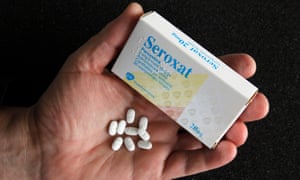
By 2003, worldwide sales of Seroxat, manufactured by GlaxoSmithKline, were worth £2.7bn. Photograph: Alamy
SSRIs have beenaround for more than 40 years, but grew in popularity in the late 1980s and 90s after pharmaceutical companyEli Lilly launched fluoxetine, otherwise known as Prozac. Time magazine put the drug on its cover twice, asking, “Is Freud finished?” and describing SSRIs as “mental health’s greatest success story”. In 2001, a landmark report on a clinical trial into paroxetine (sold as Seroxat in North America and Paxil in the UK), called Study 329, concluded that it demonstrated “remarkable efficacy and safety”. Study 329 led directly to a massive increase in prescriptions: by 2003, worldwide sales of Seroxat (manufactured by GlaxoSmithKline) were worth £2.7bn.
But concerns were raised about the study –the US food and drug administration (FDA) officer who reviewed the data disagreed with the findings, calling it a failed trial – and in 2015 the British Medical Journal published a re-evaluation. Seven authors went through as many of the thousands of individual case reports as they could, and found not only that “the efficacy of paroxetine… was not statistically or clinically different from placebo”, but that “there were clinically significant increases in harms, including suicidal ideation and behaviour”. The original study reported 265 adverse reactions; the BMJ found 481. The re-evaluation also found that psychiatric responses were grouped together with “dizziness” and “headaches”, rather than given their own category. In 2003, the UK banned the use of Seroxat by anyone under 18; and in 2004 the FDA required a “black box warning” on all antidepressants, its strictest level of patient warning.
“Patient safety is our number one priority,” a GlaxoSmithKline (GSK) spokesperson tells me. “We believe we acted responsibly in researching paroxetine, monitoring its safety once it was approved and updating its labelling as new information became available.”
It’s more reliably predictable that they’re going to get rid of sexual function than get rid of depression
Many SSRI users report blunted emotions, even long after they have ceased taking pills, and an impact on sexual function. “They should be called anti-sex drugs rather than antidepressant drugs,” says Jon Jureidini, a child psychiatrist of 30 years’ standing, a professor of psychiatry and paediatrics at the University of Adelaide and co-author of the BMJ study, “It’s more reliably predictable that they’re going to get rid of sexual function than it is that they’re going to get rid of depression.” Again, some people find this persists long after they cease taking the drug. One person I spoke to, Kevin, had taken Prozac for six months when he was 18; now 38, he hasn’t had an erection since.
Last September, Healy and colleagues published a further examination of the data gathered for Study 329. This data followed the trial participants for six months after they started taking paroxetine (the “continuation phase”) and while they were tapered off it. GSK, which in 2004 published a clinical study report, had argued that “the long-term safety profile of paroxetine in adolescents appears similar to that reported following short-term dosing”. Healy and co, however, concluded that the “continuation phase did not offer support for longer-term efficacy”. More alarmingly, they found that the taper phase, when patients were being taken off the drugs, was the riskiest of all, showing a “higher proportion of severe adverse events per week of exposure”. This, they said, opens up the risk of a “prescribing cascade”, whereby drug side-effects are thought to be symptoms, so are treated with further drugs, causing further side-effects and further prescriptions – thus increasing the risk of long-term prescription drug-dependency.
In October, the British Medical Association published its response to a two-year fact-finding exercise into long-term use of psychoactive drugs. It noted that while benzodiazepines, z-drugs, opioid and antidepressants are “a key therapeutic tool”, that their use can “often lead to a patient becoming dependent or suffering withdrawal symptoms… the evidence and insight presented to us by many charity and support groups… shows us that the ‘lived experience’ of patients using these medications is too often associated with devastating health and social harms”; it was therefore, the report concluded, a “significant public health issue”.
The BMA made three key recommendations: first, and most urgently, that the UK government establish a 24-hour helpline for prescribed drug dependence; second, that it establish well-resourced specialist support units; and third, that there should be clear guidance on prescription, tapering and withdrawal management (they found the current approach to antidepressants, in particular, to be inconsistent: too many patients were suffering “significant harm”). There are also increasingly urgent calls for studies into long-term effects that are not funded by drug companies, because, Moncrieff says: “We don’t have very much data. This research is really important, but hasn’t been done. It’s a massive blind spot. It’s extraordinary – or maybe, given the pressures and interests at work, not extraordinary at all – that it hasn’t been filled.”
In March this year, members of the BMA, along with MPs and researchers from Roehampton University, went to parliament to lobby Public Health England, armed with research estimating that there are 770,000 long-term users of antidepressants in England alone, at a cost of £44m to the NHS per year (a figure that does not account for the cost of GP appointments, or the impact of side-effects, withdrawal effects and disability payments).
“I think you have to adopt a very conservative approach,” says psychiatrist Jon Jureidini. “These are brain-altering drugs, and our overall experience with brain-altering drugs of all kinds is that they tend to have a detrimental effect on some proportion of people who take them long term. All we know about the benefits is from short-term symptom-reduction studies. The careful prescriber needs to say, ‘Well, in balancing the likely benefits and harms, I need to be very cautious about how much benefit I’m expecting, and I need to be very generous about the possibility that the harms might be more than they appear to be.’”
Quite a few long-term users, such as those I spoke to below (and who wished to be anonymous), would agree.
‘Tapering off is the hardest thing I’ve ever done’:Sarah, 32; has taken Seroxat for 14 years
I was prescribed Seroxat when I was 18, the year I started university. I grew up with a disabled sister, so things at home were very stressful, and I had a history of anxiety and panic attacks. I had counselling, but the problems persisted, so I went back to the GP. I don’t remember everything that was said, but there was no conversation about side-effects.
Within the first two weeks of starting Seroxat, I remember I was sitting in the front room watching TV when out of nowhere I had this intense feeling of heat, like an electric shock. It started in my hands, went all the way up my arms and through to my head.
The GP said it was probably just my body getting used to the drug. And after a few weeks the weird sensations did ease off. I had a fabulous time at university. I still had panic attacks, and there were certain situations I would avoid – as I still do – so it wasn’t a wonder drug, but there were no major problems.
But in 2006 I tried to come off it. There were a couple of Panorama documentaries about the side-effects and I was starting to become concerned. The GP said, “That’s fine, but do it gradually, over three weeks.”
I thought I was losing my mind. I was going to work, but it was difficult to get through the day. My mouth was so dry
I immediately became incredibly unwell. I thought I was losing my mind. I was going to work, but it was difficult to get through the day. My mouth was so dry, I was constantly drinking water. I had bizarre thoughts – not hallucinations – that were frightening or distressing. I had a strong sense of detachment from reality.
Eventually, the doctor said, “Look, you coming off is obviously not working: we need to get you back to 20mg.” Within a week I was much better.
A few years later, when I realised my mental health was getting worse, even though I was on the medication, I started to do some research, reading case studies about withdrawal. I find it so offensive when a GP says, “This is who you are.” I didn’t have these symptoms 10 years ago. I didn’t have this sense of detachment. I saw various psychiatrists. They just kept saying, “The drug is safe, you need to be on it.” A couple of others told me the reason I was having these problems was because I wasn’t taking enough. Another said, “If you were diabetic, you’d take insulin and you wouldn’t have an issue. Why are you so bothered about taking this drug?”
I’ve been on it since I was 18, so I don’t know who I am without it, as an adult. Who knows? I might have all kinds of problems, but I need to know I’ve tried. Tapering off is the hardest thing I’ve ever done. It’s taken me three years just to get from 20mg to 5mg. I’m no longer with my partner – we were together for six years. I believe Seroxat has played a part: it affected my moods, it made my anxiety worse and, by necessity, I’ve had to be selfish, really. I don’t want to say all my problems are to do with Seroxat, because they’re not. But I do believe that it has caused me harm.
‘I don’t have much of an interest in interacting romantically or physically with the opposite sex’: Jake, 24; took SSRIs for eight years
I had been dealing with symptoms of OCD and anxiety for a lot of my childhood. It’s in my family, affecting two siblings and one parent. I was prescribed Zoloft when I was 12; I took a variety of SSRIs, Zoloft to Prozac to Lexapro, and then two others, for eight years.
Did they help? You know, I can’t really tell you, because I got through school. I got high marks, I had a lot of friends. So, in that sense, they must have helped. That’s the thing: for people with major depression, it’s easy to say, this has a measurable effect. But I kept taking them just because that’s what I’ve always done.
I went to university right out of school. I did very poorly. I had a bit of a breakdown, isolating myself, not sleeping. I was still on medication. I came home and enrolled at a community college. That was my worst period – I was very depressed. And I started to think, “I’ve been on these medications a long time. I’m not doing well – why not get off them?” I don’t recommend this at all to anyone, but I stopped going to a psychiatrist and took myself off.
Prozac. Photograph: Getty Images
For months I had trouble sleeping. I was jittery. I had brain zaps. My anxiety was pretty ramped up. I would feel numbness in my extremities – generally my arms. My psychiatrist told me these were just normal withdrawal symptoms, and they’d be gone in four to six weeks: “Anything you feel beyond that is your anxiety and depression returning.” Basically, if you still feel anything beyond this window that the medical community has established, it’s all in your head.
Eventually I went back to school full-time, and I remember doing OK, feeling somewhat better.
I’ve now been drug-free for four years. What’s lasted are the sexual side-effects. They were definitely worse in withdrawal than they had been on the drug, even though I didn’t really realise or understand it at the time, primarily because I started to take SSRIs at 12. While my brother took the same medicine over the same period and had a normal sexual life, I had a lack of sexual interest. I had erections, and I have regularly masturbated my entire life. But I don’t have much of an interest in interacting romantically or physically with the opposite sex.
I didn’t even start thinking about sex until a couple of years ago. It’s almost like I woke up one day and thought, “OK!” I started getting these windows – days or weeks – when normal sexual feelings would appear. But they’re new to me and I don’t know what to do about them. And because I don’t know what to do, I get anxious, and the anxiety kills any feeling – and then I’m anxious because I’ve lost all my feeling.
Online, I’ve come across a big asexual community. Some also took antidepressants; I think there are a lot of people like me out there. I’d like to think that if I keep going to counselling and sleeping and eating properly, I can rectify these things.
In the end, it’s about pros and cons. If you’re lying in bed and can’t get up, is it better to function? If it was up to me, I’d say that, barring extreme circumstances, nobody under 18 should be prescribed these things. Your brain develops around them. Drug companies should be thinking of the long-term effect on people who can’t even consent.
‘If I missed a dose, I’d get shocks down the side of my body’:Chris, 43; has been taking Seroxat for 26 years
I was originally prescribed Seroxat for mild anxiety about my GCSEs. It was 1991, about the time GlaxoSmithKline released Seroxat. I was one of the first people to be given it.
I was prescribed 20mg, the basic dose, to start with. It helped me: I got through school, I went to uni, I went to work. But I had side-effects from the off: profuse sweating, low libido. I’m quite a placid person, but I became aggressive. I never suffered, in the beginning, with the suicidal thoughts that people talk about now, but what I did notice was that if I missed a dose – especially after eight years of taking it – I’d get shocks down the side of my body. I’d be nauseous, my limbs would become weak. I’d be in a constant state of confusion and was very impatient. I couldn’t communicate well with people. I said this to the doctor, and he said, “We’ll up the dose to 40mg.” That was 1998.
I tried to go back to 20mg, but my words became slurry, so the doctor put me back up to 60mg
The 10 years after that weren’t too bad. I managed to work, as a sales rep, for 18-20 years. But by 2012, by which time I was up to 60mg, I had tried on numerous occasions to withdraw. I tried to go back to 20mg, but my words became slurry, so the doctor put me back up to 60mg.
By the time I was 38, even that wasn’t enough. I tried to take my life. The doctor wouldn’t prescribe a higher dose. I couldn’t do my job, I couldn’t concentrate, I couldn’t drive. A psychiatrist once said to me that coming off Seroxat is harder than quitting heroin. That really hit home.
I have now been unable to work for four years. I’m still seeing a psychiatrist. I’ve also been diagnosed with fibromyalgia: constant tiredness, aches in the neck, and in the lower back and lower limbs. I’m 43 and still live with my mum and dad.
I also have no libido. Since the age of 30, I have had no feelings in that regard whatsoever. I have had relationships, but they’ve all failed. I haven’t been in a relationship for 10 years, which is a long time to go without sex, but I just don’t get the urge.
I don’t really have emotions, to tell you the truth. The drug takes your emotions away. I’m sort of existing, not living.
And when the drugs do work…
‘I wanted to be able to feel good when good things were happening, bad when bad things were happening’
BySimon Hattenstone
I suppose I was a depression snob. A purist. Why should I take antidepressants? Yes, there was something rubbish about crying all the time, not functioning, being unable to answer simple questions because of the fug in my head. But, hey, at least I was true to myself.
My depression went back to my late teens. I didn’t like to think of myself as depressive, because depressives were losers. And I didn’t think I fitted the bill: I was pretty funny and able, and I could get girlfriends. I guess most depressives don’t think they fit the bill.
It might have been genetic. My dad had paralysing depression, and so did his father. As a young boy, I’d spent three years off school with encephalitis – an inflammation of the brain that is often fatal. Survivors are often left with depression.
I remember as a teenager being on holiday in Greece with friends. The weather was gorgeous, and I thought, “Why can’t it piss down, because then at least I’d have a reason to feel this way?”
That is what I always craved – objectivity. To be able to feel good when good things were happening, to feel bad when bad things were happening. I hated the fact that my feelings rarely correlated to what was going on in my outer world.
In my 20s, I got by. I held down a good job, fell in love, had kids, made friends, had a pretty good life. But things came to a head when my best friend killed herself. I’d find myself weaving in between traffic wondering what the impact would be like. I took a period off work and gratefully accepted my Prozac prescription.
Things had changed since I first rejected them. Prozac looked cool (lovely green-and-white pills) and rock bands wrote great songs about it (even if REM’s Shiny Happy People was supposed to be dystopic). After telling people I was off work with depression, I ended up feeling like a priest at confessional. It turned out that virtually everybody I knew was a depressive and pilling their way out of it; now it was “our secret”.
I would try to come off the pills and felt rubbish again – not more rubbish than before, but the same. So I returned
Initially, Prozac made me feel sick. And then magically, after a couple of weeks, I felt lighter, as if something had been lifted. I could hear questions properly, answer logically, enjoy a sunny day.
My partner said I was transformed. Occasionally, I would try to come off the pills and felt rubbish again – not more rubbish than I had before, but the same. So I returned, and after a while, I thought, “What’s the point of even thinking about coming off the pills if they make life work for me?”
There are times now when I wonder if I weep and fret and withdraw too much, and whether I’m becoming immune to the Prozac. But on balance I think not, because life is still so much better than it was.
If Prozac was no longer working for me, would I stop taking it? Probably. Would I stop taking antidepressants full stop? I doubt it. I’d simply look for another super pill.
• Are you a long-term user of antidepressants? Tell us about your experiences
If you are affected by the issues raised in this piece, contact the Samaritans here.
In the past decade there has been a doubling in the number of prescriptions written for selective serotonin reuptake inhibitors (SRRIs) – the most common antidepressant. NHS research shows there are now more than 70m prescriptions dispensed in the UK in a year, the “greatest rise” of any drug in the last year.
But while the short-term side effects of taking this medication are well-known, there has been less exploration into the longer-term impact of them. In an article for Guardian Weekend magazine, Aida Edemariam spoke to people who had been taking the drugs for many years. She found that many SSRI users report blunted emotions and an impact on sexual function, with the effect lasting long after people have stopped taking pills.
Those attempting to come off these drugs also face withdrawal symptoms. This can include feeling heightened anxiety or depression, with some going back onto the drugs believing their mental health problems have returned.
That is not to say that these drugs are not helpful. They can prove life-saving in terms of helping them cope and live with mental health problems. The Guardian’s Simon Hattenstone said: “If Prozac was no longer working for me, would I stop taking it? Probably. Would I stop taking antidepressants full stop? I doubt it. I’d simply look for another super pill.”
Share your experiences
We want to hear from our readers about long-term antidepressant use. Have you been on medication for a long time and struggled to come off it? Do you want to? Do you feel these drugs are overprescribed? Should more be done to warn patients about long-term side effects before they take them? Or do you feel you would never have coped without them? Share your stories.
Psychological thrillers are a great way of understanding the skewed perception of first-person consciousness
With the hotly anticipated Into The Water by Paula Hawkins out next month, the interest in psychological thrillers isn’t going away. The genre’s preoccupations are shared with neuroscience – in particular, how we process memory. But it’s not recent breakthroughs within neuroscience and psychology that make it such a rich seam for novelists.
In fact, there haven’t really been any, although much new data about the brain is available, thanks to imaging techniques, neuroscience projects and interest from venture capitalists into artificial intelligence, our basic view of it is not that different to what it was 20 years ago. Now novels offer the most realistic accounts of first-person consciousness, particularly psychological thrillers that rely on skewed perception and unreliable narrators. This style, suggesting that what we experience isn’t objective reality but rather a story we tell ourselves, is closer to the truth than most psychological theories. When we can finally explain how the brain works, perhaps scientific representations will be more accurate. But for now, the novel is the real story.
Prince Harry spoke over the weekend about the emotional cost of suppressing his grief over his mother’s death when he was 12 years old. Prince William followed up by saying that his work as an air ambulance pilot made him aware of the large number of people, mainly men, who attempt suicide. The two of them, along with the Duchess of Cambridge, have launched an awareness campaign that aims to highlight the dearth of good mental health provision in Britain.
For some, all this means is that – disappointingly – the royals have joined the “snowflake generation” of young people who are simply too sensitive to little things like “feelings”. For others, including myself, their Heads Together initiative is admirable, not least because in itself it calls attention to the ludicrously basic level at which the building of “awareness” needs to begin.
Imagine how weird it would be if this trio were sticking their necks out to raise awareness of physical health, pointing out that you don’t just carry on, yelling that it’s only a flesh wound if you’ve made a gash in your hand. Clean it, at the very least. Put on a plaster. If it won’t stop bleeding, see a doctor. These are things everyone is nowadays expected to know. Yet, not so long ago, humans had no understanding at all of the implications of leaving a physical wound untreated.
We’re not far beyond that point with “mental health”. For a start, this is a huge, catch-all term. In Harry’s case, normal emotional distress was left untreated, and festered into something more serious. And yet … expressing his distress? Having it addressed? That, in some people’s eyes, would have made Harry a snowflake. This dangerous attitude is particularly fostered in men and boys. It’s not masculine to show your emotions – though they tend to show in other ways, in anger, aggression, self-harm or depression. I daresay that in at least some of the cases to which William refers, men bottled up their distress until it became overwhelming.
Very often a “mental health problem” starts out as mere emotional distress, a natural, healthy part of life. It’s when that distress isn’t sensibly addressed that it can grow into something that can be labelled a problem. Simply being aware of one’s emotions is the first step towards regulating them. Telling a whole generation that they’re “snowflakes” for having such awareness is actually an awful thing to do.
Which is not to say that every manifestation of emotional distress should be indulged or validated. That, I think, is what makes people talk of “emotional incontinence”. There’s a tendency among some to start believing that if a view or opinion upsets them then it is wrong. On the contrary, that’s usually a sign that the distressed person has difficulty handling conflict. What’s really going on with the “snowflake generation” is that people are becoming more aware of their feelings and needs, but don’t have the knowledge or experience to understand what those reactions are telling them about themselves.
In January this year, Theresa May announced that schoolchildren will be given greater access to NHS mental health workers. She has also praised Prince Harry for helping to “smash the stigma” around mental health and reassuring people that they are “not alone”. (She’s also called a snap general election, of course, which isn’t going to help anyone’s mental health.)
But this too is evidence of the crudity of our thinking. What is actually needed is far more sophisticated emotional awareness, so that people can recognise and manage their own emotions and, just as importantly, interactions with others who may have unhealthy or abusive emotional agendas themselves.
The good news is that all this is not actually as difficult or complex as it may appear. Emotional awareness could easily be taught in schools. It should be seen as just as necessary as PE. Already people are doing amazing and cost-effective work that can have a huge impact in helping people understand and care for themselves and those around them. Last week, for instance, I took part in a conflict workshop run by youth charity Leap. Around 20 adults who had never met before became fairly emotionally intimate with each other over just a couple of hours.
Emotional awareness should be taught in schools, and seen as just as necessary as PE
Some declared they’d achieved insights that they were going to apply within their marriages. Someone who’d worked for years with the most troubled young people announced she was “blown away”. Yet the room was full of people who didn’t even know that conflict was a problem in their lives.
And that’s the thing. People soldier on, unaware they have a problem. Worse, that problem becomes familiar; it feels safe, even comfortable, because it’s what they know. It’s why people make the same mistakes again and again, abusing others or allowing themselves to be abused without even knowing this behaviour isn’t “normal”.
There’s a tendency to see the “snowflake generation” as narcissistic, demanding constant attention and validation, wrapped up in their own needs and unaware of those of others, refusing to take responsibility for their choices or mistakes, playing the victim. Yet these critics are themselves being typically narcissistic in denying that the youngsters they berate have any right to their own feelings and perceptions, let alone might need or deserve some help in untangling them.
If anything, I believe, this generation is suffering because generations before it were as narcissistic as any that ever lived. If you think that’s far-fetched, take a look at Donald Trump, elected King of the Baby Boomers.
Talking of kings, there’s not a lot that’s more narcissistic than the concept of monarchy. When the youth of that institution say there’s a problem, then you really, really know there is. And that it’s a big one.
‘The most disconcerting side-effects were disturbed sleep and night sweats, waking up literally wrung out, with no discernible pattern to either,” says Kirsty Wark. She sounds as measured, informed and professional as is her norm when presenting Newsnight but Wark is talking about something much more personal than current affairs: her menopause.
Wark is fronting a documentary that will air on BBC1 on Thursday: The Menopause and Me. Her involvement in the programme comes from her own sudden and unexpected experience. She had a “medical menopause” at the age of 47, after a hysterectomy and after coming off hormone replacement therapy(HRT) because of fears over its reported link to breast cancer.
“Suddenly, I had no oestrogen and the disturbed sleep and night sweats started. By the time I started making the documentary, nothing much had changed for me in 12 years and I just coped with it, as so many others do.”
But, aside from the obvious physical battle she had to endure, what Wark also struggled with was the apparent silence surrounding the menopause. In many households it is still not discussed and, in those that do broach the subject, it is often talked about in hushed tones as “the change”.
“It’s not so long ago that the hormonal changes that came with menopause were regarded as madness – the madwomen in the attic,” says Wark. “Mythology has a lot to answer for.”
Just 50 years ago, menopausal women tended to suffer alone, mortified by hot flushes and bewildered by hormonal mood swings. There was also a general acceptance that they should retire into the shadows in case it bothered anyone else. The very idea that work colleagues might know or show empathy was anathema.
It has, however, long been the subject of comedy, featuring in episodes of Father Ted and Absolutely Fabulous, as well as in routines by Les Dawson. Jennifer Saunders – who had a cancer-induced menopause – is both funny and uplifting in the Wark documentary. “There’s a moment when you realise everything’s changed,” she says. “Your metabolism, energy levels, skin, hair … so I just had a large glass of champagne and got on with it.”
This 2001 episode of Absolutely Fabulous is called Menopause – the subject crops up frequently on comedy programmes. Photograph: Brian Ritchie/BBC
Not until relatively recently has it started to be something that is not ignored or giggled at, or both – and this is partly owing to the willingness of celebrities such as Wark and others to speak openly about it.
In a recent interview with People magazine, Gillian Anderson talked about a sense of life falling apart when she experienced perimenopause, the hormonal transition prior to menopause. “All of a sudden, I felt like I could handle nothing. I felt completely overwhelmed,” Anderson said. “When I talked to the specialist, she said she often gets phone calls from female CEOs screaming, ‘I need help now! I’m losing my mind!’ I felt like somebody else had taken over my brain.”
She credits Angelina Jolie with helping change the stigma when she spoke openly about her menopause after having her breast and ovaries removed because of being genetically at risk of breast and ovarian cancer. “Perimenopause and menopause should be treated as the rites of passage that they are,” Anderson told People. “If not celebrated, then at least accepted and acknowledged and honoured.”
Cynthia Nixon, famous for her role in Sex and the City, has also been open, although she had a completely different experience from Anderson, telling the Telegraph that she and her wife are going through the menopause together. Nixon wasn’t upset, revealing: “There has been no sadness for me, because once you hit 50, you’re done.” She cites the advantages of passing childbearing age and experiencing it together. “Although I have a six-year-old, the freedom that comes from no longer being fertile is huge.”
Those differing experiences also highlight a potential problem in being more open about menopause, since symptoms can vary wildly. We have gone from a culture where it was rarely mentioned to, in some cases, one where women suffering badly ask for special consideration in the workplace. This leads to inevitable scepticism not just from men, but from other women who simply don’t suffer to the same extent and feel their colleagues should just put up with it.
Wark’s response to this is to suggest we should all be a bit kinder in the workplace if colleagues aren’t feeling well – which is possibly the best approach.
Wark’s programme is also for partners, husbands, family, friends and employers, to help give them an understanding of what women go through when they enter the menopause. Every angle is explored, with many women and one husband talking about loss of libido, weight gain, hair loss, joint pain and the almost unspeakable vaginal atrophy.
It’s also useful as a reminder that times change – everyone recognises the classic image of menopausal women as witch-like harridans exhibiting seriously odd behaviour – and that the modern menopausal women is more likely to be leading a busy and satisfying life.
Many confident, articulate women are now talking and writing about the menopause, with India Knight and Christa D’Souza producing highly entertaining books, and Miranda Sawyer writing on the subject with such penetrating honesty and empathy that you wonder if she has been poking about in your own mind.
Gillian Anderson spoke of a sense of her life falling apart following her perimenopause in an interview with People magazine. Photograph: Anthony Harvey/Getty Images
Many women live a third of their lives post-menopausal, often at the peak of their careers and still with big plans. Medical advances are also making a huge difference to women’s experiences – and how they are seen to be dealing with it by those around them.
Wark admits she was surprised by how much she learned during the making of the programme, particularly from Dr Heather Currie, chair of the British Menopause Society and consultant obstetrician and gynaecologist at Dumfries and Galloway Royal Infirmary in Scotland. Currie also runs the Menopause Matters website.
“Discovering Heather was on HRT was an absolute eye-opener for me,” says Wark. “The US study that prompted me to come off HRT has been considerably revised and HRT only increases the risk of breast cancer if you are already predisposed. I’m back on a small dose of HRT and think I’m starting to see my sleep improve.”
Currie says a new paper by Professor Robert D Langer demonstrates that errors in the study led to 15 years of unnecessary suffering for women who stopped HRT. “There’s a better understanding of risk,” she says. “For most women who commence HRT under the age of 60, or within 10 years of the menopause, it provides more benefits than risks, including symptom control, as well as improved urogenital, bone and cardiovascular health.”
She adds: “The study didn’t show any statistically significant increased risk of breast cancer or heart disease in women using HRT, yet the highly publicised conclusions emphasised these risks. It’s hard to come back from such panic-inducing headlines but I think we are getting there, with more women talking to their GPs about the consequences of menopause and treatment options.”
WHI Study errors led to 15 years of unnecessary suffering for women who stopped HRT.
Carol Smillie, another famous face who has previously spoken openly about incontinence and periods, thinks women should not be afraid to talk with GPs, friends and family about the menopause. “We live in a far more tolerant society than our parents did,” she says. “Look how far we have come with issues like gender and disability; menopause is more openly discussed and therefore better understood now.”
It is a sentiment echoed in India Knight’s book, where she writes: “There’s a whole third of life to go. That’s not an ending – it’s a thrilling new beginning. And as you approach the years ahead, you do so at the height of your powers. You know more than you’ve ever known. You are the wisest you’ve ever been.”
THE FACTS
The menopause is when a woman stops having periods and cannot get pregnant naturally. It usually occurs between 45 and 55, as oestrogen levels decline. The average age in the UK is 51.
Common symptoms include hot flushes – sudden body temperature changes that produce heat and sweating – night sweats, irregular periods, decreased libido, vaginal dryness and mood swings.
Treatments include HRT and gabapentin, which have received mixed reviews in treating hot flushes and can have significant side-effects.
The most significant recent development is the clinical trial of a new drug carried out by Dr Julia Prague and colleagues at Imperial College London that promises the development of an effective way of reducing hot flushes. The drug is currently undergoing further trials and if these are successful it could make a considerable difference to women’s lives.
Alternative remedies include bio identicals and evening primrose oil.
This summer marks 25 years since one of the greatest moments of my career, winning Olympic gold in Barcelona. It often feels like the last 25 years have flown by as quickly as the 9.96 seconds it took to run the race!
A quarter of a century on and I’ve just turned 57. In my mind, I don’t feel any different to how I felt on that day in 1992. I still feel in good shape and to this day I spend more time at the track than I do in my house. However, as I’ve grown older, I’ve become much more mindful of the potential threats to my health than I ever was then.
I’ve recently started working with the men’s health charity Prostate Cancer UK and have learned some startling statistics. As a black man over 50, my risk of prostate cancer is double that of a white man the same age. One in four black men will be diagnosed with prostate cancer in their lifetime – the equivalent of one member of a 4×4 relay squad.
The prostate is an invisible gland; you can’t see it, you can’t feel it. In fact, 17% of men don’t even know they have a prostate.
If I’m being honest, until lately, I was one of the many thousands of men who knew next to nothing about the vital, walnut-size, reproductive gland inside me. More than 11,000 men die from prostate cancer every year in the UK, but over the next 10 years Prostate Cancer UK is ramping up its investment in research and has set a goal to transform the disease into one that the next generation will not fear.
Despite the odds being stacked against black men, just saying the word “prostate” within many black communities remains a massive taboo subject. Still, in 2017, the disease is simply not spoken about and, if it is, it’s in a “hush-hush, don’t tell anyone” type of way. How can it be that something that affects so many black fathers, uncles, sons and friends is continually swept under the carpet and ignored?
My health has always been important to me. When I was in the prime of my career, it was the most important thing. I was conscious of my diet and keeping myself in shape. I had to; other than a pair of running spikes, my physical and mental fitness was all I had – my career depended on it. Unbeatable; indestructible; that’s what I wanted to be, and I believed I was.
As I’ve grown older, my diet is still vital, but I’ve come to realise that no matter how well I eat or how fit I am, I am not indestructible – nobody is. But there are defence measures I can take and arming myself with knowledge is by far the most important.
If prostate cancer is caught early, more often than not, it can be successfully treated. The problem lies in the fact that when it’s in its early stages the disease is just as invisible as the gland itself – it has no symptoms.
This is why awareness of the potential threat, talking to your doctor and spreading the word among men is so important – it saves lives.
I’m currently fronting Prostate Cancer UK’s campaign, Stronger Knowing More, to get black men to face up to their risk of prostate cancer and take action. If you’re a black man, you’re not only more likely to get prostate cancer, you’re more likely to be diagnosed at a younger age.
This challenge is a marathon, not a sprint, and if we’re going to beat it we need to break down the taboos and start talking. It’s only by doing this that we can put a stop to the number of men who die from the disease every year.
Last year, I quit teaching. I had completed my NQT induction, and despite the years of self-doubt and tears I’d finally come to recognise that I was a competent teacher, and had started to believe my positive feedback.
I had also come to realise, however, that teaching was an unhealthy career choice for me. I am a perfectionist – or now, I hope, a recovering perfectionist – who is prone to anxiety. Unfortunately, I could not reconcile these aspects of my mentality with the never-ending pressures of being a teacher.
My health was poor while I was in the classroom. I was on medication, undergoing therapy and had to twice take time off sick when I couldn’t leave my house without breaking down. As the end of the year approached, I knew I would be leaving teaching.
But as the end of term loomed, I wondered: “What will I tell my students?” I remember standing in front of my lovely class, with whom I had developed an extremely good relationship, trying to find the words to explain why I was leaving them in the middle of their GCSEs.
They were a wonderful bunch – curious, energetic and high-achieving. But many were also anxious and stressed. I saw myself in so many of them. Their perfectionism and ridiculously high standards were a mirror of myself. I stood before them, without having learned to deal with those issues, about to give up on my dream career after two years of mental anguish.
And so, on my last lesson I stopped, looked them in the eye, and said:
Guys, I am leaving because I have never tackled my perfectionism – that same perfectionism that you think will get you A*s and make you happy.
I am leaving because I have not yet learned how to cope with failure or deal with negative emotions. I have not yet worked out how to tackle my faulty thinking. I have achieved so much academically and have a wonderful social life, but I have been suffering with poor mental health. I am anxious and depressed, and so I can’t carry on being your teacher at this moment in time.
But that’s OK. Our lives will go on. I am already receiving help, both through medication and therapy. I’ve talked to my family and my friends and it’s helping. I’m taking small steps to manage my lifestyle, to make sure I’m getting enough sleep. Mindfulness helps. Exercise helps. For me, music helps. There are so many ways you can mend yourself.
I am a not a doctor. I cannot tell you how to recover if you are suffering from poor mental health – not now or in the future. This is just my experience, but I think you should be aware of it.
Mental health issues are not something to be ashamed of. They are not always obvious. They can express themselves in many different ways. I think there is a scale; some mental health issues are life-threatening and totally debilitating. Mine, fortunately, are not. But had I carried on without talking and reaching for help, they may well have become so.
There is little that’s more important than your own health – physical and mental. Look after yourself, look after each other and talk. Build yourself a support network when times are good, just in case things get harder. Work on challenging negative thought patterns and disputing irrational thinking. Research what makes your brain work, investigate mindfulness, work on yourself.
And if you ever find yourself tempted to lie about a natural, normal period of ill health because you are ashamed, stop and think: “What would you tell a class of 15-year-olds? What would your 15-year-old self have benefitted from hearing?” Don’t be ashamed, use your journey to help others.
But I didn’t say that. Of course I didn’t.
I made up a different illness, in the same way I tell friends that I can’t come to their party because I have a migraine, when the truth is that I cannot see past the tears to make it out the front door.
Even in 2017, mental health stigma still exists and few people are brave enough to talk about it out loud to those kids who need to hear it. I certainly wasn’t. I passed up on perhaps the most “teachable moment” of all.
And so, I’m sorry I lied. I’m sorry we are not yet in a time or place where it is acceptable for me to have shown such weakness. I hope you do not suffer from mental health issues, but the reality is that many of you will. And I hope, if you do, you are brave enough to share your story when you can.
Follow us on Twitter via @GuardianTeach. Join the Guardian Teacher Network for lesson resources, comment and job opportunities, direct to your inbox.
Vicky Frost is joined by Guardian members; Sarah Boseley, the health editor of the Guardian; Professor Jane Dacre, president of the Royal College of Physicians; Helen McKenna, senior policy adviser at the King’s Fund, an independent healthcare charity; and Denis Campbell, the Guardian’s health policy editor. They consider the current state of the National Health Service in the UK, President Trump’s approach to healthcare reform in the US, and the global approaches that seem to be working best. What can we learn from each other about funding effective healthcare? And are our expectations realistic?
• In the next episode of this series, we will be discussing the global rise of nationalism. Find out more, and submit your questions to our panel here.
Gareth Parry has spent almost three decades supporting people with disabilities and mental health issues find work, but a recent mental health crisis of his own has given him a personal insight into the remit of the organisation he leads.
Parry has only ever worked for Remploy, starting as a trainee administrator and becoming chief executive a year ago. Problems in his personal life two years ago triggered depression. At the time, he was overseeing a government contract for workplace mental health support. “I knew a lot [professionally] about mental ill health, but I didn’t recognise it,” he says. “Suddenly I was on the other side. It reinforced the importance of organisations like Remploy; work gave me routine, structure, focus, when everything else in my life was in chaos.”
Parry became chief executive in May 2016, several months after disclosing his condition (“all credit to the board”), which he manages with antidepressants, cognitive behaviour therapy-style self-help and maintaining a reasonable work-life balance. Living with depression, he says, “has made me a better person to run an organisation like Remploy”.
Remploy is a big provider of welfare-to-work services, running £50m worth of contracts for national and local government, and for a range of employers from retailers and supermarkets to construction firms and facilities management companies in Great Britain. About 95% of its contracts are with government or other public bodies and agencies, such as the Care Quality Commission, the BBC and GCHQ, and for local authorities. Its government contracts include providing mental health support to employees and people in work who are referred to Remploy or who self-refer through the access to work programme; disability employment support through the work choice scheme; and running part of the much-criticised work programme for the long-term unemployed. It helps disadvantaged people to start, keep or return to employment, supporting 130,000 people into work over the past decade.
These 130,000 are just a proportion of the total who have accessed Remploy in some way. Some are helped to keep jobs when going through mental health issues, or supported in less direct ways, through internships, walk-in advice in high street branches, applications for work or training, online access for help with CVs or letters, and phone support.
For the workplace mental health support scheme, of 7,000 people helped by Remploy over the past five years, 92% still had their jobs six months later. In addition, supported internships have helped people with learning disabilities. “For a good supported internship scheme, let’s say a cohort of 10 people, it’s reasonable that six of the 10 will end up in work,” Parry says. He adds: “There is a challenge around what happens about the four who did not get work, but the point is you’ve got six into work.”
According to government figures, in mid-2016 in the UK, 49% of disabled people aged 16–64 were in work, compared with 81% of non-disabled people. The disability employment gap – the difference between the employment rates of disabled and non-disabled people – therefore stood at 32 percentage points.
Of Remploy’s own staff of 750, just under one-third are disabled. So how can you get more disabled people into work when government policy and cuts seem to undermine that end? Parry fudges the question somewhat. “Regime and government administrations change and evolve and have different types of impact,” he says. “Our role is regardless of that to get disabled people who want to work, into work.”
What does he make of a damning report published by the Equality and Human Rights Commission on Monday, showing that progress towards real equality for disabled people over the past 20 years is insufficient and “littered with missed opportunities and failures”, including a lack of equal opportunities in education and employment?
“I realise that we still have a long way to go to achieve true equality of opportunity for disabled people in our communities,” he says.
“Achieving real social inclusion has to be the goal and while having structures and regulation in place to support and protect people with disabilities and health conditions is important, societal change is vital. We must recognise, harness and nurture people’s abilities rather than see only a disability. I am heartened by the attitude of employers large and small that we work with and among whom this recognition is evident and increasing. Genuinely putting ability first not only makes sense in working towards a more equal society, but it makes good business sense, which in turn will increase employment opportunities for disabled people.”
Remploy has changed a lot in its 72 years of existence. Launched by the postwar government in 1945 to employ disabled second world war veterans in sheltered factories producing everything from furniture to shoes, the last factories closed in 2013, as the government and many campaigners regarded mainstream employment as preferable to segregated or sheltered employment. While some welcomed the move, others felt the closures abandoned disadvantaged people.
In April 2015, Remploy was outsourced to a joint venture between US-born international outsourcing giant Maximus – which has come under fire as the provider of the Department for Work and Pensions’ controversial “fit for work” tests – and Remploy’s employees, who have a 30% stake in the business.
But Parry denies that being owned by Maximus undermines Remploy’s status as a champion of disabled people. “I can understand why people would see it that way, but we have a strong social conscience, the employee ownership keeps us focused on that, the profits don’t go overseas to America, they go back into the [Remploy] business.
“We have to be commercially successful and sustainable – so we want to make a profit because that will ensure we continue to exist for another 70 years and impact positively on the lives of disabled people,” he says.
While Remploy is financially secure – it declared £2m profits in 2015 – it is having to seek more business outside the public sector. “The business will reshape because our core market – welfare to work – is resizing and reshaping,” says Parry. This autumn sees the government’s work programme and work choice scheme replaced by a single work and health programme – Remploy may get the contract in Wales – but there are fears that such reforms decimate the welfare to work sector. Austerity, says Parry, “speeds up the need to diversify”. Hence Remploy does more “commercial work” like supported employment schemes with big retailers, although 95% of its business is still with the public sector.
Parry wants more supported internships for learning disabled people (the employment rate for learning disabled people is 5.8%). No longer state-owned, he says Remploy is not apolitical, but “constructively critical”: “We think government could do a lot more for supported internships for people with learning disabilities.” He wants young people with an education care and health plan (for additional support to those with special educational needs) to get “automatic entitlement” to supported internships.
For now, Parry wants to challenge the negative language used to describe people with higher support needs as “unemployable” or “hardest to help”. “The welfare-to-work market needs to develop a much more aspirational language … it’s not about lecturing people to get a job.” Raising aspirations, he says, is the responsibility of business leaders. Parry’s own experience of depression underlined to him the importance of senior staff advocating for and demystifying mental ill-health. “You get sports stars and personalities talking about it, but not many business leaders. There’s still a taboo we need to break.”
CV
Age: 50.
Lives: Leamington Spa, Warwickshire.
Family: Separated, three children (14, 12 and 10).
Education: Mosslands comprehensive, Wirral, Merseyside; University of Hertfordshire: social sciences degree.
Career: May 2016-present: chief executive, Remploy; 2013-May 2016: director of strategy, Remploy; 1988-2013: various roles at Remploy, including factory manager, HR manager, head of learning; 1988-90: administrator, Remploy
Public life: 2015-present: board member of Remploy’s employee ownership association.
Interests: Cycling, music and spending time with the children.
We must recognise, harness and nurture people’s abilities rather than see only a disability