state etiketine sahip kayıtlar gösteriliyor. Tüm kayıtları göster

11 Mayıs 2017 Perşembe

Children need to be in the right mental state to learn effectively | Tony Draper

There is a crisis in mental health for young people. Services are operating in silos and they are not working for over-tested, overstressed young people. Much emphasis has been placed on teenagers with low self-esteem, with behavioural and emotional issues and how we can support them.


At Water Hall primary school in Milton Keynes, we believe in the need to identify and address these issues early to be able to implement intervention strategies as soon as possible.


Taking action early enables vulnerable children to rebuild their self-esteem and take responsibility for their emotions, behaviour and learning. The outcome will be that they re-engage with education, perform well and are confident and happy young people.


Water Hall primary serves the Lakes Estate in Bletchley, a disadvantaged area where external issues regularly affect children’s mental and emotional wellbeing. The school has used the Kaleidoscope programme for eight years. The support system enables children to forget the things worrying them at home or elsewhere when they are in school.


Seven different stages make up a Kaleidoscope session: relax, visualise, express, move, build, explore and affirm. A designated room is used for sessions for either small groups or one-to-one sessions. Interventions last six to eight weeks.


The programme is used in all classes every day. Each morning starts with a session enabling children to be in the right frame of mind to learn. Lights are low, relaxing music is played and children are taught various calming techniques that they can use anywhere.


Kaleidoscope has had an amazing impact on the children’s emotional and mental wellbeing and their learning. Exclusions have fallen, attendance and behaviour has improved, children have taken responsibility for their learning and results have shot up. Kaleidoscope works, it gives children the tools to enable them to raise their self-esteem, with the accompanying improved outcomes for the school.


Our work proves that unless the child is in the right place emotionally and mentally, learning will not take place, however good the teaching and leadership in the school.


Tony Draper is headteacher of Water Hall primary, chief executive officer of Lakes Academies Trust, and the immediate past president of the school leaders’ union, the National Association of Head Teachers.


Children need to be in the right mental state to learn effectively | Tony Draper

10 Mayıs 2017 Çarşamba

The high social cost of downsizing the state | Letters

In your report on the mayoral elections in Greater Manchester (Manchester mayor puts focus on homelessness, 9 May) you highlight the financial challenges facing the region, including that local authorities have undergone cuts of around £2bn since 2010. We have just completed a study of the impact of austerity on devolution and growth in Greater Manchester and we find that, in addition to local government cuts, the post-2015 welfare reforms will take almost £13bn from claimants in the region by 2020-21 as a result of benefit cuts and changes. This is the equivalent of £690 per working-age adult per annum. And there are other cuts which devolution has to manage, such as to adult skills and health and social care, where there is a £2bn funding gap.


Andy Burnham’s intention to prioritise homelessness is important and is to be welcomed, but to donate some of his salary to a new fund can send out the wrong message. It is austerity which is reinforcing social inequalities and homelessness in Manchester and elsewhere. We propose that Andy Burnham should argue for a different type of devolution model that is not about devolving austerity, but genuine local control over policies, finances and resources that will realistically address the economic and social problems of Manchester. We argue for a public services and investment case for addressing both growth and social disadvantage, which, combined with more local control over finances, will go some way to addressing not only homelessness, but also poverty and inequality.
Dr David Etherington Middlesex University
Professor Martin Jones Staffordshire University


• The concerns of Hartlepool residents at reductions in police numbers are well founded and regularly featured in over 430 community meetings I have attended in the area since my election in 2012 (Voices and votes, 9 May). The simple facts are that since 2010 the Cleveland area has lost £39m, or 36% of our policing budget, and the government, despite comments on ringfencing police spending, has taken another £1.2m off our grant settlement for this coming year (2017-18). We have implemented economies and efficiencies to maximise investment in neighbourhood policing, and to protect vulnerable people, but it is within a context of seven gruelling years of government-imposed austerity for communities like Hartlepool that impacts on the quality of life here.
Barry Coppinger
Police and Crime Commissioner for Cleveland


• While Polly Toynbee and David Walker are right to bemoan the cuts in services (Disparage, downgrade, downsize, G2, 9 May), surely the underlying issue is how to revive the local state – and in the process restore faith in building a fairer future? This means finding better ways of funding local services, rather than depending on unpredictable government grants. Most of the countries in the OECD do this by raising significantly more funding locally, from cities that cover much larger areas.


This can be achieved quite easily by reforming our anachronistic property rating system. Those with large land ownerships need to pay more, while small businesses, for example, should pay less. As a start councils can use parking charges to shift behaviour, as Nottingham has done in funding a third of the costs of its tram extensions through its workplace parking levy. Similarly, by building many more homes on public land, councils could plough the increases in land value back into improved local services, as Croydon, for example, is starting to do. People may no longer trust the national state to build utopia, but they will support measures that make sense locally.
Dr Nicholas Falk
Executive director, Urbed Trust


• Polly Toynbee and David Walker’s article on shrinking the state was right to mention evidence of rising child poverty. Our recent research shows that Britain has the third worst relative poverty of 21 developed countries, the fourth highest child mortality rate (CMR, 0-4 years) and an underfunded health service, as health expenditure fell from 9.4% of GDP in 2010 to 9.1% in 2015.


While CMR fell in every developed country, nine other nations had significantly bigger reductions than the UK, so we have an excess of child deaths. If we had the same CMR as Portugal, which previously had the highest rate, but which is now considerably lower than Britain, then we would have 1,300 fewer grieving parents. The link between relative poverty and CMR is again confirmed by our and other international research. Every parliamentary candidate should be asked what will they do to reverse relative poverty in Britain and perhaps match Portugal’s child mortality rate.
Professor Colin Pritchard
Bournemouth University


• It is government policy to reduce state spending, but billions of pounds of taxpayers’ money being channelled into private hands. Would a government really committed to lowering taxes and an economy based on free-market competition, spend £10bn a year to subsidise wages in private companies? Why would it be willing to give about £27bn a year to landlords, rather than imposing rent controls or building more homes? Why would it pay through the chancellor’s nose for private finance initiatives, now crippling NHS trusts? Plainly the government is only against state spending when it is on public services, not when it increases the private sector’s ability to make bigger profits.
Derek Heptinstall
Westgate-on-Sea, Kent


• Join the debate – email guardian.letters@theguardian.com


• Read more Guardian letters – click here to visit gu.com/letters


The high social cost of downsizing the state | Letters

15 Şubat 2017 Çarşamba

Dad’s Mental State Can Seriously Affect Children’s Development

Children’s self-esteem, emotional stability, mental health and behavior deeply depend on the behavior, love, and mental health of their parents. Many studies show that father’s love is as important as mother’s. According to the director of the Center for the Study of Parental Acceptance and Rejection at the University of Connecticut, Ronald P. Rohner, Ph.D, father’s rejections influences a lot children’s psychological problems, delinquency and addiction.  On the other hand, father’s love increases children sense of wellness, boosts kid’s emotional health and improves physical health. When the man becomes a parent, he should be more aware about his mental stability. This is essential for children’s development.


Dad’s Bad Mood Directly Influences his Children’s Mental State


According to research, the overall mental state of a father directly affect the mental state and mood of his kids. Parents’ stress levels, mental problems and behavior influence how they communicate with their children. Therefore, the father’s behavior directly affects his child’s behavior, development and mental health. It is surprising that the mental health of a dad has long-lasting implications. This influences his child’s social skills, self-control, reactions and way of communication by the time children reach 11. According to research, a father’s depression and bad mood during the toddler years has more implications in child’s later development, social skills and life than a mother’s bad mood, anxiety and depression.


According to researchers from Michigan State University, father’s stress level harm his children language development and cognitive skills while they are 2 to 3 years old. Thus, the father’s influence has a stronger effect than the mother’s on the children’s ability to learn and produce language during this age.


Therefore, these findings a great reminder that fathers should pay special attention to their psychological well-being if they want to raise more confident, healthy children.


Father’s role in kids’ childhood, is as important as a mother’s. Their influence is a key in helping his kids grow and develop into healthy human beings.


How to Minimize Father’s Negative Mood


How to find out whether you are a toxic parent to your children? Raise awareness that you are angry, anxious and stressed out. Recognizing your stress is the first step towards finding a solution. Then, learn what makes you stressed out and angry and de-stress as fast as you can – Analyze what situations cause you stress. If you can avoid them, do it. Take up some hobby or sport that makes you more relaxed. go for a walk or take some ‘me time’. Engage in reading or writing, relieve your stress level with yoga, do whatever makes you more relaxed. This is the best way to reduce your stress level and be a better parent to your kids. If you have a long history of depression, mental illness or anxiety, seek professional help. You are the head of the family. You can’t raise healthy kids if you are suffocating. Help yourself first, in order to be able to help them grow.


Source:


Michigan State University


LifeHack


ScarryMommy


Dad’s Mental State Can Seriously Affect Children’s Development

25 Kasım 2016 Cuma

Thatcher pushed for breakup of welfare state despite NHS pledge

Margaret Thatcher secretly tried to press ahead with a politically toxic plan to dismantle the welfare state even after a “cabinet riot” and her famous declaration that the “NHS is safe with us”, newly released Treasury documents show.


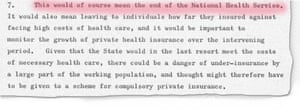
The plan commissioned by Thatcher and her chancellor Sir Geoffrey Howe included proposals to charge for state schooling, introduce compulsory private health insurance and a system of private medical facilities that “would, of course, mean the end of the National Health Service”.


Some of her cabinet ministers believed they had buried the plan, drawn up by a seconded Treasury official, Alan Bailey, from the Central Policy Review Staff (CPRS), at a special cabinet meeting on 9 September 1982.


Nigel Lawson in his memoirs said the paper of “long-term public spending options” had been buried after what he described as “the nearest thing to a cabinet riot in the history of the Thatcher administration”. In her own memoirs, Thatcher claimed to have been “horrified” by the CPRS paper and insisted that she and her ministers had never seriously considered it.


The CPRS paper had been partially leaked and she was only able to quell the subsequent furore by famously pledging the “NHS is safe with us” at the October 1982 Tory party conference. Downing Street briefed that the toxic plan had been “shelved”.


Thatcher documents ragout


Photograph: Handout

But Howe’s Treasury private office papers released by the National Archives on Friday confirm that not only had that special cabinet meeting taken place to discuss the plan but that two months later, far from being buried, Thatcher was still secretly trying to press ahead with it.


The Treasury papers show that once a clutch of tricky byelections were out of the way she was keen to keep pushing the plan and held a series of meetings in December to “to soften up the big three spenders” under her chairmanship “to resolve any immediate political anxieties”.


The papers also show after the 9 September cabinet showdown Howe rejected an approach from the Adam Smith Institute, the rightwing libertarian thinktank, to back their “slightly oddly-named Omega Project” despite it being personally endorsed by Thatcher’s own economic adviser, Sir Alan Walters.


The Omega Project papers said the plans were modelled on research by a rightwing US thinktank for the incoming Ronald Reagan administration. It also argued for many state services to be replaced by “more efficient alternatives from the private sector”.


Chancellor - Adam Smith Institue - Ragout from 1982


Photograph: HM Treasury

Howe rejected the approach in a note on 29 September not because he objected to their proposals to dismantle the welfare state but because he feared its “ill-researched proposals, which will be portrayed as strongly resembling our own, might prove an embarrassment”. The then chancellor added: “Every proposal will be seized on and hung (round) our necks. Cf CPRS Report. I see v. (underlined twice) great harm.”


The Treasury papers show that “no real action” was taken on the CPRS “radical right manifesto” until November 1982. “The prime minister (we understand privately) did not want to stir this up before the cabinet discussions on the 1982 survey, nor risk any adverse publicity while the last two byelections were pending. The leaks of the CPRS report did not help,” a senior Treasury official, Peter Mountfield, told Howe in a confidential note entitled “Follow-up of cabinet discussion on long-term public expenditure”.


Margaret Thatcher


Margaret Thatcher secretly continued to pursue the politically explosive plans even after ministers thought they had been killed off by a cabinet revolt. Photograph: PA

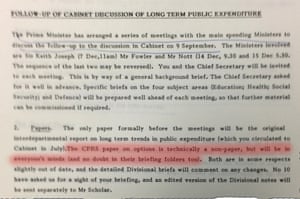
“The prime minister has arranged a series of meetings with the main spending ministers to discuss the follow-up to the discussion in cabinet on 9 September. The ministers involved are Sir Keith Joseph (7 Dec, 11 am), Mr Fowler and Mr Nott (14 Dec, 9.30 and 15 Dec 5.30.). You and the chief secretary will be invited to each meeting.”


Joseph was education secretary, Norman Fowler was health secretary and John Nott was defence secretary. The CPRS paper proposed to cancel Trident and halt the growth in defence spending.


“The only paper formally before the meetings will be the original interdepartmental report on long-term trends in public expenditure … The CPRS paper on options is technically a non-paper, but will be in everyone’s minds (and no doubt in their briefing folders too),” Mountfield told Howe.


The chancellor was told the objective of the meetings was “designed to soften up the three big spenders. Without their support the operation will not work. Your main aim, I suggest, should be to ensure that no sacred cows are prematurely identified. Given the prime minister’s concern about the NHS, this may be difficult. But we want to make sure that the ministers concerned do not close off any options at this stage, and, if possible, put their personal weight behind the exercise.’’


Follow up of Cabinet Discussion of Long Term Public Expenditure - Ragout


Photograph: HM Treasury

These papers flatly contradict Thatcher’s claim that the CPRS proposals were never seriously considered by ministers. The Treasury files released on Friday do not record what happened at the meetings with the big three spenders.


But a Treasury official’s note on 28 October 1982 to the then chief secretary to the Treasury, Leon Brittan, gave an indication of the depth of internal opposition Howe and Thatcher faced. “DHSS (health and social security) officials say there is no chance that Mr Fowler would agree to a further study of this idea. I imagine in the circumstances, and especially given the prime minister’s speech at Brighton it is difficult to press them.”


In his memoirs, Howe reflects that although the row had postponed the “fundamental debate” he had hoped to start, until after the 1983 general election, “nothing from the Treasury’s point of view is ever as quite as bad as it seems”.


He reported that the impact of what he called the “CPRS furore” had ensured ministers made no new spending pledges and had “set the pace for our forthcoming 1983 manifesto”.


Thatcher pushed for breakup of welfare state despite NHS pledge

20 Eylül 2016 Salı

I remember the welfare state being built. A divided Labour cannot save it | Harry Leslie Smith

As the date for the Labour conference grows closer, like dark clouds gathering on the horizon, my thoughts are focused on the social and economic injustices from our nation’s history that helped form this party’s progressive political ideology.


Come this October it will be 90 years since my eldest sister Marion was buried in a pauper’s pit on the outskirts of Barnsley. Not a day has gone by in the intervening decades when I have not thought of her miserable death from TB in a workhouse infirmary, or her ignoble burial in a mass grave for indigents because my parents, being from the working class, were too poor to afford my sister a doctor’s care.


My sister’s tragic end came at a time when Britain was ruled by a Tory government that had unleashed austerity on the citizens of Britain. Her death, and the misery I endured from poverty in the 1930s, were caused by government indifference to the plight of working-class Britain – and that politicised me to become a pragmatic socialist. I learned during the Great Depression that there can be no middle road to social or economic justice when my family, along with millions of other British citizens, were forced to live in substandard housing or slums because the government didn’t adequately tax its most affluent citizens and corporations.


Labour must end its eternal battle between its heart and its head. Both are necessary for electoral victory


It’s why since 1945 my political ideology has been fixed in orbit around the Labour party’s commitment to social democracy. So, when I was invited to speak at the Labour conference in 2014 about what life was like in Britain before the NHS, I was honoured. I was also gratified that I was finally able to give the speech I had waited a lifetime to give about the iniquities ordinary people endure if there is no social safety network to protect them.


Since then, I have spoken all across Britain to small and large crowds about how my generation struggled to build a welfare state, and how that became a tide which raised all boats from the miseries of unharnessed capitalism. But my talks were not so much about my past as about everyone else’s future, and how the younger generations must now shoulder the responsibility to maintain and preserve my generation’s legacy, the welfare state.


But for the young to make a difference and reverse years of neoliberalism that have fragmented this society and ossified their ability to prosper, the left must unite for one purpose: to defeat conservative politics that benefits the few at the expense of the many. Those of social conscience who want a nation based upon egalitarian ideals can only accomplish this if the Labour party ends its eternal battle between its heart and its head. Both are necessary for electoral victory. The warring factions in Labour must unite in a grand alliance that includes the PLP and its 500,000 enthusiastic members, as well as the millions of voters all across these islands who want a new deal.


Make no mistake: I am a fervent supporter of Jeremy Corbyn but I will not forget or ignore how I came to speak at that Labour conference in 2014. I will always be grateful to Andy Burnham, along with Ed Miliband and his office of dedicated staffers, who asked me to speak about healthcare because they believed in an NHS that is for the people and not for the benefit of hedge funds. It’s why, having met many of the members of the PLP over the past two years in every nook and cranny of this country, I can attest to their professionalism and their dedication to social justice. But in their anguish after Brexit, I believe the PLP members erred when they tried to oust a leader who had been elected less than a year earlier. I understand their frustrations just as well as those party members who are now angry at the PLP. I can see the merits to both sides in this acrimonious battle.


That’s why this year’s conference in Liverpool will be more important than even one held right before a general election. The speeches will be a window for the British electorate to see whether Labour can tell the human stories that win elections, rather than just settling old scores.


So, for those members given the great honour of addressing conference delegates – whether they support Corbyn or Owen Smith – they must remember that history is watching them and measure their words accordingly. This is not the time nor the place for the politics of revenge, but instead a time for amity. This is the time for Labour to reaffirm its commitment to forming the next government and building a compassionate Britain, where all are welcomed. The only way to do that is to get our own house in order.


I remember the welfare state being built. A divided Labour cannot save it | Harry Leslie Smith

6 Eylül 2016 Salı

NHS dentistry is in a state of serious decay | Owen Jones

Finally, some outrage about the national scandal that is dentistry. The health of our teeth matters, but dentistry has long been a neglected arm of the NHS. The British Dental Association has just revealed that 600,000 people have made futile appointments with GPs over dental problems in a year, at a cost to the NHS of £26m. It’s a statistic that has provoked mockery – one person tweeted: “I wonder if the 600,000 people a year who go to the GP for dental care ask electricians to fix their roofs as well?” But it is not the patients who should be shamed – it is the government.


As the BDA points out, nearly one in five patients have postponed treatment because of fear of what it might cost. The government has slashed funding for NHS dentistry by £170m since the Tories first entered No 10, and it is expecting patients to make up the shortfall. This year, dental charges were hiked by 5%, and they’re expected to increase by the same amount next year. On the current trajectory, in 16 years’ time most of the NHS dental budget will be funded by patients rather than by central government. But the whole point of the NHS is that it should be free at the point of use, and treatment should be provided according to need, rather than ability to pay.


One in seven children haven’t visited a dentist by their eighth birthday


Even children, who are entitled to free NHS dentistry, are being let down by a system that is unable to provide enough dentists to cope with demand. Earlier this year, more than 400 dentists signed a letter advising that dental health was collapsing to “third world” levels in parts of Britain. “The NHS dental system in England is unfit for purpose,” was their stark warning. So severe is this crisis that more than 62,000 people – mostly children – end up in hospital every year because of tooth decay; half of adults haven’t seen a dentist in a two-year period; and one in seven children haven’t visited a dentist by their eighth birthday.


When dental charges were first introduced in 1951, Nye Bevan – the architect of the NHS – resigned from the government in protest. Sixty-five years on, the service is marred by underinvestment, excessive charges and a lack of NHS dentists. We should aspire to properly publicly funded NHS dentistry, free of rip-off charges. Tragically, we’re headed in the opposite direction. The teeth of lower-income Britons – particularly children – will suffer as a consequence.


NHS dentistry is in a state of serious decay | Owen Jones

30 Ağustos 2016 Salı

Top 10 Signs of a Police State

Top 10 Signs of a Police State


As terrorism rapidly spreads worldwide the governments of each country are heavily arming and militarizing their police forces.  In essence, every country worldwide is slowly becoming a police state.  Here are the top 10 signs of a police state to see if your country is becoming one too.


  1. Consent of Political Leaders

Firstly, the political leaders of your country will all consent to this arrangement with a limitation on individual liberties in order to do so.  This includes arresting without cause, indefinite detention, continuous tracking and spying and of course additional crimes that would be considered “terrorism”.  A great majority of leaders will consent to these terms with the exception of a few that don’t whom will be quickly be labeled as “unpatriotic”.


  1. Free Speech Zones

The second sign of the top 10 signs of a police state will be a quick limitation of free speech as well as the creation of free speech zones.  Those who speak out against the militarization of police forces will be labeled dissenters and because of the popularity of such outspoken words free speech zones will be established.  This means you could be arrested if protesting in certain areas and even your internet communication posts could be deleted if noticed online.


  1. National Registry Database

Through every means necessary every citizen will be forced to be on some sort of national registry database.  This includes firearms owners, those without medical insurance, those living from paycheck to paycheck and even those who make their income under the table.  The point of a national registry database is to make sure every citizen can be thoroughly monitored in order to prevent dissenters before they begin.


  1. Liberties in Exchange for Security

When the political leaders have already agreed to the terms they will expect the citizenry to do so also.  Although the average citizen is affected entirely on a larger scale from a police state than your local senator.  This will be the expectations that political leaders will create especially with the help of the media.


  1. Stock Piles

It will become well known that the police, military and every other government organized force will begin to stock pile large amounts of storable food, ammunition and even gear and equipment.  Although many will be suspicious the media will pass it off as a conspiracy theory for those who draw to much attention to the fact.


  1. Secrecy

Secrecy, secrecy and more secrecy.  From spying to indefinite detention without committing a crime secrecy will be all over the place.  Political leaders will admit to secrecy but pass it off as the “norm” as well as the media will speak only as if the secrecy is necessary to national security.  More like a “don’t ask too many questions if you can’t handle the truth” kind of a society.


  1. Open Abuse of Power

Since political leaders will be getting away with so much open secrecy other scandals will arise in which these same political leaders will face no punishment.  This would be the open abuse of power in the top 10 signs of a police state.  Scandals in which countrymen are killed will have no fault with political leaders even if negotiated and approved by those same political leaders.  No days in office suspended or even so much as a jail sentence these political leaders will display nothing but abuse of the law and of their positions with no sign of consequences.


  1. Propaganda and Whistle Blowing

Along with the open secrecy and abuse of power, political leaders will start propaganda campaigns that desensitize the majority of the citizens.  Fortunately a small rogue group of citizens will start a whistle blowing trend from deep inside government controlled and funded agencies that will reach out to individuals in the media that are determined to open the eyes of the public.  Although it sounds like the plot to a great movie the fact of the matter is that this will be and currently is real life.


  1. False Flags

In order to keep the public in fear false flag operation will be initiated by shadow operatives of an underground government.  These shadow operatives will be working for the agenda of the few political leaders that have the most to gain from a completely controlled police state.  These political leaders will be the same leaders who control businesses in foreign lands and have great political influence to waging either war or peace.


  1. Revolution and Martial Law

Before all the conspiracies can be deemed true and before the corrupt political leaders can be prosecuted martial law will be enacted as a final move followed shortly by revolution.  Most times the enemy is already decided however, during a revolution sides will be chosen by every individual citizen: Are they for or against a police state and ultimately a new world order?  This revolution will happen before any corrupt political leader ever sees a day in jail.  Analyze these 10 signs and decide does your country show the top 10 signs of a police state?


Source:


The Top 10 Signs of the Encroaching Police State


Top 10 Signs of a Police State

10 Ağustos 2016 Çarşamba

Emily’s List aims to shift US Congress to the left – state by state

In the midst of a political season in which all eyes are on the US presidential election, one of America’s largest women’s rights political advocacy groups is turning its attention to a new mission: state legislative races.


Emily’s List, a group that traditionally focuses on electing individual pro-choice women to office, announced a new plan to target seven vulnerable states where they believe they can flip the some of legislatures from red to blue – and then, perhaps more permanently, the US Congress.


The idea is that if the group can help elect enough Democratic women in state legislatures by the 2021 congressional redistricting cycle, they’ll be able to swing both many state houses and the House of Representatives in favor of Democrats, and make it more likely to pass legislation in favor of reproductive rights and women’s equality.


“Currently, Republicans control 68 of 98 legislative chambers in the United States,” said Emily’s List president Schriock. “That’s a result of the 2010 elections, when the Democrats lost so many state legislatures.”


Once there, she said, “Republicans gerrymandered a huge number of Congressional seats,” a reference to the constitutionally-protected redistricting process, leading to the Republican takeover in the US House. They also pushed what she termed “an extreme anti-choice legislative movement” on the state and federal level, while blocking any progress on equal pay legislation, child care assistance, paid sick time or family leave.


The women of Emily’s List want that to stop. To that end, on Tuesday the organization launched Focus 2020, vowing to help elect enough pro-choice Democratic women in 2016, 2018, 2020 and beyond that they will be able to build Democratic legislative majorities in 14 states in time to affect the partisan make-up of the US Congress.


“We’ve got to end this process of gerrymandering by Republicans,” Schriock added. “We have to make sure that we have fair districts in this country, so that we can fight over ideas, not process.”


First up in 2016, Emily’s List is pushing candidates in Michigan, Maine, New Hampshire, Nevada, Minnesota, New Mexico and Colorado – all states that have passed or nearly passed anti-abortion legislation over the last few years.


In Colorado, widely seen at the original home of the so-called “personhood” movement – which attempts to define fetuses as people under the law and thereby classify abortion and even some methods of birth control as murder – the senate went from blue to red in 2014, after a razor-slim Democratic majority created by the recall of two pro-gun-control Senators in 2013 failed to hold.


To change that, Emily’s List has endorsed three pro-choice women in state senate races there, though Democrats need to only pick up two seats. Rachel Zenzinger, who is challenging a Republican incumbent, Laura Woods, to retake the seat she she lost to Woods by 663 votes in 2014 is one of them.


Zenzinger describes her race as “a swing district in a swing country in a swing state” where “you would think [Woods] would be trying to defend and protect women and women’s issues, but she’s done the exact opposite”.


Woods supported a variety of anti-abortion bills in the last session, including ones that Zensinger said “ranged from mandatory, invasive ultrasounds to defunding a local university because it used fetal tissue for research” in addition to one that would have defunded Planned Parenthood.


Given the anti-abortion movement’s history of unsuccessfully putting “personhood” legislation on the ballot, Zenzinger believes that many Republicans “will try to seek action legislatively, where they have the opportunity to control the agenda if they are able to maintain the Republican majority” in the state senate.


But beyond the immediate concerns for reproductive rights in the state, Zenzinger says that if her party fails to regain a majority presence in the state Senate by 2020, her constituents will see a “significant rolling back of the clock, just trying to go back and undo some of the good, progressive work that has been done over the past few years that really benefitted everybody in Colorado” – let alone anything that might be on a Democratic president’s agenda.


Last April, the Michigan state House of Representatives passed a budget defunding Planned Parenthood. It’s another state where Emily’s List is backing candidates under the Focus 2020 initiative in an attempt to bring that state’s House of Representatives back under a Democratic majority. One of these candidates is Collene Lamonte. Like Zensinger in Colorado, Lamonte also lost a seat she held during the 2014 midterm elections. She’s running to regain the seat she lost to a Republican opponent.


“A lot of issues in Michigan, things are not able to move forward because of a lack of women in our political system right now. Pay equity in our state is a huge issue – Michigan is lower than the national average when it comes to pay equity for women. And we haven’t been able to get that addressed with our current legislature,” Lamonte says. “And we continue to see bills that restrict women’s access to proper healthcare in the state. We need to ensure that women receive proper access to healthcare when they need it, without facing barriers.”


In 2018, Emily’s List plans to expand its focus to Ohio, Pennsylvania, Florida, Georgia, North Carolina, Virginia and Wisconsin – many of which have legislatures that are notoriously hostile to women’s reproductive rights, and some of which have voted for national Democrats even while their Congressional delegations skew Republican.


“We know that we have three full election cycles ahead of us,” said Schriock. But, if Republicans are able to gerrymander as many districts in 2021 as they did in 2011, “Women for generations are going to be left behind in this country.”


Emily’s List aims to shift US Congress to the left – state by state

18 Ağustos 2015 Salı

Disabled youngsters are very easily misplaced in a welfare state cut to the bone | Frances Ryan

Against the backdrop of this month’s jubilant A-level and GCSE final results, 17-year-previous Sanjeev Singh gives a various image of what it is to be younger in Conservative Britain.


In several methods, Sanjeev is a younger individual “doing the right thing”. He lives at house with his mum and 3 siblings and, because leaving school a year in the past, he has persisted in seeking for function. But Sanjeev, 17, is deaf and as soon as prospective employers know he has a disability, they really don’t get in touch with him once more. He keeps making an attempt to get interviews but, unable to travel securely alone on public transport, he has no way of receiving to them.


This is where the welfare state’s security net is meant to kick in. Disability living allowance (DLA), for instance – a benefit Sanjeev has obtained since he was 6 years previous – could pay for a taxi on the days he demands get to an interview and has no one to support him communicate with the crowds on a bus. But the government chose to change DLA with personal independence payment (PIP) and following currently being tested for the new, tougher evaluation in December, Sanjeev had his advantages stopped, soon after much more than a decade


Related: We must assist the disabled men and women dealing with imprisonment at property | Frances Ryan


Even unemployment advantage is out of his attain. There is no specific entitlement for jobseeker’s allowance for anybody below 18, in accordance to the Division for Operate and Pensions (DWP). As an alternative, it is left to regional jobcentres to arbitrarily judge if an individual is in “hardship”. Neither is Sanjeev eligible for the disability “unfit for work” benefit, employment and help allowance (ESA). As a DWP spokesperson confirmed to me this week, that advantage is only available to beneath-18s if they have not only left school but also are residing “independently”. So a teenager coping with chronic sickness or disability is expected to move out of their loved ones residence ahead of the government will take into account them for unemployment help.


Perversely, as a younger disabled jobseeker, Sanjeev has no way of knowing if he is even classed as “fit for work”. He can’t be assessed for ESA right up until he is 18 but in the meantime, have to commit yet another 12 months attempting to uncover a job no employer so far desires to give him.


This is unwinnable Britain. Where you can be outdated enough to have left college but be classed as too youthful for out-of-operate rewards. Where you can have a disability that stops you acquiring to a task interview but are not disabled sufficient to get living allowance.


What is occurring to Sanjeev sits within a wider landscape of the state’s abandonment of youthful individuals: housing benefit cuts for beneath-21s, unemployed 18- to 21-12 months-olds to be sent on instruction “bootcamps”, and the servicing grants for students from bad backgrounds abolished. Each and every policy is based mostly on the exact same assumption that each mother or father can afford to feed, clothe and residence their children into adulthood.


Latest government ideas to eliminate 18- to 22-12 months-olds’ in-perform rewards – that is tax credits to youngster advantage – will only hit disabled younger individuals and youthful dad and mom (any other below 25-12 months-outdated is not eligible). As Sam Royston, policy director at the Children’s Society, put it to me: remove assist this kind of as tax credits, and youthful disabled men and women who are moving into adulthood and needing added help will locate it significantly more difficult to get into function and to reside independently. It factors to how far fears of so-referred to as “welfare dependency” are detached from actuality. The advantage technique is not a crutch of dependency but – for any person born outside of the protection of income – often the launchpad to independence. To stamp out younger people’s housing, wages, training, unemployment, and disability assistance is to lock a entire generation – bar the wealthy – into stagnated opportunity, low incomes, and insecure work.


Sanjeev tells me he’s going to maintain hunting for function even though beginning the appeal approach to try out and get his disability advantage back. He asks if I know how to fill out the types. “I’m not receiving any assist,” he explains. “I’ll need to have to tell my mum to ring them.”


Disabled teenagers are easily lost in a welfare state lower to the bone. To be younger whilst bad or disabled is more and more to view your existence chances be pulled away.


Disabled youngsters are very easily misplaced in a welfare state cut to the bone | Frances Ryan

12 Temmuz 2014 Cumartesi

Sandra Fluke to run for California state senate

The former Georgetown University law pupil who acquired national consideration for getting denied a possibility to testify in Congress concerning overall health strategy contraception coverage – and then was subjected to degrading remarks by radio host Rush Limbaugh – is hoping to make public policy of her personal.


Sandra Fluke is working as a initial-time candidate for a seat in California’s state senate to represent some of the most affluent communities of Los Angeles County, a district that stretches from the Hollywood Hills to the Palos Verdes peninsula.


In a district exactly where Democrats outnumber Republicans two to one, Fluke is campaigning on an agenda that contains subsidised early education, greater environmental protection, expanded public transit and public matching money for political campaigns, not to mention her advocacy of women’s rights.


Fluke stated she noticed an possibility “to grab that microphone and make use of it” right after she was thrust into the spotlight two many years ago.


She drew interest in February 2012 right after congressional Republicans denied her a possibility to testify about wanting her university wellness prepare to cover birth handle. Following she spoke to a panel of Democratic lawmakers, Limbaugh compared her to a prostitute. He later apologised.


“I do not consider that my time in that circumstance is what in any way qualifies me for workplace, but I consider it provides voters an example of what my leadership appears like,” explained Fluke, 33. “You can see that I don’t back down from my position, that I’m willing to stand for my community’s wants regardless of the consequences for me.”


Despite the name recognition, her road to the state capitol is not a certain 1. Fluke finished 2nd in a area of eight candidates in the three June major and faces fellow Democrat Ben Allen, who has a wide network of connections in the district, in the November general election.


She at first regarded a run for Congress following Democratic representative Henry Waxman announced his retirement but decided against it soon after higher-profile candidates entered that race.


Fluke made the decision to run for a newly created district in the forty-member state senate due to the fact the legislature is exactly where “I can in fact have a policy affect,” she explained. Democratic state Senator Ted Lieu, who represents the present, overlapping district, is operating for Waxman’s seat.


Allen, 36, is an attorney and Santa Monica college board member who has acquired broad support from Republicans and independents, who account for 43% of the district’s voters. He is single.


Allen was aided by almost $ 600,000 in independent expenditures from businessman and independent congressional candidate Bill Bloomfield, who has a background of backing Republicans this kind of as Senator John McCain and Home speaker John Boehner. Bloomfield is active with No Labels, an organisation devoted to electing centrist candidates.


Allen mentioned he is proud of his record in reaching out to function with people who have diverse perspectives. The Santa Monica native hopes his dedication to the community will trump Fluke’s name recognition.


“I consider it really is about roots. It really is about temperament. It truly is about significant policy-generating knowledge,” Allen explained. “I’ve acquired a track record of doing work with people from all across the political spectrum to get items accomplished.”


Allen has raised at least $ 443,388, such as more than $ 50,000 from his law firm, Richardson &amp Patel LLP, even though Fluke has raised about $ 500,000, which includes $ 175,000 from her personal loans and contributions, according to campaign finance reviews.


Fluke is a social justice attorney who represents victims of human trafficking and domestic violence and also does nonprofit advocacy. She lives with her husband, author and producer Adam Mutterperl, in West Hollywood. She has been endorsed by EMILY’s Checklist, Planned Parenthood and California NOW.


Scott Lay, who research California political races for his site AroundTheCapitol, said it is tough to predict how voters will react. He stated Fluke could have an edge if ladies vote in response to the US supreme court’s “Hobby Lobby” choice that exempted some companies with religious objections from covering women’s contraceptives in their overall health ideas.


“All national analyses appropriate now are that the 2014 election is going to be largely made a decision by white women, particularly people among say forty and 55,” Lay said.


Sandra Fluke to run for California state senate

29 Haziran 2014 Pazar

New York state can end Aids crisis by 2020, says Governor Andrew Cuomo

New York state can finish its three-decade HIV crisis by the year 2020, Governor Andrew Cuomo mentioned on Sunday as he announced an ambitious plan to supply a knockout blow to the epidemic by boosting testing, minimizing new infections and expanding treatment.


The governor explained the state is aiming to decrease new HIV diagnoses to 750 by the end of the decade – about the same number of tuberculosis circumstances noticed in New York City every yr – down from 3,000 expected this yr and 14,000 new cases of the ailment in 1993. If the state is profitable, it would be the initial time the variety of folks residing with HIV has gone down given that the crisis began with the 1st extensively reported cases in 1981.


“Thirty years in the past, New York was the epicenter of the Aids crisis,” Cuomo mentioned. “Nowadays I am proud to announce that we are in a position to be the initial state in the nation committed to ending this epidemic.”


To increase therapy, the state’s department of overall health has negotiated bulk rebates with 3 organizations making HIV medicines. The state is also taking methods to make it easier to get tested, altering how HIV circumstances are tracked to make certain sufferers proceed to obtain therapy, and boosting accessibility to “pre-exposure” medication that can aid substantial-threat men and women keep away from infection.


Cuomo did not supply an estimate of the price of the prepare, but explained it would finish up conserving the state a lot more than $ 300m per 12 months by 2020 by minimizing the volume the state pays for health care care for these with HIV.


Groups that have extended advocated for HIV individuals praised the governor’s announcement, saying it shows that efforts to fight the condition are paying off, and that a scourge that once appeared unbeatable can be efficiently fought.


“We have the tools and know-how to finish the Aids epidemic in New York, the only query is no matter whether we have the political will,” stated Jason Walker, an organiser at Vocal-NY, which advocates for lower-revenue HIV sufferers. “Even with out a vaccine or remedy, Cuomo understands that we can drastically lessen new infections under epidemic levels and make sure all men and women residing with HIV obtain optimum health.”


Although the state’s plan might sound overly optimistic, the number of new HIV circumstances in New York has dropped practically forty% in the last 10 years since of greater, faster exams entry to condoms public outreach campaigns and other initiatives.


Meanwhile, individuals with the disease are living longer thanks to substantially a lot more effective therapies.


The purpose of bringing the disease to beneath epidemic ranges “is ambitious”, stated Mark Harrington, executive director of the anti-HIV organization Therapy Action Group, but “grounded in reality”.


New York state can end Aids crisis by 2020, says Governor Andrew Cuomo

26 Haziran 2014 Perşembe

Architect of Private Alternative Loses Election, Is Medicaid Expansion Turning Politically Lethal for State Lawmakers?

By Jonathan Ingram, Nic Horton and Josh Archambault—Mr. Archambault and Mr. Ingram are Senior Fellows, and Mr. Horton Policy Analysis Analyst, at the Foundation for Government Accountability.


U.S. Property Majority Leader Eric Cantor’s gorgeous loss in the Virginia principal to underfunded insurgent candidate David Brat sent shock waves by means of the nationwide political establishment, but its affect on the American men and women may rival the outcome of a state senate major in Arkansas, as the architect of the “Private Option” Medicaid growth lost his major largely on the expansion issue. Lawmakers in the 24 states that have not expanded are beginning to see the prospective political fallout from supporting an “alternative” Medicaid expansion program.


Voters Driven by ObamaCare’s Medicaid Expansion Situation


In Arkansas, three-term Republican State Representative John Burris misplaced a main runoff for a State Senate seat to first-time candidate and political novice Scott Flippo. Rep. Burris, an architect of the ObamaCare “Private Option” Medicaid expansion, need to have walked away with the GOP nod right into the State Senate right after a November vote for which Democrats failed to area their personal candidate.


Image and video hosting by TinyPic

Rep. John Burris: Private Choice ObamaCare Growth Architect


Burris had much more identify ID and substantially a lot more funding: the most recently offered campaign reviews display Burris obtaining outraised Flippo almost three-to-one—including tens of thousands of dollars in contributions from hospital lobbyists and other Personal Selection-supportive well being care special interests.


By all accounts, Rep. Burris has been the face of the ObamaCare Private Choice. Not only did he sponsor the ObamaCare growth bill, he came up with numerous of the empty guarantees utilised to squeeze just enough help to enact the plan.


Despite the political frenzy induced by the Personal Choice debate, Rep. Burris was still the favored. Flippo was a political unknown when he announced his candidacy earlier this yr, but as he hit the trail his message was simple and clear: ObamaCare growth is undesirable for Arkansas taxpayers, and John Burris is to blame for it.


Rep. Burris must have been a minor weary heading into the runoff.


An anti-Private Selection message throughout a specific election for a State Senate seat last yr vaulted Republican John Cooper to workplace in a district that hadn’t elected a Republican given that Reconstruction.


As Flippo’s anti-PO message seemed to take root, Rep. Burris’ campaign message seemed to vacillate among help and opposition for the system. While he claimed to have by no means shied away from his assistance for the Private Selection, he explained on at least a single voter’s manual that he “opposed” the Private Option law he crafted. And later on, he claimed in a Television ad to have blocked the ObamaCare exchange, even though he truly voted for it.


Despite his try to muddy the waters, and his supporters’ complaints that Flippo was making the entire race about ObamaCare, Rep. Burris couldn’t escape his direct involvement with expanding Medicaid below ObamaCare in Arkansas.


The Future of ObamaCare’s Medicaid Expansion Personal Alternative is Uncertain At Best


Final 12 months, funding for the Personal Alternative just barely squeaked by in the Arkansas Legislature. This previous legislative session, the plan barely survived a funding-reauthorization vote in March. Soon after 4 failed attempts, weeks of arm-twisting and legislators publicly trading their votes for pet projects, the system just barely survived, without having a single vote to spare in the Senate. Principal elections have previously tipped the stability strongly against the Private Choice.


The Senator whose retirement designed a pitched battle among Burris and Flippo was also a supporter of the ObamaCare Private Choice. And prior to this runoff, another Personal Option supporter, Senator Bruce Holland, was defeated in his own major by a committed anti-Personal Selection candidate.


Architect of Private Alternative Loses Election, Is Medicaid Expansion Turning Politically Lethal for State Lawmakers?

14 Haziran 2014 Cumartesi

Victoria Derbyshire State of Grace radio overview

victoria derbyshire

Victoria Derbyshire: handled the programme with ‘careful dignity’. Photograph: Richard Saker for the Observer


Victoria Derbyshire (five Dwell) | iPlayer


State of Grace (Radio 4) | iPlayer


Back in February 2011, on the usually likable if unaccountably vilified – but she is, following all, a female – Victoria Derbyshire morning display, listeners around the nation slowed their vehicles, paused mid-potter, turned up a bit late for lunches. They had been held in thrall by a mobile phone-in on alcoholism, and especially a phone from a physician, Rachel, who admitted quietly on air that she was just cracking open her third can of Guinness that morning.


Derbyshire at some point tracked her down, and she became what’s called a pal of the programme. Each time she spoke, the phones were deluged by calls, reacting to searing tender honesty from a just-working alcoholic and what emerged was a tale of a lot of other professional mothers held in the savage thrall of… properly, either a way of life-selection addiction or an illness, about which there was a lot heated debate. What was undeniable was that the programme assisted move the argument far from the stereotypes of pineapple-nosed meths males, and into the milieu of chintzy (or cosy, or minimalist) middle-class living rooms everywhere, and highlight a hidden nation coping towards hope with each the bottle and full-time jobs – solicitors, managers, anaesthetists. Standard mother’s contact: “I usually try out to seem great, smell wonderful, get the children to school. But I’m just pouring my very first glass of wine of the morning. And I would often felt I was on my very own, special.”


Rachel, final time we heard from her, had been clean, giggling and smart, and signally failing to slurp from a bottle at ten in the morning. Rachel, not her real name, died in her rest in excess of the Easter weekend. She was 45, and left a companion and daughter. She had relapsed, briefly, just ahead of Easter. Derbyshire knew, went to the funeral, but it was only last week that her household made a decision the news must come out. It was a mesmerising programme, featuring callers who said Rachel’s contribution had, in absolutely no tiny way, saved their lives. Tears have been shed. Derbyshire dealt with the whole with the careful dignity it deserved – there was some laughter, but a chilling pall hung more than the programme of needless waste. Crucially, there was no knee-jerk condemnation – we would moved far beyond that – but compassion and sincere, subtle debate, and I only want other morning telephone-in (radio and Television) programmes could deal with related levels of, if you’ll excuse me, sobriety: an impassioned and vital tale.


grace dent Grace Dent: identified ‘some superb interviewees’. Photograph: Chris Floyd


Grace Dent had some exciting with her identify in State of Grace – a flimsy ample premise you may well believe, but she actually created it operate. She hardly harped on at all about wishing she’d in childhood had a “normal” title – her choice would have been Joanne, as in the lass from t’Human League – but as an alternative set about resolutely discovering some superb interviewees. She spoke to Olivia “damegrace” Cowley at the Royal Ballet about, simply, grace of motion, and fascinating it was, and quizzed wonderful movie historian Stella Bruzzi on Grace Kelly. Bruzzi came up with the workably non-pat theory that Kelly was hogtied, in her time, among becoming Marilyn Monroe and getting Audrey Hepburn – neither vamp nor ingenue, she was famously described as “also excellent” by James Stewart, which helps clarify his otherwise mesmerising decision to reject her throughout considerably of Rear Window. Best, additional Bruzzi, she was not. She slept with practically all her foremost males, and the list helps make some reading through: Clark Gable, Bing, Ray Milland, William Holden, Oleg Cassini – and was sent shut to panic when Monaco’s courtiers tentatively suggested a test for virginity. A great minor programme, hugely aided all through by the laughing, gallus presence of Grace Maxwell, who nursed Scots singer (and husband) Edwyn Collins back to eventual wellness after his devastating brain haemorrhage, and informed her tale with wit, warts and a thoroughly refreshing lack of mawkishness or self-pity. As, indeed, had Rachel.


Victoria Derbyshire State of Grace radio overview

21 Mayıs 2014 Çarşamba

Tiny State, Big Consequences: Will Rhode Island Be The First With a "Functional" State-Based mostly Exchange To Switch To Healthcare.gov?

Following the information of the federal government taking above the now-defunct Oregon exchange, Nevada defaulting to healthcare.gov, and now Massachusetts contemplating defaulting later on this year, the Ocean State adds a new twist.  A bipartisan bill to shut down the state-primarily based exchange and default to Healthcare.gov that is gaining traction due to the expense of sustaining a state model. Rhode Island is very likely to be on the vanguard of a second round of state-based mostly exchange closures as infrastructure cost gets far more transparent—and less appealing—to taxpayers and policymakers.


Federal taxpayers have shelled out more than $ 3.85 billion on all state-based exchanges, with a substantial volume likely going down the drain as state-based mostly exchanges shut. Nonetheless, these expensive taxpayer-funded wrecks could consider a couple of many years to play out as the Obama administration has allowed states to preserve investing establishment grant cash up to 5 many years, and is nonetheless awarding tens of millions of bucks to even the worst doing exchanges.


Right after Oregon, Nevada, Massachusetts and possibly Rhode Island, we could see state-based exchanges collapse in Hawaii, Minnesota and Colorado. Also of note are the several “partnership-exchange” states that have shelved plans to open state-based mostly exchanges: Delaware, Illinois, Iowa, Michigan, New Hampshire, New Mexico and West Virginia.


Image and video hosting by TinyPic HealthSource RI executive director Christine Ferguson may possibly be hunting for work soon if Rhode Island moves to default to healthcare.gov. Photo credit score: (AP-Steven Senne)


Rhode Island’s Difficulties Represent State’s Exchange Issues


Governor Lincoln Chafee (D-RI) implemented a state exchange (HealthSourceRI) by executive buy in September 2011, following authorizing legislation died in the Property.


The executive order enabled the state to apply for $ 163 million in federal exchange grants (of which the state has received more than $ 114 million). This amounts to a per-enrollee value of approximately $ 4,002, whilst the federal exchange averaged an approximate per-enrollee cost of $ 647.


Even so, it has been reported that Rhode Island has only spent $ 46 million of its establishment grants. Beneath this situation, the value per enrollee nonetheless runs 2.5x far more per enrollee ($ 1,615) versus the cost of the federal exchange.


Numerous considered the remaining federal income would be returned, but state officials are fighting to hold their hands on the funds, and to the dismay of taxpayers, it seems the federal government may permit such a move. But federal funds will run out soon, which indicates state lawmakers will have to discover a method to fund exchange operations or shut its doors.


Former Rhode Island Secretary of Health and Human Companies Gary Alexander laid out the budgetary issue in a current op-ed:


…according to the governor’s 2015 spending budget, $ 23 million [is necessary] yearly to operate and sustain HealthSourceRI, the state-based insurance coverage exchange. That’s not $ 23 million to aid low-earnings residents purchase well being insurance it is $ 23 million in overhead that would have been pointless had the Ocean State made a decision, as 27 states have accomplished, to depend on the federal exchange. These other states use the federal portal and pay out nothing at all.


Now, $ 23 million is a lot of income for a small state like Rhode Island. It is far more than we spend to run the Division of Motor Cars, three instances what the state budget appropriates for public libraries, and twice the volume needed to pay out this year’s installment of the 38 Studios bonds. If returned to our cities and towns, that $ 23 million would improve complete nearby aid by 20 percent. That quantity could also be allocated to reduce house taxes or the revenue tax or purchase a new laptop system for the DMV. Or minimize by virtually a sixth the projected $ 151 million 2016 budget shortfall.


For context, Rhode Island, a state with a population of 1.05 million, is seeking to devote at least $ 23 million a yr, whilst Massachusetts, a neighboring state with a population six instances as huge, has run an exchange with an annual price range of around $ forty million. But placing that comparison aside for a minute, it need to be mentioned that a lot of have questioned the return on investment of the Massachusetts exchange.


I just lately spoke with bill co-sponsors Rhode Island State Representative Patricia Morgan (R, Member of the Residence Committee on Finance) and Representative  Jared Nunes (D) to get their get on the problem. I also spoke with State Senator Lou DiPalma (D- 1st Vice Chairman of Senate Committee on Finance ) who sits on the committee that will hear the bill in the Senate.


Representative Morgan:


Rhode Island ought to not commit taxpayer bucks on HealthSource RI, due to the fact we currently face a $ 70+ million dollar spending budget shortfall, and just can not afford this type of paying. Our state requirements to take away this pricey potential expense, transition men and women to the federal website, and alternatively target on generating our state far more aggressive.


Representative Nunes:


HealthSource RI has been spending cash like drunken sailors. It is unsustainable the way it is. This is just income for the well being exchange, not for a single patient or care for a resident of Rhode Island. We are speaking about a lot of cash, a hefty line-item if it is included in the budget. There is no likelihood I can assistance pumping that volume of cash to run this method.


Senator DiPalma:


They [HealthSourceRI] have accomplished a phenomenal job in implementation, but putting that aside, $ 23 million a 12 months is a good deal of money, and I am not convinced that $ 23 million is even the proper number. I want to see the data and details that this is the most efficient and productive method to do this in Rhode Island. We need to see more choices, including defaulting to the federal website. If the present proposal was brought prior to me right now, I would vote towards it.


The Senator followed this up with a hypothetical– if the value ended up getting $ 25 million a 12 months, over 40 years that would volume to $ one billion in administrative costs,  he worries the return on investment would not be justified.


How Prolonged Can Federal Money Final?


In Chafee’s unique executive buy, he explicitly prohibited state funds from currently being employed to fund potential operation or the diversion of unused federal cash:


13. Financial Accountability. The charges and expense of establishing, working, and administering the RIHBE shall not exceed the combination of federal funds, personal donations, and other non-state common revenue money offered for this kind of purposes. No state basic revenues shall be used for functions of RIHBE, and no liability incurred by the RIHBE or any of its staff may be satisfied using state standard revenues…


15. Prohibition on Diversion. Pursuant to Reasonably priced Care Act S 1311(a)(three) and the prohibited utilizes of money in the Funding Chance Announcement for a Cooperative Agreement to Assistance Establishment of State-Operated overall health Insurance coverage Exchanges, federal grant funds acquired in the Fund shall not be diverted to routines unrelated to Exchange planning and establishment.


Even so, the Obama administration has permitted Rhode Island to carry above funds to next subsequent year, the 1st such arrangement in any state that has appeared in the press. And in a FAQ posted on-line by the Centers for Medicare and Medicaid Providers (CMS), the company indicated it might permit money to be used for up to five-many years:


Q4: What is the final day that a State can spend its award?


A4:  Grantees are encouraged to drawdown funding inside their price range time period (up to 1 year for Degree One particular and up to 3 many years for Level Two grants) nevertheless, at the recommendation of CCIIO’s State Officer and at the discretion of the Grant Management Officer, grantees could acquire a no-price extension that will enable them to commit funding up to the expiration date of the undertaking period.  At HHS’s discretion, a undertaking period can be extended for a optimum of five many years previous the date of the award. Note, however, that all paying of §1311(a) funds awarded underneath a cooperative agreement have to be constant with the scope of the statute, FOA, and terms and situations of the awarded cooperative agreement.


This provision and extension of funds seems to be in conflict with Governor Chafee’s executive order, and therefore opens up however one more legal gray region in ObamaCare. Yet it is important to bear in mind, it does not adjust the underlying issue of sustainability for a state-based mostly exchange. When federal funds run out, states even now have to pay for the exchange.


Tiny State, Big Consequences: Will Rhode Island Be The First With a "Functional" State-Based mostly Exchange To Switch To Healthcare.gov?

17 Mayıs 2014 Cumartesi

State leaders" emergency meeting in Sydney to discuss spending budget cuts

State premiers and territory chief ministers have been holding an emergency meeting on Sunday to talk about their response to the federal price range that included, between other measures, a shock $ 80bn lower to wellness and schooling funding tied to agreements produced underneath the earlier Labor government.


Many states have previously committed funding to applications, like preventive overall health measures, and now may possibly have to axe them.


Leaders of all the states and territories, except the West Australian premier, Colin Barnett, attended the meeting to examine their response to Tuesday’s budget cuts to health and schooling, and the proposed introduction of a $ 7 co-payment fee for a consultation with a common practitioner.


There is speculation the federal government’s proposals will force states to inquire for an enhance in the products and providers tax.


Just before the meeting, the Queensland premier, Campbell Newman, mentioned the cuts would lead to a reduction of 1,700 hospital beds in his state. “What [the federal government] are performing essentially is putting $ 80bn of heavy lifting onto the states when they are not ready to do it themselves,” he mentioned.


“It’s no secret I’m a strong supporter of [the prime minister, Tony] Abbott, but on this concern I’m fair dinkum. I want a honest deal for the states and territories,” Newman said.


The Victorian premier, Denis Napthine, railed towards immediate reductions in state funding, which he said would total $ 200m a year, from 1 July, for his state. “We also have concerns with the $ seven GP co-payment and the impact it will have on our emergency departments,” he stated.


“We also have grave worries about the $ 80bn to be eliminated from well being and schooling at the end of the forward estimates,” Napthine mentioned. “We’re content to accept the obligation for education and public hospitals, but possibly the government should transfer the collective funding with it,” he advised.


Napthine said his government was not interesting in increasing, or broadening, the GST but he suggested it might be applied to online purchases from overseas.


“I believe there should be a GST rethink and it must be that Victoria will get its honest share. We only get 88 cents in the dollar back. If we got a dollar back we would be $ one.5bn a 12 months greater off,” he said.


The Northern Territory chief minister, Adam Giles, said the spending budget cuts would result in fewer hospital beds and much less funding for schools in the territory.


“Fundamentally, from the Northern Territory’s level of see, we want to be responsible and accountable for wellness and education,” he said. Nonetheless, the territory would not have the cash to do so, with funding cuts having been revealed “at the last minute”, Giles explained.


The federal opposition leader, Bill Shorten, explained Abbott was forcing the states into a position whereby a rise in the GST was all but inevitable. “Abbott understands you can not consider $ 80bn from schools and hospitals without the states possessing to increase tax,” he informed the Victorian ALP conference on Sunday morning.


Speaking on ABC Tv, Abbott stated voters ought to have anticipated the cuts, in spite of pre-election guarantees to the contrary. Asked about the cuts, Abbott explained “money is not everything”. He dismissed ideas that the government had broken its “unity ticket” guarantee on the Gonski training reforms.


“We said we would honour the then government’s commitments over the then [four-yr] forward estimates,” he stated on the Insiders plan. “We stated that we weren’t bound by their pie-in-the-sky promises for the out many years [past the forward estimates]. We’ve just been totally upfront with the states.”


On Friday, the NSW overall health minister, Jillian Skinner, advised the state invite GPs to deal with patients in public hospitals, which would shift the value back on to the Commonwealth.


State leaders" emergency meeting in Sydney to discuss spending budget cuts

17 Nisan 2014 Perşembe

A significant new documentary series examines the state of elderly care

News: 1000′s of dementia individuals not referred to professionals


Hospital care is just the tip of the iceberg. Most care of older folks will take location in the home with primary health care and local community well being teams, supported by social services and mental well being. As this kind of, a lot of Safeguarding Our Parents focuses on the complex, distressing, frequently near not possible alternatives dealing with nearby authorities and social welfare companies when it comes to balancing overstretched budgets towards the needs and desires of men and women. In no way more so than when it comes to care in the home.


Fighting for independence: patient Betty Williams Photo: BBC


The 1st movie concentrates on sufferers whose arrival at Heartlands following severe falls points up deeper rooted concerns above their safety in advance of discharge. For octogenarian Betty Williams, the difficulty is balancing her ferociously held wish for independence with worries above deteriorating residing problems in her residence. For 80-year-old dementia sufferer Jim Webpage, a current widower, a complicated multi-agency dilemma arises in excess of how to preserve his care at home where everyone agrees he is happiest.


“What I’ve observed in excess of my career is that the numbers of people presenting in crisis is increasing,” Wallis says. “Often these are situations that have been brewing gradually in excess of a extended time and out of the blue they’ve reached a stage in which a crisis has been precipitated by a fall, or an infection or a time period of lowered mobility. Occasionally it has been picked up by local community services in a good deal of conditions it hasn’t. ”


Possibly surprisingly, given that Defending Our Mothers and fathers depicts a scenario in which resources across the board seem stretched to the restrict, neither of these clinicians target specifically on far more funding as a resolution.


Sufferers Betty Williams and Catherine O’Mahoney Photo: BBC


“It’s not constantly about more funds.’ says Wallis. “I believe a great deal of it is about integrating companies much better. We have a method which is historical. We have psychological overall health, social services, local community health, primary overall health, hospitals. There are some truly great examples of joined up, coordinated care, but this is an location where we can get considerably, significantly far better.”


For George Tadros, training and early intervention are crucial. “Dementia is costing us £30 billion a yr and this will triple soon,” he says, quoting the National Dementia Approach report published last 12 months. “We need to target on instruction for nurses and doctors. Individuals with dementia are not only on geriatric wards.”


View: Dementia wants more than excellent intentions


In an increasingly mobile society, the place children move extended distances from mothers and fathers and increasing numbers of individuals reside alone into outdated age, he also emphasises the value of personal preparedness.


“Acute hospitals are active places, and a time of crisis is not the best time for creating prolonged-lasting choices. We need to make individuals aware of this. So they can make planning for the potential.”


Wallis agrees. “These scenarios will influence all of us when we’re older. Selling healthier ageing and minimising the consequences of frailty is possible.”


For Wallis, Defending the Mother and father represents a dose of realism following a decade in which exposés of practices linked with elderly care, such as “Care Pathways” for individuals deemed dying, had shocked the public.


Study: NHS millions for controversial care pathway


“A great deal of media focus in the past had been scaremongering which can be frightening for folks viewing and dispiriting for us. We felt we didn’t want this to be an exposé nor did we want it to portray a health and social care system that was perfection and had all the solutions.”


But he remains steadfastly optimistic. “The demographic changes in society are not a disaster,” he insists. “The ageing of society genuinely is a good results story as there are numerous additional years of daily life and most of those are healthful. If we get organised, it is containable.”


Safeguarding our Mothers and fathers airs tonight on BBC Two at 9.00pm


Go through: WHY ARE Girls Scared OF Receiving Previous?


A significant new documentary series examines the state of elderly care