There is a crisis in mental health for young people. Services are operating in silos and they are not working for over-tested, overstressed young people. Much emphasis has been placed on teenagers with low self-esteem, with behavioural and emotional issues and how we can support them.
At Water Hall primary school in Milton Keynes, we believe in the need to identify and address these issues early to be able to implement intervention strategies as soon as possible.
Taking action early enables vulnerable children to rebuild their self-esteem and take responsibility for their emotions, behaviour and learning. The outcome will be that they re-engage with education, perform well and are confident and happy young people.
Water Hall primary serves the Lakes Estate in Bletchley, a disadvantaged area where external issues regularly affect children’s mental and emotional wellbeing. The school has used the Kaleidoscope programme for eight years. The support system enables children to forget the things worrying them at home or elsewhere when they are in school.
Seven different stages make up a Kaleidoscope session: relax, visualise, express, move, build, explore and affirm. A designated room is used for sessions for either small groups or one-to-one sessions. Interventions last six to eight weeks.
The programme is used in all classes every day. Each morning starts with a session enabling children to be in the right frame of mind to learn. Lights are low, relaxing music is played and children are taught various calming techniques that they can use anywhere.
Kaleidoscope has had an amazing impact on the children’s emotional and mental wellbeing and their learning. Exclusions have fallen, attendance and behaviour has improved, children have taken responsibility for their learning and results have shot up. Kaleidoscope works, it gives children the tools to enable them to raise their self-esteem, with the accompanying improved outcomes for the school.
Our work proves that unless the child is in the right place emotionally and mentally, learning will not take place, however good the teaching and leadership in the school.
Tony Draper is headteacher of Water Hall primary, chief executive officer of Lakes Academies Trust, and the immediate past president of the school leaders’ union, the National Association of Head Teachers.
‘Economic and financial mismanagement, along with predatory policies, are in danger of making us believe that we can neither afford to feed the hungry nor care for the old.” These words, as true now as when they were written in 1985, are from the paper Economic Policy As If People Mattered, by the distinguished public health researcher Peter Draper, who has died aged 83.
That we now routinely consider causes of ill health – and of wellbeing – to be as diverse as work and unemployment, macroeconomic policy, fuel poverty and the arms trade owes much to Peter’s contribution. He was instrumental in creating the study of health policy in the UK and was the country’s outstanding public health practitioner in the second half of the 20th century.
Early 1970s public health had a settled, environmental focus with no awareness of what we now call the social determinants of health. The 1974 reorganisation of the NHS removed local authority advocacy from public health, replacing it with technocratic NHS “community medicine”. In this stifling climate, Peter’s launch of the Unit for the Study of Health Policy (USHP) at Guy’s hospital medical school, London, in 1975 was a breath of fresh air. He brought together practitioners of epidemiology, sociology, health economics, statistics and public health to challenge the predominant approaches that emphasised individualistic “victim-blaming”. The USHP’s groundbreaking reports redirected policymakers and practitioners towards the root causes of public health problems.
For example, the 1980 report Accident and Illness Prevention analysed how the pursuit of market-oriented economic policies – what Peter called “the theology of economic growth” – leads to unhealthy outcomes in which, for instance, traffic accidents are viewed not as social costs, but as an economic benefit because of the motor repair work and new car sales that they generate.
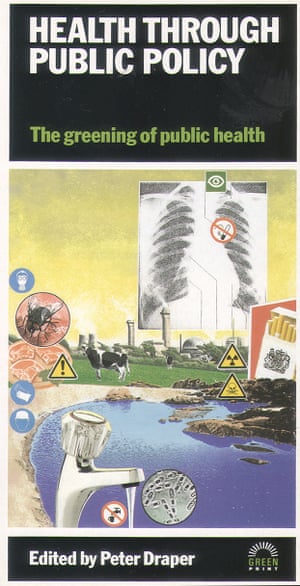
Health Through Public Policy, 1991, edited by Peter Draper
Similarly, the 1977 USHP report Health, the Mass Media and the NHS, and the 1980 BMJ paper Three Types of Health Education, showed how public policy promotes the marketing of unhealthy products. The BMJ paper described the government’s reliance on tobacco revenue at a time of recession and the media’s dependence on tobacco advertising. Evidence from both Labour and Conservative health ministers (David Owen and Sir George Young) showed that these issues, and concerns for industry workers’ and tobacconists’ jobs, prevented effective control and weakened action to prevent smoking.
The 1980 USHP report Rethinking Community Medicine – Towards a Renaissance in Public Health was a call for his profession to rediscover its role in the prevention of disease and the promotion of health.
After funding problems shut down the USHP in 1984, Peter remained a prolific writer, consultant and activist. His Economic Policy As If People Mattered paper made a key contribution to The Other Economic Summit (Toes) conference, set up as an alternative to that year’s G7 conference in London. In 1986 a Health Service Journal article, Whatever Happened to Public Health? which Peter and I wrote, led to the founding of the Public Health Alliance pressure group, later the UK Public Health Association.
He continued working on public health issues and in defence of the NHS, through the NHS Consultants Association (now Doctors for the NHS). In 1991 he edited Health Through Public Policy: the Greening of Public Health, which brought together his thinking about the broad scope of healthy public policy – a now-familiar term that Peter had imported from the US a decade earlier.
Born in Blackburn, Lancashire, to Alan, a textile engineer and mill manager, and Mary (nee King), Peter studied at Bolton school and Wrekin college, where he was head boy. His national service was as a Royal Air Force pilot in Canada and the UK. He studied medicine at Magdalene College, Cambridge, and trained in Manchester hospitals.
Experience as a junior doctor influenced his future career in two ways. Horrified by the anger of a senior physician whose NHS waiting list Peter had cleared while covering his leave, thus preventing, as he saw it, the doctor from prioritising his private patients, Peter developed a dislike for private practice. He became aware of the importance of public health as he realised how much disease could be prevented through earlier intervention, or by different social and economic circumstances.
Always reaching beyond the NHS and medical boundaries, Peter was president of the British Humanist Association (BHA), vice-president of the Ecology (now Green) party and president of the Health Visitors’ Association. The BHA website states: “Throughout its existence, the guiding conviction of the BHA has been that ‘this is our world, our responsibility, our possibility’, in the words of an early BHA member, Dr Peter Draper.”
He also gave strong support to community health councils as the campaigning voice of patients. Peter drew on his personal experience of being bipolar to campaign for recognition of the importance of working with the patient in managing this condition.
He is survived by his second wife, Carol Herrity, whom he married in 1999, and her children, Emma and Kayte; by two children, Nick and Jane, from his first marriage, to Dorothy Hopley which ended in divorce; and by five grandchildren and three stepgrandchildren.
• Peter Alan Draper, public health researcher, born 3 July 1933; died 30 July 2016