We had to fight to get my grandfather good care. Those of us who don’t have children need a new approach
Few of us are immune from the anxiety that can quickly set in when we contemplate our own ageing. Who will be there for us when us can no longer physically take care of ourselves? Who will be around to remind us of who we were in our moments of lucidity when our minds have started slipping away?
For those of us who don’t have children, these questions take on a particular significance. I had mixed feelings after watching Still Alice, an Oscar-winning depiction of early-onset dementia. It made for grim viewing. But it was easy to imagine the ways it could have been even grimmer: what if the protagonist, Alice, had no children, a partner long departed or divorced, or friends who had drifted away?
Related: Why should older people rely on their families for care? | Catherine Bennett
Related: Mice benefit from research into cannabis. Why not us? | Simon Jenkins
There is a crisis in mental health for young people. Services are operating in silos and they are not working for over-tested, overstressed young people. Much emphasis has been placed on teenagers with low self-esteem, with behavioural and emotional issues and how we can support them.
At Water Hall primary school in Milton Keynes, we believe in the need to identify and address these issues early to be able to implement intervention strategies as soon as possible.
Taking action early enables vulnerable children to rebuild their self-esteem and take responsibility for their emotions, behaviour and learning. The outcome will be that they re-engage with education, perform well and are confident and happy young people.
Water Hall primary serves the Lakes Estate in Bletchley, a disadvantaged area where external issues regularly affect children’s mental and emotional wellbeing. The school has used the Kaleidoscope programme for eight years. The support system enables children to forget the things worrying them at home or elsewhere when they are in school.
Seven different stages make up a Kaleidoscope session: relax, visualise, express, move, build, explore and affirm. A designated room is used for sessions for either small groups or one-to-one sessions. Interventions last six to eight weeks.
The programme is used in all classes every day. Each morning starts with a session enabling children to be in the right frame of mind to learn. Lights are low, relaxing music is played and children are taught various calming techniques that they can use anywhere.
Kaleidoscope has had an amazing impact on the children’s emotional and mental wellbeing and their learning. Exclusions have fallen, attendance and behaviour has improved, children have taken responsibility for their learning and results have shot up. Kaleidoscope works, it gives children the tools to enable them to raise their self-esteem, with the accompanying improved outcomes for the school.
Our work proves that unless the child is in the right place emotionally and mentally, learning will not take place, however good the teaching and leadership in the school.
Tony Draper is headteacher of Water Hall primary, chief executive officer of Lakes Academies Trust, and the immediate past president of the school leaders’ union, the National Association of Head Teachers.
Poverty is seriously affecting the health of many British children, who are paying a heavy price as a result of housing, food and financial insecurity, paediatricians have warned.
A report from the Royal College of Paediatrics and Child Health (RCPCH) and Child Poverty Action Group (CPAG) paints a bleak picture of the wellbeing of children in low-income households.
Among the problems cited by paediatricians are poor growth in children, whose parents cannot afford healthy food or to take them to medical appointments, respiratory illnesses being caused or exacerbated by cold, damp housing, and mental health problems resulting from financial stress.
Two in five of surveyed doctors said they had experienced difficulty discharging a child in the past six months because of concerns about housing or food insecurity.
Prof Russell Viner, RCPCH officer for health promotion, said its members were seeing problems that seemed to belong to a bygone era.
“Paediatricians around the country are telling us that poverty is affecting the health of children in a way we haven’t seen before,” he said.
“It’s an absolute wake-up call for our political parties that they really need to deliver on promises to make Britain a more equal society.
“The prime minister talked on her first day about the burning injustices in society and how she wants to change that and this chimes with that kind of focus.”
Latest figures show that 4 million children in the UK live in poverty and projections suggest that could rise to 5 million by 2020. In 2015, the Conservative government scrapped the target requiring the eradication of child poverty by the end of the decade. The decision was much-criticised at the time and the restoration of the target is one of the recommendations of the RCPCH and CPAG in their report, published on Thursday.
Only one respondent out of 266 paediatricians from 90 NHS trusts who completed the survey said poverty and low income did not contribute to the ill health of the children they work with, while more than two-thirds said it contributed “very much”. Almost half of doctors who responded said things were getting worse and only three believed they were improving.
Housing problems or homelessness were a concern for just under nine out of 10 respondents, with one London doctor commenting that “overcrowded, damp or unsuitable housing amongst our patients is the rule rather than the exception”.
Another paediatrician said that they had seen a number of babies unable to be discharged from the special care babies unit due to the parents being homeless. Four out of five doctors said an inability to keep warm at home contributed to ill health among children they treat.
More than three in five said food insecurity contributed very much to the ill health of children, with more than nine in 10 saying it had some impact. The inability to afford enough healthy food is associated both with poor growth of deprived babies and children on the one hand, and rising child obesity on the other.
One doctor who responded to the survey said the biggest impact of poverty on their patients was “insecurity, inferiority and stress. Through the biological and psychological factors these undoubtedly lead to poor health”.
More than nine in 10 paediatricians said financial stress and worry contributed to the ill health of children they work with.
The CPAG chief executive, Alison Garnham, said the results “should sound alarms for the next government. Low family incomes, inadequate housing and cuts to support services are jeopardising the health of our most vulnerable children.”
As well as restoring child poverty targets the report recommends that the next government reverses cuts to public health and universal credit, and examines the impact on child health of all prospective policies.
Viner stressed that the report did not aim to lay the blame for the problem at the door of one political party. “We need our children to be healthy, for the economy to be competitive, post-Brexit,” he said.
The shadow health secretary, Jonathan Ashworth, said child health inequality was a “national scandal”. He added: “Labour will bring down childhood obesity rates, improve early years’ services, enhance mental health provision and improve the state of all our children’s teeth.
“Our children deserve the best possible start in life and no child will be left behind under the next Labour government.”
Adverts for junk food and sweets will be banned from hit TV shows including The X Factor, Hollyoaks and Britain’s Got Talent under Labour plans to tackle childhood obesity.
A £250m-a-year fund aimed at making UK youngsters the healthiest in the world would also see investment in school nurses.
In an effort to tackle child mental health problems, the plan would support counselling services in primary and secondary schools. Adverts for unhealthy products high in fat, salt or sugar are already banned on children’s television. Labour’s plans would extend the prohibition to cover all programmes before the 9pm watershed.
Campaigners have argued that the existing ban does not cover TV programmes popular with youngsters but not specifically aimed at them.
Labour highlighted figures suggesting the move would reduce children’s viewing of junk food adverts by 82%. The move is part of a strategy to halve the number of overweight children within 10 years in an effort to curb the £6bn annual cost to the NHS of obesity.
The shadow health secretary, Jonathan Ashworth, said: “The scandal of child ill-health is a long-standing, growing and urgent challenge. It should be a matter of shame that a child’s health is so closely linked to poverty and that where and in what circumstances you grow up can dramatically affect your life chances.
“Evidence shows the link between deprivation and poor health in childhood, so with child poverty on the rise, the need for action becomes more acute. The UK has one of the worst childhood obesity rates in western Europe. Tooth decay is the single most common reason why children aged five to nine require admission to hospital. Around 13% of boys and 10% of girls aged 11-15 have mental health problems.
“When it comes to our children we should be ambitious. It’s time we invested properly in the health of the next generation. That means the sort of bold action we are outlining today to tackle obesity and invest in mental health provision. Labour will put children at the heart of our health strategy and put measures in place to make Britain’s children the healthiest in the world.”
The £250m child health fund would be paid for by halving the amount the NHS spends on management consultants each year, Labour claimed. The money would be used to expand the public health workforce and help with promotional schemes. The opposition said England has lost 8% of its health visitors since January 2016, and 15% of school nurses since 2010.
Within 100 days of a victory for Jeremy Corbyn on 8 June, Labour would produce a plan to halve childhood obesity within a decade. A new child health bill would write into law the ambition for the UK’s children to be the healthiest in the world and require all government departments to have a strategy in place.
An index of child health would measure progress against international standards and report annually on four key indicators: obesity, dental health, under-fives – including breastfeeding, immunisation and childhood mortality – and mental health.
Our childhood stays with us throughout our lives. We know this intuitively, from the shiver that can accompany memories of an upsetting event from our early years even into adulthood. But it is also true in a much deeper way.
The Adverse Childhood Experience (Ace) study, carried out in the US in the 1990s, found that children exposed to serious neglect, abuse or household dysfunction were at significantly greater risk of a litany of poor health and social outcomes, ranging from heart disease, liver disease and sexually transmitted diseases to depression, suicide attempts and intimate partner violence. Most starkly, people with a high score on the Ace scale died on average nearly 20 years earlier [pdf] than their counterparts who reported no childhood adversity.
This is not just a case of traumatic events leading to unhealthy behaviours leading to poor health outcomes. There is a growing body of evidence that suggests the impact of toxic stress on the developing brain has the potential to transform the way we view health problems.
Toxic stress is the term used to describe the prolonged physiological arousal that occurs when people find themselves in a threatening situation for an extended period of time. When that threatening situation is an abusive or neglectful home, and when the period of time coincides with a person’s formative years, the effects can change how the body’s organs function and drastically alter the course of a life. It has even been suggested that many poor health and social outcomes in adulthood are really developmental disorders with their roots in childhood, not simply the result of poor health choices in adulthood.
If the right questions are not being asked, we cannot expect to find the right answers
This represents a radical shift in the way we see and treat health and social issues. Our healthcare system tends to treat presenting symptoms rather than root causes. Clinicians tend to ask: what is wrong with this person? Now there is an emerging movement that advocates a “trauma-informed” approach, asking instead: what happened to this person?
Take attention deficit hyperactivity disorder (ADHD). The symptoms of ADHD can bear a remarkable similarity to the effects of childhood trauma, which include hypervigilance and an inability to focus, and could be caused by the heightened physiological arousal associated with toxic stress. Yet there is concerning evidence that children who have experienced trauma are more likely to receive a diagnosis of ADHD than post-traumatic stress disorder. If the right questions are not being asked, we cannot expect to find the right answers.
So what is the solution? Resilience has been shown to mitigate the lifetime impact of childhood adversity, but resilience relies on connection with others – nobody can be resilient without support. Early neglect, abuse and family disruption are about lack of connection, broken connection or loss of connection. At Body & Soul we aim to build the resilience of people of all ages by fostering a restorative, healing connection within a supportive and loving community of members, volunteers, staff and professionals.
Our approach is designed to mirror the holistic care that, in an ideal world, everyone would receive in childhood. When our members come to the centre, we provide them with a nutritious, home-cooked meal, which they share in a warm, social environment. They have access to one-to-one and group psychotherapy. They can book in for massages, shiatsu and reflexology. They can see a casework team if they are having practical difficulties with things like housing or benefits. They are encouraged to attend workshops on the importance of physical health and nutrition, as well as training courses on employability. They are invited to explore their feelings through music, dance and poetry. Nurturing these connections mitigates some of the physical, emotional and psychological effects of a childhood spent in a state of uncertainty, fear and physiological arousal. Over time, our members develop the resilience they need to withstand life’s challenges.
Screening for adverse childhood experiences in primary care is feasible, but ultimately primary care clinicians can only refer patients to services that exist. If money continues to be channelled into the treatment of symptoms at the expense of investigating root causes, people’s lives will continue to be defined by their childhood experiences.
What we need is for funders, both statutory and independent, to see beyond the symptoms, and recognise the healing power of human connection, particularly when that connection was missing in childhood. Failure to do so risks consigning those who have experienced adversity in childhood to a future of psychological hardship, relentless medication and an early death.
Would you like to write for the Social Life Blog? Email socialcare@theguardian.com with your ideas.
Join the Social Care Network to read more pieces like this. Follow us on Twitter (@GdnSocialCare) and like us on Facebook to keep up with the latest social care news and views.
A children’s charity is providing a growing number of counselling sessions for young people concerned about the content of the Netflix drama 13 Reasons Why.
The NSPCC said some children who had received counselling via its Childline service said the series had triggered memories of suicidal thoughts. Others were worried that the programme did not offer advice on how to help someone who was feeling suicidal.
The drama has been criticised by mental health groups for its portrayal of a 17-year-old’s suicide, which they say could encourage young people to take their own lives.
A number of schools have sent letters to parents alerting them to the series, among them St Catherine’s independent girls’ school near Guildford in Surrey. The letter says the series has an 18 rating but that younger girls have watched it and may be encouraging others to do so.
“We don’t want to scaremonger but we do want to flag up what’s out there,” a spokeswoman for the school said. “It was a step we took along with other schools we work with to alert parents to the risks. We’ve had a very positive response from parents.”
Netflix has added an additional warning at the start of the series – on top of warnings already in place for specific episodes – in response to concerns from mental health campaigners.
An NSPCC spokesperson said: “No child should ever feel so helpless that they find themselves at such a crisis point, and we want young people to know they can talk to Childline about anything, anytime on 0800 1111 or childline.org.uk.”
The US-set series is based on a novel of the same name by Jay Asher and is made up of 13 episodes featuring 13 friends of the central character, Hannah Baker, listening to a tape she made for each of them, explaining the difficulties she faced that prompted her to kill herself.
The NSPCC spokesperson said: “Schools must be alive to issues that are affecting their children, and we welcome open communication between teachers and parents.
“Raising concerns, sharing information, and flagging worries can all help adults care for young people and stay abreast of the issues that young people face online. If any adult has a concern about a child they can always call the NSPCC Helpline on 0808 800 5000.”
In the UK, the Samaritans can be contacted on 116 123. In the US, the National Suicide Prevention Hotline is 1-800-273-8255. In Australia, the crisis support service Lifeline is on 13 11 14. Hotlines in other countries can be found here
It’s good news that mental health in general, and children’s mental health in particular, is being given increasing attention by the media and greater consideration by policymakers. Yet the mental health and wellbeing of children in care is too often marginalised in these debates. More than 70% of children in care have been diagnosed with mental health problems. Perhaps you just assume that it goes with the territory and there’s not much that can be done about it. This is absolutely not the case.
The Social Care Institute for Excellence (Scie) has started a new project, commissioned by the departments of health and education, to ensure that children in care have access to high-quality services, based on a clear assessment of need, from a range of professionals working across different agencies. The project is likely to suggest significant changes to the way assessments are conducted for children in care, which could have a big impact on up to 70,000 care-experienced children and young people.
As part of the project, we have put together an expert group that combines knowledge of experienced professionals across the health, social care, academic and voluntary sectors. Crucially, young people who use these services are being given equal billing.
One of the most exciting things about our project is the involvement of children and young people in care, as well as those who have recently left care, in our consultation process. In total we will hear from more than 100 young people and 400 other service users to ensure the working group’s recommendations will be founded on the evidence of those with first-hand experience of the system.
This means we’re speaking to people like Matt Langsford, who was in care until recently and was as keen as healthcare professionals in the group to point out that attending to children’s mental health and wellbeing shouldn’t just mean dealing with crisis situations. “If you get a slapdash service at an early stage,” he says, “it won’t be more than a few months before you’re back in a crisis situation.”
The causes of mental ill health for children in care are complex. These young people have often experienced trauma, maltreatment and perhaps exposure to drugs and alcohol. This is rarely a one-off occurrence. It is a daily reality for these children and at Scie we believe that no one is better placed than the children themselves to highlight where mental health services are working to help with this and identify where they need improving.
The expert group’s professionals are learning much from our experts-by-experience and vice versa. One foster carer reports that every young person who has come to him has had a tough experience and believes that support services are not doing enough to help them. A clinical psychologist has talked about too many “messy systems” that don’t communicate with each other, leaving the child in care confused and feeling that their voice isn’t being heard.
The experts-by-experience, meanwhile, are helping the group to establish practical outcomes and identify concrete milestones. We don’t want our project to produce just another dust-gathering policy document. We want to reach commissioners, professionals, providers and advocates, as well as policymakers.
By October 2017, the group will report its final recommendations, which will include clearer guidance for professionals working with children in care and better information for children and young people themselves. What makes this project unique is the pooling of expertise that will enable real insight and transformation in the way we approach mental health services for children in care.
Tony Hunter is chief executive of the Social Care Institute for Excellence
Join the Social Care Network to read more pieces like this. Follow us on Twitter (@GdnSocialCare) and like us on Facebook to keep up with the latest social care news and views.
Being a girl or woman with autism is hard: it’s only in the past two to three years that many professionals have begun to recognise that the condition is not limited to boys and men. But what’s harder is to be a mother with autism – and harder than that, is to be a mother with autism, of children with autism.
Experts say that there is a hidden pool of mothers who have grown up with undiagnosed autism. These women often only recognise their own condition when researching their children’s symptoms.
About a fifth of people with autism are thought to have been diagnosed as adults, although no national figures for adult diagnosis are available. Women with autism are most likely to remain undiagnosed: a survey by the National Autistic Society found that twice as many women were undiagnosed compared with men (10% against 5%).
Even once diagnosed, mothers with autism often hide their condition from the outside world, terrified their children will be removed from them if social workers misinterpret their autistic traits as indicating potential harm to the child.
“Their own autism, often undiagnosed, means they put professionals’ backs up and can be accused of causing or fabricating their children’s condition,” said Dr Judith Gould, the lead consultant and former director of the Lorna Wing Centre for Autism who developed the first and only female-specific diagnostic tests, and who trains doctors in how to recognise late-adult female diagnosis.
Laura James
Married with four children aged 19 to 26 – two of whom are neurodiverse and two neurotypical – Laura James has written Odd Girl Out, the first memoir by a British woman with autism to be published by a mainstream UK publisher. She was diagnosed last year.
“I mothered my children in a very different way to a neurotypical mother. For a start, I never told them off about anything. It just doesn’t seem logical to me. If they’re doing something you don’t like, it’s because you have a preconceived idea of how children should be, behave or look. That’s illogical. If, on the other hand, they are doing something dangerous, then it’s much more effective to sit down and discuss it with them.
If they’re in trouble, I’ll do everything practical I can to help them. It would be illogical to punish them
“The consequence of this approach is that I’ve got one child who has always had straight As and is now heading for a first at university – and I have another child who has never passed an exam and doesn’t care. I’m equally proud of them both because I want my children to be content, happy and in a place of safety. To me, academic success isn’t a logical step towards that goal. I love my children desperately and would do anything for them, but I do think I don’t understand that fieriness that comes about when people talk about parenting. I simply don’t feel that sense of passion that neurotypical parents seem to feel.
“It could be because of this lack of passion that I have a different relationship with my children than most parents do: they like to hang out with me and message me just as much as they do their friends, and there’s nothing they would not tell me because they know I would never, ever get angry with them. If they’re in trouble, I’ll do everything practical I can to help them, which means it would be illogical to get angry, upset or punish them.”
Nicola
Nicola, 39, was diagnosed at 34 after stumbling across information on autism and women when researching her son’s symptoms. Her son, Andrew, was diagnosed at two and Nicola received her diagnosis six months later. It took four years, however, to get last year’s diagnosis for her daughter, Marion, now eight (the names of her children have been changed).
“My children are happy and doing well at school. What other measure can there be that I’m a good mother? But because of my autism, I live in fear. Society thinks that autistic mothers are, first and foremost, a safeguarding issue. I’m terrified that social services will take them away from me.
My son loves his squeezes and hugs, and I give them to him even though I find it almost intolerable to do so
“I’m not worried about whether I’m a good mother or not. I know I am. I also know that my autism helps me be a good mother: autistic people get obsessions, and my obsession is making sure I’m doing everything I can to give my children everything they need, to love them, fight for them, and get them to adulthood healthy and happy.
“When my husband and I decided to start trying for children, I knew that I didn’t have any idea how to be a mother: my own childhood had been very unhappy. So I did loads of research. That’s how I discovered that children need cuddles and affection, and even though I don’t do touching – my idea of heaven is to live in a parallel non-touching world to everyone else – I make sure my kids get all the physical affection they need. My son loves his squeezes and hugs, and I give them to him even though I find it almost intolerable.
“Being autistic has meant my autistic children have grown up without the usual pressures and stresses that neurotypical parents can unknowingly subject their children to. My parents tried to force me to be ‘normal’ and to conform. They tried to force me to socialise, eat normally, behave normally. It was terrible: I grew up in fear and trauma.
“Before I knew that my children or I were autistic, it was natural to me to give them an autistic-friendly upbringing when they showed signs that was what they wanted. I didn’t think there was anything strange in it at all. And thank God I did: it means my children have never been stressed at home because of their autism.
“I’m not sure I would have been such a good mother to non-autistic children. I find it completely normal that my daughter plays by arranging her rubbers and then looking up more rubbers on the computer. It’s how I play, and I can do that with her for hours. But when my stepson wants to do imaginary play with his dinosaurs, I’m completely at sea.”
Melanie Mahjenta
‘My autism was ultimately a good thing’ … Melanie Mahjenta with Rosie as a baby.
Melanie Mahjenta was accused of a rare form of child abuse – fabricated or induced illness (FII) – by paediatricians and social services in 2015 during her fight to get her three-year-old daughter, Rosie, diagnosed with autism.
“Rosie was incorrectly diagnosed as not being autistic in 2013, despite the results from a clinical assessment which found she was on the spectrum,” says Melanie. “I believe the team rejected the assessment results because they had a basic lack of understanding about the different manifestations of autism, particularly in females. They refused me a second opinion, which is unlawful, and accused me of fabricating Rosie’s symptoms.
Part of being autistic is being unable to cope with injustice
“The team also failed to recognise that I was on the autistic spectrum, although I told them that I believed I was. They should have been able to recognise my behaviour – which I understand can be challenging – as typical of an autistic parent. Instead, in 2014, they held a safeguarding meeting to discuss whether I was exaggerating Rosie’s symptoms. This single area of concern led directly to a referral to children’s services and to Rosie being made a child in need, a decision that was taken without any formal review.
“When Rosie was made a child in need, my friends and family told me to stop fighting for her diagnosis. But I couldn’t stop: part of being autistic is being unable to cope with injustice.
“I understand that my autism makes me a difficult person to deal with: I don’t know when to back off when I know I’m right. Maybe I can’t always look people in the eye, so perhaps I come over as being shifty. Autistic people do hyper-focus, but they mistook my obsession as a sign I was unstable.
“But although those traits are hard for people to deal with, my autism was ultimately a good thing. Perhaps a neurotypical person would have thought the doctor knew best and backed off. Or they would have stopped fighting because they feared losing their child. But I fought on and because of that, not only has Rosie finally been diagnosed with autism, opening the doors for more support, but the ombudsman found in my favour on all my points, and even awarded us damages.”
Carly Jones
Carly Jones.
Carly Jones, 35, is a divorced parent of three daughters: Chloe, 18, Honey, 14, and Cherish, nine. “Chloe is neurotypical. Honey was diagnosed in 2008 at six with Asperger’s, and Cherish was diagnosed two years later with autism, at two years old. I was diagnosed four years after Cherish. It was 2014 and I was 32.
“Not knowing what was ‘wrong’ with me until I was 32 was catastrophic for my life in many ways. Not knowing I was autistic meant I didn’t cope at school and left with no GCSEs. I got pregnant at 15, suffered abuse, got into controlling relationships, and mistook users and bad people for real friends.
“But part of me is glad that I didn’t know I was autistic until I had already had children. I don’t know that I would have been brave enough to have had them, had I known I was autistic. I might well have been too cautious to think I could be a good mother.
I only admit that I’m autistic to better support my daughters and jump hurdles on their behalf
“There is so much judgment against autistic mothers that I consider myself genuinely lucky never to have been subjected to the interrogation of the social service professionals. It’s a constant cause of terror for autistic mothers. I only admit that I’m autistic to better support my daughters and jump those hurdles on their behalf. I’ve done it because what happens when my daughters grow up if they decide to become parents? What hurdles and preventions and heartbreak will they face if autistic mothers do not stand up today and tell people how we can be an utter success for our families?
“The level of care an autistic girl needs to be able to socialise is vast. Because I’m autistic, I understand and will spend the necessary hours helping them, before they go out socially, to work out everything that could possibly happen when they’re out and how they could react. We then work out a contingency plan for if something happens that we have not predicted. A neurotypical mother might not understand this, with the result that their children go out unprepared, or don’t go out at all.
“Because I’ve been the subject of it myself, I also know how common it is for autistic people to be horribly abused. I’ve had to find a way of helping my daughters to be mindful of their vulnerability without them seeing it as a deficit or negative, or becoming cynical. I also know, from my own experience, that autistic people often don’t tell you about the abuse they’ve suffered, because they assume everyone knows what they do. I’ve had to always remember to press my daughters to tell me everything about their days that could be important in keeping them safe and happy.”
• Amelia Hill will be in conversation with Laura James, who will answer questions about what it means to be a mother with autism at a Facebook Live event at 1pm on 19 April. Watch the live stream at https://www. facebook.com/theguardian
Parents who oppose vaccinations on conscientious grounds won’t allowed to enrol their children at New South Wales childcare centres under legislation to be introduced by the state opposition.
Labor leader Luke Foley announced the policy on Sunday and said the legislation, set to be introduced this week, would plug the loophole which had allowed specialist anti-vaccination childcare centres to be set up.
The changes won’t affect children who can’t be vaccinated for medical reasons, such as a specialised cancer treatment.
“We need to be encouraging vaccinations not discouraging them,” Foley said in a statement.
“Vaccinations are the only way to protect against serious diseases like polio, mumps, whooping cough, meningococcal, diphtheria and tetanus.”
Foley said his plan would also cover family day care operations.
The announcement comes after an unvaccinated NSW girl was diagnosed with tetanus earlier this month. It’s believed the seven-year-old picked up the disease through an open wound on her foot while playing in the garden of her northern NSW home.
The case prompted renewed debate in the north coast region, which has some of the lowest immunisation rates in Australia.
Sleep deprivation is a growing problem in schools, with pupils struggling to concentrate in lessons due to lack of sleep, MPs have been told.
Edward Timpson, minister for children and families, highlighted the issue while being questioned by MPs who are investigating the role of education in preventing mental health problems in children and young people.
Lack of sleep has been linked to children’s use of mobile phones and tablets late into the night, MPs sitting on the joint inquiry by the Commons health and education committees were told at Wednesday’s hearing.
Timpson said: “A big issue in schools now is around sleep deprivation. Children are not getting enough sleep and that causes problems concentrating.”
Doctors have previously reported a dramatic increase in children with sleep disorders; NHS data shows hospital attendances in England for under-14s have risen from almost 3,000 in 2005-06 to more than 8,000 in 2015-16.
MPs also raised concerns about the impact of social media on children’s mental health, with reports of widespread cyberbullying, and parents’ inability to protect their children.
Former government mental health champion Natasha Devon said neither teachers nor parents could keep up with the fast-moving technology and suggested schools needed IT experts to help children use social media safely.
“There is a gap in understanding between young people and their parents and teachers and the technology is developing faster than we can measure the psychological impact.
“Last year an extensive report on the impact Facebook had on self-esteem was published but teenagers aren’t on Facebook anymore. They’ve moved on to Instagram and Snapchat.”
The MPs heard that some schools try to tackle the problem by confiscating mobile phones for the duration of the day, but Devon – who founded the Self-Esteem Team – said children and young people were able to get round safety measures adults try to impose.
“I went into a boarding school where they removed their phones at the beginning of the day and handed them back at the end for a few hours – they all have two or three phones to circumnavigate that problem.
“There was an example where they gave a teenage boy the Fort Knox of laptops with every single parental control on it and challenged him to find some pornography. He did it in 30 seconds by Googling the Spanish word for pornography. They find ways around the safety measures that we put in.
“What schools need, I think, are experts in this field who are really up to date with the technology.”
Lady Tyler of Enfield, who chairs the Values-Based Child and Adolescent Mental Health System Commission agreed: “The technology is moving on at such a pace that many people, many parents, really don’t feel very well equipped to know what’s going on and how best to support their children.
“If there was that more specialist expertise in schools, I think schools would be very well advised to pass some of that on to parents in simple ways – tips on how to help manage their child’s use of social media and what the pitfalls are.”
She added: “For me what is particularly important to get across is a balance between screen time, physical activity, sleep and all sorts of things that contribute to overall wellbeing.”
Also giving evidence was Lord Layard, emeritus professor of economics at LSE, who is advising the government on a trial of weekly mindfulness classes in 26 schools.
Asked about the effectiveness of mindfulness, he said he believed in it and tried to practise it himself but added: “It’s only a part of the answer to this problem.”
He called for a “radical initiative” to support children with mild to moderate mental health disorders in a school-based setting, so they are seen early on before they become so seriously ill they reach the high thresholds required to be seen by Child and Adolescent Mental Health Services.
“It’s important to realise just how bad a place we are in. We are in a situation where only 25% of children in psychological need are receiving any kind of psychological help. That has to to be changed.”
A vaccine capable of enduring scorching temperatures for months at a time could strike a decisive blow in the fight against rotavirus, preventing nearly half a million children around the world from dying of diarrhoea each year.
Médecins Sans Frontières (MSF) has hailed successful trials of the BRV-PV vaccine in Niger as a “game changer” in tackling rotavirus infection, which is the leading cause of severe diarrhoea globally and claims the lives of an estimated 1,300 children daily, most of them in sub-Saharan Africa.
According to results published in the New England Journal of Medicine, the vaccine has proven as effective as those currently used to treat severe gastroenteritis. Trials in Niger’s Maradi region successfully treated 4,000 children under the age of two.
Unlike existing vaccines, the BRV-PV vaccine does not require refrigeration and can remain stable for up to one year at 37C or six months at 40C. It is particularly effective against the strains of rotavirus found in sub-Saharan Africa, as well as affordable: at only $ 2.50 (£2), the vaccine could potentially be rolled out quickly in routine immunisation programmes.
“This is a game-changer,” said Dr Micaela Serafini, MSF’s medical director. “We believe that the new vaccine can bring protection against rotavirus to the children who need it most.”
Diarrhoea is the second largest cause of death in infants and children worldwide, primarily in low-income countries where access to clean water and sanitation is limited. Rotavirus is highly contagious, particularly among babies and young children, and can be spread by contaminated hands, objects such as toys and surfaces, and water and food.
Children in the world’s poorest countries account for 82% of rotavirus deaths, but vaccines make a significant difference. In Mexico, diarrhoeal deaths among children under five declined by as much as 50% after rotavirus vaccines were introduced.
The trials in Niger – the first of their kind to be approved in an African country – were conducted by MSF’s research and epidemiology branch Epicentre, in collaboration with Niger’s ministry of health, the Cincinnati children’s hospital and the makers of the vaccine, the Serum Institute of India. According to MSF, the results demonstrated no safety concerns and as a result the vaccine is hoped to fill the current supply gaps of the existing rotavirus vaccines, RotaTeq and Rotarix, both of which require refrigeration.
The World Health Organization recommends that rotavirus vaccines should be included in all national immunisation programmes, and considered a priority in south and south-east Asia and sub-Saharan Africa. The BRV-PV vaccine is awaiting pre-qualification from the WHO before it can be rolled out.
Licensing the product could take up to 18 months, said Anna-Lea Kahn, a WHO technical officer looking at innovations for facilitating vaccine supply and delivery. During that period, WHO scientists evaluate data supporting the vaccine’s quality and safety, drawing on independent specialist help when needed.
Most difficulties with vaccine delivery tend to arise during the “last mile” of the vaccine supply chain, said Kahn. “That’s where it goes wrong the most: where being able to maintain the cold chain is hardest; where constraints are most pronounced, be it due to lack of electricity or lack of resources, or inability to maintain a cold fridge. There may be geographical barriers, too, presenting a logistical challenge.
“In these scenarios, not having to depend on the cold chain … can make a valuable difference in getting vaccines to those who otherwise might not receive it.”
Serafini said: “The success of this trial shows that research and development into vaccines that are specifically adapted for use in low-income countries yields results.”
A spokesperson for Gavi, the international vaccine alliance, said BRV-PV’s results were encouraging.
“Adding more flexibility to the cold chain could allow more vaccines to reach the hardest-to-reach locations, boosting coverage and giving many more children access to lifesaving vaccines,” the spokesperson said. “However, it is anticipated that an important consideration for the countries will be the final recommendations on temperature control conditions of the vaccine, which could be different than the conditions used during the clinical trial.”
Sesame Street is adding a new character to its ranks – a muppet called Julia, who has autism.
Julia, a four-year-old with bright orange hair, a pink dress and a favorite toy rabbit called Fluffster, will make her debut on 10 April in an episode called “Meet Julia”. She has already appeared in Sesame Street cartoons and books, but this will be her first appearance on the famous children’s show.
“We wanted to address autism in general because of the growing number of children who are diagnosed with autism spectrum disorder,” Sherrie Westin, EVP of global social impact and philanthropy at Sesame Workshop, the non-profit behind Sesame Street, told the Guardian.
“We felt that creating a character who was autistic would allow children to identify her but equally important, it would allow us to model for all children the differences and commonalities of a child with autism.
“It was an opportunity to help explain autism and to help increase awareness and understanding.”
On Monday, Sesame Street released a number of video clips featuring Julia. One shows her sitting at a table, painting with some of the other characters. Big Bird arrives and says hello to Julia, who carries on with her work rather than saying hello back.
Big Bird and Sesame Street stalwart Elmo appeared on CBS’s 60 minutes on 17 March, to talk with host Lesley Stahl. Big Bird told Stahl he had initially been perturbed by Julia’s lack of response.
“I thought that maybe she didn’t like me,” Big Bird said.
“We had to explain to Big Bird that Julia likes Big Bird,” Elmo said. “It’s just that Julia has autism. So sometimes it takes her a little longer to do things.”
[embedded content]
Sesame Street introduces Julia to the Associated Press.
Later in the episode – according to a clip seen by the Associated Press – Julia becomes distressed when a siren goes off.
“She needs to take a break,” the muppets’ human friend Alan calmly explains. Julia soon relaxes and the friends carry on playing.
Another video shows Elmo approaching Julia, who is playing with Fluffster on her own. Elmo sees that Julia is focused on her own activity and says: “We can play side by side, like we do sometimes.”
“There’s lots of ways to play,” Elmo tells the camera.
Julia’s introduction is part of an initiative: “Sesame Street and Autism: See Amazing in all Children”. Sesame Workshop said it consulted with more than 250 organizations and experts over a five-year period, ahead of unveiling the character.
Julia is played by puppeteer Stacey Gordon, who told the Associated Press her 13-year-old son also has autism.
“The ‘Meet Julia’ episode is something that I wish my son’s friends had been able to see when they were small,” Gordon said. “I remember him having meltdowns and his classmates not understanding how to react.”
Roukaya Hamani has an in-law problem. Her husband’s parents want more grandbabies, but she doesn’t want any more children right now. She’s already given birth four times; one of the babies died, and so now she has three, ages seven, five, and 16 months. She’s 18 years old.
“I just pray to God to bless those three babies I have,” she says. The local health centre in her village of Darey Maliki offered her free contraception, which they get partly from the NGO Pathfinder, but Hamani declined. “Maybe [my in-laws] would tell my husband to marry another woman to have more babies,” she says. “If they want me to have another pregnancy, I can do it just for them to feel happy.”
Hamani, a smiley, gap-toothed girl in a long orangey-brown headscarf worn in the popular style here – tight around her face and then flowing down to the knee, over a bright printed dress – never went to school, and got married when she was 10 and her husband was 20. He works in the fields and she keeps the home, waking up at dawn every day. “Why don’t I want to have another?” she says. “Because being a mother is not easy work.”
Hamani’s life is in many ways illustrative for women in rural Niger, where she lives in a small village of mud-brick houses lining sand-dust roads. Girls here get married young, usually as teenagers, and have their first child at 18. Polygamy is legal and commonplace, especially in the rural areas where about 80% of the population resides. More than half of girls don’t complete primary school, and fewer than one in 10 attend secondary school – as a result, less than a quarter of women here are literate. Women have an average of more than seven children apiece, the highest in the world. And they face a one-in-23 chance of dying from pregnancy or childbirth.
But Hamani is unusual in that three babies are enough for her. Despite having the highest fertility rate in the world, women and men alike in Niger say they want more children than they actually have – women want an average of nine, while men say they want 11.
When you have a huge number of young people who are jobless, they have no choice but to emigrate
Birth rates as high as Niger’s contribute to rapid population growth. The country’s population exploded from 3.5 million people in 1960 to nearly 20 million today, with half of the current population under the age of 15. The overwhelming majority – 80% of Nigeriens – live in poverty. The landlocked nation is largely desert, less than 20% of the land is arable, and that number is shrinking due to climate change. At current growth rates, the population is set to double in 17 years. This, experts say, drives poverty, famine, political instability, and violence.
“When you have a huge number of young people who are jobless, they have no choice but to emigrate,” says Hassane Atamo, the division chief for family planning at the Niger ministry of health, noting that large numbers of young men go to nearby Ghana, Nigeria or Ivory Coast seeking work. “They may also fall into crime, or integrate into terrorism. The country is facing this problem as well, with the Boko Haram issue – they are recruiting jobless young people.”
To combat the health issues that come with high birth rates as well as the burden many young and out-of-work people place on a fragile economy and vulnerable security situation, the Nigerien government has turned to the solution: modern contraception. What they haven’t figured out, though, is how to get women to use it.
“This is a time bomb, because all the Sahel is in this situation, and especially with climate change, the food supply will be less abundant than before,” says John May, a visiting scholar at the Population Reference Bureau. “It’s a huge crisis.”
In a jam-packed room at a health clinic in Magama, a town in Niger’s Tillaberi region, 60-odd women cram side by side, each with a baby or two in tow, to hear Aboubacar Gousmane talk about family planning. Gousmane, an expressive, charismatic employee of Marie Stopes International, a global reproductive health organisation that does family planning work at this clinic, stands in front of a desk with a “choice kit” packed full of sample contraceptives.
“Family planning is about making space between your children,” Gousmane tells the group as babies cry. “We know our communities are poor. If we have many babies, we make it harder for ourselves. That’s why we say you should space pregnancies.” Contraceptives at this clinic, he tells the women, are free.
Currently, Marie Stopes International’s family planning work at this clinic is funded by USAid. Last year, they served nearly 30,000 clients. But since it is an international organisation that supports liberalising abortion laws and provides elective abortions in other countries where the procedure is legally allowed (in Niger, abortion is largely outlawed) it is going to lose its US funding thanks the “global gag rule” put into place by President Trump. Leaders from the organisation say they are hopeful that private donors and more sympathetic governments will fill the gap, but that it will be a substantial blow.
Marie Stopes International healthcare workers counsel women about contraceptive options. Photograph: Jill Filipovic
In front of an attentive all-female audience, Gousmane goes through each contraceptive method, holding up samples – a T-shaped IUD, a needle with a little bottle of Depo-Provera, two white matchstick-sized implants, a slinky female condom – and explains how they’re used and how long they last. “It’s not for you to stop pregnancies or stop delivering babies,” he says. “It’s so you can deliver healthy babies and your body can make another baby.”
Many working in development say that to prevent a series of catastrophes – environmental, economic, security – women in Niger need to have smaller families. But unless women want their families to be smaller, there’s no reason to think the fertility rate will decrease anytime soon.
In Niamey, Niger’s capital city, the global health organisation PSI sends outreach workers to meet with women and talk about family planning. This is how 30-year-old Hadiza Idrissa ended up in the front yard of Mohammadou Rabi, a 39-year-old mother of four, her hair tucked under a gold scarf, a month-old infant in her lap.
Idrissa is helping Rabi figure out what kind of contraceptive to use, showing her samples and explaining the benefits of each one. Rabi asks if the IUD might fall out, or if the implant might break in her arm. Idrissa answers patiently (no and no); when Rabi says she isn’t sure what to pick and just asks Idrissa to choose for her, Idrissa says: “It’s up to you to choose a method. We just explain how the methods work.” She asks Rabi if she wants to come back in a few days, “so you can have a little time to reflect on what you want”. What Rabi wants is a break before having more children, ideally two or three more. “I like to make the Muslim community grow,” she says.
Niger’s population challenges are compounded by the prevalence of a conservative strain of Islam, which encourages followers to have as many children as possible. Any organisation working to put contraceptives into the hands of women has the dilemma of doing so in a way that doesn’t provoke religious backlash. Political leaders, too, have elections to worry about, and don’t want to cross influential clerics by pushing the population issue.
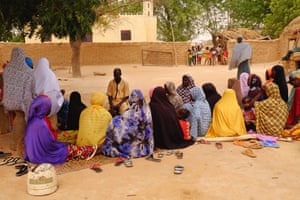
Women gather below a neem tree in a village outside of Dongondoutchi to hear Moundadou Magagi, a health agent with PSI, explain family planning options. Photograph: Jill Filipovic
Some women feel that having more babies gives them a break in their difficult lives. In the villages the days are an endless cycle of hard physical labour from the time you’re an adolescent (or younger) until you become too old to work.
The thing I like in motherhood … is giving my baby his bath and playing with him
“I really don’t have time for amusement,” says Hamsatou Issaka, a pretty 15-year-old who lives in a village several hours from the nearest city of Dosso. “I just work all day. Then you sleep.” She nurses her one-year-old son, Habibou. “The thing I like in motherhood,” she says, a big smile breaking across her face, “is giving my baby his bath and playing with him.” A new baby also means a 40-day break from the usual demanding physical labour – and another few years of baby baths and giggles breaking up the monotony of tilling the earth and pounding the millet.
Issaka met her husband, a lanky young man with a wide smile and easy laugh, when she was 12 and he was 15; they got married soon thereafter. All of her friends are married with children and she can’t imagine going into her 20s without a husband and children. Having lots of children is the norm because they bring wealth (“they come with two hands to work but only one mouth to feed”). So why have four when you could have seven? Seven, one of Issaka’s neighbours says pointedly, is a bigger number than four.
“A large family size is a cultural ideal in Niger in a similar way that in the US or UK, a romantic relationship is a cultural ideal,” says Hope Neighbor, a partner at consulting firm the Camber Collective, which has researched increasing contraceptive use in the country. “We need to be more thoughtful in how we communicate family size and desires,” she says. “This doesn’t mean you tell people they need to have smaller families. It means reframing how they think about families, because it creates tremendous risk to the mother, and tremendous risk to the fragile environment in Niger.”
This is why, many experts say, Niger needs a strong campaign for girls education. “If we want to bring change, we must bring young girls to school,” says Laouali Assiatou, the deputy secretary general of the ministry of population, promotion of women, and protection of children.
Most of the time the girl is in school but the parents pull her out. She can’t speak for herself
Child marriage, Assiatou notes, “happens to vulnerable families. Most of the time the girl is in school but the parents pull her out. She is going to be violated. She can’t speak for herself. She will be pregnant early. She’s in her husband’s house, she has no money. She’s not mature enough to deliver and health services are not very developed in our country. She’s going to have a difficult pregnancy. She can die, or she can deliver a stillborn, or she can end up with a fistula and be rejected by society.” The end result, she said, is that keeping girls out of school “keeps the community in a cycle of poverty”.
Despite assumptions, studies haven’t demonstrated a correlation between polygamy and family size. Nigerien women in polygamous marriages have about the same number of children as women in monogamous ones. But some women’s health advocates argue that polygamy contributes to the norm-setting of large families and consolidation of male power in the household, with a potential second wife wielded as a threat to a married woman who doesn’t want more babies.
Mariama Hassan, who has lived in Darey Maliki village her whole life, got married at 18, late by village standards. As she breastfeeds her daughter, Ramatou, she says she wants to see her baby girl finish school, and eventually get married as well – but not until she’s 25. “I want her to be a doctor,” Hassan says. “I say 25 because I want her to be mature before getting married, and I want her to finish her studies.”
Her hopes for her own life are different. “In my lifetime, I want to have what God decides for me,” she says. What does that mean in terms of children? She smiles and laughs. “I hope God gives me 12.”
Join our community of development professionals and humanitarians. Follow @GuardianGDP on Twitter. Join the conversation with the hashtag #SheMatters.
Children who are allowed more than three hours of screentime a day are at greater risk of developing diabetes, new research suggests.
The study found that children who were glued to their screens for three or more hours a day scored higher on measures of body fat and had higher levels of resistance to the hormone insulin than their peers who spent an hour or less watching TV, videos or playing computer games.
But the authors cautioned that the research does not show that increased screentime itself results in raised levels of risk factors for the disease.
“Screentime could be capturing something about your behaviours – how much sedentary time you have and how much you break that up [or] what your dietary habits [are], potentially,” said Claire Nightingale, a medical statistician at St George’s, University of London and co-author of the research.
Writing in the journal Archives of Disease in Childhood, Nightingale and colleagues described how they sought to probe whether for children, as is known for adults, screentime is linked to an increase in risk factors for type 2 diabetes. To do so, they analysed data from the Child Heart and Health Study in England – a survey carried out between 2004 and 2007 of almost 4,500 children, aged between nine and 10, from primary schools in three UK cities: London, Birmingham and Leicester.
Among the questions asked, data was collected on the length of time the children spent watching TV, video games or playing computer games. A host of physical measurements were also taken including measures of the children’s body fat and resistance to insulin – a hormone that controls blood glucose levels. In addition, levels of physical activity were monitored for 2,031 of the children.
The results revealed that while 37% of children reported that they spent an hour or less watching TV or playing computer games a day, 18% reported spending three or more hours in front of a screen.
Comparing the groups, researchers found the children who reported three or more hours of screentime scored higher on various measures of body fat. What’s more, these children had 10.7% higher levels of insulin after fasting, 10.5% higher levels of estimated insulin resistance and 9.3% higher levels of leptin – a hormone involved in controlling appetite – all of which are risk factors for type 2 diabetes.
The associations held even when factors such as socioeconomic status and levels of physical activity were taken into account.However the study did not not follow up on the children to see whether they actually went on to develop diabetes.
While the data was collected a decade ago, before electronic devices such as smartphones became ubiquitous, the team believe the link between screentime and diabetes risk is likely to remain. But Nightingale said it is difficult to offer advice to parents. “Potential decreases in screentime could be beneficial, but we can’t really say a cut-off point,” she said.
Dan Howarth, head of care at Diabetes UK said that the study highlights a worrying trend.
“The rising number of type 2 diabetes in children is an alarming statistic and addressing the nation’s childhood obesity issues should be the responsibility of us all,” he said.
“Encouraging physical activity over a sedentary lifestyle, such as that relating to screen time, and a healthy balanced diet clearly plays a significant part.”
The warning that children with cancer risk missing out on drug trials (Report, 9 March) highlights an issue that has been largely overlooked in the Brexit debate. I led work on the EU clinical trials regulation, which will come into force in 2018. By harmonising EU law and creating a single application portal, this will make it easier to carry out clinical trials in more than one country. Cross-border trials are particularly important for paediatric cancers because there are usually not enough cases in one country to make a trial viable. Once outside the EU, it will be harder for UK patients to participate in these trials.
Although cancer in children is relatively rare, more than 1,700 children are diagnosed and 257 die from cancer every year in the UK. Due to the lack of treatments available, a clinical trial may represent the only chance of survival for a child with cancer. Children are already missing out on access to innovative treatments because drug companies are reluctant to carry out paediatric testing due to the small anticipated profit margins; if children in the UK no longer have access to EU trials, this situation could become much worse. Withdrawing from the European Medicines Agency (EMA) could further impact the time it takes for new medicines to be available to patients in the UK.
Theresa May seems determined to cut all ties with the EU, even where there are obvious advantages from continued cooperation. It would certainly benefit patients in the UK, and children with cancer in particular, if we seek to remain part of the EMA and the EU clinical trials framework. Dame Glenis Willmott MEP Labour’s European parliament spokesperson on health
Leading doctors are warning that British children with cancer could suffer if they are no longer able to join Europe-wide trials of innovative new medicines as a result of the Brexit deal.
The Institute of Cancer Research (ICR) and the Royal Marsden NHS Foundation Trust say the best hope for some children with cancer is a clinical trial where a new drug is being tested. But because of the small number of children with the same cancers, the trials have to be run in many hospitals, often across Europe.
If the UK leaves the European Union and withdraws from the currently London-based European Medicines Agency which licenses new drugs, as expected, then pharmaceutical companies may choose to trial drugs just for children from countries in the EU. Children in the UK would lose out, and it could take years before they could get access to the newest treatments.
The ICR and the Marsden say EU regulations governing the way medicines are tested in children badly need reform to make companies trial more drugs in children, but the UK would be worse off without them.
“It is imperfect but it is all we have,” said Prof Louis Chesler, a consultant in paediatric oncology at the Marsden.
Children’s cancer is a very small field, he said. “The most effective way to run a clinical trial is to run a big one. If the regulations change and stop us working across European sites, that is a big problem for us,” he said.
The ICR and the Marsden, in their response to a European commission consultation on the future of drug regulation for children, are calling for changes so that drug companies cannot so easily obtain a waiver and duck the obligation to do trials in children once they have shown a drug works in adults.
A new analysis by the ICR shows that over the past five years (2012-2016) pharmaceutical companies were granted waivers from having to trial cancer drugs in children for 33 of 53 approved cancer treatments.
“By allowing pharmaceutical companies to use waivers to avoid trials in children so they can focus on adult treatments, the regulation is stifling progress and could be stopping children receiving a treatment that could save their lives,” said Chesler.
Prof Paul Workman, the chief executive of the ICR, said: “Children with cancer are currently missing out on the kind of innovative cancer treatments that are becoming increasingly common in adults because of outdated European rules that have failed to keep up with advances in science.
“We’ve been urging decision-makers to change the regulation for several years now, so that adult cancer drugs are tested in children whenever their mechanism of action suggests they could be effective.
“This is a real chance for reform to prevent the current out-of-date approach from being cemented for a decade. It could also be the last chance to make meaningful changes that apply across Europe, including the UK, before we leave the EU. It’s vital that whatever deal the UK does preserves access to Europe-wide clinical trials for children with cancer and avoids creating even longer delays in children accessing the latest cancer medicines.”
Dr Lynley Marshall, a consultant in child and adult cancer drug development at the Marsden, said families who are going through the trauma of caring for a child with cancer should not be alarmed. She pointed out that children with cancer in countries outside the EU, as far away as Israel and Australia, participate in some of the big treatment trials because of the difficulties of getting enough children with the same condition in one place.
She did not think fewer children in the UK with cancer would be included in trials. “I think it would be difficult to be categorical about it, but we will all be working very hard to ensure that there wouldn’t be,” she said.