Care etiketine sahip kayıtlar gösteriliyor. Tüm kayıtları göster

12 Mayıs 2017 Cuma

If you have no children, who will care for you when you’re old? | Sonia Sodha

[unable to retrieve full-text content]

We had to fight to get my grandfather good care. Those of us who don’t have children need a new approach

Few of us are immune from the anxiety that can quickly set in when we contemplate our own ageing. Who will be there for us when us can no longer physically take care of ourselves? Who will be around to remind us of who we were in our moments of lucidity when our minds have started slipping away?


For those of us who don’t have children, these questions take on a particular significance. I had mixed feelings after watching Still Alice, an Oscar-winning depiction of early-onset dementia. It made for grim viewing. But it was easy to imagine the ways it could have been even grimmer: what if the protagonist, Alice, had no children, a partner long departed or divorced, or friends who had drifted away?


Related: Why should older people rely on their families for care? | Catherine Bennett


Related: Mice benefit from research into cannabis. Why not us? | Simon Jenkins


Continue reading…


If you have no children, who will care for you when you’re old? | Sonia Sodha

6 Mayıs 2017 Cumartesi

What I’m really thinking: the care home visitor

I come whenever I can, a round trip of several hours. And although the care staff are always welcoming, I see the disappointment in their eyes when I leave. With a couple of short breaks, I can usually last three hours. It’s all I can take of the mumbled sentences that make no sense, watching television while he sleeps and swapping pleasantries with the staff, who always seem surprised by my presence.


They assure me that there is a steady stream of other family and friends who drop in. I try not to take it personally, although it feels like a criticism. I am thankful for the way the staff look after our relative but we all know he barely registers my presence. As far as I can tell, he is happier in the company of the people who care for him and clean and feed him.


Frankly, I feel like an inconvenience, a stranger interrupting his routine. I have thought about not coming any more and I secretly wonder how a civilised society can allow a person to subsist in his condition – not living, merely existing in a gradual, unstoppable decline.


He lies there bedridden, half-paralysed and hovering between worlds. I am in no doubt that he receives the very best palliative care, but I can’t help thinking that society shows him less compassion than it would an animal in making him endure this.


The whole experience has made me think about making a living will, and also about the wider issue of end-of-life care. I also question my own motives more now. Do other visitors wish their loved ones dead, to end their suffering and ours?


Tell us what you’re really thinking at mind@theguardian.com


What I’m really thinking: the care home visitor

Lib Dems pledge 1p tax rise to "rescue NHS and social care"

The Liberal Democrats have pledged to increase income tax by a penny for every earner to fund a £6bn-a-year cash injection for the NHS and social care.


In what was described as their “flagship” spending commitment of the general election campaign, the party’s leader, Tim Farron, said voters recognised the need to “chip in a little more” to address the “chronic underfunding” of healthcare.


Under the Lib Dem plan, 1p would be added to the basic, higher and additional rates of income tax and the rate of dividend tax from the next financial year, with the £6bn raised being ring-fenced for the NHS, social care and public health.


The proposal – which echoes the Lib Dems’ pledge from the 1990s to put a penny on income tax for education – will be seen as a clear attempt to capitalise on public concerns about the state of healthcare.


Theresa May has insisted the Conservatives have no plans for tax rises while appearing to back away from a previous pledge not to put up income tax or national insurance.


Farron said: “Theresa May doesn’t care about the NHS or social care. People are lying on trolleys in hospital corridors and she has done nothing.


“The Liberal Democrats will rescue the NHS and social care. We are prepared to be honest with people and say that we will all need to chip in a little more.”


The party’s health spokesman, Norman Lamb, said: “The NHS was once the envy of the world and this pledge is the first step in restoring it to where it should be. A penny on the pound to save the NHS is money well spent in our view.”


The Lib Dems pointed to an opinion poll finding from last year, which suggested 70% of voters would back a 1p rise in income tax if the money was guaranteed to go to the NHS.


According to figures released by the party, the rise would mean an increase of £33 a year – or less than £1 a week – for someone earning £15,000 a year, rising to £133 a year – or less than £3 a week – for someone earning £25,000.


At the top end, someone earning £150,000 would pay an extra £1,500 a year – or £29 a week – while someone on £250,000 would pay £2,500 a year, or £48 a week extra.


In the longer term, the Lib Dems said they would introduce a health and care tax to bring spending on both services together in a collective budget, and make clear on people’s payslips what was being spent on those services.


The party said it would seek to establish a cross-party health and care convention to review longer term sustainability of the health and care finances while setting up an office of health and care funding, similar to the Office for Budget Responsibility.


Lib Dems pledge 1p tax rise to "rescue NHS and social care"

25 Nisan 2017 Salı

How a digital NHS saves time and money – and transforms care | Afzal Chaudhry

Imagine this scenario: a patient arrives at hospital for an appointment or an emergency, or is admitted for treatment and the clinical team can see their medical record in its entirety, wherever and whenever they need to.


At Cambridge University hospitals NHS foundation trust, that is what we set out to achieve when, seven years ago, we decided to invest in a sustainable digital future for our hospitals. Rather than relying on paper-based processes and simply replacing outdated technology as it became obsolete, we wanted to transform the way we care for our patients.


In 2013 we began a 10-year eHospital digital programme, to create a fully integrated electronic patient record (EPR) system, andset in motion a modernisation of our networking and computing infrastructure. More than 100 colleagues from various clinical areas were seconded to the eHospital team, so our EPR was built by our staff, for our staff.


In October 2014 our EPR went live across both hospitals in our trust: Addenbrooke’s and the Rosie. It spans all clinical areas – both inpatient and outpatient – including A&E, critical care, clinics, wards, surgery, pharmacy, laboratory and radiology services.


It was a big undertaking. More than 175,000 hours of training were delivered to about 12,000 staff in nine weeks as we prepared to make the system live. Around 5,500 old computers were replaced with 6,750 new ones, and we connected another 500 laptops, 395 workstations on wheels and 420 handheld devices, such as iPods with barcode wristband scanners. We also installed 1,350 wifi access points across all clinical areas.


For some of our staff the transition from paper to digital was not simple, even though they had access to the same information as before, just presented in a different way. Having “super users” – hospital staff who volunteered to have extra training so they could help others – proved invaluable.


The EPR has 3,200 concurrent users and every single one looks at the most up-to-date version of patient records


Today our EPR is vital to better patient care. It has helped us improve quality and safety, reduce duplication and eliminate unnecessary delays. Inpatients do not have to stay in hospital for longer than necessary as the time taken to prepare discharge medications has halved. Every inpatient has a barcoded wristband, which links directly to the EPR, and allergy-related prescribing alerts in the system have reduced adverse medication reactions, saving around 2,500 inpatient bed days per year.


Outpatients now only come in to hospital if it’s necessary as clinicians can review their patients’ notes and x-rays virtually. In orthopaedics this has freed up 4,500 appointments a year. Patients attending the surgical pre-assessment clinic complete their initial documentation on tablets, meaning this department now sees approximately 20% more patients than before.


Integrated handheld and mobile devices enable clinicians to document information in the EPR in real time at a patient’s bedside. This has released the equivalent of 120 nursing posts, allowing staff to spend more quality time with patients.


We typically have 3,200 concurrent users of the EPR at peak times and every single person is looking at the most up-to-date version of their patient’s record. Overall, we have reduced the use of paper records by 99%.


Moving forward, we are introducing a patient portal, MyChart, which will give patients secure access to parts of their medical record, so they can be more in control of their health information. The future of electronic healthcare is coming with the forthcoming launch of Care Everywhere and EpicCare Link, which will allow us to share key patient information electronically with other hospitals and primary care services.


As one of the UK’s highest rated trusts for the effective use of technology in providing high-quality patient care, not only will we continue to focus on using technology to deliver further improvements for our patients, but also as a global digital exemplar hospital we are committed to sharing our learning with others and helping the NHS embrace its digital future.


Dr Afzal Chaudhry, chief medical information officer at Cambridge University hospitals NHS foundation trust, will be speaking at eHealth Week on 3-4 May. The Guardian Healthcare Professionals Network is media partner for the event.


Join the Healthcare Professionals Network to read more pieces like this. And follow us on Twitter (@GdnHealthcare) to keep up with the latest healthcare news and views.


How a digital NHS saves time and money – and transforms care | Afzal Chaudhry

21 Nisan 2017 Cuma

We"re working with children in care to improve mental health | Tony Hunter

It’s good news that mental health in general, and children’s mental health in particular, is being given increasing attention by the media and greater consideration by policymakers. Yet the mental health and wellbeing of children in care is too often marginalised in these debates. More than 70% of children in care have been diagnosed with mental health problems. Perhaps you just assume that it goes with the territory and there’s not much that can be done about it. This is absolutely not the case.


The Social Care Institute for Excellence (Scie) has started a new project, commissioned by the departments of health and education, to ensure that children in care have access to high-quality services, based on a clear assessment of need, from a range of professionals working across different agencies. The project is likely to suggest significant changes to the way assessments are conducted for children in care, which could have a big impact on up to 70,000 care-experienced children and young people.


As part of the project, we have put together an expert group that combines knowledge of experienced professionals across the health, social care, academic and voluntary sectors. Crucially, young people who use these services are being given equal billing.


One of the most exciting things about our project is the involvement of children and young people in care, as well as those who have recently left care, in our consultation process. In total we will hear from more than 100 young people and 400 other service users to ensure the working group’s recommendations will be founded on the evidence of those with first-hand experience of the system.


This means we’re speaking to people like Matt Langsford, who was in care until recently and was as keen as healthcare professionals in the group to point out that attending to children’s mental health and wellbeing shouldn’t just mean dealing with crisis situations. “If you get a slapdash service at an early stage,” he says, “it won’t be more than a few months before you’re back in a crisis situation.”


The causes of mental ill health for children in care are complex. These young people have often experienced trauma, maltreatment and perhaps exposure to drugs and alcohol. This is rarely a one-off occurrence. It is a daily reality for these children and at Scie we believe that no one is better placed than the children themselves to highlight where mental health services are working to help with this and identify where they need improving.


The expert group’s professionals are learning much from our experts-by-experience and vice versa. One foster carer reports that every young person who has come to him has had a tough experience and believes that support services are not doing enough to help them. A clinical psychologist has talked about too many “messy systems” that don’t communicate with each other, leaving the child in care confused and feeling that their voice isn’t being heard.


The experts-by-experience, meanwhile, are helping the group to establish practical outcomes and identify concrete milestones. We don’t want our project to produce just another dust-gathering policy document. We want to reach commissioners, professionals, providers and advocates, as well as policymakers.


By October 2017, the group will report its final recommendations, which will include clearer guidance for professionals working with children in care and better information for children and young people themselves. What makes this project unique is the pooling of expertise that will enable real insight and transformation in the way we approach mental health services for children in care.


Tony Hunter is chief executive of the Social Care Institute for Excellence


Join the Social Care Network to read more pieces like this. Follow us on Twitter (@GdnSocialCare) and like us on Facebook to keep up with the latest social care news and views.


We"re working with children in care to improve mental health | Tony Hunter

12 Nisan 2017 Çarşamba

Lack of post-hospital care "leaving mental health patients at risk"

Thousands of vulnerable people are being left at increased risk of suicide because NHS mental health teams in England and Wales are not checking up on them within a week of their discharge from hospital.


At least 11,000 people a year who have recently been in mental health inpatient care are not followed up within a week of coming home, despite guidelines requiring the NHS to contact them.


People discharged after hospital treatment for a mental health crisis should receive a visit or phone call to assess their needs, the National Institute for Health and Care Excellence (Nice) says. But figures obtained under freedom of information laws by the charity Mind show that one in 10 such people are not contacted.


“Patients should only be discharged from specialist mental health services when there are ongoing care arrangements in place for them. Failure to do so can put the person at risk of harm, their condition can relapse and it can mean they are more likely to go going back into hospital,” said Dr Paul Lelliott, the Care Quality Commission’s deputy chief inspector of hospitals.


Mind discovered that the Nice guidelines were often breached after receiving information from 54 of England’s NHS 56 mental health trust and one of Wales’s seven health boards.


“If you don’t get the right care after you leave, if you’re left to cope alone, you end up in a revolving door, going straight back into hospital or being at risk of taking your own life,” said Sophie Corlett, Mind’s director of external relations.


The widespread lack of follow-up “is not good enough. It’s a tragedy so many people so very recently leaving the care of hospitals are losing their lives,” she added.


Separate research by Mind, among 850 patients about their experience of after-hospital care, found that those who were not followed up were twice as likely to attempt to take their own lives and a third more likely to harm themselves.


They are also more than twice as likely to end up back in A&E suffering another crisis, the survey found.


Natalie, 26, from Somerset, who ended up in hospital after trying to take her own life, said the crisis team did not visit her for a week afterwards.


“When you’re that unwell, it’s hard getting through each day. Each hour is tough, so just 24 hours can feel like such a long time. I needed someone to talk to, to help me understand my thoughts and feelings. To see someone only after a week, it’s not enough,” she said.


The CQC’s Lelliott said pressure on mental health services, including to discharge patients to free up beds, should not compromise the aftercare they received.


“We know that hospitals are under increasing pressure to discharge patients as soon as possible but providers must not compromise their ongoing care responsibilities to their patients. It is vital that when they discharge patients into community, it is done in a safe way that ensures people get the continuity of care they deserve and have every right to expect,” he stressed.


Nice guidelines say all such patients should be contacted within a week, and those thought to be at risk of suicide within 48 hours. Last year’s National Confidential Inquiry into Suicide and Homicide found that most suicides occurred on the third day after release.


“Patients leaving hospital can feel unsupported as they return to the problems that may have led to their admission. Those first few days are the time of greatest risk,” said Prof Louis Appleby, the director of the confidential inquiry.


Barbara Keeley, the shadow minister for mental health, said: “Mind’s research is yet more evidence of the gap between rhetoric and reality with this government. We are seeing people in some of the most vulnerable positions with their mental health being put at further risk.”


The Liberal Democrat MP Norman Lamb, who was the mental health minister in the coalition government, backed Mind’s call for all discharged patients to be contacted within 48 hours. “The moral case for this proposal is overwhelming. When we know that the risk of loss of life through suicide doubles if there is no timely follow up, the government and NHS England have an absolute duty to act. But this requires investment in community support which is so often lacking.”


Prof Mark Baker, director of the Nice Centre for Guidelines, said it was reviewing its recommendations to see if they needed to be updated in the light of Mind’s findings.


NHS England said: “Improved access to mental health support for people in the community where they live is part of our plans for the biggest expansion of mental health services in Europe.”


  • In the UK, the Samaritans can be contacted on 116 123. In the US, the National Suicide Prevention Hotline is 1-800-273-8255. In Australia, the crisis support service Lifeline is on 13 11 14. Hotlines in other countries can be found here.


Lack of post-hospital care "leaving mental health patients at risk"

11 Nisan 2017 Salı

What we need is a national social care service | Anne Perkins

Neil Kinnock was on the radio at the weekend, talking about his hero Aneurin Bevan with the journalist Matthew Parris and one of Bevan’s biographers, John Campbell. Any conversation about Bevan’s life is mostly about the NHS and so it was this time, too. But it was a useful reminder of how, among all the battles fought over its creation, among the fiercest was the question of replacing a patchwork of local provision with a single centralised structure that tried to guarantee that everyone got the same level of care wherever they lived. At that the point the radical, big-government approach petered out. Social care was left where it always had been, with local councils.


Now the Institute for Fiscal Studies (IFS) has published a study looking at the difference in social care provision across England that raises the question of whether it too should be centrally funded. After all, whether it’s soaring demand for A&E or delayed discharge from hospital, the impact of inadequate or ill-designed social care services on the overall state of the health service has become the stuff of daily headlines.


Then there is the ageing population. Although we are all healthier in old age, the need for care doesn’t track changing demography exactly: men’s life expectancy is growing faster than women’s, so there are more old couples looking after each other rather than relying on formal care.


George Osborne’s response to the incipient social crisis was to set in motion plans to shift the entire cost of locally incurred spending to local taxes, with a system of equalisation that has yet to be explained. He introduced a social care precept allowing an increase of up to 2% in council tax to be spent on social care.


Since the amount councils can raise through council tax depends on their tax base, these changes are – as the IFS points out – hitting poorer councils much harder than well-off ones, even though in theory, the introduction of national criteria for eligibility for paid-for social care should mean a reasonably equitable approach. The IFS study found that cuts in social care were much steeper in metropolitan areas such as Greater Manchester, Tyneside and Greater Birmingham, which typically have significantly higher levels of need, than in the south of England (although that may be partly because there are more older people in the south).


But the distinction between what we pay for and what we expect wider society to support is more than just a matter of an arbitrary geographical divide. We are so familiar with it that we rarely ponder the palpable inequity between providing free care for, say, a cancer patient, regardless of their wealth, while charging someone with dementia who also has some modest assets.


Councils argue that keeping older people well is about much more than care homes and clearing hospital beds


Because social care is provided locally, the national focus is always on the NHS. So although last month’s budget made another £2bn available for social care, it is being delivered in a way that ties it in to supporting the kind of services that will ease pressure on the NHS. Councils rightly argue that keeping older people well is about much more than care homes and providing a bed clearance service for their local hospitals. It’s about wellbeing in the widest sense of the word, and the NHS’s provision of community services like stroke rehabilitation also have a significant role to play.


In some ways, NHS England chief executive Simon Stevens’ sustainability and transformation plans with their objective of integrating health and social care in ways that meet local priorities are an attempt to synthesise the national with the local. Yet there is such an inbuilt conflict between a free-at-the-point-of-use NHS and means-tested social care that it is hard to see how they can continue to coexist.


It comes at a high cost to patients. When hospitals are in effect incentivised to shovel the old lady who’s had a fall out of bed and off their books pronto (I exaggerate, a little), leaving her local authority to pick up the bill for getting her back on her feet, it seems the two arms of care that ought to be wrapped protectively around her are instead locked in a standoff. It is more arm-wrestling than hand-holding.


The government now promises (another) green paper on paying for social care in the autumn. But successive plans, each of which points to more central government funding, have crashed and burned on the runway. Oh, for a Bevan (and a Clement Attlee) with the courage and determination to sort it out.


Anne Perkins is a leader writer


What we need is a national social care service | Anne Perkins

928 carers in England quit a day as social care system "starts to collapse"

More than 900 adult social care workers a day quit their job in England last year, figures reveal, as homecare providers warn the adult social care system has begun to collapse.


Analysis by the BBC of data released by a charity, Skills for Care, shows that in 2015-16 about 338,520 adult social care workers left their roles, equal to 928 people leaving their job every day. There were more than 1.3 million people employed in the adult social care sector in England in the period.


Of those leaving a job, 60% left the adult social care sector altogether, the figures showed, while there was an estimated shortage of 84,320 care workers, meaning about one in every 20 care roles remained vacant.


The average full-time frontline care worker earned £7.69 an hour, or £14,800 a year, according to the data, and one in every four social care workers was employed on a zero-hours contract.


The figures come as the UK Homecare Association wrote a letter to the prime minister warning of the crisis facing social care.


Mike Padgham, the chair of the UK Homecare Association, said: “My biggest fear is that we will soon run out of capacity to provide care to those who cannot fund themselves. I agree wholeheartedly with Age UK’s warning that the social care system will begin to collapse this year, but I would go further and say that the system has already begun to collapse.”


The Skills for Care figures show that the industry has a staff turnover rate of 27%, which is nearly twice the average for other professions in the UK, according to the BBC report.


The government has said it will spend an extra £2bn on the social care system and permitted local authorities to raise council tax bills in order to fund the gap in social care budgets.


The Department of Health said: “Social care jobs have increased at an average of 3% a year since 2010, but we want to see improvements in turnover rates, with talented staff attracted to a robust sector backed by an additional £2bn over the next three years.


“Meanwhile, we’re investing in the workforce of the future, with a total of 87,800 apprentices starting last year – up 37,300 compared to 2010.”


928 carers in England quit a day as social care system "starts to collapse"

10 Nisan 2017 Pazartesi

How we can start a social care revolution in seven easy steps | Katie Johnson

The government’s commitment to provide an additional £2bn for social care in the spring budget was presented as a solution to help ease pressure on the NHS and councils over the next three years. While the measure has addressed the immediate funding crisis, there is concern that this is no more than a short-term fix. The announcement risks masking the true scale of the challenges ahead and the radical surgery required to reform social care.


In all likelihood, the extra money will be used by local authority and NHS commissioners to block purchase places in residential care homes. This is not the answer.


Spending money in this way will do little to tackle the fundamental problem: we are admitting too many older people to hospital, keeping them there for too long and failing to give them the care they need in their own homes.


While cheaper than a hospital bed, a place in a residential care home is still more expensive and, crucially, less effective than care and support in the community.


There needs to be a transformation in the way that social care is commissioned and provided, to improve the quality of care, but also to make services financially sustainable, without the need to raid other budgets for extra funding.


A strategy for reform would have seven key elements:


1. Champion independent living


We need to engineer a dramatic shift away from residential care towards the kind of support elderly people actually want and need. That means better support for people to live independently in their own homes, with a skilled, professional workforce to provide the advice and assistance they need. We need to invest in a model of care that involves greater collaboration between the person being supported and those providing support.


2. Support families and carers


There needs to be stronger provision of advice and assistance for families and other carers, and more effective liaison with voluntary and community organisations that are skilled in providing support to older people. This means creating partnerships that can empower volunteers and deliver more professionalised community care.


3. Shift the funding focus to community-based care


Local authorities need to switch their focus away from expensive residential provision to support family, carer and community-based services. This funding shift is necessary if we are to create a fundamentally new system that offers holistic care in the home and keeps older people, wherever possible, out of hospital and residential care.


4. Incentivise local authorities


Local authorities should be incentivised to purchase individually tailored packages of care. Why are we so afraid of asking people, and their relatives and carers, what they really want and need? Many councils want to do this, but their options are limited by what the market can provide or by a lack of imagination. They should be rewarded when they invest in transforming the way providers think about services.


5. Prevention rather than cure


Transforming the social care system, rather than simply shoring it up, would address the problem of delayed discharges from hospital, but also reduce the flow of older people into hospital in the first place. It would prioritise prevention, rather than waiting for problems to arise and then attempting an inadequate cure. The best local authorities are already using their resources creatively, such as looking at predictive analytics to anticipate demand.


6. A better alternative to ‘integration’


There is plenty of talk about the need for an integrated health and social care system, or even a “National Care Service”. There is a much simpler solution. NHS providers and local government need to co-operate better to find the right kind of care for elderly people.


Liaison between hospitals and local authorities will never be truly effective if it is just one more item on the to-do list of hard-pressed nurses and social care workers. It requires dedicated resources – well qualified people whose full-time job it is to ensure that the hand-offs between hospital and community care are speedy, efficient and driven by the individual needs of the patient. Creating these vital liaison roles should be only the first step in a programme to transform the skills and role of the social care workforce.


7. Pool resources


Just as the NHS and local authorities should look to share resources, there is a key role to be played by combined authorities and other city and county partnerships. They should be encouraged to pool their money to fund the transformation of social care.


The budget has already seen one U-turn. It is not too late to redirect the £2bn and make a real difference to health and social care in the UK.


Katie Johnston is director at KPMG


Join the Social Care Network to read more pieces like this. Follow us on Twitter (@GdnSocialCare) and like us on Facebook to keep up with the latest social care news and views.


How we can start a social care revolution in seven easy steps | Katie Johnson

6 Nisan 2017 Perşembe

Social care reviewer condemns UK system and calls for new tax

Andrew Dilnot, who carried out the government review into the funding for care and support in England, has condemned Britain’s social care system as “the most pernicious means-test in the whole of the British welfare state” and called for a new tax to fund adult social care for everyone who needs it.


The chair of the Dilnot commission on funding of care and support said a tax was needed to provide lifelong adult social care that was not means-tested.


The average person will need social care worth about £20,000 during their lifetime, with slightly more than a fifth of the population dying before they require any support. But for 10% of the population care costs are high: a couple with arthritis requiring residential care for the last 20 years of their lives will need care costing over £1m.


Andrew Dilnot


Andrew Dilnot believes social care should not be means-tested. Photograph: David Levene for the Guardian

The current system provides care for adults of working age and older people with disabilities, mental health problems, sensory loss or general frailty. Personal and practical support can be provided in a care home, in the community, in hospital or in someone’s home.


For those with less than than £14,000 in capital and savings the system covers the cost of all care, but pays nothing for those with more than £23,250. Dilnot said that in its present form it creates a “massive sense of inequity and encourages a significant amount of cheating”.


Changes to the means test were due to come into effect in April 2016 but have been delayed until April 2020, after which the £23,250 upper limit will be raised to £118,000 and the lower limit to £17,000.


Dilnot, however, believes social care should not be means-tested. On Thursday, he used his first speech since his five-year term as chair of the UK Statistics Authority ended last week, to return to the issue of social care – adding that he was relieved that he could now finally “speak about almost anything” since joining the authority in December 2011.


Using a Resolution Foundation lecture, he said the controversial state pension triple lock (which sees pensions rise each year by the highest of the rate of inflation, average earnings or a minimum of 2.5%) should be rewritten to include a new, non-means tested, social care guarantee.


The Dilnot commission report concluded that individuals should pay the first £35,000 of their care if they have more than £100,000 in assets. Once that excess has been paid, the government would provide free social care. The findings were never implemented despite being welcomed by the then health secretary, Andrew Lansley, the then prime minister, David Cameron, and the then leader of the opposition, Ed Miliband.


But Dilnot said social insurance with an excess for social care was now urgently required for “staggeringly striking, massive welfare-inefficiency reasons”.


“I think it would be entirely reasonable to look again at the triple lock and say, ‘Let’s substitute some of the more expensive elements of the triple lock. Let’s turn them into a new triple lock with social care as part of the triple lock’,” he added.


Dilnot’s proposal is that the money saved by shedding the most costly of the triple lock’s conditions could be used to pay for the cap.


This means, he said, that providing non-means-tested social care to every British citizen would not require more money from state coffers. “There are many ways in which the scale of money we’re talking about could be reallocated in the upcoming budget without looking for extra money.”


Dilnot rejected claims that Britain can’t afford a “decent care system”. “There’s plenty of money,” he said. “GDP in real terms is more than 5.5 times as big as it was in 1948. So if anyone says to you, we can’t afford X, Y or Z, the appropriate response is: ‘That is not a well-formed formula”. We may choose not to afford it but the notion that we can’t afford something, given what has happened to our income is striking and quite surprising, and doesn’t strike me as correct.”


Social care reviewer condemns UK system and calls for new tax

How to Take Care of Combination Skin This Season

Have you ever paid close attention to certain faces that have oily skin in some areas and dry skin in other areas? If your own skin is characterized by oily as well as dry areas, then you might have a combination skin type. Usually, people with combination skin find it tricky to figure out how to take care of their skin properly. It can feel like quite the balancing act when trying to address the oily and dry areas of your skin. Once you achieve this, the mystery to having great skin will be unlocked in much easier ways than you may have thought.


What is combination skin and how is it caused?


To put it simply, someone with combination skin has both skin that is oily in the area called T-zone (forehead, nose, and chin) while also having dryness in other areas. Even if you have oily skin only around your nose and center of your forehead but dry skin over cheeks and jaw area, then you are also said to have a combination skin.


The predominant factor that is responsible for combination skin is the genetics. It is inherited similarly as you would your hair color, eye color, skin color, and the body type from your parents.  Usually the people who have combination skin have more active oil glands on their nose, forehead, and chin which lead to clogged pores in these areas.


The other factors that play a key role in causing combination skin are lifestyle, nutrition, and skincare products. The wrong products for this skin type contain skin-aggravating ingredients that dry out certain areas of your face, while exacerbating oil production in other parts that were already oily. These ingredients are harmful sulfates and alcohols that prompt the skin to produce more oil in the T-zone area which, in turn, produces the symptoms of combination skin.


Important Tips to Follow For Treating Combination Skin


Treating the combination skin requires a dual approach of skincare in which different areas of skin are treated individually along with suitable products. Apart from these steps, there are also some natural ways that help greatly in treating combination skin:


  • Use a gentle but effective cleanser

The skin of your face is the most exposed part of your body. As the day closes in, your skin gets covered with dirt, excess oils, and impurities. So a right cleanser is the one that effectively removes dirt, impurities, and makeup without making skin feel tight, dry, or greasy. It is important to retain the softness rather than causing it to be tightened and aggravated. This is one of the best approaches to gentle skincare for having a natural glow on your face.


  • Balance your skin with a toner

Skin experts recommend using a hydrating, soothing, and non-irritating toner that should consist of skin-revitalizing ingredients and antioxidants. A toner of such quality really helps in effectively nourishing the dry skin and reduces oiliness at the same time.


Apply a gentle and non-abrasive exfoliant in order to gently and effectively exfoliate the combination skin. Products that contain BHA exfoliant are good in helping shed the dead skin without abrasion. It doesn’t require any scrubs or cleansing brushes to unclog pores. Lessen oily skin and gently smooth existing  rough, dry, and flaky skin to revive a healthy glow.


  • Apply a suitable moisturizer

Choose a moisturizer that targets your dry patches of skin and mattes the oily areas of your face. A gel-based moisturizer or a gel-cream moisturizer usually works well. Such a moisturizer is important in helping calm skin, lessen excess oil on the surface, and improve dry areas including around the eyes.


  • Protect your face from sun damage

All the skin types are sensitive towards sun rays – some only a little while others are extremely sensitive. One of the effective ways to counter this is to apply a generous amount of broad spectrum sunscreen with an SPF of 15 or more every day. This is also one of many steps in skincare that can help reduce the early signs of aging. Ideally, you need to apply a nourishing serum or booster over the dry areas and then apply the ultra-light sunscreen over the oily areas.


Conclusion


Your combination skin might be a cause of worry for you but, due diligence on your part in specifically treating different areas of your skin is key. The above mentioned tips can go a long way in treating combination skin. Apart from these, the natural ways like regular exercise, healthy diet, and disciplined fitness regime are also extremely helpful in treating skin problems.  


robin


How to Take Care of Combination Skin This Season

29 Mart 2017 Çarşamba

Wraparound care: is it the future of the NHS? | Denis Campbell

“This is a way of working that’s so obviously beneficial that I’m not sure why we didn’t do it before. We’ve gone from uncoordinated, fragmented care that was very unsatisfactory for patients, to wraparound care that takes into account the holistic needs of the patient.” Dr Karen Kirkham, a GP in Weymouth, is describing how Dorset has been quietly implementing a different way of providing healthcare which, if it works out, might just help save the NHS.


Sitting in a side room at Weymouth’s Westhaven community hospital, Kirkham outlines an approach that is simultaneously radical and commonsensical, and also controversial, despite being backed by all those whose job is to improve the health of Dorset’s 750,000 residents. “In Dorset, necessity has been the mother of invention. We’ve taken the issue of relentlessly rising demand and proposed bold action to adapt what we do for our patients,” she adds. While all this sounds novel, it is also one of the oldest tunes in the jukebox of NHS great policy ideas.


By bold action she means integration – both of health services and also health services with social care – reconfiguration of acute hospital services and the creation of 10 “hubs” to coordinate or deliver a recently extended array of out-of-hospital services. Dorset’s push to modernise how health and social care work is so advanced that on Friday NHS England’s chief executive, Simon Stevens, will name it as one of the official microcosms of the “new NHS” he has pledged to create by 2020.


Dorset will be one of between six and 10 areas of England in which Stevens will give the green light to the local NHS sustainability and transformation plan (STP). These will be the first wave of what he still hopes will ultimately be all 44 regional STPs, each doing their bit to implement the “five-year forward view” he originally set out in October 2014. Its mission: to make the NHS sustainable as a system of healthcare by both improving quality of care and preventing illness occurring in the first place, while simultaneously somehow bridging the £22bn gap in the service’s finances expected by 2020. Stevens’s “delivery plan” this week will hail Dorset as a pioneer from whom the wider NHS can learn a lot.


Karen Kirkham, a GP in Weymouth


Karen Kirkham, a GP in Weymouth: ‘This is so obviously beneficial, I’m not sure why we didn’t do it before’. Photograph: NHS England

Kirkham has played a key role in recent years in building agreement between Dorset’s three acute NHS trusts, one community services trust, 97 GP practices, three local councils and 30,000 clinical staff – and Dorset NHS clinical commissioning group (CCG), with which she is the assistant clinical chair – that working together is the right direction of travel. NHS and town hall chiefs across the country recognised in 2015 that they had to transform how they provided health and social care if services were, in her words, to avoid being “overwhelmed with demand” caused by the ageing population.


Dorset CCG’s Your NHS document, which explains what it admits are “large-scale changes to health and care services in both community and hospital settings”, is admirably no-nonsense on the urgent need for change. “Doing nothing is not an option, because by staying the same our healthcare would get much worse. Doing nothing would mean lower safety standards, worsening health [and] reduced survival rates,” it says.


Integrated community services are a key element of the STP’s ambition to keep people out of hospital, provide much more care in or near people’s homes and ensure that the anticipated £229m deficit in Dorset’s NHS finances does not emerge as expected by 2021. And the 10 “community hubs” are the key to making integration itself work. They are all similar in that they all coordinate the delivery of care; but while seven have beds attached for patients, three do not.


The hub for Weymouth is no more than a room at Westhaven hospital full of desks, computers and telephones. But this is where different types of care professionals – including GPs and personnel from the ambulance service, local acute hospital, social care and district nursing services – work together to take calls from fellow professionals, discuss individual patients’ needs and decide how each is cared for.


“It’s a simple idea – that when GPs need to refer a patient, for surgery or a home visit or a residential home placement, they ring one number and refer the problem to the team in the hub, and they decide what to do. It’s a one-stop shop,” explains Dr Riaz Dharamshi, a consultant geriatrician who works two and a half days a week with the hub team, including paying home visits to frail, elderly people.


Louise Clark, head of occupational therapy at Dorset healthcare NHS foundation trust, explains: “If we need to discharge someone from the local acute hospital we refer them to the hub. They arrange the care that someone needs – therapy, district nurses or mental health input, so that the person can go home safely. They wrap the care around them in a way that didn’t happen before.”


The service is aimed primarily at frail elderly people, who comprise about 80% of all hospital inpatients these days and are therefore a huge driver of the increasing costs facing the NHS as a whole. Dorset’s coastline and quality of life means it has far more over-75s and more over-85s than the average for England, with those numbers due to swell in coming years.


Intermediate care nurse Jackie Goldsmith discusses a patient’s case during a team meeting at Westhaven hospital


Intermediate care nurse Jackie Goldsmith discusses a patient’s case during a team meeting at Westhaven hospital. Photograph: Sam Frost for the Guardian

If one of them needs an investigation, or rehabilitation after a spell in hospital, then they go into Westhaven’s 34-bed ward. “That might be someone who has become confused or had a fall but not broken a bone,” says Dharamshi. The average age of those admitted here is 86.


A similarly joined-up, multidisciplinary approach elsewhere in Dorset, coupled with the opening last September of a frailty unit at Royal Bournemouth hospital, has seen the average length of stay for acutely frail elderly people treated in its older people’s medicine wards fall from 10.3 days as recently as April 2016 to just 5.87 days now – a difference of 4.43 days. As it costs £400 a night to keep a patient in an acute hospital, that means the average cost of treating a patient has fallen from £4,120 to £1,772.


Dr Andrew Williams, the hospital’s clinical director of older people’s medicine, stresses that the motivation for everyone working together to support medically vulnerable older people is not financial. “The project was about improving patient outcomes, not cash savings,” he says. Stopping older people becoming inpatients unnecessarily means they are much less likely to get “deconditioned” – to lose vital muscle mass due to being in hospital – which makes them more likely to fall over, lose their independence and have further complications, he adds.


There are other big benefits, too. Extra care at home means the average length of time for which such patients need support after discharge has fallen from 32 to 24 days. And this means the hospital has more spare beds, is more likely to hit its four-hour A&E target and less likely to have to cancel operations due to overcrowding.


Other elements of Dorset’s STP are certainly proving controversial: Bournemouth becomes the main acute hospital, while Poole will play the lead role for non-urgent care. As a result, Poole is set to lose its A&E unit and maternity and paediatric services. In all, 100 acute beds are due to go across the county, at least three community hospitals face the axe, while the number of beds in the remaining community hospitals will also be dramatically scaled back. Poole residents and campaign groups 38 Degrees and the NHS Support Federation are among those that have voiced concern.


But Stevens sees Dorset as a trailblazer, a crucible of how the entire NHS across England needs to work. “Dorset’s NHS has been ahead of the game in spotting that the local NHS needs to join forces to be more than the sum of its parts. They are proposing important changes for patients.


“It has been clear for a long time that the traditional divide between GPs, hospitals and community services is increasingly a barrier to the personalised, coordinated healthcare patients need. We can see in Dorset that this is the kind of practical improvement that many doctors, nurses and carers are now beginning to create.”


Wraparound care: is it the future of the NHS? | Denis Campbell

24 Mart 2017 Cuma

The Top 10 Essential Oils For Skin Care And Health

Almond, Orange, Lemongrass, Frankincense, Ylang Ylang, Peppermint, Tea Tree, Lavender, Rosemary, Lemon
I’m pretty sure that you’ve all heard of, or at least encountered essential oils at some point in your life. Whether through a friend or family member, at the gym, in the kitchen or through your own means of research, essential oils have been with us for hundreds if not thousands of years. They’ve been utilized throughout history for a variety of reasons, from physical and mental health care to spiritual healing and meditation. They’re incredibly powerful and all natural and are making quite the comeback in modern society.

If you’re reading this article, then you’re probably interested in natural and holistic products/solutions for one reason or another. In most cases, we’ve become disillusioned by the expensive and sometimes even harmful products that you’ll find on shelves in cosmetics stores or supermarkets around the world – especially with regards to skin care. Many have started turning to holistic or organic products as a way of treating their skin and health issues because they have no adverse side-effects, are often much cheaper than the products in the store and generally encourage a greener, more environmentally conscious lifestyle – something we should all be aware off.

Essential oils are particularly useful for treating and maintaining a healthy skin tone and an overall better complexion. They’re packed full of natural phytonutrients, minerals and vitamins (which are diluted into all on-the-shelf products) that keep your skin feeling fresh, clean and promote strong cell growth. But the beauty of most essential oils (or at least the one’s I’ll be discussing in this article), is that they also contain potent natural antibacterial and antiseptic qualities that kill off any free-radicals or bacteria that could lead to or worsen skin irritation and infection. So keep reading to find out more!


Top 10 Essential Oils for Skin Care

(Please note that this list is in no particular order of rank – these are simply the top 10 essential oils that I would recommend for treating your skin in general)


1.) Sweet Almond Oil

Sweet almond oil is truly one of nature’s most divine gifts and can be used as a potent natural alternative for treating skin affected by acne or maintaining the general healthiness of your skin. It is rich in Vitamin E, A, B and Omega 9 – both nourish and revitalize your skin, stimulating skin cell growth and also act as strong antioxidants, helping to flush your skin of any harmful toxins as well as neutralizing any free-radical molecules that may degenerate skin cell growth.

Free-radicals occur as a part of our daily lives and are produced by the food we eat (fatty foods), general air pollution, aerosol deodorants and even medication we take. They are one of the main causes of cell damage and it’s important to flush them out regularly with water (drink a lot of it) and lot’s of natural antioxidants. Almond oil has a very low comedogenic rating, so can be applied to your skin without the worry of having it clog your pores. In fact, it helps to clear out your pores and remove any excess skin cells or oil that might lead to blemishes or blackheads.


2.) Orange Essential Oil

This is one of my personal favourites as it has a great scent and is a very effective natural treatment for a variety of skin types. As we all know, oranges are a strong source of Vitamin C – an essential for keeping everything from your immune system to your skin cells strong and healthy.

The high content of hesperetin, naringenin, anthocyanins and hydroxycinnamic acids make the essential oil of the orange an incredibly powerful antioxidant – good for clearing your skin of any toxins. The strong citrus qualities of orange essential oil also make it highly effective in cutting through the oil on your skin’s surface and clearing your pores of any excess oil that may clog your pores – a common issue with naturally oily skin types.

I recommend using the oil as a natural toner, by applying it with a swab of cotton and wiping the excess oil and skin cells off your skin. When you’re done, rinse the oil off with warm water. However, orange oil also has a very low comedogenic rating – which means you can leave it in overnight to rehydrate and soothe your skin, without the worry of clogging your pores.


3.) Lemongrass Essential Oil

Lemongrass is quite popular in a variety of ways. In it’s natural form, it is often used as a herb or natural flavorant in many forms of Asian cuisine (especially in beef and poultry dishes as well as soups) and is quite popular as an additive to teas. It is a strong antioxidant and is very effective for uplifting your spirits and strengthening your immune system.

Lemongrass essential oil is even more potent because it is a concentrated form of the essential chemical compounds and phytonutrients that make the herb so effective as a natural remedy. Lemongrass is a natural astringent – which means that it causes the tightening of skin cells and tissue and can be used to help remove or reduce the signs of aging by lifting and tightening the skin tissue – reducing the effects of wrinkles. The added effect of this is that it can help to seal your pores, reducing the risk of blockage or further blemishes.

Lemongrass also has strong antiseptic or antibacterial qualities which makes it effective in removing harmful bacteria that may cause irritation or infection on the surface of your skin. By reducing the amount of malign bacteria that you have on your skin’s surface, you also reduce the signs of inflammation and redness that often accompany irritated skin which will give your skin a healthier looking complexion and a more rounded tone.


4.) Frankincense Essential Oil

This oil has been known to us for thousands of years for it’s incredible healing and antibacterial qualities as well as being highly regarded for spiritual reasons. In fact, it formed the basis of most of ancient medicine and at one point was worth more than gold! The reasons for frankincense oil’s popularity is largely due to its antibacterial qualities, as well as its ability to heal wounds and promote skin tissue regeneration.

Basically, the oil acts as a natural cicatrisant, which means that it helps scars to heal faster by tightening the skin tissue around the affected area, allowing nutrients, carried in our blood cells, to be directed to wound and speed up the healing process. This makes it very useful for healing superficial marks and wounds on your face (such as acne scars) and helping you achieve a healthier complexion faster. I recommend utilising frankincense oil with sweet almond or lavender oil for the best results.

5.) Ylang Ylang Essential Oil

Ylang Ylang (pronounced EE-Lang EE-Lang) essential oil is very popular in the cosmetic and fragrance industries for its decadent top-note scent. In fact, it’s one of the key ingredients in the famous ‘Chanel No.5’ perfume. It has a floral yet citrusy odor that will leave your skin feeling and smelling fresh and beautiful all day long.

But the amazing properties of Ylang Ylang oil don’t stop with it’s scent. The oil is also highly concentrated in natural antiseptic sesquiterpenes and other antibacterial agents, which make it helpful in reducing and removing harmful bacteria and toxins that gather on the surface of your skin over the course of the day.

By treating your skin regularly against these harmful bacteria, you reduce the possibility of infection and improve your skin’s tone and complexion by relieving it of irritation and redness. The oil also works well as a natural toner and will leave your skin hydrated and moisturized. Ylang Ylang also works well as an anti-seborrhoeic – which means that it works to reduce the sebum oil that your skin produces and often clogs up your pores when left untreated. By regulating the amount of oil your skin produces, you prevent the chances blocked pores and thus additional blemishes or blackheads.


6.) Peppermint Essential Oil

Peppermint has a very familiar and nostalgic scent and taste that I’m pretty sure we’ve all encountered at some point in our lives. It’s tasty and tremendously healthy – but also great for treating your skin surprisingly enough!  

The chemical components of peppermint essential oil are what make it so effective as an skin care remedy. It has high levels of menthol, limonene and 1,8-cineole which make it a strong natural antiseptic agent (great for killing of germs that might worsen any skin irritation) as well as helping your skin cells regenerate and renew the tissue affected by sores or blemishes. Limonene and 1,8-cineole are key compounds of Vitamin E which is essential to regulating and maintaining a healthy complexion. So use it regularly to ensure maximum effect.

To apply Peppermint oil, I recommend a steam treatment first (3-5 minutes of steam to your face) to open your pores, then wipe away any bacteria, excess oil or dead skin cells with the oil on a fresh cotton swab. Rinse your face with cool water to help close your pores again, and allow your skin to rest. Repeat this roughly 2-3 times a week to ensure a healthier complexion in no time.


7.) Tea Tree Essential Oil

As a rule of thumb, I do not recommend that anyone use foundation or concealer on a regular basis. Of course, this is just my opinion – I can’t force you to do anything with regards to your own body. However, it has been proven that they generally worsen your skin by clogging your pores and causing blemishes that are unsightly which, in turn, make you use more foundation or concealer and so on. A bit of a cruel vicious cycle which is best avoided.

However, if you do find that you need to apply make-up or foundation (for whatever reason), then I highly recommend using tea tree oil as a natural make-up remover. It’s highly effective in cutting through the layers of make-up and fully removing any traces of it from the surface of your skin, as well as clearing out your pores – preventing a build up of comedogenic material and allowing your skin to breath. Tea tree oil is also a strong natural anti-septic and can be used to keep your skin free on any bacteria that may gather over the course your day and lead to infections or skin irritation.

The oil is also a magnificent alternative to the common chemical acne treatment known as benzoyl peroxide as it helps to reduce skin irritation, but it’s important not to overuse the oil as it can dry out your skin. So controlled and regulated doses are best – roughly 2-3 drops maximum a day should be fine. A final word of advice when using tea tree oil is that you should try and stay out of direct sunlight for an hour after applying the oil as it is sensitive to UV rays and can damage your skin’s pigments when exposed to direct sunlight.


8.) Lavender Essential Oil

Everyday, our skin is exposed to the sun – it’s generally an unavoidable issue. The sun emits harmful UV (ultra-violet) rays that lead to free-radical damage on the surface of our skin, enhance the effects of aging and depending on how long we’re exposed to the light directly, can even cause burns or irritation.

Utilizing lavender oil with a mixture of aloe vera oil or frankincense oil makes for a strong treatment for free-radical damage due to the high antioxidant content of these oils. The antioxidants effectively contain and remove the free-radical molecules before a chain reaction process can begin and the damage can be done.

By applying lavender oil to sunburns or minor cuts can also help the healing process as the antimicrobial qualities of the oil help to reduce the possibility of infection and speed up cell regeneration. This ability to help the regeneration of skin cells also allows the oil to treat sunspots – a common symptom of aging. Lavender oil is quite potent by itself, but I highly recommend blending the oil with almond or frankincense oil as a means of strengthening the effects of the oil.


9.) Rosemary Essential Oil

Rosemary is something we’ve all come into contact with at some point whether in a friend or family members garden, or in the kitchen. It’s an amazing herb and has a very pungent aroma that really adds a delicious flavour to almost any poultry dish, beef roast or vegetable bake.

However, the properties of the rosemary herb are not limited to the kitchen alone. This amazing plant has the ability to improve blood circulation which will help to restore the color and natural sheen to your skin as well as allowing wounds and scars to heal faster.

The antiseptic properties of rosemary also make it very effective in removing the bacteria that occur on the surface of your skin on a daily basis which lead to irritation and further infection. This also makes the oil suitable for removing excess skin cells and sebaceous oil that gather on your skin and clog up your pores.  


10.) Lemon Essential Oil

Last but certainly not least on our wonderful list of natural treatments, we have lemon oil. This powerful citrus fruit packs a real punch and comes with a delightful odor that we all know (and hopefully love). It has strong antibacterial and antiseptic properties which make it incredibly suitable for treating irritated and infected areas on your skin, as well as killing off or removing any bacteria that may linger on the surface of your skin and further any irritations.

The oil is also loaded with 1,8-cineole, limonene and linalool which make it a powerful antioxidant – effective in removing and reducing the signs of free-radical damage on the surface of your skin. It also acts as a natural toner and will help to promote skin cell and tissue regeneration. I highly recommend using this daily or as an effective makeup remover as well. It’s quite commonly available and is very affordable – due to the large scale cultivation of lemons around the world, making it a must have in any natural remedy seekers home.


Conclusion


Ultimately, I think most people are starting to wake-up to the fact that most cosmetic, skin care or pharmaceutical treatments are not always that good for you in the long run, and that there are a variety of shortcomings to the insta-fix, over-the-shelf methodology that we’ve become so used to in our rushed lifestyle.

Instead of putting all our faith in chemical products that often have lists of side-effects, why not take things back to basics and slow it all down a little. Instead of spending 5 minutes treating your skin with pharmaceutical or cosmetic products, spend 10 minutes using natural products. It might take a little more time, but the health benefits are well worth the wait and the results will definitely make your mind up for you if you’re still undecided.

The natural route for skin care is cheaper, healthier and more sustainable – no need to read long precautionary pamphlets or consult your doctor before trying it out. This is one of the few cases in life where you really do stand to lose very little, and could gain a whole lot. So what are you waiting for? Try one of these amazing oils as soon as possible, and see the results before you listen to that salesperson in the makeup aisle next time or fall for the next high budget skin care advert. Go back to basics.


calebmaple on Blogger

calebmaple

A lover of all things natural holistic. Oh, and I like to write, too. Proud Maple Holistics family member! Caleb is a writer and editor for Maple Holistics.


The Top 10 Essential Oils For Skin Care And Health

20 Mart 2017 Pazartesi

LGBT seniors marked for removal from survey on elder care services

The US Department of Health and Human Services has proposed the elimination of data collection for LGBT seniors from an annual survey that helps determine how billions of dollars are allocated for vital care services.


The National Survey of Older Americans Act Participants (NSOAAP) collects information about services including senior centers, home-delivered meals and transportation. The proposed 2017 survey is missing a question about the sexuality of respondents, which has been included since 2014.


“It’s a very bad sign because to strip LGBT older adults out of the survey suggests that the federal government believes that the needs of this elder population do not matter,” Michael Adams, chief executive officer of Services and Advocacy for LGBT Elders (Sage), told the Guardian.


Alongside basic demographic data, NSOAAP respondents give information as detailed as how many servings of meat they eat per day and what level of help they need for activities such as walking, dressing and eating.


Such information is used to measure the impact of government-funded services and is included in a report in the annual budget.


Adams said it was important to identify LGBT seniors in the survey because they are underserved.


“It doesn’t matter, frankly, whether LGBT elders are eating chicken or steak or fish in a senior center,” he said, “but what does matter is: are they eating in a senior center at all? Are they receiving care management services? Are they receiving caregiver support?”


Sage and other groups lobbied the Obama administration to include a question about sexuality in the survey. One was introduced in 2014.


The surveys from that year, 2015 and 2016 asked: “Which of the following best represents how you think of yourself: lesbian or gay; straight, that is, not lesbian or gay; bisexual; something else [which respondents were asked to clarify later]; refused; and don’t know [which respondents were also asked to clarify].”


A notice to the Federal Register dated 13 March 2017 said “no changes” had been made to survey. However, in its draft form it does not include the sexuality question.


The health department’s Administration for Community Living (ACL) said on a link to the draft that it “does contain modifications from the currently approved collection”. The agency is accepting comments on the proposal until 12 May.


The health department did not immediately respond to a request for comment. Adams said he would welcome a dialogue with the White House.


“In recent years, we have made significant progress in including LGBT elders in federally supported elder services and we will be watching very closely for any efforts to roll that back,” he said.


The disappearance of the sexuality question comes after moves by the White House to eliminate two federal statistical programs, igniting fears among senior statisticians that data that does not fit with administration policy could cease to be collected.


Last month, the Trump administration rescinded an Obama-era protection that allowed students unfettered access to bathrooms and locker rooms that corresponded with their gender identity.


On Monday, Sage launched a campaign to get LGBT supporters to respond to the call for public comments on the survey draft. As of Monday afternoon, nearly 700 people had sent letters opposing the planned change.


LGBT seniors marked for removal from survey on elder care services

Has your immigration status affected your care from the NHS?

Hundreds of pregnant women without legal status are avoiding seeking NHS antenatal care because of growing fears that they will be reported to the Home Office or face high medical bills, according to charities that work with vulnerable migrant women.


The Guardian has seen letters from one NHS trust sent to women with complex asylum claims warning they will have their antenatal care cancelled if they fail to bring credit cards to pay fees of more than £5,000 for maternity care. These letters contravene NHS guidelines, which state that maternity care should never be denied.


We’re interested in hearing from other undocumented migrants or people with a complex asylum situation about their difficulties with accessing NHS care.


Please share your experiences in the form below. We understand that this is a sensitive issue and you can respond anonymously if you prefer. We will do our best to keep your responses secure. We will contact you before we publish your responses.


Please share your experiences in the form below and we’ll use a selection in our reporting. We understand that this is a sensitive issue and you can respond anonymously if you prefer. Please do not include any information that you would not want to be published. We will contact you before we publish your responses.


Has your immigration status affected your care from the NHS?

Pregnant women without legal status "too afraid to seek NHS care"

Hundreds of pregnant women without legal status are avoiding seeking NHS antenatal care because of growing fears that they will be reported to the Home Office or face high medical bills, according to charities that work with vulnerable migrant women.


The Guardian has seen letters from one NHS trust sent to women with complex asylum claims warning they will have their antenatal care cancelled if they fail to bring credit cards to pay fees of more than £5,000 for maternity care. These letters contravene NHS guidelines, which state that maternity care should never be denied.


Doctors of the World, which runs clinics for trafficked women, undocumented migrants and asylum seekers whose claims have been rejected, is seeing increasing numbers of women seeking medical help at its clinic in east London in the late stages of pregnancy, who say they are too scared to go to the NHS for fear of high bills or of being reported to the Home Office.


In January, a woman came to the charity’s east London clinic already in labour, having received no antenatal care. “She was very fatigued, she was pale. She had been too frightened to go to hospital because of her immigration status,” said Deman Le Déaut, who runs the women’s and children’s clinic in Bethnal Green.


She was the second woman in four months who had come to the clinic for the first time, at the end of the pregnancy, who had not sought mainstream healthcare. “We are seeing a lot of women six months’ pregnant onwards not accessing medical care. That is incredibly dangerous,” Le Déaut said.


One patient, an asylum seeker from Eritrea, was homeless and living in a bus shelter when she visited the clinic in early pregnancy, having been wrongly turned away from a GP because she had no proof of address.


A number of women have visited the clinic, alarmed by debt-collection letters they have been sent by NHS trusts that instruct them to come to their antenatal appointments with money to make deposit payments of several thousand pounds for maternity care.


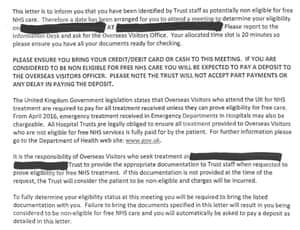
An extract from a letter sent out by the NHS.


An extract from a letter sent out by the NHS.

“Please ensure you bring your credit/debit card or cash to this meeting. Please note the trust will not accept part payments or any delay in paying the deposit,” one letter sent by Barking, Havering and Redbridge University Hospitals NHS trust states. “Failure to pay a deposit for treatment may result in your future appointments being cancelled. In addition, overseas visitors who incur costs for treatment and do not pay will be reported by the trust to the Home Office and debt collecting agencies. The Home Office will review all records of bad debt and this could be detrimental to any future applications to visit the UK.”


NHS rules stipulate that it is legitimate to ask for payment from those who are not eligible for free care (because they are not ordinarily resident in the UK or because they are living here illegally), but emergency treatment cannot be withheld if a patient cannot pay.


A Department of Health spokesperson said staff should be “especially careful to inform pregnant patients that further maternity healthcare will not be withheld, regardless of their ability to pay … our guidance specifically says that maternity care should never be denied or delayed while a patient’s eligibility is established”.


The Barking, Havering and Redbridge University Hospitals NHS trust said that it had recently “updated” the standard letter to make “it clearer that maternity care would never be withdrawn or appointments cancelled”.


Le Déaut said: “It is bad practice to send these letters demanding credit cards. You are not supposed to threaten pregnant women – documented or undocumented – that you are going to withhold services. We are seeing this kind of letter quite often now. These people have no means whatsoever to pay this debt.”


One patient was telephoned weekly by a debt collection agency, which had a negative effect on her mental health, according to staff at the charity.


The pregnancy discrimination charity Maternity Action runs a helpline for women in this situation and has also noted a rise in demand for its services. “We regularly hear from women who are very distressed about receiving large bills from the NHS for their maternity care. It is pointless sending letters of demand to women who can’t afford to pay for their food and housing,” said its director, Ros Bragg.


The Department of Health spokesperson said no one should be denied urgent treatment and “vulnerable people, including those seeking asylum and refugees, are not charged for NHS care they receive”.


The case of a Nigerian woman who gave birth to quadruplets at London’s Queen Charlotte’s and Chelsea Hospital and incurred a bill of several hundred thousand pounds triggered popular hostility earlier this year, but the charity stressed that its patients had not travelled to the UK in search of free medical treatment.


Sarah Pillai, a volunteer GP who works at the east London clinic, said: “This is not health tourism by any stretch of the imagination. These are people at the outer reaches of society, cleaning, cash in hand jobs, providing the infrastructure for society, but unable to access healthcare.


“The women I’ve seen tend to be very anxious and nervous. A lot of these have been women in hiding until now. Lots of these women present late in pregnancy, which has an adverse effect on their pregnancy because delayed antenatal care can create problems for the mother and baby.”


Staff said there was growing awareness among patients of a controversial memorandum of understanding jointly published by the Home Office and NHS Digital that came into effect on 1 January and set out how the Home Office could request information on immigration offenders from the NHS.


Dr Sarah Pillai


Dr Sarah Pillai, a volunteer at the east London clinic: ‘A lot of these have been women in hiding until now.’ Photograph: Sarah Lee for the Guardian

“When they hear if you go to the doctors, the Home Office might be knocking on your door, they choose to stay away,” Le Déaut said. “The results have serious implications; we see women who are nine months’ pregnant coming to our clinic. We assume that some people are giving birth at home”


She said she understood the need to ensure health tourists paid “but a trafficked woman or an undocumented migrant, who has no way of paying bills should be refused care when she is at her most vulnerable?”


Binta, a pharmacist from Sudan, arrived in 2010 to visit her husband, a doctor from Sudan who had a British passport and who had fled Sudan for political reasons. While she was trying to organise permanent residencyshe became pregnant. She was told by the Home Office that she needed to return home to apply for a new visa but did not feel able to travel because she was in the late stages of pregnancy. She was given leave to remain on appeal, but the papers did not come through immediately so she found herself ineligible for NHS treatment.


When the GP referred her for a scan, she was sent a bill for £2,669. “I was very frightened. I thought that they would deport us or that I would be sent to jail,” she said.


Her husband, who has now requalified and is working as an NHS doctor, was unemployed while he studied for UK medical exams and was receiving only £65 a week. “They kept resending the invoice; we received many letters. We couldn’t afford to pay. It distracted me from that beautiful moment of giving birth – all the time I was thinking about the money, are they going to take me to court? It is a part of my life I don’t want to remember again.”


Li arrived in the UK in 2012 after fleeing China because she was being targeted for promoting Christianity. She paid traffickers to get her out of China and arrived in the UK on a false passport. She spent more than a year locked in a house, forced to work for her traffickers, who produced illegal DVDs, to pay back some of her debts. Later she was freed and moved to live with a boyfriend. During her pregnancy, she was wrongly turned away by a GP when she tried to register because she had no papers.


“They asked me to pay £5,000 before I delivered the child. At one of my antenatal appointments, they brought me to a small room and explained I would have to pay more if I needed a caesarean. I felt very scared. There’s no way I can pay that much. I thought about not going to hospital, but I knew I couldn’t deliver a child by myself. I couldn’t cut the umbilical cord.


“When I was in the little room, explaining about the payment plan, I had to fill in a form with my immigration status, my names and address. They said they would hand that to the Home Office. I didn’t know what the Home Office would do – if they could deport me back to China. When I was in labour I was thinking about money all the time.”


She has subsequently begun the process of applying for asylum. She is not working because she is looking after a baby, so is not yet able to begin paying back her debts to the NHS.


Pregnant women without legal status "too afraid to seek NHS care"