'Too etiketine sahip kayıtlar gösteriliyor. Tüm kayıtları göster

20 Mart 2017 Pazartesi

Pregnant women without legal status "too afraid to seek NHS care"

Hundreds of pregnant women without legal status are avoiding seeking NHS antenatal care because of growing fears that they will be reported to the Home Office or face high medical bills, according to charities that work with vulnerable migrant women.


The Guardian has seen letters from one NHS trust sent to women with complex asylum claims warning they will have their antenatal care cancelled if they fail to bring credit cards to pay fees of more than £5,000 for maternity care. These letters contravene NHS guidelines, which state that maternity care should never be denied.


Doctors of the World, which runs clinics for trafficked women, undocumented migrants and asylum seekers whose claims have been rejected, is seeing increasing numbers of women seeking medical help at its clinic in east London in the late stages of pregnancy, who say they are too scared to go to the NHS for fear of high bills or of being reported to the Home Office.


In January, a woman came to the charity’s east London clinic already in labour, having received no antenatal care. “She was very fatigued, she was pale. She had been too frightened to go to hospital because of her immigration status,” said Deman Le Déaut, who runs the women’s and children’s clinic in Bethnal Green.


She was the second woman in four months who had come to the clinic for the first time, at the end of the pregnancy, who had not sought mainstream healthcare. “We are seeing a lot of women six months’ pregnant onwards not accessing medical care. That is incredibly dangerous,” Le Déaut said.


One patient, an asylum seeker from Eritrea, was homeless and living in a bus shelter when she visited the clinic in early pregnancy, having been wrongly turned away from a GP because she had no proof of address.


A number of women have visited the clinic, alarmed by debt-collection letters they have been sent by NHS trusts that instruct them to come to their antenatal appointments with money to make deposit payments of several thousand pounds for maternity care.
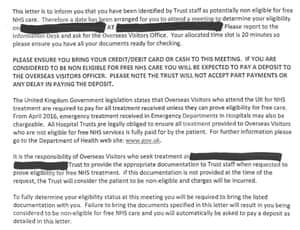


An extract from a letter sent out by the NHS.


An extract from a letter sent out by the NHS.

“Please ensure you bring your credit/debit card or cash to this meeting. Please note the trust will not accept part payments or any delay in paying the deposit,” one letter sent by Barking, Havering and Redbridge University Hospitals NHS trust states. “Failure to pay a deposit for treatment may result in your future appointments being cancelled. In addition, overseas visitors who incur costs for treatment and do not pay will be reported by the trust to the Home Office and debt collecting agencies. The Home Office will review all records of bad debt and this could be detrimental to any future applications to visit the UK.”


NHS rules stipulate that it is legitimate to ask for payment from those who are not eligible for free care (because they are not ordinarily resident in the UK or because they are living here illegally), but emergency treatment cannot be withheld if a patient cannot pay.


A Department of Health spokesperson said staff should be “especially careful to inform pregnant patients that further maternity healthcare will not be withheld, regardless of their ability to pay … our guidance specifically says that maternity care should never be denied or delayed while a patient’s eligibility is established”.


The Barking, Havering and Redbridge University Hospitals NHS trust said that it had recently “updated” the standard letter to make “it clearer that maternity care would never be withdrawn or appointments cancelled”.


Le Déaut said: “It is bad practice to send these letters demanding credit cards. You are not supposed to threaten pregnant women – documented or undocumented – that you are going to withhold services. We are seeing this kind of letter quite often now. These people have no means whatsoever to pay this debt.”


One patient was telephoned weekly by a debt collection agency, which had a negative effect on her mental health, according to staff at the charity.


The pregnancy discrimination charity Maternity Action runs a helpline for women in this situation and has also noted a rise in demand for its services. “We regularly hear from women who are very distressed about receiving large bills from the NHS for their maternity care. It is pointless sending letters of demand to women who can’t afford to pay for their food and housing,” said its director, Ros Bragg.


The Department of Health spokesperson said no one should be denied urgent treatment and “vulnerable people, including those seeking asylum and refugees, are not charged for NHS care they receive”.


The case of a Nigerian woman who gave birth to quadruplets at London’s Queen Charlotte’s and Chelsea Hospital and incurred a bill of several hundred thousand pounds triggered popular hostility earlier this year, but the charity stressed that its patients had not travelled to the UK in search of free medical treatment.


Sarah Pillai, a volunteer GP who works at the east London clinic, said: “This is not health tourism by any stretch of the imagination. These are people at the outer reaches of society, cleaning, cash in hand jobs, providing the infrastructure for society, but unable to access healthcare.


“The women I’ve seen tend to be very anxious and nervous. A lot of these have been women in hiding until now. Lots of these women present late in pregnancy, which has an adverse effect on their pregnancy because delayed antenatal care can create problems for the mother and baby.”


Staff said there was growing awareness among patients of a controversial memorandum of understanding jointly published by the Home Office and NHS Digital that came into effect on 1 January and set out how the Home Office could request information on immigration offenders from the NHS.
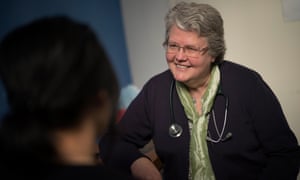


Dr Sarah Pillai


Dr Sarah Pillai, a volunteer at the east London clinic: ‘A lot of these have been women in hiding until now.’ Photograph: Sarah Lee for the Guardian

“When they hear if you go to the doctors, the Home Office might be knocking on your door, they choose to stay away,” Le Déaut said. “The results have serious implications; we see women who are nine months’ pregnant coming to our clinic. We assume that some people are giving birth at home”


She said she understood the need to ensure health tourists paid “but a trafficked woman or an undocumented migrant, who has no way of paying bills should be refused care when she is at her most vulnerable?”


Binta, a pharmacist from Sudan, arrived in 2010 to visit her husband, a doctor from Sudan who had a British passport and who had fled Sudan for political reasons. While she was trying to organise permanent residencyshe became pregnant. She was told by the Home Office that she needed to return home to apply for a new visa but did not feel able to travel because she was in the late stages of pregnancy. She was given leave to remain on appeal, but the papers did not come through immediately so she found herself ineligible for NHS treatment.


When the GP referred her for a scan, she was sent a bill for £2,669. “I was very frightened. I thought that they would deport us or that I would be sent to jail,” she said.


Her husband, who has now requalified and is working as an NHS doctor, was unemployed while he studied for UK medical exams and was receiving only £65 a week. “They kept resending the invoice; we received many letters. We couldn’t afford to pay. It distracted me from that beautiful moment of giving birth – all the time I was thinking about the money, are they going to take me to court? It is a part of my life I don’t want to remember again.”


Li arrived in the UK in 2012 after fleeing China because she was being targeted for promoting Christianity. She paid traffickers to get her out of China and arrived in the UK on a false passport. She spent more than a year locked in a house, forced to work for her traffickers, who produced illegal DVDs, to pay back some of her debts. Later she was freed and moved to live with a boyfriend. During her pregnancy, she was wrongly turned away by a GP when she tried to register because she had no papers.


“They asked me to pay £5,000 before I delivered the child. At one of my antenatal appointments, they brought me to a small room and explained I would have to pay more if I needed a caesarean. I felt very scared. There’s no way I can pay that much. I thought about not going to hospital, but I knew I couldn’t deliver a child by myself. I couldn’t cut the umbilical cord.


“When I was in the little room, explaining about the payment plan, I had to fill in a form with my immigration status, my names and address. They said they would hand that to the Home Office. I didn’t know what the Home Office would do – if they could deport me back to China. When I was in labour I was thinking about money all the time.”


She has subsequently begun the process of applying for asylum. She is not working because she is looking after a baby, so is not yet able to begin paying back her debts to the NHS.


Pregnant women without legal status "too afraid to seek NHS care"

17 Şubat 2017 Cuma

"Eating disorders are black women’s issues too" – video

In the second of our three-part Speak your Mind series, we meet Georgia, 22, who suffered from eating disorders through her teenage years. Thinspiration Tumblrs inspired her to lose weight but that spiralled to starvation and bulimia. Now recovered, she wonders why black women are rarely identified as having eating disorders


"Eating disorders are black women’s issues too" – video

24 Şubat 2014 Pazartesi

"Men and boys get raped too"

“If men feel like they can’t talk about it, or they really don’t comprehend that it’s abuse, then it’s only going to complicate their feelings about being violated in the initial place,” he says. “There’s something in that procedure of violation that is a bit like losing a battle – you truly feel like you have been as well weak, you misplaced management of your own physique, you should have fought back. People typically come to feel like it’s their fault.”


Craig understands much better than most the realities of sexual abuse, why it can frequently get men so lengthy to talk about it – and why all-male help groups are so essential when they do. From the age of 11 to 16 he was groomed and then raped by an older “authority figure” in his east Manchester community, but it was only a decade later on, when he was instruction to be a therapist himself, that he fully understood what had happened to him.


“He began by acquiring my sweets and modest gifts, performing everything he could to normalise the procedure,” Craig says of the guy. “As I grew to become far more grownup, the abuse grew to become more grownup – it moved on from factors like tickling, making an attempt to break down my boundaries, to currently being raped.


“Then, when I was carrying out my psychotherapy coaching in my 20s, I realised a client’s personalized experience was actually affecting me. I brought it up with my supervisor, who asked me why I believed that was. I informed her it reminded me of a connection I’d had when I was a boy – I utilised the word relationship – and when she asked me how old the other particular person was, I informed her he was in his fifties. As soon as I stated that I just broke down, due to the fact I couldn’t believe I’d never seen it for what it was just before.”


Duncan Craig has appeared in a government-produced video with Hollyoaks actor James Sutton, aimed at breaking the taboo close to male rape


Soon after so a lot of years of repressing this childhood knowledge, Craig looked for a specialist services for male survivors of sexual abuse but found there was nothing offered in his area. He had to travel down to a group in Wiltshire, which has given that been closed, to speak to males with equivalent stories. Comprehending that he wasn’t alone was a key second in coming to terms with what had happened to him and it was then, he says, that he made a decision to set up a related group of his very own in Manchester.


“I feel if there had been more things in the media, or an organisation like Survivors at the time this was happening, I would have been more mindful that anything was wrong,” Craig says. “Things are better now but there are nonetheless only a handful of other organisations like ours close to the country, so it’s a postcode lottery whether or not you can get support. I’d like to see so numerous more.”


London-primarily based researcher Michael, 42, also understands the benefits of men-only group treatment. He was repeatedly raped by his father for about a yr from the age of eight but, like Craig, left it many years prior to he sought aid.


“I was in my 30s and had just come out of a connection,” Michael remembers. “I was mindful that this sexual abuse may well have had an effect on the break-up, but it wasn’t some thing I needed to handle head on. I had a feeling of shame, guilt and complicity in what had took place.


“I usually located it hard to bring it up with individuals close to me, and then I couldn’t describe why I at times grew to become withdrawn and angry. A single time I did mention it to a girl I was seeing and she recommended I talk to a person, but I considered ‘what’s the stage of that?’”


After that relationship ended, Michael began going to sessions at Survivors United kingdom, a London-primarily based organisation for male victims, and speaking about the abuse. Via group sessions, Michael started to realise that he wasn’t the only man this has took place to and that he didn’t have to carry this feeling of guilt about with him permanently. Now he runs informal assistance groups himself and says he finds it “heartbreaking” when guys in their 60s or even 70s come in to talk about assaults that took location many decades ago, having buried their experiences for so extended.


Of program, rape is not the only concern. Some 72,000 guys are victims of sexual offences each 12 months, in accordance to official estimates, whilst other studies recommend as a lot of as one particular in 6 guys are the topic of “unwanted sexual attention” ahead of the age of 16. Alisdair, now 49 and the director of a recruitment company, was heavily concerned with the church in his first yr at university but located unwanted advances from senior figures in it left him wary of sexual speak to for many years. “After what happened I didn’t know how to deal with something even more than kissing. I felt awkward about individuals touching me sexually and that genuinely delayed my sexual improvement,” he says.


Alisdair followed a equivalent path to Michael when it came to dealing with the assault. “It came out very significantly later, in my late 20s, when a spouse left me and I had counselling. Most absolutely if there had been organisations like Survivors United kingdom on campus I would have spoken to them straight away I would have been a lot more aware that what had occurred was wrong. The only man or woman I could have confided in was a Methodist minister, and he wouldn’t have identified how to deal with it at all.”


Michael Harris, a senior manager at Survivors Uk, welcomes the information of the government fund but is keen to ensure the funds, when it is launched in October, will go to males-only companies, rather than groups which primarily cater for females even though providing some assistance for male victims. “There’s no competing agenda, but there are a good deal of survivors who inform us they want to go to a male-only support,” he says. “They do not want to feel like the therapy they are acquiring is secondary.”


He adds: “From infancy we’re informed that boys don’t cry and if you’re sturdy sufficient you can fight individuals off. You’re advised that your function is to penetrate, so if you are raped and you’re penetrated, what does that make you: a female? Gay? And there are a lot of other sorts of sexual abuse. It is so great that this is being talked about a lot more and people are coming to our solutions, but we require the money to be ready to offer them.”


For much more details check out Survivors Uk, Survivors Manchester or the Brighton-based mostly Mankind


"Men and boys get raped too"

29 Ocak 2014 Çarşamba

BPA Publicity Is "Too Reduced to Trigger Harm," In accordance To Regulators. But You"d In no way Know That From The Media Coverage.

Suppose a new authoritative evaluation revised the estimate of your lifetime odds of being struck by a meteorite — from, say, a single in a hundred billion to a single in 10 billion.  Should that tenfold boost in the probability make you any more concerned?  No– since both values are someplace between negligible and infinitesimal.


A similar and much more pertinent query of that kind was posed by an announcement earlier this month by the European Foods Security Authority of a new “tolerable daily intake” (TDI) of a typical industrial chemical called bisphenol-A (BPA).  (BPA has been utilised for the past half century to make shatterproof polycarbonate plastics and is an ingredient in the epoxy safety liners of foods and beverage cans that shield shoppers from meals poisoning.)


At the exact same time that regulators reduced the TDI for BPA, they emphasized that human exposure comes nowhere close to the new, stricter restrict – a essential point missed by a lot of journalists and commentators.


TDI is an assessment of a person’s highest everyday consumption of a substance that can happen each and every day for a lifetime with out appreciable risks.  It is based on studies of relevant animal species and is intentionally set extremely conservatively.  In 2010, EFSA assessed BPA and set a TDI of 50 micrograms per kilogram of body weight per day.  In the current announcement, EFSA up to date that evaluation, proposing a lowered TDI of five micrograms per kilogram of body bodyweight per day.


Chemical structure of bisphenol A.

Chemical construction of bisphenol A. (Photo credit score: Wikipedia)


The updated, diminished TDI, which was proposed to reflect data from new studies that have become available given that 2010, represents a very conservative technique.


Taken at face worth, this TDI reduction might appear to be an indictment of BPA and to reflect a risk to human well being and, predictably, a lot of activists groups have touted the proposed modify as this kind of.  But EFSA’s most significant finding is buried deep in information reviews, if it is present at all: Even measured towards the proposed diminished TDI, “EFSA finds there is no overall health concern, as the highest estimates for mixed oral and non-oral publicity to BPA are three-five occasions lower than the proposed TDI, dependent on age group.”


Bolstering that conclusion is a related evaluation last 12 months by the U.S. Meals and Drug Administration, which concluded that “BPA is safe at the really reduced amounts that take place in some foods”–an evaluation “based on evaluation by FDA scientists of hundreds of scientific studies such as the most recent findings from new scientific studies initiated by the company.”


EFSA employed new data and details gleaned from more than 450 scientific research to propose the lower TDI, which is in essence a distinction without a difference: Even assuming the highest exposure estimates for any age group, from fetuses to the elderly, BPA consumption is well below the extremely conservative, up to date TDI.


Placing it another way, despite the fact that BPA’s TDI has been lowered, the sensible impact stays the exact same: No matter whether 50 or five micrograms per kilogram, the TDI is set at a degree to which people are not probably to be exposed.  Thus, reflecting a centuries-previous tenet of toxicology that “the dose tends to make the poison,” BPA is not harmful to human wellness simply because the dose is far as well lower.


One particular crucial takeaway from this revelation is the need to have to consider media reviews on chemical regulation with a big grain of sodium chloride.  The media like “if it bleeds, it leads” stories, specially if they involve particular activist-designated bogeymen, such as chemicals, nuclear electrical power and genetic engineering.  Often, the emphasis is on interest-grabbing headlines about shoddy research or created-up phenomena, this kind of as “BPA Exposure Linked to Prostate Cancer” or “Fukushima Radioactive Materials Washed Up on California Seashores.”  In this instance, even so, we have an exact, science-based mostly report that received uncritical, flawed media coverage.  One headline, for illustration, read, “EFSA Confirms the Hazards of BPA for Well being.”


EFSA’s tenfold decreasing of the TDI is analogous to  a tiny boost in thesa odds of being struck by a meteorite: There is no cause for heightened concern.  The actual story is that yet another mindful evaluation by a prominent regulatory agency has identified that BPA poses negligible danger to human well being.


BPA Publicity Is "Too Reduced to Trigger Harm," In accordance To Regulators. But You"d In no way Know That From The Media Coverage.