afraid' etiketine sahip kayıtlar gösteriliyor. Tüm kayıtları göster

20 Mart 2017 Pazartesi

Pregnant women without legal status "too afraid to seek NHS care"

Hundreds of pregnant women without legal status are avoiding seeking NHS antenatal care because of growing fears that they will be reported to the Home Office or face high medical bills, according to charities that work with vulnerable migrant women.


The Guardian has seen letters from one NHS trust sent to women with complex asylum claims warning they will have their antenatal care cancelled if they fail to bring credit cards to pay fees of more than £5,000 for maternity care. These letters contravene NHS guidelines, which state that maternity care should never be denied.


Doctors of the World, which runs clinics for trafficked women, undocumented migrants and asylum seekers whose claims have been rejected, is seeing increasing numbers of women seeking medical help at its clinic in east London in the late stages of pregnancy, who say they are too scared to go to the NHS for fear of high bills or of being reported to the Home Office.


In January, a woman came to the charity’s east London clinic already in labour, having received no antenatal care. “She was very fatigued, she was pale. She had been too frightened to go to hospital because of her immigration status,” said Deman Le Déaut, who runs the women’s and children’s clinic in Bethnal Green.


She was the second woman in four months who had come to the clinic for the first time, at the end of the pregnancy, who had not sought mainstream healthcare. “We are seeing a lot of women six months’ pregnant onwards not accessing medical care. That is incredibly dangerous,” Le Déaut said.


One patient, an asylum seeker from Eritrea, was homeless and living in a bus shelter when she visited the clinic in early pregnancy, having been wrongly turned away from a GP because she had no proof of address.


A number of women have visited the clinic, alarmed by debt-collection letters they have been sent by NHS trusts that instruct them to come to their antenatal appointments with money to make deposit payments of several thousand pounds for maternity care.
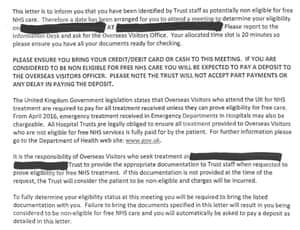


An extract from a letter sent out by the NHS.


An extract from a letter sent out by the NHS.

“Please ensure you bring your credit/debit card or cash to this meeting. Please note the trust will not accept part payments or any delay in paying the deposit,” one letter sent by Barking, Havering and Redbridge University Hospitals NHS trust states. “Failure to pay a deposit for treatment may result in your future appointments being cancelled. In addition, overseas visitors who incur costs for treatment and do not pay will be reported by the trust to the Home Office and debt collecting agencies. The Home Office will review all records of bad debt and this could be detrimental to any future applications to visit the UK.”


NHS rules stipulate that it is legitimate to ask for payment from those who are not eligible for free care (because they are not ordinarily resident in the UK or because they are living here illegally), but emergency treatment cannot be withheld if a patient cannot pay.


A Department of Health spokesperson said staff should be “especially careful to inform pregnant patients that further maternity healthcare will not be withheld, regardless of their ability to pay … our guidance specifically says that maternity care should never be denied or delayed while a patient’s eligibility is established”.


The Barking, Havering and Redbridge University Hospitals NHS trust said that it had recently “updated” the standard letter to make “it clearer that maternity care would never be withdrawn or appointments cancelled”.


Le Déaut said: “It is bad practice to send these letters demanding credit cards. You are not supposed to threaten pregnant women – documented or undocumented – that you are going to withhold services. We are seeing this kind of letter quite often now. These people have no means whatsoever to pay this debt.”


One patient was telephoned weekly by a debt collection agency, which had a negative effect on her mental health, according to staff at the charity.


The pregnancy discrimination charity Maternity Action runs a helpline for women in this situation and has also noted a rise in demand for its services. “We regularly hear from women who are very distressed about receiving large bills from the NHS for their maternity care. It is pointless sending letters of demand to women who can’t afford to pay for their food and housing,” said its director, Ros Bragg.


The Department of Health spokesperson said no one should be denied urgent treatment and “vulnerable people, including those seeking asylum and refugees, are not charged for NHS care they receive”.


The case of a Nigerian woman who gave birth to quadruplets at London’s Queen Charlotte’s and Chelsea Hospital and incurred a bill of several hundred thousand pounds triggered popular hostility earlier this year, but the charity stressed that its patients had not travelled to the UK in search of free medical treatment.


Sarah Pillai, a volunteer GP who works at the east London clinic, said: “This is not health tourism by any stretch of the imagination. These are people at the outer reaches of society, cleaning, cash in hand jobs, providing the infrastructure for society, but unable to access healthcare.


“The women I’ve seen tend to be very anxious and nervous. A lot of these have been women in hiding until now. Lots of these women present late in pregnancy, which has an adverse effect on their pregnancy because delayed antenatal care can create problems for the mother and baby.”


Staff said there was growing awareness among patients of a controversial memorandum of understanding jointly published by the Home Office and NHS Digital that came into effect on 1 January and set out how the Home Office could request information on immigration offenders from the NHS.
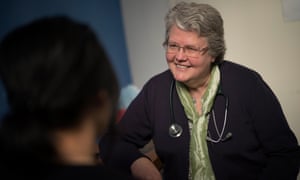


Dr Sarah Pillai


Dr Sarah Pillai, a volunteer at the east London clinic: ‘A lot of these have been women in hiding until now.’ Photograph: Sarah Lee for the Guardian

“When they hear if you go to the doctors, the Home Office might be knocking on your door, they choose to stay away,” Le Déaut said. “The results have serious implications; we see women who are nine months’ pregnant coming to our clinic. We assume that some people are giving birth at home”


She said she understood the need to ensure health tourists paid “but a trafficked woman or an undocumented migrant, who has no way of paying bills should be refused care when she is at her most vulnerable?”


Binta, a pharmacist from Sudan, arrived in 2010 to visit her husband, a doctor from Sudan who had a British passport and who had fled Sudan for political reasons. While she was trying to organise permanent residencyshe became pregnant. She was told by the Home Office that she needed to return home to apply for a new visa but did not feel able to travel because she was in the late stages of pregnancy. She was given leave to remain on appeal, but the papers did not come through immediately so she found herself ineligible for NHS treatment.


When the GP referred her for a scan, she was sent a bill for £2,669. “I was very frightened. I thought that they would deport us or that I would be sent to jail,” she said.


Her husband, who has now requalified and is working as an NHS doctor, was unemployed while he studied for UK medical exams and was receiving only £65 a week. “They kept resending the invoice; we received many letters. We couldn’t afford to pay. It distracted me from that beautiful moment of giving birth – all the time I was thinking about the money, are they going to take me to court? It is a part of my life I don’t want to remember again.”


Li arrived in the UK in 2012 after fleeing China because she was being targeted for promoting Christianity. She paid traffickers to get her out of China and arrived in the UK on a false passport. She spent more than a year locked in a house, forced to work for her traffickers, who produced illegal DVDs, to pay back some of her debts. Later she was freed and moved to live with a boyfriend. During her pregnancy, she was wrongly turned away by a GP when she tried to register because she had no papers.


“They asked me to pay £5,000 before I delivered the child. At one of my antenatal appointments, they brought me to a small room and explained I would have to pay more if I needed a caesarean. I felt very scared. There’s no way I can pay that much. I thought about not going to hospital, but I knew I couldn’t deliver a child by myself. I couldn’t cut the umbilical cord.


“When I was in the little room, explaining about the payment plan, I had to fill in a form with my immigration status, my names and address. They said they would hand that to the Home Office. I didn’t know what the Home Office would do – if they could deport me back to China. When I was in labour I was thinking about money all the time.”


She has subsequently begun the process of applying for asylum. She is not working because she is looking after a baby, so is not yet able to begin paying back her debts to the NHS.


Pregnant women without legal status "too afraid to seek NHS care"

28 Kasım 2016 Pazartesi

Don’t Be Afraid to Make Mistakes, Dare Instead

Successful people are not afraid to make mistakes. They know that they learn from them. After every mistakes they make, they are aware that success is just around the corner. Idea is the first step towards riches. However, the idea may never see the light of day if you don’t dare. Success is impossible without the don’t courage to act boldly. Even if you fail, be persistent. Complete the tasks and achieve your dreams.


Staying in you comfort zone is easy, it takes no action, but it also doesn’t bring any results. By staying passive you allow other influences control your life. Instead of you controlling your situation, you allow other things and other people control you.


Why is it so hard


Although daring seems intimidating, if you can control your mind to avoid all the fears that stop you from being great, you can achieve things you have always dreamed of. You’ll live an amazing life. If you are struggling with self-esteem, you need to become aware that you are the person who controls your own thought. By having more positive attitude, you make more positive results. Act. Release your fear. Don’t be afraid to make mistakes.


Don’t be afraid of being judged. People will judge you whatever you do.


It is easier than it seems


By replacing your negative thoughts by positive ones in every situation you find yourself, you make your subconscious mind have positive attitude about all the situations you find yourself. Thus, you create your positive mindset. Subsequently, your positive mindset can only bring positive results. And, you’ll live the life you’ve always wanted.


The key to every success story is to never give up. If you analyze all successful people in this world, you’ll find out that they made more mistakes than everyone else. However, persistence made them great. They did not give up. This is crucial for your success story.


What to do


Go meet new people, take the trip abroad you’ve always dreamed of, start learning a new language, start exercising. You’ll see that it was the first step that was the most difficult to make. After you make the first one, the next one seems to be easier than before. When you start doing it, you’ll find yourself with more self-confidence. And, you’ll be ready for more difficult tasks such as find a better job, start your own business, immigrate to a new country, start studying at the University etc. Don’t worry when you make a mistake during your journey. Everyone makes them. People who don’t make mistakes, don’t do much. Learn from your mistakes and don’t let them discourage you or make you feel bad about yourself. It is impossible to succeed without making at least one mistake. Furthermore, you need to learn how to encourage yourself. You don’t need encouragement from other people. You’ll never find it, anyway. Therefore, don’t feel the need to be motivated from other people.


It all depends on your thoughts and actions


You are the only motivation you need. Don’t blame others for your failures, because you are in control of your own destiny. Willpower and self discipline make you stronger, better and more courageous. Take action and be a doer. Don’t let laziness and passiveness discourage you. Be certain that you’ll make mistakes. It’s part of the game. Be initiative and start acting now. Imagine all the results you’ll get from your actions. Become aware of all the experience you’ll gather from your journey. Imagine how much a better person you’ll become from all those actions. Become aware of your confidence. Imagine the results. Become aware of the success. Have faith. And you’ll get what you always wanted.


Sources:


TheGuardian.com


HuffingtonPost.com


Enterpeneur.com


Don’t Be Afraid to Make Mistakes, Dare Instead

1 Kasım 2016 Salı

US veterans on life after the Iraq war: "I don’t want my son to be afraid of me" – video

In 2007 Sean Smith made an award-winning film about the Apache Company Stryker Brigade Combat Team during war in Iraq. Nine years on, the soldiers are back in the United States. They discuss post-traumatic stress and how their experiences in Iraq affect their daily lives and their political beliefs in 2016


US veterans on life after the Iraq war: "I don’t want my son to be afraid of me" – video

24 Ağustos 2015 Pazartesi

Female Viagra? Almost everything You Wanted to Know About Sex Drug Flibanserin But Have been Afraid To Request

[unable to retrieve complete-text content material]


Female Viagra? Every thing You Wanted to Know About Flibanserin But Had been Afraid To Inquire I&rsquom a 37-yr-old married female with two small young children, a total-time work, and not enough hours in the day. Putting my occupation as a journalist aside, you&rsquore darn straight I have a lot of queries about the [...]


Female Viagra? Almost everything You Wanted to Know About Sex Drug Flibanserin But Have been Afraid To Request

25 Mart 2014 Salı

FGM fees towards medical doctor "have left medical staff afraid"

Whittington hospital

Dr Dhanuson Dharmasena from the Whittington hospital in London is 1 of the 1st to be charged under the Female Genital Mutilation Act. Photograph: Steve Parsons/PA


Victims of female genital mutilation could be left bleeding right after childbirth simply because health care workers are now afraid they might be prosecuted if they repair harm in the incorrect way, a single of the country’s leading authorities in maternal overall health has warned.


Prof Peter Brocklehurst, director of the Institute for Women’s Wellness at University University London, stated the first ever expenses announced final week towards a medical professional who is said to have repaired a mutilation on a mother after childbirth had sparked “a great deal of fear amid midwives and obstetricians about what they can and cannot do to control haemorrhaging”.


Some female genital mutilation requires sewing up the vagina to leave a tiny hole and childbirth leads to significant bleeding that demands quick fix.


“Your primary goal is to reduce the bleeding and pain and you are possessing to think about regardless of whether someone is going to prosecute you for FGM,” Brocklehurst explained. “A good deal of obstetricians and midwives right now will be feeling terrified about how to act. Individuals will want to check with senior colleagues in FGM cases and girls may possibly be waiting and bleeding in the meantime.”


His feedback came right after Dr Katrina Erskine, consultant gynaecologist and head of obstetrics at Homerton hospital in Hackney, north-east London, voiced anger at the prosecution of Dr Dhanuson Dharmasena, 31, a registrar in obstetrics and gynaecology at the Whittington hospital, north London, for allegedly carrying out FGM on a patient.


The director of public prosecutions, Alison Saunders, trumpeted the expenses final week against Dharmasena and yet another guy as the 1st ever beneath the Female Genital Mutilation Act – 29 years following FGM 1st grew to become unlawful in England and Wales. The decision to charge a hospital medical doctor in excess of a fix rather than somebody accountable for carrying out the mutilation in the initial spot has sparked concern in components of the medical occupation.


Erskine mentioned repairing preceding FGM procedures should not be regarded a criminal act.


“All females are asked if they have been reduce [just before labour] and if there is only a small opening they are provided a approach referred to as defibulation,” she explained. “Some don’t want to be opened just before going into labour. Then the infant comes out and there is tons of blood and the medical professional has to sew it up. That is not FGM. FGM is slicing off the clitoris and labia minora. Which is what can make me truly angry.”


The Crown Prosecution Services (CPS) stressed that the facts of the Dharmasena situation were however to be heard in court, and said there was ample evidence and the prosecution was in the public interest.


Joseph Aquilina, advisor obstetrician at the Royal London hospital, questioned no matter whether “the CPS are barking up the wrong tree”.


“If [the FGM] is done presently and [repairing it] is going to cease the bleeding then so be it,” he explained. “Offered the woman’s consent is involved that would be a personal matter amongst the physician and the patient. Hospital medical doctors who are faced with FGM have to restore it to stop the bleeding simply because the damage is currently carried out.”


Earlier Saunders informed MPs that healthcare, educational and social function employees must be necessary by law to report to the police suspected cases of female genital mutilation. She stated that more than the past two to 3 years only eleven FGM circumstances had been referred to the CPS by police, despite at least 144 complaints currently being manufactured to police. She mentioned the lack of prosecutions stemmed from a lack of evidence rather than flaws in the legislation.


Keith Vaz, chairman of the property affairs select committee, stated it had heard evidence that as many as 66,000 girls in England and Wales had been subjected to FGM.


“Eleven referrals sounds a extremely small figure,” he said.


Saunders mentioned it was no use waiting for “the archetypal youthful girl to come via the door” who was ready to give proof towards her family members. What was required was far more “intelligence-led investigations” and much more experts referring instances to the police.


FGM fees towards medical doctor "have left medical staff afraid"