Take etiketine sahip kayıtlar gösteriliyor. Tüm kayıtları göster

14 Nisan 2017 Cuma

Desperate hospitals beg doctors to take on extra shifts – at £95 an hour

Desperate hospitals are so short of doctors they are pleading with them to take on extra shifts, with some offering up to £95 an hour to cover gaps in medical rotas to maintain patient safety.


Hospitals are so chronically understaffed they have been hiking pay rates in recent weeks and bombarding doctors with urgent emails and text messages in a bid to ensure standards of care do not suffer.


On Tuesday, Peterborough City hospital raised the pay available for working overnight that night in its “extremely busy” A&E to £95 an hour for a 10-hour shift to try to attract recruits.


“Exceptionally, we approved a maximum hourly incentivised rate for our senior trust doctors. This will ensure safe medical staffing levels and enable the department to continue to give high quality care to all our patients,” said Neil Doverty, the North West Anglia NHS foundation trust’s chief operating officer.


Hospitals often scramble to make 11th hour arrangements to fill rotas. Last Monday the Dudley Group NHS foundation trust in the West Midlands was forced to increase the fees for senior house officers in its A&E from £60 an hour to £70 an hour for shifts lasting 10 and 12.5 hours.


The Guardian has seen messages sent by dozens of hospitals across England and Wales to doctors which paint a picture of near panic as many of them struggle, often at the last minute, to have enough medics on duty.


Many hospitals have been struggling to find enough doctors to work over the Easter weekend, with some trying more unorthodox approaches to get staff in. West Middlesex hospital in London, which is facing problems staffing its rotas despite having a well regarded bank of staff and paying high locum rates, this week offered any doctor working over the holiday weekend an Easter egg as an incentive.


Faced with an acute shortage of A&E doctors last month, the John Radcliffe hospital in Oxford sent scores of doctors an email entitled “help!” which said: “I am sorry to be sending so many messages but I am in real need here. I am practically begging at this point. I really need some help.


“Can ANYONE help out for any length of the shifts needed this weekend? It really is a matter of keeping the department safe.” The email was sent on 16 March by Brigid Greaney, the medical staffing administrator for the hospital’s emergency department.


This week Lewisham hospital in London, in its search for doctors to staff its general medicine department, sent an email that said: “We are struggling with the cover for on-call shifts this week. Please let me know if you can help.” It offered to cover doctors’ day shifts if they agreed to work nightshifts.


Doctors’ leaders say the problem is getting worse, blaming NHS workforce planning and the pressure of coping with the growing number of patients needing care.


“Hospitals should not be reduced to begging, but what other option do they have when the NHS is so chronically under-resourced? This should set alarm bells ringing right through the NHS,” said Dr Liam Brennan, the president of the Royal College of Anaesthetists.


Dr Mark Holland, the president of the Society for Acute Medicine, said: “Rota gaps are common – very common. I would be surprised if any hospital anywhere has a full complement of staff. There are some trusts under huge stress and where putting a workforce in place is very challenging, I would be surprised if there wasn’t a sense of desperation to get doctors on the shopfloor.”


Hospitals are sometimes being forced to pay well over the normal rates for hard-to-fill shifts because “there is a pan-NHS workforce crisis. This isn’t about greedy doctors,” Holland said.


The emails and text messages show that almost every branch of medicine is experiencing acute shortages of doctors in at least some hospitals. They range from surgery to cardiac care, anaesthetics to A&E and general medicine to intensive care. For example, Manchester Children’s hospital last Tuesday solicited volunteers for 19 “long days” and 26 nightshifts this month in its paediatric intensive care unit “to be paid at the enhanced rate of £60 per hour”.


Some hospitals facing acute shortages are advertising scores of shifts at a time. Milton Keynes hospital this week notified doctors of 52 shifts over 20 days this month in its A&E. Worcestershire Royal hospital in Worcester has so far only filled five of the 69 shifts it is seeking to fill between now and early August.


A doctor at Chesterfield Royal hospital, who asked to remain anonymous, said: “The rota gaps problem here is insurmountable and, frankly, rather dangerous. The quality of my life has been greatly impaired by the busiest winter we had on record followed by no real drive by the trust to recruit more doctors to anticipate this deluge of patients. The biggest culprit is A&E which is almost entirely staffed by locums, most of them being long-term [locums], followed by the emergency medical unit, which is very short on nights and weekends.”


Despite hospitals’ best efforts some shifts are still going unfilled, which puts extra pressure on other staff. A trainee surgeon at a major London teaching hospital said: “I’ve had occasions where instead of having two on-call senior house officers to hand over to, I’ve had to cover both shifts, after already working 12 hours.


“Working locum shifts in short-staffed departments often feels like juggling with your medical licence as your clinical decisions are affected by time pressures and bed shortages more than your assessment of the patient in front of you.”


Hospital bosses warned that endemic understaffing is threatening patient safety.


“Along with high levels of bed occupancy, gaps in rotas can mean patient safety is put at risk. Fewer medical staff on shifts create intolerable workload pressures for all staff. This is bad for morale which has a further impact on the quality of care,” said Saffron Cordery, the director of policy and strategy at NHS Providers, which represents hospitals.


“Workforce pressures are fast becoming the number one concern for many NHS trusts, including hospitals, mental health, community and ambulance services. These are particularly difficult over holiday periods. All types of trust are affected but we know that this can be very challenging in rural areas and in specific specialties. Patient safety is always the top priority and every trust wants to guarantee safe care. The steps described here are an indication of just how seriously they take this,” Cordery added.


A Department of Health spokesperson said: “Staffing is a priority – that’s why we have invested in the frontline and there are over 31,400 more professionally qualified clinical staff including over 11,200 more doctors, and over 12,100 more nurses on our wards since May 2010.


“With over 52,000 nurses in training we will continue to make sure we have the staff available to give patients high-quality care as part of a safer NHS seven days a week.”


Desperate hospitals beg doctors to take on extra shifts – at £95 an hour

10 Nisan 2017 Pazartesi

Should you take your shoes off inside the house?

My brother is a fastidious shoes-off-er. I visited him recently and, within a couple of minutes, he gestured at my feet in horror. “What are those?” he asked. “These?” I replied, pointing to my trainers. “I bought them onli–” “No!” he yelled. “What are they doing on in my house?”


This is the best way to divide people. There are those who despise the thought of rubber on carpet, who lie awake panicking because wearing outdoors shoes indoors upsets the natural order of things. Then there are normal people like me, who don’t really care because they understand the purpose of doormats.


However, as much as I hate to admit it, the shoes-off-ers might be on to something. A recent study led by researchers at the University of Houston has shown that 26.4% of shoes carry Clostridium difficile, while a 2015 study claimed that 40% of shoes carry Listeria monocytogenes. Work on a farm? A 2014 study concluded that your boots are almost certainly covered in E coli. These are not the things that should be traipsed through living rooms.


But I’m not going out without a fight. Sure, it might be more hygienic to remove your shoes at the door, but only infinitesimally so. By all accounts, you’re unlikely to get ill just because someone is wearing shoes in your living room. And if you have got young kids, who bolt in and out of the house without warning at the first sign of sun, it’s much more practical to keep your shoes on. Not to mention dignified; fewer things inspire more pity than the sight of adults flamingoing themselves into knots as they attempt to do up their shoelaces in a narrow hallway at the end of a night.


True, the answer to both of these problems is loafers. But given the choice of loafers or E Coli, I’ll take the latter every time.


Should you take your shoes off inside the house?

6 Nisan 2017 Perşembe

How to Take Care of Combination Skin This Season

Have you ever paid close attention to certain faces that have oily skin in some areas and dry skin in other areas? If your own skin is characterized by oily as well as dry areas, then you might have a combination skin type. Usually, people with combination skin find it tricky to figure out how to take care of their skin properly. It can feel like quite the balancing act when trying to address the oily and dry areas of your skin. Once you achieve this, the mystery to having great skin will be unlocked in much easier ways than you may have thought.


What is combination skin and how is it caused?


To put it simply, someone with combination skin has both skin that is oily in the area called T-zone (forehead, nose, and chin) while also having dryness in other areas. Even if you have oily skin only around your nose and center of your forehead but dry skin over cheeks and jaw area, then you are also said to have a combination skin.


The predominant factor that is responsible for combination skin is the genetics. It is inherited similarly as you would your hair color, eye color, skin color, and the body type from your parents.  Usually the people who have combination skin have more active oil glands on their nose, forehead, and chin which lead to clogged pores in these areas.


The other factors that play a key role in causing combination skin are lifestyle, nutrition, and skincare products. The wrong products for this skin type contain skin-aggravating ingredients that dry out certain areas of your face, while exacerbating oil production in other parts that were already oily. These ingredients are harmful sulfates and alcohols that prompt the skin to produce more oil in the T-zone area which, in turn, produces the symptoms of combination skin.


Important Tips to Follow For Treating Combination Skin


Treating the combination skin requires a dual approach of skincare in which different areas of skin are treated individually along with suitable products. Apart from these steps, there are also some natural ways that help greatly in treating combination skin:


  • Use a gentle but effective cleanser

The skin of your face is the most exposed part of your body. As the day closes in, your skin gets covered with dirt, excess oils, and impurities. So a right cleanser is the one that effectively removes dirt, impurities, and makeup without making skin feel tight, dry, or greasy. It is important to retain the softness rather than causing it to be tightened and aggravated. This is one of the best approaches to gentle skincare for having a natural glow on your face.


  • Balance your skin with a toner

Skin experts recommend using a hydrating, soothing, and non-irritating toner that should consist of skin-revitalizing ingredients and antioxidants. A toner of such quality really helps in effectively nourishing the dry skin and reduces oiliness at the same time.


Apply a gentle and non-abrasive exfoliant in order to gently and effectively exfoliate the combination skin. Products that contain BHA exfoliant are good in helping shed the dead skin without abrasion. It doesn’t require any scrubs or cleansing brushes to unclog pores. Lessen oily skin and gently smooth existing  rough, dry, and flaky skin to revive a healthy glow.


  • Apply a suitable moisturizer

Choose a moisturizer that targets your dry patches of skin and mattes the oily areas of your face. A gel-based moisturizer or a gel-cream moisturizer usually works well. Such a moisturizer is important in helping calm skin, lessen excess oil on the surface, and improve dry areas including around the eyes.


  • Protect your face from sun damage

All the skin types are sensitive towards sun rays – some only a little while others are extremely sensitive. One of the effective ways to counter this is to apply a generous amount of broad spectrum sunscreen with an SPF of 15 or more every day. This is also one of many steps in skincare that can help reduce the early signs of aging. Ideally, you need to apply a nourishing serum or booster over the dry areas and then apply the ultra-light sunscreen over the oily areas.


Conclusion


Your combination skin might be a cause of worry for you but, due diligence on your part in specifically treating different areas of your skin is key. The above mentioned tips can go a long way in treating combination skin. Apart from these, the natural ways like regular exercise, healthy diet, and disciplined fitness regime are also extremely helpful in treating skin problems.  


robin


How to Take Care of Combination Skin This Season

9 Mart 2017 Perşembe

UK workers take fewest sick days since records began

Britons were more likely to struggle into work last year with coughs and colds than at any time since records began almost a quarter of a century ago, according to official figures.


About 137m working days were lost from illness and injury in 2016, said the Office for National Statistics, equivalent to 4.3 days per worker, the lowest rate since 1993, when it was 7.2 days.


Minor illnesses such as coughs and colds accounted for almost a quarter of the days lost due to sickness in 2016, at 34m. The second most common reason for not turning up to work was musculoskeletal problems including back pain, neck and upper limb problems, which accounted for 22.4% of days lost to sickness.


Mental health issues including stress, depression, anxiety and more serious conditions such as manic depression and schizophrenia resulted in 15.8m days being lost or 11.5%.


The total number of work days lost to sickness and injury peaked in the late 1990s at 185m. Although the figure reached a low of 132m in 2013, before rising again in 2014 and 2015, this was down to a steep increase in the working population.


The TUC general secretary, Frances O’Grady, said the fall in the sickness rate showed that “it is a myth that UK workers are always throwing sickies”.


She said: “We are really a nation of mucus troopers, with people more likely to go to work when ill than stay at home when well.


“Sickness absence rates have fallen steadily over the past decade, and let’s not forget that working people put in billions of pounds’ worth of unpaid overtime each year.”


The ONS said the groups with the highest rates of sickness absence were women, older workers, those with long-term health conditions, smokers, public health sector workers and those working in the largest organisations.


“The groups that have seen the greatest reduction in sickness absence rates over the past two decades are workers with long-term health conditions, workers aged 50 to 64, and those in the public sector,” it said.


Wales and Scotland suffered the highest rates of sickness absence in the UK, at 2.6% and 2.5% respectively, while the lowest rate was found in London at 1.4%.


Employees lost 2.1% of the year to sickness compared with 1.4% for the self-employed and the public sector lost 2.9% compared with 1.7% for workers in private firms last year.


ONS statistician Brendan Freeman said: “Since 2003, there has been a fairly steady decline in the number of working days lost to sickness, especially during the economic downturn.


“In recent years, there has been a small rise in the number of days lost, but due to an increasing number of people entering the workforce, the rate per worker and overall sickness absence rate have stayed largely flat.”


UK workers take fewest sick days since records began

27 Şubat 2017 Pazartesi

I"m starting a new job, but will need to take time off soon for therapy

Twice a week we publish problems that will feature in a forthcoming Dear Jeremy advice column in the Saturday Guardian so that readers can offer their own advice and suggestions. We then print the best of your comments alongside Jeremy’s own insights.


I’m about to start a new job, my first with any prospect of security after several years of juggling part-time, short-term contracts, and I’m keen to make a good impression.


However, my previous work pattern and some of the stresses involved have taken their toll and I’ve been struggling with depression for a while. I have just been offered a few months of therapy on the NHS, starting in the next couple of weeks.


The catch is, to take this up I would need to take some time out of my working day. As a certain amount of my work is fairly independent of my colleagues’ input, making up the hours won’t be a problem. I’ve already worked out a few strategies to do this, depending on what would best fit with my new employer’s work pattern.


My worry is that I don’t know how to broach the subject – starting a new job by declaring any health issues is difficult enough, but I fear they may see those involving mental health as a stigma and this makes this worse.


How can I best approach this? I don’t feel I can let the opportunity for treatment go. I’ve done the sums and there’s just no way I can afford to get this privately, now or in the foreseeable future, but I also need this job.


Do you need advice on a work issue? For Jeremy’s and readers’ help, send a brief email to dear.jeremy@theguardian.com. Please note that he is unable to answer questions of a legal nature or to reply personally.


I"m starting a new job, but will need to take time off soon for therapy

31 Ocak 2017 Salı

Take care of your elderly mothers and fathers, says Tory minister

People have just as much of a duty to look after their elderly parents as they do to care for their own children, a health minister has said.


David Mowat made the comments alongside an admission that the government had no “final answer” on how it was going to cope with the rising costs of social care.


Speaking to the House of Commons’ select committee on communities and local government, the minister said that tackling the care crisis involved “interwoven issues” including the question of how society deals with the care of ageing parents.


“One of the things that has struck me is no one ever questions that we look after our children – that is obvious. No one says that is a caring responsibility, it is what we do,” he said.


“I think some of that logic and some of the way we think about that in terms the volume of numbers that we are seeing coming down the track will have to impinge on the way that we think about caring for our parents. Because it is a responsibility in terms of our life cycle which is similar.”


The comments come as the Local Government Association, which represents more than 370 councils in England and Wales, claimed that the social care system was on the brink of collapse. The group is warning the chancellor, Philip Hammond, before the spring budget that failure to act urgently to plug the funding gap could leave councils open to legal challenges as they fail to fulfil their duties under the Care Act.


“The intentions and the spirit of the Care Act that aims to help people to live well and independently are in grave danger of falling apart and failing unless new funding is announced by government for adult social care,” said Cllr Izzi Seccombe, who chairs the LGA’s community wellbeing board.


She said social care was not just about getting people washed and dressed but aspiring to help people live the fullest of lives and with dignity.


Speaking to MPs on the committee, Mowat admitted that demand was rising and social care would inevitably require the UK to spend a higher proportion of its overall income on supporting elderly and disabled people.


“What we do know when we look at the GDP that we spend on care, we spend more than some countries like Germany that we would consider to be comparative and more than Canada,” he said.


But he admitted the total spend would inevitably rise, partly because of an ageing population and because of rapidly rising life expectancy among people with learning disabilities whose care was very expensive.


Mowat said there were “discussions with the Treasury all of the time” about how to cope with the demand.


“Over a period of time, the amount of money our society will spend on care will increase. You then get into what the options are and that is a wider question. There have been a lot of reviews. We are unusual in Europe in that we don’t have a social insurance system or long-term savings scheme,” he said.


The minister said personally he felt that such schemes could only help in the very long term and suggested there was a more pressing need to tackle the issue, including through societal changes.


Part of the answer was ensuring that people felt the responsibility to care for elderly mothers and fathers, said Mowat. He talked about the high levels of “informal caring” that already take place, saying six million people were taking on some form of care responsibility, including 200,000 children, alongside 1.6 million full-time carers.


“Part of the solution is properly bringing those informal carers into some kind of system,” he said, highlighting plans for a carers’ strategy that could help people get back into the workplace. “If people doing more than 10 hours of care a week, it is hard to get back into work.”


Take care of your elderly mothers and fathers, says Tory minister

14 Ocak 2017 Cumartesi

GPs should do more to take pressure off A&E departments, says May

Theresa May is urging GP surgeries to make more effort to provide a seven-day service as she seeks to deflect blame for the deepening crisis in the NHS.


With pressure mounting on the prime minister, amid growing evidence that hospitals are struggling to cope with surging winter demand, Downing Street issued a statement on Friday saying that surgeries should do more to ensure they offer appointments in the evening and at weekends. GP leaders reacted with fury to the announcement and accused May of trying to scapegoat family doctors for the unfolding NHS crisis.


A Downing Street source said: “Most GPs do a fantastic job and have their patients’ interests firmly at heart. However, it is increasingly clear that a large number of surgeries are not providing access that patients need – and that patients are suffering as a result, because they are then forced to go to A&E to seek care. It’s also bad for hospitals, who then face additional pressure on their services.”


Surgeries were told to extend their opening hours, to cover 8am to 8pm, seven days a week, as part of a five-year reform programme, but the government suggested that some GPs were failing to inform patients about the availability of out-of-hours appointments or to offer them at times the public wanted.


Extra funding for out-of-hours care will in future be linked to evidence that it is being tailored by doctors to their patients’ demands and making use of digital technology. Ministers are considering using the digital appointment system to monitor demand and ensure that doctors are responding.


Many doctors already feel they are struggling to meet demand with limited resources. Earlier this week, Simon Stevens, the NHS’s chief executive, suggested May was “stretching it” by claiming that the NHS was getting more than the minimum £8bn by 2020 it had asked for. He made the claim in a combative performance before MPs at the public accounts committee, where he contradicted several of the prime minister’s assertions.


Ministers are determined not to offer additional funding without evidence that the service is being more efficiently managed, and Stevens is pressing ahead with changes he has promised.


Philip Hammond, the chancellor, told the Economist earlier this week: “We don’t have any spare cash. There isn’t a pool of cash available. We’ve been asked to provide the NHS with a certain amount of funding by its own management through to 2020. We’ve done that and more and we expect the NHS to deliver within that envelope.”


Dr Chaand Nagpaul, chair of the British Medical Association’s GPs committee, said: “This is not the time to deflect blame or scapegoat overstretched GP services, when the fundamental cause of this crisis is that funding is not keeping up with demand.


“This is evidenced by the fact the UK spends less on health and has fewer doctors and beds per head than other leading countries, as highlighted by the head of NHS England, Simon Stevens, only this week. Rather than trying to shamelessly shift the blame on to GPs, the government should take responsibility for a crisis of its own making and outline an emergency plan to get to grips with the underlying cause, which is the chronic under-resourcing of the NHS and social care.”


Nagpaul pointed out that GPs already provided care around the clock through their involvement in GP out-of-hours schemes and that many practices already offered evening and weekend appointments. “However, there are examples where extended opening has been abandoned due to lack of demand,” he said. “Government funding for extended opening has also been halved in some areas.”


The Royal College of GPs denounced the government’s move in unusually strong terms and described it as nonsensical. “It’s extremely unfortunate that the prime minister is being reported as pushing forward with a misguided scheme to force GP surgeries to offer routine services from eight to eight, seven days a week, regardless of patient demand or local resources,” said Prof Helen Stokes-Lampard, the college’s chair.


“It is not the case that GP surgery routine opening hours are contributing to the pressures our colleagues in A&E departments are currently facing. GPs and our teams are also struggling to cope with increasing patient demand without enough investment and without nearly enough family doctors and practice staff to deal with it; this is a year-long problem for us, not just during the winter.


“It has never made sense to force GPs to offer services that there is little patient demand for. In many cases, practices have already had to actually stop offering extended opening hours because of a lack of patient demand for them. Blaming GPs for the crisis facing our NHS is not going to help anyone. Instead we need to start investing in our health service properly, so that there are adequate resources and clinical staff to deliver the care our patients need and deserve.”


The shadow health secretary, Jon Ashworth, said: “The Conservatives promised this in their manifesto six years ago. We don’t need more broken promises, but clear action, starting with facing up to social care needs that have been subjected to cuts of £4.6bn under the Tories. This is another example of Theresa May’s floundering in the response to the NHS crisis.”


GPs should do more to take pressure off A&E departments, says May

9 Aralık 2016 Cuma

"It could be any of these men": how we learned to take stalking seriously

About five years after the first emails arrived, the death threats started. When Sarah first began receiving messages from a man expressing a romantic interest, she shrugged them off. “I didn’t realise for some time that I had a stalker,” she says. They seemed confused and clumsy; strange, but nothing much to worry about. Later, when they became threatening – the man stalking her said he would attack her, or kill her – she went to the police. Even then, the police said it wasn’t very significant and not to worry about it. She was reassured at first, until she began to suspect that wasn’t the best advice. “I realised from the content of some of the messages that he was referring to real events in my life and that, according to him, we had met on one or two occasions. I don’t recall ever meeting him. I was alarmed – he wasn’t just a random person on the internet. Or he was, but he had taken a great deal of trouble to find out information about me. It was at that stage that I became really quite frightened that he might carry out one of these threats.”


She kept contacting the police, including making one statement at 4am “when I had received a number of threats and I couldn’t take it any more, and thought I would have to go and sleep at the police station”. Still nothing was done about it. “Eventually I found a very motivated police officer, who hadn’t had much training in this, but she made it her business to make something happen. With her support, I did eventually get somewhere, but I still had to do all of the preparation myself. I had started a long process of educating myself and educating the police. I had to learn everything myself.” The victim log she put together would detail how at one point she was receiving up to 10 emails a day.


Thinking back to when it started, Sarah says that if she had known more about stalking then, she would have gone to the police much earlier and pushed them to take it seriously. “I think it’s normal for people to think it doesn’t mean anything, or it will go away, but in my case it reached a point where it was unbearable. The earlier it can be stopped, the better.”


This week, the home secretary, Amber Rudd, announced plans for new Stalking Protection Orders, which would hopefully address this, and at an early stage. It would allow courts to ban stalkers from contacting their victims, even if they hadn’t been charged or convicted.


It has largely been welcomed by anti-stalking campaigners. “Anything that is another tool to deal with a stalker is great news,” says Jane Harvey, campaigns director of Network for Surviving Stalking. “But we need to get some of the basic building blocks in place. It takes people a long time to recognise what’s happening to them as stalking, so there’s under-reporting, and then at an early stage of a case, things can go wrong – a police officer hasn’t had training in stalking and the case is dismissed, or another element, such as criminal damage, will be seized upon instead of seeing the wider picture.”


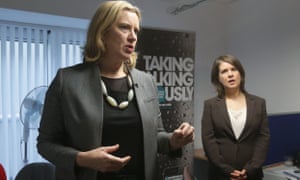
Anti-stalking charities have broadly welcomed the new powers introduced by Home Secretary Amber Rudd, pictured at the Suzy Lamplugh Trust this week.


Anti-stalking charities have broadly welcomed the new powers introduced by home secretary Amber Rudd, pictured at the Suzy Lamplugh Trust this week. Photograph: Yui Mok/PA

Catherine Skinner, chief executive of the charity Paladin, says: “You still hear that [police officers and others in the criminal justice system] don’t see the risks; they don’t see how the behaviour of the perpetrator can not just psychologically affect the victim – we see issues of suicidal ideation from our clients. But also there could be threats to kill, a history of violence, and things that could put victims at high risk.”


Research by the Suzy Lamplugh Trust has found that one in five women and one in 12 men will experience stalking. There have been several high-profile cases recently – a man was jailed in September for stalking the broadcaster Emily Maitlis for 25 years; in June, a man who stalked the singer Lily Allen for seven years, breaking into her house and entering her bedroom, was detained indefinitely under the Mental Health Act.


It is largely an unreported crime. The Suzy Lamplugh Trust estimates that in England and Wales, more than 1.1 million people are stalked each year, but police recorded 4,156 stalking crimes in the year to June, and just 1,102 cases were prosecuted. The proposed new protection orders are “a good thing,” says Victoria Charleston, policy and campaigns officer of the trust. “Where we are cautious is if the police are responsible for applying for these orders. If they’re not recognising stalking at the moment, are we clear that they are going to think about using them? We hope that there will be further training for police.”


It’s not a typical crime, Charleston says. “It’s a pattern of behaviour. It can be very small to begin with, before it escalates.” It is also a fairly new area for many health and criminal justice professionals. “It wasn’t really recognised until the 1980s, and the current anti-stalking legislation didn’t come in until 2012 [in England and Wales],” she adds. In October, Alex Chalk launched a private members’ bill to increase the maximum sentencing of five years. One of his constituents, Dr Eleanor Aston, a GP, had been targeted for seven years by a man who continued to stalk her even after serving a prison sentence for it.


Shan Parker, who lives in north Wales with her partner and daughter, has experienced stalking by a neighbour for the past five years. He would watch from his doorstep every time she left the house or came home. After about six months, when Parker was returning to work after maternity leave, he would follow her to work in his car. Around six months after that, he started following her partner as well. “On the days when he didn’t, it still made me nervous because I didn’t know where he was,” she says. “I didn’t know if he would turn up somewhere else.” The police have been repeatedly involved, but Parker feels there has been little support. “I’ve had anxiety and panic attacks. It’s caused a lot of stress between me and my partner. I feel awful for my daughter, who has had to grow up with visits from the police, and us watching over our shoulders.”


This year, research by the Suzy Lamplugh Trust found that 36% of stalking cases included online behaviours. For Emily, the man who stalked her was not someone she had met, but someone who became fixated on her and her family online. He found out her family’s email addresses and bombarded them with emails about her. “We reported it to the police and they said: ‘Just keep an eye on it and see what happens.’” He went quiet for a while, then started up again, trying to follow their various social media accounts. Shortly after this, he turned up at her parents’ house and tried to get in; he was arrested, and is awaiting sentencing. “It has been absolutely horrific,” Emily says. “I didn’t feel safe anywhere. I still check under my bed, in my cupboard. I spent £1,500 getting new locks put on my house. On the street, I don’t make eye contact with men. You lose all sense of faith in people.”


stock picture of anonymous silhouette


Amy, who has been stalked for four years, said she would keep her curtains closed in summer in case her stalker was watching her. Photograph: Thomas Fricke/Getty Images/First Light

Something similar happened to Beth Rylance, an actor and writer, who was stalked for several months in 2014 by a man who followed her on Twitter. She noticed him “liking” or replying to every tweet she wrote, and he would write about her on his own account. Eventually she blocked him and complained to Twitter several times. “But he would often delete his tweets, so Twitter would say they weren’t violent or harmful, and they couldn’t do anything about them. It was often a robotic reply. It wasn’t like they’d actually researched it and checked out what was going on. They did nothing.”


He started contacting her friends, and a few months later, he turned up on her doorstep. “It was horrific. When I started getting a bit worried about it, I used to picture in my head what I would do if I saw him. You think of the worst-case scenario, so when he turned up I wasn’t expecting it – but I also sort of was.” She screamed, slammed the door and called the police. When they arrived, they found him still sitting on her doorstep, tweeting about her. Later, looking at his account, she saw that the man – who lived several hundred miles away – had spent the week walking around her area, looking in pubs and cafes for her.


Amy has been stalked by a man for the last four years – an acquaintance from several years ago who developed a fixation with her. “It has gone from unwanted text messages and phone calls to hand-delivered letters and gifts,” she says. “They are all of a very strange nature. He’s delusional and has mentioned God having a plan for us to be together.” The first couple of times she went to the police about it, they talked her out of making a complaint, saying they would just have a word with the man. Later, he was charged with harassment without violence (rather than stalking), and after it went to court, he was given a restraining order, which he ignored. Even though he had breached the order, she says the police were dismissive of her – it was only after she got in touch with the National Stalking Helpline, who contacted the police on her behalf, that they followed it up. “Before, they would say things like ‘chances are you won’t hear from him again’. But it was obvious I would.”


The experience has had a huge effect on her life. In the summer, she says she was staying at home all day with the curtains closed because she was worried he would walk past the window and see her. “As soon as I walk in the door, I check for any letters. I feel really tense. Every time he is punished with a restraining order or community service hours, I don’t completely relax because the pattern is that it will start again at some point. The thing I would really like is for the mental health aspect to be recognised, because I think that is the root cause of the problem with him. People say [we should] make the stalking laws stricter, but it seems a shame to put someone into prison when it could be dealt with as a mental health issue. I would feel more reassured if he was being treated than if he was just going into prison and coming out again.”


Frank Farnham, consultant forensic psychiatrist at Barnet, Enfield and Haringey Mental Health NHS Trust, and a specialist in stalking behaviours, also favours treatment over custodial sentences for many offenders – not least because it is more likely to reduce reoffending, and is far cheaper. But one of the problems with the new stalking prevention order model, he says, is that requiring mental health treatment as part of the order might be too optimistic – if the offender doesn’t give consent, it can only be done under the Mental Health Act. But he does like the idea of requiring assessments. Stalking behaviours can look similar, but the motivations can be very different.


It is widely accepted there are five categories of stalker. The largest – thought to be somewhere between a third and a half – is the “rejected” stalker: someone, usually a man, upset by the end of a relationship who harasses his ex-partner. “That group are not usually mentally ill, but they might have personality problems – they can be quite grandiose, narcissistic. If you take that group away, there are very high rates of mental illness in [the other] groups.”


Intimacy seekers are “deluded” people who believe they are in a relationship with their victim, or could be. “The problem with that group is that if you believe you are on a mission from God, or convinced you’re destined to be [together], simply imposing an order isn’t going to stop you from doing it.” A third group – “incompetent suitors” – are not deluded but their behaviour may be due to a learning disability, and they don’t realise it is frightening or inappropriate. The “resentful” stalker is someone who harasses a person they believe is to blame for something that has happened to them – it is not uncommon for MPs, councillors and GPs to be stalked like this. “Some of those people are mentally ill – their paranoia is so severe that they are deluded. But underpinning all of this is a process where [there should be a] good assessment, to spot the people who are mentally ill and give them treatment.” (A fifth group, mercifully small, are “predatory” stalkers, whose victims are unaware they are being stalked; the stalking can be a prelude to a sexual attack.)


“Even if you do identify someone who is unwell, with the current state of mental health services, how do you get them into treatment?” asks Farnham, who used to treat people convicted of stalking until his funding was cut. He, along with the Suzy Lamplugh Trust and others, are trying to get a pilot programme going with the police service to look at intervention treatment – to treat stalking behaviour before it becomes dangerously entrenched – but they are yet to receive funding.


For the victims who have to endure stalking for years, the effects are profound. Sarah’s relationship with her partner broke down because of the stress it caused them; he felt worried about her, but also worried for his own safety. “There were times when [the man who was stalking her] would say he was going to come and kill me. Part of my rational brain said, ‘Well, he hasn’t up until now,’ but the other part thought: ‘Where do I go? To the police station? Where is he and what does he know? Should I move?’ It makes you hypervigilant. I would leave the gym, look around and think: ‘I just don’t know who it is. It could be any of those men.’ In my career I should probably be using the internet a lot more to publicise the work I do, and I don’t do that. I used to be a very sociable person but I entirely stopped socialising at one point.”


The man who has stalked her for 10 years eventually pleaded guilty and is awaiting sentencing. She isn’t wholly optimistic that her ordeal is over. “The truth is you never know.”


"It could be any of these men": how we learned to take stalking seriously

29 Kasım 2016 Salı

7 Kind Ways To Take Care Of Your Parents In Their Old Age

Our parents dedicate their whole life to our well-being, and now that we are well-settled, it is our duty to reciprocate the same level of love and affection to them. You have your own little world now, and it is hard to maintain close bonding with your parents, but your little efforts can go a long way in making them feel happy and contented.


You need to take initiatives that will help your parents to be comfortable and secure as they enter the end stage of their lives. You are so busy growing up; that you often forget that they are also growing old. Without wasting a minute, go through a few things that would surely make your parents feel special with each passing day.


1. Show gratitude


Your parent’s contribution towards your present life is beyond words and it is because of them that you are leading a good life with the best education and occupation. Undoubtedly, parents give us so much but do not anticipate anything in return. Take this as an opportunity and express your gratitude towards them. It necessarily needs not to be hefty. A pretty card or a bouquet of flowers, a hug or even a small conversation can do wonders to them. A simple activity like accompanying them to the morning walk can make their day. Such small acts will strengthen your bonding with them and further would create memories that your parents will remember for all times to come.


Be respectful, that’s the best you can do, as this makes them feel elated and honorable. It is obvious that your parents are more knowledgeable and worldly-wise than you and so it is all the more necessary that you pay heed to their advice and present your view with respect to them.


2. Never forget their special events: Always do little things


Parents cherish to be remembered on their prized specific day. They do not expect a fancy ceremony, simply remembrance works great for them. Just as you feel elated when you receive gifts from your parents, they too fancy the same reciprocation of love. Treating them with their favorite dishes in a restaurant will make them thoroughly relish it.


Always convey that you are thinking about them. Wish them a warm birthday and surely it gets very memorable when you are encircled by your closest people whom you love when you turn 70 plus. Likewise, always include your parents in your main events and invite them specially. They would always love to be a part of your special events like holiday dinners, weddings, and vacations. At times, an invitation to your house for Sunday dinner will make their day purposeful. If your parents invite you and the rest of the family over for evening meal, respond positively to the invitation and turn up.


3. Spend some time with them


In this hectic life, time is the best gift that you can give them! It has been days when you spent a whole day with them. This Sunday, make it a point to spend quality time with your parents and make them feel appreciated. Just being with them would brighten their mood and put your whole-hearted effort in consolidating the bond and cultivating a healthy relation. Express that you admire them! It’s wonderful to see your parents grin more so when the reason is only you.


Take your time out to be with your mom and dad, as for parents children are the real treasures of their life. They feel terribly hurt and left out when you tend to ignore your parents as they turn old and are in dire need of company. Thus, always make it mandatory to spend some quality time with them. Enjoying dinner with your parents or viewing their favorite TV programs together or just engaging in a hearty talk would make them feel on top of the world.


4. Understand them


If you find your parents stressed, give a break to everything else for a few minutes and inquire as to what is disturbing them and if there is anything that you can do to sort it out. If your parents do not wish to convey their problem, its fine, rather you should not try to irritate them. Always be cautious of not invading their personal space. If they decide to share their issues with you, be a patient listener and do not interrupt. Who knows, maybe it’s you who is the cause of their worry. Try to stay calm and poised when they speak out their mind.


Share the problems of your guardians and if they are ready to discuss it with you, console them and if you are unable to fix the problem give them assurance of not to worry.


5. Show respect and importance


Listen with respect when your parents place their viewpoint and make an effort to agree with it. In case, you do not subscribe to their views, explain your points respectfully before them. Never raise your voice or argue vociferously as it will spoil the matter and further, hurt them immensely. Maybe, they might even start thinking that you do not respect them and do not even want them. If you believe, that it is their fault, still hear them and do not talk rudely or out rightly criticize them. They only wish good for you and desire to do the greatest good to you.


You should also hand over them enough money, in case, they do not have any income source. Show them you care by closely monitoring their health or closely tracking their medicine.


6. Present gifts to them


Ever noticed their level of happiness wherever you bring their favorite books to them? Small things can have an everlasting impact on them, and seize this opportunity whenever you can! Plan out a surprise get-together by inviting your parents’ friends to your home. They will surely appreciate your effort, and would also have a wonderful time together. Purchasing health insurance for your guardians is amongst the best ways to provide them assurance. Taking the responsibility of hospitalization as well as medical expenses and providing them a health cover will be the perfect gift that you can present your parents for a stress-free life after retirement.


7. Provide them support


Remain conscious of the fact that elderly parents are going to suffer time-induced health deterioration. Be supportive whenever they complain about aches and discomfort affecting them. Refrain from displaying a careless attitude. Take them to the local clinic or hospital or a private physician if so required. This way, you will be able to prevent further damage to their health and overall well-being. Besides, it also will show that you really care and guardians find it very comforting that their children support them.


They might also nurture wrong ideas regarding their ailment and might feel that they would not recover soon. During such moments, instill self-belief in them and provide support so that they can cope up with the ailment and poor health. Motivate them to stick to a healthy diet. It is the age when they are highly prone to various diseases and joint pains, primarily the knee pain. So ensure that they intake the best food for overcoming knee pain. Facilitate them with the best proactive tips for maintaining healthy knee joints along with measures like adopting home remedies and the likes to ensure that they lead a happy life throughout.


Remember, if you do not work towards making your parents happy, you are going to feel that you have failed. Keep your old parents beaming with happiness and health care and try to set a high standard for your children to follow!


7 Kind Ways To Take Care Of Your Parents In Their Old Age

26 Ekim 2016 Çarşamba

Gender pay gap could take 170 years to close, says World Economic Forum

The authors of a new report forecasting that it could take 170 years to eradicate the disparity in pay and employment opportunities for men and women have called for urgent action to close the gender equality gap.


The report by the World Economic Forum – best known for its high-profile gathering each year in Davos, Switzerland – found that economic disparity between women and men around the world was rising even though the gap was closing on other measures, such as education.


When measured in terms of income and employment, the gender gap has widened in the past four years; at 59%, it is now at a similar level to that seen in the depths of the financial crisis in 2008.


Last year, the WEF predicted it would take 118 years for economic parity to be achieved. This year, the Geneva-based institution has calculated the gap would take until 2186 – 170 years – to close.


Now in its 11th year, the report measures the relative discrepancies between women and men across four key areas: health, education, economy and politics.


The report says: “More than a decade of data has revealed that progress is still too slow for realising the full potential of one half of humanity within our lifetimes.”


The authors, Richard Samans and Saadia Zahidi, said they hoped the report “will serve as a call to action for governments to accelerate gender equality through bolder policymaking, to business to prioritise gender equality as a critical talent and moral imperative, and to all of us to become deeply conscious of the choices we make every day that impact gender equality globally”.


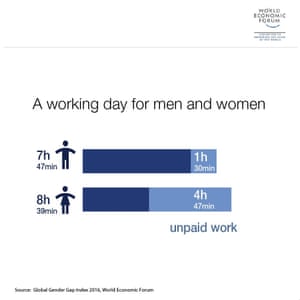
The economic gap is caused by a number of factors, including women being paid almost half of what men receive, working on average 50 minutes a day longer and having a much slimmer chance of reaching senior roles.


Graphic showing the average working day for men and women across the 144 countries surveyed.


Graphic showing the average working day for men and women across the 144 countries surveyed. Photograph: WEF

Zahidi blamed slower economic growth for keeping women out of the workforce and added that, after making some progress, “we’re now hitting a bit of a wall” in terms of policy changes to help women in the workplace. Automation is affecting jobs in sales and administration – sectors with relatively high levels of female employment.


On an overall scale, including health, education and politics, the gender gap could be closed in 83 years across the 107 countries included in the report since it was originally published in 2006 – which is “just within the statistical lifetime of the baby girls born today”.


Gender gap

Within that overall measure, the education gap could be closed in 10 years, while the inequality in politics – which has the widest gap, despite having closed by 23% – should end in 82 years because of the fast pace of improvement since 2006, when it stood at 14%.


This year, 144 countries are included. Iceland, Finland, Norway and Sweden are in the top four, while Rwanda makes it in to the top five.


The UK has risen to 20th from 18th place in the overall rankings, well below its top 10 position in 2006.


The UK’s rankings were compiled before Theresa May became prime minister following the vote for Brexit and are affected by a change to the way income is measured, which lifted the cap on estimated income from $ 40,000 (£32,800) to $ 75,000. This pushed the UK down in the economic parity ranks by 10 places to 53. As a result, the US is also ranked as less gender equal, falling 17 places to 45.


Gender pay gap could take 170 years to close, says World Economic Forum

20 Ekim 2016 Perşembe

Woman died after paramedic told her to take paracetamol for chest pains

An ambulance service has apologised for the death of a woman after a paramedic told her to take paracetamol for chest pains.


Carol Wilson’s husband, Peter, called 111 on New Year’s Day in 2015 after she had been suffering from chest pains for a few days, as well as severe throat and ear pain, and pain on breathing.


The 111 service sent a paramedic to the couple’s Sheffield home at about 7am but, rather than giving her a heart scan or taking her to hospital, they said she should take paracetamol.


Wilson, 70, who had three sons, died in her sleep two days later as the result of a heart condition.


Medical negligence lawyers at Irwin Mitchell investigated her treatment and found the paramedic had failed to carry out an ECG scan, which would have identified abnormalities that needed hospital treatment.


Lawyers argued that if Wilson had been admitted to hospital, it is likely that pericarditis – a swelling of the fluid-filled sac surrounding the heart that causes chest and breathing pain – would have been picked up and treated.


Yorkshire ambulance service trust has admitted that, on the balance of probabilities, Wilson’s death could have been prevented if she had been given an ECG and sent to hospital by the paramedic.


Peter Wilson, 72, a retired HR director, said: “Since those three days at the start of 2015, my life has been turned upside down. We’d been married for over 40 years and I don’t think I will ever truly get over Carol’s death and I’m still devastated thinking about it now.


“Carol was an active, healthy woman who practised yoga on a daily basis, walked regularly and ate healthily. Her sudden illness was just such a shock.


“Nothing can turn back the clock, but I just hope that the trust will learn the importance of investigating chest pain in the future.


“Carol was devoted to her family. She was proud of her sons and adored her young grandchildren, who she thought she would see progress at school and beyond. She was cruelly denied that opportunity.”


Hayley Smith, a medical negligence lawyer at Irwin Mitchell in Sheffield, representing Mr Wilson, said: “Peter was understandably distraught at his wife’s unexpected death and wanted answers about what happened to her.


“One minute he was being told to get paracetamol and just two days later, his wife had died during her sleep.


“After our investigation the NHS trust has admitted its mistakes and apologised for the substandard care provided. Although paramedics do a difficult job and have to make split-second decisions, the symptoms and medical history in this case clearly show that more should have been done to diagnose Carol’s chest pain.


“Patient safety should be the number one priority of the NHS and Peter hopes that lessons will now be learned from this tragic incident to reduce the risk of other families suffering in similar circumstances.”


Steve Page, executive director of quality, governance and performance assurance at the ambulance service, said: “First and foremost our thoughts are with Carol Wilson’s family following their sad loss.


“We would like to apologise for the standard of care that was provided to Mrs Wilson on 1st January 2015. The assessment carried out by a member of our staff was not reflective of the high-quality clinical care provided by the trust and actions have been taken as a result of this incident to prevent such an occurrence in the future.


“We would like to reassure members of the public that we take very seriously any concerns that are raised by patients and their relatives and we are committed to being open and honest with them.”


Woman died after paramedic told her to take paracetamol for chest pains

12 Ekim 2016 Çarşamba

Social care cuts take English service to tipping point, regulator warns

A&E units are struggling to cope because social care services that help elderly people have been cut so much that they are reaching a “tipping point”, England’s care regulator is to warn.


Hospitals are ending up dangerously full and have seen “bedblocking” hit record levels because of a widespread failure to give elderly people enough support to keep them healthy at home, says the Care Quality Commission.


A worsening lack of at-home care services and beds in care homes are forcing hospitals to admit more patients as emergencies, which deepens their already serious financial problems. “What’s happening, we think, is that where people aren’t getting access to [social] care, and we are not preventing people’s needs developing through adult social care, is that they are presenting at A&E,” said David Behan, the CQC’s chief executive.


Figures contained in the commission’s annual report show that the number of hospital bed days lost through patients being unable to leave because social care was not available to allow them to be discharged safely soared from 108,482 in April 2012 to 184,199 in July this year – a 70% rise.


The fact that growing numbers of mainly frail, elderly people are being left without the help they need with basic chores such as washing, dressing and cooking “creates problems in other parts of the health and care system, such as overstretched A&E departments or delays in people leaving hospital,” he added. GP surgeries are also having to treat patients who became unwell or suffered an injury because they did not receive help they needed.


Behan urged ministers to give social care a higher priority and urgently find extra money for it to prevent its ongoing deterioration causing even worse problems. “We are becoming concerned about the fragility of the adult social care market, with evidence suggesting that it might be approaching a tipping point,” he said.


The CQC’s assessment of health and social care, called State of Care, adds that: “The difficulties in adult social care are already affecting hospitals. Bed occupancy rates exceeded 91% in January to March 2016, the highest quarterly rate for at least six years, and in 2015-16 we saw an increase in the number of people having to wait to be discharged from hospital, in part due to a lack of suitable care options,” the CQC’s annual report says.


The number of people in England receiving local council-funded social care services fell by 26% from 1.1m in 2009 to about 850,000 in 2013-14, at a time of Whitehall-driven cuts to town hall budgets. The number of people with unmet needs has risen from 800,000 in 2010 to more than 1 million last year, according to Age UK.


Growing unavailability of social care was a key driver of the 3% rise in emergency admissions to hospital last year and 11% rise in bed days lost to bedblocking. That was mainly due to patients having to wait for a package of care to be put in place to let them return home or for a place in a nursing home to become available. “The effect of these delays on the NHS is significant, costing hospitals £820m a year,” the National Audit Office says.


NHS bodies, health thinktanks and charities urged government to use next month’s autumn statement to inject extra funding into social care.


Simon Stevens, the chief executive of NHS England, has already called for any extra funding for the health service to instead be used to prop up social care. Jeremy Hunt, the health secretary, is understood to privately agree. On Monday Stephen Dorrell, the ex-Conservative health secretary, said that the government’s policy of giving social care less and less money was “insane economics and bad social policy” and undermined its claim to be backing the NHS.


Cuts to social care and also mental health and public health mean “the NHS is being stretched to the limit,” said Stephen Dalton, chief executive of the NHS Confederation, which represents hospitals. “Relying on political rhetoric that promises to protect the NHS but fails to acknowledge that a cut in social care results in a cost to the NHS, is an economic deception.”


The CQC also disclosed that about 800,000 patients are registered with a GP practice that its inspectors have judged to be inadequate on safety grounds. It is concerned that some surgeries deliver “unacceptable standards of care”. Safety failings include poor management of medicines, inappropriately trained staff and premises that are unsuitable.


The Department of Health welcomed the CQC’s findings that “the majority of the NHS, 72% of adult social care services and 87% of GP practices inspected are good or better – and that improvement is taking place all over the country”.


A spokeswoman said: “The NHS is performing well at a time of increasing demand. The government is investing £10bn to fund its own plan for the future, and crucially is ensuring that the amount of money available to local authorities for social care is rising in future years of the parliament, reaching up to £3.5bn extra by 2020.”


Social care cuts take English service to tipping point, regulator warns

3 Ekim 2016 Pazartesi

5 Strategies to Calm the Chaos of Everyday Stress and Take Back Your Power

Are you struggling with getting stuff done?  Is overwhelm paralyzing you from taking action?


So often I see folks just winging it every day. Hop out of bed frantically rushing around to start the day with no real plan for the family, no advance planning of typical daily activities, etc. leaving them depleted, mentally drained, frustrated and disappointed that things are so chaotic and not getting things done as hoped.


This leads to stress, overwhelm, and poor self-care leaving you feeling powerless and lacking confidence.


You must have systems to get organized, manage time and manage yourself to feel more empowered with more clarity and confidence.


I’m sharing 5 strategies that I use in my life to calm the chaos, have more clarity throughout the day and feeling in control with more confidence to take action. Implementing these 5 strategies will absolutely help you take back your power:


  1. Use a Life calendar                                                   

Use one calendar that encompasses personal, family, community and work commitments. Get one that is digital; not the paper calendar you hang on the wall or the desk blotter that is doodled on either.


Using this system ‘no important task gets left behind’. Having a calendar that encompasses all aspects of our blended lives is critical to calming the chaos and managing your time effectively.


Sync with your smartphone, tablet and computer. Google calendar is the best and most universal I have discovered. You can even set a time reminder that pops up so you remember where and when to show up or complete a task. With Google calendar you can color code each category, and even give everyone in the family their own color. It can even be shared so everyone is responsible for adding their own stuff – wow, surrender the title logistics manager.


Take back your power with one less job!


  1. Use a To-Do list

Creating a To-do list provides clarity of what needs to get done. No more papers floating around to get lost.


Using your To-do list with your calendar will really boost your organization and clarity. Open your calendar/planner and To-do list. Take items from your To-do list and add to your calendar by blocking off the time you estimate needed to complete that task. These items should include the 5 most important things you need to get done today.


If nothing else gets done, you will feel accomplished knowing that the most important tasks did.


  1. Establish a Routine for Beginning and End of Day

Routine and structure will help calm the chaos and reduce stress. Our brain loves routine and structure. By establishing a routine, your brain learns this rhythm and helps you stay in the flow which turns into an effortless habit over time.


The beginning and end of the day are crucial times to prepare and control your day. A good morning routine will set you up with a positive mindset, energy and organization for less chaos.


At the end of the day wind down with a routine with daily reflection and planning for the next day. Making your plan the night before, your subconscious mind will work on your list while you sleep, and you’ll be better prepared to take on your day.


  1. Just Say No!

One thing that steals your power and causes high level stress is your inability to say no. This can often lead to frustration, anxiety and resentment both towards ourselves and others. Most of us spend our days getting pushed and pulled by other people’s desires and demands.


Essentially, YESing all day to someone else and something else. You look at your schedule and start to feel the anxiety setting in because you know YOU are getting crowded out.


No is beautiful word.


Just say NO to three things for more control and calm throughout your day:


One is interruptions.


Two is multitasking.


Three is people, places and things that will not support and move you closer to your personal, family and professional goals.


  1. Take Clarity Breaks

Clarity will only happen by calming the mind (and body for that matter). Lack of clarity can occur from being in a constant state of stress; it’s a brain thing. The sense of overwhelm that comes from lack of clarity can also be from lack of direction and not having a defined purpose.


You need more clarity to let those creative juices flow. You need to lessen your distractions to make better, more thoughtful decisions without that constant sense of urgency.


Take a few clarity breaks throughout the day. It’s a great way to transition from one project to another. Whether it is from work to home, running errands to cooking dinner, or client meeting to picking up kids from school. It also works great when you get stuck or frustrated on a task (or with a person).


Taking a clarity break will help you regroup, be more present and engaged.


Here is a simple and quick Clarity Break exercise:


Sit in a comfortable position. It is best if your back is straight to have your chest open so your breath can flow easily. Set a timer for 3-5 minutes (turn off all electronic notifications to minimize distractions). Close your eyes and let your mind and body just be for a minute or two. Your mind will probably wander with distracting thoughts, as you notice this happen just focus on your breath.


Have your mind’s eye focus on it flowing in and out of your body.


Now as your thoughts enter again as you breathe out from your mouth, imagine blowing out all those distracting and worrisome words and thoughts. And then, as you breathe in through your nose, imagine everything that is good in your life and all that you desire coming into your body.


Breath in all the good you received already today; breathe out the worry, frustration and negative.


Ahhhhh…feel better?


Would you like the expanded version with the how-to’s and more strategy? You can have it free http://bit.ly/5-radical-to-crush-overwhelm


Sources:


http://www.fastcompany.com/3013188/unplug/why-you-need-to-unplug-every-90-minutes


http://blog.healthychoicenaturals.com/discover-your-brains-best-time-to-learn/


https://www.youngliving.com/blog/the-snooze-routine-tips-for-a-better-nights-sleep/


Plan Ahead and Increase Productivity


5 Strategies to Calm the Chaos of Everyday Stress and Take Back Your Power

27 Eylül 2016 Salı

The Lowdown on BCAAs: Why You Should Take Branched Chain Amino Acids

If you’re working out regularly, you might have heard around that you should take BCAAs. BCAAs, or branched chain amino acids, are superstar supplements, especially in the world of bodybuilding, but they also have their place in the hearts of endurance athletes too.


While it’s nice if you can take all your essential amino acids from real food, it’s not always possible. BCAAs, for example, are most abundant in protein-rich foods, such as beef, salmon, eggs, nuts, and Greek yogurt. But if you’re exercising vigorously, you’ll find that you could greatly benefit by taking BCAAs in supplement form.


When in free-form BCAAs bypass the liver and go straight to the muscles to power them immediately. This is why you’ll find out many experts recommend taking your BCAAs right before, after, or during your workout.


What are BCAAs, Anyway?


BCAAs are three of the nine essential amino acids that our body needs to synthesize protein and build muscle. Unfortunately, our bodies do not manufacture their own BCAAs; we have to get them from elsewhere.


Out of these nine essential amino acids, three make up 35% of our muscles. These are leucine, isoleucine, and valine. These three have distinctive branched side chains that allow the body to easily convert them into energy.


Having a rich supply of these BCAAs can trigger more protein synthesis, make you burn more fat, reduce exercise-induced muscle soreness, improve endurance, and even sharpen your mind.


BCAAs increases protein synthesis.


There’s a reason why bodybuilders stock up on BCAAs, whether in powder or capsule form. The essential amino acids trigger the cells to create more protein, which are the building blocks of all muscle found in your body. When you take BCAAs, you stimulate your muscles to grow faster, which means you’ll likely see gains from your workouts faster than you would if you didn’t take BCAAs.


This effect is so powerful that it works even after you take a break from your regular workouts, such as if you have to travel or recover from an injury. Research shows that people who continue to supplement with BCAAs even on an exercise break are able to maintain muscle even without lifting a single weight during that time.


BCAAs make you burn more fat.  


The powerful combination of leucine and isoleucine can provide your body what it needs to access its fat stores and burn them up directly for fuel. Isoleucine has properties that improve glucose tolerance, while leucine boosts your ability to burn more fat.


In addition, the increased amount of muscle in your body revs up your metabolism, which directly contributes to your increased fat-burning abilities as well. When you combine these two properties, you get a supplement that promotes accelerated muscle gain and fat loss at the same time.


BCAAs reduce muscle soreness.


Soreness after a particularly intense workout is to be expected, but sometimes, soreness can prevent you from exercising the next day or upping your ante. Multiple studies have shown that taking BCAAs can largely reduce soreness after exercise, and it works whether you’re lifting weights or doing endurance exercises.


What’s even more remarkable is BCAAs work against soreness even for people who have not worked out for a long time. This is great news since people who haven’t moved off the couch for a while will definitely feel a lot more soreness than athletes who have been exercising for years.


But even if you’re an advanced exerciser, reducing soreness helps because it speeds up your recovery and allows you to raise the bar more quickly. When you push the intensity level up more often, you take your body to places you thought were impossible to go and see more incredible results from your workouts.


BCAAs are great for older people.


The bad news is as we grow older, our bodies start losing muscle at around age 35. The good news, however, is protein and BCAA supplementation paired with regular resistance training can push back the age at which we start dropping muscle.


Many experts believe that the BCAA leucine alone can increase protein synthesis by a whopping 145%. Don’t think it’s an excuse to hoard all the leucine tabs, though, because isoleucine and valine have their own benefits. An extra high dose of leucine could also lead to an imbalance in your amino acid levels.


BCAAs sharpen your mind.


Scientists couldn’t explain how this works, but it definitely does. Athletes supplementing with BCAAs during a marathon have significantly better results in a mental performance test done right after the race.


A study was done on athletes who were asked to take three BCAAs during a marathon. After the race, the athletes had to complete the Stroop Color Test, where they had to name the word or color that appears on a page.


The results show that those who supplemented with BCAAs performed better on the test than those who didn’t. Also, the slower runners showed improvements in their running time, although the faster runners didn’t go faster.


BCAAs reduce fatigue and increase endurance.


BCAAs are not for bodybuilders only. If you’re an endurance athlete, you can gain a lot from them. These specific amino acids can be burned directly for energy, which is especially useful if you’re doing glycogen-depleting cardio exercises.


They have also been proven to inhibit the rise of tryptophan, a naturally occurring amino acid that produces serotonin. While serotonin improves your mood during exercise, it also speeds up the onset of fatigue. So while you may feel happier, you also feel more tired earlier. With the use of BCAAs, you can prevent fatigue by curbing the release of serotonin into your nervous system.


Andy Atari is a fitness blogger, researcher, and enthusiast. She writes for the every guy and every girl, the average Joes and Janes of the world who aren’t training to win a competition tomorrow or run a marathon in a week. She believes that everyone can have a fit and strong body, a goal that is not impossible to achieve if you set your mind to it. For more information, check out Andy’s work at FitnessAtrium.com.


The Lowdown on BCAAs: Why You Should Take Branched Chain Amino Acids

1 Eylül 2016 Perşembe

Time to take laughter seriously?

“We don’t laugh because we’re happy, we’re happy because we laugh” – William James


Do we laugh enough or should we learn to laugh more?
Joyful, good-natured, ‘mirthful’ laughter is a tonic for our body, mind, emotions, and spirit. Whether we use it as a distraction, to cheer ourselves up, or as a practice to energise and enthuse us, laughing impacts every part of us. In many ways it is the ultimate drug, with no harmful side-effects.


It activates our zest for life.


On a physical level, laughter stimulates our cardiovascular and pulmonary systems by giving our hearts and lungs a vigorous workout. It stimulates blood flow, oxygenates our blood and energises our whole physical system even if we’re hospitalised. The US doctor Patch Adams has been using it professionally for years.


Its endorphin-triggering effect makes laughter a strong painkiller for emotional and mental pain, as well as physical. It has been proven that higher levels of pain can be readily tolerated and the healing process is speeded up. Both the Norman Cousins experience, described in his classic best seller ‘Anatomy of an Illness’, and the current RX Laughter project with children in UCLA hospital in Los Angeles provide the evidence.


Psychologically, laughter is the antithesis of depression. If we’re feeling any anxiety, it is an excellent antidote. In fact, in 2002 in Austria Dr Koutek started using the sound of spontaneous group laughter as part of his treatment for patients with depression. In our Bristol laughter club (www.bristollaughterclub.com) there are countless examples of people whose lives have benefited from the ‘lightness’ that laughter induces. People’s faces change, their body language and posture become more open and relaxed, their communication becomes more playful and spontaneous. Even the simple smiling exercise based on the 1988 F. Strack, L.L. Martin and S. Stepper’s pencil exercise produces lasting results. All you need do is smile genuinely three times a day for at least 10-15 seconds and some people find it transforms their lives.


Laughter and playfulness, in turn, unlock our natural creativity. “You can learn more about a person in an hour of play than a year of conversation” said Plato. Creativity is an essential part of a fun-filled life and helps neuroplasticity, our brain’s learning ability, by strengthening mental flexibility and resilience. Because of this – as we see in Martin Seligman’s Positive Psychology – optimism, positivity and happiness become learnable skills. In short, we learn to become happier. Learn more about this here.


On the self-development path, the practice of laughter is the practice of joyfulness. Ancient traditions as well as new ones encourage us to practice laughing – with a sense of willingness. What ancient traditions intuited and experienced, and neuroplasticity shows, is a practice is learning new skills until they become second nature. Current thinking is that it might be only 21 days, as in the Chopra 21-day meditation challenge.
The key ingredients are
single-mindedness,
perseverance and
tenacity to keep going until you become aware of the differences in your life.


There are numerous recent psychological studies which show the beneficial impact of smiling especially when this is the genuine ‘Duchenne’ smile which uses the involuntary orbicularis oculi muscles. This genuine smile encourages an empathetic response and consequently stimulates sociability.


This is also the theme in the book ‘Awakening the Laughing Buddha within’.


4 top tips to laugh more:


1. Look for laughter and laughter will find you. Look for as many opportunities to smile and laugh in your day, and importantly, communicate them. Not only will you feel better, you will also be encouraging a positive ripple in others too.
2. If it will be funny later, it’s funny now. Often we look back and laugh at things. Can we laugh at them now instead?
3. Start your day with a laugh. This is both a Zen and a Hawaiian practice. No matter what yesterday delivered, start today with a chuckle, a kinaesthetic version of a positive affirmation. Why? We get the endorphins. We may then feel more upbeat and better equipped for your day ahead. Its worth remembering, when we’re feeling really rough, that’s the time we need our endorphins most.
4. Fake it till you make it. Feeling grumpy? Sluggish? Irritable? When you’re ready to change your mood, smile and laugh, even if you don’t yet feel like it. Your system will release endorphins anyway because it can’t tell the difference between the real joyful laugh and a fake one. The key is your willingness.


For more information, please visit www.joehoare.co.uk


Time to take laughter seriously?