world etiketine sahip kayıtlar gösteriliyor. Tüm kayıtları göster

5 Nisan 2017 Çarşamba

Funding the NHS in a retail world | Letters

Your editorial (31 March) calling for repeal of the 2012 Health and Social Care Act is a transformative shift of position and potentially very significant. Repeal will save huge sums of money for the NHS with immediate effect. If sustainability and transformation plans are used to return to geographical areas, ending stand-alone hospitals, substantive returns in terms of integrated care will be easier to achieve. I hope Labour will soon commit to repeal the Act. 


David Cameron admitted that this act was the coalition government’s biggest mistake. Theresa May should remove it from the statute book as an economy measure.
David Owen
House of Lords


The NHS was designed to serve a more or less cohesive, class-based society where there was a political will to provide jobs and homes for all. Illness was due to bad luck and everyone deserved treatment.


We now know that bad luck is not random: unjustifiable inequalities set relatively disadvantaged people on an unhealthy path. The fact that resilient individuals will buck the trend merely fuels public scorn for people who cannot help themselves.


Without public investment in egalitarian family and social provision from the start of life, the NHS will seem increasingly irrelevant to citizens who have swallowed the idea that you can’t rely on the state to look after you, and expect to pay for everything they get. 


The “flexible, efficient organisation” that you call for will never be able to care for a demoralised population with diminishing opportunities for good health. The NHS is cornered in a retail world that has no concept of socialism.
Dr Sebastian Kraemer
London


Replacing routine operations with non-surgical treatments implies that 60 years of NHS funding, staffing and competence crises arose from a system clogging itself up with unnecessary operations (Deborah Orr, 1 April). If avoiding them can significantly reduce the workload, removing targets should not be necessary. The danger of removing waiting time targets is that it will allow the stream of unnecessary work to continue unmonitored, to the great reward of the medical profession, relieved of the risk of being challenged about what they are doing at taxpayers’ expense.
John Hall
Bristol


Join the debate – email guardian.letters@theguardian.com


Read more Guardian letters – click here to visit gu.com/letters


Funding the NHS in a retail world | Letters

29 Mart 2017 Çarşamba

World Glucoma Week 2017 – Discover and Confront Your Glaucoma

Glaucoma is an eye disease which if left untreated can ultimately lead to vision loss. Approximately 11-67 million people worldwide suffer from this disease. In the UK alone, about 300,000 people have undetected glaucoma. To bring awareness to people about this disease and help them fight it, NRS Healthcare has prepared an educational guide and an infographic. The guide has been launched during the World Glaucoma Week 2017. This guide mostly contains information about the disease, its causes, symptoms and treatment. It is not only useful for Glaucoma patients, but also for others, so that they understand the disease and know how to avoid it.


The guide also included interview of an 81-year old lady, who has been fighting glaucoma for the past 9 years It serves as a source of inspiration for other people. Her experience with the disease and survival tactics will help other patients to live a hassle-free life.


Glaucoma is globally known as the silent thief of sight, because most Glaucoma types do not have any symptoms. It is a disease caused due the impairment of optic nerve, which usually happens when fluid builds up in front of the eye causing extra pressure in the eye, thus damaging the optic nerve. The condition if not treated properly can slowly lead to blindness over a period of time. Old people are mostly prone to this disease. Besides, people with eye injury, diabetes, migraines, and those with family history of Glaucoma are more likely to get this disease. After cataracts, Glaucoma is the second most common cause of blindness in people.


The most appropriate way to diagnose Glaucoma is to get your eyesight checked and do it regularly. However, merely checking the eye pressure won’t be enough. Your ophthalmologist should perform a complete eye exam to find any abnormality in your eye. Unfortunately, if you get diagnosed with the disease, you have to take regular medicine to prevent your vision from deteriorating. The medication is mostly in the form of eye drops and should be taken as prescribed.


To generate awareness of Glaucoma among people, NRS Healthcare is working effectively for the cause. They will also be sharing their Glaucoma guide on their blog and social media channels during the World Glaucoma Week 2017 with the aim to educate more and more people about this disease.


Sheikh Zeeshan

Zeeshan is a health journalist who writes for various health care & fitness blogs. He recently covered World Glucoma Week 2017 and worked to generate awareness about Glucoma.


World Glucoma Week 2017 – Discover and Confront Your Glaucoma

5 Mart 2017 Pazar

Hairdressers of the world unite against hidden dangers of the salon

Hairdressing is not an obviously dangerous occupation. Yet working in a hair salon or a barber’s shop can provoke skin conditions, musculoskeletal diseases such as arthritis and tendonitis and work-related asthma.


Now Usdaw, the shopworkers’ union which represents many of Britain’s estimated 140,000 hairdressers, is calling for a “new deal” to protect them. Paddy Lillis, the union’s deputy general secretary, said the government needed to give “proper protection” to barbers and hairdressers, the majority of whom are female and younger than 40.


A Europe-wide agreement on health and safety standards for the industry has been blocked by the European commission, under pressure from successive British governments. “It’s time we had a new deal for hairdressers,” Lillis said. “All too often the safety of shopworkers is overlooked in the mistaken belief they work in low-risk environments.


“This is a mistake the UK government made when they scaled back Health and Safety Executive inspections and slashed inspections by local authorities who enforce safety in shops, warehouses and offices. It is time that the government and the European commission took these risks to the health and safety of hairdressers seriously and gave them proper protection.”


Research indicates that hairdressers are at risk from seemingly innocuous activities such as washing hair, cutting hair and using hairspray. Repeatedly washing hands can lead to dermatitis, a non-contagious sensitivity to chemicals that causes painful cracked skin and bleeding, and research has shown that 70% of hairdressers have suffered from skin conditions.


Breathing in hairspray and other chemicals may be linked to asthma, according to some studies. Using scissors day in, day out can provoke arthritis and tendonitis in the hands and thumb, through loss of cartilage.


And hair dye has been blamed for a link between hairdressing and bladder cancer, although Cancer Research UK believes this is more likely to be the result of older hair dye ingredients which have been discontinued. Most of these issues could be solved by wearing appropriate gloves and taking regular breaks.


Rebecca Walker had been a hairdresser for nearly 10 years when she developed arthritis. The first signs were a “really stiff shoulder”. “I thought that maybe I’d been overworking it, but it didn’t go away and the pain moved to my elbow,” she said.


Within two months she had resigned because she was taking too much time off because of the pain in her wrists and hands. “I suppose I’m quite a determined person so I didn’t want to give up,” she said. So in 2011 Walker opened her own salon, quirkydo in Macclesfield, and now employs several other people.


“There have been times I’m not sure how I’m going to get through the day, but if I give myself a break for half an hour between clients, it’s OK,” she said.


The picture is different on the continent where hairdressers are more likely to be employees. Regina Richter has been a hairdresser in Leipzig for 51 years, but for the last 30 years she has suffered major back problems due to standing up for eight hours a day. “It seems to be affecting my younger colleagues more now,” she said. “After four or five years they are starting to experience pain. I think it is because the pressure has increased – now everyone has to cut hair as quickly as possible to get as many clients as possible.”


She believes that sometimes being able to sit down while cutting hair, and using ergonomic scissors and lighter hair dryers, would have prevented or delayed her condition.


In 2012, the union that represents about one million hairdressers across the EU, Uni Europa, was involved in drawing up an agreement for EU member states to sign up to shared health and safety standards for hairdressers. But since Jean-Claude Juncker became president of the European commission, the agreement has been blocked, under pressure led by Britain and some other parts of the EU, according to Oliver Roethig, regional secretary of Uni Europa.


“When we look at hairdressing, it’s the tip of the iceberg,” he said. “Social legislation by the EU has been completely taken off the agenda by the Juncker commission. He said the EU must not be big on the smaller things. But we don’t think that hairdressers having to give up work is a small thing.”


In the UK, where nearly half of all hairdressers are self-employed, it can be difficult for individual stylists to raise health and safety issues in their salon, and given the role of Britain in obstructing progress at a European level, life after Brexit is unlikely to get any easier.


In 2009, the Health and Safety Executive handed over responsibility for its campaign on dermatitis to the Hairdressing and Beauty Industry Authority (Habia) and the National Hairdressers’ Federation.


However, Habia’s website refers to health and safety only from an employers’ perspective and does not offer guidance to hairdressers.


Hilary Hall, chief executive of the National Hairdressers’ Federation, said it did offer guidance to employers on contracting dermatitis and advised staff to wear vinyl gloves when washing hair.


“The directive pretty well captures what is available in the UK,” she said. “The difference is enforcement. The individual is responsible and they could be subject to inspections. We feel it is better to let people choose.”


THE DANGERS


Dermatitis


A study in 2004 revealed that 70% of hairdressers in Britain had suffered from work-related dermatitis, in the form of red, sore and sometimes itchy skin, mainly to the hands and fingers but also to the arms, face and neck.


Asthma


In France, a paper published in 2003 showed that 20% of women affected by work-related asthma were hairdressers, compared with 1% for the general population.


Arthritis


According to the European Agency for Safety and Health at Work, musculoskeletal disorders are five times more prevalent among hairdressers than in the general population. Research published in the journal Work in 2009 showed that in a study of 145 hairdressers, 41% experienced ‘work-related upper limb disorders’.


Cancer


An analysis of 42 bladder cancer studies in 2010 showed that hairdressers faced a risk 30 to 35% higher than the general public. However, Cancer Research UK says that because cancer can take many years to develop, this may be due to exposure to older chemicals that are no longer used.


Hairdressers of the world unite against hidden dangers of the salon

27 Ocak 2017 Cuma

Mario, you crossed into our world at the worst time – it’s no game over here | Emily Reynolds

Mario is coming to a street near you. His latest outing, Super Mario Odyssey, was unveiled in a Nintendo trailer earlier this month, and shows the moustachioed plumber gleefully sprinting around a facsimile of New York, hopping over taxis and scaling skyscrapers. Elsewhere, he swings through dewy forests and slides through realistically animated streams. The angry, sentient plant pots may be slightly less believable, but that’s besides the point – Mario has been plucked from the multicoloured fantasy of the Mushroom Kingdom and dumped into our much less palatable reality.


Unfortunately for him he appears to have crossed dimensions at the worst possible time. Super Brexit Odyssey doesn’t sound like a very appealing venture, though Boris Johnson’s foppish faux-blustering would probably slot disturbingly easily into a fantasy game. In an ideal world, Donald Trump would remain a harmless parody of the boorish, hard-to-beat final boss in a video game; in the real world he is the newly inaugurated president of the United States, and already having a marked and negative impact on people’s lives.


His picks for cabinet have included a raft of ardent anti-choice climate change deniers, including a vice-president who supports “conversion therapy” for members of the LGBT community, and believes women should have to state in writing whether aborted or miscarried foetuses should be buried or cremated. The real world is currently looking pretty overrated.


And not only that, there will be no predetermined paths for Mario’s coin collection anymore. Unlike previous iterations of the game, which have taken place in set, closed-off levels, players will be able to roam a more open-ended world. Mario can cross roads, climb ladders, scale buildings and hitch a ride on taxis. That might sound like a good idea until you consider some of the political decisions made by the general public over the last year – maybe a lack of choice is good for us after all.


Tortuous analogies aside, there may be some genuine benefits to ignoring the real world in favour of unashamedly escapist entertainment. Games have long been posited to help with anxiety and stress: alongside bucketloads of anecdotal evidence, numerous studies have found positive links between gaming and mental health.


One, from the universities of Oxford and Cambridge, found that Tetris helped reduce stressful intrusive memories in patients with post-traumatic stress disorder. A study due to be published in March’s edition of the journal Computers in Human Behavior also found that games could encourage positive, co-operative, pro-social behaviour.


‘Numerous studies have found positive links between gaming and mental health.’


‘Numerous studies have found positive links between gaming and mental health.’ Photograph: Wavebreak Media ltd / Alamy/Alamy

More evidence came in a 2012 study from Stanford University that found gamers “hyper-stimulating” the brain’s mesolimbic pathways (associated with goals and motivations) and hippocampus (linked to learning and memory).


In 2014, Dutch researchers suggested that gaming can “foster real world psychosocial benefits” – cognitive, motivational, emotional and social. There’s no lack of evidence to suggest the positive impact gaming can have, especially on someone experiencing low-level stress, depression or anxiety.


And while Mario might not have a depression level yet – arch-enemy Bowser approaching asking “Have you tried yoga?” and saying “Cheer up!” – a growing number of games have been designed with mental health in mind. For example Sparx, a game designed to help residents of New Zealand with depression, which builds upon gaming’s mental health benefits to create something therapeutically valuable as well as fun.


Comments about how rightwing authoritarian regimes create the best conditions for creativity are obviously facile, especially now: people rightfully fearing discrimination need more than limp, empty reassurance that they needn’t worry because music, games or books are going to get really good again. When artists such as Amanda Palmer – white, able-bodied, rich, and privileged – say things like “Donald Trump is going to make punk rock great again” it’s a frustrating distraction from the potentially horrifying realities of the situation.


But that’s not to say that escapism isn’t a valuable tool if used correctly. Playing Mario – or any other game – is obviously not going to make you less miserable about the realities of any given political climate. What it can do, though, is provide a small amount of respite when you’re feeling stressed about something or you just want to pretend that the real world doesn’t exist for an hour or two. Perhaps Nintendo should bear this in mind when they design the next set of adventures for Mario – next time, maybe he should spend less time in our world, and we should spend more time in his.


Mario, you crossed into our world at the worst time – it’s no game over here | Emily Reynolds

18 Ocak 2017 Çarşamba

Nipah: fearsome virus that caught the medical and scientific world off-guard

In 1998, with no explanation or signal of danger, a fearsome disease took off in Malaysia. Pigs died in large numbers and then men slaughtering infected animals also fell ill. They passed it to their families at home. Nearly half of those who got sick died.


It was not Ebola – it was a virus that became known as Nipah, after the Malaysian town of Kampung Sungai Nipah where it was first identified. But there are resemblances to Ebola in the way the disease suddenly emerged from the animal world and then spread between humans, causing a threat to life that caught the medical and scientific world off-guard.


The story of the outbreak of Nipah in Malaysia was told – and embellished – in the 2011 film Contagion, starring amongst others, Kate Winslet, Gwynneth Paltrow and Matt Damon. There, the disease became a global pandemic, killing 26 million people.


In reality, the death toll from Nipah in Malaysia and Singapore, where it had spread, was 105 out of 265 cases, but could have been much worse had it been more easily transmitted. It also caused the collapse of the $ 1bn pig industry. The disease seemed to come from nowhere, but as with other such viruses, the emergence and spread was caused by a cocktail of human behaviour and environmental change.


The virus is endemic in fruit bats – also known to carry Ebola virus. The bats were on the move, leaving rainforests where slash-and-burn logging was causing massive haze, shutting out sunlight and preventing the fruit they ate from growing. Drought caused by El Niño made things worse.


Large numbers of bats were later seen in the orchards around the pig farms of northwest Malaysia. The virus from their saliva was in the half-eaten fruit they dropped – which was devoured by the pigs.


The Malaysian outbreak was finally stopped by mass culling of pigs in May 1999. But since then there have been regular Nipah outbreaks in Bangladesh, where transmission occurs directly from fruit bats to humans.


“We know how it happens,” said Professor John Clemens, executive director of the International Centre for Diarrhoeal Disease Research, Bangladesh. “The fact that it has established itself as an endemic focus in Bangladesh with regular, albeit infrequent, transmission to man suggests that it could cause broader problems for humanity at large. I would add as well that similar to Ebola virus, people in intimate contact with Nipah patients can acquire the infection, human to human.


“I’m sure you see the parallels there with Ebola, except unlike Ebola, which has its traditional homeland in sub-Saharan Africa, Nipah is here in Asia.”


Nipah was at first misdiagnosed in Malaysia as Japanese encephalitis, because of the swelling of the brain that occurs.


“When it is transmitted to man, it can cause an extremely serious encephalitis, sometimes with pneumonia, and when people get sick with this, the case fatality rate is about 50%, with substantial serious neurological impairment of a fraction also who survive,” said Clemens.


In Bangladesh, the outbreaks occur because of the traditional drinking of palm wine, a delicacy made from date palm sap. Fruit bats like to hang upside down in the palm trees, with the result that their excretions – urine and saliva can find their way into the sap.


There should be ways to avoid this route of transmission – if not through persuading people to avoid palm wine, then by putting skirts on the trees to keep the bats away, said Clemens.


But that would not end the hidden risk. Changes in people’s behaviour or alterations we make to our environment can precipitate a small outbreak – perhaps with a different and unexpected route of transmission – that becomes something far more dangerous. It happened with Ebola, which spread from rural villages into the cities, where large numbers of people lived close together and were easily infected. That is also the danger with other zoonotic diseases, including Nipah, said Clemens.


Nipah: fearsome virus that caught the medical and scientific world off-guard

10 Ocak 2017 Salı

What can this Peru slum teach the world about stopping the spread of TB?

For Jasmin Bueno, aged seven, and her brother Aaron, aged six, there is little that can make swallowing chemo-profilactic pills any less bitter. But the tablets they stoically gulp down daily during the next six months are the best protection they can get from contracting tuberculosis.


Just a sheet draped over a washing line separates their sleeping area from that of their 20-year-old brother, Jose, a tuberculosis sufferer. The whole family, their mother and an older sister with an infant baby, live in shack on a hill overlooking the sprawling Carabayllo slum. It is a tuberculosis hotspot where the overcrowded, poorly-ventilated and often damp homes provide a breeding ground for one of the world’s most ancient diseases, which recent research shows claims 1.8 million lives a year globally, not the 1.5 million it was previously thought.


Peru has the highest incidence per capita of tuberculosis in the Americas, including virulent multi-drug resistant (around 2,300 patients per year, 35% of all cases in the region) and extensively drug resistant (around 100 patients per year, 75% of all cases in the region) strains. Its reduction is slow at around 1.5% a year, just short of the global reduction of 1.65% annually, according to the World Health Organisation (WHO). The rate of reduction would need to increase to a 4-5% annually, in order to reach sustainable development goal target 3.3 – ending epidemics of tuberculosis and other infectious diseases by 2030.


The WHO admits this is an ambitious aim. It said in a statement last year: “While there has been significant progress in the fight against TB, with 43 million lives saved since 2000, the battle is only half-won: more than 4,000 people lose their lives each day to this leading infectious disease. Many of the communities that are most burdened by tuberculosis are those that are poor, vulnerable and marginalised.”


We go to the patients’ houses and we find the best way on ensuring they don’t abandon the treatment


Carmen Contreras​,​ Partners in Health


But as well as being one of the hotspots for the disease, Peru has some of the world’s highest cure rates for multi-drug resistant tuberculosis (MDR-TB) at 83% and the extremely drug resistant strain (XDR-TB) at 60%. The global reduction rate for MDR-TB is around 50% and is just 25% for XDR-TB.


“Search, treat, prevent – that’s our approach,” says Carmen Contreras of US-based charity Partners in Health. “We go to the patients’ houses and we find the best way on ensuring they don’t abandon the treatment.” The WHO’s End TB hands-on approach has been implemented since 2015 and it is reaping rewards in Peru.


Decades on the streets as a drug addict smoking unrefined cocaine left 56-year-old Francisco Verastegui’s health in ruins. He became HIV positive then found out he had tuberculosis. Now off the streets in a homeless shelter run by an evangelical church, Verastegui says he has cheated death more than once. “I’ve abandoned the treatment on several occasions in the past but I didn’t die so I know that God must have a purpose for my life,” he says, taking his daily dose of pills.


Francisco Verastegui


Francisco Verastegui is HIV positive and has TB after years living on the streets as a drug user. He now lives on a farm for homeless men on the outskirts of Lima. Photograph: Jorge de la Quintana

Partners in Heath works with several thousand patients in Peru and has seen the number of people who abandon treatment reduce from 7-8% to less than 1%. The secret of their success is training local health promoters in the community itself, says Leonid Lecca, the NGO’s director in Lima: “They come from the same community; they know who the coughers are, who has lost weight, who’s hiding because they have problems. They find those people who sometimes never reach the health services.”


The NGO’s aim for 2017 is zero deaths and zero abandonment of treatment. A quick and accurate diagnosis is key to achieving this. So Partners in Health built a state-of-art tuberculosis detection laboratory in an old shipping container in the heart of this deprived community. It’s been operating in Carabayllo, in northern Lima, since 2012.


The lab is the only one of its kind in Latin America and can make 25 diagnoses a day. This is a big boost for Peru’s strained healthcare services, says its head, Roger Calderon: “The diagnosis is very important because the patient often doesn’t know what’s wrong with them. A quick and opportune diagnosis is best way to control tuberculosis but the problem is not just a medical one, it’s a social one. While there’s poor and needy people, there will be tuberculosis.”


Taking patients like Julia Roque, 53, through the lengthy treatment for multi-drug resistant tuberculosis is part of the job for Contreras at Partners in Health as she strolls arm-in-arm with her patient. Roque caught MDR-TB while being treated in hospital for diabetes.


Recovery is arduous. She is too weak to continue her work as a street vendor and lack of money to support herself and her family is constant worry, says Roque. “To recover you have to be determined, strong and have plenty of willpower otherwise you won’t get better,” she says. “If you quit the treatment then only God will gather you up.”


Accompanying patients on the road to recovery with consistent moral support is how Peru is leading by example. Perhaps the rest of the world can follow in its footsteps to make a dent on the global epidemic.


Join our community of development professionals and humanitarians. Follow @GuardianGDP on Twitter. Join the conversation with the hashtag #Dev2030.


What can this Peru slum teach the world about stopping the spread of TB?

3 Ocak 2017 Salı

How the world got fat: a visualisation of global obesity over 40 years | Max Galka

Last year, a network of health scientists from around the world set out to create the most comprehensive portrait of world obesity ever produced. The researchers compiled results from 1,698 studies on adult obesity, covering 186 countries, 19.2 million participants, and spanning 40 years. And they condensed it all into a single study, published earlier this year in the Lancet medical journal.


And here are the full results, presented in one eye-opening graphic.


The colour of each country represents its adult obesity rate in the year shown. Hover over a country to see what its obesity rate was in 1975 and what it is today.


Since 1975, obesity rates have risen in every country in the world, without exception. That includes countries like the United States and the UK, where food is cheap and abundant, and countries like Somalia and Angola, where malnutrition remains an epidemic.


At the low end, North Korea’s obesity rates are up about 1% (from 1.6% in 1975 to 2.8% today). Japan is also near the bottom with a 2% increase since 1975 (from 1.1% to 3.3%). The largest changes occurred in smaller Pacific island countries. Samoa, Tonga, and Tuvalu all saw their obesity rates increase by more than 20%, a doubling of what they were in 1975.


Perhaps the country that stands out most of all is China. In 1975, only 0.5% of Chinese adults were obese. Today, China’s obesity rate is about 8%, a 16-fold increase in the most populous country in the world.


Globally, the average adult today is three times as likely to be obese compared to the average adult in 1975.


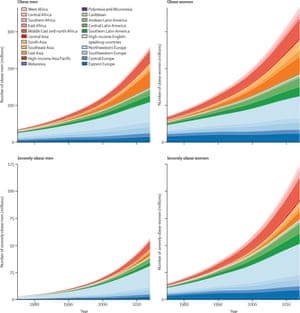
Trends in the number of obese and severely obese people by region. A person is obese if they have a body-mass index (BMI) of 30 kg/m2 or higher, or is severely obese if they have a BMI of 35 kg/m2 or higher. From Lancet report: Trends in adult body-mass index in 200 countries from 1975 to 2014


Trends in the number of obese and severely obese people by region. A person is obese if they have a body mass index (BMI) of 30 kg/m2 or higher, or is severely obese if they have a BMI of 35 kg/m2 or higher. Photograph: The Lancet Publishing Group/Trends in adult body-mass index in 200 countries from 1975 to 2014

Few other problems exhibit such a clear trend, over such a long time frame, across the entire world. In fact, I created this map because I think the magnitude of the global obesity epidemic is difficult to communicate with statistics alone.


However, the map also illustrates another point about a completely different topic, one that is even bigger and further reaching than global obesity – the problem of information overload.


The digital universe is growing exceptionally fast. Half of the information available online today was created in just the last two years. But for that information to be useful to anyone outside of subject matter experts, it must overcome a host of challenges.


First, the information must be practically accessible. This obesity study represents the work of thousands of researchers over perhaps millions of hours. Data visualisation, reduces it all into an intuitive, easily-digestible graphic.


At the same time, data visualisation gives us a frame of reference for understanding what would otherwise be cold, abstract numbers. When you read statistics about obesity, either as written language or as tables of numbers in a spreadsheet, you realise obesity is a problem. But when you watch the story unfold visually, you can feel the depth and magnitude of the problem because you are witnessing it firsthand.


Finally, for the information to be useful, it must be discoverable from among an ever-growing sea of digital noise. Data visualisations are not only informative, they can also be fun and beautiful, something that people will want to share with their friends.


As the digital universe continues to grow, making sense of all that information presents an increasingly difficult challenge. Fortunately, it may have an easy solution: communicate it visually.


How the world got fat: a visualisation of global obesity over 40 years | Max Galka

30 Aralık 2016 Cuma

Bill Gates: world faces decade at risk from antibiotic-resistant bugs

People across the world, particularly those in developing countries, face a decade at risk from pandemics spread by antibiotic-resistant bugs, the billionaire Bill Gates has warned.


Gates, who made his fortune with the Microsoft Windows operating system before becoming a philanthropist, said the success of antibiotics had created complacency that was now being exposed by the rise of microbial resistance to the drugs.


“I cross my fingers all the time that some epidemic like a big flu doesn’t come along in the next 10 years,” Gates told a special edition of Radio 4’s Today programme guest-edited by Dame Sally Davies, the chief medical officer for England.


“I do think we will have much better medical tools, much better response, but we are a bit vulnerable right now if something spread very quickly like a flu that was quite fatal – that would be a tragedy and new approaches should allow us to reduce that risk a lot.”


Gates said it was crucial for wealthier countries to step in to help the developing world fight disease, both for humanitarian reasons and for their own health security.


Although mistakes were made, criticism of the World Health Organisation (WHO) during the Ebola crisis in west Africa was unfair, he said, because it was not funded or staffed to do all the things that observers wanted it to do.


International cooperation had led to the eradication of smallpox, and was on the verge of eradicating polio, he added.


“The cooperation that we have seen, I think, needs to intensify,” Gates said. “It’s the only way that global problems like epidemics will get solved and so [for] all the people who are negative on WHO, the message to take away from that is not that that kind of multilateral cooperative effort is doomed and the money is not well spent, rather that we actually need to broaden their capacity. We actually need to dedicate ourselves to this global cooperation.”


In September the UN secretary general, Ban Ki-moon, warned that antimicrobial resistance was a “fundamental threat” to global health that risked making high quality universal healthcare impossible.


It is estimated that more than 700,000 people die each year from drug-resistant infections, though it could be much higher because there is no global system to monitor the figures. There has also been difficulties in tracking death tolls even in places where they are monitored, such as the US, where tens of thousands of deaths have not been attributed to superbugs, according to a Reuters investigation.


The European Centre for Disease Prevention and Control reported in November that illnesses resistant to so-called last-line antibiotics – drugs kept in reserve for use against pathogens that have proved resistant to all other antibiotics – were on the rise in the continent.


Without them, some infectious diseases could become untreatable and some forms of major surgery would again become perilous.


Davies said Britain’s health service was well placed to handle a flu pandemic, although it would still take as long as six months to “produce enough vaccine to start putting it into people”. She was less optimistic about how resilient the rest of British society would be to an outbreak.


“It’s not just the NHS,” she said. “It’s how would our social care system cope with people who aren’t ill enough to be in hospital but need extra support? It’s how would our economy cope if a large proportion are too ill to work? When we have a just-in-time ordering policy for delivery of food, petrol, whatever.


“And if you think about the issues that could happen here if we had a recurrence of the 1918 type flu, then what would it be like in middle- and low-income countries where they don’t have the health systems to look after the patients?”


Bill Gates: world faces decade at risk from antibiotic-resistant bugs

28 Kasım 2016 Pazartesi

How to Stay Healthy While Travelling the World: A Vegetarian Survival Guide

For backpackers, long-term travelers, or anyone who travels widely for work, sampling new local cuisines is one of the things to look forward to most. Who wouldn’t be enthusiastic about to trying traditional tacos in Mexico, sampling steaming-hot street food in Southeast Asia, or digging into a bowl of fresh spaghetti in Italy?


But if you don’t eat meat or fish, things can be trickier. Though the vegetarian movement is growing across the world, in many places meals still center on meat, and even the concept of vegetarianism can be met with a blank look. It isn’t easy for vegetarians to stay healthy on the road, particularly if you’re on a backpacker’s budget. Often, veggie-friendly restaurants hike their prices up, because they know vegetarian tourists will pay for a good meal.


But it doesn’t have to be so difficult. If you’re a committed vegetarian and avid traveler, here’s how to stay healthy while traveling the world.


CHOOSE YOUR DESTINATIONS WISELY


Admittedly, this isn’t always something you can control – if you travel for work you often don’t get a say where you’re sent. But if you’re traveling independently, you have the luxury of choosing destinations where Vegetarians are spoilt for choice – and sometimes these aren’t the countries you expect.


Take Belgium, for example. While it’s not exactly known for being a veggie-friendly country, it’s also home to the city with the largest number of vegetarians per capita: Ghent. This trailblazing town is also home to ‘Donderdag Veggiedag’ – Meat Free Thursdays, an initiative created to tackle growing obesity and greenhouse gas emissions. This soon spread throughout the city, and vegetarian street maps are handed out to visitors to Ghent.


Away from Europe, there are vegetarian hotspots across the globe. India is quite simply a vegetarian’s dream: around a third of people here are vegetarian, and most restaurants have clearly marked meat-free meals. In Southeast Asia, the Buddhist culture that pervades Thailand means vegetarian meals are plentiful, and because dairy is rarely used vegans will also be in their element. In the Middle East, Israel offers a mouth-watering array of vegetarian treats, from pita bread and hummus to falafel to baba ganoush.


Do your research before you go and consider what meat-free food options will be easily available. Bear in mind that some South American countries are notoriously bad for vegetarians.


DON’T BE SCARED TO SAMPLE STREET FOOD


Many vegetarians I’ve spoken to shun street food, believing that it’s usually meat-orientated and unhealthy. While this is often the case (particularly in the U.S.), in many countries the majority of street-food is in fact vegetarian by default. Meat is universally expensive, and the point of street food is usually that it’s quick and cheap.


Take Guatemala, for example. This country is the darling of backpackers across the globe and offers a wide-array of healthy and delicious vegetarian street food. This is starkly contrasted against its meat-loving neighbors – Mexican street food is infrequently vegetarian and in other Central American countries, meat makes an appearance at most street food stalls. In Guatemala, you can enjoy a whole array of vegetarian street food, from empanadas to rellenitos to salads and soups.


IF IN DOUBT, ASK


Though even the idea of vegetarian food is still alien in some cultures, most people will be happy to help you out if you ask.


The local diet in much of Central America is known to revolve around simple meals of meat or fish with rice, beans, and vegetables. Take Costa Rica, for example, where the traditional meal of ‘casado’ consists of rice, beans, plantains, salad and some meat. One vegetarian traveler described how, on explaining she was vegetarian (“soy vegetarian” in Spanish), the restaurant staff happily replaced the customary meat with grilled cheese. This is a great way to stay healthy in Central and South America, as due to their reliance on beans these meals provide vegetarians with enough protein.


Bear in mind that ‘vegetarian’ can mean something else in other countries: it can refer to someone who doesn’t eat red meat but does eat chicken and fish. In Thailand, the term “vegetarian food” often isn’t understood unless you’re in touristy hubs, and asking for just vegetables – “pak” – is sometimes inferred as asking for pork. If you’re unsure, refer to yourself as a Buddhist, and it’ll be instantly understood that you don’t eat any meat.


WHEN ALL ELSE FAILS, COOK


Cooking for yourself rather than eating out in a foreign country can seem like an admission of failure for vegetarians, especially if you’re someone who excitedly looks forward to trying new food. But it doesn’t have to be that way. Head to a local market and pick up some of the oft-used ingredients there, and make a vegetarian version of one of the national dishes.


For example, you don’t have to buy fish to make a delicious ceviche; vegetarian ceviche is becoming a thing, and the blend of fresh vegetables with citrus makes an exceptionally healthy as well as a delicious meal. If you’re in Asia, replace the meat or fish in dishes with extra veg or tofu; a few tweaks to the traditional Tom Yum recipe will result in a wonderful vegetarian alternative that’s packed with vitamins.


In addition to helping you find healthy, delicious and varied vegetarian meals, traversing vibrant and bustling local markets is one of the best ways to understand a new culture. Buying fresh fruit and vegetables will always be cheap and healthy, and whether you’re on a budget or not, is a great way of ensuring you’re getting your five-a-day.


Be brave and imaginative, and you may find yourself with a new understanding of a country’s culture – as well as a lasting appreciation of their cuisine.


How to Stay Healthy While Travelling the World: A Vegetarian Survival Guide

20 Kasım 2016 Pazar

‘Cyber-bullies, obesity and stress … this is a scary world’ says the new top GP

‘ This is a scary world,” says Dr Helen Stokes-Lampard, the new leader of the UK’s 49,439 GPs. She is not referring to soaring obesity, or the fact that dementia has replaced heart disease as the nation’s biggest killer, or the truth that everyone’s risk of getting cancer has recently gone from one in three to one in two. She’s talking about social media, its downsides and its contribution to ill-health – mental ill-health specifically – and how more and more of its victims are ending up in GPs’ consulting rooms.


“I wouldn’t want to be a teenager nowadays. The social media pressures are phenomenal. People have become more judgmental about appearance. If I was a chubby teenager, the only people who knew were those around me. But now strangers on the other side of the world have a view on how teenagers look. Can you imagine how awful that must be? Unless you’ve got incredible resilience then that puts you at real risk. It grinds people down. It’s the inexorable pressure to be perfect,” adds Stokes-Lampard, who became the new chair of the Royal College of GPs this weekend.


Instagram and Snapchat are the two biggest facilitators of this worrying trend, she says. “You get eight- or nine-year-olds coming in worried about how they’re looking, and nine-year-olds talking to their parents but not wanting to eat because the food’s fattening. That makes my skin crawl; that’s a real cause for anxiety for us all. Social media’s created a new set of norms and values and we’ve not given our children the resilience and wisdom to know how to use these things safely.”


Family doctors now see depression in prepubescent children who have been bullied – cyber-bullied – because they have freckles, wear glasses or are overweight. “So there are clearly negatives from social media and technology,” she says, before adding, laughing: “Says she – who loves Twitter.”


Stokes-Lampard, 46, is what she calls “a coalface GP” in Lichfield, Staffordshire – “a very normal practice full of very normal people” – though her new role will limit her to just one day a week in her surgery. Reflecting on the changing nature of illness, she says that these days “obesity pervades the consultation. At least half of consultations I have are with people who are overweight, because society is overweight; real, normal people are overweight. It impacts on people’s health in myriad ways. There’s the obvious stuff – it can affect your breathing or joints, give you diabetes or increase your risk of cancer. But people’s self-worth and their mental health is dragged down when their body shape isn’t right because we’re, you know, an incredibly fat-shaming society.”


Family doctors can do only so much, Stokes-Lampard explains in a soft south Wales accent that indicates her upbringing in a mining village just outside Swansea. Doctors identify a patient’s condition and draw up a plan, but often other health professionals then need to take over, she adds. She laments the NHS’s postcode lottery in the specialist services to which GPs should be able to refer patients with a range of problems, not just dangerous obesity. It limits GPs’ ability to help and may reduce someone’s chances of recovery.


“We’ve got so many problems of where to refer patients on to, the next tier of our referral services – our physiotherapists, our memory clinics for people with dementia, [and] weight management services. It’s a big problem. If we’ve got nowhere to help, to channel these people to, they get stuck with us, and that’s not necessarily the best place for patients.”


Being overweight harms people’s health in physical and psychological ways.


Being overweight harms people’s health in physical and psychological ways. Photograph: Chris Radburn/PA

The media and political focus in the past year or two has been on the UK-wide shortage of GPs. “But we need more practice nurses, far more district nurses and far more health visitors, far more community mental health support workers, far more CBT [cognitive behavioural therapy]. It’s been a chronic underfunding problem. So much resource and energy has gone into shoring up hospitals due to winter crisis and pressures in A&E but actually they took their eye off the ball in terms of the vital role of primary care in supporting the rest of the NHS.”


In England at least, though, Simon Stevens, the head of NHS England, has promised to send what the GPs’ leader only half-jokingly calls “the cavalry”. That should entail not just 5,000 more family doctors, but also 3,000 new mental health therapists who will be based in GP surgeries, 1,500 pharmacists who will also see patients there, as well as more practice nurses, “physician assistants” – who are meant to do some tasks usually performed by nurses or doctors – practice managers and receptionists.


They are all intended to help relieve the strain on GPs, who by common consent are struggling to keep up with the demands posed by our ageing, growing and increasingly medically complicated population. General practice will receive an extra £2.4bn a year by 2020-21 that will push its share of the NHS budget from £9.6bn to £12bn.


That pledge of 5,000 extra GPs was originally made by David Cameron before the 2015 general election. It remains a totemic Conservative promise, the missing of which would be very embarrassing. No one in the NHS thinks it will happen, though the health secretary Jeremy Hunt is still gamely insisting it will be met. Stokes-Lampard is understandably sceptical. “We’re concerned about the 5,000 GPs. It’s a good pledge but it’s not going to be met at the moment. Things are moving too slowly to reach that level by 2020, so it’ll take a big concerted effort by a lot of people to push us from the amber, which is where I think we are now on that, back into the green.”


She is worried that few if any of the 500 extra GPs that were meant to be coming from abroad to help meet the 5,000 target have actually come. For example, despite publicity months ago announcing the imminent arrival of family doctors from India, none is here yet. Brexit seems to be a factor, she says. “Inevitably we’ve already had doctors [overseas] saying to us, ‘I’d like to come but actually I’m not sure what the visa situation’s going to be in a few years’ time and, well, I don’t want to bring my family over, start a new life and discover I’m not welcome.’ So we need to change the language.” The government’s Migration Advisory Committee could help by adding GPs to its list of shortage occupations, just as they did with nurses earlier this year, and thus make it easier for family doctors from around the world to come here, she suggests.


Jeremy Hunt, the health secretary, insists the pledge of an extra 5,000 GPs will be met.


Jeremy Hunt, the health secretary, insists the pledge of an extra 5,000 GPs will be met. Photograph: Carl Court/Getty Images

Even if all the pledges by Stevens and Hunt to improve the lot of GPs are delivered, she fears that will not be enough to enable them to cope with the growing volume of illness. She wants to see big changes in public health policy – the sugar tax, minimum unit alcohol pricing – and for everyone to become more active. “We need to make it easier for people to be healthy. We need to make walking the new norm and to have more cycleways. Kids used to walk to school, but now there’s a culture of being chauffeured. People think it’s safer but it’s not. The evidence is increasingly that it’s the sofa that kills you, not the eating. Inactivity underlies a lot of problems. Being more active helps with our weight, our wellbeing and our heart.”


Better diet, including eating less meat, would also help prevent illness, she says. “I say this as someone who loves meat, so I’m not being hypocritical, but we need to change the culture of meat and two veg being the staple diet in the UK. We definitely need to eat less red meat and processed meat. Meat should be a treat, not part of every meal.” Consuming more white meat and fish, especially oily fish, would help reduce the risk of certain cancers, she says. She also advises cooking meat ourselves rather than buying pre-cooked joints, and eating it no more than twice a week.


General practice is closer to the precipice than it’s ever been in living memory


Helen Stokes-Lampard


So there is the nation’s health, an issue as always for the gatekeepers to the NHS. But she is also determined to do what her office allows – through lobbying ministers and arguing her case on TV and radio – to improve the health of Britain’s general practitioners, or “expert generalists”, as she calls them. A friend – a 38-year-old female GP – recently packed in the profession when it all got too much and her relationship with her partner and children began suffering under the weight of the constant stress, 14-hour days and endless workload family doctoring involves. “She cracked.” Another has recently emigrated to Australia in search of a better work-life balance.


“General practice is closer to the precipice than it’s ever been in living memory. The NHS is its people,” Stokes-Lampard adds. “If you take them for granted and don’t value what you’ve got, once they’ve gone it’s so, so much harder to come back from that brink.” Minister, take note.


CV


Name Dr Helen Stokes-Lampard


Age 46


Born Swansea, south Wales


Educated Comprehensive school in Swansea, then St George’s medical school in London.


Career Worked in obstetrics and gynaecology before becoming an academic GP and has been a GP since. Until September was head of primary care teaching (undergraduate) at Birmingham university’s school of medicine. Held various roles in the RCGP, including council member and treasurer.


Roles Chair, Royal College of General Practitioners (2016-2019) – the third woman in a row to hold the post after only men for the previous 50 years; GP partner (part-time) in Lichfield, Staffordshire.


‘Cyber-bullies, obesity and stress … this is a scary world’ says the new top GP

8 Kasım 2016 Salı

Secular groups fight exclusion from AA: "The best support system in the world"

The Almighty plays a central part in the hallowed 12 steps of Alcoholics Anonymous. Six of them make reference to God, Him or Power. In one step, members vow to hand “our will and our lives” to God while another implores Him to remove their shortcomings.


Now the organisation’s religious undertone – and its utility in fighting alcoholism – has come under fire in Canada, where an atheist has lodged a human rights complaint alleging AA discriminated against him.


For more than two years, Lawrence Knight has watched his complaint snake through the Ontario Human Rights Tribunal. Earlier this year, the tribunal said the complaint raised a number of complex legal issues and recommended it go to a full hearing.


More than 23 years sober, Knight says he always found that the world of AA was an uneasy fit. “I come from a long line of humanists,” said the 59-year-old.


We Agnostics, a Toronto secular AA group created in 2010, seemed the perfect solution, offering all the support and companionship of AA but without the trappings of God. Here the 12 steps were still followed – each carefully rewritten to scrub out any mention of God or prayer.


But the group’s separation of church and sobriety didn’t sit well with some. In 2011, We Agnostics and Toronto’s other secular AA group, Beyond Belief, were delisted from the Toronto AA website and directory, in effect removing them from the city’s network of 500 weekly meetings.


The decision prompted tears and shock among the three dozen or so people who had embraced the secular groups. “It was painful. It’s shunning,” said Knight. “It was unbelievable that an organisation that can’t kick anybody out, and that prides itself on that, had kicked us out.”


Members of the secular groups – worried that their hard-won efforts at staying sober were now in jeopardy – vowed to push forward. What emerged was a parallel system of sorts, one that has today swelled to about 350 members in 12 secular AA groups across Toronto.


As the secular movement grew in numbers, Knight and others continued to push to be brought back into Toronto’s AA fold. They appealed to the city’s coordinating body, urging them to reconsider the decision. “We ran into a brick wall,” said Knight.


Frustration drove him to lodge a human rights complaint two years ago, claiming that AA had discriminated against his group on the basis of creed. While directed at Toronto’s coordinating body, the complaint also names the highest levels of the organisation in North America. “They didn’t make any decisions directly,” said Knight. “But there is something that they did do, in my opinion, and that is the fact that there have been agnostic meetings for 40 years, but they haven’t clarified anything; they didn’t have any human rights protocols in place.”


The result is a scattered approach to secularism around the world. In some places, such as New York City, secular groups are allowed to operate freely and under the umbrella of the local AA hierarchy. Other secular groups – from Des Moines to Vancouver – have been treated similarly to those in Toronto, pushed out and left to their own devices over their rejection of God.


Knight’s complaint will head to mediation in the coming weeks. To date, AA has argued to the tribunal that it is a special interest organisation, a status that affords it the right to restrict its membership.


The dispute hints at a broader question being asked among the group’s two million members worldwide as they seek to incorporate 12 steps first penned in the 1930s into modern times: How important is God and religion in AA’s quest to empower people to fight alcoholism?


Some, like Knight, argue that AA’s curative power lies not in religion, but instead in the fellowship it fosters. A growing body of research, he pointed out, now suggests that the roots of addiction are tangled in isolation and loneliness.


The argument clashes with the Toronto coordinating body, which has argued to the tribunal that a belief in the higher power of God is a bona fide requirement for groups in Toronto.


Officials in Toronto declined to comment, while a spokesperson from AA World Services in New York City said the organisation was unable to comment as the matter was before the Human Rights Tribunal.


Knight is hoping that the human rights complaint will force the organisation to definitively address the long-simmering issue. “Alcoholism kills more people than it saves. It’s killed a lot of my friends, it’s killed a lot of my family, it’s an insidious thing. And the best support system in the world is AA.”


But the strength of that support hinges on AA being accessible to all. “The point is that anybody should be able to go to a meeting and not feel intimidated, not feel forced out or that they have to believe in something that somebody else believes,” he said. “Because that’s just ludicrous in this day and age.”


Secular groups fight exclusion from AA: "The best support system in the world"

3 Kasım 2016 Perşembe

The Most Popular Sports in the World and What Muscles They Work Out

If you participate in any sport, it’s likely that it’s one of the following ten. Soccer, basketball, tennis, cricket, volleyball, American football, table tennis, rugby, baseball, or golf. Being as these are the ten most popular sports in the world, if you chose a random athlete anywhere in the world, they are likely to play one of these. It’s not to say that other sports aren’t as great or anything like that, but people from all walks of life seem to enjoy playing and watching these games the most. That’s why today, for each of the top ten most popular sports in the world, we’ll see what makes them so attractive and what muscle groups they work out when you play. Hopefully, this will motivate some people to get outside and work out to tone those muscles! Let’s continue.


1. Soccer


Popularity: Topping out our list is soccer hands down, or referred to as “football” almost everywhere else in the world. Although it has the most followers in Europe, it’s virtually played and watched everywhere including Japan and the US. The World Cup is the most watched sports competition in the world, with the FIFA World Cup 2014 viewed by nearly 4 billion people.


Muscles It Works Out: Mostly leg and thigh muscles, although it also works out the core, glute, hips, and upper body


2. Basketball


Popularity: Basketball is by far one of the fastest growing sports in the world. With 2-3 billion fans mostly in the US, China, Philippines, Japan, and Canada, it’s still growing in popularity in other parts of the world.


Muscles It Works Out: Calves, Glutes, thighs, upper body, and core


3. Cricket


Popularity: Cricket is enjoyed mostly in India, the UK, Pakistan, Asia, and Australia, although it’s spreading its influence to other countries fast. There’s estimated to be anywhere from 2 to 3 billion fans in the world, with the Cricket World Cup 2015 being watched by around 2.2 billion people.


Muscles It Works Out: Upper body, arms, hips, glutes, core, and calves


4. Tennis


Popularity: There are around 1 billion fans of tennis, mostly spread across Asia, America, and Europe. Nearly 400 million fans tune into the major tennis competitions every time tennis season rolls around the corner.


Muscles It Works Out: Legs, glutes, calves, quads, lower back, core, chest, shoulders, and arms


5. Volleyball


Popularity: There are around 900 million fans of volleyball across Asia, Europe, the US, and Australia. Although it’s mostly watched on TV for major competitions and the Olympics, it’s still widely played everywhere.


Muscles It Works Out: Ankles, hips, knees, shoulders, forearms, elbows, wrists, and lower body


6. Table Tennis


Popularity: Also known as ping pong, table tennis is a widely played sport mostly in Asia, Europe, Africa, and the US. With about 900 million fans, it’s also one of the most casually played sports, often considered a hobby by many.


Muscles It Works Out: Core, hips, lower back, hands, arms, calves, quads, feet, and hamstrings


7. Rugby


Popularity: Rugby used to be higher on this list but has been slowly losing popularity. Still, it’s in the top ten and is enjoyed by many. There are estimated to be around 400 million fans mainly from France, the United Kingdom, Australia, New Zealand, and South Africa.


Muscles It Works Out: Back, shoulders, abdominals, chest, quads, legs, and arms.


8. Baseball


Popularity: There are about 500 million baseball fans in the US, Japan, Cuba, South Korea, Canada, and the Dominican Republic. US and Japan especially love baseball


Muscles It Works Out: Lower abdominals, upper abdominals, back legs, calves, thighs, forearms, wrists, and shoulders


9. Golf


Popularity: With close to 400 million fans in the US, Japan, Korea, the UK, Europe, and Canada, golf is enjoyed mostly by the upper class and doesn’t require much physical intensity. This means it can be played by most if not all people.


Muscles It Works Out: Core, hamstrings, glutes, back, hips, legs, and arms


10. American Football


Popularity: As the name suggests, American football is highly popular in the United States. As such, it’s known as just “football” in the US, taking priority over soccer “football” whereas other countries refer to it as the gridiron. There are around 350-390 million American football fans, most of which are from the US.


Muscles It Works Out: Glutes, quads, hamstrings, chest, shoulders, abs, obliques, lower back, forearm, biceps, and triceps


Sources:


http://www.totalsportek.com/most-popular-sports/


http://athleteaudit.com


http://pingpongpro.net


http://sporteology.com/top-10-popular-sports-world/


http://www.livestrong.com/sscat/how-to-gain-muscle/


The Most Popular Sports in the World and What Muscles They Work Out

26 Ekim 2016 Çarşamba

Gender pay gap could take 170 years to close, says World Economic Forum

The authors of a new report forecasting that it could take 170 years to eradicate the disparity in pay and employment opportunities for men and women have called for urgent action to close the gender equality gap.


The report by the World Economic Forum – best known for its high-profile gathering each year in Davos, Switzerland – found that economic disparity between women and men around the world was rising even though the gap was closing on other measures, such as education.


When measured in terms of income and employment, the gender gap has widened in the past four years; at 59%, it is now at a similar level to that seen in the depths of the financial crisis in 2008.


Last year, the WEF predicted it would take 118 years for economic parity to be achieved. This year, the Geneva-based institution has calculated the gap would take until 2186 – 170 years – to close.


Now in its 11th year, the report measures the relative discrepancies between women and men across four key areas: health, education, economy and politics.


The report says: “More than a decade of data has revealed that progress is still too slow for realising the full potential of one half of humanity within our lifetimes.”


The authors, Richard Samans and Saadia Zahidi, said they hoped the report “will serve as a call to action for governments to accelerate gender equality through bolder policymaking, to business to prioritise gender equality as a critical talent and moral imperative, and to all of us to become deeply conscious of the choices we make every day that impact gender equality globally”.


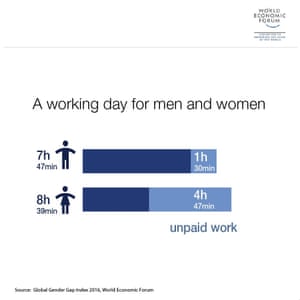
The economic gap is caused by a number of factors, including women being paid almost half of what men receive, working on average 50 minutes a day longer and having a much slimmer chance of reaching senior roles.


Graphic showing the average working day for men and women across the 144 countries surveyed.


Graphic showing the average working day for men and women across the 144 countries surveyed. Photograph: WEF

Zahidi blamed slower economic growth for keeping women out of the workforce and added that, after making some progress, “we’re now hitting a bit of a wall” in terms of policy changes to help women in the workplace. Automation is affecting jobs in sales and administration – sectors with relatively high levels of female employment.


On an overall scale, including health, education and politics, the gender gap could be closed in 83 years across the 107 countries included in the report since it was originally published in 2006 – which is “just within the statistical lifetime of the baby girls born today”.


Gender gap

Within that overall measure, the education gap could be closed in 10 years, while the inequality in politics – which has the widest gap, despite having closed by 23% – should end in 82 years because of the fast pace of improvement since 2006, when it stood at 14%.


This year, 144 countries are included. Iceland, Finland, Norway and Sweden are in the top four, while Rwanda makes it in to the top five.


The UK has risen to 20th from 18th place in the overall rankings, well below its top 10 position in 2006.


The UK’s rankings were compiled before Theresa May became prime minister following the vote for Brexit and are affected by a change to the way income is measured, which lifted the cap on estimated income from $ 40,000 (£32,800) to $ 75,000. This pushed the UK down in the economic parity ranks by 10 places to 53. As a result, the US is also ranked as less gender equal, falling 17 places to 45.


Gender pay gap could take 170 years to close, says World Economic Forum

9 Ekim 2016 Pazar

The week in TV: Westworld; A World Without Down’s Syndrome; The Apprentice; Real Time With Bill Maher

Westworld (Sky Atlantic/Now TV)
A World Without Down’s Syndrome? (BBC2) | iPlayer
The Apprentice (BBC1) | iPlayer
Real Time With Bill Maher (Sky Atlantic/Now TV)


The much-vaunted Westworld, HBO’s grandiloquent bid to sew our carcasses ever more tightly into a cocoon of weekly fantasy – Game of Thrones officially runs out of breasts and dying heroes some time in 2018 – arrived with low-key splendour. Muted title sound, yet an opening sequence of such technical magnificence it looked as if it had been beamed back to us from about 2048. The fetlocks of horses were being 3D-modelled with filigree’d and granular precision, as were the noses of crooked barmen (as if there’s any other kind) and doughty sheriffs, and the very ivories of nags’ teeth and of pianolas, and suddenly we were into Westworld, a panorama of haughty big skies, aching beauty and spitefully small human dreams.


A world, in case you missed all the media hype (and where on earth were you? Possessing a life?), in which guests will pay handsomely for a week or so in a wild west in which they can go riotously tootsie: sleep with every perfumed whore, gut-shoot every sweaty dog-breath hoodlum. Even, if addled and bourbonned enough, shag the bandit and gun the girl. They’re all robots, programmed to hurt and bleed like us, but also to wake the next day mended and with no memories.


It’s an intriguing premise, of course, and, of course it will all go wrong: a sudden aberrant line of source code will risk not only the lives of the guests but, more crucially, the psyches of the androids in the park, who suddenly have twitches of memories. For the moment, we care more about the robots, who seem more human than the visitors, who cannot be physically harmed in the park: a depressing number have chosen to go all black hat with their moneyed freedom, murdering and fornicating at any whim: be advised that this is often nasty viewing.


[embedded content]


Watch a trailer for Westworld.

It could have been just another tricksy CGI fantasy. But it came from the pen of Michael Crichton, responsible for Jurassic Park, which also asked pertinent questions about humanity and technology. I would happily class Crichton with Ray Bradbury and Philip K Dick, because they also wrote wisely about ourselves: even when it might have been spuriously about robots, or dinosaurs, it was always about us. What might we do? Are we happy with discovering the people we truly are or only happy with the people we want to be? And if you can’t tell the difference between the humans and the androids, should it matter?


This is existentially and morally mired, in that it raises questions not of the narrative in itself but of us, the reader/viewer. This opener was tremendously, deliberately confusing: the good guy is a robot, the bad guy (a tremendous Ed Harris, playing the part he was born to play) a veteran vicious tourist on the hunt for darker levels, to assuage all he lacks in real life, which is shaping up as a howdy-doody lot of a lack. It’s all rather scintillating, not least because if features Borgen’s Sidse Babett Knudsen as the searingly blue-eyed head of quality assurance, off stage and chain-smoking high on the controllers’ gantry, intent not on money but simple control: of robots, the “livestock”, but also of every human around her.


Could it be a worthy successor to GoT? Absolutely. HBO has another global heavyweight on its hands, thanks to the authors: I’m hooked, in a way I never was with early Thrones. Again: this is not about robots: it’s about us. Yet every time I am tempted to worry about robots taking over the world any time before about 2416 I simply think of self-service tills. Smile my usual smile.


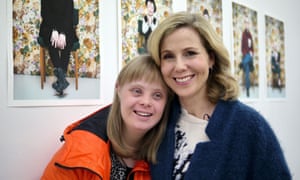
Most winning programme of the week was undoubtedly A World Without Down’s Syndrome?, in which Sally Phillips, with quizzical wit and just the right salting of lip-trembling anger, asked whether we’re right to hail with such a blizzard of approbation a new non-invasive test for pregnant mothers.


Halldóra, one of the few people in Iceland with Down’s, and actor Sally Phillips.


Halldóra, one of the few people in Iceland with Down’s, and actor Sally Phillips. Photograph: Not Known/BBC/Dragonfly

Some of the statistics were frightening. In Iceland, where they have had the test for a while, every positive diagnosis for Down’s has resulted in termination: 100% in the past five years. There are now fewer than 40,000 people with Down’s in Britain. Phillips, whose dear son Olly is one, made a passionate yet refreshingly unsentimental case for the right to have Down’s extant in this world. It’s not a disease, it’s a set of characteristics (and ones that, actually, genetically predispose the child to happiness).


Hugely set against this comes the understandable set of fears of any mother: of an inability to cope, of a child’s being bullied, even of their own prejudices. Yet Down’s remains the one disability it has become socially acceptable to “cleanse” and Sally was more than troubled (as was I) by medical professionals’ universal embracing of one and only one tenet: Down’s is always bad, choice is always good. This lucid and strangely uplifting programme should be only the very beginning of a debate we should have been busily having for about 30 years.


“I’m the business equivalent of a diamond. I can sparkle, and light up a room, but if you’re not careful I can cut you.” Was this contestant perhaps confusing “a diamond” with “scissors”? I can’t think of anyone in the history of ever who has actually been cut by a diamond. Just by the people who wear them.


The women’s team discuss how to turn a whelk stand into a pig’s ear in The Apprentice.


The women’s team discuss how to turn a whelk stand into a pig’s ear in The Apprentice. Photograph: BBC

Yes, The Apprentice is back, complete with ol’ Lord Bearded Man-Stoat and the usual basket of deplorables. And back this year to guys v gals, an intriguing reversion that shouldn’t in an ideal world work, but does. It might be my imagination but some of the candidates seem a little more sympathetic than in recent years. Some, and it’s all relative, of course, and they managed as usual to turn a whelk stall into a pig’s ear with their first task. The women called back into the boardroom made a masterclass only of being able to turn viciously, wheel and blame each other, and regroup in nanoseconds to re-blame another other: bitchy death by scuffed Louboutin heels. Bring it on.


For those not yet driven forlorn by attemping to make sense of America, I cannot recommend highly enough Real Time with Bill Maher. Like a Democrat version of PJ O’Rourke, Maher is suave, angry, pithily funny and possessed of a fine foul mouth when necessary.


He makes no secret of his loathings for Mr Trump, the most badass black hat of this and most other years. “Welcome to another week of ‘yes, this is really happening,’” he began a more than usually confrontational show. It’s not perfect: some humour strains in the translation and I wish these shows wouldn’t always rely on visual gags that always flash up for about six seconds longer than it has taken to get the often negligible “joke”. Yet Maher, and John Oliver, proves that there’s space to manage both satire and deadly serious within the very same hour, and I wonder anew why we don’t quite have the equivalent here: a TV version of Private Eye. Eddie Mair for the job.


The week in TV: Westworld; A World Without Down’s Syndrome; The Apprentice; Real Time With Bill Maher