Down's etiketine sahip kayıtlar gösteriliyor. Tüm kayıtları göster

4 Kasım 2016 Cuma

New prenatal test for Down"s syndrome "will not lead to more terminations"

A safer prenatal test for Down’s syndrome due to be introduced on the NHS is not predicted to lead to more pregnancies being terminated, according to one of Britain’s most eminent statisticians.


Sir David Spiegelhalter, professor for the public understanding of risk at the University of Cambridge, said that the best evidence available suggests that the blood test, which will be made available in 2018, would lead to an increase of around 20 in the number of positive diagnoses made each year through screening.


He added the test would result in far fewer women opting for invasive testing, reducing miscarriage numbers.


Spiegelhalter cautioned that this evidence sometimes appeared to have fallen out of view in debates in which some campaigners have warned that a generation with Down’s syndrome could be “screened out”.


“People feel very strongly about it, of course they do. It’s all the more reason to stand back and look at the figures,” he said. “There’s a mismatch at the moment between the official basis on which this is being rolled out and the discussion around it.”


According to the Department of Health’s own projections, Spiegelhalter said, more than 40 miscarriages would be avoided every year because far fewer women would be given amniocentesis, an invasive test in which a tiny amount of fluid is removed from the womb. He added, however, that it was impossible to predict exactly how families would respond to the new screening regime.


“There’s been a lot of concerns expressed about the increased number of terminations,” said Spiegelhalter. “In the assumptions under the current model that’s not the case. The estimate is that there wouldn’t be a change.”


The new test, which works by detecting tiny quantities of foetal DNA circulating in the mother’s blood, will be offered to about 10,000 women a year who are considered to have a higher chance of giving birth to a baby with Down’s syndrome, or two rarer genetic conditions: Edwards’ and Patau’s syndromes.


The test is offered after the standard screening that all pregnant women receive at 12 weeks, which involves an ultrasound and a blood test.


According to recent Department of Health figures, 7,900 women agreed to an invasive test and 46 miscarried. More than 3,000 chose not to have the test for fear of losing their baby or because they would wish to continue with their pregnancy regardless of the result. The figures showed 1,031 Down’s cases detected in a year.


The blood test, which predicts Down’s syndrome with more than 90% accuracy, means most high-risk women will be able to avoid amniocentesis. The government predicts that around 10,000 women would opt to have the non-invasive prenatal test (NIPT). Of these, the Department of Health predicts that most would be screened out and fewer than 1,500 would proceed to the invasive test, where 1,055 Down’s cases would be positively identified.


The motivation for introducing the new blood test is safety, but controversy has been building based on concerns that far more parents would be inclined to find out if their baby was affected by a genetic disorder, potentially leading to more pregnancies being terminated.


In a BBC documentary last month, A World Without Down’s Syndrome?, actor Sally Phillips, whose son Olly has Down’s syndrome, raised concerns about the new test and highlighted the joy that her son had brought to her family.


Spiegelhalter said he “in no way seeks to criticise the campaign groups”, but wants to give people access to the best evidence available. His analysis is due to be published on the website of the Winton Centre for Risk and Evidence Communication at the University of Cambridge, which launched last week and will aim to provide unbiased statistics on public health and policy issues.


Philip Dunne, the health minister, said: “We want women to be able to access the safest screening tests available, so based on the clinical evidence, we have approved the use of a new non-invasive prenatal test for Down’s, Edwards’ and Patau’s syndromes. By offering non-invasive prenatal testing, fewer pregnant women will go on to be offered diagnostic testing which carries a risk of miscarriage.”


Lynn Murray, spokesperson for the campaign group Don’t Screen Us Out, said that the concerns of those opposed to the policy went beyond the projected screening statistics. “We are very disappointed that the Department of Health have approved the NIPT roll-out without consultation with the very group that this is going to have the biggest impact on, people with Down’s syndrome and their families,” she said. “The government has admitted itself that it has made no assessment of the impact this will have on the community of people with Down’s syndrome.”


New prenatal test for Down"s syndrome "will not lead to more terminations"

9 Ekim 2016 Pazar

Down’s syndrome and the threat of eugenics | Letters

Neither in Sally Phillips’ film, A World Without Down’s Syndrome, nor in your review by Julia Raeside (Last night’s TV: A documentary straight from the heart – and that’s the problem, 6 October) was there any reference to “eugenics”. Yet possibly still within living memory proponents of eugenics in America (and elsewhere) were advocating selective breeding to determine the future of society. It is worth noting that such ideas were grounded in the work of Francis Galton, who was a powerful influence on Cyril Burt, who in turn later developed the 11-plus exams. (His influence might be resurrected in the tests used to determine who is most fit for the new grammar schools we’re promised.)


Sally Phillips’ programme does, therefore, offer a timely reminder of the dangers of embarking on a determinist view of society and the risk that selective breeding is acceptable. As Phillips reported, there is a lot of pressure to avoid a potential “burden” as an outcome of the wrong sort of foetus. In America the eugenicists gathered data purporting to show which sectors of society were more (or less) fit for the future. Favoured solutions proposed to avoid a future populated by those deemed to be “unfit” for society included restrictions on immigration and enforced sterilisation. There is much in the history of that movement to warn us of the dangers of a determinist future. It is, therefore, right to have the questions raised: what kind of society do we want; and how kind do we want society to be?
Dr Simon Gibbs
Reader in educational psychology, University of Newcastle


Hadley Freeman, in her opinion piece on A World Without Down’s Syndrome, writes that it is genuinely shocking that BBC 2 decided to screen such a blatantly anti-choice message (Sorry, Sally Phillips, but a woman should be able to know if her unborn baby has Down’s syndrome, theguardian.com, 6 October). Is she advocating censorship? In showing the joy her son with Down’s syndrome brings to her family, Sally Phillips is trying to counter negative headlines and arguments. She is not anti-choice. She wants people to have better information. We mothers who have or have had sons or daughters with Down’s syndrome should not be impeded from saying they enrich our families and lead valuable lives. It is important to have a debate about the kind of society we want to live in.
Hazel Morgan
Dorchester


Down’s syndrome and the threat of eugenics | Letters

The week in TV: Westworld; A World Without Down’s Syndrome; The Apprentice; Real Time With Bill Maher

Westworld (Sky Atlantic/Now TV)
A World Without Down’s Syndrome? (BBC2) | iPlayer
The Apprentice (BBC1) | iPlayer
Real Time With Bill Maher (Sky Atlantic/Now TV)


The much-vaunted Westworld, HBO’s grandiloquent bid to sew our carcasses ever more tightly into a cocoon of weekly fantasy – Game of Thrones officially runs out of breasts and dying heroes some time in 2018 – arrived with low-key splendour. Muted title sound, yet an opening sequence of such technical magnificence it looked as if it had been beamed back to us from about 2048. The fetlocks of horses were being 3D-modelled with filigree’d and granular precision, as were the noses of crooked barmen (as if there’s any other kind) and doughty sheriffs, and the very ivories of nags’ teeth and of pianolas, and suddenly we were into Westworld, a panorama of haughty big skies, aching beauty and spitefully small human dreams.


A world, in case you missed all the media hype (and where on earth were you? Possessing a life?), in which guests will pay handsomely for a week or so in a wild west in which they can go riotously tootsie: sleep with every perfumed whore, gut-shoot every sweaty dog-breath hoodlum. Even, if addled and bourbonned enough, shag the bandit and gun the girl. They’re all robots, programmed to hurt and bleed like us, but also to wake the next day mended and with no memories.


It’s an intriguing premise, of course, and, of course it will all go wrong: a sudden aberrant line of source code will risk not only the lives of the guests but, more crucially, the psyches of the androids in the park, who suddenly have twitches of memories. For the moment, we care more about the robots, who seem more human than the visitors, who cannot be physically harmed in the park: a depressing number have chosen to go all black hat with their moneyed freedom, murdering and fornicating at any whim: be advised that this is often nasty viewing.


[embedded content]


Watch a trailer for Westworld.

It could have been just another tricksy CGI fantasy. But it came from the pen of Michael Crichton, responsible for Jurassic Park, which also asked pertinent questions about humanity and technology. I would happily class Crichton with Ray Bradbury and Philip K Dick, because they also wrote wisely about ourselves: even when it might have been spuriously about robots, or dinosaurs, it was always about us. What might we do? Are we happy with discovering the people we truly are or only happy with the people we want to be? And if you can’t tell the difference between the humans and the androids, should it matter?


This is existentially and morally mired, in that it raises questions not of the narrative in itself but of us, the reader/viewer. This opener was tremendously, deliberately confusing: the good guy is a robot, the bad guy (a tremendous Ed Harris, playing the part he was born to play) a veteran vicious tourist on the hunt for darker levels, to assuage all he lacks in real life, which is shaping up as a howdy-doody lot of a lack. It’s all rather scintillating, not least because if features Borgen’s Sidse Babett Knudsen as the searingly blue-eyed head of quality assurance, off stage and chain-smoking high on the controllers’ gantry, intent not on money but simple control: of robots, the “livestock”, but also of every human around her.


Could it be a worthy successor to GoT? Absolutely. HBO has another global heavyweight on its hands, thanks to the authors: I’m hooked, in a way I never was with early Thrones. Again: this is not about robots: it’s about us. Yet every time I am tempted to worry about robots taking over the world any time before about 2416 I simply think of self-service tills. Smile my usual smile.


Most winning programme of the week was undoubtedly A World Without Down’s Syndrome?, in which Sally Phillips, with quizzical wit and just the right salting of lip-trembling anger, asked whether we’re right to hail with such a blizzard of approbation a new non-invasive test for pregnant mothers.


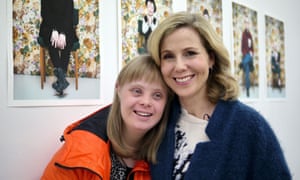
Halldóra, one of the few people in Iceland with Down’s, and actor Sally Phillips.


Halldóra, one of the few people in Iceland with Down’s, and actor Sally Phillips. Photograph: Not Known/BBC/Dragonfly

Some of the statistics were frightening. In Iceland, where they have had the test for a while, every positive diagnosis for Down’s has resulted in termination: 100% in the past five years. There are now fewer than 40,000 people with Down’s in Britain. Phillips, whose dear son Olly is one, made a passionate yet refreshingly unsentimental case for the right to have Down’s extant in this world. It’s not a disease, it’s a set of characteristics (and ones that, actually, genetically predispose the child to happiness).


Hugely set against this comes the understandable set of fears of any mother: of an inability to cope, of a child’s being bullied, even of their own prejudices. Yet Down’s remains the one disability it has become socially acceptable to “cleanse” and Sally was more than troubled (as was I) by medical professionals’ universal embracing of one and only one tenet: Down’s is always bad, choice is always good. This lucid and strangely uplifting programme should be only the very beginning of a debate we should have been busily having for about 30 years.


“I’m the business equivalent of a diamond. I can sparkle, and light up a room, but if you’re not careful I can cut you.” Was this contestant perhaps confusing “a diamond” with “scissors”? I can’t think of anyone in the history of ever who has actually been cut by a diamond. Just by the people who wear them.


The women’s team discuss how to turn a whelk stand into a pig’s ear in The Apprentice.


The women’s team discuss how to turn a whelk stand into a pig’s ear in The Apprentice. Photograph: BBC

Yes, The Apprentice is back, complete with ol’ Lord Bearded Man-Stoat and the usual basket of deplorables. And back this year to guys v gals, an intriguing reversion that shouldn’t in an ideal world work, but does. It might be my imagination but some of the candidates seem a little more sympathetic than in recent years. Some, and it’s all relative, of course, and they managed as usual to turn a whelk stall into a pig’s ear with their first task. The women called back into the boardroom made a masterclass only of being able to turn viciously, wheel and blame each other, and regroup in nanoseconds to re-blame another other: bitchy death by scuffed Louboutin heels. Bring it on.


For those not yet driven forlorn by attemping to make sense of America, I cannot recommend highly enough Real Time with Bill Maher. Like a Democrat version of PJ O’Rourke, Maher is suave, angry, pithily funny and possessed of a fine foul mouth when necessary.


He makes no secret of his loathings for Mr Trump, the most badass black hat of this and most other years. “Welcome to another week of ‘yes, this is really happening,’” he began a more than usually confrontational show. It’s not perfect: some humour strains in the translation and I wish these shows wouldn’t always rely on visual gags that always flash up for about six seconds longer than it has taken to get the often negligible “joke”. Yet Maher, and John Oliver, proves that there’s space to manage both satire and deadly serious within the very same hour, and I wonder anew why we don’t quite have the equivalent here: a TV version of Private Eye. Eddie Mair for the job.


The week in TV: Westworld; A World Without Down’s Syndrome; The Apprentice; Real Time With Bill Maher

7 Ekim 2016 Cuma

My brother has Down’s syndrome. I wouldn’t change him for the world | Oliver Shone

“Sausage rolls!” I hear him exclaim, sitting in his place at the table while indulging in his favourite ice-cream. His knowledge is limited, his speech is limited, his comprehension of life is limited – but his emotions are heightened. This is my 13-year-old brother, Sebbie; he has Down’s syndrome, a congenital disorder arising from a chromosome defect.


He may not seem as clever as the average child; however, his intelligence, though less apparent, is no less valuable. He is not able to conform to society’s expectations by taking exams and tests to demonstrate his intellect. But Albert Einstein said: “Everybody is a genius. But if you judge a fish by its ability to climb a tree, it will live its whole life believing that it is stupid.” He is clever, but cannot be part of “our” life because he is not clever in the “normal” way.


He is sitting opposite me at the table eating his pudding, while dancing to a “happy song”; he just has to physically express enjoyment (he loves his vanilla soft scoop). Internal rhythm is often talked about by musicians and is something to which I cannot relate; Sebbie’s rhythm, however, represents his effusive personality. Dancing is one of his greatest passions.


Looking at him from across the table, I think how far he has come, physically and mentally. He has recently learned to swim and is making progress towards adding numbers.


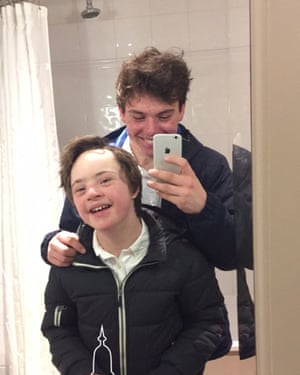
‘He can be tricky, perplexing and sometimes outrageous, but his sense of fun and love outweighs all else.’


‘He can be tricky, perplexing and sometimes outrageous, but his sense of fun and love outweighs all else.’ Photograph: Oliver and Sebbie Shone

I will never forget the day Sebbie was born; it was my fourth birthday and he arrived so quickly I didn’t even have time to finish my cake before going to see him in the hospital. He was in the special care baby unit, surrounded by wires and lying in a tiny pod. Lots of doctors surrounded him and, young as I was, I realised that he was not a healthy child, but to me he was just my new little brother and was perfect. I did not understand, then, the overwhelming distress and horror that faced my family.


There were many big words flying around that I did not understand. Tetralogy of Fallot … atrial septal defect … open-heart surgery … My parents were alarmed, panicked; I had not seen them like this and I felt afraid too. This was the start of a long and terrifying journey of operations, hopes and fears. But nothing seems to dampen his enthusiasm and his quirky outlook on life.


It is hard to judge “normal” in this world. There is talk of testing for Down’s syndrome, selective abortion and eradicating this condition. While I understand that no disability is ideal, I think it would be desperately sad to lose these precious children and adults who bring so much light into their families’ lives. Gone would be my crazy brother who talks of pizzas, trains and skiing all in the same sentence; gone would be the adoration that he feels for me and gone would be that wonderful dancing and tuneless singing.


We often find ourselves laughing round the table at funny remarks and comments of his; he has always had the ability to generate laughter. His sense of humour is infectious; there have been many times that he has diffused a tense situation with his comical asides. It is hard to take life too seriously when Sebbie lifts up his jumper and tells me to “Put your belly away!” His sense of timing is impeccable.


His lack of inhibition means he is more likely than not to join another family at the park or beach while giving us a cheeky wave. He has no sense of embarrassment, shyness or social conventions; this can lead to some embarrassment from me, although most people’s reactions are positive.


I often think of his future and what it holds. Sebbie will never be able to live alone and will need constant care and supervision, which I plan to always be a part of. Although we love him, it is frightening to look ahead to a life that will never be independent. We not only worry about how he will cope in later life, but also the major operation that will probably face him before he is 18.


Sebbie’s current condition (although he is physically more than able) can lead to frustration and difficulty. Even the simplest tasks, such as putting on a coat, socks and shoes, can lead to disputes, especially as he is such a strong character. Growing up with a brother with Down’s syndrome has been a real challenge but I would not change him for the world. He can be tricky, perplexing and sometimes outrageous, but his sense of fun and love outweighs all else. There are adults with the condition who have learned to drive cars, are performing in drama groups and are holding down jobs.


My great uncle had the same condition and he was born exactly 100 years before Sebbie, in 1903. Thankfully times have changed since he was alive – he spent his life in an institution. Now disabled children have huge opportunities open to them and are achieving more than was ever thought possible. With our help I hope that Sebbie will grasp these opportunities. Who knows what he might achieve? I will always be at his side to help him along and I know the rewards I get back from him, in the form of love and friendship will make it worthwhile.


Oliver originally wrote this piece as part of his GCSE English course last year


My brother has Down’s syndrome. I wouldn’t change him for the world | Oliver Shone

6 Ekim 2016 Perşembe

Sorry, Sally Phillips, but a woman should be able to know if her unborn baby has Down’s syndrome | Hadley Freeman

I’ve always been a fan of Sally Phillips. I loved her as the chain-smoking feminist Shazza in Bridget Jones, of course, as well as the nightmare girlfriend from the past in Green Wing. But mainly I loved her for the 90s feminist sketch show Smack the Pony. Some women experience their feminist awakening when they read The Female Eunuch or Andrea Dworkin. For me, it came from Nora Ephron and Smack the Pony, in which Phillips, along with Fiona Allen and Doon Mackichan, gloriously satirised the rigid expectations placed on women, often by other women.


Which brings me to Phillips’ documentary, A World Without Down’s Syndrome?, which screened on Wednesday night on BBC2. There has been an enormous amount of publicity for this documentary, with praise for Phillips’ clearly heartfelt intentions. The actor has an adorable young son, Olly, who has Down’s syndrome, and one of her aims is to provide a counterbalance to the almost entirely negative depiction of Down’s syndrome in both society and the media. For this, she should be loudly applauded. True, her wholly positive depiction of her life with a child with Down’s syndrome is as partial as the wholly negative ones, not least because her son is relatively high-functioning and Phillips and her husband are able to afford help. Still, as I said, it’s a much-needed corrective, and hats off to her.


But that is not all Phillips and her film are arguing for. Rather, the documentary was pegged to the imminent availability of non-invasive prenatal testing on the NHS, which is a safe and more accurate method of screening for Down’s syndrome than the form currently available, and with no risk of miscarriage. This, according to Phillips, is “sad, it’s just horrible, really”. Later, she describes herself as “really quite angry” about it.


To argue for screening is not to argue, as Phillips suggests, that people with Down’s don’t have a right to life


Phillips makes no bones that she is coming at this subject from a deeply personal perspective, one that is occasionally blurred with tears during her film. This perhaps explains why such a bright woman repeatedly and determinedly conflated equipping pregnant women with knowledge about their unborn baby – that is, being screened – and the advice they are then given about it. No doubt some medical professionals have advised women to have terminations after receiving a positive test; there absolutely should be campaigning about how this kind of information is imparted to expectant women and mothers who have just given birth.


This, however, does not mean that women should be denied available information about their unborn baby’s health, and instead be unnecessarily surprised at birth with a situation for which they may be entirely unprepared. Phillips is right: rates of Down’s syndrome probably will decrease with the rise of easier, more accurate screening. But she is wrong to then draw the conclusion that women should therefore not be informed about the health of their in utero baby.


Phillips did not know Olly had Down’s syndrome until he was born. But this, she says, was a good thing, because by having no choice she was compelled to see how much Olly benefits her family. “That made me wonder whether choice is always the wonderful thing it’s cracked up to be,” she says, a statement which casts something of a shadow on her description of herself as “pro-choice”. But while not having a choice has worked out wonderfully for her family, no consideration is given to women who do not have Phillips’ aforementioned privileges. A single mother with two jobs and three kids, for example, might not find similar benefits from a lack of choice. It is very difficult to see how compelling women who genuinely feel they cannot care for a child with special needs to give birth helps anyone, least of all people with Down’s syndrome.


To argue for screening – and for women to have the freedom to make their own choice with the information – is not to argue, as Phillips suggests, that people with Down’s syndrome don’t have a right to life, or should never have been born. The point is it’s the woman’s choice about what’s best for her and her family, whatever the situation. Early in the film Phillips meets Prof Sue Buckley, who works at Down’s Syndrome Education. “We don’t believe that a diagnosis of Down’s syndrome should be a reason for termination,” Buckley says to a solemn Phillips.


And therein lies the rub: the idea that women should only have terminations for reasons someone else finds acceptable. How about if a woman feels too young to have a baby, or too poor, or doesn’t want to be tied to the man she conceived with for the rest of her life, or she doesn’t want a third baby, or any baby at all – are these permissible reasons for a termination? They are all pretty common ones. Or is it just a Down’s syndrome diagnosis that is deemed an unacceptable cause for an abortion? In more controversial areas, such as sex-selection abortion, the correct approach is to tackle the attitudes behind it, not ban abortion per se. Similarly, with Down’s syndrome screening what needs examining is the image around the syndrome and the way doctors discuss it, not the screening itself. It’s the attitudes, not the science, that’s the problem. Science is what gives women the choice. Which brings me to the nub of Phillips’ documentary.


Phillips, a committed Christian (which was not mentioned in the documentary), and her many online supporters insist that they’re not anti-choice – they just want women to make “informed” choices. The lie of this was revealed when Phillips met Kate, a woman who terminated her pregnancy after she was told her baby would have Down’s syndrome. Kate talked about how she read blogs, positive (“loads”) and negative, by parents of children with Down’s syndrome. She felt “informed”, and she then opted for a termination. Phillips says afterwards to the camera that she felt Kate was wrong: “Kate didn’t want a child like mine. That was difficult to hear.”


So it’s not choices that are “uninformed” that are the problem, it’s choices Phillips and others of her mindset don’t agree with. It is human for Phillips to relate these stories so closely to herself, but it is also astonishingly solipsistic and, given that she is doing so on such a public platform, potentially destructive. I am not generally given to making hand-wringing proclamations about what the BBC should and should not show, but it is genuinely shocking that BBC2 decided to screen a documentary with such a blatantly anti-choice message.


Phillips opened her documentary with the following questions: “What kind of society do we want to live in and who should be allowed to live in it?” The answer to the latter is, of course, everyone, which is the status quo – and more screening would not change that.


Phillips’ inference that screening will lead to babies with Down’s syndrome not “being allowed” to live in this society is dishonest. Anything that gives women more objective scientific information about their pregnancy is good.


The question of what kind of society we want to live in is, to my mind, even more simple: one in which women are not dismissed as “uninformed” or “wrong” on national TV – or anywhere – for making a choice about their pregnancy, and that goes equally for women who decide to carry their Down’s syndrome baby to term, or women who opt for a termination. Feeling is not fact, and being pro-choice means supporting all women’s choices, not just the ones you agree with. I’m pretty sure Smack the Pony once taught me that.


Sorry, Sally Phillips, but a woman should be able to know if her unborn baby has Down’s syndrome | Hadley Freeman

A World Without Down’s Syndrome? review – straight from the heart, and that’s the problem

‘This is Olly, my son,” says actor and writer Sally Phillips, over footage of her grinning 11-year-old cracking jokes to his siblings at the dinner table. Aside from being an amateur standup, paint-flinger and epic hugger, Olly has Down’s syndrome, a condition he was diagnosed with at 10 days old. Phillips wants to talk about a new test offered on the NHS that will give expectant mothers a non-invasive, 99% indication of the Down’s status of their unborn baby. Other countries using the test have had an increase in the rate of post-positive-result terminations. As it stands, nine out of 10 British women choose abortion if their baby is diagnosed in utero.


In her documentary, A World Without Down’s Syndrome? (BBC2), Phillips hopes to kick off a debate on the wisdom of introducing the test, which she fears will cause the number of terminations to go up here, too.


She goes to considerable lengths to take in all aspects of the subject, meeting parents, experts, educators and scientists in places as far apart as Iceland and California. But she is both the perfect person to give an account of Down’s syndrome and the worst possible person to present this documentary about the pros and cons of screening.


How could anyone look at Phillips’s son and say they wouldn’t want their child to be like him? This is the nub of programme, the undeniable foundation on which her argument is built. Now take that out into the world, this image of Phillips metaphorically clutching a picture of lovely, funny, warm, wonderful Olly in her hands and try to get a sensible conversation going about the pros and cons of screening. It isn’t possible for the other side of the debate to flow freely under these circumstances.


What I get instead of an even-handed discussion is at least a light shined on something that has only ever been in my peripheral vision. Phillips is right that the subject needs raising because the way a pregnant woman is spoken to about a Down’s diagnosis undeniably needs to change. “I expected tragedy and got comedy,” is how she puts it. A long list of potential health problems, as currently provided in NHS leaflets, isn’t enough to go on when you’re deciding whether or not to bring a life into the world. She has so much insight and intelligence to bring to this, but her interactions with experts and parents on the other side of this debate often leave her tearful and frustrated.


Producer/director Clare Richards does try to keep a careful hand on the tiller, often framing setups with Phillips’s own disclaimers about being a novice film-maker, and occasional questions about whether she is getting it right. Phillips herself said in an interview (on ITV’s This Morning) that she wanted someone else to make this film, someone with documentary experience. Presumably, her celebrity status made her a more appealing prospect for the broadcaster than a scientist or journalist with that degree of distance.


As she treads on ever more tricky territory, you can see why she was reluctant. The most difficult scene is her interview with Kate, an expectant mum who terminated a pregnancy after a positive Down’s diagnosis. As she describes aborting her 25-week-old foetus, Phillips tears up and bows her head. She acknowledges Kate’s bravery in talking about such a hard choice, but then she takes out an iPad and shows Kate a video clip of a young American gymnast called Chelsea, who also has the condition. Phillips’s smile seems to be urging Kate to see what she can plainly see: that their lives are no less valid. That people with Down’s can go on to great things.


“Do you mind if I ask you the really difficult question?” Phillips says, in the most direct confrontation of the programme. “So, you think her life would have been better not happening?” she asks tentatively. Kate takes a moment, then says that she thinks it should be up to each mother to decide.


“Kate didn’t want a child like mine,” says Phillips in voiceover after their interview. That wholly emotional summary of what we’ve just seen is why this doesn’t work as a documentary. When a subject is so close to the presenter’s heart that it is indivisible from it, the result is impassioned but not impartial.


As Phillips herself says, this is “a film that asks the question – what kind of society do we want to live in?” The answer here is unequivocal from minute one: a society that cares about everyone, no matter what their chromosomal makeup. Who could disagree?


A World Without Down’s Syndrome? review – straight from the heart, and that’s the problem

5 Ekim 2016 Çarşamba

Whether to have a Down’s syndrome baby – it’s not black and white | Frances Ryan

There’s a scene in BBC2’s A World Without Down’s Syndrome?, which airs tonight, in which Sally Phillips, Bridget Jones’ Diary actor and mother of a son with Down’s, shows a video of a disabled girl competing at a gymnastics competition to a woman who chose to end her own pregnancy. The interaction isn’t designed to guilt the woman who made a different decision – Phillips is an empathetic presenter and describes herself as pro-choice – but it is a snapshot of how the conversation around disability and abortion is routinely set up: one woman’s choice versus another’s.


We see this in articles praising women who choose to have their child despite the fact a foetal abnormality has been detected, often asking other female readers: what would you do? Or the tone of news items in which women express doubts or fears about raising a disabled child. Katie Price was described as having “confessed”when she said she probably would have had an abortion if she’d known her son Harvey was going to be severely disabled, as if the thought, let alone the act, was a heinous crime.


On the other hand, I’ve seen women with disabled children – and disabled people themselves – be asked incredulously (often by complete strangers) why an abortion wasn’t chosen. Such attitudes are particularly alarming in a climate where disabled people are increasingly perceived as a costly burden to the state.


When it comes to disability and pregnancy, we are routinely stuck in this sort of black-and-white dichotomy: having a disabled child is said to be a tragedy or inconvenience that should always be avoided, while women who do choose to abort a foetus with abnormalities are vilified as “shallow” and “selfish”. Neither is accurate nor addresses the issues that really matter.


The truth is there is still considerable prejudice around disability. We live in a culture where disabled people’s lives are often said to be worth less, and difference is equated with failure or negativity. Even Paralympians are described in some media reports as “suffering” from their disability. It’s not alarmist to accept that the way as a society we understand disability can directly impact on how individuals feel about bringing up a disabled child.


Medical professionals – the very people pregnant women rely on – are not exempt from spreading such attitudes. Phillips has spoken of the way that, after her son was born with Down’s, her doctor broke the “bad news” and the nurse cried. (Her child’s disability wasn’t detected during pregnancy.)As the NHS looks set to introduce a more effective screening for Down’s syndrome, it’s a valid moment to question how we view disability as a society, and to accept that women, and of course men, deserve accurate information in order to make an informed decision.


But in doing so, we should be vigilant of how quickly this conversation can be derailed. It is an ongoing strategy of anti-choice groups to hijack disability, generally as a way to reduce women’s reproductive rights. This sort of faux concern tends to be less about disabled people’s equality and more about women’s inequality. (And though we’re often cut out from the discussion, disabled women can be the ones who are pregnant.) Days before Phillips’ documentary was even set to air, the Mail used it as an opportunity to run an article claiming women “are being pressured to abort babies” with Down’s.


And yet anti-choice campaigners and media organisations who purport to wish to “protect” disabled foetuses tend to be very quiet – or in the Mail’s case, very vocal – about the support disabled people should receive once they are out of the womb. Raising a child with a severe disability can be exhausting and difficult, as well as wonderful, and this is much harder when the state cuts play centres for disabled children, respite care and transport. Phillips herself admits she was lucky to be able to afford to hire a live-in nanny to help with her disabled child, an advantage women on low incomes struggling alone can only imagine.


And we need to talk about that too, if we are going to really have this discussion. We need to admit that things such as economic and gender inequality, as well as perceptions of disability, impact on our supposedly free choices. And we need to argue for positive change, such as more government support for disabled children (and adults), and more inclusion of disabled people in all parts of society.


As we all know, life, let alone disability or raising children, is not black and white but rather filled with multiple shades of grey. I hope Phillips’ documentary starts a long overdue and nuanced conversation. Both women and disabled people deserve better than simplistic judgments.


  • Comments on this article will be pre-moderated


Whether to have a Down’s syndrome baby – it’s not black and white | Frances Ryan

1 Ekim 2016 Cumartesi

Sally Phillips’s film on Down’s is ‘unhelpful’ for families, warns antenatal specialist

One of Britain’s leading antenatal experts has strongly criticised a BBC film about children with Down’s syndrome, before its broadcast this week.


The documentary, A World Without Down’s Syndrome?, will be shown on Wednesday and is presented by the actress Sally Phillips, who has a child with Down’s herself. In the programme Phillips, known for her role as Tilly in Miranda, makes the case against the introduction of a new NHS pregnancy screening test that would detect with 99% accuracy the foetal abnormalities indicating Down’s syndrome.


Jane Fisher, director of Antenatal Results and Choices, an organisation set up to support parents affected by foetal screening and its consequences, said she thought the programme – in which she is interviewed – was “not at all helpful” to people facing difficult decisions around a prenatal diagnosis of disability.


“Sally is a very compelling presenter,” Fisher told the Observer, “and – absolutely – it’s great to have the positive images of people [with Down’s] who are already here. But it’s very personal, and it’s an extra layer of difficulty for couples and families who might be making the decision now about whether to end their pregnancy. It risks offering the suggestion to those who have [decided to end a pregnancy] that they have made the wrong decision.


“It’s too problematic to have one individual representing that choice – one who is an advocate for not screening, who has a high-functioning, much-loved child. A woman who admits she has the resources for extra help with her absolutely lovely little boy.” She added: “No one is casting aspersions on Sally’s son. Or trying to invalidate his right to be here.”


People with Down’s have an extra copy of a chromosome and have learning and developmental difficulties ranging from mild to severe. Some are more prone to serious health conditions, especially heart and thyroid problems.


Jane Fisher, director of Antenatal Results and Choices.

Jane Fisher, director of Antenatal Results and Choices.

Current testing for the condition takes place after 12 weeks, at which point women are told if they are at high or low risk. They can also be invited to have a more accurate – but invasive – amniocentesis test, which carries a one-in-100 risk of miscarriage.


The new test, non-invasive prenatal (NIPT), is a blood test that boasts a detection rate of 99%. Currently 90% of people informed that their child has Down’s choose to terminate the pregnancy. Anti-screening campaigners fear that rate will rise if the more accurate, non-invasive NIPT is made available on the NHS, something ministers are currently considering. When NIPT was introduced in Iceland, the termination rate rose to 100%. The test is already available in private clinics, costing around £400.


About 750 babies are born each year with Down’s syndrome in the UK, and there are an estimated 40,000 people living with the condition.


In a joint statement with the BBC, the programme’s makers, Dragonfly, said the film was intended to “bring difficult questions into the public arena. This film follows Sally Phillips as she explores what effect the test could have on our society, drawing not only from her first-hand experience but also by meeting several families who give an insight into their experiences of having a child with Down’s syndrome, as well as people with Down’s syndrome themselves. She also talks to health professionals and experts with a wide variety of views.”


Phillips, who is a Christian, is pro-choice, but says women are pressurised into having abortions by medics, and that the positives and rewards in parenting a disabled child are ignored. “Nobody knows what Down’s syndrome children can achieve,” she says.


There will always be people who choose not to screen, who choose to have the child. The point is choice


Jane Fisher


Anti-abortion groups are involved in the Don’t Screen Us Out (DSUO) campaign, calling on MPs not to introduce NIPT. Lynn Murray of DSUO has called the test the “new eugenics”.


But, according to Fisher, the programme’s warning of a potential “world without Down’s”, if NIPT screenings are introduced, is an over-simplification.


“Full respect for Sally,” said Fisher. “You can see her empathy and her love for her son, and wish for people to have a more positive attitude towards the condition. But it’s important we don’t get too simplistic about this. There will always be people who choose not to screen, who choose to have the child. The point is choice.


“We want to make sure that women who take the decision to end the pregnancy are not perceived somehow as saying they do not value people who are here – they are saying this is not something they can do, that it is not right for them or for their families.


“Not only does no one know how their child would be affected by Down’s, but the big conflict for women is the adult the child will be 20 or 30 years down the line. For most women, that is the bit that tips them to end the pregnancy. An adult who will be, at best, vulnerable,” she said.


Sally Phillips in a scene from A World Without Down’s Syndrome?


Sally Phillips in a scene from A World Without Down’s Syndrome? Photograph: Brian Ritchie/BBC/Dragonfly

The Down’s Syndrome Association has not taken a position either for or against the proposed new screening regime, focusing instead on its own Tell It Right, Start It Right educational campaign, which calls for better training and information provided for health professionals.


Carol Boys, chief executive of the charity and mother of a young man with Down’s, said: “For a long time, we’d been receiving calls from families who are going through the screening process and want more information. Quite a number complain about the way they have been treated.


“Our organisation wasn’t set up to make judgments, but you cannot make an informed decision if you don’t have all the facts. The problem with testing is that people go along and don’t really know what they are being tested for or the implications of the result.


“They find themselves in a high-risk category and don’t know what it means. The screening committee have asked us to help them with training, and we are happy to do that.


“We are essentially here for people with Down’s and their families. As far as life for people with Down’s goes, things have come a long, long way in the past 30 years. Life is always going to be more challenging. They have a learning disability, and they are always going to need extra help and support – but then so do a lot of other people in our communities.”


A World Without Down’s Syndrome? is on BBC2 at 9pm on Wednesday


Sally Phillips’s film on Down’s is ‘unhelpful’ for families, warns antenatal specialist

Sally Phillips: Do we really want a world without Down’s syndrome?

Sally Phillips and her husband, Andrew, didn’t find out that their first child, Olly, 12, had Down’s syndrome until he was 10 days old. Nobody noticed on the day he was born. “I had a caesarean because he was breech,” says Phillips. “I reacted badly to the anaesthetic so everyone was focused on me. Olly scored highly on all the tests and no one noticed there was anything different about him. I noticed. And I asked them to look at him. There was something about his eyes that was troubling me. It was as if his cheeks were really big and not allowing his eyes to open. I said, ‘Does he look like that because I ate a lot of cake when I was pregnant?’ They said, ‘Yes, probably.’”


Best-known for her roles in the Bridget Jones films (as Bridget’s best friend, Shazza) and Miranda (where she plays Miranda’s old school friend, Tilly), she has a knack of making comedy out of life, including her own. And she is not afraid of making fun of herself or her family. Indeed, showing that you can have a normal family life (because what is that anyway?) with a child with Down’s syndrome is one of the main points of a documentary Phillips has made for BBC2, A World Without Down’s Syndrome?


Her first documentary, it examines whether the new, non-invasive screening tests that are available will eventually eradicate Down’s syndrome. Phillips finds the prospect chilling.


She didn’t know that Olly would have Down’s syndrome. “Babies with Down’s syndrome quite often have poor muscle tone and find it hard to feed. We would stay up all night trying to feed him and by 10 days after his birth, he had gone down from 8lb to 3lb. Everyone was still saying, ‘You’re a first-time mum and you’re worrying. Babies always lose weight.’”


She had all the usual prenatal tests but they all came out as indicating an average risk. She admits she felt strange during the pregnancy but put it down to being a first-time mother. “I’m not one of these people who thinks they are psychic. But I just didn’t feel good during the pregnancy. I was all swollen up. It was like I’d been stung by a giant hornet. But everyone kept saying, ‘You’re a first-time mum, it’s all fine.’ Now, being politically correct, I wouldn’t say that I felt that something was ‘wrong’ but I knew that it was different.”


Phillips’ instinct was right. But she is evidently resilient and resolved to be open-minded about parenting a child with Down’s syndrome.


She has been pleasantly surprised. “There were lots of moments during Olly’s babyhood where I would think to myself, ‘Wait a minute, I am not experiencing this as a disaster.’ But you are so bought into the narrative. All the pregnancy books refer to Down’s syndrome as a ‘defect’. All you get is this information that says ‘High incidence of leukaemia, high incidence of deafness’ … It’s totally overwhelming and unhelpful.”


Her family life, as seen on the documentary, is the counter-narrative: water fights, paint fights, an obsession with Barcelona football club and a lot of dancing. Olly, it turned out, was completely different to the “tragedy” she was reading about. “Olly smiled his first smile at four weeks, like any baby, and it was this massive great big smile. I remember I had this one moment when I was going into town on the bus and there were these two mums with their ‘perfect’ babies and they were complaining and whingeing about everything. I thought, oh. I’m supposed to be having a dreadful time? I’m really not.


Sally Phillips in a scene from the documentary, A World Without Down’s Syndrome?


Sally Phillips in a scene from the documentary, A World Without Down’s Syndrome? Photograph: Brian J Ritchie

“At that point I was swinging Olly around the house in a towel, trying to teach him to crawl. That is something you would not have to teach a ‘normal’ child. But we were learning to crawl together and our bond was incredibly strong. We would laugh like lunatics for large portions of the day.”


We are talking in a large room overlooking the garden at her house in south-west London. Every two seconds we are interrupted by her two younger sons, Tom, four, and Luke, nine, showing off and being random. Their father, Andrew, a shipping industry executive, hovers nearby. She chases the boys out but they keep coming back. Eventually Olly wanders in with his iPad, looking for peace and quiet.


“Turn the sound off if you’re coming in here, Olly,” says Phillips.


“It is off,” he looks at us, witheringly, suddenly deciding against sharing space with two boring old people, “But bye bye.” It’s standard 12-year-old behaviour.


Olly attends a mainstream school and has disproved a lot of theories Phillips was told about when he was born. “I was told he would never ride a bike. He goes for a bike ride every day. I was told he would never be able to climb anything. Then we started having this problem where he would scale the back fence of the garden because he wanted to make friends with the neighbour’s children. None of the rest of us could scale that fence. The thing is, nobody knows what Down’s syndrome children can achieve.”


Do we really want to eliminate this community of people – 40,000 strong – in the UK?


It took years for her to decide that she was willing to front a documentary about Down’s syndrome. For a long time she had been hoping that someone else would make one and show the truth about how living with a child with Down’s syndrome is not depressing and life-ruining – in fact, the opposite. Eventually she realised that this wouldn’t happen and she would have to make it herself.


The tipping point? The new prenatal testing that should soon be available on the NHS – NIPT (non-invasive prenatal testing). This is a blood test that is done from week 10 of pregnancy and detects Down’s syndrome with 99% accuracy. In countries such as Iceland (which Phillips visits in the film), the introduction of the test has meant that 100% of Down’s syndrome pregnancies are terminated.


Phillips wants to pose the question: Do we really want to eliminate this community of people – 40,000 strong – in the UK?


“We have the most expensive state-of-the-art Down’s syndrome detection test and the ability to terminate right up until birth. But no allowance is made for the point of view of the other side. The families of people with Down’s syndrome are not consulted. People with Down’s syndrome are not consulted. There has never been an ethical debate about it.”


Phillips didn’t particularly want to be the one to start this debate, but that’s how it has worked out. Her status as an apologetic and reluctant activist is what makes the film appealing, funny and easy to watch. Although she has made no secret of the fact that she is a Christian and a lot of her fascination with ethics is clearly informed by her faith, she is keen to emphasise that she is pro-choice. Plus, she has a fierce curiosity about the views of those she disagrees with.


The film shows her struggling with her emotions as she interviews a woman who decided to abort a Down’s syndrome child. Phillips shows the woman a video of a Down’s syndrome woman competing at a gymnastics competition. The woman is unmoved and unimpressed. As the mother of a Down’s syndrome child, Phillips is clearly angry. But you can also see that she is empathetic, trying to understand. She’s a good person to put across two sides of the story.


There are, of course, two sides to her own story in this context: life before and after Down’s syndrome. “I didn’t know anything about Down’s syndrome at all,” she says. “I didn’t even know anyone with a disabled child. In fact, I don’t think I knew anyone who was disabled.”


Her point is that we are sleepwalking into a world where we could eliminate Down’s syndrome. Is that what we really want? There is a question she has faced all her life as a parent that has always bothered her. “I get asked, ‘Did you know?’ But what I hate is that I also get asked, ‘Didn’t you know?’” The implication being that if she had known, surely she would have terminated the pregnancy.


“And that’s what worries me.”


She would not have terminated the pregnancy. And with what she knows now, she wants to make more people aware of the fact that a Down’s syndrome child does not need to be in the “defect” category. Quite the opposite, she would argue.


She adds: “In a system where everybody screens and where you know at 10 or 12 weeks with 99% certainty whether your unborn baby has Down’s syndrome, it becomes ‘your fault’ if you choose to have the baby. We have imperceptibly flipped into a situation where the woman is under societal pressure to have that termination. Where does it lead? If you choose to have that child, should the government help you? After all, it was your choice. Why should anyone else help you?


“We are really close to that attitude already. There is already a new kind of pernicious discrimination towards disabled people, the idea that they are scroungers. ‘Why should you steal my taxes?’ Who, then, would want to have that child?”


A World Without Down’s Syndrome? will be shown on BBC2 on 5 October


Sally Phillips: Do we really want a world without Down’s syndrome?

28 Şubat 2014 Cuma

The Market place For DNA-Sequencing-Based Down"s Syndrome Exams Could Exceed $six Billion


On Wednesday evening the New England Journal of Medication published a research showing that a new, DNA-sequencing based blood test provides a dramatic improvement in accuracy at screening for Down’s syndrome and a 2nd, connected ailment. That could open up a $ 6 billion market to the biotechnology companies that are presently advertising these exams.


Each 12 months in the U.S. there are 6.six million pregnancies and 4 million births, in accordance the Centers for Ailment Management &amp Prevention. The record costs of the exams, which are sold by four distinct organizations, assortment from $ 700 to $ 2500. Assuming that pricing settles in the middle of that range and that there are 5 million women who select to have the test, that would be a $ eight billion marketplace.


But give that number a haircut. “I have to imagine pricing could come down much more aggressively if tips expanded,” says Douglas Schenkel, an analyst at Cowen &amp Co. Not each and every pregnant woman will ever get the check. But he still argues that the industry for these exams could increase six-fold from its present dimension of about $ one billion. Isaac Ro, an analyst at Goldman Sachs, supplied comparable estimates in a note to clientele.


Such a industry expansion could be critical to all of the companies that make the tests, such as Ariosa, which can make the lowest cost check, Natera, and Sequenom Sequenom. But the biggest winner could be Illumina, the San Diego maker of DNA sequencing gear that funded the trial and that obtained Verinata, a fourth maker of the new exams, for $ 350 million final year.


Illumina says it believes Verinata has strong intellectual home position in this booming new industry. Past that, however, all four producers run their exams on Illumina’s DNA sequencing machines, which means the firm wins no matter what. Francis DeSouza, Illumina’s president, stated in an interview that, if anything at all, he expects to commit significantly less on marketing Verinata and that the business is taking care for there to be an even playing field for the exams. It prices its check in the mid-range of the marketplace, at a $ one,500 checklist price tag.


Illumina also says that it does not anticipate a value war, since the market place expansion will be dependent on healthcare societies writing suggestions that endorse the new check. Right now the American University of Obstetricians and Gynecologists suggests the DNA-based mostly tests only for mothers at substantial danger, including people more than 35.


But the NEJM paper makes a strong argument for expanding that recommendation. Proper now it is suggested that all pregnant females be presented a pair of tests – a blood test and an ultrasound to search for fluid at the base of the fetus’ neck – to display for 3 issues induced when the infant has an further copy of 1 of the 46 chromosome bundles that incorporate the human genetic code. There are 3 this kind of issues that occur commonly: trisomy 21, or Down syndrome, is the most common, creating diminished intellectual ability and slower development trisomies 18 and 13 are less typical, but are often fatal for the infant.


Present screening exams yield a huge variety of false positives, so they have to be followed up with an invasive test that samples cells from the fetus. One such check, chorionic villus sampling, has a miscarriage price of 1 in 200 the other, amniocentesis, causes miscarriages one out of every single 600 instances.


These invasive exams would nevertheless be essential to verify positives from the DNA exams, but they’d be utilised in ladies whose fetuses really do not have Down’s or other trisomies far less typically. The NEJM examine gave the old screening exams and the new DNA-based mostly test to 1,914 pregnant women and followed them right up until the baby was born. For Down Syndrome, the new test gave just six false positives compared to 69 for the previous screening exams. For trisomy 13, there had been 3 false positives with DNA sequencing in contrast to eleven with the classic number. For trisomy 13, the numbers were 1 and 6.


Assuming five million women are tested each and every year, that would indicate 245,000 would be spared an invasive check, and 358 miscarriages may possibly be prevented. Even at a larger expense, that could be tough for insurance coverage companies to say no to. Some professionals, which includes Illumina, assume that more studies will be needed to modify the recommendations.


How does the new check perform? Basically, by counting. Because some of the fetus’ cells circulate in the mother’s blood, researchers can sequence DNA and see if genes from any chromosomes appear also typically. For a much more complete description, examine out the video embedded from Steve Quake at Stanford, who co-invented Verinata’s technological innovation. His explanation commences at five:fifty five.


Not everyone is positive that the new technological innovation, recognized as non-invasive prenatal testing, is an unmixed blessing. Hank Greely, a professor of law at Stanford Law College who has written extensively on genetic concerns, says that the new test is “more reason to think NIPT will largely take more than Down’s screening.” But he warns that these very same approaches may possibly lead to exams for far more difficult tests. “If, say, 70% of American pregnancies obtained broad genetic screening, the up coming generation would look diverse – some will say for better, some for worse.”


The Market place For DNA-Sequencing-Based Down"s Syndrome Exams Could Exceed $six Billion