We congratulate Diana Johnston for introducing her bill (New bill to challenge UK’s Victorian-era abortion law, 14 March) and are delighted it was passed by 172 to 142 votes. As a 10-minute rule bill, it has no chance of becoming law, but it is important in starting the debate about whether, after 50 years, it is time to revisit the 1967 Abortion Act. It is time to treat abortion like any other medical procedure, and control it with regulation and the GMC. It is wrong that three women have been jailed or had a suspended sentence, and that doctors responding to women’s requests may face criminal prosecution. Many people (and even some gynaecologists) do not realise abortion is a criminal offence unless it conforms with the conditions set out in the Act. Up to 80% of people polled believe the woman should make the decision in consultation with her doctor and 90% of a random sample of gynaecologists surveyed in 2015 said that the woman should make the decision to end her pregnancy. It is time for women to be treated as autonomous adults capable of making their own decisions about continuing a pregnancy, a view that the some tabloid newspapers seem incapable of understanding. Wendy Savage Co-ordinator, Doctors for a Woman’s Choice on Abortion
• Join the debate – email guardian.letters@theguardian.com
• Read more Guardian letters – click here to visit gu.com/letters
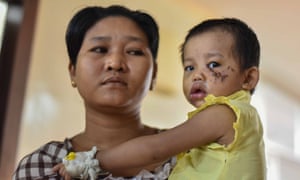
Zu May Naing was playing with her brother outside their house in Bago Region, close to Myanmar’s commercial capital of Yangon, last month when a pack of stray dogs rounded on the 18-month-old.
Her mother, San Thar Myint, found her lying prone on the ground, bleeding and in shock. “Her temperature was over 100 [degrees fahrenheit] before they got to the operation room,” she says.
At the nearest children’s hospital in Yangon, doctors performed surgery and injected the baby with the anti-rabies vaccine. It was the second time that week a child had come in with dog bites. A doctor who declines to be named (he is not authorised to speak to the press) says they see between two and five cases per week.
A few days later, Zu May Naing’s arm is swaddled in bandages at the wrist where the dog seized her in its jaws. A red-brown gash sweeps from her left eye across her cheek. Another droops from the corner of her bottom lip where it was torn off. She glances fitfully around the hospital ward.
“She can’t sleep well at night,” her mother says. “She wakes up suddenly. She’s still afraid.”
Like many parts of the developing world, Myanmar has lived with stray dogs for generations. More than six decades ago, travel writer Norman Lewis described the mutts of Mergui, a coastal city in the south, with unsparing vividness: “There are more dogs than humans; they are a slinking, evil breed, cursed with every conceivable affliction … Many were earless, partially blind and had paralysed or dislocated limbs.”
For now, there is no killing – just breeding
The situation has not improved – and is arguably most acute in Yangon, the country’s rapidly developing commercial capital with a population of some five million. It is overrun with strays; government estimates seen by the Guardian put the number at more than 120,000. Some are scrawny creatures, rib cages pressing against flea-bitten skin, tumours flapping as they nose through rubbish carts. Others are visibly well fed, their muscular tawny torsos straddling spindly legs.
After dark, when the traffic clears and the air cools, some neighbourhoods descend into a chorus of howling. Others face more niggling problems: in a recent post on the local Facebook group “Eliminate All Stray Dogs”, one resident claimed an unruly pack kept jumping on his car, destroying its windscreen wipers.
“They occupy the streets – especially at night,” Ye Naung Thein, a local administrator, says at his office in Mingalar Taung Nyunt township.
Zu May Naing was bitten on the face by a stray dog in Yangon. Photograph: Aung Naing Soe
For decades the government has sought to curb the ever-spiralling canine population with regular mass culls. But increased resistance from animal lovers has led authorities to take a different tack – much to the ire of people such as Ye Naung Thein.
Last July, he says, the Yangon City Development Committee (YCDC) – the city’s chief administrative body – banned the killing of all dogs in two areas: Sanchaung, and his neighbourhood, Mingalar Taung Nyunt.
It was a condition of an agreement signed last year with the global nonprofit Humane Society International (HSI) and the Bangkok-based Soi Dog Foundation, which are set to help Yangon authorities implement a project that would replace culling with a spay-and-neuter programme while also vaccinating dogs against rabies. Six months on, however, Ye Naung Thein has heard nothing about the plan; HSI says it is finalising a proposal.
“For now, there is no killing – just breeding,” he complains.
In the past month, two children have been bitten in his quarter alone – including four-year-old Thurein Lin. He and his mother, Zin Mar Min, were sitting at a teashop when one of the dogs milling around lunged for the boy, sinking its teeth into his skin. The same dog had bitten a different child earlier that day; the girl was in hospital for a week. The dog was later beaten to death.
“The residents are scared,” says Ye Naung Thein. “They are scared of sending their children on to the streets.”
The threat of rabies
As well as attacks, the dogs bring with them a graver threat: rabies. Invariably fatal once symptoms appear, the virus is now largely forgotten in the UK, though it was a real fear in the 19th century.
Today, it is Asia and Africa that bear the largest burden. The virus claims an estimated 50,000 lives a year, and Myanmar has the second-highest incidence of any country in south-east Asia with about 1,000 deaths per year, according to the World Health Organisation.
Last year, 41 patients with rabies were sent to Yangon General Hospital, the biggest in the city, according to its deputy medical superintendent Daw Khin Than Mon. But the overall number of victims is likely higher: “It’s hard to know the number of people bitten because people can go to the clinic or regional hospital,” she says.
In Yangon, once rabies patients are confined to the isolation ward in the hospital – a vast, colonial-era building with no air-con and sporadic fans – there’s not much else to be done. Most people die within a few days.
“It’s very depressing,” says one of the nurses, who asked not be named.
After dark some neighbourhoods descend into a chorus of howling. Photograph: Romeo Gacad/AFP/Getty Images
Yangon’s regular mass dog culls have involved municipal workers laying out poisoned meat; scooping up the corpses later. But this method is deeply divisive in the Buddhist-majority nation, where religious conviction strengthens a deep love for animals.
“I have a YCDC official friend who worked for the animal department,” says Ye Naung Thein. “I met with him a couple of months ago and he said he is happy now because he moved to another department and doesn’t need to do killing any more.
“I told him: ‘You are government staff and you’re doing the government’s work. Who said this is a sin?’ But he replied: ‘Buddha said he doesn’t like killing and this is the sin’.”
While allowing authorities to remove obviously rabid or sick animals, the culls did little to bring the population down or eliminate the virus. Animal experts and humane organisations say culling alone has never helped a city control its dog population.
“I mean, it’s just common sense,” says Rahul Sehgal, Asia director at HSI. “If you compare the statistics of rabies in a country that is undertaking culling over the years, you will hardly see any hint of reduction in the number of rabies cases.”
Indeed, studies show culls can actually worsen the problem by killing vaccinated animals, unsettling the population – leading to fights over territory – and keeping it young and more aggressive.
“What is happening is a kneejerk reaction,” says Sehgal. “It’s a symptom but we are not finding a cure.”
He advocates the “spay-neuter-release” strategy, which involves capturing animals, neutering and vaccinating them and letting them go in the exact place they were caught.
The method – which studies say have produced results in some cities, including Jaipur – is now enshrined in law in India and elsewhere. But it takes time to work.
“The dog population has existed for several decades,” says Sehgal. “You can’t bring it down in a couple of years – it’s not magic.”
Residents are still waiting for the launch of a ‘spay-and-neuter’ programme to control the stray dogs. Photograph: Aung Naing Soe
‘We just want killing’
In her spacious office in the downtown YCDC building, Dr Hla May Oo, assistant head of the veterinary and slaughterhouse department, pulls a black plastic blowpipe out of a cardboard box and puffs into the tube.
“Stray dogs are very difficult to catch so we use a traditional method,” she says, laughing.
The city authorities carried out their own spay-and-neuter plan in one township late last year, sending municipal workers out with blowpipes loaded with anaesthetic.
Hla May Oo claims workers vaccinated and sterilised more than 70% of strays – the minimum threshold animal experts say must be met for population control to be sustained. Plans are under way to extend the campaign, funded by donations, to another township this month.
In the meantime, the department has stopped culling except on special request, aside from the two townships involved in the HSI project where it is banned outright.
Hla May Oo, who has led the department since 1988, says she is caught in the middle of what some are calling a war between dog lovers and dog haters. “We are receiving a lot of complaint letters every day,” she admits.
Ye Naung Thein is skeptical about the plan, having seen similar projects fall by the wayside in recent years.
“In our situation, a lot of corruption is happening everywhere,” he says. “We don’t how the money comes and what it goes on … We objected to the [spay-and-neuter] plan because we knew they would not do any follow-up after the project. We just want killing.”
Even in places where anti-rabies spay-and-neuter plans have showed signs of success, including Bali and some Indian cities, the expense of the programmes and the sheer terror of rabies has led governments back to culling.
“I live in India, which has 35 million stray dogs,” says Sehgal of HSI. “A massive amount of money is needed to do this, and [implementation of spay-and-neuter] has been sporadic there … You work for a year, you stop for a year. By the time you are coming back to it, the dog population has multiplied again.”
But if the efforts are sustained, Sehgal says, “it just cannot fail.”
The thing about culling, by contrast, is that the results can be seen straight away. As San Thar Myint cradles her baby in the hospital ward, she is in no doubt about what she wants.
“I want to kill these dogs – I don’t want to look at them,” she says. “I want to say that villages and residential areas should not have dogs.”
Additional reporting by Cape Win Diamond and Aung Naing Soe
Follow Guardian Cities on Twitter and Facebook to join the discussion, and explore our archive here
There’s a scene in BBC2’s A World Without Down’s Syndrome?, which airs tonight, in which Sally Phillips, Bridget Jones’ Diary actor and mother of a son with Down’s, shows a video of a disabled girl competing at a gymnastics competition to a woman who chose to end her own pregnancy. The interaction isn’t designed to guilt the woman who made a different decision – Phillips is an empathetic presenter and describes herself as pro-choice – but it is a snapshot of how the conversation around disability and abortion is routinely set up: one woman’s choice versus another’s.
We see this in articles praising women who choose to have their child despite the fact a foetal abnormality has been detected, often asking other female readers: what would you do? Or the tone of news items in which women express doubts or fears about raising a disabled child. Katie Price was described as having “confessed”when she said she probably would have had an abortion if she’d known her son Harvey was going to be severely disabled, as if the thought, let alone the act, was a heinous crime.
On the other hand, I’ve seen women with disabled children – and disabled people themselves – be asked incredulously (often by complete strangers) why an abortion wasn’t chosen. Such attitudes are particularly alarming in a climate where disabled people are increasingly perceived as a costly burden to the state.
When it comes to disability and pregnancy, we are routinely stuck in this sort of black-and-white dichotomy: having a disabled child is said to be a tragedy or inconvenience that should always be avoided, while women who do choose to abort a foetus with abnormalities are vilified as “shallow” and “selfish”. Neither is accurate nor addresses the issues that really matter.
The truth is there is still considerable prejudice around disability. We live in a culture where disabled people’s lives are often said to be worth less, and difference is equated with failure or negativity. Even Paralympians are described in some media reports as “suffering” from their disability. It’s not alarmist to accept that the way as a society we understand disability can directly impact on how individuals feel about bringing up a disabled child.
Medical professionals – the very people pregnant women rely on – are not exempt from spreading such attitudes. Phillips has spoken of the way that, after her son was born with Down’s, her doctor broke the “bad news” and the nurse cried. (Her child’s disability wasn’t detected during pregnancy.)As the NHS looks set to introduce a more effective screening for Down’s syndrome, it’s a valid moment to question how we view disability as a society, and to accept that women, and of course men, deserve accurate information in order to make an informed decision.
But in doing so, we should be vigilant of how quickly this conversation can be derailed. It is an ongoing strategy of anti-choice groups to hijack disability, generally as a way to reduce women’s reproductive rights. This sort of faux concern tends to be less about disabled people’s equality and more about women’s inequality. (And though we’re often cut out from the discussion, disabled women can be the ones who are pregnant.) Days before Phillips’ documentary was even set to air, the Mail used it as an opportunity to run an article claiming women “are being pressured to abort babies” with Down’s.
And yet anti-choice campaigners and media organisations who purport to wish to “protect” disabled foetuses tend to be very quiet – or in the Mail’s case, very vocal – about the support disabled people should receive once they are out of the womb. Raising a child with a severe disability can be exhausting and difficult, as well as wonderful, and this is much harder when the state cuts play centres for disabled children, respite care and transport. Phillips herself admits she was lucky to be able to afford to hire a live-in nanny to help with her disabled child, an advantage women on low incomes struggling alone can only imagine.
And we need to talk about that too, if we are going to really have this discussion. We need to admit that things such as economic and gender inequality, as well as perceptions of disability, impact on our supposedly free choices. And we need to argue for positive change, such as more government support for disabled children (and adults), and more inclusion of disabled people in all parts of society.
As we all know, life, let alone disability or raising children, is not black and white but rather filled with multiple shades of grey. I hope Phillips’ documentary starts a long overdue and nuanced conversation. Both women and disabled people deserve better than simplistic judgments.
What can the NHS afford? Every week one pressure group after another protests at rationed treatments, as the NHS suffers its greatest funding shortfall since it was founded.
Today, it’s Breast Cancer Now – and its case is exceptional. Usually rows over cancer drugs involve extraordinarily expensive new treatments, often not properly proven, offering a few months’ extension at the end of life. But here is a cheap drug – bisphosphonates to be taken for three years at a cost of just 43p a day – that would prevent one in 10 deaths if given to all eligible breast cancer patients. A study in the Lancet shows it cuts the risk of cancer returning by 28% and the risk of death within 10 years by 18% – a significant effect. But it has been caught in a money row that is a typical symptom of the fragmented, competing service created by the 2012 NHS Act, where everyone offloads costs on to everyone else: should it be paid for locally (yes, says NHS England), or funded nationally (yes, say local clinical commissioning groups – CCGs – and providers). The National Institute for Health and Care Excellence (Nice) – excellent but often too slow due to lack of resources – will not adjudicate until 2018.
And what of IVF? It’s constantly picked on as if it were a mere lifestyle choice, like cosmetic surgery. But Nice decrees that every woman who needs it should get three free cycles of infertility treatment on the NHS. A survey shows only one in four areas in Britain offers all three cycles: who gets a baby is a postcode lottery as arbitrary as delivery by stork. Instantly on the Today programme, IVF campaigners were grilled as to whether desire to have a baby should really be a priority compared with, say, cancer treatments?
That’s the way it always goes – one lot of NHS needs pitted against another, when the answer of course, is both. The pain of childlessness – a health malfunction – can be a lifelong agony, far worse than minor ailments that are treated unquestioningly. Nice recognises it and it is the best judge we have of value for money treatments when even a well-funded NHS always has to prioritise. Rationing is inbuilt in every health system – and it’s far more brutal under US private insurance plans. The only question is only how much are we willing to pay for what? The RNIB reported this week that people are waiting up to 15 months for cataract treatment, as cash-strapped CCGs, ordered to cut their debts, ration non-life-threatening treatments, even if delay may be life-crippling.
What can we afford? A strong report emerged on Wednesday from the Office for Budget Responsibility – the government’s getting and spending arbiter. Yes, it concludes, the NHS will still be affordable in 2030 and it could increase its share of GDP by almost a fifth. Just as growing numbers of politicians thrash around for new ways to pay – insurance or top-up fees – here come the official budgeteers saying the growth the NHS needs is affordable. Leading health economist Professor John Appleby, of the Nuffield Trust, says the OBR report shows the NHS can comfortably be paid for through general taxation.
We spend 7.4% of GDP on the NHS, but that’s due to fall to just 6.9% by 2020: can that be kept to in the current crisis? Though Theresa May has told top health officials that there will be no more money, she may be forced to relent. The OBR says spending could rise to 8.8% by 2030, an annual real-terms increase of 3.5% a year, still less than the NHS’s 4% average increase since 1948. Appleby says: “The real debate the UK needs to have is over how much more we want to spend on the NHS, not whether we need to change the way the health service is funded.” The OBR figure for 2030 simply puts us in line with most equivalent countries – such as France, Japan, Germany and the Netherlands.
The House of Lords long-term sustainability of the NHS committee will report in March. This is a never-ending story, as the cost of the NHS has caused untold anguish to one government after another. Only five years after its foundation, the Tory government set up a commission to look into whether its long-term funding would meet future demand, though it only cost 3% of GDP then.
The NHS always had enemies – and its affordability is a 1950s question very like grammar schools. However often the evidence shows that the cheapest and most efficient way to pay for health is collectively through general taxation, there are some who imagine private insurance, or some kind of complex semi-private system, or top-up fees would magically see us all pay less for more. Year after year the US Commonwealth Fund points to the UK system as being the best bang for the buck – but mere evidence seems to count for less and less.
The one big question is how much tax we will pay for what standard of treatment. The NHS tops public concerns right now, and so it should. What politicians should really be asking themselves is how best to put this honest question to voters – what will you pay?
The Royal Courts of Justice in London. The court of protection is taking into consideration the case of a woman who could require a hysterectomy but allegedly lacks the capacity to consent to it. Photograph: Martin Godwin
A mentally unwell girl will need to have to be handcuffed if she is to be produced to have a hysterectomy regardless of not becoming capable to consent to it, a court has heard.
Mr Justice Peter Jackson is thinking about whether to purchase that the procedure be carried out in the woman’s ideal interests following a request from wellness authorities. They say she lacks the psychological capacity to make a selection about her treatment and that the operation is needed.
“[She] is a woman in her 30s, [who] is detained beneath the provisions of the Mental Well being Act 1983,” mentioned a attorney representing medical doctors, in a written statement observed by the judge.
“She lacks capability and demands healthcare treatment method for a prolapsed uterus. It is proposed that she will get surgical therapy, namely a hysterectomy, underneath standard anaesthetic at [a] hospital.
“For causes of security, it is proposed that, while [she] is away from [the unit] for the proposed therapy, she is to be restrained at all instances by means of handcuffs except when under the common anaesthetic.”
The judge has been asked to determine no matter whether the female lacks the capacity to make selections on her own care and, if not, no matter whether the operation well being bosses want to carry out is in her greatest interests.
The case is currently being heard in the court of protection, which helps make choices on behalf of men and women who lack the capability to do so. Since a lot of situations are heard in personal and publication of the identities of the parties is routinely barred, it has faced accusations that it is a secret court.
Nevertheless, the Guardian reported final yr that the head of the loved ones division, Sir James Munby, who is responsible for the court of protection, is seeking to open it up to better public scrutiny by holding much more hearings in open court.
No info that could determine the female, like names of the unit exactly where she is detained, the hospital the place she would have surgery and the wellness authorities with accountability for her care, may possibly be published for legal causes.
A decision is due on Wednesday on regardless of whether the Mid Staffordshire NHS basis trust ought to be dissolved.
Jeremy Hunt, the well being secretary, has the final say on ideas to dissolve the trust and move crucial services to neighbouring hospitals. In January the health watchdog Check accredited strategies drawn up by administrators to downgrade some providers at Stafford hospital in spite of opposition from neighborhood campaigners.
Mid Staffordshire was the focus of one of the most significant scandals in the historical past of the NHS when hundreds far more folks died than would usually be anticipated. The Francis inquiry of 2013 highlighted the “appalling and needless suffering of hundreds of people”, with some individuals left lying in their personal faeces for days or acquiring the wrong medication.
That followed a 2009 investigation by the Healthcare Commission, which located that amongst 400 and 1,200 more people died at Stafford hospital than would have been expected.
In December trust special administrators stated the general trust was unsustainable and that without alterations Mid Staffordshire would face annual debts of much more than £40m by 2017 even though maternity solutions at Stafford Hospital should be downgraded rather than closed as initially planned.
A new midwife-led maternity unit will be created at the hospital underneath the adjustments but advisor-led services for a lot more difficult births will be dealt with at North Staffordshire University hospital.
Overall control of Stafford hospital is anticipated to go to North Staffordshire University hospital, although Cannock hospital will be run by Royal Wolverhampton trust.
Paediatric assessment will still take area at Stafford hospital by specialist staff, in conjunction with accident and emergency, and vital sufferers will be permitted to keep overnight in Stafford as lengthy as the acceptable workers are on duty.