economic etiketine sahip kayıtlar gösteriliyor. Tüm kayıtları göster

24 Kasım 2016 Perşembe

The obesity epidemic is an economic issue

It is estimated that today’s obesity epidemic costs the global economy about $ 2tn (£1.6tn) or some 3% of GDP. For individuals, deciding what to eat is a jealously guarded privilege, but for economists obesity is not really about people exercising free-market choice. Instead it is a market failure.


The causes of the epidemic are complex, spanning the social sciences to biology and technology. Consider, for example, the shift towards urbanisation and car transport. By reducing many people’s daily physical activity, these are estimated together to reduce individuals’ need for food by 300 calories a day. So how much less food should the car driver eat to compensate? About one biscuit less a day – a trivial change that only goes to illustrate that few of us really understand the energy needs of our bodies.


In market terms, making a rational choice at the dining table requires people to know how much energy they need and how much they are getting – yet neither of these is known. As any one who has ever tried to lose weight knows, in these matters talk is cheap and advice is unreliable. At various times sugar, protein, fat, starch, fast food, home cooking and snacks have all been held to be responsible for the obesity epidemic.


Back in the 1950s, the dominant theory was that eating fat was responsible for making you obese – and by sating appetite, sugar could help to reduce weight gain.


However, food companies prefer to deflect rhetoric about poor diet being the primary cause of obesity, and instead promote messages focused on exercise and other factors – a phenomenon termed “leanwashing”.


Nonetheless, the political spotlight is now on sugar, with “environmental” changes proposed to reduce the appeal of sugary foods, such as warning labels and nutritional information panels. There’s serious talk of taxing them, in the way that tobacco has been. None of this is supported by any real evidence, but certainly new taxes are always popular with governments. (It’s pretty obvious, after all, that there are plenty of thin children who enjoy sugary foods, and plenty of overweight people whose tastes lie elsewhere.)


Prof Kevin Fenton, national director for health and wellbeing at Public Health England, says there are “practical solutions”, by which he means a de-sugaring of foods such as cakes, biscuits and puddings. But these foods are not sugary by accident – they are sugary because that’s what we like about them. It’s like salted crisps having salt removed … but yes, the health industry has pushed that one too.


Solutions based on labelling of foods by calorific content to improve consumer choices belie both human psychology and the complexity of the body’s digestive mechanisms. As a result, it is futile leaving a solution to the food and drink industry, or on relying on “education” to correct consumer behaviour.


However, consumer choices are being skewed by government actions, such as massive programmes of agricultural support that actually favour fast foods over healthy eating. Billions of dollars go towards subsidising junk foods, through farm subsidies for producing ingredients such as soya and high-glucose corn syrup.


Obesity affects poor households far more than their richer neighbours – and the cost of eating healthily is a very practical reason why.


And, as the US economist Richard McKenzie has pointed out, much of the rise of obesity is precisely a consequence of free-market economics. For example, fast food has become cheaper, in part because of mechanisation and in part because the workers producing it are paid less and less. At the same time, the economic forces that propelled 1960s women away from the kitchen and into jobs also propelled families towards processed foodstuffs and eating out … or just snacking.


When markets go wrong, governments need to step in. Agricultural support should be switched away from junk foods and towards producing healthy ones. The low wages and poor training that fast-food outlets rely on should be made a thing of the past, and tax incentives (such as zero VAT) should support the labour-intensive production of “real food” in cafes and restaurants.


Market corrections, rather than punitive moves aimed at individuals, are the only way to tackle what has become, in economic as well as in social terms, a very real crisis.


Martin Cohen is editor of the Philosopher. His recent book, Paradigm Shift (Imprint 2015), discusses ‘how expert opinions keep changing’


The obesity epidemic is an economic issue

26 Ekim 2016 Çarşamba

Gender pay gap could take 170 years to close, says World Economic Forum

The authors of a new report forecasting that it could take 170 years to eradicate the disparity in pay and employment opportunities for men and women have called for urgent action to close the gender equality gap.


The report by the World Economic Forum – best known for its high-profile gathering each year in Davos, Switzerland – found that economic disparity between women and men around the world was rising even though the gap was closing on other measures, such as education.


When measured in terms of income and employment, the gender gap has widened in the past four years; at 59%, it is now at a similar level to that seen in the depths of the financial crisis in 2008.


Last year, the WEF predicted it would take 118 years for economic parity to be achieved. This year, the Geneva-based institution has calculated the gap would take until 2186 – 170 years – to close.


Now in its 11th year, the report measures the relative discrepancies between women and men across four key areas: health, education, economy and politics.


The report says: “More than a decade of data has revealed that progress is still too slow for realising the full potential of one half of humanity within our lifetimes.”


The authors, Richard Samans and Saadia Zahidi, said they hoped the report “will serve as a call to action for governments to accelerate gender equality through bolder policymaking, to business to prioritise gender equality as a critical talent and moral imperative, and to all of us to become deeply conscious of the choices we make every day that impact gender equality globally”.


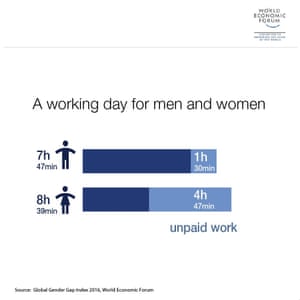
The economic gap is caused by a number of factors, including women being paid almost half of what men receive, working on average 50 minutes a day longer and having a much slimmer chance of reaching senior roles.


Graphic showing the average working day for men and women across the 144 countries surveyed.


Graphic showing the average working day for men and women across the 144 countries surveyed. Photograph: WEF

Zahidi blamed slower economic growth for keeping women out of the workforce and added that, after making some progress, “we’re now hitting a bit of a wall” in terms of policy changes to help women in the workplace. Automation is affecting jobs in sales and administration – sectors with relatively high levels of female employment.


On an overall scale, including health, education and politics, the gender gap could be closed in 83 years across the 107 countries included in the report since it was originally published in 2006 – which is “just within the statistical lifetime of the baby girls born today”.


Gender gap

Within that overall measure, the education gap could be closed in 10 years, while the inequality in politics – which has the widest gap, despite having closed by 23% – should end in 82 years because of the fast pace of improvement since 2006, when it stood at 14%.


This year, 144 countries are included. Iceland, Finland, Norway and Sweden are in the top four, while Rwanda makes it in to the top five.


The UK has risen to 20th from 18th place in the overall rankings, well below its top 10 position in 2006.


The UK’s rankings were compiled before Theresa May became prime minister following the vote for Brexit and are affected by a change to the way income is measured, which lifted the cap on estimated income from $ 40,000 (£32,800) to $ 75,000. This pushed the UK down in the economic parity ranks by 10 places to 53. As a result, the US is also ranked as less gender equal, falling 17 places to 45.


Gender pay gap could take 170 years to close, says World Economic Forum

21 Eylül 2016 Çarşamba

How Prepared Are You for an Economic Collapse?

How Prepared Are You for an Economic Collapse?


These days almost everyone is talking or is aware of our national debt, ongoing militarization and near brink of an economic crisis.  In fact, throughout history, especially in the 19th and 20th centuries, economic crises occurred several times in our own country.  From the greenbacks introduced after the civil war to the great depression even to the gold standard act in which citizens could be criminalized and jailed if they did not turn in their gold.  During an economic crisis the majority of the average citizens’ property value and even business worth are taken against their will by their own government in eventual return for an inflated ‘newer’ currency.  Of course, the citizenry has to suffer first in each economic crisis before submitting to the new form of controlled currency at an inflated rate.  This leads to the question.  How prepared are you for an economic collapse?


Trade and Bartering


A crisis will begin and currency will be no more.  Instead, especially as witnessed in Venezuela, trade and bartering will become the new way of life.  This means what skills you can offer or provide will become your new way of earning an income or at least just food for you and your family.  Learning as many trades as possible will give you the chance to offer other people your skill set if currency and rule of law are no more.


Trade and bartering date back to before currency became a controllable commodity itself.  For example, in the ancient days of Greece the people met every day in the Agora to talk news, trade supplies and even make deals, arrangements and pacts.  Everyone traded with everyone, what you offered eventually became of value to the right person in every town.  Often times many people offered several different trades or specialties helping to advance scientific theories, technology and methodologies of their time.


This form of trade died out once currency became the main commodity to gain access to which you seek.  Small businesses and trade squares were squashed to make room for supermarkets and supermalls owned by few very powerful corporate identities.  Fortunately though several communities have picked up a form of “agorism” both knowingly and unknowingly and have begun trading their specialties amongst themselves in place of the current currency sinking in value.  From food to massage therapy many individuals have even picked up farming in order to increase their own knowledge and trade value.


Homesteading


Just to avoid the fact that rule of law is no more families will take up homesteading.  If they’re not growing crops than they will be raising livestock.  Many of these families that conquer homesteading will become small communities that will be able to sustain themselves in any crisis that comes along.  It is possible learn the trades of homesteading even if it is just harvesting meat to be able to offer a specialty amongst a community that must take these tasks on.


Many people avoid the fact that in case of an economic crisis they will have to hunt their own food to survive.  It’s these people that are prepared for this fact of life that are the most prepared for an economic collapse.


Bug Out Bags


Even a basic bug out bag properly stored is a step up as opposed to scrambling for all of your important supplies while looting and rioting is happening in your neighborhood.  Will you really remember your photo albums, birth certificates and passports during a crisis like that as well?  The key is to prepare as much as you can even if it is just the very upmost essential supplies in a basic bug out bag for the entire family stored and ready to go.  Expanding beyond that would be wise as well preparing a bug out bag for each individual and keeping them close to hand.  Copies of all of your important documents kept safe and prepared will also help you in a recovering situation as well.


Survival Kits


Survival kits range from SHTF toiletry kits to basic IFAKs (Individual First Aid Kits).  Depending on what you foresee for you and your family will determine what survival kits you are keeping on hand.  For those who see themselves defending their family and communities IFAKs are purchased or prepared so they may have the proper medical supplies on hand in case of injury.  Toiletry kits are prepared so that the entire family can maintain basic hygiene in order to maintain preventative medicine.


These survival kits can be kept anywhere from the home to the car such as the survival kit in a pill bottle which provides basic supplies in case your vehicle breaks down in the wilderness.  There are a range of survival kits that should be thoroughly researched as they are an advantage of foresight that most people already are not taking advantage of.


Weapons Handling


How prepared are you for an economic collapse?  Honestly ask yourself. Gangs, thugs and small bands of militia will rise up and take to the streets once rule of law is no more.  Essentially everyone will be out to establish their own rule of law.  Will you be one of those people?  Weapons handling is essential to modern day survival whether for basic hunting or defending against intruders and those who would do you harm.


Starting with your basic hunting weapons begin to master the elements of hunting in your region.  Research what common prey are around, how far and what rifles will take your game down with as much ease as possible.  Meanwhile research what weapons are suitable for your home and residential area.  Having a rifle for self defense that allows you maneuverability in an urban environment is your American right to preparing yourself against both domestic and foreign enemies.  Understand what rifle will allow you this than take the time to research your training.


How Prepared Are You for an Economic Collapse?

2 Temmuz 2014 Çarşamba

Obamacare both hurts or aids the US economic system no one"s sure

The Cost-effective Care Act, or Obamacare, is wreaking havoc with our view of the American economic system.


This yr, each and every revision of gross domestic product – our measure of GDP – has supplied a new read through on what Obamacare is carrying out for the economic climate. Initially, the overall health insurance program appeared to give an huge increase to healthcare spending in the US, indicating that Americans had been rushing in droves to indicator up.


Most recently, US healthcare investing for the 1st quarter of 2014 went from unbelievably sturdy to unbelievably weak. “The close to-record setting 9.9% improve in well being spending proven in the advance Q1 report has been revised to a 1.four% decline,” Goldman Sachs analysts summed up in a report these days.


The downward revision in itself was not a shock to most analysts. The dimension was.


“The revision to Q1 was even larger than we expected,” admitted Goldman Sachs analysts.


Paying on wellness solutions has been a bit of a roller coaster above the last numerous months. The report also found that personalized cash flow and investing information for April and Could demonstrate “almost flat true development in health paying”.


There might be a number of reasons for this back and forth in healthcare paying, says Goldman.


1. Hoping to keep away from insurance coverage disruptions relevant to Inexpensive Care Act, some Americans possibly scheduled their elective and less urgent procedures in the final couple of months of 2013.


2. With sufferers switching to new insurance coverage programs – far more insurance coverage disruption – payments to healthcare companies might have been delayed. As a end result, they might be counted amid healthcare paying in the 2nd quarter.


three. Timing. The rolling deadlines for Obamacare stored rolling previous the traditional fiscal cutoffs for measuring economic action. “Several enrolees waited right up until the 31 March enrolment deadline, which meant in most instances they began to obtain benefits only in April or even Could,” notes Goldman. The healthcare.gov did see a surge of visits and indicator-ups in the weeks leading up to the enrolment deadline. In truth, about 900,000 added enrolees signed up for a strategy in the initial two weeks of April after they had difficulty signing-up by the original 31 March deadline.


4. As constantly, blame the climate. In this case, the culprit may be “a milder than usual flu season”. If you did not get sick, maybe you hurt the economic system by paying much less on healthcare.


US Money Flue health care spending
This female contributed to the economy by obtaining sick during flu season, some say. Photograph: Axel Bueckert/Alamy

five. Private investing. “It is achievable that the difference is due to other personal-sector forces (eg employer-sponsored insurance coverage or out-of-pocket paying) that are more difficult to observe on a month-to-month basis,” explains the Goldman report.


As amount of the health ideas sold through the Inexpensive Care Act exchanged came with large deductibles that the shoppers have to meet just before their programs kick in, out-of-pocket spending could absolutely play a role. Particularly, given that in the starting of 2014, both physician and hospital investing have been working at much more than twice their pre-Obamacare trend, in accordance to Ian Shepherdson, chief economist at Pantheon Macroeconomics.


So what’s up coming? A lot more revisions.


“[T]he estimates could merely be revised higher after the Quarterly Services Survey data for [the 2nd quarter of the 12 months] becomes obtainable in September,” says Goldman. Quarterly Service Survey offers estimates of income and expenditures for select industries, 1 of which is healthcare.


Obamacare both hurts or aids the US economic system no one"s sure

18 Haziran 2014 Çarşamba

How Corporate America Could Conserve $300 Billion By Measuring Overall health Like Economic Efficiency

The U.S. could save a lot more than $ 300 billion annually if employers adopted approaches that promoted well being, prevention of continual illness and measured progress of “working-age” individuals like they did their financial overall performance, according to a new report.


The examination, created by some properly-known public health advocates brought together and funded by The Vitality Institute, mentioned employers could conserve $ 217 billion to $ 303 billion annually, or five to seven percent of total U.S. yearly health spending by 2023, by adopting strategies to aid Americans head off “non-communicable” conditions like cancer, diabetes, cardiovascular and respiratory concerns as well as psychological well being.


To increase, the report’s authors say firms ought to be reporting wellness metrics like BMI and other worker well being statuses just like they frequently report earnings and how an growing quantity of companies report sustainability. Companies need to be needed to integrate well being metrics into their yearly reporting by 2025, the Vitality Institute said. A link to the whole report and its suggestions is here. 


“Companies ought to consider the wellness of their staff as 1 of their best assets,” mentioned Derek Yach, executive director of the Vitality Institute, a New York-primarily based organization funded by South Africa’s greatest overall health insurance organization, Discovery Constrained.


People involved in the report say its suggestions come at a time the Affordable Care Act and employers emphasize wellness as a way to enhance quality and reduce charges.


“Healthy staff are far more productive, resulting in improved monetary functionality,” Yach stated.  We believe this will positively influence the health of each employees and the corporate bottom line.”


The Institute brought with each other a commission linked here that consists of some executives from the wellness care sector and other people who perform in academia and enterprise. Commissioners came from Microsoft Microsoft (MSFT)  the Robert Wood Johnson Foundation drug and health-related gadget giant Johnson &amp Johnson Johnson &amp Johnson (JNJ) well being insurer Humana Humana (HUM) and the U.S. Department of Health and Humana Services.


The Vitality Institute said up to 80 % of non-communicable conditions can be prevented via existing “evidence-primarily based methods” and its report encourages the nation’s policymakers and legislative leaders to boost federal paying on prevention science at least 10 % by 2017.


“Preventable persistent ailments this kind of as lung cancer, diabetes and heart condition are forcing large numbers of people to exit the workforce prematurely due to their own bad well being or to care for sick relatives,” said William Rosenzweig, chair of the Vitality Institute Commission and an executive at Physic Ventures, which invests in health and sustainability tasks. “Yet private employers commit much less than two % of their complete overall health budgets on prevention.  This trend will stifle America’s financial growth for decades to come unless of course overall health is embraced as a core value in society.”


Asking yourself how Obamacare will affect your overall health care? The Forbes eBook Inside Obamacare: The Repair For America’s Ailing Overall health Care System answers that question and a lot more. Available now at Amazon and Apple. 


Health

Well being (Photo credit: 401(K) 2013)


How Corporate America Could Conserve $300 Billion By Measuring Overall health Like Economic Efficiency

12 Haziran 2014 Perşembe

Far more Than ten,000 Suicides Tied To Economic Crisis, Research Says

A dramatic spike in suicides between 2008 and 2010 can be linked with the financial crisis, according to a examine published these days in the British Journal of Psychiatry.


Researchers from the University of Oxford in contrast suicide data from before  2007 with the years of the crisis and discovered a lot more than ten,000 “economic suicides” linked with the economic downturn across the U.S., Canada and Europe.


‘There has been a significant rise in suicides for the duration of the recession, significantly much more than we would have expected primarily based on prior trends,” says lead writer Aaron Reeves, a postdoctoral researcher in the sociology department at Oxford University.


And, says senior author David Stuckler, also of Oxford: “Suicides are just the tip of the iceberg. These information reveal a looming mental overall health crisis in Europe and North America.”


Job loss was one of the top reasons for high suicide rates, research shows. (Photo: public domain)

Dropping a work was 1 of the prime causes for higher suicide rates, study demonstrates. (Photo: public domain)


The boost was 4 instances higher in males than in females, which the researchers advised was simply because males feel better pressure and shame when faced with financial failure, and are also much less probably to look for psychiatric care.


In accordance to the researchers, primary chance variables for the increased suicide charge throughout the economic downturn were:


  • occupation reduction

  • house foreclosures

  • debt


Nonetheless, the majority of the suicides had been amongst folks already suffering from depression, the examine found. Data display prescriptions for antidepressants also spiked for the duration of the exact same time period.


While America was not the worst hit (that honor goes to Greece), previous investigation by the exact same staff published in The Lancet in 2012 estimated that the U.S. suffered 4750 “excess suicide deaths” following the recession hit in 2008.


Final yr, in a New York Occasions Op-Ed provocatively titled How Austerity Kills, Stuckler and Stanford Professor Sanjay Basu level out that suicide charges had been significantly better in states where the most people misplaced their jobs. In 2009, the worst 12 months of the crash, deaths from suicide topped these from car crashes.


In this examine, the researchers discovered marked distinctions from country to nation, variations that appeared to be tied to the quantity of social and economic help accessible to folks affected by the downturn.


Suicide prices in Sweden and Austria, for illustration, remained steady, regardless of an equal quantity of economic turmoil and distress, researchers stated. They singled out Sweden as an example of a nation in which men and women with monetary troubles get considerable government help.


The fact that suicide costs rose a wonderful deal in some nations and not in other folks looks to indicate that tragedy is not inevitable and intervention is warranted, researchers explained.


In the future, Stuckler and Reeves suggested, countries could prevent repeat suicide increases by offering greater social assistance for men and women impacted by recession, such as government “return to work” plans and psychological interventions.


Concluded Stuckler: “These economic suicides are avoidable.”


For a lot more bodyweight loss and well being news, comply with me here on Forbes.com, on Twitter and Instagram @MelanieHaiken, and subscribe to my posts on Facebook.


Far more Than ten,000 Suicides Tied To Economic Crisis, Research Says

27 Mayıs 2014 Salı

Economic crisis might have intensified obesity epidemic, report finds

Obesity trends in selected OECD countries

Weight problems trends in selected OECD countries Photograph: OECD


The economic crisis could have intensified the weight problems epidemic in wealthy nations as folks switched to less costly and less healthier food items, acccording to a report.


The Organisation for Financial Co-operation and Development also identified that the drop in bodily exercise for people who lost their task was likely to have contributed to higher weight problems rates in some spots.


In an update to its perform on the economics of obesity begun in 2010, the Paris-based mostly thinktank discovered the epidemic had spread further in the past 5 many years, although charges have been increasing at a slower pace than before.


“Until finally 1980, fewer than one particular in 10 folks had been obese in OECD countries. In the following decades, charges doubled or tripled, and are continuing to develop,” the report said, placing the weight problems fee now at 18% of adults.


One particular in five youngsters is overweight, on common, in OECD countries, but rates are as high as one particular in three in some nations, including Greece, Italy, Slovenia and the US.


The report advised monetary hardship and unemployment could be partly to blame. “The economic crisis is very likely to have contributed to further development in weight problems. Social disparities in weight problems persist, and have enhanced in some countries,” it mentioned.


Men and women with much less schooling and decrease socio-economic status are much more most likely to be obese, and the gap is usually larger in females, the analysis identified. Its report into England – it did not have data for the total of the Uk – discovered girls with less schooling were 1.six occasions far more very likely to be obese than a lot more educated females.


But the thinktank also noted a adjust in patterns in individuals nations with the highest obesity charges. “[In] Mexico and the United States, obesity has spread even faster between men and women with far more schooling in recent many years,” the report mentioned.


It highlighted the impact of fiscal hardship on food purchasing routines. “In 2008, the globe economic system entered 1 of the most serious crises ever. A lot of households, particularly in the hardest hit nations, have been forced to minimize their meals expenditures, and tighter foods budgets have supplied incentives for consumers to switch to reduced-priced and significantly less healthier meals,” the OECD said.


It cited a report from the Institute for Fiscal Research that during the 2008-09 slowdown, households in the United kingdom cut their food expenditure by eight.five% in true terms but the average calorie density of the food they bought increased by 4.eight%, resulting in a rise in consumption of saturated fat and sugar.


There was also proof of a drop in investing on fruit and veggies in the worst-hit countries in the eurozone, such as Greece, Ireland, Italy and Spain. The report mentioned information displaying fruit and vegetable consumption in the US went down as unemployment rose from 2007-09.


Meanwhile, it suggested, the unemployed obtaining a lot more time to hold fit did not overall offset the result of not functioning. “Even though some evidence suggests that shorter operating hours and lack of employment are associated with much more recreational bodily exercise … at occasions of increasing unemployment any gains are very likely to be offset by reduced work-related physical activity.”


“The financial crisis may possibly have contributed to a even more growth in weight problems, but most governments want to do much more to end this rising tide,” OECD wellness professional Michele Cecchini explained.


Economic crisis might have intensified obesity epidemic, report finds

13 Mayıs 2014 Salı

Cutting hospital beds is a false economic climate | Zara Aziz

Old man in bed being given a pill by doctor

‘It is accurate that our elderly population is living longer, but with a better burden of illness.’ Photograph: Alamy


A latest examine by the Organisation for Financial Co-operation and Development found the United kingdom had the 2nd lowest variety of hospital beds per capita in Europe. There are two.95 beds in the United kingdom per one,000 men and women, and we are seeing more and much more beds currently being lower as smaller sized hospitals amalgamate into larger trusts. The only country that has fewer beds is Sweden, but it has different patient demographics and invests more in community overall health providers, this kind of as for ailment prevention and management of prolonged-phrase problems.


It is symptomatic of the challenge facing the NHS. Commissioning groups and hospital trusts are asked to supply ever much more: reduce A&ampE attendance, unplanned admissions and outpatient waiting occasions, whilst concurrently coping with a workforce crisis and catastrophic budget cuts.


My patient Arthur is a sprightly 81-12 months-outdated retired lecturer, who lives in warden-controlled accommodation. He nursed his wife by means of breast cancer until she died two years ago. He typically manages well: he has meals on wheels and one carer check out a day, to aid with any home tasks or buying. If he needs to see a medical professional, he typically walks the 50 yards it will take to get to our surgery.


He has never ever requested a property pay a visit to right up until the Tuesday that he requests a home call. When I see him, he is quite brief of breath and agitated. I suspect that he has pneumonia. His oxygen ranges are slipping, so I arrange an emergency ambulance to take him to the local hospital. I ring the single level of referral telephone line (this accepts all acute GP health care and surgical admissions). It generally faces higher demand on most days, but that day the hospital is on “red alert”: ambulances are backing up in A&ampE, unable to transfer their individuals. There are no empty healthcare beds to talk of, and hospital doctors are urgently making an attempt to discharge inpatients.


Soon after eight hrs of waiting in A&ampE, Arthur is transferred to an outlying orthopaedic ward. His chest x-ray showed pneumonia. He is handled on intravenous antibiotics for 24 hours and discharged with oral antibiotics on Thursday. When I see him the subsequent day, he admits that he feels tiny better, but is adamant he needs no even more intervention in hospital, come what could. He is philosophical about the care he has acquired. “Absolutely everyone functions really challenging and with resigned excellent humour, but the method is bursting at the seams,” he says.


It is true that our elderly population is living longer, but with a greater burden of illness. The standard position of a generalist GP is altering, as we see far more expert work spilling out of secondary care. GPs are expected to absorb this operate, but with no further sources. When I 1st joined my practice in 2010, we utilised to have an in-residence local community matron (to support assistance our sufferers with prolonged-phrase conditions). The funding for this was cut, and we now share a matron with three other practices (covering a total baseline population of all around forty,000 patients).


Our neighborhood trust has undergone major reconfiguration, with the imminent closure of one massive hospital and the transfer of all companies to the other web site. This will consequence in a net loss of 200 acute beds, which is probably to impact sufferers like Arthur, and stretch primary care in Bristol in an unprecedented way.


Several NHS trusts in England face comparable reconfigurations, and the government would do nicely to emphasis on what this means at patient degree, as there are no “quick fixes” when planning healthcare demands for sick individuals. Cuts in numbers of hospital beds can only work if these are replaced with equivalent community-based solutions, this kind of as more stage-down intermediate beds. Otherwise we will carry on to see an escalation of failed hospital discharges and “revolving-door” admissions.


Cutting hospital beds is a false economic climate | Zara Aziz

4 Nisan 2014 Cuma

There"s no economic, ethical or clinical justification for NHS fees | Jacky Davis

Lord Warner

The former Labour health minister Lord Warner, who has ‘formed an unholy alliance with the rightwing thinktank Reform’. Photograph: Don Mcphee


Simon Stevens, until not too long ago a vice-president of the US wellness giant United Wellness – and ersthwhile Blairite well being adviser to New Labour – took in excess of this week as the NHS chief executive. It can hardly have been by opportunity that his arrival coincided with two new reports recommending the introduction of up-front costs for NHS care –one from the King’s Fund, the other from an unholy alliance amongst the former Labour wellness minister Lord Warner and the rightwing thinktank Reform.


Both reviews start from the unchallenged but erroneous assertion that the NHS is “unsustainable”, and are padded out with a plethora of platitudes about a lot more care in the community and the merging of wellness and social care solutions. But at their heart are radical recommendations for the introduction of upfront charges for the NHS. In the case of Reform, this would be a “recommended” £10 “membership charge” a month.


Research is clear that expenses of this type deter the poor and the elderly – the quite men and women who need the NHS most – and as a end result they present later with far more advanced sickness. To Warner and the pundits at Reform £120 a year could not look considerably, but it will feel like the last straw to these already struggling with the consequences of austerity. The public understand this and, as a current survey displays, are overwhelmingly towards upfront payments.


There is no monetary, ethical or clinical argument in favour of upfront expenses for the NHS. The most efficient and the fairest way of funding it is by means of progressive central taxation. Flat-price charges, this kind of as these proposed, would require to be indicates-tested, a reality that Warner was forced to concede in a radio interview. He also admitted that the costs as laid out would only increase £2bn a year, a drop in the ocean of the NHS funding gap.


This raises the query of the level of introducing a technique of means-examined costs that would practically definitely raise much less money than it would price to administer. But there is no secret about the agenda here. Reform is funded by the very folks who would benefit from undermining the fundamental concepts of the NHS. The listing of their donors contains major insurance companies, management consultants and private healthcare companies.


Reform is essentially a third celebration speaking for people whose voice – for very good cause – is not trusted it is a front for the well being industrial complicated, which for many years has worked to get its hands on the NHS spending budget. They recognize that once the fundamental concepts of the NHS are breached with upfront payments, it will be a quick phase to best-ups, co-payments and insurance coverage to cover the escalating fees. Consequently their enthusiasm for the big conversation about the “unsustainablity” of the NHS and their remedy of conserving it with modest direct charges. Who could possibly be churlish enough to say no?


It is no surprise that neither report mentions far better approaches of raising or conserving money for the NHS: £10bn a year could be saved by ending the market place in the English NHS, a lot of a lot more by tackling the PFI debts emptying taxpayers’ funds into share holders’ pockets – £11bn of infrastructure is costing us in excess of £60bn to fund. But these solutions would not benefit the backers of Reform.


No politician with any sense would publicly endorse these proposals for costs, but however they have served their function: they have reinforced the myth that the NHS is “outdated and unaffordable”, and re-animated the zombie policy that it could be saved by upfront personal payments. With phone-in hosts striving to persuade callers that it would be completely affordable to spend less than the cost of a tin of salmon each week to conserve the NHS, Reform’s corporate backers have to take into account their income to have been well invested.


The rest of us will view this as a poll tax for the NHS and act accordingly. Simon Stevens, as he will take over the reins of the NHS, ought to not underestimate the strength of public feeling against undermining one particular of the founding concepts of the NHS.


There"s no economic, ethical or clinical justification for NHS fees | Jacky Davis

11 Mart 2014 Salı

The economic price of cancer: live discussion

purse with little money

Folks living with cancer usually earn much less and have extra costs. Photograph: Graham Turner for the Guardian


Cancer leaves in its wake not only a host of physical side-effects, but also possibly crippling economic charges.


4 in 5 cancer sufferers are hit with an common cost of £570 a month as a outcome of their illess, in accordance to research by Macmillan Cancer Support.


Why is cancer so pricey? Individuals residing with cancer frequently have diminished earnings and want to discover funds to cover further expenses this kind of as hospital travel expenses and improved fuel expenses, amid a gloomy financial climate.


A single in three drop on typical £860 a month in earnings because they are unable to operate or have cut down their hrs. Six in 7 cancer sufferers see monthly costs shoot up by £270 on regular.


The economic burden of cancer is not the identical for everyone. Those in perform, and people with kids, are far more most likely to bear the expense of their illness. The effect for people on minimal incomes is twice that for individuals on the highest incomes. And those with a rarer cancer are hit with a bill twice the dimension as that of a person with colorectal or prostate cancer.


How can employers assist? What rewards are available? How can sufferers deal with the economic expense of cancer? We will be answering these inquiries and much more in an on the web discussion on Thursday 13 March from noon to 2pm.


Jo Salter, researcher, Demos
Neil Shadbolt, customer diversity manager, HSBC
Sarah Preston, welfare rights adviser, Macmillan Cancer Assistance
Hugh Robertson, health and safety spokesman, TUC
Neal Southwick, financial support programme lead, Macmillan Cancer Assistance
Paul Elkins was diagnosed with stage 3 Lymphoma in November 2010. He misplaced his job, had issues with rewards and incurred direct and indirect fees as a outcome of his diagnosis
Cynthia Allan was diagnosed with breast cancer in October 2008. She has been unable to return to work following experiencing excessive fatigue and she struggles to pay out her payments


The economic price of cancer: live discussion

3 Şubat 2014 Pazartesi

Motivate people to exercise, councils are told, and save the economic system £1.2bn

Is there an inactivity pandemic?


Regional authorities have been urged to decrease physical inactivity by 1% a yr for 5 years – a move that could conserve the Uk economic system £1.2bn.


This comes soon after a new review showed hundreds of thousands of men and women are not working out routinely. A not-for-revenue health organisation looked at neighborhood authority data across England, obtaining that in boroughs exactly where individuals are not doing exercises routinely there is a increased degree of early death.


Poor boroughs bear the brunt of government cuts


Investigation shows that the poorest regions are bearing the brunt of regional government cuts as richer areas get much more income.


Poor boroughs in Liverpool, Middlesbrough, Manchester and London will lose 10 instances more from the government than a lot more affluent locations.


Councils in the most deprived locations encounter 25.3% cutbacks on average from the time period 2010-eleven to 2015-sixteen this can be in contrast to two.54% cuts in the least deprived regions. Labour mentioned data demonstrates that the government was hitting the poorest hardest.


The shadow local government secretary, Hilary Benn, said: “These figures are shocking. They present the direct influence of David Cameron and Eric Pickles’s unfair policies.”


Council of Europe says Uk benefit degree is ‘inadequate’


The Council of Europe in Strasbourg has mentioned the advantages paid in pensions, jobseeker’s allowance and incapacity benefit falls under 40% of the median cash flow of European states and is “manifestly inadquate”.


Ian Duncan Smith dismissed this as “lunacy” and stated the findings, in an annual evaluation of the UK’s adherence to the council’s European social charter, are just to be “taken into account” by British courts when assessing claims.


Report exhibits that councils could save £125m from welfare administration fees


A report by the Audit Commission shows that councils could minimize the quantity they invested on welfare payments by as significantly as £125m.


They found that regional authorities spent £827m administering the benefits on behalf of the Department for Operate and Pensions (DWP) in 2012-13. DWP gave £466m in direction of this price and councils were anticipated to fund £361m themselves.


Jeremy Newman explained: “Soon after taking into account the size of their caseload, the Audit Commission found there was a fantastic deal of variation in the amount councils spent. Greater-investing councils might be capable to carry their costs down.”


Want your say? Email sarah.marsh@theguardian.com to recommend contributions to the network.


Not currently a member? Join us now for a lot more comment, examination and the most current task opportunities in neighborhood government.


Motivate people to exercise, councils are told, and save the economic system £1.2bn

28 Ocak 2014 Salı

This investment tends to make good economic sense and can save children"s lives

food distribution in Mogadishu

Kids are far more probably to be well-nourished if their mothers know which food items are nutritious. Photograph: Goran Tomasevic/Reuters


Policymakers are confronted on a daily basis with an huge list of priorities. From strengthening the standing of females, to mitigating climate change and infrastructure advancement, numerous worthy activities are competing for restricted resources. It is in this context that we argue: investing in the reduction of continual undernutrition in extremely young kids is not just worthy, it truly is sound economics.


The economic rationale for investments that lessen undernutrition is simple: weigh the expenses against the positive aspects. The catch in this, of program, is specifically how you calculate every single side.


Reducing continual undernutrition has numerous benefits. There are economic gains because greater nourished children are much less probably to be sick and grownups who had been much better nourished as young children are less most likely to endure from persistent conditions. These gains encompass both reduced direct fees associated with sickness and also reduction in time invested searching following sick young children.


A 2nd group relates to financial gains that arise simply because far better nourished youngsters are taller in adulthood and have greater cognitive abilities. For instance, undernourished youngsters score poorly on tests of consideration, fluency and operating memory all of which impact accomplishment at school. In flip, taller folks with far better cognitive capabilities are far more economically productive. Some benefits are intergenerational – for illustration, women who are much better nourished as youngsters total much more schooling and are consequently much less very likely to have undernourished young children themselves.


And all these gains could be feasible at low expense. Recent research has established a bundle of interventions, costing close to $ a hundred, that when implemented with each other would minimize the prevalence of undernutrition by twenty%. The package would consist of interventions aimed at:


one. Strengthening the well being and nutrition of mothers


Investing in universal salt iodisation, micronutrient supplementation and calcium supplementation can aid to make sure mothers are nicely-nourished. Healthier mothers have healthier young children for illustration, numerous micronutrient supplementation has been proven to improve birthweights.


two. Strengthening the amount and high quality of a child’s diet


Neighborhood-primarily based interventions that deal with serious acute malnutrition and the provision of supplementary food items in particular circumstances support make sure children’s diet plans are sufficiently nutritious in terms of the two power and micronutrients.


three. Decreasing the influence of infections


Infections typically contribute to undernutrition. Vitality that should be employed for development is as an alternative diverted to fight off infections and the infections themselves often diminish appetite and thus power consumption. Offering every individual with therapeutic zinc supplementation can aid to mitigate against the results of infections, which includes diarrheal disease, and therefore avoid undernutrition.


four. Improving nutritional expertise


Youngsters are much more most likely to be nicely-nourished if their mothers know which meals are nutritious and recognize how their offspring advantage from consuming them. In environments characterised by food insecurity, community-based programmes that supply data on nutrition, breastfeeding and complementary feeding function properly to guarantee this.


There is no denying that some of the positive aspects we have described above, such as lowered mortality, take us into the ethically tough terrain of valuing human existence. Even though it is tough to quantify gains such as people derived from lowered continual disease in adulthood, we do have some comprehending of how undernutrition in early lifestyle has an effect on attained height, cognitive capabilities in adulthood, revenue and poverty. Utilizing insights from this data, we see that if folks are provided the bundle of interventions described above, their cash flow would, on average, rise by eleven% each and every year.


Utilizing these techniques, we locate that the financial positive aspects far exceed the economic expenses of investing in the reduction of undernutrition in the 17 nations which collectively account for much of the worldwide prevalence of stunting. For instance, in Bangladesh, every dollar invested in decreasing continual undernutrition generates around $ 18 in financial returns. Employing the requirements by which public expenditure is measured, these are enormously substantial returns. As policymakers grapple with multiple priorities, striving to weigh up the fees and benefits of each and every, it is clear that investing in minimizing undernutrition is in fact genuinely great economics.


John Hoddinott is a deputy director and Harold Alderman is senior investigation fellow at the poverty health and nutrition division at the International Food Policy Study Institute. Follow @ifpri on Twitter


This material is brought to you by Guardian Expert. To get far more articles like this direct to your inbox, sign up free to grow to be a member of the International Growth Pros Network


This investment tends to make good economic sense and can save children"s lives

19 Ocak 2014 Pazar

Davos 2014: Be conscious – a healthy economic climate puts high value on wellbeing

Walkers on the slopes in Davos

On the slopes in Davos: delegates will be offered wise devices to measure how a lot exeercise they are acquiring. Photograph: Arno Balzarini/AP


Participants at the Globe Economic Forum’s Annual Meeting in Davos count on to talk about pressing social and financial concerns. They might not anticipate to be handed wearable gadgets that inform their smartphones if they are walking far enough or obtaining adequate restful sleep.


But that’s occurring at this year’s meeting. We want to persuade the world’s corporate, political and civil society leaders that very good mental and bodily well being is one particular of the most pressing social and financial problems of the day.


Our concept of healthcare has turn into too narrow. Also typically we see the occupation of health programs as mending folks when they get unwell, instead of giving them the tools to remain wholesome. We delegate the dilemma to ministries of well being, rather than creatively engaging other public and private organisations to promote well being. From regulating particulate emissions to encouraging cutting down on sugar and salt to addressing anxiety in the workplace, the choices are endless.


It may possibly look evident that a healthier population can make for a happier society and a far more productive economy nevertheless, the insight is typically overlooked. We require to commit less energy worrying about funding institutional care for an ageing population, and more asking how to minimise these expenses by assisting every person stay healthful longer. Young children born right now should hope not only to live a long lifestyle, but to still be wholesome and content in old age.


If that’s to occur, we require to elevate overall health to a high-level, cross-sectoral conversation that informs each and every selection a society makes. How to design and style our cities? How to transport ourselves? How to create, label and marketplace our foods? How to generate power with no polluting our air? These decisions should be guided by a wellness point of view, just as a lot as selections about how to fund our hospitals.


What are the most effective formal and informal techniques of educating our young children to make healthier way of life alternatives? What incentive structures for grownups make the healthful alternatives the straightforward ones? Individuals are the type of queries we’ll be exploring in the inaugural overall health summit and 25 other sessions at this year’s Davos.


The time is proper to elevate the conversation on overall health. For the last number of many years, economic crisis management has understandably absorbed considerably of Davos delegates’ interest. This yr, there is a sense that the international economic climate is out of intensive care and embarking on rehabilitation. As we inquire how metaphorically to improve the economy’s well being, actually strengthening the population’s overall health need to be component of the solution.


Recent years have likewise seen breakthroughs in personalised medication, which will increasingly allow the repersonalisation of healthcare. Typically, falling unwell feels like losing one’s individuality – being lowered to a patient identification number and a definition in the health-related textbooks.


As genomic knowing turns into more nuanced and testing more accessible, we will get far more personalised tips on how each and every of us can greatest maximise our health.


Importantly, that goes for mental well being as nicely as bodily. We are comprehending far more and much more about how the wiring of our brains can go amiss, and how it can be put right. But that information is useless if not acted upon. In low- and middle-revenue nations, it is estimated that far more than 3-quarters of severe mental wellness issues go untreated. Even in larger-earnings nations, untold numbers of folks endure in silence from their psychological health problems from concern of currently being stigmatised if they look for therapy.


A single in 4 of us will endure from psychological wellness concerns at some point in our lives. Past the human costs – not only on individuals struggling with mental ailments, but on their families and close friends – there is a significant economic burden. Mental sick-well being has turn into the leading result in of absenteeism in a lot of firms. Its cumulative cost is estimated at £10 trillion over the up coming 20 many years.


We need to have to uncover techniques to develop a culture in which nobody fears moral judgment in mentioning that they are suffering from depression, any more than in describing how they broke an ankle.


Rehumanising well being is 1 of the fantastic possibilities of our time. We want to consider healthcare choices out of institutions and empower folks to optimise their own health. Personalising the problem of well being for the world’s financial leaders at Davos is a great way to begin.


Robert Greenhill is managing director, chief enterprise officer and a member of the managing board of Planet Financial Forum


Davos 2014: Be conscious – a healthy economic climate puts high value on wellbeing