hospital etiketine sahip kayıtlar gösteriliyor. Tüm kayıtları göster

12 Mayıs 2017 Cuma

The life-changing flying eye hospital treating blindness across the globe

In Kitwe, the second largest city in Zambia, young mother Verah is carrying her one-year-old daughter, Racheal, into the consultation room at the eye annexe. The only dedicated paediatric eyecare centre in the country, the Kitwe annexe also attracts patients from neighbouring Angola and Congo. Racheal is here for surgery to remove the bilateral cataracts that prevent her from seeing.


A few months after Racheal was born, Verah noticed that something didn’t seem right with her vision. “I would move my hands in front of her face but she would not react. I would move things past her eyes but she would not follow them,” she explains.


The team of nurses, anaesthetists and paediatric ophthalmologists treating Racheal have been trained and are being continually supported by peers from some of the world’s most respected eye hospitals, who fly in on a specially adapted plane – the flying eye hospital – thanks to an initiative of Orbis, an international blindness prevention charity.


“Orbis volunteers who come to share their knowledge and give technical support are very good – most of them have been working for a long time so they have very good experience,” says Chineshe Mboni, the paediatric ophthalmologist treating Racheal. “So we have some from the US, Britain and Israel etc. Techniques are different around the world, so we get a mix of everything.”
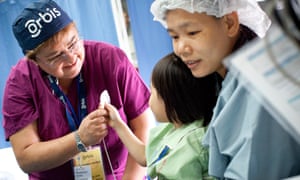


A volunteer ophthalmic nurse in the recovery room.


A volunteer ophthalmic nurse in the recovery room. Photograph: Geoff Oliver Bugbee/Orbis

Sharing experiences and discussing cases with the visiting Orbis medical volunteers “raises your confidence, to see that what you are doing is what everyone else is doing around the world”, Mboni concludes.


Globally, 285 million people are blind or visually impaired and yet for 80% of them, this could be prevented with access to the right treatment like the surgery Mboni is able to give Racheal. Orbis focuses its efforts in Africa, Asia and Latin America because 90% of the world’s 39 million blind people live in developing countries. Many of the conditions causing blindness – such as cataract and trachoma – can be easily treated. The loss of sight these conditions can cause have a huge impact as it will impede a person’s ability to gain an education, prevent them from finding employment and can plunge families into a life of poverty.


Ann-Marie Ablett, a nurse from the University Hospital of Wales in Cardiff, has been giving up four weeks of her annual leave to volunteer with Orbis since 2003. “You can’t change everything overnight but you can start with one patient and help them,” she says. “If everyone plays their small part together, you can make changes.”


Ablett is speaking in a terminal at Stansted Airport and just outside is the flying eye hospital, here for a short promotional visit. The white MD-10 aircraft on the tarmac looks like a typical passenger plane. In fact, this is a 46-seat classroom complete with audio-visual equipment that transmits live surgeries that can be watched in 3D. The lead surgeon, who is just next door in a state-of-the-art operating theatre, can be asked questions throughout the procedure. The aircraft, donated by FedEx, also features pre- and post-op spaces and a laser suite.
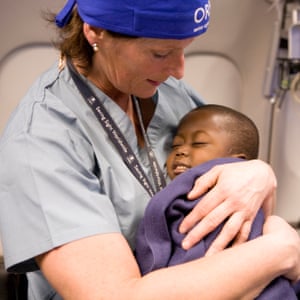


A patient wakes up from surgery.


A patient wakes up from surgery. Photograph: Orbis

Orbis’s main aim is to train eyecare teams and strengthen hospitals in the 92 countries where it works. It’s for this reason that Ablett first chose to volunteer. She says: “We’re not in the developing country just for numbers, we’re there to teach so that means we do less surgeries but when we fly off to the next country, the local doctors have got the skills to treat their own patients because they were trained up.”


Dr Jonathan Lord, global medical director for Orbis, went from being a regular volunteer to giving up his position as a consultant at Moorfields eye hospital in London and becoming a staff member for the charity before being promoted to his current role.


“I was just hooked after my visit trip,” he says. “Seeing the flying eye hospital work in real life, in the field with the patients being treated on the plane and that treatment being part of a really comprehensive training package that is upskilling all the groups of staff that are needed for each surgery, is amazing.


“The need round the world is huge. You realise the magnitude when you look at some of the statistics. In Ethiopia, there is a population of over 80 million, but [until recently] there was little over 80 ophthalmologists practising in the whole country. When I left Moorfields, it had over 150 covering just the catchment area of London.”
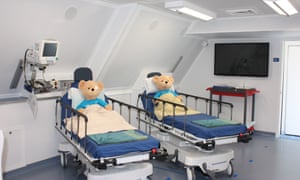


Recovery Room


The flying hospital’s recovery room. Photograph: Orbis

Programmes usually last two weeks, and require a lot of pre-planning with a team from Orbis flying in ahead to consult on what would be most helpful to the healthcare professionals in that country. The plane will land at a local airport and the team of local surgeons, nurses and anaesthetists board to join their volunteer counterparts. Meanwhile, another team of volunteers goes to the local hospital to provide training using the equipment in situ. At the end of the week, the teams swap.


Becoming hooked after stepping foot on the plane is a running theme among staff and volunteers, including the pilots, all FedEx employees who volunteer their time. Gary Dyson, who has been involved since 2001, says: “On my first trip, which was to China, I saw a child who couldn’t see on Monday but could see on Wednesday. It’s such a life-changing event for them.”


For Racheal, the short surgery will have undoubtedly had that effect. As Mboni removes the patches, she blinks a few times and waves her hands in front of her eyes, before looking up and seeing her mother for the first time.


News is spreading across Zambia of successes like this, Mboni says. “[People] know we can act fast, so they are telling patients with eye conditions – ‘This problem? Go to Kitwe central hospital’.”


Join the Healthcare Professionals Network to read more pieces like this. And follow us on Twitter (@GdnHealthcare) to keep up with the latest healthcare news and views.


The life-changing flying eye hospital treating blindness across the globe

Mentally ill woman"s treatment in Lismore hospital "deeply distressing", says Greg Hunt

Appalling footage of a mentally ill woman stumbling around a NSW hospital, covered in faeces and falling over at least 25 times before she died of a brain injury, has shocked the public and politicians.


Footage released by the coroner shows the woman, mother-of-two Miriam Merten, locked in a seclusion room for more than five hours at the Lismore Adult Mental Health Inpatient Unit on 1 June 2014.


A nurse unlocks Merten’s room the next morning, before she is left to stumble around the hallway naked, eventually collapsing in a corner before an emergency crash cart is rushed in by staff.


Merten died at Lismore base hospital on 3 June 2014.


A coronial inquest found she died of “traumatic and hypoxic brain injury caused by numerous falls and the self-beating of her head on various surfaces, the latter not done with the intention of taking her own life”.


A senior nurse at the facility was aware Merten had been sedated with psychotropic drugs and fallen on at least one occasion, but failed to take appropriate action, the coroner Jeff Linden found.


A second nurse was also involved.


“The lack of care and compassion showed to the deceased was monumentally disgraceful and appeared to emanate from an: ‘Oh, it’s just Miriam’s mentality,” Linden said in his inquest findings.


“To see a mentally ill person in 2014 at a public hospital in NSW treated in such an appalling manner is really beyond comprehension.


“While this appears not to be a system failure it is clearly a serious human failure.”


The New South Wales Labor party on Friday called for an urgent parliamentary inquiry into the state’s mental health facilities.


Opposition mental health spokeswoman Tania Mihailuk says the incident is a “Don Dale moment” for the NSW mental health system and demonstrates “abhorrent mistreatment and abuse”.


Mihailuk said the government should apologise to Merten’s family and conduct a full and transparent review.


The federal health minister Greg Hunt said the two nurses “are no longer in service”, and the state government had Canberra’s “full support for the strongest possible steps against what was completely unacceptable”.


“I have (seen the footage) … it is deeply distressing,” Mr Hunt said in Sydney on Friday.


The NSW premier Gladys Berejiklian echoed that view.


“We’ll do everything we can to make sure this never happens again,” she told reporters.


Mentally ill woman"s treatment in Lismore hospital "deeply distressing", says Greg Hunt

3 Mayıs 2017 Çarşamba

Baby boomers warned over alcohol intake as hospital admissions soar

Alcohol-related hospital admissions in England have increased by 64% in a decade and are at their highest ever level, prompting experts to warn that baby boomers are continuing to risk their health through frequent and excessive drinking.


There were an estimated 1.1m admissions where alcohol was the primary or secondary issue in 2015/16, compared with 670,000 in 2005/06, according to NHS Digital data published on Wednesday.


Separate data from the Office for National Statistics (ONS) for England shows people aged 45 and over are frequently drinking at more hazardous levels.


Married and cohabiting couples are more likely than single people to consume alcohol on five or more days a week, though they are slightly less likely to binge drink.


Surveys found 60% of women aged 45 to 64 and 69% of men of the same age had drunk alcohol in the last week – the highest proportions of any age group.


Prof Sir Ian Gilmore, a liver doctor and chair of the Alcohol Health Alliance UK, said the figures proved the UK continued to have a dysfunctional relationship with alcohol.


He said: “We know that over the long term, rates of binge drinking are falling and more people are choosing to abstain from alcohol. Worryingly, however, these trends do not appear big enough to stop alcohol harm from continuing to rise, and the sharp increase in alcohol-related hospital admissions over the last few years means hundreds of thousands more people each year are experiencing the misery associated with harmful alcohol consumption.”


Dr Tony Rao, co-chair of the Older People’s Substance Misuse working group at the Royal College of Psychiatrists, said: “These figures show that alcohol abuse is not a ‘young person problem’. While the rest of the population reduces its alcohol intake, it is very concerning that baby boomers are drinking at a similar rate as before and are exceeding recommended guidelines.”


Alcohol figures

The ONS data also shows that the proportion of adults who say they drink alcohol is at the lowest level for more than a decade.


The trend has been largely driven by an increase in the proportion of younger people abstaining, but there has been no decline in the proportion of over-65s drinking, and they are the age group most likely to have consumed alcohol on five or more occasions in the week before they were interviewed.


Such regular drinking is more than three time more likely among over-65s than in the 16-24 age group, the data shows.


Alcohol is linked to more than 60 illnesses and diseases including heart disease, liver disease, cancer and dementia. Hospital admissions due to liver disease have gone up 57% over the last decade, and the number of people diagnosed with alcohol-related cancer has risen by 8%, according to the AHA. The World Cancer Research Fund has said that if nobody drank alcohol in the UK, 21,000 cases of cancer could be prevented each year, including nearly 12,000 cases of breast cancer.


NHS Digital cautions that a narrower measure of alcohol-related hospital admissions is more reliable for tracking changes over time than the broad measure – which the 1.1 million figure relates to – because it is less affected by improvements in recording of secondary diagnoses. But even under the narrow measure, hospital admissions have risen by 22% since 2005/06, to 339,000.


The ONS data shows that 7.8 million people admit to binge drinking – defined for men as consuming more than eight units and for women more than six units – on their heaviest drinking day.


Men are more likely to drink than women and to binge drink. Higher earners, on £40,000 and above annually, are more likely to be frequent drinkers and to binge drink than the lowest earners.


Gilmore said: “The data released today should be sobering reading for whoever wins the upcoming general election, and we would urge the next government to make tackling alcohol harm an immediate priority to save lives, reduce harm, and reduce the pressure on the NHS.”


The Alcohol Information Partnership, which is funded by global drinks companies, said binge drinking and harmful drinking had declined by 17% and 23% respectively since 2005.


Baby boomers warned over alcohol intake as hospital admissions soar

2 Mayıs 2017 Salı

Labour to propose immediate halt to hospital closures

Labour has promised to immediately stop the proposed closures of A&Es and other health services across England and instead carry out a full-scale review of controversial government plans.


The shadow health secretary, Jonathan Ashworth, revealed that a flagship commitment in his party’s manifesto, to be published later this month, will be a moratorium on so-called sustainability and transformation plans (STPs).


“We have listened to the hundreds of patients and campaigners up and down the country that have been pleading with the government to hear their concerns about their local services,” he said.


“Threats of hospitals being closed, A&E services moved miles up the road, and children’s wards being shut, have caused widespread concern and confusion. What is more, these decisions have been decided behind closed doors, with no genuine involvement of local people. It’s a disgrace.”


He said Labour would ask a new body – called NHS Excellence – to lead a review that would place local people at the heart of decisions.


STPs were meant to be necessary local blueprints designed to keep the NHS afloat in the face of massive pressure and a £22bn financial black hole. But they have caused huge controversy with critics claiming they amount to plans for hospital closures, cutbacks and radical changes to the way that health is delivered.


The health secretary, Jeremy Hunt, hit back by calling Labour’s policy proposal a “nonsensical Jeremy Corbyn idea”. He claimed that Ashworth had supported the policy as recently as December and that Labour had backed the plans in its last manifesto.


“These local plans are developed by local doctors and communities, backed by the top doctors and nurses of the NHS, and will improve patient care. This is all underpinned by an extra £10bn for the NHS, which we can only afford thanks to our strong economy,” he said, claiming Corbyn would put that at risk.


The Liberal Democrat health spokesman, Norman Lamb, said the original purpose behind the STP process of bringing fragmented parts of the service together was a good one. “But it is based on the fantasy that there is enough money to deliver this vision, when the plans are now hundreds of millions of pounds short,” he said.


Lamb argued that only the Lib Dems would take the “tough action” needed to increase investment by making the case for increasing tax to support the NHS.


Labour to propose immediate halt to hospital closures

1 Mayıs 2017 Pazartesi

Critics slam "rip off" 50p-a-minute charge to call patients" hospital phones

Relatives who call patients in hospital are still being forced to pay “rip off” charges of 50p a minute despite a promised clampdown on the issue.


The firm Hospedia, which runs bedside TV and phone services in NHS hospitals and made £21.2m in revenue last year, makes people call loved ones via costly 070 numbers. The charges vary from hospital to hospital, but many trust websites say they cost about 50p a minute or more.


Callers are also forced to listen to a lengthy recorded message of about 70 seconds – which racks up charges before they are even connected to their loved one.The message contains information already obvious to the caller, such as the fact the patient is in hospital, and tells callers to be “patient”. Critics say patients are being treated as “cash cows” and described the charges as “extortionate”.


Hospedia currently manages TV and bedside phone services in 150 NHS hospitals, installing services for free in return for keeping the money charged to patients and relatives.


The firm said in 2014 it planned to phase out the use of 070 numbers but it has not happened. Ofcom reviewed the high costs in 2006 following complaints from users and recommended a substantial reduction in incoming call charges.


It urged the Department of Health to review all aspects of the system, and the way these costs appear “to be borne disproportionately by friends and family”.


The department looked at the issue and agreed to consider a skip facility at the start of the recorded message, enabling callers to bypass it and reduce the cost of the call. But this never came into effect and high call charges have remained.


A health department report in 2007 concluded that decisions on phones should remain with local hospitals. MPs on the health select committee also recommended a reduction in phone costs and called for a skip facility on the recorded message.


Hospedia refused to answer several questions posed by the Press Association, including how much money it makes from 070 numbers and why it still uses them.


A spokesman said: “Ofcom granted us use of the 070 number range to enable every bedside unit to have its own unique telephone number so that friends and relatives can call patients directly, alleviating pressure on nursing staff having to field calls.


“The patient’s bedside phone number is unique to each patient’s account and can follow them around the hospital if they are moved bed, a frequent occurrence.”


He said Hospedia offers free TV on children’s wards and free channels BBC1, BB2, ITV, Channel 4 and channel 5 from 8am to noon on adult wards. Outbound calls to landlines are also free.


He added: “We believe we offer an excellent service, which would not be provided at all if it weren’t for us taking on the investment and on-going management and support costs.


“Patients can choose to pay for our services, beyond those we offer for free, or not.”


But Liberal Democrat leader Tim Farron said: “These charges are a total rip off. When channels are free at home and people have already paid for their TV licence, it is unfair for them to need to pay it again.


“If someone is to spend four weeks in hospital with a full TV package that is the same price as their yearly fee.


“Hospitals and these businesses are treating the sick as cash cows.


“From hospital parking charges, TV packages to making people call expensive phone services, it seems like they try to eke out every bit of cash they can, it’s frankly unacceptable.”


Liz McAnulty, chair of the Patients Association, said: “Phone contact can be hugely valuable and reassuring to people in hospital and their loved ones at home.


“Any facility to provide this must offer a high quality service at a fair price, but Hospedia’s service appears to fail these tests badly.


“It is unacceptable for people calling someone in hospital to be charged heavily for 70 seconds before they even get through.”


Caroline Abrahams, charity director at Age UK, said: “Since older people typically have longer hospital stays and do not always have access to a mobile phone, they and their families are particularly likely to be impacted.”


Lynda Thomas, chief executive for Macmillan Cancer Support, said the cost of calls was “shocking”.


She added: “When you are having cancer treatment, getting a call from a relative can make a huge difference as you can share your worries, seek reassurance, or just hear their voice.


“But if relatives have to pay extortionate amounts to make these calls they may not call, cut it short, or shoulder the burden of these high charges, at a time when the whole family may be struggling financially.”


A spokeswoman for Ofcom said it was “concerned” about 070 costs and wished to hear from customers as part of its ongoing monitoring.


She said there is no requirement on Hospedia to use 070 numbers, adding: “We are concerned about the cost of making calls to and from hospital patients.


“Following an investigation into this, we referred our findings to the Department of Health, which has since changed its rules on mobile phone use in hospitals.


“We are glad that more patients now have the option of using their mobiles when in hospital, but arrangements for bedside phones are managed by the NHS.


“We want to ensure adequate safeguards for consumers so we are examining the use of 070 number ranges, amid concerns that the cost of calling these numbers can be confusing.


“We welcome evidence of any harm so we can further protect consumers.”


A health department spokeswoman said: “Suppliers should always put patients first in the way they provide services.


“Staying connected to friends and family while in hospital is crucial and we expect local hospitals to tackle anything that prevents this.”


Last year, Hospedia doubled its minimum price for a TV package from £2.50 to £5.


Prices for TV packages vary between hospitals, with the Big Bundle TV and internet package costing £17.50 for two days at Newcastle General, but £15 at Ipswich Hospital. Five days can cost £35.


Sky Sports can cost an extra £10 on top each day. Longer-term packages are less costly.


Critics slam "rip off" 50p-a-minute charge to call patients" hospital phones

23 Nisan 2017 Pazar

Rise in hospital admissions for infants triggers call for NHS overhaul

The number of infants admitted to hospital for emergency care for conditions such as asthma, bronchitis and jaundice has risen sharply in the past decade.


More young children are also ending up spending time in hospital being treated for tonsillitis, breathing problems, drug poisonings and infections, new NHS figures show.


Experts behind the report into children’s care are demanding that the NHS overhauls services inside and outside hospital to provide better care and avoid young people adding to the pressures on hospitals by spending time unnecessarily as an inpatient.


They have raised concerns about a number of weaknesses they have identified in NHS care of children and young people, including a lack of knowledge among GPs, poor mental health services and paediatricians spending too little time helping patients in community-based settings. Problems with the quality of care children receive helps explain why some need to be admitted in the first place and, in some cases, have to be readmitted soon after their hospital stay.


“We have identified a number of areas of concern, which highlight potential inadequacies in the level of care and support this group is receiving outside the emergency hospital setting”, said co-authors Ellis Keeble and Lucia Kossarova, who work at the Nuffield Trust thinktank.


They undertook the research, alongside the Health Foundation thinktank, by examining official NHS hospital episodes statistics records for admissions to hospital in England by newborns up to those aged 24 between 2006-07 and 2015-16.


Emergency hospital admissions for all under-25s grew during the decade from 990,903 in 2006-07 to 1,124,863 in 2015-16 – a rise of 14%. However, that was lower than the 20% increase in emergency admissions among the population as a whole over that time.


But they learned that there had been a 30% jump in the number of infants having to be admitted and a 28% rise among those aged one to four. The “concerning” spikes in those younger age groups raised inevitable questions about the availability and quality of maternity and community services, the researchers said.


“The number of infants, children and young people using emergency departments continues to increase – with 30% more emergency admissions for under ones and 28% more for one- to four-year-olds than 10 years ago. This is placing huge pressure on a service already under strain,” said Dr John Criddle, a spokesman for the Royal College of Paediatrics and Child Health.


The number of admissions among infants for jaundice more than doubled from 8,186 to 16,491 per year and cases of acute bronchitis rose 88% from 21,235 to 39,122.


Spells in hospital for “other perinatal conditions”, which includes digestive problems and feeding trouble in babies, also increased sharply, from 14,293 to 24,848. Upper respiratory infections except asthma rose from 17,357 to 20,940; viral infections rose by 116% from 12,730 to 16,826.


Tens of thousands of emergency admissions a year in the nought to 24-year-old range as a whole – each of which costs the NHS about £400 a night – could be avoided with better management and treatment, the report concludes. Four-fifths of the 37,549 admissions seen in 2015-16 for acute and chronic tonsilitis could have been prevented, as could “a proportion” of the 27,727 inpatient stays for epilepsy and 27,325 admissions for asthma, the authors said.


Emergency readmissions rose 12% over the decade, including 17% among 15- to 19-year-olds. “Perhaps most worryingly, compared to other conditions the analysis revealed a larger rise in emergency readmissions following emergency admission for acute and chronic tonsilitis (27%) and poisoning by other medications and drugs (25%) for children and young people”.


Dr Bob Klaber, a paediatrician at St Mary’s hospital in London, said: “There is no one medical explanation for why 30% more young children are now being admitted to hospital than before. So there must be something about how we are supporting these families and a lack of support for mums with newborns who are socially isolated.


“From my experience, the fragmentation of our health and social care system, including antenatal support and help in the child’s first five years of life, has made things really difficult for parents with new babies and young children, and so too often our hospitals become the default place for them to attend.”


A lack of focus on developing joined-up preventative care plans may help explain the growth in admissions for asthma and it could be that the NHS has made the eligibility criteria for children having their tonsils removed too tight so that some with recurrent tonsil problems end up needing hospital care, according to Klaber.


He urged paediatricians to work more closely with GPs, health visitors, school nurses and other primary care health professionals in their area so they can help them identify and manage illness in children.


Klaber said a scheme in which children’s doctors from St Mary’s did that with seven “hubs” showed that approach worked. “As well as extremely positive patient and staff experience, our published evaluation of the first full hub showed that 39% of new patient hospital appointments were avoided altogether and a further 42% of appointments were shifted from hospital to GP practice,” he said.


“In addition, there was a 19% decrease in sub-specialty referrals, a 17% reduction in admissions to hospital and a 22% decrease in A&E attenders.”


Rise in hospital admissions for infants triggers call for NHS overhaul

20 Nisan 2017 Perşembe

The harrowing hospital night shift nothing could have prepared me for

The most important part of every night shift is matching your scrub top to your bottoms. Odd shades, bad luck. Match for the best chance of success.


I’m full of superstition because fate doesn’t follow conventional rules. I sit, cross-legged comparing until I’m satisfied with my choice. I pull my clothes off and my blue scrubs on. Stethoscope, badge and water bottle. Downstairs, grab phone and rush to handover, hoping I’ve remembered my pen.


Back of house, but this is no theatre production. A list of jobs to mop up from the day. Twelve wards, the nurse practitioner and me, “Let’s hope they all behave tonight”.


First up, fluids. Ward 50 needs a cannula, or two, or three – while I’m there. A couple of bags of normal saline go up and it’s time for me to go down to ward 20 where a lovely woman has slipped off the commode. She’s ever so embarrassed. A check from head to toe, some reassuring words and an offer of a gingernut. Then back to the desk to scribble down the story.


The phone rings, again and again, sore foot, chest pain – blood pressures through the floor and in the clouds. A woman sobers up and wants to leave – listening, persuading, assessing and eventually letting her sign the papers to walk out the door, no doubt next week we’ll meet again for the same dance.


A warm hand on my shoulder and cup of tea beside my hand. “Do you want some cake doc?” – I want nothing more. The 3am slump is here and sugar is my drug of choice. I sit, and chat – and melt into the ward for a few minutes.


An unfamiliar sound from round my neck – I answer, crash call. I drop everything and run. Down two flights of stairs, along the corridor. Turn right. I see a set of anaesthetic greens in front of me. “Bay four, bed six” a voice shouts, we pile in.


A man lies on the floor, breathing hard. Oxygen on. Pulse felt. No response to voice, grumbling to pain. Eyes deviating to the left. I grab the notes and start piecing together the history. Mild upper body weakness, query stroke, a head scan showed nothing much. Back to airway, gurgling noises from his throat. A tube down the nose to help get air into the lungs. We take an arm each, one for arterial blood and one for venous. My hands don’t shake.


Stabilised, we need imaging and fast. I ring the radiologist, ready to plead my case. “Send him down” she says. The ease of the phonecall doesn’t fill me with hope. My senior house officer grabs the emergency drugs from the crash trolley and a fresh faced nurse clutches the oxygen ready to transport. They follow him down. The ward becomes quiet.


I flick through a thin set of notes to try and build a picture. Lives with a loving wife. Walks his dog every day. Gave up smoking years ago – drinks a couple of pints on a Friday. Not too bad for a man in his 70s. Children and grandchildren.


A bed slides through the doors and he returns, the report is back. Large bleed. Blood pushing the brain against the skull. Neurosurgical opinion advised. My registrar arrives, talking fast to someone. I hear “grave”, I hear “imminent”. The bleed is too big and his brain is crushed. There is nothing we can do. Keep him conscious, keep him comfortable, next of kin.


The newly qualified nurse goes white. The notes are in my hand. “I’ll call,” the words leave my mouth before my lips move. A 4am phonecall to a telephone number. A quiet voice answers. She only left at 11pm, the nurses say. “I’m calling from the ward, about your husband, things have changed and I think you need to be here”. She’ll be here as soon as she can. Panic seeps through the phone and into my hand. “Will I make it?” her voice cracks. “Will I see him before he dies?”.


“Call me as soon as she arrives” my registrar says. I nod. She leaves. I stay, breathe in, walk around the corner, shut myself in the clean utility and put two hands up to my wet face. These aren’t my tears to cry but they still come. I push them all back in. Professional.


Years of training do not prepare you for this. Nothing prepares you for your role in someone else’s tragedy. I will leave the hospital in four hours and his wife will still be clinging to his hand. I will come back in 16 hours and they will both be gone. A new name earmarked for his bed. Another story that might end a different way.


The phone rings, and someone needs something. A temperature, a catheter and some laxatives. I glance down at my trousers. They were a perfect match.


Some details have been changed to protect patient confidentiality.


If you would like to contribute to our Blood, sweat and tears series about memorable moments in a healthcare career, read our guidelines and get in touch by emailing sarah.johnson@theguardian.com.


Join the Healthcare Professionals Network to read more pieces like this. And follow us on Twitter (@GdnHealthcare) to keep up with the latest healthcare news and views.


The harrowing hospital night shift nothing could have prepared me for

12 Nisan 2017 Çarşamba

NHS doctors: how are rota gaps affecting your hospital?

Doctors feel they are spread to thinly to provide good care to patients, a survey found last month. The poll of more than 2,100 members of the Royal College of Physicians found 84% had experienced staffing shortages across their team, while 82% believed the workforce was demoralised. Many believed patient safety has deteriorated over the 12 months.


It comes after The Royal College of Physicians annual census of British consultants showed the pressure NHS staff were under. Doctors who were polled said they worried there were not enough medics to keep patients safe. A quarter of those who responded expressed concern about rota gaps, when a hospital or department is unable to cover the working shift pattern due to a lack of staff.


Share your experiences


The Guardian wants your stories about this. How often do shifts go unfilled where you work? What pressure does this put on remaining staff members? Are some medical specialties more affected than others? Have you found yourself working long hours to fill gaps? Are you concerned that this is affecting patient safety?


Share your stories and experiences, anonymously if you prefer in our encrypted form, only the Guardian has access to your contributions. We will do our best to keep you anonymous.


NHS doctors: how are rota gaps affecting your hospital?

6 Nisan 2017 Perşembe

I was ready to quit nursing until I went to work in a Laos hospital

I didn’t go into nursing ignorant of the challenges ahead. I’d witnessed the enormous toll it can take emotionally and physically, and was exposed to the seemingly constant negative press surrounding the NHS about overworked staff and a broken system. Yet I wanted to be a nurse. And I wasn’t going to let the NHS break me.


After three years of training, I started my first job as a children’s nurse on a busy surgical ward. I sat in my first handover, listening to the nurses complain about not getting breaks until, eventually, one turned to me and said dryly, “Welcome to the NHS!” These weren’t bad people. They were exhausted from giving so much to a system that relies on the good nature of its staff. But I was still optimistic. I wanted to be a good nurse. I wasn’t bitter. Yet.


My enthusiasm very quickly waned. My optimism and energy were worn down by the patient load, 14-hour days with just a cup of coffee to see me through, and the crushing responsibility of being a newly-qualified nurse. I made an agreement with myself: I’d get through one full year before I quit, just to prove to people I’d tried.


As the months passed I found myself actually enjoying the job. Yes, I still worked long days without a real break. And yes, I did still worry about my patients on my days off. But I’d somehow adapted to the gruelling schedule of a nurse. And so I continued.


But gradually, over the years, my list of grievances with nursing grew. It started to affect my home life and I noticed that I was getting sick more often. My resilience had been weakened and I felt like I was running on empty.


My partner and I had been talking about living abroad for a while and we came to the conclusion that now was as good a time as any. We were both ready for a break. Many of our friends were buying houses and climbing career ladders, and would often comment that we were brave to quit it all. But for me taking a break seemed selfish and indulgent rather than brave. I didn’t even consider whether it would harm my career progression. At that point I yearned for less, rather than more responsibility.


And so we packed our bags and headed for Asia. On long bus journeys or during quiet moments I would sometimes question whether I could go back to nursing. With the luxury of distance and time I saw myself as the bitter, overworked nurse I’d been sure I wouldn’t become. I was ashamed. I’d lost sight of why I wanted to be nurse.


After six months away from nursing, I heard that the Lao friends hospital for children in Luang Prabang was looking for nursing volunteers. Re-energised by our time away so far, I felt ready for a new challenge and so, with a mixture of apprehension and excitement, we headed to Laos.


The hospital is well equipped thanks to the generosity of the charity that funds and runs it. Yet compared with NHS hospitals it lacks the equipment, medicines and expertise that we take for granted. In the UK I never saw a child go without a blood transfusion because the blood bank was empty, or watched a terminally ill child be discharged home with only an apology that we could do no more. It reminds me how lucky we are to have the NHS. The limitations we worked with in Laos encouraged innovation and teamwork, which can sometimes be lacking or forgotten about in the vastness of the NHS.


Being part of a team that responds innovatively and tirelessly to the challenges these limitations provide, combined with spending my days (and nights) with children and their families and the joy of seeing these children get better, has reignited my enthusiasm for nursing.


I’m extending my stay here in Luang Prabang. Hopefully when I return to the UK, I’ll be a better nurse for my time spent here. But I certainly wouldn’t rule out another career break. It’s been difficult financially, and yes, it’s a luxury, but a break from my normal has made me remember why I’m proud to be a nurse.


If you would like to contribute to our Blood, sweat and tears series about memorable moments in a healthcare career, read our guidelines and get in touch by emailing sarah.johnson@theguardian.com.


Join the Healthcare Professionals Network to read more pieces like this. And follow us on Twitter (@GdnHealthcare) to keep up with the latest healthcare news and views.


I was ready to quit nursing until I went to work in a Laos hospital

4 Nisan 2017 Salı

Are hospital chaplains a waste of NHS money?

Kole Morgan was on holiday in Plymouth when she was involved in a serious car accident. The 47-year-old gardener from Bristol sustained extensive injuries including multiple fractures to her back, which kept her in intensive care for 48 hours and in hospital for a fortnight. The other driver, who was found to have caused the accident, died.


Away from her family, in pain and feeling alone, she struggled to process all that had happened. When a nurse suggested she ask the chaplain to visit, Morgan agreed, despite not having any religious affiliations of her own.


“The chaplain came within half an hour and listened to me while I thought out loud about what had happened,” says Morgan. “She didn’t suggest I pray, there was no pushing religion on me, it was just somebody really gentle and kind to talk to when I was having a really hideous time.”


Morgan describes the care she received as “invaluable”, but in these times of austerity, are chaplains really worth the expense to the NHS and by extension the taxpayer? NHS funded chaplains cost an estimated £25m annually, with 916 full and part time posts in 2015.


Staff nurse Jodi Norman, who works part time at Southmead hospital in Bristol, believes the chaplaincy plays an important role, not just for patients but also for staff. “When I first started, they would always come by on a weekend and say, ‘If you need a chat, we’re here’ and ‘Have a good shift’ – it made you feel someone’s thinking about us.”


She hasn’t seen them around as much in recent years, she adds, and patients and their families don’t seem to use the service as often as they used to. “When I’ve had patients pass away I’ve offered [colleagues] the service of a chaplain,” she says. “Most people decline. It’s so sad. Faith is becoming less talked about. Honestly I think that the younger generation of nurses and medics wouldn’t even consider the service or how to access it.”


One way that the chaplaincy has tried to engage with people more is by increasing the diversity of its faith offerings to reflect the communities it serves. The lead chaplain at Tameside in Manchester is a Muslim, for example, while Free Church ministers hold lead posts in Leicester and Cambridge, and at Kings London the lead is an Anglican priest.


Imam Yunus Dudhwala has worked within the chaplaincy service for 19 years and is currently head of chaplaincy and bereavement services at Barts health NHS trust. He was the one of the first Muslims to join the service and the first non-Christian appointed as a chaplaincy head.


“It’s very difficult to explain the value of the chaplaincy service,” he says. “It’s about compassion, it’s about support, it’s about kindness. It’s difficult to measure because it’s not very tangible.”


But with almost half the population of England and Wales identifying as having no religion, there are those who feel the NHS shouldn’t be funding a religious offering of any kind, such as the National Secular Society. The non-party-political organisation maintains that no service should be provided within an exclusive religious context and that religious and pastoral care should remain distinct.


“For the minority of patients who would desire specifically religious care, this can continue to be provided by religious groups – possibly through a charitable trust,” says campaigns director Stephen Evans. “But these groups should have no part in deciding who can be employed as chaplains.”


Mark Burleigh, head of chaplaincy and bereavement services at Leicester’s hospitals and president of the College of Health Care Chaplains, disagrees. He believes putting chaplains on the payroll has a number of key benefits. Not only does it ensure that they are accountable to the same policies as other NHS staff – for example, with a restriction on converting people to their faith or challenging them over lifestyle choices – it also ensures a higher quality of candidate.


“Because the chaplains are working in the hospital day in and day out, they know how the hospitals work, they know how to support people in their darkest hour,” he explains. “For local clergy, a baby death is something they might not have to face regularly, whereas for a professional hospital chaplain that’s something they have a lot of experience in dealing with.”


Finally, he argues, it makes the service more reliable. “If a chaplain is paid to be on call, if he or she is asked to come in, they will do so. To rely on ringing up people in the local community at 1am because a baby has died, you can’t necessarily guarantee they will come out.”


If the chaplaincy service were dismissed altogether, there are those who would definitely miss out. For Morgan, the fact that the chaplain who visited her in hospital was a religious representative was important.


“I couldn’t tell you why I found it comforting that she was a vicar, but I did,” she says. “If it had been an imam or a rabbi, I would have possibly felt the same way. It was a sense of comfort and of reassurance.


“I haven’t been to church since I got out of hospital, I haven’t followed up on religion, but I did find it comforting when I was going through a particularly unpleasant time. Chaplains are invaluable. I would hate to see them got rid of.”


Join the Healthcare Professionals Network to read more pieces like this. And follow us on Twitter (@GdnHealthcare) to keep up with the latest healthcare news and views.


Are hospital chaplains a waste of NHS money?

2 Mart 2017 Perşembe

Have you been affected by NHS hospital closures and cuts to services?

There’s no more controversial decision the NHS makes than removing services from hospitals, or even closing them. To investigate the causes and consequences of that kind of change, on Friday the Guardian is spending the day at the Royal Brompton hospital, where NHS England has said that, subject to public consultation, it will stop paying for congenital heart disease services.


The hospital and its supporters say that it makes no sense to close the service, which it describes as among the best in the country. But advocates of the change say that concentrating services in fewer locations makes for better care, and that the Royal Brompton doesn’t meet agreed standards.


The Royal Brompton isn’t the only hospital affected. Newcastle, Manchester and Glenfield hospital in Leicester are facing the same proposals. More generally, NHS England’s sustainability and transformation plans (STPs) are likely to mean the closure of 19 hospitals, including five major acute hospitals. Some experts say that this is an essential part of moving the fulcrum of the NHS from hospitals to a new set of community services integrated with social care – a move they say is vital for the health of patients and the NHS alike. But others say it’s just cover for swingeing cuts.


As part of our coverage on Friday, we want to hear from our readers. Is your hospital being affected? What are your concerns? Can you understand the rationale behind the plans? Do you think you or your child could have received better care, or do you worry about the loss of local services? If you work at a hospital, are you worried about the plans, or do you believe they will raise the standard of care?


Share your stories and concerns.


Have you been affected by NHS hospital closures and cuts to services?

6 Şubat 2017 Pazartesi

Woman, 89, trapped in hospital for six months despite being fit to leave

An NHS trust has launched a formal inquiry after an 89-year-old woman who was medically fit to leave hospital was trapped on a ward for six months, costing the NHS more than £80,000.


Iris Sibley and her family were left feeling “distressed and let down” after she was kept isolated on a hospital ward at Bristol Royal infirmary because the community healthcare provider failed to find her a suitable nursing home place.


The situation put a huge strain on the family and left her 90-year-old husband deeply unhappy, said her son John Sibley. “It’s pretty scandalous,” he said. “It’s not until you get caught up in it that you realise how serious the situation is. I decided to speak out about it because I wanted to stand up for ordinary people like my mum.”


In a case which highlights the deepening social care crisis in the UK, Iris was taken into hospital last June after a fall in her residential home. She was assessed by Bristol Community Health (BCH) on behalf of the South Gloucestershire clinical commissioning group, the NHS body responsible for local healthcare services.


On 11 August, BCH said she needed 24-hour nursing care, which would be covered by the NHS – but a place in a suitable nursing home was only found on 4 January this year, a few weeks after the agencies involved had been contacted by the Guardian for comment about the case.


Her son John Sibley said: “It’s pretty scandalous. It’s not until you get caught up in it that you realise how serious the situation is. I decided to speak out about it because I wanted to stand up for ordinary people like my mum.”


Sibley said the staff who looked after his mother were amazing. “They just don’t stop, they are always working – nothing is too much trouble for them. I call them angels and they are – but they shouldn’t have to do it,” he said.


The family were offered two places, one on 13 September and the other on 4 October, but both were too far for Iris’s husband to visit. The first was also a very poor choice, said Sibley. “I read the CQC report and it was appalling, and when I visited it I thought I wouldn’t put a sick dog in there let alone my mum. It smelt of urine, the paper was peeling off the wall in the room they wanted to put her in. It was disgusting.”


To make matters worse, Iris was diagnosed as being a carrier of C diff, a bacterium that can cause diarrhoea, so spent much of her time alone in a side room. Sibley said the family constantly had to chase for information about her future. According to BCH, the ongoing health team “actively communicated” with the family on nine occasions.


Iris’s physical and mental health deteriorated significantly, Sibley said. “She was mixing with other people [in the residential home], it stretched her mind a bit,” he said. “But in the hospital there is nothing. They are wonderful people, they do the best they can – but my mum was in a hospital, not in a place where she could call home.”


Ambulances wait outside Bristol Royal infirmary


Ambulances wait outside Bristol Royal infirmary. Photograph: Matt Cardy/Getty Images

That was very common in older people whose discharge from hospital was delayed, said Caroline Abrahams, the charity director at Age UK. “People in hospital lose confidence, they lose muscle mass. Their families can see their situation deteriorating before their eyes and that is very distressing,” she said.


Robert Woolley, the chief executive of University Hospitals Bristol NHS foundation trust, said it had launched a formal investigation into the case.


Iris’s protracted hospitalisation – which her family described as “traumatic for all concerned” – cost the NHS £450 a night, approximately £81,000 in total.


Although her experience is extreme, it is not unusual. In a typical week in January, 60 patients at Bristol Royal infirmary were “green to go”, waiting for an assessment or care package for about three weeks. Patients who could not be discharged could result in medical patients occupying surgical beds and surgeries cancelled, said Woolley.


“I’m very sorry for what happened to Mrs Sibley and apologise to her family for the massive frustration that all of us have caused,” Woolley said. “There is a critical interdependency between social care and the NHS and, if we get the capacity wrong in social care, it’s the NHS that bears the consequences, that is plain for all to see.


“We are doing everything we can to deal with a constant and growing demand. I think it is very difficult and we are having to look at more and more radical ways to cope with the pressure.”


BCH, which was charged with finding Iris a nursing home place, said it had contacted 24 homes “sometimes multiple times”. Of these, 11 had no vacancies, 11 were not able to meet Iris’s needs and two were too far away. All were privately run.


Iris’s case was unusual, said chief executive Julia Clarke, BCH’s chief executive. “In Mrs Sibley’s case, we are really sorry she was in hospital for that length of time – it is not what we were working towards,” she said. After an internal investigation, BCH was reviewing its communication with patients and had changed its processes so individual cases were flagged to senior leaders after a few weeks.


Anne Morris, the director of nursing at South Gloucestershire CCG, said Iris’s case was under review and it was “extremely sorry when any patient is kept in hospital any longer than they need to be”.


The Department of Health said it had published guidelines to improve coordination between the NHS and councils and was working with all agencies to improve the transfer of patients from hospitals. A spokesperson said: “We are supporting councils with up to £7.6bn of dedicated funding for social care over the course of this parliament.”


If this is how bad it is now, what is it going to be like in another 20 year​s’ time?


John Sibley


Iris has since been reassessed and her family has been told she no longer qualifies for complete NHS funding. Her care will be funded by the council, but the family – who are appealing against the decision – may face top-up payments.


According to a joint King’s Fund and Nuffield Trust report published in September, about four in 10 people pay for their own social care, with 300,000 fewer people receiving council-funded help than four years ago. According to Age UK, 1.2 million people do not get the social care they need, up 48% since 2010.


The Local Government Association (LGA) estimates the social care funding gap will be about £4bn by the end of the decade, leaving council short by a thirdCllr Izzi Seccombe, who chairs the LGA’s community wellbeing board, said: “The scale of underfunding is placing the care provider market under huge pressure, making it more difficult to discharge people from hospital into care.”


More than 100 care home businesses have collapsed since 2010, and more are struggling after councils’ social care budgets were slashed by up to 50% as the government pressed on with austerity measures.


People who pay for their own care pay more than a local authority for an identical care home placement, which, said Sibley, was leaving people like his mother at the bottom of the pile. “As result, my dear old mum who I love to bits was stuck in a hospital for six months with her dementia getting worse and worse,” he said.


“I don’t want to make this political, but this is a problem that has been waiting to happen for 25 years. Government after government have put their head in the sand. But now we have to make a decision: if this is how bad it is now, what is it going to be like in another 20 years’ time?”


Woman, 89, trapped in hospital for six months despite being fit to leave

2 Şubat 2017 Perşembe

Older patients seeing same GP each time "key to reducing hospital admissions"

Seeing the same GP each time they visit the doctor can reduce avoidable hospital admissions among older patients, a study published in the British Medical Journal has found.


But the government’s focus on increasing access to GPs, such as through longer hours, may have unintentionally affected the continuity of care patients experience, the authors warn.


The study, by researchers at the Health Foundation charity, found that older patients who saw the same GP most of the time were admitted to hospital 12% less for conditions that could be treated in doctors’ surgeries than those who had a lower continuity of care.


The researchers looked at ambulatory care sensitive conditions: these include long-term conditions such as asthma, where flare-ups can be reduced by high-quality GP care, acute conditions such as gangrene that can be prevented by timely treatment, and illnesses such as flu and pneumonia that can be prevented through vaccination.


Admissions for these types of illness are expensive for the NHS: hospital admissions for conditions that could be treated at doctors’ surgeries cost £1.42bn in 2009-10, or more than £170,000 for each GPs’ practice.


Under changes to the GPs’ contract introduced in 2014, all patients in England must have a named GP who is accountable for their treatment. But researchers at the University of Bristol warned in response to the BMJ study’s findings: “There is evidence that continuity of primary care is actually declining in the UK.”


In an editorial for the BMJ, they called for policies to help ensure greater continuity of care.


Seeing the same doctor more of the time could reduce hospital admissions because it “builds trust and a sense of mutual responsibility between patients and GPs”. Older patients were particularly likely to appreciate seeing the same GP, although they were less likely to receive it, the researchers said.


The editorial added: “A primary care system that is increasingly fragmented, in which neither patients nor doctors feel strongly connected to their local general practice, provides the setting for patients to choose to attend an emergency department.”


Difficulty in getting appointments at GP surgeries, “which are at least as overwhelmed as emergency departments”, compound the problem.


Improving the proportion of the time that patients saw the same GPs would improve doctors’ job satisfaction, and was “very likely” to reduce pressure on hospitals, they added.


The Health Foundation researchers analysed patient-level data for more than 230,000 people in England aged between 62 and 82, focusing on older patients because they make up a high proportion of GP appointments and avoidable hospital admissions.


Patients who experienced a medium level of continuity of care had almost 9% fewer avoidable admissions, while those who saw the same GP a high proportion of the time saw just over 12% fewer avoidable hospital admissions in comparison with patients who had a low continuity.


The researchers found a particularly pronounced association between continuity of primary care and reduced hospital admissions among patients who were frequent users of primary care, which they defined as more than 18 visits over the two-year period covered by the data.


The study was observational, and did not prove cause and effect, the researchers emphasised. But improving the continuity of care could reduce hospital costs, especially for the heaviest users of the system, they added.


A spokeswoman for the Department of Health said: “This government is committed to making sure patients can get the right care at the right time from well-resourced GPs and, from April 2015, all patients have had the right to continuity of care through a named GP, as part of the GP contract.


“This remains a key part of our plan to reduce pressure on hospitals, and is in no way diminished by extending access.”


Older patients seeing same GP each time "key to reducing hospital admissions"

28 Ocak 2017 Cumartesi

Hospital closes two wards after flu outbreak

An outbreak of flu has left 60 patients ill and forced the closure of two wards at Addenbrooke’s hospital in Cambridge.


People are being urged to stay away after a surge in admissions due to flu this week and a further outbreak within the hospital.


Two wards are shut and three others have bays that are affected, a Cambridge University hospitals spokesman said.


He added: “There are a high number of flu cases across the hospital and our emergency department is already at capacity.


“We are urging people to keep visiting to a minimum and not to bring children on site.


“If you are suffering with flu-like symptoms, please check with your GP, local pharmacist or NHS 111.”


Influenza is a viral illness that is especially common in winter and is spread by coughing and sneezing.


Many people can have a flu vaccine free on the NHS, but as a viral infection it cannot be treated by antibiotics.


More details soon…


Hospital closes two wards after flu outbreak

26 Ocak 2017 Perşembe

Mentally ill patients face "double whammy" of poor hospital care

More than half of people with mental health problems receive a “double whammy” of poor care in general hospitals which increases patients’ risk of dying, according to a major new NHS inquiry.


Only 46% of patients with serious mental health conditions were well looked after when they attended hospital with a physical ailment such as heart trouble, a group of independent experts found.


Many A&E unit staff lack the knowledge or confidence to care properly for mentally ill people, according to a report by the National Confidential Enquiry into Patient Outcome and Death (NCEPOD).


Substandard care that mentally ill patients receive for physical health problems results in many of them repeatedly returning to A&E , the NCEPOD team found when they analysed the medical records of 552 patients who sought help at an acute or general hospital.


“Good care was only provided to 46% of patients in this study, showing patients who had a mental health condition suffered the double-whammy of both poor physical and mental healthcare,” said co-author Dr Vivek Srivastava, who is the NCEPOD clinical coordinator and a consultant in acute medicine.


“The systems don’t exist to train hospital staff appropriately in the care of patients who also happen to have a mental health condition, so immediately there is an issue with having the confidence to care for this group of patients.


“Once someone is admitted to hospital it is likely to expose any underlying issue such as a mental health problem, and staff need to have the confidence to deal with this, and have access to and know how to refer to mental health services,” he added.


Poor physical health care leads directly to patients with a mental health condition staying longer in hospital, Srivastava added. “They are often discharged into the community inappropriately and then bounce back in and out of hospital if the underlying health condition is not treated properly.”


Inadequate treatment of such patients matters because they are already more likely to die than other people, the report says. “It is well established that patients with severe mental illness develop co-morbid physical health conditions, like heart disease, about a decade earlier in their life. They are also more likely to die more than a decade earlier than those without mental health conditions.”


Prof Sally Davies, the government’s chief medical officer, has estimated that 60% of the excess mortality among people with a mental health condition could be avoided if they received better care.


Prof Lesley Regan, the ex-president of the Royal College of Psychiatrists and chair of NCEPOD, said: “For many years mental healthcare in the NHS has been underfunded, and you may rightly conclude from this new NCEPOD report that patients with mental health conditions are seriously disadvantaged when treated for physical disorders in hospital. I fear that the patients we studied could well be only the tip of the iceberg.”


The Department of Health said it was improving how A&E services cared for people with mental illnesses. “We have invested £247m to make sure support will be available for people who come to A&E needing mental health care. The NHS is also working to develop the mental health skills of all staff so that issues are identified earlier and patients receive the care they need,” a spokeswoman said.


Mentally ill patients face "double whammy" of poor hospital care

Jeremy Hunt"s hospital food revolution has failed, campaigners say

Jeremy Hunt has been accused of failing to deliver his promised revolution in hospital food after the health secretary’s own department found that many hospitals have still not improved patient catering.


A Department of Health study shows that almost half of hospitals in England have failed to implement key improvements almost two and a half years after Hunt’s crackdown.


The disclosure led food campaigners to claim that supposedly legally binding duties put on hospitals in 2014 to serve healthier food and check if patients were malnourished had come to nothing.


At the time Hunt claimed his new hospital food standards would force NHS trusts to offer patients fresh fruit around the clock and cut the amount of salt in meals or risk being fined or losing contracts to deliver vital care.


“These figures from the government’s own research show the widespread failure in England to drive up food standards in hospitals. We can see from the report that almost half of all hospitals are not meeting the government’s own standards on hospital food,” said Katherine Button of the Campaign for Better Hospital Food.


The DH research, titled “Compliance with hospital food standards in the NHS. Two years on: a review of progress since the Hospital Food Standards Panel report in 2014”, found widespread breaches of what were meant to be mandatory standards that all should meet.


• 48% of hospitals are still not meeting government buying standards that oblige them to meet a range of standards regulating the quality, nutritional value and ethical sourcing of the food they serve patients, staff and visitors.


• While over half of all hospitals had by last year begun assessing the nutritional needs of every patient in order to detect and avoid malnutrition, an unspecified substantial minority still had not.


• Only 55% of hospitals have fully complied with the British Dietetic Association’s nutrition and hydration digest, a toolkit designed to help hospitals ensure patients receive nutritious meals that meet their dietary requirements.


Katharine Jenner, the campaign director of Consensus Action on Salt, Sugar and Health, said: “This is more evidence that voluntary measures don’t work, even when they are dressed up as ‘legally binding’ in NHS standard contracts for hospitals. We need mandatory standards, with rigorous monitoring, reporting and meaningful sanctions for non-compliance.”


Button said she feared that hospitals’ push to overhaul their food may have been hampered by NHS-wide cost-cutting. “It seems that this well-intentioned drive to increase standards has fallen victim to budget cuts in catering departments and kitchens across the country.”


The DH insisted that its research painted a much more positive picture of progress made since Hunt unveiled the new standards to widespread acclaim in August 2014. It also shows, for example, that 96% of hospitals are either already compliant with the 10 key characteristics of good nutritional care or working towards that goal.


A spokeswoman said: “Every patient deserves nutritious food when they are in hospital which is why we introduced the first ever legally binding food standards in the history of the NHS. We can now see that over 90% of hospitals are compliant or actively working towards compliance with food standards and food is rated good in nine out of 10 hospitals.”


Jeremy Hunt"s hospital food revolution has failed, campaigners say

24 Ocak 2017 Salı

Patient who spent two years in hospital evicted under court order

A patient who was evicted from a hospital under a court order after spending more than two years in a bed has insisted that he did not want to stay there.


Adriano Guedes was removed from the James Paget hospital in Gorleston, Norfolk, which said the 63-year-old was occupying the bed “unnecessarily” and was fit to be discharged.


Guedes, who came to the UK from Portugal 15 years ago seeking work and suffers paralysis following a stroke in 2008, said he “didn’t want to stay” but “they forced me to stay”.


He told the BBC: “It’s very bad to occupy a place which should be used by someone in need, but I didn’t cause the situation; on the contrary, I tried to get out of there.”


The hospital obtained a possession order from the court to remove Guedes and it was granted on 1 December and enforced on 10 January.


Guedes said he had asked to be moved from the hospital to a “wheelchair-friendly place” and said he had been on hunger strike since his removal, with his last meal on 10 January.


He said he was initially admitted to hospital in 2014 on mental health grounds and not because of his physical condition.


His request to see a spinal specialist in London for his injuries was ignored, he said, adding: “I wanted to leave, but they always offered what they knew I would refuse.”


Guedes, whose hospital stay is estimated to have cost around £340,000, is now living in a council flat in Suffolk.


The Department of Health says the average daily cost of a hospital bed is about £400.


Director of governance at the hospital, Anna Hills, said Guedes had “repeatedly refused all offers of appropriate accommodation organised by our local authority and social care partners, despite being fit for discharge”.


The hospital said it had worked “in partnership with a range of agencies to achieve a safe discharge from the hospital” for Guedes.


It said “detailed planning” had taken place which “led to a successful discharge in this complex case”.


Guedes has been described as a so-called “bed blocker”, but the NHS Confederation’s director of police, Johnny Marshall, told the Guardian last year that the term was an inappropriate description of people staying in hospital when they did not need to be there.


He said: “These ‘blockers’ are often older people who are frail and vulnerable and who would like nothing more than to return home to their families. The phrase ‘bed blocker’ puts all the emphasis, and blame, on the individual.


“The reality is that it is the system that has failed to move quickly enough to put together the right package of care to enable the person in the bed to return home.”


Patient who spent two years in hospital evicted under court order

20 Ocak 2017 Cuma

Overweight patients less likely to die in hospital after heart operations

Patients who are overweight or obese are less likely to die in hospital after a heart operation than those who are a healthy weight, a study has found.


The results of the British Heart Foundation (BHF)-funded research suggest it is wrong to deny people surgery because they are overweight and that underweight patients could benefit from gaining weight prior to a heart operation.


A team at the University of Leicester collected data on about 400,000 adults in the UK and Ireland who underwent cardiac surgery between 2002 and 2013, categorising them into different weight categories, according to their BMI (body mass index).


Of those included, 11,511 patients died in hospital, including 4.4% of patients who were of healthy weight, compared with only 2.8% of those who were overweight and 2.7% in obese class I (with a BMI of 30 to 35). The study, published on Friday in the journal Circulation, found that 8.5% of patients who were underweight died in hospital.


Gavin Murphy, BHF professor of cardiac surgery at the University of Leicester, said: “We saw a 25% reduction in death by being overweight as opposed to being normal [healthy] weight. That’s a bigger effect on mortality than statins.


“It changes one of the most basic approaches behind surgery, which is that people need to lose weight before surgery. Obese patients are generally considered unfit for surgery. This study shows the very morbidly obese – with a BMI greater than 40 – did not have a greater risk. It shows that no patient should be rejected for surgery on the basis of body mass.”


The authors believe the study confirms the existence of the much-debated obesity paradox, whereby obesity can cause illnesses, such as heart disease or a heart attack but at the same time have certain protective effects.


Murphy said they found a linear association between increasing BMI and lower risk of acute heart failure or acute stroke but the relationship did not hold for all adverse outcomes post-surgery (infections, for example). How being overweight or obese protects patients who undergo surgery is unknown but the researchers plan to investigate this in future.


“If you imagine that having a heart operation is like climbing a mountain, you’re probably better doing that if you’re nutritionally nourished than if you’re under-nourished, if you’re having an energy surplus than having an energy deficit, although it’s probably a bit more complex than that,” said Murphy.


The researchers found that overweight or obese patients had greater protection regardless of age and even if they had experienced complications associated with obesity, such as hypertension, diabetes and coronary artery disease.


They also reviewed data from 557,720 further patients included in studies across Europe, the United States and Asia, finding similar results.


BHF’s associate medical director, Prof Jeremy Pearson, said: “We always recommend a healthy waistline, which significantly reduces lifetime risk of heart disease and therefore a person’s risk of needing cardiac surgery. However, this large study strongly suggests that being overweight can give patients added protection when facing major heart surgery, reducing their chance of complications or death before leaving hospital.”


A large number of NHS groups are believed to have placed restrictions on access to surgery for overweight people, although, in most cases this applies to elective procedures for non-life-threatening conditions such as hip and knee replacements.


Overweight patients less likely to die in hospital after heart operations

19 Ocak 2017 Perşembe

Nurse shifts left unfilled at nearly every hospital in England, figures show

Almost every hospital in England has fewer nurses on duty than each believes are needed to guarantee safe patient care, research shows.


Analysis of official data by the Health Service Journal (HSJ) found that 96% of NHS hospital trusts in England had fewer nurses covering day shifts in October than they had planned and 85% did not have the desired number working at night.


The disclosure of such widespread failure to ensure hospitals are properly staffed has prompted fresh concern that a chronic lack of nurses and the NHS’s dire finances are putting patient safety at risk.


Nurse shortages have led to patients having to wait for medication, going unwashed or not having observations done on time, the HSJ said.


Janet Davies, the chief executive of the Royal College of Nursing, said: “This is yet more evidence that there are too few nurses caring for patients, putting people at serious risk. Safe staffing levels aren’t an optional extra. Having the right number of nurses is essential to ensure that patients can recover properly.”


The college estimates there are as many as 24,000 vacancies for nurses across the UK.


Nurses told the HSJ that understaffing meant hospitals were already providing substandard care, leading to patient safety “near misses”.


The figures are the worst hospitals have recorded since they were obliged to start publishing details of staffing levels in 2013, in the wake of a report on the Mid Staffordshire care scandal.


The number of trusts that do not have planned numbers of staff at work has gone up despite the recruitment of record numbers of nurses by acute hospitals. Limits introduced in 2015 on the amount hospitals can pay to hire agency nurses may help explain why staffing levels are dropping in many places.


One nurse said: “Sometimes observations get missed and I can recall many times where the patient is found to be deteriorating when they are eventually done. This gives you immense stress as you are left with the realisation you did not pick up on your patient’s condition early enough to prevent an acute episode.”


Another said: “I have seen patients not have proper care, dressings not changed, [and] not given the choice of shower or a wash as it takes more time that we do not have.”


HSJ reached its conclusions by examining data on nurse staffing levels that trusts release through the NHS Choices website. These include the numbers present in general medical wards, maternity units, surgical wards and intensive care units at 214 acute hospitals.


In hospitals in England, a nurse is meant to look after no more than eight medical patients, and the ratio can be as low as one to one in neonatal and intensive care units.


The figures show that Dewsbury and district hospital in West Yorkshire had 75% of the number of nurses it had planned to have on duty last October, down from the 87% it managed in the first three months of 2015.


Princess Alexandra hospital in Harlow, Essex, which went into special measures that month, covered 77% of shifts, as did Pontefract general infirmary in West Yorkshire.


The HSJ found that some trusts were employing unusually high numbers of healthcare assistants. That may suggest they are replacing nurses with cheaper personnel who have little clinical training.


Prof Peter Griffiths, of Southampton University, a member of NHS Improvement’s safe staffing committee for acute wards, said: “This is clearly not a good place for the NHS to be and it isn’t getting any better.” He said healthcare assistants could help plug gaps but relying on them to deputise for nurses in the long term risked compromising patient safety and involved “the risk of a false reassurance”.


The shadow health secretary, Jonathan Ashworth, said: “Tired, overworked nurses cannot be expected to continue providing the quality of care which patients need. The government needs to do much more to make sure nursing remains an attractive profession and to ensure hospitals can get in place the number of nurses they need to keep patients safe.”


A Department of Health spokesman said: “We expect all parts of the NHS to make sure they have the right staff in the right place at the right time to provide safe care. That’s why there are already almost 26,000 extra clinical staff, including almost 11,400 additional doctors and over 11,200 additional nurses on our wards since May 2010.”


Nurse shifts left unfilled at nearly every hospital in England, figures show