Hunt's etiketine sahip kayıtlar gösteriliyor. Tüm kayıtları göster

26 Ocak 2017 Perşembe

Jeremy Hunt"s hospital food revolution has failed, campaigners say

Jeremy Hunt has been accused of failing to deliver his promised revolution in hospital food after the health secretary’s own department found that many hospitals have still not improved patient catering.


A Department of Health study shows that almost half of hospitals in England have failed to implement key improvements almost two and a half years after Hunt’s crackdown.


The disclosure led food campaigners to claim that supposedly legally binding duties put on hospitals in 2014 to serve healthier food and check if patients were malnourished had come to nothing.


At the time Hunt claimed his new hospital food standards would force NHS trusts to offer patients fresh fruit around the clock and cut the amount of salt in meals or risk being fined or losing contracts to deliver vital care.


“These figures from the government’s own research show the widespread failure in England to drive up food standards in hospitals. We can see from the report that almost half of all hospitals are not meeting the government’s own standards on hospital food,” said Katherine Button of the Campaign for Better Hospital Food.


The DH research, titled “Compliance with hospital food standards in the NHS. Two years on: a review of progress since the Hospital Food Standards Panel report in 2014”, found widespread breaches of what were meant to be mandatory standards that all should meet.


48% of hospitals are still not meeting government buying standards that oblige them to meet a range of standards regulating the quality, nutritional value and ethical sourcing of the food they serve patients, staff and visitors.


While over half of all hospitals had by last year begun assessing the nutritional needs of every patient in order to detect and avoid malnutrition, an unspecified substantial minority still had not.


Only 55% of hospitals have fully complied with the British Dietetic Association’s nutrition and hydration digest, a toolkit designed to help hospitals ensure patients receive nutritious meals that meet their dietary requirements.


Katharine Jenner, the campaign director of Consensus Action on Salt, Sugar and Health, said: “This is more evidence that voluntary measures don’t work, even when they are dressed up as ‘legally binding’ in NHS standard contracts for hospitals. We need mandatory standards, with rigorous monitoring, reporting and meaningful sanctions for non-compliance.”


Button said she feared that hospitals’ push to overhaul their food may have been hampered by NHS-wide cost-cutting. “It seems that this well-intentioned drive to increase standards has fallen victim to budget cuts in catering departments and kitchens across the country.”


The DH insisted that its research painted a much more positive picture of progress made since Hunt unveiled the new standards to widespread acclaim in August 2014. It also shows, for example, that 96% of hospitals are either already compliant with the 10 key characteristics of good nutritional care or working towards that goal.


A spokeswoman said: “Every patient deserves nutritious food when they are in hospital which is why we introduced the first ever legally binding food standards in the history of the NHS. We can now see that over 90% of hospitals are compliant or actively working towards compliance with food standards and food is rated good in nine out of 10 hospitals.”


Jeremy Hunt"s hospital food revolution has failed, campaigners say

2 Ocak 2017 Pazartesi

Junior doctor Nadia Masood: "Hunt"s driven a lot of us out of the NHS"

Dr Nadia Masood’s public involvement in the junior doctors’ dispute began in a layby somewhere in north-east London on 11 January. “I was driving to Essex to see my mum, who was in hospital with sepsis after having chemotherapy for breast cancer. I was listening to LBC and James O’Brien was talking about the first junior doctors’ strike, which was due the next day,” she recalls. “I pulled over, phoned in and ended up on air, trying to explain to listeners why we were going on strike. I was feeling very emotional both because of my mum and because of the strike.”


It was unusual behaviour for the 35-year-old anaesthetic registrar. “I’m from a completely apolitical background. I didn’t have a political bone in my body until the health secretary, Jeremy Hunt, decided to impose an unfair and unjust contract on 54,000 junior doctors,” Masood says. “At first I saw the contract as an ethical, not political, issue. It wasn’t right to impose a contract on a workforce who give up their entire lives and pour blood, sweat and tears into their jobs and have no choice but to work under the conditions the NHS gives us, because that’s the only way we can become consultants, which is our goal. I was shocked Jeremy Hunt had the balls to do it.”


The next day brought the first of what would be eight strikes between January and May. They pitted young medics renowned as workhorses of the NHS against a health secretary regarded with deep suspicion by the medical profession for his disparaging comments about GPs and consultants. Doctors in scrubs on picket duty outside their hospitals vied with Hunt for public sympathy over his insistence that juniors had to work more at weekends to deliver the government’s promised “truly seven-day NHS”.


Striking wasn’t easy for the doctors, who realise the uniqueness of their jobs, which they love, says Masood. On day one she was among the pickets outside Great Ormond Street hospital in London, where she worked at the time. “We were all feeling really bad about refusing to work that day. But parents brought their children outside from the wards to say hello and said they supported us, and our consultant colleagues kept everything running smoothly, which all helped.”


Did junior doctors expect to win? “Yes. That 98% of junior doctors who took part in a ballot organised by the British Medical Association backed strike action to oppose a contract we argued was unfair and unsafe – that made us realise that we all felt the same shock and horror at what Hunt was doing. We all felt justified in our resistance. Maybe I can call this naivety, but I think that the right thing – truth, honour, justice – always prevails in the end,” says Masood.


As walkouts, on-off negotiations and the war of words rolled on, opinion polls showed the medics were winning the battle for hearts and minds, even when they escalated their action to include withdrawal of cover from areas of life-or-death care, such as A&E and maternity units.


“The RMT give the impression that they don’t care [about the impact the rail strikes by their members has on the public], and people think they are being selfish and not handling things right,” Masood says. “But as junior doctors we felt that our motivation was really pure. We were genuinely concerned about the wellbeing of the NHS and genuinely believed that what we were doing was to protect it.


“It wasn’t about money, though Jeremy Hunt portrayed us as money-grabbers by constantly stressing that we’d be getting a pay rise. It was about patient safety and the sustainability of the NHS. Some people thought we were against a seven-day NHS, but most doctors – especially junior doctors – already work seven days a week.


“We spoke about how the NHS was already at breaking point, with too few staff and too little money to do its job properly. But no one took notice of us. But a year on, people like [the NHS England chief executive] Simon Stevens and [the NHS Providers chief executive] Chris Hopson, who distanced themselves from us a year ago, are now saying publicly what we were saying then, that the NHS is struggling with the lack of funding that it has.”


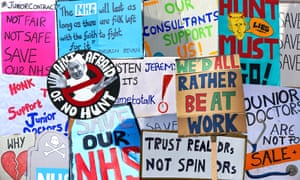
Posters made and carried by junior doctors during the strikes.


Posters made and carried by junior doctors during the strikes. Photograph: Photomontage/Roger Tooth

Hunt has insisted hospitals have to be able to roster doctors to work more at weekends to enable the NHS to treat more patients on those days, though precisely what services he wants to be expanded remains unclear. Eight strikes did not force him to backtrack. Masood repeats what junior doctors argued repeatedly throughout the dispute: “There’s not enough doctors at the moment to staff the current service we’re trying to deliver over five days, so why has Jeremy Hunt brought in the new contract when he knows that? It’s madness to stretch a workforce that’s already too small across seven days.”


In May the then chair of the BMA’s junior doctors committee endorsed a revised version of the contract, but members rejected it by 58% to 42%. In August the union threatened a series of five-day walkouts between then and Christmas, but abandoned the plans in the face of huge opposition, both internal and external. Juniors began moving on to the contract in October.


So who won? “They did,” says Masood quietly, her voice trailing away. “The government have won in the short nterm and I’m worried that they will now do the same thing to nurses, consultants – to all NHS staff. But long term I fear that more junior doctors will decide not to train to be NHS consultants and quit, and that more people will be burned out mentally and physically.” She was one of five junior doctors who in September challenged in the high court the legality of Hunt’s decision to impose the contract. That action ended in defeat too.


The dispute has left junior doctors feeling miserable and demoralised, Masood says. She is still so outraged by Hunt’s behaviour that she stepped away from her training last month, even though she is close to becoming a consultant. Her decision means an understaffed NHS is one more medic short. She is taking a career break and now works as a locum in various London hospitals.


“There’s a big need for locums because there are rota gaps in every specialty in every hospital,” she says. “What Jeremy Hunt has done is driven a lot of us out of the NHS, either temporarily – like me – or permanently. He says he values us, but everything he has done has made us feel devalued. I just worry that he will do to other NHS workers what he did to us and if he does, that will kill us as a workforce, and that will kill the NHS, because there will be no one to work in it.”


Junior doctor Nadia Masood: "Hunt"s driven a lot of us out of the NHS"

15 Eylül 2016 Perşembe

Stephen Hawking urges inquiry into Hunt"s NHS patient death claims

Stephen Hawking, Lord Winston and a number of senior doctors are urging the prime minister, Theresa May, to hold an inquiry into Jeremy Hunt’s controversial claim that 11,000 patient deaths a year are caused by a lack of medics on duty in hospitals at weekends.


Their plea comes in a letter to the Guardian that claims the health secretary has caused a “devastating breakdown of trust between government and the medical profession” by misrepresenting the evidence on the “weekend effect”.


Hunt has come under fire since he began maintaining last year that “there are 11,000 excess deaths because we do not staff our hospitals properly at weekends”. Critics, including the British Medical Journal, have rejected his claim and accused him of highly selective use of complex evidence about the higher number of patients who die within 30 days of being admitted to hospital on a weekend.


The letter is a significant new challenge to Hunt’s integrity over the weekend effect – higher mortality among those admitted on a Saturday or Sunday – and what lies behind it.


Its authors want the prime minister to order an independent inquiry into the process behind the definition and claims of a weekend effect. They say there is so much disagreement about the evidence underpinning the weekend effect that ministers should pause the new junior doctors’ contract and the push to create “a truly seven-day NHS”.


Physicist Stephen Hawking.


Physicist Stephen Hawking. Photograph: National Geographic Channels/Pau

Hunt’s assertion of a weekend effect due to understaffing is important politically because he has consistently used it to justify imposing the unpopular new contract on England’s 54,000 NHS junior doctors and the government’s push to make more NHS services in England available at weekends. The latter was a key Conservative pledge in last year’s general election campaign.


Other signatories to the letter include: Trish Greenhalgh, a professor at Oxford University specialising in evidence-based medicine; Prof Neena Modi, president of the Royal College of Paediatrics and Child Health; and Prof Alistair Hall, a cardiologist and epidemiologist at the Leeds teaching hospitals NHS trust.


They accuse Hunt of wasting NHS resources by forcing it to expand to a much fuller seven-day service on the basis of “bad evidence”, and of ignoring findings that challenge his thesis and misleading MPs and the general public.


“It is wrong to waste precious resources, or lives, because of bad evidence. Like NHS treatments, health policy should be evidence-based to demonstrate clinical and cost-effectiveness,” they write.


Scientist Lord Robert Winston.


Scientist Lord Winston. Photograph: Murdo Macleod for the Guardian

“Hunt has cherrypicked research, causing a devastating breakdown of trust between government and the medical profession. In making these claims without faithfully representing the evidence, he has obstructed fact and misled parliament and the public,” they add.


Other signatories include: Dr Margaret McCartney, a prominent GP and an author, columnist and broadcaster on medical matters; Dr Phil Hammond, vice-president of the Patients Association; and several prominent junior doctors.


The doctors dispute specifically Hunt’s claim that eight research studies back up his concern that a lack of medics in hospitals at weekends is leading to large numbers of avoidable patient deaths.


The authors of the letter also want the prime minister to halt “any policies or contractual reform driven by this evidence until it can be examined objectively and with rigour”.


Prof Julian Bion, an expert in the weekend effect at Birmingham University, said that the High-Intensity Specialist-Led Acute Care project, which he has been leading since 2014, is undertaking the sort of inquiry that the letters writers seek.


While not disputing the existence of a weekend effect, Bion said the causes of it were “multifactorial” and not simply due to too few doctors being on duty. “There is evidence that patients admitted at weekends are sicker and the weekend effect may therefore have a ‘community dimension’,” he added. “The causes may include [the availability or not and quality of] community and social care as much as hospital care.”


Paul Aylin, another expert in weekend-related mortality and a professor at Imperial College London, said there were many “studies out there of varying quality, and people therefore have plenty to pick from to support their side of the argument”. But international evidence showed a weekend effect in patients who had a gastrointestinal haemorrhage, stroke, heart attack, arrhythmia or cardiac arrest, but not in neonatal deaths, he said.


A Department of Health spokesman rejected the authors’ concerns. “Over the past six years, we have been presented with clear independent evidence of variation in care across the weekend – this government makes no apology for tackling the issue, to build a safer seven-day NHS for patients,” he said.


“Further peer-reviewed evidence is emerging all the time, including the authoritative 2015 Freemantle report, which confirmed previous evidence of a weekend effect.”


Stephen Hawking urges inquiry into Hunt"s NHS patient death claims

22 Ağustos 2016 Pazartesi

These leaks show Jeremy Hunt’s deception over the seven-day NHS | Rachel Clarke

It’s 4am. When your heart arrests and the emergency call goes out, what you really don’t want is a doctor whose first response to your crisis is a silent stream of expletives. You don’t want the person racing to your bedside to be so exhausted they can barely think straight. And you definitely don’t want them to be pumping your chest while wondering what to do with the patient pile-up threatening to overrun the unit from where they’ve just sprinted.


I don’t want those things either – but I’ve been that doctor and I’ve been that callous. I don’t know a single one of us who hasn’t. There’s an ugly truth about the NHS frontline right now that health secretary Jeremy Hunt would dearly love to airbrush away. We, the doctors and nurses at the sharp end, increasingly feel we are bearing witness to its slow, relentless disintegration. Daily, we are fighting against a breaking system and though for us that may be soul-destroying, for our patients – in so many different ways – it is potentially life-threatening.


The government would have you believe that not only is the NHS flourishing, but that it is being safely steered on its way to becoming the world’s first “truly seven-day” health service – an all-singing, all-dancing bonanza of unprecedented weekend care. Without any new doctors for these new weekend services. Or extra nurses. Or extra resources, in fact, of any kind.


But in private, as incendiary documents leaked to the Guardian and Channel 4 News now reveal, Hunt’s own department admits the lack of funds and staff for a seven-day NHS may derail the glib promises of last year’s general election manifesto. In its unpublished risk assessment of the seven-day policy, the Department of Health’s own working group admits that workforce overload means it may simply not be possible to find sufficient “skilled/trained staff” to safely deliver the new service. Worse, says the secret “7 Day Services Governance Group”, the objectives of this centrepiece of health policy, “are not fully agreed upon, but delivery has started”.


Imagine committing millions of pounds of precious NHS cash to a new service you know you lack the staff to run safely, and whose point – extraordinarily – you haven’t quite decided upon. Imagine the extra child mental health beds or groundbreaking new cancer drugs upon which you could be spending that money, had you not already committed to something so sketchy.


No one who actually works in the health service is remotely surprised the staff aren’t there: we can barely keep patients safe over five days, let alone seven. But for a doctor such as me, who could be hauled before the General Medical Council were I not to practise evidence-based medicine, this admission by the department that it doesn’t even know what it’s aiming for with the seven-day charade destroys Hunt’s efforts to portray himself as a patient safety champion.


My world is one of junior doctors squabbling to grab the last remaining space in which to see new patients, essentially a store cupboard with a couch squeezed inside; of trolleys deployed in corridors as de facto beds, flanked by foldaway screens that barely protect the patient’s dignity; of ambulances sitting idle outside the hospital, unable to deliver their blue-lighted occupants because A&E is crammed to bursting point.


On becoming a doctor, I was fully prepared for the blood, the gore, the death, the slog, but not – it turns out – for the shame of it. Increasingly, my eyes cannot meet those of the patients and relatives marooned under strip-lights, waiting and waiting to be seen. And it’s not just embarrassment. Head down, cheeks burning, I’m trying to avoid becoming the arbitrary target of an enraged family member who needs someone, anyone, upon whom to vent their spleen.


When Robert Francis published his report detailing the horrors patients endured in the now-defunct Mid-Staffordshire NHS Trust, the then prime minister, David Cameron, told a stunned parliament that the report was a “cry from the heart” for “quality, vocation, compassion” in our health service. Three years on, I can tell you that those values are being purged from the NHS by a government that has chosen, year on year, to shrink the share of GDP it spends on our health service. Overstretched doctors and nurses are as demoralised and exhausted as it is possible for a workforce to be. And what many of us now fear is Mid-Staffs writ large – this time on a national scale.


Only a politician who’s singularly out of touch – or driven by an ulterior motive – could possibly pretend the NHS is healthy. This year’s “winter” crisis has started in August. Doctor shortages are forcing A&Es to close. Whole populations in some parts of the country are being denied all but emergency care. My friends are quitting the profession they love in droves. Nurses on my ward are often in tears.


What many of us now fear is another mid-Staffs disaster writ large – this time on a national scale


As a junior doctor, the public exposure of the fatal vacuity of Hunt’s seven-day soundbite ought to make me feel vindicated. Instead, I feel sickened. For over a year, Hunt spun the line that our resistance to his new junior doctor contract was about nothing but grubby self-interest and our grasping obsession with Saturday “overtime”. The truth is, what prevents more doctors from working at weekends isn’t contractual limitations, it’s that there simply aren’t enough of us, and we’re already spread too thinly. We’d all love a seven-day NHS.


Hunt has refused to come clean on the multiple flaws and limitations of the policy he so fervently championed. Perhaps he thought Francis’s duty of candour didn’t apply to health secretaries.


To be perfectly candid, the NHS frontline these days is threadbare, scrappy, perilously understaffed and barely held together by legions of nurses, doctors and allied health professionals. I’m afraid there is no question of any of us being able to do more. I long for the government to choose honesty, not empty rhetoric – actions, not words – and inject the funding so desperately needed to give our health service a fighting chance of survival.


These leaks show Jeremy Hunt’s deception over the seven-day NHS | Rachel Clarke

8 Temmuz 2014 Salı

Jeremy Hunt"s plan to shame GPs with minimal cancer referrals is not the solution | Zara Aziz

A GP in consultation with a patient.

A GP in consultation with a patient. Referral rates for cancer diagnosis will fluctuate in accordance to a variety of factors. Photograph: David Sillitoe for the Guardian


The well being secretary, Jeremy Hunt, desires to name and shame GP practices with lower cancer referral costs. The NHS Selections website will mark reduced-referral GP practices as “red”, or “green” if they refer far more. This is in response to significant variations in cancer diagnoses across England, which is becoming attributed to GPs not referring individuals early sufficient. According to figures from the Royal College of Basic Practitioners , three-quarters of individuals with cancer are referred right after one particular or two GP consultations. There is definitely room for improvement.


Several higher-danger symptoms are less difficult to refer, such as a persistent cough, a adjust in bowel routines or excess weight loss. It is the non-certain symptoms this kind of as tiredness that are typically the most demanding. Pancreatic cancer is a notoriously challenging diagnosis and can present with just malaise, reduction of appetite, new onset diabetes or back ache, all of which we see on a day-to-day basis in basic practice. Pancreatic cancer is the ninth most typical cancer in the Uk but the fifth most typical cause of cancer death.


GPs have clear tips on “two-week wait” referrals for all cancers, whereby any person who presents with specific high chance indicators or signs, known as “red flag”, ought to be referred straight away and seen in hospital within two weeks. The criteria for referral is really specific and does not consider into account a GP’s intuition or non-particular symptoms. In our practice we audit our two-week wait referrals, to guarantee first of all that the patient has been witnessed by a specialist and hasn’t been misplaced in the method and secondly, to see if a cancer diagnosis was produced. The vast bulk of our referrals are, reassuringly, not diagnosed with cancer.


Demographics also perform a large element when it comes to looking at cancer diagnosis and mortality costs. I educated as a GP in an affluent semi-rural practice and often noticed the anxious nicely. The appointments were longer, much less pressured and a lot of sufferers attended for an “MOT”. It was then that I saw my 1st malignant melanoma when a “well” patient came to have all their moles looked at. It was a quite early presentation and they made a full recovery with no spread or recurrence of the disease.


I now function in a massive urban practice with varied health beliefs. There is more deprivation and healthcare complexity and a lot of sufferers, specifically guys, will present right after weeks or months of worrying signs and symptoms. For some of our sufferers, their proximity to hospitals or cultural beliefs indicate that they will bypass GPs altogether and attend A&ampE departments for initial presentation of signs and symptoms.


Most GPs do not see plenty of new cancer diagnoses each year, however most of us will make one or two cancer referrals a day. Nationally, only 10% of two-week referrals turn out to be cancer, which is comparable to individuals referred from our practice. But we do see lots of coughs, colds, malaise, aches and pains. The danger with this “kneejerk” name and shame policy would be that we would see a sharp rise in anyone with a cough or cold getting referred. As a end result, this will rapidly saturate the capacity of cancer clinics and delay investigations. The last point that we would want is the two-week wait to improve to a four-week wait or even longer.


Statistics for every practice are presently offered on the internet for GPs and the public to appear at. GP practices are conscious if they are substantial or reduced referrers it would seem that the new proposals would include absolutely nothing but be tantamount to “naming and shaming” medical professionals. Any analysis of cancer referral prices need to seem at the patient demographics of a practice, its cancer prevalence and other parameters such as no matter whether it is an outlier in other respects. There will indeed be some GP practices that are a result in for concern, but this is normally currently apparent to commissioning groups and NHS England, and it would make much more sense to performance manage these locally rather than adopt a damaging culture of blame and dread.


Jeremy Hunt"s plan to shame GPs with minimal cancer referrals is not the solution | Zara Aziz

26 Mart 2014 Çarşamba

NHS workers" views are "damning indictment of Jeremy Hunt"s record"

The huge vast majority of NHS staff want well being services to be merged with social care in order to support guarantee the NHS survives amid the increasing pressures of ageing, tight budgets and the need to have to seem soon after older men and women better.


Four out of five of the 1,069 respondents to the most current survey of members of the Guardian’s Healthcare Network, who do a wide range of clinical and management roles in the NHS, mentioned they backed a policy aim often described as the “holy grail” of healthcare.


Participants from a selection of NHS organisations, such as GPs, consultants, nurses, approach and policy managers at NHS trusts, and officials from NHS England, shared their views just prior to the initial anniversary of the coalition’s radical restructuring of the service in England.


When asked, “Are you in favour of integrating overall health and social care?”, 81% mentioned yes, 9% explained no and 11% have been uncertain.


A much smaller sized vast majority (61%) believed that merging the two solutions into a single was achievable, – although 18% disagreed, with 21% unsure – but offered that integration would inevitably involve alter, pain and a loss of autonomy and handle, that is a relatively optimistic response.


Supporters of integration said the move was “essential with an ageing population” and “essential to improving patient-centred healthcare”. Yet another stated: “We waste so a lot cash by obtaining different methods and it prevents continuity for sufferers.”


But there were sceptics too. “We integrated four years ago and the services are nevertheless fragmented, with patients falling among the two”, stated one particular. “Collaborative operating is far better than integration”, explained yet another, and further remarks backed integration “as prolonged as [it truly is] not under the management of local authorities”.


Comments on the achievability of this broadly sought after aim highlighted the complications concerned. “It will take a monumental shift in budgets, staffing and providers”, said one. It “will need pooled overall health and social care budgets, but absolutely everyone is so desperate for funds that no one particular can commit to taking the plunge in situation they appear to shed out. Present funding concerns lead to continuous brief-termism”, explained an additional.


One particular suggested “joint appointments to senior posts, but at present what I have seen is duplication of senior posts as every organisation would like to hold management of ‘their’ spending budget”.


Ministers are striving to encourage health and social care providers to come collectively and provide joint providers across England by way of the creation, from April 2015, of the Greater Care Fund. The Department of Wellness (DH) says its fund would “bring £3.8bn of overall health and social care funding collectively into a single seamless support to preserve our elderly and most vulnerable effectively for longer.” It will lead to pooled budgets in each and every portion of England, with £200m to aid smooth the integration. It is seen as a crucial way of prompting the joint operating, and possibly in the end the merger, of solutions experts think are necessary to hold the NHS sustainable.


Surprisingly, given how piecemeal integration has proved so far, as many as 49% of respondents stated their organisation was currently concerned in integrated doing work with social care providers in its area. Of these, 13% have been part of an integration pioneer task. Significantly less positively, when asked to determine the barriers to integration, respondents pointed out structural variations (78%), incompatible IT methods (66%), cultural differences (64%) and various regulatory techniques (59%) as effectively as “lack of curiosity at senior degree” (33%).


A lot of of the rest of the findings make worrying reading, each for the well being secretary, Jeremy Hunt, and for staff, bosses and supporters of the NHS. For illustration, 77% explained their job was harder now than final year, with just 5% disagreeing, and 50% explained they now had much less time with individuals than just before the 2013 shakeup, although a mere 6% said they had far more time. “Elevated workload”, “significantly less employees, far more patients” and “stress to make far more financial savings” had been among respondents’ feedback.


Crucially, 52% mentioned patient care had not improved more than the last year, regardless of the hefty strain on NHS companies to enhance the high quality and safety of care in the wake of Robert Francis’s report into the Mid Staffordshire scandal in February 2013, although twenty% mentioned it had received better.


“Staffing amounts are unsafe, unreliable and unpredictable” was one comment. Another respondent said: “Mantra is to discharge as quickly as achievable. If they are re-referred it counts as a new referral –we get paid yet again.” Other individuals talked about heightened pressure and unfilled vacancies.


Following his higher-profile drive to raise care standards, Hunt might react with anxiety to this kind of findings.


Even more doubts about the wisdom of last year’s massive upheaval emerged in the locating that 79% do not think the NHS is much more financially sustainable than it was a 12 months ago. Just 4% think it is.


Is the NHS match for goal? Although 47% said it was, a considerable minority (35%) disagreed. The majority view among survey respondents echoes the consensus amongst important health policy thinkers.


Two weeks in the past, Sir David Nicholson, the NHS’s outgoing boss, reshaped the expanding debate on how to preserve the NHS functioning appropriately in the many years ahead when he advised the Guardian that the service would require additional funding during the five many years of the next parliament to smooth its transition from its “unsustainable” existing to a long term in which several solutions come about outdoors hospitals.


Some 57% of respondents want higher taxation for deeper NHS investment. Of these, 38% favour higher taxes and 19% a hypothecated tax, even though perhaps surprisingly, 23% back charging sufferers for services and 21% endorse much more rationing of treatment method.


The money question is turning out to be urgent. Anita Charlesworth, the authoritative chief economist at the Nuffield Trust wellness thinktank, warns that: “If we want to maintain the existing NHS with a expanding and ageing population, and tackle issues about top quality, we will have to pay out for it one particular day. There is now a critical chance that the NHS will hit the monetary buffers prior to and not right after the subsequent election.”


4 in five (79%) think the NHS is beneath too considerably political handle, a concern shared at senior amounts in supposedly quasi-independent organisations such as NHS England and the regulator Check. Handful of think the Well being and Social Care Act’s intention of “liberating” the NHS from political direction and interference has become a actuality. And 61% back a database of patient information, although fewer (56% ) would allow their very own information to go into it.


Hunt evokes robust feelings. In all, 77% explained they did not have self-assurance in him just six% did. Right after alienating key personnel groups such as GPs, nurses and managers, and cancelling the NHS workforce’s advisable one% pay rise, that vote of no self confidence is to be anticipated.


Jamie Reed, a shadow overall health minister, calls it “a damning indictment of his [Hunt"s] record. It is small wonder men and women feel this way following his persistent attempts to run down the NHS”.


Christine McAnea, head of overall health at union, Unison, agrees. “It comes as no shock that an mind-boggling bulk of health workers have no confidence in a secretary of state who has put the NHS underneath assault. Personnel are on common ten% worse off than when the coalition came to electrical power,” she says.


A DH spokesman says: “The health secretary recognises the really challenging operate of NHS workers but makes no apology for pushing for better transparency and increased requirements for individuals.”


Labour and Unison blame the difficulties highlighted in our survey on the NHS shakeup final 12 months. “The reforms have had a devastating influence on the NHS as a support and on personnel morale. Workers are feeling increasingly demotivated and demoralised. They are concerned about the top quality of care they are in a position to provide as they struggle with increasing amount of sufferers and staff shortages”, says McAnea.


The top priorities for the new NHS England chief executive, Simon Stevens, who begins next week, say Healthcare Network members, must be to increase employees morale, by some means get a lot more money for the NHS and to drive forward the integration of well being and social care that so many individuals doing work in the overall health support plainly think is so essential. All of these, however, are the accountability of ministers, not Stevens.


Far more on the survey at theguardian.com/healthcare-network


NHS workers" views are "damning indictment of Jeremy Hunt"s record"

13 Mart 2014 Perşembe

Steve Bell on Jeremy Hunt"s selection to freeze well being workers" pay out – cartoon

35min ago


Asylum seekers: the essential to compassion lies in human stories


Sunili Govinnage: It was the energy of human connection, not rhetoric or info, that assisted my dad and mom comprehend the reality of the scenario for asylum seekers


Steve Bell on Jeremy Hunt"s selection to freeze well being workers" pay out – cartoon

Hunt"s determination to cancel the NHS shell out rise displays just how tight income is

Jeremy Hunt

Jeremy Hunt has alienated the NHS workforce to conserve £200m – just .18% of his department’s yearly spending budget. Photograph: Joe Giddens/PA


The well being secretary, Jeremy Hunt, has incurred the fury and opprobrium of one.165 million NHS workers to conserve just £200m. That is the Division of Health’s (DH) personal estimate of the volume it will save by denying individuals beneficial, largely admired public servants the 1% across-the-board salary rise that the NHS shell out review body – and the chancellor, George Osborne – stated they should get. Put another way, it is a mere .18% of the DH’s yearly £110bn price range. A small volume, but nevertheless a sum important sufficient for Hunt to see as well worth alienating the NHS’s workforce for – a method the union Unison dubbed “electoral suicide”.


So what does that determination inform us about the state of the NHS’s finances? Response: a whole lot, and all of it worrying, to these in the NHS, to individuals who use it and to these politically accountable for it – ministers.


The DH said the 1% rise, which would have price £450m, was unaffordable, particularly due to the fact increments, which 55% of individuals personnel get, cost up to £1bn a yr. But that £450m is just 1.02% of the NHS’s total £44bn shell out bill – one more small fraction.


The inescapable lesson from this broken guarantee on NHS spend is that NHS finances are in a extremely tight spot. Certainly, the predicament is only very likely to worsen in the foreseeable potential, especially provided hospital trusts’ want to retain the services of a lot more staff to ensure they give the routinely safe, substantial-high quality care demanded by Hunt and an array of publish-Mid-Staffs evaluations.


The proof is piling up that the NHS is coming beneath growing economic strain. NHS England (spending budget £95.6bn) not too long ago ripped up its personal considerably-vaunted policy of “parity of esteem” in between mental and bodily well being, penalising the former to favour the latter and incurring widespread wrath in the process to discover just £150m to fund further nurses in acute hospitals. Money is so tight that the organisation’s bean-counters deemed that needed.


Health policy experts routinely now refer to the NHS as unsustainable in its existing form, as the outgoing NHS England boss Sir David Nicholson did in his Guardian interview on Thursday. Altering that will get many years. What is unsustainable now, currently, is the belief or expectation that the wellness services can cope with rising demand, the require to be adequately (ie greater) staffed and the £20bn Nicholson Challenge, while continuing to acquire in impact flat budgets for the duration of what overall health economists have warned could be a decade of austerity for the NHS. Dr Mark Porter, the leader of the doctors’ union, is explicit about this. Privately, other senior figures warn that doing all that constitutes an extremely hard work and that sooner or later one thing is going to give.


That moment seems to be drawing close to. Increasing numbers of hospital trusts are incurring economic problems. NHS England has warned of a £30bn gap by 2021 in between the demand for care and their potential to supply it. The creation next 12 months of the £3.8bn Much better Care Fund will consider £2bn away from hospitals that are currently possessing difficulties creating their sums include up. As Prof Chris Ham, chief executive of the King’s Fund, warned lately, “laid on prime of a program that is already struggling to cope with rising demand, the leaders of NHS organisations commissioning and providing care are previously questioning out loud whether or not they will be ready to preserve solutions of acceptable high quality and balance their price range”.


Hands up who needs worse care, or higher rationing of accessibility to remedy, or fewer employees, or a clutch of tiny hospitals ending up in monetary failure? No one.


So anything has to give. Nicholson’s phone in Thursday’s Guardian for extra income for the NHS from 2015 to 2020 was explained as a “modify fund”, to ease the way from the outdated (recent) NHS to the planned new, hopefully sustainable, one particular. Privately, other leaders think the NHS needs up to another £10bn a yr now just to maintain working appropriately.


The 3 primary political events do not want to hear this. As one former overall health minister puts it: “If they agree to further funds for the NHS, that will be the income for their tax cut or other vote-catching scheme disappearing down the street.”


Even if a future government pledged to give the NHS a lot more cash, in which would it come from? Larger taxes? An even better share of existing public paying? A new hypothecated NHS tax? Bringing in fees for NHS services? There are no simple solutions.


As factors stand, no senior politician publicly disputes the consensus that the NHS will have to make do, by some means, with more years of tiny budget rises. It can’t, or not painlessly. But that won’t cease everyone pretending that it truly is feasible.


Hunt"s determination to cancel the NHS shell out rise displays just how tight income is

8 Mart 2014 Cumartesi

Jeremy Hunt"s "hospital closure" clause prompts cross-party revolt

Lewisham hospital protest

Wellness secretary Jeremy Hunt proposed the changes soon after the court of appeal ruled he had exceeded his powers in attempting to close components of Lewisham hospital. Photograph: Leon Neal/AFP/Getty Pictures


The government faces a serious cross-celebration revolt this week above ideas that would give the well being secretary and officials he appoints better powers to shut hospital accident and emergency departments and other services.


The problem is politically explosive, with campaign groups – such as 38 Degrees – warning all MPs that hospitals in their constituencies could be vulnerable to sudden cuts or even closure in the runup to the 2015 general election.


Ahead of what could be a heated Commons debate, a Lib Dem former wellness minister, Paul Burstow, has tabled amendments to the care bill that are likely to be backed by Labour and some rebel Tory MPs.


They dread the powers would let popular and successful services to be closed or downgraded inside forty days, with no appropriate public consultation.


The controversial Clause 119 was inserted into the bill after overall health secretary Jeremy Hunt was advised by the court of appeal final 12 months that he had acted past his authority in attempting to minimize emergency and maternity services at Lewisham hospital in south London.


The proposed alterations had been element of a shakeup proposed soon after the neighbouring South London Healthcare trust went into administration, with losses of far more than £1m a week. Opponents of the cuts at Lewisham argued that their profitable hospital must not suffer following failings elsewhere. Hunt mentioned providers would be delivered ideal if reorganised over a wider region.


Now Labour as properly as Lib Dem MPs and Tory rebels are insisting on appropriate consultation with nearby medical professionals and services users just before adjustments are created to productive hospitals.


Clause 119, dubbed the “hospital closure clause” by critics, gives powers to a “trust specific administrator”, appointed to a financially failing believe in, to suggest changes across a region. Labour well being spokesman Jamie Reed has signed an amendment put forward by Burstow to require much more consultation and give physicians who commission providers a veto above any reorganisation that follows failure in a separate hospital.


Nick de Bois, Tory MP for Enfield North, who fought a lengthy battle for his regional hospital, mentioned he would not be backing the government: “My constituents have witnessed first hand the flawed, unrepresentative consultations on the future of Chase Farm hospital … I have no intention of voting for a clause that reduces further the voice of patients and residents.”


Shadow well being secretary Andy Burnham said: “It is arrogance in the intense for Jeremy Hunt to ask parliament to give him powers that the high court refused. No hospital in England is secure from this power grab, which would permit funds-driven hospital closures to be imposed on any community. With so a lot of hospitals in economic difficulty, this move will send a chill via each local community in the nation.”


Burstow explained that if a hospital was failing badly, ministers ought to have a “rapid way of assessing the alternatives and repairing the issue”. Even though he accepted that providers provided by 1 hospital have been portion of a internet that linked them to other people nearby, ” the alterations deliver hospitals that are not failing into this fast procedure”. “It is crucial that clinicians and the public are completely concerned, and that is what my amendment is striving to repair.”


A Department of Wellness spokesperson explained: “The NHS is at the moment turning round a variety of hospitals in particular measures, several of which have had deep-seated difficulties for many years.


“In extremis, when a trust goes into administration, it is needed to give the administrator ample energy to consider the difficult choices essential to make sure sufferers get protected care. In such situations lives are put at threat if the difficulty is not dealt with swiftly.”


Jeremy Hunt"s "hospital closure" clause prompts cross-party revolt

6 Mart 2014 Perşembe

Today in healthcare: Jeremy Hunt"s speech at the Nuffield Trust Well being Policy Summit

Excellent morning and welcome to the day-to-day weblog from the Guardian’s neighborhood for healthcare experts, we’re reporting from the Nuffield Believe in Wellness Policy Summit, which will hear keynote speeches from both Jeremy Hunt and Andy Burnham right now.


Prior to the event commences, here’s a run through today’s best healthcare stories.


The Guardian reviews on research findings by Age Uk that about 168,000 older people have stopped acquiring aid with important tasks such as eating, washing and acquiring dressed as a end result of deep and continuing cuts to social care beneath the coalition government. Healthcare correspondent Denis Campbell reports:


NHS leaders complain that some of the increasing overcrowding in emergency departments and a considerable proportion of bedblocking are due to the inadequacy of nearby social care provision, due to the fact these in hospital are unable to reside semi-independently at house or be discharged there, in spite of currently being medically match to go.


Meanwhile, a piece for our sister Social Care Network by former care companies minister Phil Hope seems to be ahead to the Independence Day forum, which is currently being held in the Property of Commons nowadays. Hope says the event supplies the opportunity for a constructive debate about how we can deliver a transformed well being and social care system.


In other news:


• BBC: Course revamp aims to preserve healthcare graduates in Wales


• Telegraph: Dementia death toll could be worse than cancer


• Guardian: Three-year-previous heart patient Samuel Starr died following NHS system ‘failure’


If there is a story, report or occasion you’d like to highlight – or you would like to share your ideas on any of the healthcare troubles in the information today – you can get in touch by leaving a comment beneath the line or tweeting us at @GdnHealthcare.


Today in healthcare: Jeremy Hunt"s speech at the Nuffield Trust Well being Policy Summit