blindness etiketine sahip kayıtlar gösteriliyor. Tüm kayıtları göster

12 Mayıs 2017 Cuma

The life-changing flying eye hospital treating blindness across the globe

In Kitwe, the second largest city in Zambia, young mother Verah is carrying her one-year-old daughter, Racheal, into the consultation room at the eye annexe. The only dedicated paediatric eyecare centre in the country, the Kitwe annexe also attracts patients from neighbouring Angola and Congo. Racheal is here for surgery to remove the bilateral cataracts that prevent her from seeing.


A few months after Racheal was born, Verah noticed that something didn’t seem right with her vision. “I would move my hands in front of her face but she would not react. I would move things past her eyes but she would not follow them,” she explains.


The team of nurses, anaesthetists and paediatric ophthalmologists treating Racheal have been trained and are being continually supported by peers from some of the world’s most respected eye hospitals, who fly in on a specially adapted plane – the flying eye hospital – thanks to an initiative of Orbis, an international blindness prevention charity.


“Orbis volunteers who come to share their knowledge and give technical support are very good – most of them have been working for a long time so they have very good experience,” says Chineshe Mboni, the paediatric ophthalmologist treating Racheal. “So we have some from the US, Britain and Israel etc. Techniques are different around the world, so we get a mix of everything.”
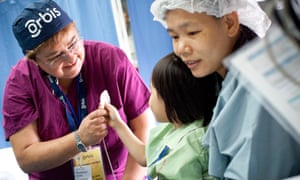


A volunteer ophthalmic nurse in the recovery room.


A volunteer ophthalmic nurse in the recovery room. Photograph: Geoff Oliver Bugbee/Orbis

Sharing experiences and discussing cases with the visiting Orbis medical volunteers “raises your confidence, to see that what you are doing is what everyone else is doing around the world”, Mboni concludes.


Globally, 285 million people are blind or visually impaired and yet for 80% of them, this could be prevented with access to the right treatment like the surgery Mboni is able to give Racheal. Orbis focuses its efforts in Africa, Asia and Latin America because 90% of the world’s 39 million blind people live in developing countries. Many of the conditions causing blindness – such as cataract and trachoma – can be easily treated. The loss of sight these conditions can cause have a huge impact as it will impede a person’s ability to gain an education, prevent them from finding employment and can plunge families into a life of poverty.


Ann-Marie Ablett, a nurse from the University Hospital of Wales in Cardiff, has been giving up four weeks of her annual leave to volunteer with Orbis since 2003. “You can’t change everything overnight but you can start with one patient and help them,” she says. “If everyone plays their small part together, you can make changes.”


Ablett is speaking in a terminal at Stansted Airport and just outside is the flying eye hospital, here for a short promotional visit. The white MD-10 aircraft on the tarmac looks like a typical passenger plane. In fact, this is a 46-seat classroom complete with audio-visual equipment that transmits live surgeries that can be watched in 3D. The lead surgeon, who is just next door in a state-of-the-art operating theatre, can be asked questions throughout the procedure. The aircraft, donated by FedEx, also features pre- and post-op spaces and a laser suite.
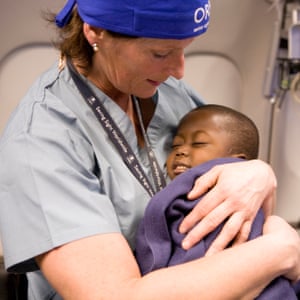


A patient wakes up from surgery.


A patient wakes up from surgery. Photograph: Orbis

Orbis’s main aim is to train eyecare teams and strengthen hospitals in the 92 countries where it works. It’s for this reason that Ablett first chose to volunteer. She says: “We’re not in the developing country just for numbers, we’re there to teach so that means we do less surgeries but when we fly off to the next country, the local doctors have got the skills to treat their own patients because they were trained up.”


Dr Jonathan Lord, global medical director for Orbis, went from being a regular volunteer to giving up his position as a consultant at Moorfields eye hospital in London and becoming a staff member for the charity before being promoted to his current role.


“I was just hooked after my visit trip,” he says. “Seeing the flying eye hospital work in real life, in the field with the patients being treated on the plane and that treatment being part of a really comprehensive training package that is upskilling all the groups of staff that are needed for each surgery, is amazing.


“The need round the world is huge. You realise the magnitude when you look at some of the statistics. In Ethiopia, there is a population of over 80 million, but [until recently] there was little over 80 ophthalmologists practising in the whole country. When I left Moorfields, it had over 150 covering just the catchment area of London.”
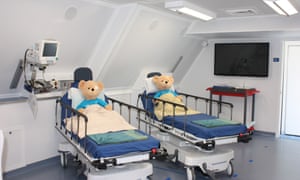


Recovery Room


The flying hospital’s recovery room. Photograph: Orbis

Programmes usually last two weeks, and require a lot of pre-planning with a team from Orbis flying in ahead to consult on what would be most helpful to the healthcare professionals in that country. The plane will land at a local airport and the team of local surgeons, nurses and anaesthetists board to join their volunteer counterparts. Meanwhile, another team of volunteers goes to the local hospital to provide training using the equipment in situ. At the end of the week, the teams swap.


Becoming hooked after stepping foot on the plane is a running theme among staff and volunteers, including the pilots, all FedEx employees who volunteer their time. Gary Dyson, who has been involved since 2001, says: “On my first trip, which was to China, I saw a child who couldn’t see on Monday but could see on Wednesday. It’s such a life-changing event for them.”


For Racheal, the short surgery will have undoubtedly had that effect. As Mboni removes the patches, she blinks a few times and waves her hands in front of her eyes, before looking up and seeing her mother for the first time.


News is spreading across Zambia of successes like this, Mboni says. “[People] know we can act fast, so they are telling patients with eye conditions – ‘This problem? Go to Kitwe central hospital’.”


Join the Healthcare Professionals Network to read more pieces like this. And follow us on Twitter (@GdnHealthcare) to keep up with the latest healthcare news and views.


The life-changing flying eye hospital treating blindness across the globe

31 Ocak 2017 Salı

Eliminating infectious blindness in Nigeria – in pictures

Since 2013, NGO Sightsavers has been part of a programme in northern Nigeria to prevent unnecessary sufffering caused by seven neglected tropical diseases (NTDs) – blinding trachoma, bilharzia, elephantiasis, river blindness, hookworm, whipworm and roundworm. It includes training community directed distributors (CDDs) to deliver medicines to remote areas. In 2016, 25 million people received treatment through this programme


Eliminating infectious blindness in Nigeria – in pictures

14 Kasım 2016 Pazartesi

The way I see it: living with partial blindness

Two young men are in my way. Their laughter echoes off the houses opposite as I move quickly to skirt around them on the narrow pavement. As I pass, they fall silent. I am a few inches away now, my white cane skimming the uneven paving stones, when one of them shouts to the other. His voice is confused, angry. He is shouting: “She’s not blind.”


You can’t be a bit dead. It’s a binary thing. You either are or you aren’t – same goes for pregnancy. But what about blindness? Can you be a bit blind? Is that allowed? And how does that work? What does it look like?


It looks like a woman seeing two men in front of her and using her cane to navigate around them. It looks like a man folding up his cane outside the cinema and going in to enjoy a movie. It looks like a girl on a train reading a newspaper while her guide dog rests his chin on her lap.


I have a genetic eye condition called retinitis pigmentosa (RP). One in 3,000 of us have it. People with RP begin losing their night vision and peripheral vision any time from infancy to their early 20s and, in many cases, lose their central vision entirely in later life. Many of us struggle in bright light as well as low light. Many of us wear sunglasses in the rain. But what most of us contend with for a good few decades is tunnel vision.


Imagine looking through a fogged-up window with a tiny dot of clarity in the middle. Now imagine the dot as a cursor on a screen. I can move my eyeballs around to get a sense of the big picture. This is why I am able to see a train arrive at the platform, walk to the doors and get in without needing help. I can also find a seat, get out my Kindle and read this summer’s bestseller.


But there are a multitude of situations where my scanning technique isn’t up to the job. Playgrounds, revolving doors, pavements – most outdoor places, really. So I can enjoy lunch in a cafe. I can get the bill and type in my PIN. All this will be fine until I get up, walk into a chair and fail to locate the exit. Once I have found the door, I will probably have to scrabble around to find the handle. I will be that person, hesitant and slow, standing on the pavement outside until my eyes adjust to the sun. I will get in your way. I will hover at the top of the stairs gripping the railing. I will apologise constantly, even though I won’t have actually seen what I have done wrong. I will crash into you as you queue up at the turnstiles at the tube station. When I get home, I will cry from nothing more than sheer physical exhaustion. My head will ache. My neck will ache. I will check my new array of flowering bruises and will decide to cancel all further social engagements because it has just been too bloody hard. But when I am reading my Kindle on the train, I look normal. I feel normal.


Lately, as my central vision has begun to worsen, my scanning technique has become less effective. My eyes do not clasp on to those crucial details – facial features, for example – with the ninja-like speed they used to. I am missing more. The misty mazes around me feel thicker and more befuddling. So, last year, I decided to abandon the art of being sighted. It was a decision made with surprising ease. I called social services and was put through to a man called Andy who offered me mobility training and the gift of a shining white cane.


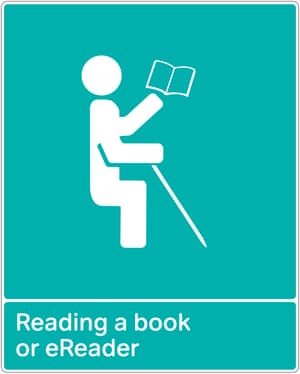
An RNIB graphic shows cane user reading


An RNIB graphic shows how cane users can enjoy activities most people would assume they can’t. Photograph: RNIB

When I say I made the decision “with surprising ease”, I mean that it wasn’t with tooth-gnashing resistance. I waited for Andy’s first visit with the enthusiasm of a condemned woman. The surprising ease came later. Andy showed me three different canes. The symbol cane looks like a conductor’s baton. It doesn’t reach the ground. It is there merely for show – to let other people know you cannot see very well. I had never heard of a symbol cane before. Andy showed me two other canes that touch the ground, thereby giving the user “feedback”. We decided I needed feedback. My heart was thumping as we left the house together with my new cane. I felt sick with misplaced, wrongheaded and overwhelming shame.


And yet, a few days later, I was swanning through Canary Wharf shopping centre, my cane sweeping the shining floor in front of me, my daughter skipping alongside. I wanted to dance and shout. My eyes didn’t ache. My back was straight. My stomach was unclenched. I felt amazing. I felt free. I felt as though I had got my sight back. I realised so much on that day – what it felt like to be in the world and not feel stressed; why my friends and family are never as exhausted as I am all the time; how mad and wrong I had been to expect myself to be able to keep up with everyone else; that I had to forgive myself for not being able to keep up.


And, as I glided around, my daughter and I chatted about the window displays. With the cane, I could free my eyes to admire my surroundings. And people kept apologising to me. All the time.


And then it happened. That pang, that familiar summoning of resilience, that surprise arrow of shame. I neared a doorway and stopped, because I saw a man approaching and I decided to wait for him to open the door rather than open it myself. I did this because, in that split second, I felt compelled to “play blind”. In that split second, I felt like a fraud.


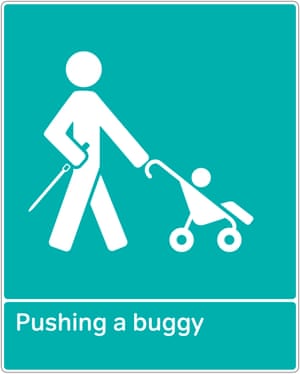
RNIB graphic of cane user pushing a buggy


Another RNIB graphic. Photograph: RNIB

“Who cares what people think?” It’s always angry, that statement. I have had it said to me a lot recently. I have also seen the expression of genuine incomprehension from Andy. “The cane is here for you,” he said, exasperated. “You are not a fraud. You are exactly who it’s here for.”


We all feel the need sometimes to explain ourselves to strangers. We all want to present a coherent picture, to make sense. Psychotherapist and cane-user Rachael Stevens has RP. She spoke about it on BBC Radio 4’s Today programme and was flooded with positive responses from visually impaired listeners. One caller spoke of a nasty encounter in which he was accused of being a “benefits fraud”. Stevens herself once told me about a time she had been confronted outside her son’s nursery by a man who had planted himself directly in front of her, smirking, as if to test her.


In order for guide canes and symbol canes to be effective, they need to be understood. Somehow, some time ago, the people who came up with these valuable low-vision solutions only did half the job. They didn’t put the resources needed into raising public awareness and, as a result, the cane has become symbolically too blunt an instrument.


I took the decision that I had to find the best way I could to present myself as partially sighted. I had to be me in the world. I unfold my cane whenever I need it. When people move out of my way, I thank them. I use different canes for different situations. I don’t use a cane when I am with my toddler as I have not yet found a way to hold a cane and push a buggy simultaneously. Also, I have found that the buggy itself (as well as the yelps from my son) provide adequate feedback. Some days, the light conditions are just right and I can operate without a cane. Other days, I stand at the front door and can’t take two steps forward.


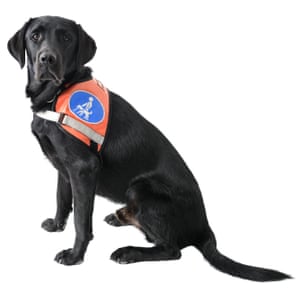
Guide dog


Some people with RP rely on guide dogs. Photograph: Alamy

I talk to people about my condition as much as possible. “Are you allowed a guide dog?” asks a friend. Good question. Yes. Jessica Luke, an RP friend with a guide dog, came with me to give a talk to my daughter’s class at school. We put up slides showing the different ways people see. We got one teacher to wear RP-simulation specs and we threw her a ball. She dropped it and the kids screamed with laughter.


The Royal National Institute for Blind People (RNIB) website tells me that 93% of people who are registered blind or partially sighted in the UK retain some useful vision. So why isn’t there better understanding of visual impairment? Is it because it is easier for sight-loss charities to raise money if they present a more simplistic, pitiable image of blindness? Or is it because it is thought too complex an issue to explain? Dyslexia is a complex condition, but nowadays a child with dyslexia can grow up in a world that (largely) understands their needs. I believe passionately that the same must be done for partial sight.


Blindness is not binary. It is a rich and fascinating spectrum. Visually impaired people come in many different variations. Some of us have central vision but no periphery. Some have periphery but no central. Some see the world through a window stained with blobs. For others, it is all a blur. We could form a zombie army. But we will probably just quietly get in your way on staircases.


And, given the chance, many lovely people do understand – such as the man who saw me holding my cane, squinting up at a noticeboard at St Pancras station. As I sat down next to him, taking my Kindle from my bag, he leaned over: “Did you get all the information you needed from that board?” I replied that I wasn’t 100% sure but I thought the Sevenoaks train was arriving in 10 minutes. He got up, checked the board and confirmed I was right. “Well done,” he said. “Thank you,” I replied, and we both got on with reading our books.


To find out more about the RNIB’s #howisee campaign, visit: rnib.org.uk/howisee


To find out more about RP, visit rpfightingblindness.org.uk


The way I see it: living with partial blindness

10 Ağustos 2016 Çarşamba

​Not just for Hackney hipsters: the Kenyan sourdough bakery ​tackling blindness

One is a hipster meeting place in the middle of east London, the other overlooks the Menengai crater in Kenya and is staffed by orphans. But these two bakeries, E5 Bakehouse and Ujima Bakehouse, seemingly worlds apart, have come together over a sourdough starter and a shared passion for healthy bread.


Situated in the Nakuru region, a four-hour drive from the Kenyan capital, Nairobi, Ujima is the brainchild of Andrew and Madeline Bastawrous, British doctors who were overwhelmed by the demand for eye operations to treat blindness in the region and wanted to find a sustainable way to fund them.


Madeleine Bastawrous, a keen baker who trained at E5 in Hackney, had the idea to sell bread to support checkups for the patients, provide local employment and extol the virtues of healthy eating.


The couple had noticed rising rates of diabetes – which can cause blindness – and high blood pressure, which made them determined that the bakery would make and sell a healthy product. They turned to sourdough.


Sourdough loaves, popular among British foodies, contain no fat, oil or sugar, unlike many mass-produced breads. Also, making sourdough requires a period of fermentation before baking, which is said to make the bread healthier and easier to digest.


The couple asked E5 to provide strategic guidance and the Kenya-based Ujima Foundation, which trains orphans for employment, to provide the staff.


The story of head baker Jastan Kimani is typical of those supported by the foundation. He was orphaned at an early age and left with the responsibility of supporting nine siblings.


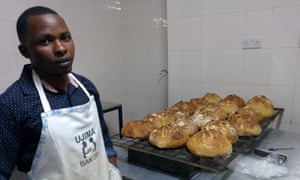
Head baker Jastan Kimani at Ujima Bakehouse


Rising star: head baker Jastan Kimani. Photograph: Andrew Bastawrous/Ujima Bakehouse

After discovering a flair for kneading, Kimani became the site’s master baker. He was recently invited to carry the flame, in the form of a sourdough starter, to Rio as part of an initiative to teach cooking skills and feed people for free during the Olympic Games.


Acclaimed chefs David Hertz and Massimo Bottura, whose social kitchens have previously attracted some of the world’s best chefs to Brazil’s favelas, or slums, invited Kimani after being inspired by the story of the bakery. He is due to travel at the end of the week.


Social enterprise


Profits from the Kenyan bakery are divided between the local eye hospital and the foundation. Some of those involved, such as Kimani, work at the bakery, while others work in hotels and shops nearby.


According to Andrew Bastawrous, eight out of 10 people who go blind do so due to entirely preventable causes. In Kenya, the biggest problem is a lack of access to treatment.


“The figures would be the same in the UK if you removed 99% of eye care,” adds the doctor, who also invented Peek, a smartphone app that offers a low-cost alternative for detecting vision problems.


Since the Kenyan bakery opened, the Bastawrouses have raised enough money to restore the sight of 60 people – a figure they hope will increase if they can start selling more bread.


They have also raised enough for 60 orphans to take a six-month employment-training programme through the foundation, which says it has an 80% success rate in getting its trainees placed in full-time employment.


The journey of the starter


The founder of E5 Bakehouse, Ben Mackinnon, has made three trips to Kenya – one with E5’s 200-year-old starter yeast – to support the bakery.


There was almost a disaster when air pressure on the plane forced open the jar carrying the starter – a fermented mixture of water and wild yeast that is used to help the bread rise. Almost all of it escaped, “but there was enough left in the pot to get going. They are remarkably resilient cultures”, Mackinnon says.


Related: How to make sourdough bread starter | Make your own


Mackinnon says that Ujima’s bakes easily passed the taste test. “There is a farmer a few miles from the bakery growing wheat and milling it in an Austrian stone mill, which is almost identical to ours here at E5,” he added.


Ujima has to use a special technique for “proving” the dough – letting it rest so the yeast can make it rise – to help preserve the loaves in Kenya’s heat, but otherwise the bread-making process is the same.


Back in the UK, E5’s special loaf is the ”Hackney Wild”. In Kenya, it’s the Afya, which is Swahili for healthy. The team are encouraged to promote the health benefits of sourdough to their customers.


Some of the customers have taken a bit of time to adjust to the taste, which is very different from the processed white loaves available on the supermarket shelves, said Andrew Bastawrous.


The average loaf at E5 costs between £3.50 and £5, and Ujima’s loaves are also at the higher end of their market, priced at about 200 Kenyan shillings (£1.50). “We are targeting people with a disposable income … like Robin Hood without actually stealing,” he says.


Next, the bakery wants to tackle diseases such as diabetes by creating an affordable product that can be sold by street vendors.


​Not just for Hackney hipsters: the Kenyan sourdough bakery ​tackling blindness

29 Temmuz 2016 Cuma

Heart disease, depression and blindness – the hazards of deep space travel

Upon his return last March from a record-breaking 340-day stay aboard the International Space Station (ISS), Nasa astronaut Scott Kelly was most excited about plunging into the swimming pool in his Houston, Texas backyard.


Kelly, who has spent more cumulative time in space than any other American, spent hours harnessed to a treadmill each day to try to keep his muscles and bones from atrophying. He also endured radiation exposure, nausea and vision problems while living on the ISS for nearly a year.


He has served as a guinea pig of sorts for scientists who are investigating the long term effects of zero-gravity environments on the human body. With Nasa planning a manned mission to Mars in the 2030s – and private outfits like Mars One advertising a colony on the planet in the next two decades – researchers want to know how to best offset the health hazards of a journey that will take two-and-a-half years. These dangers include everything from depression to loss of sight and heart disease.


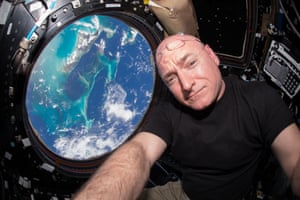
American astronaut Scott Kelly returned to Earth on 3 March, 2016, after completing 522 days living in space over four missions.


American astronaut Scott Kelly returned to Earth on 3 March, 2016, after completing 522 days living in space over four missions. Photograph: NASA

“The biggest barrier to missions like that are biomedical,” says Leroy Chiao, a retired astronaut who has logged four space flights, including a six-month stint aboard the ISS as commander of Nasa’s Expedition 10. “It’s, how are you going to keep astronauts healthy in that long period of time?”


The biggest barrier to missions like that are biomedical.


Even on a short shuttle mission lasting a few weeks, microgravity causes big physiological changes. “You notice them immediately once you get into space,” Chiao says. While they adapt to the weightless environment, astronauts’ sensorimotor skills and balance are immediately thrown off. The inner ear senses that the body is moving, the eyes see that it isn’t, and the brain is confused by these contradictory signals.


“To me, it feels like you just did a forward roll,” says Chiao of the resulting dizziness and nausea, which can last for days.


Not only that, but the bodily fluids that gravity normally pushes down into the lower extremities will float up to the neck and head, causing headaches and uncomfortable pressure, potentially leading to vision problems due to swelling of the optic nerve.


Upon further study, scientists have discovered that the extended pressure inside the skull has flattened the backs of some astronauts’ eyeballs, making them more farsighted, an effect that is exacerbated by lengthy trips in space. This could have further serious implications for space travelers’ sight.


Related: Can Mars One colonise the red planet?


“Nobody’s gone two years with exposure to this, and the concern is that we’d have loss of vision,” says Dohit Donoviel, director of the Biomedical Innovation Laboratory at the National Space Biomedical Research Institute (NSBRI), which partners with Nasa and Baylor College of Medicine to study human health in space. “That is catastrophic for an astronaut.”


No astronaut has ever gone blind from space travel, and while about 70% of them do experience vision changes while in flight – more often men than women – astronauts typically bring glasses on their space flights to help them do their jobs.


Still, the current remedy for redistributing fluids – a pair of suction pants made by the Russians called the Chibis suit, which essentially vacuums the fluids back down into the lower body – is “incredibly uncomfortable”, according to Donoviel , and can only be worn for an hour or two.


If I die on Mars: meet the people on a mission to be first on the red planet … and stay there.

The NSBRI is testing a number of solutions, including a garment under development with Under Armour that astronauts would wear while they sleep.


Another big concern about prolonged space travel is its effect on the heart. Much like the muscles and bones that are depleted because they no longer need to work to fight gravity, the heart gets used to exerting a far lighter effort to keep blood pumping throughout the body.


Astronauts traveling to Mars, which has about one-third the gravity of Earth, will have to keep up extensive cardiovascular exercise every day in order for their hearts to be able to handle the planet.


No human has been exposed to the level of radiation that it would take to make that trip to Mars.


“It’s kind of like you’re lying still in bed,” says Chiao of the effect of weightlessness on the body and the circulatory system. That’s why Nasa performs bed rest studies in order to see how the body is affected long term.


When paired with radiation exposure, the prognosis doesn’t look good. A recent study of the 24 astronauts who left Earth’s low orbit on Nasa’s Apollo missions in the 60s and 70s showed that they were five times more likely to die of heart disease than the astronauts who didn’t enter deep space – a result scientists think may have been caused by excessive radiation exposure.


Astronauts on missions at the ISS are shielded from too much radiation by Earth’s atmosphere and magnetic field. But on a trip to Mars, humans would be exposed to radiation from the sun and from high-energy particles called galactic cosmic rays, which degrade DNA and drastically increase cancer risk. Nasa studies show that a round trip to Mars would expose astronauts to radiation levels reaching two-thirds of the agency’s lifetime limit.


Related: Apollo deep space astronauts five times more likely to die from heart disease


“We have no ability to block them,” says Dovotiel of the particles. “In essence, they affect every organ. No human has been exposed to the level of radiation that it would take to make that trip [to Mars].”


Beyond the many physical difficulties astronauts will have to withstand during long journeys, veterans say the psychological aspects of hurtling through deep space shouldn’t be discounted.


Astronauts stay extremely busy during missions, whether they’re conducting research, keeping tabs on equipment or churning out the requisite two hours of daily exercise. Aboard the ISS , that means they can always maintain a visual connection with home. But on a six-month trip to Mars, that comforting view of the Blue Planet will be gone.


“Watching the Earth disappear and turn into a star – that’s going to be different. You are going to feel alone,” says Chiao. “As we go on these longer missions, the psychosocial part is going to become more and more important.”


Heart disease, depression and blindness – the hazards of deep space travel