In Kitwe, the second largest city in Zambia, young mother Verah is carrying her one-year-old daughter, Racheal, into the consultation room at the eye annexe. The only dedicated paediatric eyecare centre in the country, the Kitwe annexe also attracts patients from neighbouring Angola and Congo. Racheal is here for surgery to remove the bilateral cataracts that prevent her from seeing.
A few months after Racheal was born, Verah noticed that something didn’t seem right with her vision. “I would move my hands in front of her face but she would not react. I would move things past her eyes but she would not follow them,” she explains.
The team of nurses, anaesthetists and paediatric ophthalmologists treating Racheal have been trained and are being continually supported by peers from some of the world’s most respected eye hospitals, who fly in on a specially adapted plane – the flying eye hospital – thanks to an initiative of Orbis, an international blindness prevention charity.
“Orbis volunteers who come to share their knowledge and give technical support are very good – most of them have been working for a long time so they have very good experience,” says Chineshe Mboni, the paediatric ophthalmologist treating Racheal. “So we have some from the US, Britain and Israel etc. Techniques are different around the world, so we get a mix of everything.”
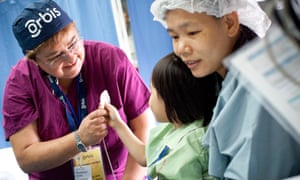
Sharing experiences and discussing cases with the visiting Orbis medical volunteers “raises your confidence, to see that what you are doing is what everyone else is doing around the world”, Mboni concludes.
Globally, 285 million people are blind or visually impaired and yet for 80% of them, this could be prevented with access to the right treatment like the surgery Mboni is able to give Racheal. Orbis focuses its efforts in Africa, Asia and Latin America because 90% of the world’s 39 million blind people live in developing countries. Many of the conditions causing blindness – such as cataract and trachoma – can be easily treated. The loss of sight these conditions can cause have a huge impact as it will impede a person’s ability to gain an education, prevent them from finding employment and can plunge families into a life of poverty.
Ann-Marie Ablett, a nurse from the University Hospital of Wales in Cardiff, has been giving up four weeks of her annual leave to volunteer with Orbis since 2003. “You can’t change everything overnight but you can start with one patient and help them,” she says. “If everyone plays their small part together, you can make changes.”
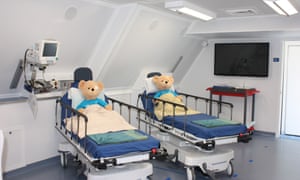
Ablett is speaking in a terminal at Stansted Airport and just outside is the flying eye hospital, here for a short promotional visit. The white MD-10 aircraft on the tarmac looks like a typical passenger plane. In fact, this is a 46-seat classroom complete with audio-visual equipment that transmits live surgeries that can be watched in 3D. The lead surgeon, who is just next door in a state-of-the-art operating theatre, can be asked questions throughout the procedure. The aircraft, donated by FedEx, also features pre- and post-op spaces and a laser suite.
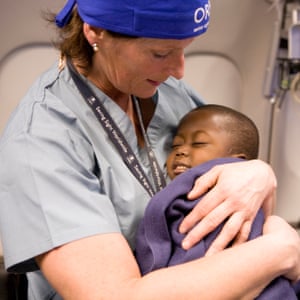
Orbis’s main aim is to train eyecare teams and strengthen hospitals in the 92 countries where it works. It’s for this reason that Ablett first chose to volunteer. She says: “We’re not in the developing country just for numbers, we’re there to teach so that means we do less surgeries but when we fly off to the next country, the local doctors have got the skills to treat their own patients because they were trained up.”
Dr Jonathan Lord, global medical director for Orbis, went from being a regular volunteer to giving up his position as a consultant at Moorfields eye hospital in London and becoming a staff member for the charity before being promoted to his current role.
“I was just hooked after my visit trip,” he says. “Seeing the flying eye hospital work in real life, in the field with the patients being treated on the plane and that treatment being part of a really comprehensive training package that is upskilling all the groups of staff that are needed for each surgery, is amazing.
“The need round the world is huge. You realise the magnitude when you look at some of the statistics. In Ethiopia, there is a population of over 80 million, but [until recently] there was little over 80 ophthalmologists practising in the whole country. When I left Moorfields, it had over 150 covering just the catchment area of London.”
Programmes usually last two weeks, and require a lot of pre-planning with a team from Orbis flying in ahead to consult on what would be most helpful to the healthcare professionals in that country. The plane will land at a local airport and the team of local surgeons, nurses and anaesthetists board to join their volunteer counterparts. Meanwhile, another team of volunteers goes to the local hospital to provide training using the equipment in situ. At the end of the week, the teams swap.
Becoming hooked after stepping foot on the plane is a running theme among staff and volunteers, including the pilots, all FedEx employees who volunteer their time. Gary Dyson, who has been involved since 2001, says: “On my first trip, which was to China, I saw a child who couldn’t see on Monday but could see on Wednesday. It’s such a life-changing event for them.”
For Racheal, the short surgery will have undoubtedly had that effect. As Mboni removes the patches, she blinks a few times and waves her hands in front of her eyes, before looking up and seeing her mother for the first time.
News is spreading across Zambia of successes like this, Mboni says. “[People] know we can act fast, so they are telling patients with eye conditions – ‘This problem? Go to Kitwe central hospital’.”
Join the Healthcare Professionals Network to read more pieces like this. And follow us on Twitter (@GdnHealthcare) to keep up with the latest healthcare news and views.
The life-changing flying eye hospital treating blindness across the globe