Nigeria etiketine sahip kayıtlar gösteriliyor. Tüm kayıtları göster

7 Mayıs 2017 Pazar

Nigeria battles to beat polio and Boko Haram

The man sporting a giant purple bottom adorned with a swinging horse tail is chanting to the beat of the drummers, his blue-painted face sweating copiously. Children delightedly race around the colourful clown. All except Ismail, 13, who watches from the ground, twisting his head to follow the dance. A man with a megaphone is yelling something, but it can’t be heard in the melee. Then a group of blue-caped women emerge from the crowd, clutching cheap market stall lunchboxes, to begin the real business of the day.


This is the “flag-off” in Ungogo, Kano state. The party marks the first of four days of intense work by an army of volunteers, mostly young mothers, who will go door to door across Nigeria. Some will pass through thousands of twisting warrens of slums fanning out into the red-orange, mud-built hamlets and reed-thatched huts. Others will visit the crumbling concrete city blocks, slipping drops of polio vaccine into as many of the 30 million Nigerian children under five as they can find.


Their capes bear the slogan: “Lafiyar al’ummarmu hakkin kowa da kowa ne” – “The health of the child is the responsibilty of all.” The lunchboxes are filled with ice and polio vaccine. They have marker pens to dab on the finger of each treated child and chalk to mark every house wall they visit, marking which child was vaccinated and when. No one is to be missed out.


Ismail has mixed feelings as he watches, his useless legs tucked under him in the dust. He contracted polio aged two. “I blame my parents,” he says, “for not having me vaccinated, it makes me angry with them. I don’t feel so glad to see this today, I feel sad.”


Polio is a plague on the poor, a paralysing, disabling brute of a virus, it deforms the limbs and wastes the muscles. Children under five are most at risk and places with poor sanitation are favoured feeding grounds for the virus, which spreads through infected faeces. For every one person paralysed by polio, another 200 will be contagious.


Even in countries like the UK, where it has long been wiped out, sewers are regularly tested to ensure that polio does not sneak back into the population. Only three host countries remain: Nigeria, Afghanistan and Pakistan. Nigeria was on track to be declared polio-free in 2017. But just as it was ready to celebrate, the disease returned.
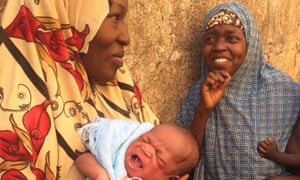


Binta Siddique, left, and Hanza Absulane await anti-polio vaccinations for their babies.


Binta Siddique, left, and Hanza Absulane await anti-polio vaccinations for their babies. Photograph: Tracy McVeigh for the Observer

The stumbling block here is not a lack of effort. The drive to vaccinate by Nigeria, with help from Unicef, which has been behind this mass mobilisation, has been heroic. The problem is Boko Haram.


This fearsome insurgency group holds a great swath of territory in north-east Nigeria, where it attempts to impose an extreme form of Islamic law and a hatred of the west. Violent and insular, Boko Haram also tries to seal people in its territory and keep vaccination teams, seen as a western influence, out. It is to this area that polio has returned, and the fear is that those fleeing their violence could bring the virus back into the wider country. The two polio cases discovered in August were children displaced from Maiduguri, capital of Boko Haram’s stronghold, Borno state.


Boko Haram is now weaker, but the poverty, propaganda and fear that brought them into being remain strong. The memory of the murder of two Kano vaccination teams four years ago is still fresh. “I was soaked in blood,” said Abbas Ibrahim Musa, in the village of Kauyen Alu. “It was a Friday, at 8.30am. I was preparing the vaccines. I heard a gunshot and raised my head and saw a man in the door holding a gun. I fell to the floor and heard ‘bang, bang’. Then ‘shoot them, shoot them’. There was the smell of petrol and they started to burn the place. I had bodies on top of me. Providence decreed I didn’t die that day. Three people died and three were injured. One had just finished her studies, one a bus conductor with one child and a pregnant wife. One sold vegetables.”


Meanwhile, in a nearby village, other gunmen were slaughtering eight women, another team of volunteers. Three days before, a radio show had run an item in which an imam repeated allegations that the polio vaccine was a western plot to sterilise Muslims.


“I can say this,” said Musa. “Without Boko Haram polio would be a thing of the past. Some say health is not the problem; security is. They are linked. If we hear one child in Maiduguri has polio, then that means there are 200. So what if there are 10 children there? And very many children are coming out of the conflict zone. We don’t know, so we have to work harder. We persuade people by educating them. You make them understand. We have reduced the non-compliance rate here now to almost zero. I tell our workers ‘your names are written in gold’.”


But with some religious leaders sharing the distrust, what should have been a celebration of a disease eradicated is now a renewed struggle to finish a job that should have been over. Since the outbreak in Boko Haram-controlled territory, northern Nigeria has been in emergency mode. Teams of vaccinators are out almost constantly. “I almost cried,” said Rhoda Samson, “but not to finish the job is not acceptable.”


‘Disabled in the body, not the mind or heart’: surviving polio in Nigeria

A supervisor in the mobilisation teams, Samson is thorough, checking every move her teams make. They visit a woman whose five-day-old baby still has no name. The chalk on the wall outside shows a list of visits here. “Seven times they have said no,” said Samson as her team coo over the baby. “Bamaso,” said the mother, Amina Ali. “We don’t want. My husband says vaccine is not food, why do the government not give us food? He refused and has not offended God.”


At this her husband, Ali Zaki, returns home, angry at the invasion of his house: “I believe God will provide; this is what we are taught.” But he is no match for Samson: “You think God doesn’t make the medicines? You want your children to have polio? To never play? Does Allah want that? What kind of man are you?”


When Zaki grudgingly agrees, the vaccine is quickly slipped into the baby’s mouth and the women clatter off, congratulating the couple. “They’ve a lot of reasons for refusing. We have some who don’t want drugs at all, some who say they won’t because they want something in return, some hear the stories,” said Samson. “The security situation is a problem. People are suspicious, they hear vaccinations make infertility. But we are bringing the numbers of non-compliants down; we will not stop.”


And they are not just fighting polio – they are creating a network and collecting data in a way never before done in Nigeria. A network of trained, community-based health workers, it’s a structure already being used to deliver other healthcare.


Senior state and government officials have recognised the value of this, gracing the polio flag-offs. In their elegant robes and themed hats, and long, often less elegant political speeches, their presence stresses to everyone in the fidgeting crowds of locals that something important is happening here. It is the kind of message that could reverse the damage done by Boko Haram, says Dr Kabiru Ibrahim Getso, Kano’s health commissioner. “Kano used to be a hub of polio cases, now it’s best practice. The last case was 2014 and this did not happen by accident. The teams are headed by the governor himself, it’s high profile This is how we do it. We go into the field every day, every day the volunteers are out there. Then we can use these structures to develop an entire primary healthcare system.”


Displaced people are especially targeted in this campaign. Abule Abdullah has hosted seven families – seven mothers and 33 children – in her home in Katsina state. One of her current guests is Aisha Idris, 40, recently arrived from Maiduguri.


“Boko Haram forced us to come here. The insurgency has stopped everything, the hospitals, the schools, everything is shut down,” she said. “My husband was killed at his Islamic reading group by a stray bullet from the fighting. My child was sick and so I came here with my children. I have to live with no roof over our heads but they have all been vaccinated now.” At the bus stations, and the state and national border crossings, the lunchbox-toting teams are there. Peering into cars, lifting the cloaks of women perched on motorbikes to find the babies strapped to their fronts and backs. Squeezing in the little vials of vaccine.


“If they say no, then we tell them they can go back,” said superintendent of immigration, Charles Tashllani, imposing order on Nigeria’s border with Niger in Katsina. Here, late in the evening, the Polio Emergency Operations committee reviews the campaign’s first day, which has seen 3,661 teams immunise 28,882 underfives. The detail is such that eight missing marker pens are on the agenda, as is the sacking of two town announcers who did not inform people about the programme.


“We look at every single child, everyone counts to us. I’m dealing with human beings. But we do have the iceberg phenomenon: many inaccessible, remote areas where we do not always know what is going on.


“People not feeling that polio is a threat to them, that is a big worry for a resurgence. But the biggest threat to health is Boko Haram. When we learned we had Borno refugees here in Katsina we were worried; they melt into the communities. It is potentially dangerous.”


The legacy of polio can be seen everywhere in Nigeria. Aminu Ahmen el-Wada lives with Hadza, his wife of 28 years, and those of their nine children who still live at home. One of life’s cheerful souls, he is enormously proud of the length of their marriage. “The trick is when I am the problem, I say sorry, when she is the problem, she says sorry,” says Wada.


The couple both skim along the floor using wooden handles Wada designed and carved to protect their hands – when your legs are withered from polio and are folded tiny and useless below your torso, your arms are the limbs that propel you. “I went to school until I became too heavy for my parents to carry me there,” said Wada. “So I taught myself to make hand-operated cycles, first for myself, then for others.” He now employs 20 people, 15 polio survivors. “Otherwise we would be beggars. This is because in Africa nobody can help you if you are disabled. But my father told me: ‘Disabled is in the body, not in the mind or in the heart,’ and this is what I believe.”


His smile falters only when he introduces Ummar, 14. His son contracted polio during a hiatus in the immunisation programme. “It was horrible. But the place behind our house is where people defecate. This is what happens.”


Wada began the Polio Survivors Group, which supports the vaccination drives. “I tell people: ‘Look at me. Do you want your child to end up like this? To never play football?’” Although he acknowledges the irony in that he also coaches a polio survivors’ para-football team. “But they would rather play for Arsenal,” he grins.


In his open-air workshop by the side of a main road in Fagge, the air smells poisonous as the men who would otherwise be beggars weld, cut and paint, making the three-wheeled, arm-operated cycles that give a certain freedom of movement. “This is the small size, for age five, then they can move up, age teenage, age adult,” he says. “One day I would like it that we make no more because polio is eradicated. Then we will make playground equipment instead, slides for happier children.”


He fires up his beaming smile: “Years ago in Nigeria we had leprosy, smallpox. We chased them all away. Now the last one is polio.”


Nigeria battles to beat polio and Boko Haram

6 Mayıs 2017 Cumartesi

"Disabled in the body, not the mind or heart": surviving polio in Nigeria – video

Unable to complete his education after contracting polio as a child, Aminu was determined not to become a beggar on the streets of Kano in north-west Nigeria. His solution was to design a bike that restored his mobility. Now he produces dozens of them, employing fellow polio survivors and helping to transform lives


"Disabled in the body, not the mind or heart": surviving polio in Nigeria – video

31 Ocak 2017 Salı

Eliminating infectious blindness in Nigeria – in pictures

Since 2013, NGO Sightsavers has been part of a programme in northern Nigeria to prevent unnecessary sufffering caused by seven neglected tropical diseases (NTDs) – blinding trachoma, bilharzia, elephantiasis, river blindness, hookworm, whipworm and roundworm. It includes training community directed distributors (CDDs) to deliver medicines to remote areas. In 2016, 25 million people received treatment through this programme


Eliminating infectious blindness in Nigeria – in pictures

13 Ekim 2016 Perşembe

Polio vaccine drive targets 41m African children as Nigeria battles outbreak

Nigeria is racing to contain a polio outbreak in its north-east state of Borno, amid fears the virus could spread to neighbouring countries and set back global efforts towards eradication.


This week, the UN children’s fund, Unicef, launched an emergency vaccination drive in 18 states in northern Nigeria and neighbouring Chad, Niger, Cameroon and Central African Republic, to immunise more than 41 million children.


Nearly 39,000 health workers will be deployed across the Lake Chad basin, where ongoing conflict with the insurgent group Boko Haram has forced 2.6 million people to flee their homes (pdf), leading to fears the virus could spread across borders.


The four-day campaign will be the third of five vaccination drives to contain the wild strain of the polio virus. Two further campaigns are scheduled for November and December in neighbouring countries.


Global efforts to eradicate polio suffered a setback in August when, after two years free of transmission, two cases of polio were detected in Borno state, followed by another in September. Nigeria is the last country in Africa and one of only three in the world where polio remains. Afghanistan and Pakistan are the other two.


A country cannot be declared polio-free until three years have passed with no new cases. Earlier this year, the World Health Organisation said it believed transmission of the virus could be stopped within 12 months.


Doune Porter, Unicef Nigeria’s chief of communication, said: “We have to respond, and we are indeed responding, with a massive show of force to make sure that it does not get out of control. We can’t afford to have polio come back to the area, to Nigeria or Africa.”


Although the polio vaccine is relatively simple to administer, large parts of Borno state have, for some years, been inaccessible to humanitarian organisations due to the Boko Haram insurgency. This has meant large numbers of children have never been immunised against life-threatening diseases.


This drive, which will involve door-to-door visits from health workers, will include 750,000 people in territory taken back by Nigerian government forces earlier this year. However, large areas of north-east Nigeria still cannot be reached with any kind of humanitarian assistance.


Porter said immunisations were crucial in keeping the re-emergence of polio in Nigeria under control, saying the new cases earlier this year were a “huge disappointment”.


“We need to start the clock again and of course there is the question of accessing more children with immunisation. However, it’s important to remember that it’s not going back to having huge numbers of polio cases. It doesn’t undo the great progress that has been made. It’s important to remember we’ve come a long way.”


The vaccination teams will also conduct malnutrition screenings among children under five. According to Unicef, 400,000 children in the three Nigerian states worst affected by the conflict will suffer from severe acute malnutrition this year.


Polio vaccine drive targets 41m African children as Nigeria battles outbreak

24 Temmuz 2016 Pazar

Only complacency can stop Nigeria – and Africa – from finally conquering polio | Oyewale Tomori

In Nigeria, if we’re diligent and careful, we may never see another child lose the use of their legs to polio.


Thirty years ago, millions of children went unvaccinated against a preventable disease that persisted and paralysed in nearly every country in the world. Since then, the number of unvaccinated children has dropped precipitously. While we still have work to do to ensure not even one child is missed, the biggest challenge Nigeria has to contend with now is complacency.


On 24 July 2016, Nigeria reachedtwo years without a case of wild polio. That is commendable. But if reaching this landmark has left many euphoric, total eradication would be historic. If Nigeria and the rest of Africa can make it to July 2017 without a case of polio, we will be officially polio free. To do this, we have to consolidate the progress we have already made, and vigorously invest in our collective capacity to contain and wipe out the disease wherever it may linger.


To banish polio from Nigeria and the rest of the continent, we must vaccinate every child. To miss even one would be to leave the door open for wild polio virus to return, or to risk outbreaks of vaccine-derived polio virus, a very rare form of polio that can emerge in under-immunised populations.


In Nigeria and across Africa, national governments have been instrumental in supporting this last-mile effort. So too have local civil society leaders, religious and traditional chiefs. All have been backed by the incredible commitment of the continent’s health workers. It is through these networks that we are able to quickly, aggressively and effectively respond to the last vestiges of polio in some of the most remote corners of the world.


Since President Muhammadu Buhari took office last year, he has clearly stated that he is committed to ending polio in Nigeria. Earlier this month, following a meeting with Dr Matshidiso Moeti, the World Health Organisation’s regional director for Africa, Buhari called for a reinvigorated approach to guaranteeing Nigeria’s polio-free status by prioritising public funding to health programmes and to innovative strategies that have enabled the country to immunise millions of children even in hard-to-reach and insecure areas. While national commitment is critical, state governors and local officials need to act on Buhari’s message. They must not only pledge to keep Nigeria polio-free, but also ensure all our children have access to the vaccines they need to protect them from killer diseases.


The health infrastructure built to eradicate polio need not disappear with the disease, either. The infrastructure and response mechanisms built to bring an end to polio can and should be repurposed into sustainable public health programmes and a functioning health infrastructure. We should care for our children with the same excitement we exhibit when bringing them into the world and not abandon responsibility to donors and international agencies.


Nigeria already has the opportunity to develop a great legacy. In the past two years, polio surveillance networks have been used to monitor and contain the 2014 Ebola outbreak, as well as responding to measles and rubella outbreaks throughout Africa.


Nigeria should also take the lessons learned from its emergency operations centres – which have been used to great effect for polio and were instrumental in stopping Ebola – to monitor and control disease outbreaks such as Lassa fever, and provide better health services to the large population of internally displaced people.


I know better than most that the obstacles that stand in the way of eradication are not to be discounted. The violent insurgency in north-east Nigeria has made routine vaccination exceedingly difficult in certain parts of the country, and finding and vaccinating children displaced by violence remains a major challenge. Nonetheless, the eradication of polio is not a luxury. We have come too far and invested too much to rest on our laurels.


Those who have dedicated their lives to improving public health are said to run on impossible idealism and a tenacious commitment to the greater good. Few of them are ever lucky enough to bring a definitive end to such a devastating disease. For all of the children whose lives have been irreparably damaged by an entirely preventable illness, let’s come together and call on our leaders at home and abroad to make polio a distant memory.


Dr Oyewale Tomori is president of the Nigerian Academy of Science and chairman of Nigeria’s Expert Review Committee on Polio Eradication and Routine Immunisation


Only complacency can stop Nigeria – and Africa – from finally conquering polio | Oyewale Tomori

7 Temmuz 2014 Pazartesi

Western lifestyles fuel expanding weight problems epidemic in Nigeria

A woman carries fruit to sell in the market on World Food Day in Lagos, Nigeria. The UN

A woman carries fruit to sell in the market on Globe Foods Day in Lagos, Nigeria. Photograph: Sunday Alamba/AP


The whole world is getting fatter. It is really clear in Latin America, exactly where Mexico now has higher costs of weight problems than the United States and is mounting a fightback by means of soda and junk foods taxes, as I described in my book. There are key issues, too, in Asia, in which China has the second greatest population of obese men and women soon after the USA. After people two come India, Russia, Brazil, Mexico, Egypt, Germany, Pakistan, and Indonesia, according to the Global Burden of Ailment research from the University of Washington, published in the Lancet. Some 30% of the world’s population is now obese or obese, raising their risk of wellness problems.


But what of Africa, where we see photos too often of emaciated, malnourished, young children and their mother and father and grandparents?


In accordance to a new review published by the open entry journal PLOS One particular, obesity is growing rapidly in elements of sub-Saharan Africa. The review appears at Nigeria and finds that western influences on diet and life style are taking part in a part in what looks set to be a critical epidemic that is going to produce all the overall health troubles the west is previously struggling with. Needless to say, the health programs of sub-Saharan Africa are going to be a whole lot less capable to cope.


The examine from researchers at Warwick healthcare college discovered that far more than a single in five ladies in Nigeria is obese or obese – among guys the charges are considerably lower, which the authors consider might be down to the sum of physical perform men even now do.


Fat goes with wealth in Nigeria right now. The richest girls are three and a half times far more probably to be overweight or obese than these in the lowest earnings bracket. That is not so surprising. But education and social status also enhance women’s probabilities of putting on far more excess weight than is great for their health. In Nigeria, there is a cultural component to this – richer and a lot more profitable girls are expected to be fatter. But element of this is the pursuit of a life style that is presumed to be enviable due to the fact it is that of men and women in the affluent nations of the planet like the US and the Uk. They emulate our success and are landed with our difficulties.


Dr Ngianga-Bakwin Kandala at Warwick puts it like this:


Obesity is now not just a western issue, but an African 1 as effectively. By turning out to be wealthier, better educated and urbanised areas of Nigeria are gaining the attributes we would much more frequently associate with western societies. This has brought both a modify in lifestyle and diet program that is reflected in discovering that educated, wealthy females are a lot much more likely to be obese than people residing in more rural, standard regions.


And this is his colleague, Professor Saverio Stranges:


Urbanisation, and the shift in the direction of what we would consider to be much more western routines, appears to come hand in hand with a more sedentary way of life and modify in diet. A lot more folks have cars and drive in which they may possibly have walked in the past. The rise in world wide web usage within the cities sees far more individuals sat down for prolonged periods, the two at house and at work.


This physical inactivity is worsened by a significantly less balanced diet plan. An in excess of reliance on energy dense processed foods can be highlighted by the developing presence of quickly foods outlets and the knock on effect is decreasing the intake of staple, minimal calorie foods.


Under-nourishment now exists cheek by jowl with overweight. There is a large contrast between urban areas like Lagos and rural regions in which folks labour to feed their families from their own patch of earth. Prof Stranges puts this double difficulties extremely well:


The be concerned is that Nigeria, like numerous Sub-Saharan African countries, is dealing with a major public health challenge with a growing variety of obese adults, whilst huge segments of the population encounter difficulties linked with underneath nutrition. This dual burden will imply combating both malnutrition and the dangers associated with obesity, this kind of as cardiovascular disease.


Western lifestyles fuel expanding weight problems epidemic in Nigeria