polio etiketine sahip kayıtlar gösteriliyor. Tüm kayıtları göster

7 Mayıs 2017 Pazar

Nigeria battles to beat polio and Boko Haram

The man sporting a giant purple bottom adorned with a swinging horse tail is chanting to the beat of the drummers, his blue-painted face sweating copiously. Children delightedly race around the colourful clown. All except Ismail, 13, who watches from the ground, twisting his head to follow the dance. A man with a megaphone is yelling something, but it can’t be heard in the melee. Then a group of blue-caped women emerge from the crowd, clutching cheap market stall lunchboxes, to begin the real business of the day.


This is the “flag-off” in Ungogo, Kano state. The party marks the first of four days of intense work by an army of volunteers, mostly young mothers, who will go door to door across Nigeria. Some will pass through thousands of twisting warrens of slums fanning out into the red-orange, mud-built hamlets and reed-thatched huts. Others will visit the crumbling concrete city blocks, slipping drops of polio vaccine into as many of the 30 million Nigerian children under five as they can find.


Their capes bear the slogan: “Lafiyar al’ummarmu hakkin kowa da kowa ne” – “The health of the child is the responsibilty of all.” The lunchboxes are filled with ice and polio vaccine. They have marker pens to dab on the finger of each treated child and chalk to mark every house wall they visit, marking which child was vaccinated and when. No one is to be missed out.


Ismail has mixed feelings as he watches, his useless legs tucked under him in the dust. He contracted polio aged two. “I blame my parents,” he says, “for not having me vaccinated, it makes me angry with them. I don’t feel so glad to see this today, I feel sad.”


Polio is a plague on the poor, a paralysing, disabling brute of a virus, it deforms the limbs and wastes the muscles. Children under five are most at risk and places with poor sanitation are favoured feeding grounds for the virus, which spreads through infected faeces. For every one person paralysed by polio, another 200 will be contagious.


Even in countries like the UK, where it has long been wiped out, sewers are regularly tested to ensure that polio does not sneak back into the population. Only three host countries remain: Nigeria, Afghanistan and Pakistan. Nigeria was on track to be declared polio-free in 2017. But just as it was ready to celebrate, the disease returned.
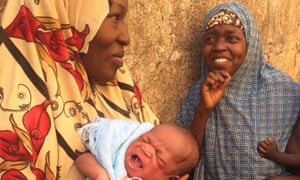


Binta Siddique, left, and Hanza Absulane await anti-polio vaccinations for their babies.


Binta Siddique, left, and Hanza Absulane await anti-polio vaccinations for their babies. Photograph: Tracy McVeigh for the Observer

The stumbling block here is not a lack of effort. The drive to vaccinate by Nigeria, with help from Unicef, which has been behind this mass mobilisation, has been heroic. The problem is Boko Haram.


This fearsome insurgency group holds a great swath of territory in north-east Nigeria, where it attempts to impose an extreme form of Islamic law and a hatred of the west. Violent and insular, Boko Haram also tries to seal people in its territory and keep vaccination teams, seen as a western influence, out. It is to this area that polio has returned, and the fear is that those fleeing their violence could bring the virus back into the wider country. The two polio cases discovered in August were children displaced from Maiduguri, capital of Boko Haram’s stronghold, Borno state.


Boko Haram is now weaker, but the poverty, propaganda and fear that brought them into being remain strong. The memory of the murder of two Kano vaccination teams four years ago is still fresh. “I was soaked in blood,” said Abbas Ibrahim Musa, in the village of Kauyen Alu. “It was a Friday, at 8.30am. I was preparing the vaccines. I heard a gunshot and raised my head and saw a man in the door holding a gun. I fell to the floor and heard ‘bang, bang’. Then ‘shoot them, shoot them’. There was the smell of petrol and they started to burn the place. I had bodies on top of me. Providence decreed I didn’t die that day. Three people died and three were injured. One had just finished her studies, one a bus conductor with one child and a pregnant wife. One sold vegetables.”


Meanwhile, in a nearby village, other gunmen were slaughtering eight women, another team of volunteers. Three days before, a radio show had run an item in which an imam repeated allegations that the polio vaccine was a western plot to sterilise Muslims.


“I can say this,” said Musa. “Without Boko Haram polio would be a thing of the past. Some say health is not the problem; security is. They are linked. If we hear one child in Maiduguri has polio, then that means there are 200. So what if there are 10 children there? And very many children are coming out of the conflict zone. We don’t know, so we have to work harder. We persuade people by educating them. You make them understand. We have reduced the non-compliance rate here now to almost zero. I tell our workers ‘your names are written in gold’.”


But with some religious leaders sharing the distrust, what should have been a celebration of a disease eradicated is now a renewed struggle to finish a job that should have been over. Since the outbreak in Boko Haram-controlled territory, northern Nigeria has been in emergency mode. Teams of vaccinators are out almost constantly. “I almost cried,” said Rhoda Samson, “but not to finish the job is not acceptable.”


‘Disabled in the body, not the mind or heart’: surviving polio in Nigeria

A supervisor in the mobilisation teams, Samson is thorough, checking every move her teams make. They visit a woman whose five-day-old baby still has no name. The chalk on the wall outside shows a list of visits here. “Seven times they have said no,” said Samson as her team coo over the baby. “Bamaso,” said the mother, Amina Ali. “We don’t want. My husband says vaccine is not food, why do the government not give us food? He refused and has not offended God.”


At this her husband, Ali Zaki, returns home, angry at the invasion of his house: “I believe God will provide; this is what we are taught.” But he is no match for Samson: “You think God doesn’t make the medicines? You want your children to have polio? To never play? Does Allah want that? What kind of man are you?”


When Zaki grudgingly agrees, the vaccine is quickly slipped into the baby’s mouth and the women clatter off, congratulating the couple. “They’ve a lot of reasons for refusing. We have some who don’t want drugs at all, some who say they won’t because they want something in return, some hear the stories,” said Samson. “The security situation is a problem. People are suspicious, they hear vaccinations make infertility. But we are bringing the numbers of non-compliants down; we will not stop.”


And they are not just fighting polio – they are creating a network and collecting data in a way never before done in Nigeria. A network of trained, community-based health workers, it’s a structure already being used to deliver other healthcare.


Senior state and government officials have recognised the value of this, gracing the polio flag-offs. In their elegant robes and themed hats, and long, often less elegant political speeches, their presence stresses to everyone in the fidgeting crowds of locals that something important is happening here. It is the kind of message that could reverse the damage done by Boko Haram, says Dr Kabiru Ibrahim Getso, Kano’s health commissioner. “Kano used to be a hub of polio cases, now it’s best practice. The last case was 2014 and this did not happen by accident. The teams are headed by the governor himself, it’s high profile This is how we do it. We go into the field every day, every day the volunteers are out there. Then we can use these structures to develop an entire primary healthcare system.”


Displaced people are especially targeted in this campaign. Abule Abdullah has hosted seven families – seven mothers and 33 children – in her home in Katsina state. One of her current guests is Aisha Idris, 40, recently arrived from Maiduguri.


“Boko Haram forced us to come here. The insurgency has stopped everything, the hospitals, the schools, everything is shut down,” she said. “My husband was killed at his Islamic reading group by a stray bullet from the fighting. My child was sick and so I came here with my children. I have to live with no roof over our heads but they have all been vaccinated now.” At the bus stations, and the state and national border crossings, the lunchbox-toting teams are there. Peering into cars, lifting the cloaks of women perched on motorbikes to find the babies strapped to their fronts and backs. Squeezing in the little vials of vaccine.


“If they say no, then we tell them they can go back,” said superintendent of immigration, Charles Tashllani, imposing order on Nigeria’s border with Niger in Katsina. Here, late in the evening, the Polio Emergency Operations committee reviews the campaign’s first day, which has seen 3,661 teams immunise 28,882 underfives. The detail is such that eight missing marker pens are on the agenda, as is the sacking of two town announcers who did not inform people about the programme.


“We look at every single child, everyone counts to us. I’m dealing with human beings. But we do have the iceberg phenomenon: many inaccessible, remote areas where we do not always know what is going on.


“People not feeling that polio is a threat to them, that is a big worry for a resurgence. But the biggest threat to health is Boko Haram. When we learned we had Borno refugees here in Katsina we were worried; they melt into the communities. It is potentially dangerous.”


The legacy of polio can be seen everywhere in Nigeria. Aminu Ahmen el-Wada lives with Hadza, his wife of 28 years, and those of their nine children who still live at home. One of life’s cheerful souls, he is enormously proud of the length of their marriage. “The trick is when I am the problem, I say sorry, when she is the problem, she says sorry,” says Wada.


The couple both skim along the floor using wooden handles Wada designed and carved to protect their hands – when your legs are withered from polio and are folded tiny and useless below your torso, your arms are the limbs that propel you. “I went to school until I became too heavy for my parents to carry me there,” said Wada. “So I taught myself to make hand-operated cycles, first for myself, then for others.” He now employs 20 people, 15 polio survivors. “Otherwise we would be beggars. This is because in Africa nobody can help you if you are disabled. But my father told me: ‘Disabled is in the body, not in the mind or in the heart,’ and this is what I believe.”


His smile falters only when he introduces Ummar, 14. His son contracted polio during a hiatus in the immunisation programme. “It was horrible. But the place behind our house is where people defecate. This is what happens.”


Wada began the Polio Survivors Group, which supports the vaccination drives. “I tell people: ‘Look at me. Do you want your child to end up like this? To never play football?’” Although he acknowledges the irony in that he also coaches a polio survivors’ para-football team. “But they would rather play for Arsenal,” he grins.


In his open-air workshop by the side of a main road in Fagge, the air smells poisonous as the men who would otherwise be beggars weld, cut and paint, making the three-wheeled, arm-operated cycles that give a certain freedom of movement. “This is the small size, for age five, then they can move up, age teenage, age adult,” he says. “One day I would like it that we make no more because polio is eradicated. Then we will make playground equipment instead, slides for happier children.”


He fires up his beaming smile: “Years ago in Nigeria we had leprosy, smallpox. We chased them all away. Now the last one is polio.”


Nigeria battles to beat polio and Boko Haram

6 Mayıs 2017 Cumartesi

"Disabled in the body, not the mind or heart": surviving polio in Nigeria – video

Unable to complete his education after contracting polio as a child, Aminu was determined not to become a beggar on the streets of Kano in north-west Nigeria. His solution was to design a bike that restored his mobility. Now he produces dozens of them, employing fellow polio survivors and helping to transform lives


"Disabled in the body, not the mind or heart": surviving polio in Nigeria – video

13 Ekim 2016 Perşembe

Polio vaccine drive targets 41m African children as Nigeria battles outbreak

Nigeria is racing to contain a polio outbreak in its north-east state of Borno, amid fears the virus could spread to neighbouring countries and set back global efforts towards eradication.


This week, the UN children’s fund, Unicef, launched an emergency vaccination drive in 18 states in northern Nigeria and neighbouring Chad, Niger, Cameroon and Central African Republic, to immunise more than 41 million children.


Nearly 39,000 health workers will be deployed across the Lake Chad basin, where ongoing conflict with the insurgent group Boko Haram has forced 2.6 million people to flee their homes (pdf), leading to fears the virus could spread across borders.


The four-day campaign will be the third of five vaccination drives to contain the wild strain of the polio virus. Two further campaigns are scheduled for November and December in neighbouring countries.


Global efforts to eradicate polio suffered a setback in August when, after two years free of transmission, two cases of polio were detected in Borno state, followed by another in September. Nigeria is the last country in Africa and one of only three in the world where polio remains. Afghanistan and Pakistan are the other two.


A country cannot be declared polio-free until three years have passed with no new cases. Earlier this year, the World Health Organisation said it believed transmission of the virus could be stopped within 12 months.


Doune Porter, Unicef Nigeria’s chief of communication, said: “We have to respond, and we are indeed responding, with a massive show of force to make sure that it does not get out of control. We can’t afford to have polio come back to the area, to Nigeria or Africa.”


Although the polio vaccine is relatively simple to administer, large parts of Borno state have, for some years, been inaccessible to humanitarian organisations due to the Boko Haram insurgency. This has meant large numbers of children have never been immunised against life-threatening diseases.


This drive, which will involve door-to-door visits from health workers, will include 750,000 people in territory taken back by Nigerian government forces earlier this year. However, large areas of north-east Nigeria still cannot be reached with any kind of humanitarian assistance.


Porter said immunisations were crucial in keeping the re-emergence of polio in Nigeria under control, saying the new cases earlier this year were a “huge disappointment”.


“We need to start the clock again and of course there is the question of accessing more children with immunisation. However, it’s important to remember that it’s not going back to having huge numbers of polio cases. It doesn’t undo the great progress that has been made. It’s important to remember we’ve come a long way.”


The vaccination teams will also conduct malnutrition screenings among children under five. According to Unicef, 400,000 children in the three Nigerian states worst affected by the conflict will suffer from severe acute malnutrition this year.


Polio vaccine drive targets 41m African children as Nigeria battles outbreak

24 Temmuz 2016 Pazar

Only complacency can stop Nigeria – and Africa – from finally conquering polio | Oyewale Tomori

In Nigeria, if we’re diligent and careful, we may never see another child lose the use of their legs to polio.


Thirty years ago, millions of children went unvaccinated against a preventable disease that persisted and paralysed in nearly every country in the world. Since then, the number of unvaccinated children has dropped precipitously. While we still have work to do to ensure not even one child is missed, the biggest challenge Nigeria has to contend with now is complacency.


On 24 July 2016, Nigeria reachedtwo years without a case of wild polio. That is commendable. But if reaching this landmark has left many euphoric, total eradication would be historic. If Nigeria and the rest of Africa can make it to July 2017 without a case of polio, we will be officially polio free. To do this, we have to consolidate the progress we have already made, and vigorously invest in our collective capacity to contain and wipe out the disease wherever it may linger.


To banish polio from Nigeria and the rest of the continent, we must vaccinate every child. To miss even one would be to leave the door open for wild polio virus to return, or to risk outbreaks of vaccine-derived polio virus, a very rare form of polio that can emerge in under-immunised populations.


In Nigeria and across Africa, national governments have been instrumental in supporting this last-mile effort. So too have local civil society leaders, religious and traditional chiefs. All have been backed by the incredible commitment of the continent’s health workers. It is through these networks that we are able to quickly, aggressively and effectively respond to the last vestiges of polio in some of the most remote corners of the world.


Since President Muhammadu Buhari took office last year, he has clearly stated that he is committed to ending polio in Nigeria. Earlier this month, following a meeting with Dr Matshidiso Moeti, the World Health Organisation’s regional director for Africa, Buhari called for a reinvigorated approach to guaranteeing Nigeria’s polio-free status by prioritising public funding to health programmes and to innovative strategies that have enabled the country to immunise millions of children even in hard-to-reach and insecure areas. While national commitment is critical, state governors and local officials need to act on Buhari’s message. They must not only pledge to keep Nigeria polio-free, but also ensure all our children have access to the vaccines they need to protect them from killer diseases.


The health infrastructure built to eradicate polio need not disappear with the disease, either. The infrastructure and response mechanisms built to bring an end to polio can and should be repurposed into sustainable public health programmes and a functioning health infrastructure. We should care for our children with the same excitement we exhibit when bringing them into the world and not abandon responsibility to donors and international agencies.


Nigeria already has the opportunity to develop a great legacy. In the past two years, polio surveillance networks have been used to monitor and contain the 2014 Ebola outbreak, as well as responding to measles and rubella outbreaks throughout Africa.


Nigeria should also take the lessons learned from its emergency operations centres – which have been used to great effect for polio and were instrumental in stopping Ebola – to monitor and control disease outbreaks such as Lassa fever, and provide better health services to the large population of internally displaced people.


I know better than most that the obstacles that stand in the way of eradication are not to be discounted. The violent insurgency in north-east Nigeria has made routine vaccination exceedingly difficult in certain parts of the country, and finding and vaccinating children displaced by violence remains a major challenge. Nonetheless, the eradication of polio is not a luxury. We have come too far and invested too much to rest on our laurels.


Those who have dedicated their lives to improving public health are said to run on impossible idealism and a tenacious commitment to the greater good. Few of them are ever lucky enough to bring a definitive end to such a devastating disease. For all of the children whose lives have been irreparably damaged by an entirely preventable illness, let’s come together and call on our leaders at home and abroad to make polio a distant memory.


Dr Oyewale Tomori is president of the Nigerian Academy of Science and chairman of Nigeria’s Expert Review Committee on Polio Eradication and Routine Immunisation


Only complacency can stop Nigeria – and Africa – from finally conquering polio | Oyewale Tomori

8 Temmuz 2014 Salı

Afghan Taliban bans polio vaccination teams from southern Helmand

AFGHANISTAN-HEALTH-POLIO

An Afghan health worker administers polio vaccine drops to a child. Photograph: AFP/Getty Images


The Afghan Taliban has banned polio vaccination teams from southern Helmand province because it suspects them of spying for the government at a time of heavy clashes with government forces, the insurgent group said in a statement on its website.


The announcement is a worrying development, because although Taliban groups across the border in Pakistan have attacked and killed polio vaccinators for years, their Afghan counterparts have mostly supported, or at least tolerated, international efforts to wipe out the disease.


The last time polio vaccinators were blocked from part of Afghanistan, the insurgent group denied any role and said it supported efforts to stop the disease.


Afghanistan is one of just three countries, along with Pakistan and Nigeria, where polio is still endemic. There has been a rise in cases this year, with seven reported so far compared with just three for the same period of 2013, according to the Global Polio Eradication Initiative.


The group said Helmand has been off limits to vaccinators since February, but did not give a reason. The southern province has seen fierce fighting between insurgent and government forces in recent weeks, and the Taliban’s statement was the first indication it had chased out polio eradication teams.


“We have stopped vaccination in Helmand for the moment,” the Taliban said in a statement posted on its website this week. “The vaccinators were also collecting information about the Taliban and Taliban commanders, they were spying.”


The statement said they had asked UN officials for talks but received no response; the UN’s humanitarian arm declined to comment when asked about the ban.


Health workers often negotiate access to difficult areas through village elders, and most Afghans are keen to protect their children from a disease which can kill or paralyse. The Taliban’s accusation that vaccinators were working as spies is a worrying new sign of hostility to efforts to wipe out the disease.


But there have for years been fears that the Pakistani Taliban’s opposition to polio vaccination campaigns, which militant leaders have banned at least three times since 2012, could influence Afghan groups.


The CIA’s decision to set up a fake vaccination programme as part of its hunt for Osama bin Laden fuelled militant suspicion of the global project to eradicate polio. The White House has since promised that the US will never again use vaccination programmes as a cover for spying.


Most polio cases in Afghanistan are believed to be the result of infections brought across the Pakistani border, but Afghans are still vulnerable because in some areas only two-thirds of children are immunised.


Afghan Taliban bans polio vaccination teams from southern Helmand

Afghan Taliban bans polio vaccination teams from southern Helmand

AFGHANISTAN-HEALTH-POLIO

An Afghan health worker administers polio vaccine drops to a child. Photograph: AFP/Getty Images


The Afghan Taliban has banned polio vaccination teams from southern Helmand province because it suspects them of spying for the government at a time of heavy clashes with government forces, the insurgent group said in a statement on its website.


The announcement is a worrying development, because although Taliban groups across the border in Pakistan have attacked and killed polio vaccinators for years, their Afghan counterparts have mostly supported, or at least tolerated, international efforts to wipe out the disease.


The last time polio vaccinators were blocked from part of Afghanistan, the insurgent group denied any role and said it supported efforts to stop the disease.


Afghanistan is one of just three countries, along with Pakistan and Nigeria, where polio is still endemic. There has been a rise in cases this year, with seven reported so far compared with just three for the same period of 2013, according to the Global Polio Eradication Initiative.


The group said Helmand has been off limits to vaccinators since February, but did not give a reason. The southern province has seen fierce fighting between insurgent and government forces in recent weeks, and the Taliban’s statement was the first indication it had chased out polio eradication teams.


“We have stopped vaccination in Helmand for the moment,” the Taliban said in a statement posted on its website this week. “The vaccinators were also collecting information about the Taliban and Taliban commanders, they were spying.”


The statement said they had asked UN officials for talks but received no response; the UN’s humanitarian arm declined to comment when asked about the ban.


Health workers often negotiate access to difficult areas through village elders, and most Afghans are keen to protect their children from a disease which can kill or paralyse. The Taliban’s accusation that vaccinators were working as spies is a worrying new sign of hostility to efforts to wipe out the disease.


But there have for years been fears that the Pakistani Taliban’s opposition to polio vaccination campaigns, which militant leaders have banned at least three times since 2012, could influence Afghan groups.


The CIA’s decision to set up a fake vaccination programme as part of its hunt for Osama bin Laden fuelled militant suspicion of the global project to eradicate polio. The White House has since promised that the US will never again use vaccination programmes as a cover for spying.


Most polio cases in Afghanistan are believed to be the result of infections brought across the Pakistani border, but Afghans are still vulnerable because in some areas only two-thirds of children are immunised.


Afghan Taliban bans polio vaccination teams from southern Helmand

19 Mayıs 2014 Pazartesi

The Battle to Beat Polio, BBC Two, overview: "a trim parable"


How could I not have known that former BBC economics correspondent Stephanie Flanders’s father was one half of Flanders and Swann, the comedy duo who wrote The Hippopotamus Song? I have to admit it slightly overshadowed the first 20 minutes or so of the excellent The Battle to Beat Polio, (BBCTwo) which Flanders presented. Her father, Michael, survived polio as a young man but the effect of the paralysis meant he spent the rest of his life in a wheelchair and his early death – when Flanders was six – was partly attributed to the disease. Terrible stuff. Unfortunately I couldn’t quite give it the attention it deserved as I was still caught in a reverie imagining if Flanders Jr had followed in her father’s footsteps and wound up doing the Gnu Song (ideally with Evan Davisas the Gnother Gnu in a supper clubs tour of the home counties).


Anyway, once I had composed myself The Battle to Beat Polio was a trim post-enlightenment parable when terrifying, mystifying plagues such as polio are sent down upon us, as they were in the late 19th century, science and reason can rid us of these evils. What made this tale particularly rum was that the two American scientists, Albert Sabin and Jonas Salk, who eventually came up with the vaccines in the Fifties, hated each other with a passion beyond reason. It was this desire to outdo the other that cracked the case as much as any thirst for empirical knowledge.


Flanders relied a little too much on an interview with an American author, David M Oshinky, whose book about polio I suspect may have been quite high on her reading list. Perhaps she is a little busy in her new job, wallowing in the filthy-rich lucre of a mega-bank. But to her credit she never overegged the family link or let things get maudlin. She has always had something of the schools lacrosse captain about her so you wouldn’t expect her to stoop to blubbing. Still, she had every right to, especially when she told of how the discovery of a polio vaccine was put back by around 20 years after some dodgy American research in the Thirties. That happened to be the same 20 years during which her father contracted polio.


The Battle to Beat Polio, BBC Two, overview: "a trim parable"

8 Mayıs 2014 Perşembe

Pakistani mothers and fathers defy Taliban with secret polio vaccines for youngsters

Polio vaccination

A child is vaccinated towards polio in Peshawar, Pakistan. Photograph: Bilawal Arbab/EPA


When Amir, a 45-yr-previous father of five, brings stashes of ice-cooled polio vaccines to his residence in an isolated village in Pakistan’s tribal belt he takes massive care not to let any person know what he is up to.


Only his most trusted pals and relatives know about his secretive efforts to protect the children in his extended family members against a devastating condition that has been wiped out in much of the rest of the globe.


The World Well being Organisation warned this week that polio had re-emerged as a public overall health emergency – with the virus affecting 10 nations around the world. Pakistan is one of three remaining countries in the globe in which polio stays endemic.


It continues to flourish in the most violent elements of Pakistan, in which the anti-polio drops are regarded with suspicion, vaccination teams are seen as potential cover for spies, and militant bosses are happy to use children as bargaining chips in their efforts to finish US drone strikes.


“If we have self-assurance in our neighbours and near relatives then we share the drops with them, but only if we know we can believe in them,” he explained.


Amir is a single of a number of residents of North Waziristan who are inclined to reveal their secret defiance of the Taliban’s ban on vaccinating young children against a illness that can destroy or depart lifelong disabilities.


“When we heard on the radio that the illness was endemic in North Waziristan we grew to become extremely worried about our youngsters,” he explained. “But it has to be secret since no a single can face the Taliban.”


The area abutting Afghanistan is controlled by militant groups with numerous various agendas, such as fighting the western-backed government in Kabul and demanding Pakistan grow to be a strict sharia state.


But in frequent with Islamist radicals in other parts of the world, some worry the oral drop vaccine is part of a western plot to sterilise Muslim children.


In 2012 militant commanders in each North and South Waziristan announced bans on the perform of anti-polio wellness teams in retaliation for the CIA’s programme of lethal drone strikes towards militants.


The warning was efficient at terrorising mother and father from even thinking of cooperating with a campaign previously produced controversial by the CIA’s use of a hepatitis vaccination campaign as cover for hunting down the whereabouts of Osama bin Laden.


Officials say some even refuse to let their youngsters to receive drops from overall health employees working at checkpoints and bus stations properly outside North Waziristan as element of schemes to catch parents when they are away from the influence of militants.


But in accordance to heads of families interviewed by the Guardian and medical doctors functioning in North Waziristan’s couple of hospitals, some men and women are taking significant risks to shield their youngsters from a illness that can cripple or destroy.


Some get their children on long journeys to main cities this kind of as Peshawar, whilst others take them to healthcare centres in the North Waziristan towns of Miran Shah and Mirali.


“Each and every day we have kids brought in for vaccination,” said a medical professional in Miran Shah, who stated mothers and fathers would usually bring them in to get handled for other ailments and request for drops at the exact same time.


“Even then we have to be mindful simply because there is no government writ, even inside the hospital.”


The government has been ramping up efforts to combat the illness amid threats of countries imposing travel restrictions on Pakistanis.


It announced on Tuesday that it would set up necessary immunisation factors at airports to help cease its polio outbreak spreading abroad.


There has been a distinct emphasis on the city of Peshawar, which was lately declared to be the greatest reservoir of the virus anyplace in the globe.


But not only are door-to-door vaccination programmes impossible in locations such as North Waziristan, public schooling campaigns also have small chance of accomplishment.


“Even if 95% of folks are prepared for vaccination the 5% who are in favour of the Taliban are a lot stronger than the ordinary men and women,” stated Muhib, yet another father who has discreetly arranged for his young children to be vaccinated.


“Even some of my family members, if they see me with the drops, will inform the Taliban,” he said.


Some are angry that militants have sustained the vaccination ban regardless of a far more than four-month hiatus on drone strikes.


“Folks cannot realize why the Taliban are even now blocking vaccination when drone strikes are in excess of,” said a guy named Sajad from Mir Ali. “The ailment is swiftly spreading but the Taliban are satisfied to use our kids as a shield for their protection.”


The US has not publicly announced an finish to the programme of remote-managed strikes against suspected militants but they have privately reassured Islamabad that the CIA will workout maximum restraint although Pakistan’s government holds peace talks with representatives of the country’s largest militant group.


Although physicians operating in North Waziristan say they discreetly vaccinate youngsters each day, or give bottles of vaccine away, no one understands how several families may be involved.


It is unlikely to be anywhere close to currently being sufficient – public well being experts say almost all kids need to be covered if the ailment is to be eradicated. And in areas of large poverty, malnutrition and ailment, a single vaccination is not often a ensure a child will not get the ailment.


“Numerous people are ready to vaccinate their young children but they have no entry to hospitals and can’t travel far,” stated Umar Daraz Wazir, a journalist covering the region. “Without having a door-to-door campaign it is really hard to cease this virus.”


Pakistani mothers and fathers defy Taliban with secret polio vaccines for youngsters

5 Mayıs 2014 Pazartesi

Pakistan"s failure to quit spread of polio sparks global emergency response

A Pakistani child is vaccinated against polio by a health worker in Islamaba

A Pakistani youngster is vaccinated against polio by a overall health employee in Islamabad. Photograph: Muhammed Muheisen/AP


Pakistan’s failure to stem the spread of polio has triggered international emergency overall health measures , with the World Overall health Organisation (WHO) recommending all residents need to present proof of vaccination prior to they can leave the nation.


The emergency measures also apply to Syria and Cameroon, which along with Pakistan are witnessed as posing the best chance of exporting the crippling virus and undermining a UN strategy to eradicate it by 2018.


Pakistan is in the spotlight as the only country with endemic polio that noticed situations rise final 12 months. Its caseload rose to 93 from 58 in 2012, accounting for a lot more than a fifth of the 417 situations globally in 2013.


The virus has lately spread to Afghanistan, Iraq, Israel and Syria, and has been discovered in sewage in the West Financial institution, Gaza Strip and greater Cairo, explained WHO assistant director basic Bruce Aylward. It also appeared in China two many years in the past.


“In the bulk of these re-infected areas, the viruses circulating truly trace back to Pakistan within the final twelve-18 months,” Aylward advised reporters on a conference call.


Pakistan has referred to as an emergency meeting of senior provincial and federal health officials for Wednesday to finalise how to employ the new demands.


“The greatest option would be vaccinating the passengers at the airport departure where polio vaccination cards would be issued to the passengers. Human resource and vaccines would have to be worked out for the purpose,” state minister for health services Saira Afzal Tarar stated in a televised broadcast.


“It would be most useful as men and women usually have to fly in emergencies.”


Aylward explained Pakistan had carried out tremendous perform to restore security in Peshawar after deadly attacks on wellness staff had impeded the battle against polio. The race to meet a target to eradicate polio by 2018 was still feasible, he explained.


“In terms of the 2014 operating target to try out and cease transmission, from the data presented, obviously Pakistan would be the only country that would be regarded ‘off track’ in terms of its capacity to meet that deadline,” he extra.


The WHO chief, Margaret Chan, declared the resurgence of the ailment to be a public overall health emergency of worldwide concern, the very first such designation considering that a 2009 flu pandemic.


The travel restrictions need to remain in place right up until there is a complete yr with no new exports of the disease, or six months if the countries can display they have carried out substantial-high quality eradication routines in contaminated and high-threat locations.


The WHO’s emergency committee, an independent group of specialists that drew up the suggestions, will meet in 3 months to assess the countries’ actions, or sooner if required.


The measures published on Monday have been the minimal actions that could be taken with no unnecessarily disrupting travel or trade, but significantly stronger measures could have been suggested, Aylward said. People consist of full vaccination programmes, restrictions on much more nations and suggestions on nations of arrival.


The WHO says ten million individuals are walking today thanks to efforts to wipe out the ailment, which primarily affects children underneath five many years outdated. It says financial designs demonstrate eradicating polio would save at least $ 40bn to 50bn more than the subsequent 20 many years.


Polio passes effortlessly from person to man or woman and can spread quickly amid kids, especially in the type of unsanitary situations endured by displaced individuals in war-torn regions, refugee camps and regions where wellness care is constrained.


The virus invades the nervous method and can trigger irreversible paralysis inside hrs. The WHO has repeatedly warned that as extended as any single youngster stays contaminated with polio, young children all over the place are at risk.


There is no remedy for the disease but it can be prevented by immunisation. The polio vaccine, administered several times, can shield a kid for daily life.


Pakistan"s failure to quit spread of polio sparks global emergency response

28 Mart 2014 Cuma

India and 10 other Asian countries declared polio free

The WHO declared 11 Asian countries free of polio

The WHO declared eleven Asian nations totally free of polio. Photograph: Saurabh Das/AP


India and 10 other Asian nations have been declared totally free of polio, that means the illness has been eradicated in 80% of the world.


The Planet Well being Organisation certified the south-east Asian area – which includes India but excludes Afghanistan and Pakistan – polio-totally free right after three years without having a single new case becoming reported. The WHO stated this meant 80% of the world’s population lived in polio-free of charge areas, an essential stage in direction of global eradication of the crippling condition.


“This is a momentous victory for the millions of health staff who have worked with governments, nongovernmental organisations, civil society and global partners to eradicate polio from the area,” mentioned the WHO’s regional director, Poonam Khetrapal Singh.


There are only three countries exactly where polio is even now endemic: Pakistan, Afghanistan and Nigeria. Even so, isolated outbreaks in the Horn of Africa and war-torn Syria emerged as leads to for concern in 2013, and vaccination workers in Pakistan are nevertheless becoming killed by the Taliban. “Until finally polio is globally eradicated, all nations are at threat, and the region’s polio-free of charge standing remains fragile,” Singh cautioned.


The certification is especially substantial in India, residence to 1.two billion people, which until 2009 accounted for half of all cases globally. The certification confirms one of India’s largest public wellness good results stories, accomplishing one thing once believed impossible, thanks to a massive and sustained vaccination programme.


India celebrated the milestone on 13 January, which marked 3 years because the last reported new situation in the nation, of a teenage lady in a slum in the eastern city of Kolkata. India reported 150,000 situations of paralytic polio in 1985, and 741 new infections that led to paralysis in 2009. In the following year, the number fell to double figures just before the last case in January 2011.


India’s poor sanitation, mass internal migration and dilapidated public health program made many professionals think it would be the final nation to eradicate the illness, if it ever did.


The nations licensed on Thursday were Bangladesh, Bhutan, Burma, Democratic People’s Republic of Korea, India, Indonesia, Maldives, Nepal, Sri Lanka, Thailand and Timor-Leste.


India and 10 other Asian countries declared polio free

UN brands polio outbreak in Syria and Iraq "most demanding in history"

Syria polio

Syrian refugee Mohammed Sammor is vaccinated against polio at a clinic in Lebanon. The UN fears the illness could spread. Photograph: Bilal Hussein/AP


A UN agency has described the reappearance of polio in Syria and Iraq as probably “the most demanding outbreak in the historical past of polio eradication” and repeated warnings that the virus could spread across the Middle East.


In accordance to the UN relief and operates agency for Palestine refugees (UNRWA), 25 confirmed situations of wild poliovirus kind 1 (WPV1) have been reported by the Syrian government given that final yr, while Iraq confirmed its very first WPV1 situation earlier this week.


The Iraqi situation, located in a 6-month-outdated unvaccinated little one in Baghdad, has raised fears that the virus could currently be spilling above the borders of conflict-torn Syria.


“The existing polio outbreak in Syria – now with 1 confirmed case in Iraq – is arguably the most challenging outbreak in the background of polio eradication,” said a UNRWA spokesman.


“Seriously damaged health infrastructure, poor wellness accessibility and utilisation simply because of insecurity within Syria, and huge movements of vulnerable and at-risk populations in and out of Syria – all make controlling the outbreak and rendering health protection to Palestine refugees in Syria and across the area very demanding.”


The exact same factors, he added, made it tough to ensure 100% immunisation coverage and to maintain the cold chain essential to shield vaccines from heat.


The UNRWA is component of the group, led by the Planet Wellness Organisation (WHO) and Unicef, that has fought to incorporate the virus because it was detected in Syria for the 1st time in 14 years final October. Right up until this week, Iraq had not reported a situation since 2000.


In the five months considering that polio was confirmed, a lot more than 22 million youngsters in 7 nations – Syria, Lebanon, Jordan, Turkey, Iraq, Egypt and Palestine – have been vaccinated as part of the biggest vaccination campaign in the background of the Middle East.


“Considering that we acquired the confirmation of the outbreak at the end of October final yr, the response was as fast as possible,” said Juliette Touma, a spokeswoman for Unicef.


“Have we reached every single kid we wished to reach? The answer is no, we have not, and this is largely simply because of entry restrictions. The severity of the conflict tends to make people move all the time and we have displacement on a day-to-day basis, so the capacity to control the illness is a challenge.”


The aim, said Touma, was to vaccinate children numerous instances: six instances in Syria and 3 in the wider area. But she additional that there was no way to ensure that the spread of the ailment could be arrested.


“As prolonged as we never have unhindered access inside Syria to areas that are under siege and that are hard to reach, polio will not be contained,” she explained. “We always say with polio that there’s no borders there is no checkpoints. The virus isn’t going to want a passport – it just travels.”


The WHO, which has faced allegations from some quarters that it was as well slow to react to the outbreak, is adamant it has moved as speedily as feasible.


Sona Bari, a spokeswoman for the organisation’s International Polio Eradication Initiative, mentioned the WHO had detected the virus in sewage in Egypt and Israel more than a 12 months ago and issued an global large-threat alert in spite of an absence of confirmed circumstances.


“In October [final yr], just before situations even had been confirmed in Syria – as soon as there was the initial cluster of suspected circumstances – we issued one more alert,” explained Bari. “When the instances in Syria had been confirmed, an worldwide emergency was declared and these seven nations put collectively a co-ordinated response plan to cover about 22 million kids.”


She said the WHO had been heartened by the growing numbers of kids being vaccinated in Syria, incorporating that the most recent round of vaccinations had possibly reached about 3 million young children.


Bari brushed off the criticisms of a US paediatrician who had accused the WHO of acting as well late and failing to properly vaccinate kids at threat.


“The thing to note is that neither the opposition groups nor the government is stirring these allegations about WHO,” she said. “I consider people allegations are motivated by a desire to do some thing for the young children of Syria I feel the determination is definitely laudable. [But] I consider focusing on WHO doesn’t really attain anything at all what we want to do is really all focus together on vaccinating Syrian children.”


UN brands polio outbreak in Syria and Iraq "most demanding in history"

27 Mart 2014 Perşembe

India could be totally free of polio but the condition has not been eradicated but

Archie Panjabi at a New Delhi polio clinic

‘I visited a health clinic in New Delhi. It brought the whole situation into crisp emphasis. It truly is about reaching one particular kid at a time.’ Photograph: Guardian


This week a regional certification commission is expected to declare the World Health Organisation south-east Asia region polio-free. I could not be prouder about this historic achievement.


Individuals of a certain age will nevertheless bear in mind the concern induced by the polio epidemics of the early 1950s, when this infectious viral ailment sickened and paralysed as numerous as 8,000 kids in the Uk every yr. But many Britons my age and younger will not know significantly, if anything, about polio. By the mid to late 1950s, effective vaccines had been in broad use, and inside two decades or so polio was gone from most of the developed planet.


My circumstance, nonetheless, was somewhat different in that my mother and father came from India, where I lived for two years as a youthful girl. One particular of the items I remember, in the course of my every day stroll to college in Mumbai, was seeing other kids crawling in the streets, their legs withered and deformed. Individuals troubling photographs stayed with me for years. At some point, I learned that the young children have been victims of polio, which until finally really lately was regarded as a grim reality of daily life in India, the place a blend of conditions – polluted water, bad sanitation, severe poverty and a extremely dense population – permitted the illness to flourish.


Then in January, one thing akin to a public wellness miracle occurred: India completed three complete many years without having a new case of polio, proving that the virus had lastly been stopped inside of its borders. India was the final of the eleven countries in south-east Asia to beat the disease, setting the stage for the region’s polio-free of charge certification this month.


Because 2011, I have been a polio eradication ambassador for the humanitarian organisation Rotary Worldwide, 1 of the founding partners in the Global Polio Eradication Initiative, which given that 1988 has been functioning to attain the world’s young children with the oral polio vaccine. My process is to raise awareness and to emphasise the importance of wiping out polio for good.


I am content to report that today polio is 99% gone, down from about 350,000 cases a yr in the 1980s to barely 400 in 2013. With India now free of the illness, only three nations stay polio-endemic: Nigeria, Afghanistan and Pakistan. We need to ramp up our efforts in the endemic countries, because from them polio can re-emerge to infect kids in locations exactly where it had been stopped, such as we noticed final yr in Syria and the Horn of Africa. If we have been to chill out our guard – choose, say, that the planet could reside with a few hundred polio situations a year and cease our mass vaccinations in at-danger countries – specialists inform us polio could rebound with a vengeance, infecting 1000′s of youngsters a yr.


That means we have to preserve the pressure on our political, company and philanthropic leaders to generate the assets to finish the occupation. As a British citizen, I am proud that the UK’s dedication to polio eradication to date now totals more than $ 1.2bn, and I strongly urge our government to proceed to lead by example. The Indian government likewise has invested $ one.3bn to safeguard the nation’s youngsters from polio.


Since my private involvement started, I have learned a wonderful deal about polio eradication, and – due to my powerful ties to my parents’ homeland – I have followed the campaign in India extremely closely. Last year, I went to New Delhi, where I visited polio survivors who have benefited from corrective surgeries paid for by Indian Rotary clubs. I visited a health clinic, where mothers and fathers brought their infants – and older youngsters brought tiny brothers and sisters – to be vaccinated against polio. The most emotional minute came when I immunised a little one, putting two drops of polio vaccine into her small mouth. I realised that the little one in my arms would by no means, ever suffer from this terrible condition. It was a transformative expertise that brought the whole concern into crisp concentrate. It truly is about reaching one particular kid at a time.


• EndPolioNow.org


India could be totally free of polio but the condition has not been eradicated but

25 Mart 2014 Salı

Pakistan polio vaccinator"s murder by militants raises well being workers" fears

A Pakistani health worker marks the finger of a child after giving her a polio vaccine

A Pakistani well being worker marks the finger of an Afghan refugee kid after giving her a polio vaccine. Photograph: Muhammed Muheisen/AP


The uncommon evening-time kidnapping and brutal murder of a female polio vaccinator in the troubled Pakistani city of Peshawar has heightened fears amongst well being employees struggling to stamp out the virus in the face of violent opposition from militant groups.


The entire body of Salma Farooqi, a thirty-yr-outdated who had been concerned for many years in Peshawar’s battle against polio, was recovered from a area 4km (two.5 miles) from her residence on Monday, a day following armed males stormed her property, tied up family members members and took her away.


Police mentioned the mom of 5 had been tortured and repeatedly shot.


Attacks on vaccination teams, a lot of of whom are drawn from the country’s 100,000 sturdy army of “Lady Health Workers”, are typical, with far more than 30 killed in the last two many years. But attacks at their homes are virtually unheard of.


Loved ones members said armed men entered the house at about 1am on Sunday morning, right after some of them climbed in excess of the boundary wall of the creating in Gulozai village on the edge of the frontier city of Peshawar.


“Salma was rapidly asleep following to me when the men came in, beat me and tied me and the youngsters up,” explained her husband, Mohammad Karim Khan. “It took us an hour to totally free ourselves and then we saw that Salma had disappeared.”


A children receives a polio vaccine in Islamabad A kid held by his brother receives a polio vaccine from a Pakistani overall health employee on the outskirts of Islamabad, Pakistan. Photograph: Muhammed Muheisen/AP


Ihsan Shah, the police inspector responsible for the neighbourhood, said it was premature to speculate about the attainable motives of the attackers.


But Tariq Khan, an uncle of the dead lady, mentioned he was convinced she was targeted for her function.


“We have no enmity with any individual, but she had been taking element in the polio vaccination campaign for many years,” he stated. “The government only provide security for the duration of the vaccination function because they are being paid millions of bucks by the worldwide local community.”


The day before her violent abduction, Farooqi took part in a polio campaign, part of a huge effort by the government of Khyber Pakhtunkhwa province to stamp out the crippling condition.


Peshawar was not too long ago named by the Planet Health Organisation as the “greatest reservoir of endemic polio virus in the globe”.


Every weekend for 3 months up to 8,000 vaccinators are trying to give oral polio drops to almost every child aged below five in the city.


As in other components of the nation, the threat of attacks by militants has forced wellness workers to be accompanied by armed police as they go door-to-door seeking for young children to inoculate against a illness that has been eradicated in virtually each and every other country in the planet.


Militants are deeply suspicious of the vaccinations, which have been demonised by radical clerics as supposedly component of a western plot to sterilise Muslim youngsters.


They also dread the campaigns could be utilized as a cover for spies. In 2012, Taliban commanders in Waziristan, a tribal location bordering Afghanistan, banned polio teams until finally US drone strikes came to an finish.


Mohammad Tahir, a national spokesman for the country’s Lady Wellness Employees, mentioned a committee had been launched to investigate no matter whether Farooqi had been killed because of her work.


“The killing has produced an even higher sense of worry,” said Tahir. “We have to have greater protection.”


Pakistan polio vaccinator"s murder by militants raises well being workers" fears

10 Mart 2014 Pazartesi

Pakistan to shell out parents in new polio vaccination drive

A Pakistani schoolgirl receives polio vaccine drops from a health worker

A Pakistani schoolgirl receives polio vaccine drops from a overall health employee. In Peshawar, eight,000 overall health staff will hit the streets to vaccinate practically 800,000 children in a single day. Photograph: Muhammed Muheisen/AP


Dad and mom in one particular of Pakistan’s most troubled provinces are to be paid to vaccinate their kids against polio, the crippling illness the planet is tantalisingly near to eradicating.


It is hoped some 2 million kids from some of the most disadvantaged places of Khyber Pakhtunkhwa (KP), the north-western province wracked by Taliban violence, will benefit from the scheme.


Mother and father will be entitled to declare one,000 rupees (nearly £6) for every single little one who completes a 15-month programme of vaccinations that will protect them against a quantity of diseases which includes measles, hepatitis and polio.


It is the very first time the nation has resorted to financial incentives, which are hardly ever utilized around the globe.


Public well being officials battling childhood diseases face immense difficulties in KP, where militant attacks are a every day schedule, poverty is entrenched and many folks are deeply suspicious of programmes enthusiastically backed by western powers.


“It has to be a excellent sum of cash to be eye-catching, even in the extremely poorest districts of the province,” explained Janbaz Afridi, deputy director of the province’s expanded programme on immunisation. “If it is a success we will lengthen it to every single little one in the province.”


KP’s government, backed by UN agencies, is at present on a war footing against polio in certain simply because Peshawar, the province’s teeming capital, has turn into a international well being issue.


The historic frontier city is 1 of the last remaining redoubts of polio, the virus that cripples and kills children and which has been eradicated in every single nation except Pakistan, Afghanistan and Nigeria.


Situations from all around the planet, such as China and Syria, have been genetically matched to the Peshawar strain.


Last month the World Wellness Organisation declared the city the “greatest reservoir of endemic poliovirus in the globe”, a problem caused in component by the city’s open sewage channels and broken water pipes. Polio is spread through make contact with with human faeces.


Inside the neighbouring tribal areas, Peshawar acts as a central exchange and an “amplifier” for a condition carried in and out of the city by the tens of thousands of folks who pass through every day, which includes a huge population of refugees who fled Afghanistan in the 1980s.


“The difficulty with Peshawar is that we often have circumstances there,” explained Bilal Ahmed, a senior Unicef official in the city. “In other districts the virus comes and goes, but it in no way leaves Peshawar, which tells us it’s the source.”


The WHO says a lot more than 90% of circumstances all around the nation and in neighbouring Afghanistan are genetically linked to the city.


Of the world’s three polio-endemic nations, Pakistan is the only one in which the situation is receiving worse and circumstances are rising.


India, which this yr acquired its difficult-earned status as polio-cost-free, now turns away travellers from Pakistan unless of course they have a certificate proving they have been vaccinated. Other countries could adhere to suit.


The most recent push in Peshawar is an attempt to give polio vaccine drops to virtually every single little one below the age of five each and every weekend for 3 months.


It needs eight,000 wellness workers to hit the streets with the aim of vaccinating virtually 800,000 children in a single day.


4 thousand police officers will escort them to defend them towards the gunmen who have killed scores of polio vaccinators close to the country in current many years.


Throughout vaccination sessions, total neighbourhoods are place into lockdown, with motorbikes banned from the streets.


One particular risk is from the Taliban, who have utilised the international campaign to eradicate polio as a chip in their battle against the US.


In 2012 insurgent commanders in the restive tribal locations of North and South Waziristan banned polio teams from their territories in what they mentioned was retaliation for US drone strikes. Some religious clerics argue the drops are portion of a foreign plot towards the Islamic world to make Muslim kids infertile – a perception arguably created worse by international interest in the concern.


It really is a major problem for a campaign officials say needs to reach 97% of children to stand a chance of eradicating the ailment in the city.


Polio teams carry booklets of “fatwas”, or religious decrees, by well-known scholars who argue there is nothing wrong with the drops.


The government has also known as on large-profile clerics to assistance the programme.


“In public the mullahs are all on the same page now,” said one health official. “A lot of still will not like it but they will not preach openly against vaccination anymore.”


Some vaccinators say that whilst fewer dad and mom are refusing the drops for their children, several hide them indoors on vaccination days.


Public antipathy is even now easy to discover. Amir Zaada, a father going to the city with his three children from a distant element of the province, explained the vaccination programme was “just a game”.


“There are other fatal ailments, so why is the government only talking about this,” he asked, also raising the case of Shakil Afridi, a medical professional who ran a hepatitis vaccination campaign in the town of Abbottabad.


The programme’s motivation was not public well being but an elaborate scheme by the CIA to learn no matter whether Osama bin Laden was hiding in the town. His unmasking confirmed the worst suspicions of individuals inclined to see vaccinators as a western conspiracy.


Zaada mentioned he had no regrets not vaccinating his youngsters.


He explained: “Search at them. They are fine and in great wellness. Only God keeps them protected and healthier.”


Pakistan to shell out parents in new polio vaccination drive

11 Şubat 2014 Salı

Afghanistan launches polio vaccination drive after Kabul"s first situation given that 2001

Afghanistan polio vaccination

An Afghan health employee administers polio vaccine to a kid in the course of a vaccination campaign in Kabul in 2010. Photograph: Shah Marai/AFP/Getty Photographs


Afghan officials have launched a polio vaccination campaign after a young lady from Kabul was diagnosed with the condition – the capital’s first situation considering that the fall of the Taliban in 2001.


Afghanistan, Pakistan and Nigeria are the only nations in the planet in which polio stays endemic. But the amount of circumstances have declined considerably in Afghanistan in latest many years.


Dr Kaneshka Baktash, spokesman for the Afghan public health ministry, mentioned on Tuesday that a 3-12 months-old lady from eastern Kabul had contracted polio and was partially paralysed. He explained the woman had been diagnosed in Pakistan, the place she was brought by her household right after falling unwell.


Baktash stated the ministry had launched a vaccination campaign across the capital and in the location exactly where the woman was residing.


Afghanistan launches polio vaccination drive after Kabul"s first situation given that 2001