Last week I mentioned how the presumed ‘safe’ ingredient aluminum may be, or is, as toxic as ethylmercury used as a preservative in vaccines. Let’s explore this fascinating topic in a bit more detail shall we?
First of all, I’d like to clear up a few areas of discussion: aluminum is added to vaccines to induce a more robust immune response in the host being vaccinated. Aluminum is referred to as an adjuvant based on it’s immune stimulating properties. In fact, many vaccines need an adjuvant or they simply won’t work. Mercury (Thimerosal), on the other hand, is used to preserve the vaccine from contamination. Many vaccines contain both ingredients.
But here’s the strange part. Mercury (Hg) and aluminum (Al) share many of the same properties. Their toxicity profiles are amazingly similar. In fact, they are so similar that they can act in very small amounts synergistically. That is, they reinforce each others toxicity, at what would normally be considered very low, safe levels if we examined each separately. In this case one plus one might equal ten for example, rather than two on the toxicity Richter Scale. I have a term that I’ve coined, it’s called Dangerous and Deadly Dysergy or DADD for short. I call it dysergy since this ‘synergy’ is unhealthy and toxic.
This dysergy helps to explain why autism, for example, remains a plague in the US in spite of patients receiving less Thimerosal than two decades ago (actually, I’ll be writing an article showing how we are perhaps NOT receiving less Hg than before). But, that’s for another day.
I’ve spoken to the UK’s Dr Exley several times while writing my book. Dr Exley, a PhD chemist, is a world authority on aluminum toxicity. Let’s see what he has to say regarding this material. I’ll paraphrase some of this section for you: If we assume that we are exposed to a mere 1/10% of the global Al burden, then our exposure equates to thirty milligrams per DAY! Now, compare that to the 1950s when our exposure was a mere one milligram. It’s predicted to be 100 milligrams per day by 2050.[2]
Should we be concerned? You bet, according to numerous authorities. We know that vaccines are a source for Al but did you ever think that soy was a huge source for Al? Soy, a supposed health food is a big Al accumulator. Soy is also surprisingly high in several other dangerous materials:
“Soy naturally has very high aluminum levels, along with high levels of the excitotoxin glutamate. Not only that, but soy is also high in manganese and fluoride, both known neurotoxins.”[1]
Dr. Exley explains the five toxic attributes of Aluminum. From his publication, aluminum is a:
Pro-oxidant. Despite Al being described as ‘redox [oxidation/reduction chemistry] inactive,’ Al is a potent pro-oxidant through the formation of an aluminum superoxide radical AlO2²+
Excitotoxin. Evidence of excitotoxic damage is common in animal models and has been implicated in human neurodegenerative disease.
Inflammagen. Human exposure to Al has been heavily linked to inflammatory cascades in a wide range of diseases.
Immunogen. The immunopotency of Al has been known for 100 years and still forms the basis for using Al as an adjuvant in vaccines. Yet, the mechanism of action is still uncertain. Compelling evidence is mounting on the toxicity of Al adjuvants in potentially susceptible patients.
Mutagen. Aluminium has been recognized as a mutagen for many years. Yet, research on mutagenicity, carcinogenicity, and teratogenicity in humans is extremely scarce.[3]
Next week, dear reader, we’ll examine other accumulators (this one will shock you, I promise), and we’ll also look into the toxic, fractal nature of this very interesting element.
[1] Blaylock, R., The Blaylock Wellness Report, Nov. 2010 Vol 7, No. 11. p. 5
Dr Rasmussen is an anesthesiologist by trade and holds a Master’s degree in traditional Chinese medicine. He is an assistant professor, continuous education and seminar provider, personal trainer, life coach, lecturer, and author. He specializes in lifestyle modification and preventive medicine. His two websites are www.adaptiveTCM.com and www.inflaNATION.com. For consultation he can be reached at cjrmd1@gmail.com. His new book which reveals the true perils of vaccination: ‘You’re Next: Lies, Corruption and the Dirty Business of Vaccines, is now available everywhere.
Remember when the narrative regarding vaccine safety was deliberately focused on Thimerosal an ethylmercury preservative and nothing else? Well, let’s dismiss mercury for the moment because we have a bigger problem on hand.
That’s because, in 2011, Shoenfeld et al. shocked the research world with their landmark publication that described a new, probably anthropogenic (caused by humans) disease called autoimmune/inflammatory syndrome induced by adjuvants (ASIA). It’s also known as Shoenfeld Syndrome, named after Dr. Y. Shoenfeld, the discoverer of this strange disease.[1] This syndrome assembles a spectrum of immune-mediated diseases triggered by an adjuvant stimulus. The chronic exposure to an adjuvant apparently triggers this disease. The adjuvants can be highly variable, including silicone, environmental molds, and aluminum salts in vaccines.
The disease’s major clinical criteria are: myalgia, myositis, muscle weakness, arthralgia and/or arthritis, chronic fatigue, unrefreshing sleep or sleep disturbances, neurological manifestations (especially associated with demyelination similar to MS), cognitive impairment and memory loss, pyrexia, and dry mouth, after exposure to external stimuli such as adjuvants, infections, vaccines, and silicone.[2]
There is now a growing fear that aluminum, a common vaccine adjuvant, is a cause of numerous chronic debilitating diseases such as a new syndrome coined in 2010 by a French myopathologist called macrophagic myofasciitis (MMF). Recently, muscle biopsy at injection sites of vaccinated patients suffering from a constellation of symptoms such as severe fatigue, muscle/joint aches, and memory loss revealed nanoparticles of aluminum contained within the cytoplasm of macrophages. Macrophages are a major immune cell type typically seen in inflammatory conditions. I don’t expand on it here, but nanomaterials present a novel and dangerous threat to our health. Therefore, nanoaluminum, in vaccines, may be particularly dangerous.
In the same journal mentioned above (Shoenfeld et al., 2011), researchers Shoenfeld and Agmon-Levin have reviewed the current data supporting a common denominator in four seemingly unrelated conditions: siliconosis from breast implants, Gulf War syndrome (GWS), macrophagic myofasciitis (MMF), and post-vaccination induced autoimmunity. All of these share a common denominator: the presence of an adjuvant that chronically stimulates the immune system. Furthermore, these four diseases share a similar complex of signs and symptoms — the ones mentioned above for ASIA — that further support a common denominator.
In my research over the last five years regarding vaccine harms and with the subsequent publication of my book in 2016, I have discovered that the assumed-to-be safe adjuvant aluminum is probably as toxic as ethylmercury, the type found in vaccines. The list of vaccines that contain aluminum are many. ASIA has been associated with many of the currently prescribed vaccines such as Gardasil and the HepB vaccine.
According to the CDC’s website:
The adjuvant aluminum is present in U.S. childhood vaccines that prevent hepatitis A, hepatitis B, diphtheria-tetanus-pertussis (DTaP, Tdap) Haemophilus influenzae type b (Hib), human papillomavirus (HPV) and pneumococcus infection…. Seasonal influenza vaccines used in the United States do not contain adjuvants. [Emphasis mine](http://www.cdc.gov/vaccinesafety/concerns/adjuvants.html) 06/06/2013.
But wait, dear reader, there’s much more to it. In the coming weeks, I’ll be revealing the profoundly toxic effects of this supposedly safe adulterant in vaccines. I will also cover shocking evidence of ‘aluminum accumulators’ in our everyday herbs. Our exposure to aluminum has been steadily increasing since the 1950s. Impressive evidence is mounting that aluminum may contribute/cause dementia, neurodevelopmental disorders, and autoimmunity to name just a few.
[1] Shoenfeld et al. ‘“ASIA” – autoimmune/inflammatory syndrome induced by adjuvants,’ Journal of Autoimmunity, Volume 36, Issue 1, Pages: 4-8, DOI: 10.1016/j.jaut.2010.07.003 FEB 2011
Dr Rasmussen is an anesthesiologist by trade and holds a Master’s degree in traditional Chinese medicine. He is an assistant professor, continuous education and seminar provider, personal trainer, life coach, lecturer, and author. He specializes in lifestyle modification and preventive medicine. His two websites are www.adaptiveTCM.com and www.inflaNATION.com. For consultation he can be reached at cjrmd1@gmail.com. His new book which reveals the true perils of vaccination: ‘You’re Next: Lies, Corruption and the Dirty Business of Vaccines, is now available everywhere.
On 9 October 1964, a baby girl was born at Philadelphia general hospital. She arrived early, when her mother was about 32 weeks pregnant. The baby weighed 3.2lb and was noted to be blue, floppy and not breathing. The only sign of life was her slow heartbeat. Nonetheless, she clung on, and her 17-year-old mother named her.
One month later, the baby was still in the hospital, and a doctor listening with a stethoscope heard a harsh heart murmur. A chest X-ray showed that she had a massively enlarged heart because a hole in the organ was preventing it from pumping blood efficiently. It also emerged that the baby had cataracts blinding both eyes. Later, other signs indicated that she was profoundly deaf.
The baby also suffered from recurring respiratory infections and had trouble gaining weight. A psychologist who assessed her in July 1965 judged the nine-month-old to be the size of a two- or three-month-old infant and at about that stage of development, too. She needed heart surgery if she was going to survive. Just before her first birthday, surgeons made an incision in her chest wall and repaired her heart. After the operation, she remained in hospital. The chronic respiratory infections continued. The baby was 16 months old and weighed just 11lb when she died of pneumonia on 18 February 1966.
The young mother had told the doctors that when she was one month pregnant, she had contracted German measles, also known as rubella.
The early 1960s marked a coming of age for the study of viruses such as the one that causes rubella – tiny infectious agents that invade cells and hijack their machinery in order to reproduce themselves. Biologists, with new tools in hand, were racing to capture viruses in throat swabs or urine or even snippets of organs from infected people and to grow them in lab dishes. Isolating a virus in the lab made it possible to make a vaccine against it. And making antiviral vaccines promised huge inroads against common childhood diseases such as measles, mumps and rubella, along with less common killers including hepatitis. The principle of vaccination is simple: if a person is injected with, or swallows, a tiny amount of a virus – either a killed virus or a weakened live virus – that person will develop antibodies against the virus. Then, if he or she is exposed in the future to the naturally occurring, disease-causing form of the virus, those antibodies will attack the invader and prevent it from causing disease.
But if the concept is simple, making effective vaccines is anything but. In the early 1960s, that reality was all too evident. In 1942, as many as 330,000 US servicemen were exposed to the hepatitis B virus in a yellow fever vaccine that was contaminated with blood plasma from infected donors (the plasma was used to stabilise the vaccine). Around 50,000 of the vaccinated servicemen contracted the liver disease and up to 150 died.
In 1955, a California-based company named Cutter Laboratories made a polio vaccine with the live, disease-causing virus in it. As a result, 192 people were paralysed – many of them children – and 10 died. Every senior US government employee involved in the Cutter incident lost his or her job, right up to the director of the National Institutes of Health (NIH) and the secretary for health, education and welfare.
Then, in the summer of 1961, Americans learned that cells used to manufacture the widely used Salk polio vaccine, harvested from monkey kidneys, harboured a virus named SV40. Tens of millions of American children had already received contaminated injections, and while the jury was still out on the tainted vaccine’s long-term health consequences, the risks were of great concern to regulators in the US and further afield.
It was against this backdrop that, on a drizzly June morning in 1962, a 34-year-old scientist named Leonard Hayflick went to work in his lab at the Wistar Institute of Anatomy and Biology – an elegant 1890s brownstone tucked in the heart of the University of Pennsylvania’s campus.
A serious, slight man with close-cropped dark hair, Hayflick was a product of working-class Philadelphia and hungry to make his name. He was in love with biology and had come to believe that he was extremely smart – a fact that was far from appreciated. Hayflick’s boss, the polio-vaccine pioneer Hilary Koprowski, saw him as a mere technician, hired to serve up bottles of lab-grown cells to the institute’s scientists.
The ambitious Hayflick was undeterred. That day, he planned to launch a group of human cells that would revolutionise vaccine-making. He was convinced that, compared with monkey cells, which were often laden with viruses, human cells would serve as cleaner, safer vehicles for producing antiviral vaccines.
Several days earlier, a woman living near Stockholm had had an abortion. The eight-inch-long female foetus was wrapped in a sterile green cloth and delivered to a yellow brick outbuilding on the grounds of the National Biological Laboratory in north-west Stockholm. The lungs were removed, packed in ice and flown to the Wistar Institute.
The Wistar Institute in Philadelphia. Photograph: The Wistar Institute
Hayflick had been waiting months for this opportunity. These lungs would be the source of the new cells he needed to make antiviral vaccines. Viruses can’t multiply outside living cells, and huge quantities of virus were needed to produce vaccines.
Now, at last, the lungs were here in his bustling second-floor lab, two purplish things floating in clear pink fluid in a glass bottle. They had been sent to Hayflick by a top virologist at the prestigious Karolinska Institute in Stockholm.
Hayflick knew that he was uniquely positioned to produce a long-lasting supply of these cells. He had spent the previous three years perfecting the procedure that would do it.
Hayflick took the lungs into a tiny room just off his lab – what passed for a “sterile” area in 1962. He picked up a pair of tweezers, dipped them in alcohol and passed them through the flame of a Bunsen burner. He waited for them to cool and then, gently, one at a time, lifted the organs and placed them on a petri dish. Each was no larger than his thumb above the knuckle. He began carefully slicing them into innumerable pieces, each smaller than a pinhead.
Hayflick nudged the minute pieces of tissue into a wide-mouthed glass flask. The translucent pink fluid was full of digestive enzymes from slaughtered pigs. These biological jackhammers broke up the “mortar” between the lung cells, separating millions upon millions of them. Later, he transferred those cells into several flat-sided glass bottles and poured a nutritious solution over them. Hayflick then loaded the bottles on to a tray, and carried them into an incubation room where the temperature was a cosy 36C. He laid the bottles on their sides on a wooden shelf and closed the door carefully behind him. There the cells began to divide. He already had a name for them: WI-38.
The WI-38 cells that Hayflick launched that day were used to make vaccines that have been given to more than 300 million people – half of them preschool children in the US. A copycat group of cells, developed using the method that Hayflick pioneered, has been used to make an additional 6bn doses of various vaccines.
Together these vaccines have protected people the world over from the gamut of viral illnesses: rubella, rabies, chickenpox, measles, polio, hepatitis A, shingles and adenovirus – a respiratory infection that flourishes in situations where people live in close quarters. (Every US military recruit – more than nine million of them since 1971 – is given an adenovirus vaccine made using WI-38 cells.) In the US, a vaccine made in WI-38 cells that is still given to young children has wiped out homegrown rubella. It was developed at the Wistar Institute by Hayflick’s colleague Stanley Plotkin, during a rubella epidemic that swept the country in 1964 and 1965.
The WI-38 cells Hayflick launched that day made vaccines that have been given to more than 300 million people
The WI-38 cells are still in use today partly because Hayflick made such a large initial stock of them: some 800 tiny, wine-bottle–shaped ampoules were frozen in the summer of 1962. When frozen, cells stop dividing, but then gamely begin replicating when they are thawed.Each glass vial that Hayflick froze contained between 1.5m and 2m cells. The cells in those vials had, on average, the capacity to divide about 40 more times. Early on, Hayflick determined that the newly derived cells in just one of his small glass lab bottles, if allowed to replicate until they died, would produce 20m tonnes of cells.In those 800 vials, he had created a supply of cells that for practical purposes was almost infinite.
In addition to their use in vaccine making, the WI-38 cells became the first normal cells available in virtually unlimited quantities to scientists probing the mysteries of cell biology. Because they were easily infected with human viruses, they became important to disease detectives tracking viruses in the 1960s, before more sophisticated technology came along.Biologists still reach for WI-38 cells when they need a normal cell to compare against a cancerous one, or to test the toxicity of new drugs. They are a workhorse of research into ageing, because they so reliably age and die in laboratory conditions. Original ampoules of WI-38 cells, and of polio vaccine made using them, are now part of the collection of the National Museum of American History.
But in the 1960s and 70s, a bitter feud broke out between Hayflick and the US government over who owned the cells.
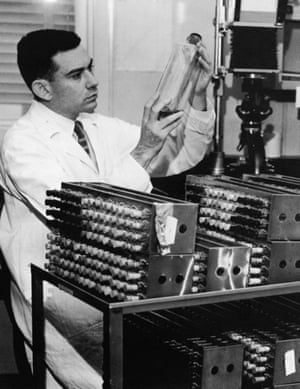
Hayflick in the lab in the 1960s. Photograph: Supplied
As the importance of the WI-38 cells grew,Hayflick was only too happy to promote them. “Human Cells Given Role in Vaccines,” the New York Times proclaimed after the scientist spoke at a vaccine conference in 1966. The article quoted Hayflick explaining that his cells were cheaper, cleaner and safer than the animal cells then used in vaccine manufacture.
As his profile rose, Hayflick ran out of patience with Koprowski. The disconnect between his contributions and his treatment by the Wistar Institute’s director had become too much to bear. Nine years after Koprowski hired him, Hayflick remained stuck as an associate member of the institute, in sharp contrast to many colleagues who had been made full members despite, to his mind, making contributions no greater than his own.
Hayflick began looking around. He applied for a position as a full professor of medical microbiology at Stanford University in Palo Alto, California. His application for the job was backed by a recommendation from a senior virologist who regarded his work as “reliable, trustworthy and original”. He was offered the post.
As Hayflick’s departure approached, there was probably only one thing that concerned Koprowski: the fate of the hundreds of ampoules of WI-38 cells that were still stored in liquid nitrogen in the Wistar Institute’s basement, under Hayflick’s watchful eye. Hayflick’s proprietary feelings about the cells were well known – he once described them as “like my children”.
Koprowski had designs on the cells from the beginning. Nancy Pleibel, a lab technician who worked for Hayflick, recalls that more than once Koprowski had turned up in the lab within a day or two of Hayflick leaving on a trip, smiling and asking her for an ampoule of WI-38 cells. Politely but firmly, she refused his requests, explaining that only her boss could hand out WI-38 ampoules. After a while, Koprowski stopped asking.
Minutes from meetings of the Wistar Institute’s board of managers in the early and mid-60s make clear that Koprowski tried repeatedly to cash in on Hayflick’s human diploid cells(defined as cells that carry the normal complement of 46 chromosomes). The institute sought payment not only from Norden, a Missouri company that was interested in using WI-38 to develop a rabies vaccine, but also from Pfizer for the use of Hayflick’s cells to make a measles vaccine, and from Wyeth, another Philadelphia-based drug manufacturer that by 1965 had used the WI-38 cells to make an adenovirus vaccine to protect US army recruits during basic training.
Koprowski’s attempts to turn a profit with the WI-38 cells were far from successful. By 1965, the board of managers had appointed “a special committee of lawyers and scientists to deal with problems” in selling the Hayflick cells to industry. The only backing that the institute landed, according to budget documents from 1965 to 1967, was $ 5,000 in each of those years from Norden.
Today it seems incredible that an institution like the Wistar, full of eminent scientists, was so at sea when it came to profiting from unique and desirable cells produced under its roof. But in that era living things, such as the WI-38 cells, could not be patented. It would take a landmark supreme court decision in 1980 to change that.
However, what could be patented was a method of using the cells to produce a novel vaccine. Koprowski had already applied, back in 1964, for such a patent for another, improved rabies vaccine that he was developing using the WI-38 cells. Soon the Wistar Institute would apply for a patent on a method of making a rubella vaccine with the WI-38s, devised by another of its scientists, Stanley Plotkin.
If and when the rabies and rubella vaccine patents were granted, Koprowski would need accessto at least some of the original ampoules of WI-38 frozen in the Wistar Institute basement.Vaccine companies would want original ampoules full of the youngest cells, which could be expanded into a nearly endless supply.
By the autumn of 1967, Hayflick vaguely suspected that Koprowski intended the WI-38 cells to serve something more thanthe good of mankind. Hayflick believed that his boss hoped to turn any vaccines made with the cells into sources of cash, boosting the Wistar Institute’s income and freeing him from fundraising duties that he detested and considered beneath him.
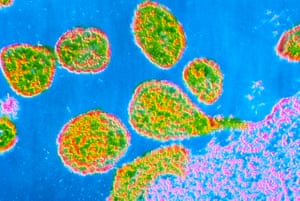
Transmission electron micrograph of Rubella virions. Photograph: Science Photo Library
Hayflick’s instincts were right. As 1967 drew to a close, a financial vice was tightening on Koprowski. While the Wistar Institute had remained solvent, it had never been flush with funds, especially after Koprowski blew through $ 271,506 to fund major renovations that were completed in 1959. By the mid-60s, his struggle to find cash not tied to specific grants was becoming desperate. Badly needed repairs to the roof and the air conditioning system were deferred.
In the autumn of 1967, when officials at the NIH’s National Cancer Institute (NCI) learned that Hayflick would be moving to Stanford, they decided to take the production, storage, study and distribution to researchers of human diploid cells out of his hands. The NCI had been paying the Wistar Institute hundreds of thousands of dollars for Hayflick to produce and distribute the cells since 1962, shortly after his paper announcing his human diploid cell strains to the world had sent demand soaring. The agency’s contract with the Wistar Institute had specified that the government would take ownership of the cells when the contract was terminated. Now, NIH officials set 1 January 1968 as the end date. The timing seemed right, and not only because of Hayflick’s impending move. The sense at the NCI was that the demand for the WI-38 cells had been sated. Those scientists who wanted them, it seemed, had them by now, more than five years after Hayflick had first produced them. They were being used widely and had already been cited in scores of papers.
On 18 January 1968, several men travelled to the Wistar Institute to sort out the physical disposition of the WI-38 cells now that the contract had ended. Koprowski summoned Hayflick to meet with them. Also present were senior scientists from the American Type Culture Collection (ATCC). This independent, nonprofit organisation was the country’s highest-profile cell bank, and was often where biologists turned when they needed a particular type of cell for an experiment. According to records, the assembled men agreed that all but 20 of the roughly 375 remaining original ampoules of WI-38 cells would be transferred to the ATCC, which would maintain them, deeply frozen, on behalf of the NIH. Hayflick would be permitted to take 10 ampoules with him to Stanford, and the Wistar Institute would also be allowed to keep 10.
The group also decided that any use of the 355 original ampoules being transferred to the ATCC – they were precious because the WI-38 cell populations in them had divided only eight times, and so could be expanded into untold billions of cells for vaccine making – “should be totally arrested”. By this, they meant that there was to be no more thawing of the ampoules, no more planting of these young cells into lab bottles, and no more splitting of those bottles over and over to generate multitudes of cells at higher doubling levels for scientists to use. Scientists could use the older cells that were already in circulation. The remaining 355 original ampoules needed to be kept safely frozen at the ATCC until such time as companies began winning US licences to make WI-38–based vaccines.
Some time during his last months at the Wistar Institute, Hayflick was working in one of the tiny “sterile” rooms that adjoined his lab. Plotkin squeezed through the door and pulled up the only chair. The two chatted for a while, then Plotkin showed Hayflick a document. It was a letter, on Wistar-headed paper, from Koprowski, written to a senior official at Burroughs Wellcome, the British pharmaceutical company. Koprowski was offering to provide to the company ample supplies of WI-38 cells, along with the recipe for making a vaccine with the cells and the virus itself, all in exchange for royalties.
‘To have the vultures descend on what I had struggled to give value to – most people would understand why I was upset’
Hayflick’s suspicions had been confirmed. He was profoundly upset. He had spent the previous decade deriving the cells and opened up a new, important field in the study of cellular ageing. He had derived enough WI-38 cells to serve vaccine makers into the distant future and worked as hard as was humanly possible to win acceptance of the cells for vaccine making. In the process of all of this, he had been ridiculed and been forced to struggle for respect and validation.
This letter signalled that not only was he not valued but that he was also being sidelined in major decision-making – and likely profit-making – connected to the WI-38 cells. As Hayflick said, “to have the vultures descend on what I had struggled so hard to give value to and [for them to] try to take it for their benefit – I think that an average person would understand why I was, to put it mildly, concerned”.
On or around 1 March – when, under the January agreement, the ampoules were to have been moved from the Wistar Institute to the ATCC – a specially outfitted station wagon arrived from Maryland, carrying the NIH project officer, Charles Boone, and John Shannon, the ATCC’s curator of cell lines. Hayflick turned them away, saying he wasn’t ready to hand over the cells because he had not prepared an inventory of them.
Not long after this, Hayflick, unobserved, visited the Wistar Institute’s basement. There he packed every single one of the remaining original WI-38 ampoules – 375 frozen vials: the largest stock of young WI-38 cells on earth – into one or more portable liquid-nitrogen refrigerators and departed the premises. He left nothing behind – not even the 10 ampoules that Koprowski’s institute had been promised in the January agreement.
Hilary Koprowski at work in his lab. Photograph: Yale Joel/The Life Picture Collection/Getty Images
Hayflick stored the frozen cells temporarily with a friend, a vaccinologist at the nearby Wyeth Laboratories who, from time to time, topped up the liquid nitrogen that kept the cells frozen. Hayflick says that he took the ampoules with the intention of keeping them only until the ownership of the cells could be properly sorted out. He believed that there were several potential stakeholders who might reasonably claim ownership: himself and his early collaborator at the Wistar Institute, the chromosome expert Paul Moorhead; the “estate” of the WI-38 foetus, by which he meant the WI-38 foetus’s parents; the Wistar Institute; and, just possibly, the NIH. But he was not going to be so naive as to leave the cells in the NIH’s possession while these matters were decided. If he did that, he was sure that he would never see them again.
In mid-1968, Hayflick left for his new job in California. Moving a family of seven 2,900 miles was no small undertaking. The Hayflicks split the travel. Ruth flew out to the San Francisco Bay Area with their two youngest daughters. Hayflick drove the three older children cross-country in their dark green Buick sedan. They drove west through Pittsburgh, stopped to see drag races in Joplin, Missouri, and then headed on to Arizona, where they gazed at the world’s best-preserved meteor crater and marvelled at the Grand Canyon. All along the way, some extra cargo travelled with them. Carefully strapped on the backseat beside his children was a liquid-nitrogen refrigerator stuffed with ampoules of WI-38.
Hayflick’s flight with the cells would make him the target of a career-derailing investigation by the National Institutes of Health. Hayflick counter-sued – eventually, in 1981, settling with the government. He was allowed to keep six original ampoules of the cells, along with $ 90,000 that he had earned by charging researchers and companies for them after he left the Wistar Institute. A letter from supporters published in the journal Science, described the “happy outcome of Dr Hayflick’s courageous, sometimes lonely, emotionally damaging and professionally destructive ordeal”.
But just as the tug-of-war over ownership of the WI-38 cells peaked, profound changes occurred in attitudes and laws governing who could make money from biological inventions. In the space of a few years, biologists went from being expected to work only for their salaries and the greater good to being encouraged by universities and the government to commercialise their innovations for the benefit of the institutions, the US economy – and themselves.
Although the WI-38 cellswere launched long before these changes took place– and 18 years before the supreme court decreed that a living entity, such as a WI-38 cell, could be patented – a lot of money has been made from them. The drug company Merck, in particular, has made billions of dollars by using the WI-38 cells to make the rubella vaccine given to more than seven million American children each year. The Wistar Institute too enjoyed a handsome royalty stream from vaccines made by its scientists using the cells – including a much-improved rabies vaccine that replaced sometimes dangerous injections. Cell banks today charge several hundred dollars for a tiny vial of the cells.
During the long battle for ownership of the WI-38 cells, Koprowski sent a Wistar scientist across the country to collect them from Hayflick’s Stanford lab. But Hayflick refused to part with them. A second emissary was more successful, returning with the 10 ampoules originally allocated to the institute. But later, while the NIH was still asserting its title to WI-38, Koprowski seems to have given up. Perhaps this was because Hayflick was now so far away. Maybe it was because, despite his propensity for it, Koprowski actually disliked direct conflict. Possibly, it was because several companies already appeared to have adequate supplies of the youngest WI-38 ampoules. On the other hand, though, it might have been because Koprowski had finally realised just how persistent, obdurate and dedicated Hayflick could be.
This is an adapted extract from The Vaccine Race by Meredith Wadman, published by Doubleday on 9 February in the UK and in the US by Viking.
• Follow the Long Read on Twitter at @gdnlongread, or sign up to the long read weekly email
9,000 people died in Haiti’s last cholera outbreak. We must act fast in disaster-affected hotspots to help prevent history repeating itself
Six years ago, as the country attempted to rebuild following a massive earthquake, cholera began spreading in Haiti. And it didn’t stop.
Adults and children – many of whom contracted cholera by drinking untreated water from familiar rivers and streams – lay listless in hospitals packed to capacity with emergency cases. The death toll mounted. The months passed. The cases continued. Stories of pregnant women and tough little girls and boys struggling to survive became the norm and were well recorded by partners on the ground, who were bearing witness to what is now considered the worst cholera outbreak in recent history.
Related: Hurricane Matthew: preparations and aftermath – in pictures
Related: UN makes first public admission of blame for Haiti cholera outbreak
Regulators have suspended the license of a doctor in Chicago who allegedly gave patients modified vaccinations containing cat saliva and vodka.
The Illinois department of financial and professional regulation ordered the emergency action in the interest of public safety, according to paperwork signed by acting director Jessica Baer.
After hearing complaints from health care providers that children were getting unapproved oral versions of childhood shots from Dr Ming Te Lin, investigators visited Lin’s practice.
They found a cluttered, unsterile office and “a box filled with vials and tubes that [Lin] was using to make his own vaccinations.”
Lin told investigators he had been preparing alternative vaccinations for children for more than a decade, according to the order.
Despite his unapproved methods, Lin is accused of signing state forms certifying he had given paediatric patients their conventional shots. Charts showed the patients who received unapproved oral vaccines included a seven-day-old infant.
A phone message and email seeking comment from Lin on the allegations were not immediately returned.
Lin added alcohol and sometimes cat saliva gathered with a swab from a cat’s mouth for patients with allergies, he told investigators, and he used a device called the “WaveFront 2000” to detoxify vaccinations from mercury.
Lin gave vaccines orally or in a nasal form if the patient or a family member had a history of autism, eczema or neurological disorder.
None of Lin’s methods is approved by the Food and Drug Administration or regarded as legitimate medicine. He didn’t inform his patients of the risks of failing to follow vaccine guidelines, the state’s paperwork says.
A hearing before the Medical Disciplinary Board is set for 11 October in Chicago.
We were taught in high school that vaccines have saved millions of lives in America and Europe. One of the greatest heroes of modern medicine is Louis Pasteur, the creator of the “germ theory,” the ideological foundation for vaccines. But the real history of vaccines, and the real story of Louis Pasteur, is something quite different.
In his early career, Pasteur did believe that germs were the cause of disease. But 15 years before his death he recanted this belief. He came to believe that it was not germs but the degradation of an organism’s internal environment that causes disease. He came to believe that germs took advantage of degraded or susceptible “terrain.”
Over a century of scientific research has validated Pasteur’s terrain theory. Maintaining a healthy terrain, not eliminating germs, has proved to be the key to disease prevention. But Pasteur’s germ theory retains a powerful hold on our collective imagination.
The polio vaccine is the most touted example of the human endeavor to triumph against germs. “Every school kid knows” that the polio vaccine eradicated polio in the Western hemisphere. But in fact there is no evidence to support this claim.
From 1923 to 1953, before Jonas Salk’s killed-virus polio vaccine was introduced, the polio death rate in the U.S. and England had already declined by 47 percent and 55 percent, respectively.
The epidemic ended not just in the United States and England, but in European countries that questioned the vaccine’s safety and refused to systematically vaccinate their citizens.
Not only was the vaccine ineffective, it produced results opposite to those intended. In the U.S, the number of polio cases following mass vaccinations was significantly greater than before mass vaccinations.
Doctors and scientists on the staff of the National Institute of Health during the 1950s were well aware that the Salk vaccine was ineffective. Some frankly stated that it was worthless as a preventive and even dangerous. Many refused to vaccinate their own children.
Dr. Salk himself said: “When you inoculate children with a polio vaccine you don’t sleep well for weeks.” But the National Foundation for Infantile Paralysis, and pharmaceutical companies with a large investment in the vaccine, convinced the U.S. Public Health Service to sign a proclamation claiming that the vaccine was “safe and 100 percent effective.”
From the early 1960s to the mid-1970s, a new live-virus polio vaccine became, in Salk’s words, “the principal if not sole cause” of all reported polio cases in the U.S. Between 1973 and 1983, 87 percent of all cases of polio (excluding imported cases) were caused by the vaccine. More recently, every case of polio in the U.S. since 1979 (excluding five imported cases) was caused by the vaccine.
In Dr. Benjamin Sandler’s book “Diet Prevents Polio,” an unequivocal correlation is found between diet and susceptibility to polio. Sandler found that persons in contact with the virus but eschewing foods high in sugars and starches have significantly greater protection from the polio virus. Dr. Sandler is one of many advocates of the terrain theory whose work has been systematically ignored. The details of his work were published in the American Journal of Pathology in 1941.
Sixty years later, in the waning days of the year 2000, members of the Association of American Physicians and Surgeons (AAPS) unanimously voted for an end to all government-mandated childhood vaccines. Jane M. Orient, M.D., AAPS executive director, said: “Children face the possibility of death or serious long-term adverse effects from mandated vaccines.”
One of the most serious adverse effects of vaccines is that they cause the very diseases they’re meant to prevent. Measles, for instance, which declined by more than 95 percent before the vaccine was introduced, is 14 times more likely to be contracted by vaccinated than by unvaccinated persons.
A recent study in Pediatrics found that women vaccinated with the measles vaccine pass on far less immunity to their offspring. Before the vaccine was introduced, it was extremely rare for an infant to contract measles. Now more than 25 percent of all measles cases are babies under a year of age.
One significant concern with vaccines today is their casual relation with the growing epidemic of childhood autism and attention deficit hyperactivity disorder (ADHD). ADHD has increased from 900,000 in 1991 to 5 million today. The MMR (measles-mumps-rubella) vaccine is the primary suspect.
Dr. Viera Scheibner, author of “Vaccinations: 100 Years of Orthodox Research” sums up the position of researchers not funded by pharmaceutical companies: “There is no evidence whatsoever that vaccines of any kind … are effective in preventing the infectious diseases they are supposed to prevent.
Further, adverse effects are amply documented and are far more significant to public health than any adverse effects of infectious diseases. Vaccinations have caused more suffering and more deaths than any other human activity in the history of medical intervention.”
Vaccines are only the tip of the iceberg for a look at how the medical industry has consistently defrauded the American public on issues from cancer to childbirth.
And, let’s not forget President Bush’s law passed in 1990 giving the pharmaceutical industry full immunity from lawsuits even when the results of vaccinations caused death.
In God we trust. All others pay cash!
Aloha!
To learn more about Hesh, listen to and read hundreds of health related radio shows and articles, and learn about how to stay healthy and reverse degenerative diseases through the use of organic sulfur crystals and the most incredible bee pollen ever, please visit www.healthtalkhawaii.com, or email me at heshgoldstein@gmail.com or call me at (808) 258-1177. Since going on the radio in 1981 these are the only products I began to sell because they work.
Oh yeah, going to www.asanediet.com will allow you to read various parts of my book – “A Sane Diet For An Insane World”, containing a wonderful comment by Mike Adams.
In Hawaii, the TV stations interview local authors about the books they write and the newspapers all do book reviews. Not one would touch “A Sane Diet For An Insane World”. Why? Because it goes against their advertising dollars.
Sarah Allen, whose two-year-old son Jasper was treated at Hinchingbrooke hospital in Huntingdon, Cambridgeshire, for a severe case of chickenpox, speaks on Tuesday about her son’s recovery. Allen says existing vaccinations should to be made more available on the NHS or affordable for parents to purchase
There is no proof whatsoever linking the advancement of autism to childhood vaccines, study from the University of Sydney has shown.
The globe-1st evaluation, published in the journal Vaccine, pooled all obtainable scientific studies on hyperlinks among autism and vaccines for diphtheria, tetanus, whooping cough, as nicely as the MMR shot for measles, mumps and rubella.
The data covered a lot more than one.25 million youngsters from the US, Uk, Japan and Denmark, and found no threat of autism associated with any of the vaccines examined, or the substances they include, including thimerosal and mercury.
“The findings were saying absolutely nothing. The odds ratio came up null, null, null. That means there’s no connection,” associate professor Guy Eslick, who led the analysis, mentioned. “You cannot get far better than that.”
“I hope it reaches a great deal of parents who are sitting on the fence about whether to vaccinate their little ones. I hope it aids to alter their minds,” Eslick mentioned.
No market funding was taken for the study.
Eslick mentioned he hoped the findings would place the “final nail in the coffin” of the anti-vaccination motion, but mentioned he understood if some mothers and fathers whose youngsters had produced autism would stay sceptical. “It’s an emotional topic … they want factors for why their little one is the way they are, and the unfortunate issue is they’ll cling onto misinformation and spurious studies.”
Fears that childhood vaccines have been linked to autism was sparked by a 1998 article co-written by Andrew Wakefield in the British journal the Lancet. The study was subsequently retracted and Wakefield was deemed to have acted “dishonestly and irresponsibly” in his study.
An Australian group that has campaigned against vaccinations was ordered final November to modify its name from the Australian Vaccination Network to the Australian Vaccination-Skeptics Network after a tribunal ruled the unique identify was misleading.
The organisation surrendered its charitable standing in March after a New South Wales government probe located it was spreading information that was incorrect or presented in a “very selective manner”.
Immunisation coverage in Australia is usually large, but about 75,000 young children are still not fully vaccinated. About 15,000 of these kids have been registered by their mothers and fathers as conscientious objectors.
Earlier this yr the NSW government issued an “urgent reminder” to parents to vaccinate their young children following ongoing measles outbreaks, including 26 cases up to the beginning of March.
What is says on the tin: A new meta-evaluation analyzing data from scientific studies involving 1.three million children is entitled “Vaccines are not associated with autism.”
If that is not clear adequate, author Luke Taylor and colleagues, who looked at five research covering 1.26 million youngsters and yet another five situation-handle studies of 9920 youngsters, also give the (pre-press) bullet-point model of their findings, published in the journal Vaccine:
There was no relationship in between vaccination and autism (OR: .99 95% CI: .92 to 1.06).
There was no partnership among vaccination and ASD (autism spectrum disorder) (OR: .91 95% CI: .68 to 1.twenty).
There was no partnership amongst [autism/ASD] and MMR (OR: .84 95% CI: .70 to 1.01).
There was no connection between [autism/ASD] and thimerosal (OR: 1.00 95% CI: .77 to one.31).
There was no relationship amongst [autism/ASD] and mercury (Hg) (OR: 1.00 95% CI: .93 to 1.07).
Findings of this meta-examination recommend that vaccinations are not associated with the improvement of autism or autism spectrum disorder.
It’s not that we didn’t know that presently. But a meta-examination takes the existing analysis and grinds the numbers and offers the bigger picture of what the aggregate of the findings tells us. Without a doubt, seeking a the odds ratios the authors report–in which one implies no effect of vaccine or other variable on odds and much less than 1 indicates reduced odds–the information recommend diminished autism chance amid young children who obtained the MMR vaccine.
The content articles integrated in their review have been any prospective (planned just before data collection) or retrospective (planned after data collection) cohort and situation-management (pairing research participants with and with no a specific variable for comparison) studies. They excluded research that employed the US Vaccine Adverse Occasions Reporting Method as their population simply because, as the authors note, there is a limitation of:
substantial risk of bias including unverified reviews, underreporting, inconsistent data quality, absence of an unvaccinated management group and many reports getting filed in connection with litigation.
There is very good reason for that exclusion–this is, following all, a database that has integrated reports that vaccines turned people into superheroes.
According to the paper authors, this meta-evaluation is the only 1 that has quantified the data from the cohort and case-management scientific studies, crunched the numbers, and turned up these meta-final results.
In an uncommon step, the paper also contains an “Epilogue,” written in the initial particular person by one particular of the unidentified authors, but I infer that the author is senior writer Guy Eslick (note that the under quote is from a pre-press model of the paper):
As an epidemiologist I feel the data that is presented in this meta-analysis. Even so, as a parent of three kids I have someunderstanding of the fears connected with reactions and effects ofvaccines. My first two youngsters have had febrile seizures following routine vaccinations, 1 of them a serious occasion. These occasions did not stop me from vaccinating my third youngster, even so, I did take some proactive measures to minimize the risk of comparable adverse effects. I vaccinated my little one in the morning so that we had been aware if[sic] any early adverse response throughout the day and I also gave my little one a dose of paracetamol 30 min prior to the vaccination was provided to lessen any fever that might develop soon after the injection. As a mother or father I know my kids much better than any person and I equate their seizures to the effects of the vaccination by growing their body temperature. For mother and father who do recognize a considerable adjust in their child’s cognitive function and behaviour right after a vaccination I encourage you to report these events immediately to your family members doctor and tothe ‘Vaccine Adverse Event Reporting System’.
As the researchers note, their conclusions agree with these of eleven of 12 systematic reviews addressing the same query. The authors state that they have no conflicts of interest.
A child is vaccinated towards polio in Peshawar, Pakistan. Photograph: Bilawal Arbab/EPA
When Amir, a 45-yr-previous father of five, brings stashes of ice-cooled polio vaccines to his residence in an isolated village in Pakistan’s tribal belt he takes massive care not to let any person know what he is up to.
Only his most trusted pals and relatives know about his secretive efforts to protect the children in his extended family members against a devastating condition that has been wiped out in much of the rest of the globe.
The World Well being Organisation warned this week that polio had re-emerged as a public overall health emergency – with the virus affecting 10 nations around the world. Pakistan is one of three remaining countries in the globe in which polio stays endemic.
It continues to flourish in the most violent elements of Pakistan, in which the anti-polio drops are regarded with suspicion, vaccination teams are seen as potential cover for spies, and militant bosses are happy to use children as bargaining chips in their efforts to finish US drone strikes.
“If we have self-assurance in our neighbours and near relatives then we share the drops with them, but only if we know we can believe in them,” he explained.
Amir is a single of a number of residents of North Waziristan who are inclined to reveal their secret defiance of the Taliban’s ban on vaccinating young children against a illness that can destroy or depart lifelong disabilities.
“When we heard on the radio that the illness was endemic in North Waziristan we grew to become extremely worried about our youngsters,” he explained. “But it has to be secret since no a single can face the Taliban.”
The area abutting Afghanistan is controlled by militant groups with numerous various agendas, such as fighting the western-backed government in Kabul and demanding Pakistan grow to be a strict sharia state.
But in frequent with Islamist radicals in other parts of the world, some worry the oral drop vaccine is part of a western plot to sterilise Muslim children.
In 2012 militant commanders in each North and South Waziristan announced bans on the perform of anti-polio wellness teams in retaliation for the CIA’s programme of lethal drone strikes towards militants.
The warning was efficient at terrorising mother and father from even thinking of cooperating with a campaign previously produced controversial by the CIA’s use of a hepatitis vaccination campaign as cover for hunting down the whereabouts of Osama bin Laden.
Officials say some even refuse to let their youngsters to receive drops from overall health employees working at checkpoints and bus stations properly outside North Waziristan as element of schemes to catch parents when they are away from the influence of militants.
But in accordance to heads of families interviewed by the Guardian and medical doctors functioning in North Waziristan’s couple of hospitals, some men and women are taking significant risks to shield their youngsters from a illness that can cripple or destroy.
Some get their children on long journeys to main cities this kind of as Peshawar, whilst others take them to healthcare centres in the North Waziristan towns of Miran Shah and Mirali.
“Each and every day we have kids brought in for vaccination,” said a medical professional in Miran Shah, who stated mothers and fathers would usually bring them in to get handled for other ailments and request for drops at the exact same time.
“Even then we have to be mindful simply because there is no government writ, even inside the hospital.”
The government has been ramping up efforts to combat the illness amid threats of countries imposing travel restrictions on Pakistanis.
It announced on Tuesday that it would set up necessary immunisation factors at airports to help cease its polio outbreak spreading abroad.
There has been a distinct emphasis on the city of Peshawar, which was lately declared to be the greatest reservoir of the virus anyplace in the globe.
But not only are door-to-door vaccination programmes impossible in locations such as North Waziristan, public schooling campaigns also have small chance of accomplishment.
“Even if 95% of folks are prepared for vaccination the 5% who are in favour of the Taliban are a lot stronger than the ordinary men and women,” stated Muhib, yet another father who has discreetly arranged for his young children to be vaccinated.
“Even some of my family members, if they see me with the drops, will inform the Taliban,” he said.
Some are angry that militants have sustained the vaccination ban regardless of a far more than four-month hiatus on drone strikes.
“Folks cannot realize why the Taliban are even now blocking vaccination when drone strikes are in excess of,” said a guy named Sajad from Mir Ali. “The ailment is swiftly spreading but the Taliban are satisfied to use our kids as a shield for their protection.”
The US has not publicly announced an finish to the programme of remote-managed strikes against suspected militants but they have privately reassured Islamabad that the CIA will workout maximum restraint although Pakistan’s government holds peace talks with representatives of the country’s largest militant group.
Although physicians operating in North Waziristan say they discreetly vaccinate youngsters each day, or give bottles of vaccine away, no one understands how several families may be involved.
It is unlikely to be anywhere close to currently being sufficient – public well being experts say almost all kids need to be covered if the ailment is to be eradicated. And in areas of large poverty, malnutrition and ailment, a single vaccination is not often a ensure a child will not get the ailment.
“Numerous people are ready to vaccinate their young children but they have no entry to hospitals and can’t travel far,” stated Umar Daraz Wazir, a journalist covering the region. “Without having a door-to-door campaign it is really hard to cease this virus.”
I usually choose not to post graphics sent to me by groups that are striving to make their personal political factors. I’ll make an exception for Unicef.
Some of the best proof that vaccines are powerful comes from the fact that we know what transpires when they are not available. We know that 453,000 young children a yr die from lack of access to vaccines towards rotavirus, which causes diarrhea. Rotavirus vaccines manufactured by Merck Merck and GlaxoSmithKline GlaxoSmithKline are common in the created globe. We’ve watched the pneumococcus vaccine, manufactured in the U.S. by Pfizer Pfizer, make meningitis and invasive blood infections a issue of the past, but in the rest of the planet pneumococcus kills 476,000 kids a 12 months. All told, 1.five million little ones die a 12 months because they really don’t get vaccines. Polio, once common throughout the globe, is now endemic in only three countries simply because of an aggressive vaccination system. These conditions are not fiction, they genuinely do lead to deaths when the vaccines are not obtainable. And generating vaccines accessible to little ones who really do not get the shots they require is surprisingly straightforward: 70% of unvaccinated kids live in 10 countries and most of the shots cost less than $ 1 every single.
There is far more foods for believed beneath. It’s shameful that in the U.S. we’re having illness outbreaks since of unscientific doubts about a technological innovation that folks elsewhere would really like to have far better access to.
You know the rule. The solution is, “No.” But the assertion has gone viral on social media thanks to the zombie-like resurrection of a lengthy-advised, oft-debunked story that the US Centers for Ailment Control (CDC) is hiding its own data linking autism and mercury in vaccines. If you see such assertions in your timelines and newsfeeds (sample headline: “CDC Caught Hiding Data Exhibiting Mercury in Vaccines Linked to Autism”), send the disseminators here. Why? Read through on.
In 1999, four authors affiliated with the CDC presented an abstract at a conference … a CDC conference for fellows of its Epidemic Intelligence Service (EIS). The EIS, by the way, serves as the Interpol of infectious ailment, monitoring down elusive perpetrators globally and stopping them ahead of they can harm yet again. In other words, they are individuals who dedicate their lives to conserving lives. Every single 12 months, the system also sponsors a conference. And 1999 was no exception.
In 1999, one Thomas Verstraeten and 3 colleagues submitted an abstract for the EIS conference. It was preliminary, as numerous, a lot of this kind of submitted abstracts are. They indicated ‘no strong preference for a poster presentation’, which implies that they have been Okay with obtaining up in front of the conference attendees and discussing their findings on the record. The zombie-like story generating the rounds would have you believe that submitting the abstract “required the approval of best CDC officials prior to its presentation at the Epidemic Intelligence Support (EIS) conference,” but all conference abstracts need approval from the individuals operating the conference–which, in this situation, was the CDC.
The authors report utilizing raw data from the Vaccine Safety Datalink and HMOs in the Pacific northwest to identify mathematical relationships between thimerosal-containing vaccines and building neurological and renal impairment (thimerosal is a preservative that consists of ethylmercury and prevents dangerous contamination of large volumes of vaccine. It at the moment is current in multidose vials of flu vaccine). In their comparison of what they call the “highest publicity group” to an “unexposed group,” they reported an enhanced threat for nondegenerative neurological disorders.
Conference abstracts and the accompanying information are virtually usually preliminary. In truth, the probability that conference material and what lastly seems in a peer-reviewed journal will vary is fairly large. Significantly conference material never ever appears in a complete, peer-reviewed article at all because completion of the examine yields the considerably-dreaded “negative benefits.”
The yr of the EIS conference, 1999, was a turning level for thimerosal in vaccines. And then in 2000, the Simpsonwood Conference took location, an assemblage of experts from inside and outside the CDC to examine the thimerosal concern. The complete transcript of that conference is offered right here. Verstraeten was in attendance and presented on the information connected to the not-even-remotely concealed benefits from his two-phase study. 1 point he noted–and this situation possibly is 1 of many that drives differences in between a conference abstract and a ultimate publication–was variability connected to the HMOs gathering the data. Individuals distinctions mattered to the outcomes and had absolutely nothing to do with thimerosal.
In his presentation at the Simpsonwood conference, Verstraeten mentioned,
This is the end result for autism, in which we don’t see considerably of a trend except for a slight, but not substantial, increase for the highest publicity. The overall check for trend is statistically not substantial.
Later on in the presentation, we discover that phase I of the study looked only at raw numbers from a database whilst phase II concerned chart examination to verify diagnoses and added in an HMO. The second phase concerned new data following on the examine described in the 1999 abstract. This chart overview matters. As a single of the other authors on the 1999 abstract notes in the Simpsonwood presentation:
Now with autism, if we limit it to kids with publicity at either one particular month or three months of age… there is a relative risk that is no various than one particular and that is replicated whether we limit it to kids with a diagnosis talked about in the chart exactly where the youngster was referred to a expert, or the child was confirmed by a specialist.
In other phrases, the chart assessment refined the original raw data and effaced any locating of enhanced danger.
In spite of the openness of this process and the adherence to an unique two-phase plan for the research, Verstraeten identified himself (and continues to find himself, it appears) the target of accusations of manipulating or hiding information, specifically when the peer-reviewed paper from this study was published in 2003 (abstract right here). His having gone to work for “Big Pharma”–in this case, GlaxoSmithKline GlaxoSmithKline–following completion of his appointment at the CDC brought even more accusations of complicity in a coverup. Certainly, the accusations were so scorching that Verstraeten responded to them in a 2004 commentary published in Pediatrics, recounting the background. Bottom line was, he was a foreign citizen whose fellowship with the CDC was ending, and he sought and obtained employment in his property country, in his field.
In his 2004 commentary (which is behind a paywall), Verstraeten says, “Did the CDC water down the authentic outcomes? It did not.”
He goes on to write
The CDC screening study of thimerosal-containing vaccines was perceived at initial as a good study that found an association among thimerosal and some neurodevelopmental outcomes. This was the perception the two independent scientists and antivaccine lobbyists had at the conclusion of the initial phase of the review. It was foreseen from the very begin that any constructive outcome would lead to a 2nd phase.
In other phrases, when you dig into raw numbers and locate some mathematical relationships, then you have a purpose to move to the second planned phase of examining the charts. If you do not discover anything, phase II is a non-starter.
He then notes
Since the findings of the initial phase have been not replicated in the 2nd phase, the perception of the examine altered from a optimistic to a neutral research. Surprisingly, even so, the research is becoming interpreted now as negative by many, such as the antivaccine lobbyists. The article does not state that we located evidence against an association, as a damaging research would. It does state, on the contrary, that added study is advised, which is the conclusion to which a neutral review should come.
Maybe you really don’t want to consider Verstraeten’s word for it simply because he went to operate for Huge Pharma. Individuals who oppose vaccines usually depend on the US Congress, for much better or for worse, to make their arguments. So, here’s a link to the findings of the Senate Committee on Overall health, Schooling, Labor and Pensions from their 2007 investigation into allegations that the CDC used Simpsonwood to cover up a thimerosal-autism link and that Verstraeten manipulated information.
Here’s what the Senate committee concluded concerning allegations towards Verstraeten:
Allegation # 2: The Centers for Ailment Control (CDC) convened the Simpsonwood Conference to cover up the locating that thimerosal leads to autism. Findings: The allegation is not substantiated. … Instead of hiding the information or restricting access to it, CDC distributed it, frequently to individuals who had by no means witnessed it just before, and solicited outside viewpoint concerning how to interpret it. The transcript of these discussions was produced obtainable to the public. The information was also talked about at the Advisory Committee on Immunization Practices, a public forum held on June 21 and 22, 2000. Simpsonwood participants generally agreed that the VSD information set was weak, it was hard to assess causality, and further examine and investigation were warranted.
Not exactly the habits of government scientists bent on a cover-up.
The committee also located that
Allegation # 3: Dr. Thomas Verstraeten, MD, MSc, was pressured into modifying his research position with regards to a causal link between thimerosal and autism. Finding: The allegation is not substantiated. … Assist Committee employees interviewed Dr. Verstraeten with regard to his findings and his participation in the Simpsonwood Conference. …Review of the phases of Dr. Verstraeten’s study, “Safety of Thimerosal-Containing Vaccines: A Two-Phased Study of Computerized Health Upkeep Organization Databases,” and examination of his voluntary response to Committee queries in the course of his interview reflect that his intention was usually to carry out a two-phase research. … there is no evidence that GlaxoSmithKline employed Dr. Verstraeten for the purpose of pressuring him to manipulate his data on a causal website link in between thimerosal and autism. … Dr. Verstraeten was operating in the United States at CDC on a short-term visa. Close to the completion of his tenure with CDC, he began searching for employment in his native nation and discovered employment with GlaxoSmithKline in which he continues to be employed.
In spite of the neutral findings from Verstraeten’s study, the US Public Wellness Services (USPHS) and the American Academy of Pediatrics (AAP) jointly suggested in 1999 that thimerosal need to be phased out of use in the handful of childhood vaccines that included it. In the wake of significant additional research exhibiting no website link in between thimerosal and developmental ailments, that recommendation was retired in 2002. Now, say AAP doctors in a 2012 commentary:
Had the AAP (and, we suspect, the USPHS) known what analysis has uncovered in the intervening 14 many years, it is inconceivable to us that these organizations would have manufactured the joint statement of July 7, 1999. The Globe Wellness Organization recommendation to delete the ban on thimerosal must be heeded or it will trigger remarkable injury to current applications to protect all children from death and disability induced by vaccine-preventable conditions.



 Youngster Advancement (Photo credit score: Wikipedia)