A man whose daughter’s death from meningitis sparked a nationwide petition for more children to be vaccinated against it has accused the government of complacency.
On the first anniversary of Faye Burdett’s death, her father, Neil said the government has done “absolutely nothing” to raise awareness of the disease, despite promises to do so.
He also revealed that two-year-old Faye – who fought meningitis B for 11 days – mouthed the word “mummy” just before she died.
Burdett and his wife, Jenny,, made the decision to turn off Faye’s life support last Valentine’s Day after her body was ravaged by sepsis caused by meningitis. They released photos of their dying daughter covered in a rash, prompting more than 820,000 people to sign a petition for the meningitis B jab Bexsero to be given to all children.
The government has since declined to make the vaccine more widely available, saying it is not a good use of money. Ministers have yet to release calculations on how vaccines are deemed to be affordable and have not launched a meningitis awareness campaign, promised by a former public health minister.
Burdett said the decision not to extend the vaccine to more age groups was “insulting and devastating”. He said he has heard nothing since appearing before MPs on the petitions committee last March. “Children under five are vulnerable to meningitis and they can’t tell you exactly what is happening,” he said. “They are solely reliant on their parents and carers to spot that something is wrong.
“We have been through something so terrible and we thought if we could stop it happening to other families, that’s what we wanted to do. But since going to parliament, we’ve heard nothing.
“If nobody in parliament is going to take any notice and do something, who else is there? The government is being complacent and we feel badly let down. There is just this massive hole that children are falling into.
“We feel like we were ushered out of the building and that was that. It’s all been brushed under the carpet. The MPs there said they would keep pushing for an awareness campaign but we’ve heard nothing, not even from our own MP. It’s not acceptable and it’s not fair because children are still dying.”
Faye’s meningitis was initially mistaken for a virus: she was sent home from Maidstone hospital but returned seven hours later.
Burdett, 38, said an investigation was still ongoing into what happened at the hospital but he is critical of the process in which hospitals carry out their own investigations when things go wrong. “This is a process where people are investigating themselves. The hospital is judging itself,” he said. “This needs to be an outside, independent process.”
Asked how he and his wife were coping, he said: “I don’t think it ever gets any better. You learn to cope, you learn that you can do crazy things or push the self-destruct button, but none of that is going to bring Faye back.
“Every day we miss her, we talk about her. There’s a huge hole in our lives that is never going to be filled. But we’re also proud of her – because of the petition and because for 11 days she fought meningitis against the odds. That shows her strength and her fight.”
Burdett, a lorry driver, and his wife Jenny, 36, a beautician, spent every day at Faye’s hospital bedside. “She could hear and she could react,” he said. “Every morning I would sit with her and she would squeeze my finger.
“Once, she opened her eyes and she looked around. She mouthed the word ‘mummy’. We never heard her voice again because of the ventilator.”
Doctors told them Faye’s chance of survival was minimal. The couple had already signed forms consenting to the amputation of both Faye’s legs at the hips, one complete arm and the other arm just below the elbow. “There was also the internal damage that sepsis had done,” Burdett said. “Her kidneys weren’t working and the list went on and on. Turning off the machine was the hardest decision we have ever had to make but it was the right thing to do. We’ve never regretted that decision.”
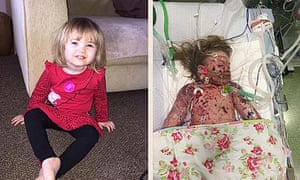
The Burdetts plan to spend the anniversary of Faye’s death quietly at home in Maidstone, Kent. “We will go and visit her gravestone and take flowers,” Burdett said. “We will light a candle for her as we do every night.
“Faye was a very happy girl who loved to run around. She loved painting and was very clever for her age, she was so bright and determined.
“Faye loved curry. I would make her chicken tikka masala and she loved it. She was such a happy little girl but that’s the thing with meningitis – in the click of a finger, it all changes.”
Burdett warned other parents not to give their child ibuprofen or paracetamol before taking them to the hospital or GP. The couple gave Faye ibuprofen, which they believe masked some of her symptoms.
Last April, Jane Ellison, then public health minister, pledged to launch an awareness campaign for parents on the signs of meningitis and the government agreed to release its cost-modelling for vaccines. There is concern that the current model does not adequately account for the lifetime costs of caring with somebody left disabled by meningitis.
Bexsero is available on the NHS for babies aged two months, followed by a second dose at four months and a booster at 12 months. Parents who wish to have older children vaccinated must pay privately. Burdett said the government had promised to include a page on meningitis symptoms in the red book given to the parents of newborns, but this had also not yet been done.
A Department of Health spokesman said: “The UK is the first country in the world to have introduced a national Men B vaccination programme using Bexsero. We have made important progress, vaccinating more than one million babies since September 2015, in which time the number of cases in infants aged one and under has dropped by 50%.”
Public Health England has launched a separate campaign on sepsis. The charity Meningitis Research Foundation estimates that 400 cases of meningitis B among children up to the age of five could have been prevented if they had been given access to the vaccine.
Father of meningitis death girl accuses government of complacency
