global etiketine sahip kayıtlar gösteriliyor. Tüm kayıtları göster

12 Mayıs 2017 Cuma

Global cyber-attack: NHS services among victims – live updates

[unable to retrieve full-text content]


• This is not targeted at the NHS, it’s an international attack, says Theresa May


• NHS England declares major incident after ransomware blocks access to patient records, internal phones and emails


More than half of Scotland’s health boards have been affected by a large-scale cyber attack on NHS computer systems. GP surgeries and dental surgeries were among some of the locations hit by the ransomware attack on IT networks, the Press Association reports.


NHS Lanarkshire said only those patients requiring emergency treatment should attend hospital while they dealt with the issue on Friday.


The Agence France-Presse news agency reports that, in Spain, employees at the telecom giant Telefónica were told to shut down their workstations immediately through megaphone announcements as the attack spread.


Forcepoint Security Labs said that “a major malicious email campaign” consisting of nearly 5m emails per hour was spreading the ransomware.


Some more quotes from the prime minister. She has told reporters:


I think what is important is that we have recognised that increasingly we need to be aware of the need to address cyber security issues, that’s why the National Cyber Security Centre has been set up. It is now able to work with the NHS to support the organisations concerned and to ensure that patient safety is protected.


After the prime minister said she was “not aware of any evidence that patient data has been compromised”, Ross Anderson, a professor of security engineering at Cambridge university, advises caution.


The NHS are saying that patient privacy hasn’t been compromised, but if significant numbers of hospitals have been negligently running unpatched computers for two months after the patch came out, how do they know?


Some more on that statement from the prime minister, Theresa May, who says:


We are aware that a number of NHS organisations have reported that they have suffered from a ransomware attack.


This is not targeted at the NHS, it’s an international attack and a number of countries and organisations have been affected.


There are reports around that as many as 40 NHS organisations have been hit by the cyber-attack. NHS Digital says it is not going to confirm the number until tomorrow.


The cyber-attack that has hit the NHS is part of a wider international attack, the prime minister Theresa May has confirmed.


She said there is no evidence that patient data had been compromised.


One expert who has worked closely with law enforcement says this would be seen as an attack on critical national infrastructure. He says investigators will be examining systems affected by the ransomware to see how badly they are affected and whether they, in turn, can or already have infected other computer systems connected to them.


He adds that the fear is that the ransonware cannot be broken and thus data and files infected are either lost or that the only way to get them back would be to pay the ransom, which would involve giving money to criminals.


One question arising from the attack on a sector of critical national infrastructure is whether the government has a policy on paying ransom to cyber hackers.


British government policy in the case of a terrorist attack or of the taking of a person hostage is clear: ransom will not be paid. But it is not clear if a policy exists for the 21st-century cyber equivalent. The lead agency dealing with the attack on the NHS is the National Cyber Security Centre, an arm of GCHQ.


The New York Times is reporting that 12 countries, including the UK, have been affected.


It reports that the attack struck “computers across a wide swath of Europe and Asia”, saying that Japan, Russia, Turkey, Vietnam and the Philippines are among those affected.


Prof Alan Woodward, a security expert from the University of Surrey, says the attackers appear to have taken advantage of a chink in the armour of Microsoft XP that was exposed in a recent leak of CIA hacking tools.


He says the problem may have been exacerbated because organisations have not updated their software with the fixes made available, or are using outdated versions.


From what we can see, it is a piece of ransomware called wanna decryptor. It goes by other names but it emerged in February 2017. Since then, it has been modified and there is evidence that it is spreading using a flaw in the Microsoft network protocol called SMB, which was exposed in the recent dump of exploits that were allegedly from US intelligence agencies.


It is not just the NHS affected: reports suggest it is a global problem. The virulence is likely to be because some organisations have either not applied the patch released by Microsoft, or they are using outdated operating systems (such as XP) that are no longer supported by Microsoft and hence no patch exists.


NHS England have released an updated statement. Dr Anne Rainsberry, the NHS incident director, said:


We’d like to reassure patients that if they need the NHS and it’s an emergency that they should visit A&E or access emergency services in the same way as they normally would and staff will ensure they get the care they need.


More widely, we ask people to use the NHS wisely while we deal with this major incident, which is still ongoing. NHS Digital are investigating the incident and across the NHS we have tried and tested contingency plans to ensure we are able to keep the NHS open for business.


Here’s a little background from my colleagues Damien Gayle, Alexandra Topping and Sarah Marsh. They report the situation as it stood at about 5pm today:


Hospitals across England have been hit by a large-scale cyber-attack, the NHS has confirmed, which has locked staff out of their computers and forced many trusts to divert emergency patients.


The IT systems of NHS sites across the country appear to have been simultaneously hit, with a pop-up message demanding a ransom in exchange for access to the PCs. NHS England has declared a major incident. NHS Digital said it was aware of the problem and would release more details soon.


The NHS has declared a major incident after it was hit by a cyber attack that is thought to have affected services across England and Scotland. Staff have been locked out of their computers and many trusts have been forced to divert emergency patients.


We’ll be updating you here as this story develops.


Continue reading…


Global cyber-attack: NHS services among victims – live updates

2 Mart 2017 Perşembe

Countries pledge millions to plug hole left by US "global gag rule"

Countries have pledged tens of millions for family planning schemes in developing countries to plug a gap left by Donald Trump’s ban on US funding to groups linked to abortion.


About 50 governments are attending the hastily convened She Decides conference in Brussels on Thursday, with early pledges closing in on $ 100m (£80m).


Sweden and Finland each promised €20m to compensate for the reinstated “global gag’ rule”, which bans US funding for NGOs that provide abortion or information on the procedure to women in developing countries.


The UK has sent the international development minister, Rory Stewart, to the one-day conference, but it remains unclear if the government will announce a financial contribution.


Organisers hope to raise $ 600m. “This is not a conference against the American administration; this is a conference for something,” Sweden’s deputy prime minister, Isabella Lövin, told the Guardian.


“We are expressing our strong support for women’s rights, for the progress that has been made. Access to contraceptives and sexual reproduction is a vehicle for development and the eradication of poverty.”


In an executive order signed last month, Trump reinstated the global gag rule, a US aid policy Republican presidents since Ronald Reagan in 1984 have imposed but their Democrat counterparts have lifted.


Sweden’s international development minister cited evidence from the World Health Organization showing that, under George W Bush’s presidency, the rule increased abortions and maternal deaths from unsafe terminations. “This is something we can prevent,” she said.


Alexander De Croo, Belgium’s deputy prime minister, told the Associated Press: “This should not be a moment where we are taking steps back into the dark ages.”


Belgium, Denmark, the Netherlands and Norway have pledged $ 10m each, with further contributions expected to be announced by other wealthy countries.


A government spokeswoman was unable to confirm whether he would announce any financial contribution from the UK.


The Department for International Development has previously described the UK as a global leader on family planning. It points to “a major international summit this summer to secure commitments that increase access to family planning services for women and girls in the world’s poorest and most fragile countries”.


Other wealthy countries are expected to announce donations. Canada’s minister of international development, Marie Claude Bibeau, said: “Women’s rights begin with their right to control their bodies. We should never take that away from them, especially for young adolescents. Canada is proud to stand with its partners and will always stand up for women’s rights everywhere.”


Afghanistan, Chad and Ethiopia are among the developing countries sending representatives to the conference, where they are expected to give evidence on how funding for family planning makes a difference to women’s lives.


Organisers have also expressed hope that US foundations may get involved by contributing funds. While the conference has been warmly welcomed by NGOs, some have voiced fears the money cannot be raised quickly enough to fill the shortfall left by Trump’s executive order.


Lövin expressed hope of hitting the target, but said Thursday’s conference was only the first step.


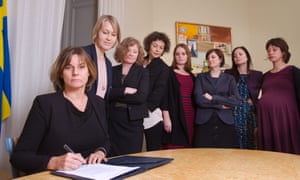
Sweden’s deputy PM, Isabella Lövin, signs bill seen as a parody of Donald Trump signing the ‘global gag’ order.


Sweden’s deputy PM, Isabella Lövin, signs bill seen as a parody of Donald Trump signing the ‘global gag’ order. Photograph: Johan Schiff/EPA

The Swedish deputy prime minister made headlines last month when she appeared to parody Trump and the all-male lineup in the Oval Office that signed the global gag order.


Lövin, who is also environment minister, tweeted a picture of herself and female colleagues, as she signed Sweden’s climate law.


But she brushed aside questions she was mocking Trump and his administration, saying: “The message was not that we were only women in that picture; the message was that we are taking leadership when it comes to tackling climate change.


“This was my staff and myself and my state secretaries and I was signing a bill and that’s all.”


Countries pledge millions to plug hole left by US "global gag rule"

20 Şubat 2017 Pazartesi

New weapon in the global fight against fake malaria drugs: a cheap scanner

A new device that uses similar infrared light to TV remotes can accurately detect fake antimalarial drugs, according to a scientific paper published Monday.


The researchers revealed how they were able to use an optical scanner purchased online for $ 250 to distinguish perfectly between life-saving malaria drugs and deadly counterfeits.


Dozens of public health scientists declared in 2015 that a global crisis of fake drugs was undermining the fight against malaria, tuberculosis and HIV/Aids, particularly in the developing world.


The World Health Organization estimates that falsified medicines represent more than 50% of the pharmaceutical market in several African countries. Ineffective antimalarial drugs alone killed over 120,000 preschool children in Africa in 2013, according to research from the Center for Disease Dynamics.


“We’ve talked to several NGOs and government agencies who would like to do drug quality screening but can’t because they don’t have effective tools,” said Ben Wilson, a research scientist at Global Good, a collaboration between Bill Gates and the technology company Intellectual Ventures.


Wilson’s team, together with researchers at the London School of Hygiene and Tropical Medicine (LSHTM), set out to design an easy-to-use, portable scanner that almost any charity or rural pharmacy could afford.


Many fake drugs are almost indistinguishable from the genuine products, even down to convincing anti-counterfeiting holograms on their packaging. Testing the drugs currently requires laboratory tests with machines costing many thousands of dollars, operated by skilled technicians.


One testing process – spectroscopy – involves shining a light on a material, then analysing the light that comes back. Precise, powerful lasers allow researchers to identify every chemical in a pill, so they can determine which ones contain sufficient artemisinin – the active ingredient in most modern antimalarials.


But Wilson opted for a more rudimentary approach. He bought a spectrometer called Scio from the Israeli startup Consumer Physics, which had crowdfunded the production of the handheld device on Kickstarter. Instead of a laser, Scio uses a cheaper LED light – essentially a souped-up version of the infrared LED in a TV remote.


While infrared spectroscopy cannot pick out the individual drugs that make up a pill, it can capture a medicine’s overall spectral fingerprint. Wilson’s team scanned genuine drugs with sensitive lab equipment, then used machine learning to extract a unique algorithm for each.


Scio is used here in another capacity: to analyze food content.


Scio is used here in another capacity: to analyze food content. Photograph: Robyn Beck/AFP/Getty Images

Scio connects to a smartphone app that compares those fingerprints to a sample in front of it.


A paper published in the American Journal of Tropical Medicine and Hygiene described lab tests of over 900 samples of antimalarial drugs purchased in Equatorial Guinea and Ghana, in which Global Good’s system detected every single fake.


Global Good and LSHTM want to get handheld scanners like Scio out to workers in the field, where they would connect with a smartphone app the organisation has also developed. Anyone from customs officials to aid workers would be able to scan a drug in seconds, getting an instant readout from the phone whether a medicine is genuine or not.


“Everything is hosted on the phone itself,” said Wilson. “This has to work in remote locations in India or Africa where there is no data service.”


Muhammad Zaman, professor of biomedical engineering and international health at Boston University, agreed that cheap, reliable scanning is essential. However, he argued that substandard drugs, whether the result of poor quality manufacturing or expired supplies, are as much a concern as counterfeit drugs.


“People envisage a mafia working in shadows but the problem is more complicated than that,” he said. “Sometimes good manufacturers make bad drugs because there is no regulation or quality oversight.”


Zaman is developing his own system, called PharmaChk, that squeezes an entire chemical lab into a suitcase. Unlike Global Good’s spectrometer, it destroys the pills it tests, requires a supply of chemicals to operate, and is likely to cost $ 5,000 or more. “But we can tell exactly how much artemisinin is in a sample,” he said.


Global Good’s system has trouble spotting some substandard antimalarials because they still carry the fingerprint of a reputable manufacturer. However, the organisation is already working with a more sophisticated scanner that should be better at identifying poor quality drugs and can even scan pills through a blister pack. If a trial of the new scanner in Laos goes well, Global Good and LSHTM hope to interest a large funding agency in rolling out the technology.


The US Food and Drug Administration is also developing its own handheld scanner to detect counterfeit medicines, and one Chinese company is even building infrared spectroscopy into an Android smartphone.


Ultimately, everyone could one day have the technology to check medicines in the palm of their hands. “The big effort is collecting the data,” Wilson said. “The way our system works, there’s no limit to how many drugs you can scan.”


The Guardian receives funding from the Bill and Melinda Gates Foundation for its Global Development site and homelessness project Outside in America. This news story is unrelated to either of those initiatives.


New weapon in the global fight against fake malaria drugs: a cheap scanner

14 Şubat 2017 Salı

Trump"s "global gag" aid rule endangers millions of women and children, Bill Gates warns

The “global gag rule” imposed by Donald Trump, blocking US funds to any organisation involved in abortion advice and care overseas, could impact millions of women and girls, endangering their lives and those of their babies, Bill and Melinda Gates have warned.


The changes are expected to result in funding from the world’s biggest donor to family planning and women’s health programmes in the developing world being slashed. It could, Bill Gates told the Guardian, “create a void that even a foundation like ours can’t fill”.


Gates and his wife spoke out as they published a progress letter to Warren Buffett, the businessman who 10 years ago invested a large part of his fortune in the couple’s foundation which has at its centre the mission to save children’s lives. Empowering women and girls, the couple said, was central to that aim.


Trump signed an executive order reimposing the Mexico City policy, also known as the global gag rule, on his first full day in office. Republican presidents since Ronald Reagan in 1984 have imposed the policy, while their Democrat counterparts have lifted it. The rule strips funds from any organisation that “performs or actively promotes abortion as a method of family planning” overseas.


But Trump’s order goes further, applied to any organisation that receives funding from US Aid , not just those involved in family planning. That expansion, said Melinda Gates, was a surprise.


“We’re concerned that this shift could impact millions of women and girls around the world,” she said. “It’s likely to have a negative effect on a broad range of health programs that provide lifesaving treatment and prevention options to those most in need.


“This includes programmes that prevent and treat HIV, TB and malaria, and provide healthcare to women and children around the world. Enabling women to time and space their pregnancies and providing access to treatment and prevention of infectious diseases is lifesaving work. It saves moms’ lives and it saves babies’ lives, and that has long had wide support in the United States.”


Bill Gates said their foundation would not be able to bridge the potential funding gap. “The US is the No 1 donor in the work that we do. Government aid can’t be replaced by philanthropy. When government leaves an area like that, it can’t be offset, there isn’t a real alternative. This expansion of this policy, depending on how it’s implemented, could create a void that even a foundation like ours can’t fill.”


He had an early phone call with Trump in November and then a meeting in December with the president-elect in New York, he told the Guardian. They talked about the eradication of polio, which Gates hopes could come as early as this year, and the research his foundation is supporting towards an Aids vaccine and ways to protect people from pandemics such as Ebola in west Africa.


“So that was a good discussion – the fact that he was interested in having me talk about the Foundation’s work – I was pleased,” said Gates.
But the philanthropist did not anticipate the scope of the executive order affecting family planning, an issue at the centre of the foundation’s work, that Trump was to sign.


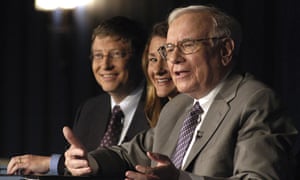
Bill (L) and his Melinda Gates (C) with Warren Buffett as the latter pledge of 10m shares of Berkshire Hathaway to the couple’s foundation.


Bill and his Melinda Gates with investment veteran Warren Buffett (R) in 2006. Photograph: Nicholas Roberts/AFP/Getty Images

The letter to Buffett is an assessment of the progress the Gates Foundation has made since 2006, when he pledged 10m shares in his company Berkshire Hathaway in annual instalments worth a total of $ 31bn at the time. The couple write of the progress that has been made in saving children’s lives, particularly through immunisation and vaccine development, and the work that lies ahead in making childbirth safer and tackling malnutrition.


Their letter makes clear what is at stake with Trump’s move to reimpose the global gag rule, arguing that women and maternal health are key to so many global health issues.


Empowering women is a key theme of the letter in which the couple argue that enabling women to access contraceptives control over the number of pregnancies they have is crucial. When women have a gap of at least three years between births, their children are more likely to survive and be healthy and well educated, the couple say. “Like vaccines, contraceptives are one of the greatest lifesaving innovations in history,” writes Bill Gates in the letter.


What is the ‘global gag rule’, and why does Trump support it?

Since they set up their foundation its focus has shift from the hunt for technological solutions towards social change. The attention to women’s empowerment came from the evidence, the couple say.


“You cannot go out and be in the developing world and then come back and look at the data and turn away from the importance of women in the developing world,” said Melinda Gates.


Whether they breastfeed and take their children to be vaccinated makes a profound difference to how the child grows and his or her life chances, and men are not always there, she added. “So you have to look at the woman’s role and when you look at it you realise it can be an accelerator to every single thing you want to have happen in the world for global health and global development and social change.”


In their letter, Bill Gates sats that poverty is sexist, a phrase he first heard from the U2 frontman Bono.


“The poorer the society, the less power women have. Men decide if a woman is allowed to go outside, talk to other women, earn income. Men decide if it’s acceptable to strike a woman. The male dominance in the poorest societies is mind-blowing.”


In the letter, Melinda Gates adds: “It’s also crippling. Limiting women’s power keeps everyone poor.”


She and her husband tell of their visits to sex workers in India whom the couple say they encouraged to form self-help groups, thinking the women would help each other insisting their clients wore condoms to protect themselves from HIV. That vision, said Bill Gates, “was way too narrow”. The sex workers began to support each other in every aspect of their lives.


“Warren, if Melinda and I could take you anywhere in the world so you could see your investment at work, we probably would take you to meet sex workers. I met with a group in Bangalore, and when they talked about their lives, they had me in tears,” writes Bill Gates.


“One woman told us she turned to sex work after her husband left her – it was the only way to feed her children. When people in the community found out, they forced her daughter out of school, which made the girl turn against her mother and threaten to commit suicide.


“That mother faced the scorn of society, the resentment of her daughter, the risks of sex work, and the humiliation of going to the hospital for an HIV test and finding that no one would look at her, touch her, or talk to her. Yet there she was, telling me her story with dignity.”


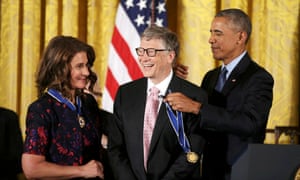
Bill and Melinda Gates receive medals from Obama at presidential medal of freedom ceremony in November 2016.


Bill and Melinda Gates receive medals from Obama at presidential medal of freedom ceremony in November 2016. Photograph: Carlos Barria/Reuters

There have been setbacks, such as the failure yet to end polio, but the couple emphasise the enormous progress that has been made in the last couple of decades in global health and speak in the letter of their optimism for the future.


“Polio will soon be history. In our lifetimes, malaria will end. No one will die from AIDS. Few people will get TB. Children everywhere will be well nourished. And the death of a child in the developing world will be just as rare as the death of a child in the rich world.


“We can’t put a date on these events, and we don’t know the sequence, but we’re confident of one thing: The future will surprise the pessimists.”


Trump"s "global gag" aid rule endangers millions of women and children, Bill Gates warns

6 Şubat 2017 Pazartesi

Anti-FGM campaign launched in UK to mark global day of opposition

A national campaign carrying the symbol of a red triangle will be rolled out across the UK to mark the International Day of Zero Tolerance for Female Genital Mutilation.


The National Police Chiefs’ Council has partnered with the Freedom charity to encourage people to provide the police with information that can help detect and prevent FGM in the UK and abroad.


Commander Mak Chishty, the police national lead on “honour”-based violence, has written to every police force in the country reminding them that while progress has been made, there is yet to be a successful prosecution for FGM.


He wrote: “This is a particular area of political and public scrutiny and I would urge each force to maximise every opportunity to demonstrate that we as a service are doing everything that is possible to combat FGM.”


His letter also cited a prevalence study published in July 2015 by City University and Equality Now, the human rights group, which showed that no local authority in the UK was unaffected by FGM.


Chishty told the Guardian: “We are raising awareness that FGM is a crime and that anybody involved in the process – from turning a blind eye to the act of cutting – commits a criminal offence. This is form of child abuse and violence against women and girls.”


More than 13,000 posters promoting the Red Triangle initiative have been distributed to police forces to display inside police buildings and within appropriate community settings.


Police leads have been asked to evaluate the campaign’s impact by monitoring any increased reporting, receipt of intelligence or new engagement opportunities.


Aneeta Prem, a writer and the founder of Freedom, has written a novel warning about FGM, called Cut Flowers, that is being distributed to schoolchildren to raise awareness of the illegal practice.


She said: “Over 200 million women and girls have gone through the horrors of FGM and we know that girls are being cut here in the UK. Unofficial figures estimate that 137,000 girls and women in Britain are affected.


“Through education we can stop FGM in a generation. Through teaching we can explain the long-term health dangers and dispel the myths that have kept this barbaric practice alive. The help of boys as well as girls is needed to change opinions.”


She added: “We are asking that people wear the red triangle badge to mark the International Day of Zero Tolerance to FGM.”


A 25-year-old from Somalia who suffered FGM and now lives in London said: “I was cut when I was five years old. I still feel pain and relive that moment every day. I completely support the Red Triangle campaign and hope it will encourage girls to ask for help.”


FGM protection orders intended to safeguard girls at risk came into effect in the UK in July 2015. The latest figures from the Ministry of Justice showed 97 applications and 79 orders had been made up to the end of September 2016.


The home secretary, Amber Rudd, said the government was taking “world-leading action” to tackle FGM by strengthening the law to improve protection for those at risk and by removing barriers to prosecution.


She said: “This government has introduced FGM protection orders, a new offence of failing to protect a girl from FGM, a mandatory reporting duty for frontline professionals, new guidance for the police, and lifelong anonymity for victims to encourage them to come forward.


“We are sending a clear message that FGM will not be tolerated, and as part of this I am determined to see the country’s first successful prosecution for FGM.”


The Red Triangle campaign, which will run until International Women’s Day on 8March, iwill officially launch at Haverstock school in Camden, north London, on Monday.


Anti-FGM campaign launched in UK to mark global day of opposition

27 Ocak 2017 Cuma

The return of the global gag rule stinks of neocolonialism | Lola Okolosie

Here’s a question I’d like somebody to ask President Trump: “What’s a woman’s life worth?” I’d hazard a guess that his response would attempt to sound reasonable.


Since the word “woman” tends to evoke a particular type, much in the same way the colour nude is taken as beige with whispers of peach, I’d like to ask another: “Mr Trump, what worth do you see in the lives of women in the developing world?”


The answer to that is revealed in Trump’s decision to reimpose the global gag rule. For women in poorer countries reliant on American aid, their lives have been deemed a fair compromise in service of politicking and moralising. It is a brutal use of these women’s bodies in order to mount an ideological assault on the idea that a woman can have bodily autonomy. Women of developing nations have become expendable collateral damage in a war far closer to home. Who isn’t reminded of colonialism and the hierarchy of bodies that matter?


Some 22,000 women will die this year because of unsafe abortions, and 8.4 million will suffer serious illness or injury


The global gag rule, also known as the Mexico City Policy, stops any foreign NGO receiving US government aid for family planning from using their own funds to provide safe abortion services, if legal in that country. Not only that, the rule stops funding NGOs if they are: known to have referred women elsewhere to receive terminations; lobbying their own governments to liberalise restrictions on abortion law; campaigning against governments wanting to restrict abortions; and even educating the public on the fact that they can ask for safe legal abortions.


The rule has been brought in and out of existence by Ronald Reagan in 1984, Bill Clinton nine years later, then George W Bush in 2001, and Obama in 2009, before Trump re-imposed it this week. Trump is in fact expanding the rule’s powers so that it no longer applies solely to family planning assistance given by the US government, but also to funding given to NGOs focusing on disease control.


Some 22,000 women will die this year because of unsafe abortions, and 8.4 million more will suffer serious illness or injury. Millions more will lose access to contraceptives and condoms because the NGOs who once provided them with such services will no longer exist. All because of the moral ideals of a powerful anti-choice lobby is intent on winning something, anything. How easy it is to play political football with the lives of people from the developing world.


[embedded content]

It is the same contingent that calls NGOs working to make abortion part of family planning initiatives “cultural imperialists”. Cultural relativism and the pretence that they are making a charitable intervention is supposed to mask a commitment to enforcing their sense of morality elsewhere. They assume that using the argument of salvaging “traditional” cultures will protect against an essential truth: it is a woman’s right to decide what happens to her body and when. Never mind that women in the developing world are not a homogenous lump with identikit views on abortion. Like colonial missionaries of old, it’s all for the moral good of the natives, apparently.


An American friend recently pointed out the paradox in Trump’s promise to put Americans first, (with its implication of isolationism) and yet make America great again, a sentiment that is nothing if not outward-looking and colonial in spirit. What better way to neatly combine the two than to withdraw billions in funding to poorer nations while making them understand the almighty power of the US dollar?


During Trump’s inauguration speech, the language of moral virtuosity was barely contained, lest it sound too imperialistic for the moment. It has nevertheless been let loose. American religious values, by way of the global gag rule, will be imposed on countries as far flung as Kenya and Peru, Ethiopia and Nepal.


Last year Trump stated that in the event of abortion being criminalised, women who went on to have a termination would have to face “some form of punishment”. Asked by MSNBC’s host Chris Matthews about how you actually ban abortion, Trump said: “Well, you know, you will go back to a position like they had where people will perhaps go to illegal places.”


The casual “you know” seems all the more perverse appearing as it does before an acknowledgement that it would mean putting women’s lives at risk. It seems that the lives of women from the developing world have been taken as a good starting point.


The return of the global gag rule stinks of neocolonialism | Lola Okolosie

Labour MPs urge Priti Patel to stand against Trump"s "global gag" rule

MPs are calling on Priti Patel to take urgent action to support charities that provide women with information on abortion in an effort to limit the impact of one of Donald Trump’s first acts as president.


Six Labour politicians have written to the development secretary suggesting Britain takes similar steps to the Netherlands, which is planning to form an overseas fund after the US ruled that it would stop providing aid to international groups working in this area.


“As we are sure you are aware, the new US president Donald Trump signed an executive order blocking funding for a number of international NGOs that support women’s rights and family planning,” the MPs wrote, about what has been dubbed the Mexico city policy, or global gag rule.


“We would implore you to take urgent steps on funding and policy as the Dutch government has and as the UK government has done so previously, to mitigate the impact of this decision.”


The group – Stephen Doughty, Stella Creasy, Gareth Thomas, Stephen Twigg, Luciana Berger and Anna Turley – praise Patel for championing the work of the Department for International Development (DfID) for women and girls in developing countries. They say it has focused on access to education, health services, family planning, better nutrition and water and sanitation.


“The department has been at the global forefront in helping poor women to lead healthy and productive lives, and to increase voice, choice and control for girls and women,” they add, warning that Trump’s decision could undermine DfID’s work.


They highlight the Dutch plans for a fund to help projects providing access to birth control, abortion and women’s education.


“If Britain is going to show the kind of global leadership the prime minister suggests, then we need to put our money where our mouth is and step in when others fall short” said Creasy, who helped organise the London Women’s March.


“Cutting funding for reproductive healthcare doesn’t end abortion, it ends safe abortions. Trump may not realise that but Britain does and should act accordingly.”


What is the ‘global gag rule’, and why does Trump support it?

Doughty, a former aid adviser who sits on the development committee, argued that Trump had delivered a “sinister start” to his presidency.


“At a time when Donald Trump is advocating torture and slashing contributions to the UN – they are also gagging women’s rights organisations,” he said, urging Patel and Theresa May to try to undo some of the damage.


Thomas, who is a former DfID minister, said he had previously been involved in a decision to set up a fund after George W Bush, the last Republican president, stopped US aid funding safe abortion and family planning.


“We worked with allies in other development agencies to try to ameliorate the consequences of George Bush’s decision,” he said. “Now that Trump has followed suit I hope Theresa May will instruct DfID to once more lead the development community to help close the gap and thus support the rights of women across the world to live the life they want to.”


A DfID source said. “The secretary of state has spoken about the fact that family planning in development is an important priority to her. We will continue to show global health leadership by working to deliver this‎.”


Labour MPs urge Priti Patel to stand against Trump"s "global gag" rule

25 Ocak 2017 Çarşamba

NGOs: How will the "global gag rule" affect your work?

In one of his first acts as president – and two days after millions of people marched for women’s rights – Donald Trump has reinstated the “global gag rule”.


The policy will cut US aid funding to international NGOs which offer family planning programmes associated with abortion. Also known as the Mexico City Policy, it was first introduced by Ronald Reagan in 1984 and has since become a political ping pong – reinstated by Republican presidents and rescinded by Democrats.


Building on the 44-year-old Helms amendment which prohibits the use of US aid money for abortions, the new policy will prevent NGOs from using private funds to offer abortions, from referring women to groups that provide abortions, and even from offering information on services.


What is the ‘global gag rule’, and why does Trump support it?

Some $ 600m of US foreign aid goes towards family planning assistance, but organisations will now have to choose between no longer offering these services, or losing funding from the US.


Two major beneficiaries of US funding for family planning programmes, the International Planned Parenthood Federation (IPPF) and Marie Stopes International have indicated that they would not comply with the gag rule. Marie Stopes estimates that without alternative funding the loss of its services will cause more than 6 million unintended pregnancies during Trump’s first term. The IPPF could lose up to $ 100m of funding, which could lead to cuts to sexual health services in at least 30 countries where its partner organisations work.


The policy could put millions of women’s lives at risk: one in 10 maternal deaths in developing countries are caused by unsafe abortions an estimated 20 million take place each year.


“This blocks access to sexual and reproductive health services in the poorest and hardest to reach communities where we are currently changing lives,” Tewodros Melesse, director general of IPPF, told the Guardian. “We can’t support something which tries to restrict people’s choices or take them away.”


We want to hear from you


Do you work for a global health organisation funded by US aid? We want to know how the global gag rule will affect your work. Tell us your stories, thoughts and concerns using the form below.


NGOs: How will the "global gag rule" affect your work?

23 Ocak 2017 Pazartesi

"Global gag rule" reinstated by Trump, curbing NGO abortion services abroad

In one of a number of sharp reversals from the Obama era, Donald Trump on Monday signed an executive order banning international NGOs from providing abortion services or offering information about abortions if they receive US funding.


The rule will put thousands of international healthcare workers in the difficult position of deciding whether to continue to offer family planning care that includes abortion at the expense of a critical funding stream.


The US is the single largest donor to global health efforts, providing nearly $ 3bn toward health efforts through the United States Agency for International Development (USAid) alone. The state department and groups like the Peace Corps offer additional funding.


Many international health advocates insist that their efforts are not comprehensive without abortion services. Unsafe abortions are a major cause of maternal mortality and kill tens of thousands of women every year.


What is the ‘global gag rule’, and why does Trump support it?

“President Trump’s reinstatement of the global gag rule ignores decades of research, instead favoring ideological politics over women and families,” said Senator Jeanne Shaheen, a New Hampshire Democrat who serves on the foreign relations committee.


“We know that when family planning services and contraceptives are easily accessible, there are fewer unplanned pregnancies, maternal deaths and abortions.


“And when women have control over their reproductive health, it improves the long-term health of mothers and children and creates a lasting economic benefit.”


Trump’s signature reinstates a Reagan-era rule that was not in effect for most of the Obama administration. The order does not eliminate international aid for abortions, which is already prohibited by federal law under the Helms amendment. Rather, the gag rule takes the Helms amendment one step further by preventing NGOs from using private funds to offer abortions or even refer women to groups that provide abortions.


The gag rule also prevents health workers in foreign countries from advocating for abortion rights, which includes testifying about the impacts of illegal abortion.


The rule does not enjoy uniform support along party lines. In 2015, Senate legislation introduced by Shaheen that would have made the gag rule impossible to reinstate by executive order attracted support from several moderate Republicans.


Still, the reinstatement of the global gag rule, also known as the Mexico City policy, has been long sought by opponents of abortion rights. To their eyes, funding groups that perform or even discuss abortions is tantamount to funding the procedure.


“President Trump is continuing Ronald Reagan’s legacy by taking immediate action on day one to stop the promotion of abortion through our tax dollars overseas,” said Marjorie Dannenfelser, president of the anti-abortion political advocacy group Susan B Anthony List.


“President Trump’s immediate action to promote respect for all human life, including vulnerable unborn children abroad, as well as conscience rights, sends a strong signal about his administration’s pro-life priorities.”


Trump is not the first president to reinstate the rule after it was suspended. George W Bush signed a similar order when he entered office in 2001.


As a result, more than 20 developing countries in Asia, Africa, and the Middle East lost access to contraceptives provided by the US and many NGOs were forced to shut down or lay off staff, according to EngenderHealth, a global women’s health organization that supports abortion rights.


EngenderHealth observed the impact in three places – Kenya, Nepal and Zambia – and found that in these countries, the gag rule reduced the availability of family planning services, HIV programs and maternal and child health programs.


"Global gag rule" reinstated by Trump, curbing NGO abortion services abroad

18 Ocak 2017 Çarşamba

$460m pledged for vaccine initiative aimed at preventing global epidemics

A coalition of governments, philanthropists and business is pledging to put money and effort into making vaccines to stop the spread of diseases that could threaten mankind – and to prevent another outbreak as devastating as the Ebola epidemic.


At the World Economic Forum in Davos, the Norwegian, Japanese and German governments, the Wellcome Trust and the Gates Foundation announced they were putting in $ 460 million – half of what is needed for the first five years of the initiative. Three diseases will initially be targeted: Lassa, Mers and Nipah. All three are caused by viruses that have come from animals to infect humans and could trigger dangerous global epidemics.


http://www.theguardian.com/world/2017/jan/18/nipah-fearsome-virus-that-caught-the-medical-and-scientific-world-off-guard


Ebola virus had been known since it first infected humans in 1976, but the outbreaks were relatively small and, although deadly, did not greatly trouble most of the world until the disease hit cities, spread across west Africa and cases were seen in the USA and Europe.


Experts are determined to do everything they can to prevent such unexpected disasters. Ebola killed more than 11,000 people and devastated the healthcare systems and economies of Sierra Leone, Guinea and Liberia.


The Coalition for Epidemic Preparedness Innovations (CEPI) will direct money into research for vaccines for infectious diseases that afflict low and middle-income countries and are not research priorities for pharmaceutical companies because there is not a lucrative market for them. One of the key aims of CEPI will be to ensure the vaccines are affordable and accessible to all who need them.


Jeremy Farrar, chief executive of the Wellcome Trust, said changes in the environment, in people’s interactions with animals and urbanisation were all factors that could trigger an outbreak in humans of a new infectious disease. Of the series of epidemics in the last couple of decades he said: “That is not going to stop. It is the way the world is structured now.”


There had been a tendency, though, to forget about the dangers once an outbreak has ended, noted Farrar. “Sars is the best example. The epidemic faded away and then interest went on to other things,” he said.


Ebola was different, said Farrar. “It was on TV screens and many people witnessed it for themselves. There was a feeling that this can never happen again. It was horrific. Many thousands of lives were lost. But also there was the optimism and hope that maybe for the first time in history, a vaccine was found to be safe and effective. We can dare to dream and can change the way things happen.”


CEPI aims to develop two promising vaccines against each of the first three diseases so that they are available before any epidemic breaks out.


Sir Andrew Witty, chief executive of GlaxoSmithKline (GSK), which is involved in the initiative, said: “We are not really learning the lessons from the previous pandemic. We are never really changing our level of readiness.” GSK was asked by the World Health Organisation in the summer of 2014 to try to develop an Ebola vaccine and had it ready to trial by the following January. That time could have been much shorter if there had been something on the shelf.


The company intends to create a “biopreparedness organisation”, based permanently at its research facility in Rockville in the USA, to work on a no-profit, no-loss basis to develop vaccines for diseases that could potentially pose public health threats.


Epidemics, said Erna Solberg, prime minister of Norway, “ … can ruin societies on a scale only matched by wars and natural disasters. They respect no borders and don’t care if we are rich or poor. Protecting the vulnerable is protecting ourselves. This is why we all must work together to be better prepared – and why my government is fully committed to ensure that CEPI achieves its mission.”


$460m pledged for vaccine initiative aimed at preventing global epidemics

3 Ocak 2017 Salı

How the world got fat: a visualisation of global obesity over 40 years | Max Galka

Last year, a network of health scientists from around the world set out to create the most comprehensive portrait of world obesity ever produced. The researchers compiled results from 1,698 studies on adult obesity, covering 186 countries, 19.2 million participants, and spanning 40 years. And they condensed it all into a single study, published earlier this year in the Lancet medical journal.


And here are the full results, presented in one eye-opening graphic.


The colour of each country represents its adult obesity rate in the year shown. Hover over a country to see what its obesity rate was in 1975 and what it is today.


Since 1975, obesity rates have risen in every country in the world, without exception. That includes countries like the United States and the UK, where food is cheap and abundant, and countries like Somalia and Angola, where malnutrition remains an epidemic.


At the low end, North Korea’s obesity rates are up about 1% (from 1.6% in 1975 to 2.8% today). Japan is also near the bottom with a 2% increase since 1975 (from 1.1% to 3.3%). The largest changes occurred in smaller Pacific island countries. Samoa, Tonga, and Tuvalu all saw their obesity rates increase by more than 20%, a doubling of what they were in 1975.


Perhaps the country that stands out most of all is China. In 1975, only 0.5% of Chinese adults were obese. Today, China’s obesity rate is about 8%, a 16-fold increase in the most populous country in the world.


Globally, the average adult today is three times as likely to be obese compared to the average adult in 1975.


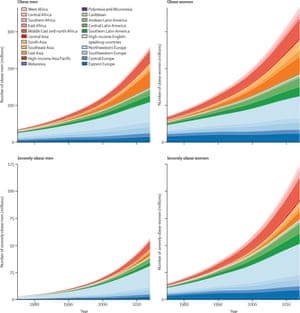
Trends in the number of obese and severely obese people by region. A person is obese if they have a body-mass index (BMI) of 30 kg/m2 or higher, or is severely obese if they have a BMI of 35 kg/m2 or higher. From Lancet report: Trends in adult body-mass index in 200 countries from 1975 to 2014


Trends in the number of obese and severely obese people by region. A person is obese if they have a body mass index (BMI) of 30 kg/m2 or higher, or is severely obese if they have a BMI of 35 kg/m2 or higher. Photograph: The Lancet Publishing Group/Trends in adult body-mass index in 200 countries from 1975 to 2014

Few other problems exhibit such a clear trend, over such a long time frame, across the entire world. In fact, I created this map because I think the magnitude of the global obesity epidemic is difficult to communicate with statistics alone.


However, the map also illustrates another point about a completely different topic, one that is even bigger and further reaching than global obesity – the problem of information overload.


The digital universe is growing exceptionally fast. Half of the information available online today was created in just the last two years. But for that information to be useful to anyone outside of subject matter experts, it must overcome a host of challenges.


First, the information must be practically accessible. This obesity study represents the work of thousands of researchers over perhaps millions of hours. Data visualisation, reduces it all into an intuitive, easily-digestible graphic.


At the same time, data visualisation gives us a frame of reference for understanding what would otherwise be cold, abstract numbers. When you read statistics about obesity, either as written language or as tables of numbers in a spreadsheet, you realise obesity is a problem. But when you watch the story unfold visually, you can feel the depth and magnitude of the problem because you are witnessing it firsthand.


Finally, for the information to be useful, it must be discoverable from among an ever-growing sea of digital noise. Data visualisations are not only informative, they can also be fun and beautiful, something that people will want to share with their friends.


As the digital universe continues to grow, making sense of all that information presents an increasingly difficult challenge. Fortunately, it may have an easy solution: communicate it visually.


How the world got fat: a visualisation of global obesity over 40 years | Max Galka

18 Aralık 2016 Pazar

How Britain plans to lead the global science race to treat dementia

Early next year, Professor Bart De Strooper will sit down in an empty office in University College London and start to plan a project that aims to revolutionise our understanding and treatment of dementia. Dozens of leading researchers will be appointed to his £250m project which has been set up to create a national network of dementia research centres – with UCL at its hub.


The establishment of the UK Dementia Research Institute – which was announced last week – follows the pledge, made in 2012 by former prime minister David Cameron, to tackle the disease at a national level and comes as evidence points to its increasing impact on the nation. Earlier this year, it was disclosed that dementia is now the leading cause of death in England and Wales. At the same time, pharmaceutical companies have reported poor results from trials of drugs designed to slow down the progress of Alzheimer’s disease, the most common form of dementia.


“Humans have truly wonderful brains that can cope with terrible diseases like Alzheimer’s for decades and can find all sorts of ways to get around defects that are growing inside,” said De Strooper, who is currently based at the University of Leuven in Belgium. “Eventually individuals succumb to the condition and start to display memory loss and other symptoms – but usually only after decades have passed and their brains have gone through considerable changes. This makes it very difficult to treat the disease. That is the challenge that we need to tackle.”


Current understanding of Alzheimer’s suggests the disease is triggered when beta amyloid, a protein in nerve cell membranes, starts to clump together. Slowly the brain undergoes metabolic changes as amyloid clumping continues. In particular, a protein known as tau, which is involved in memory storage, is affected. It starts to form tangles inside the brain’s neurons and these die off. Eventually, symptoms – such as severe memory loss – manifest themselves.


To date, most attempts at drug interventions have focused on medicines that could prevent beta amyloid from forming clumps, the most recent being Solanezumab, developed by the pharmaceutical company Eli Lilly. However, results of clinical trials of the drug – revealed last month – indicated that it had no significant effect on the thinking abilities of people with mild Alzheimer’s. Solanezumab had also failed in people with more advanced versions of the disease in earlier trials.


This double failure has led some scientists to argue that amyloid clumping is not a cause of the disease but is merely a symptom. By targeting it, scientists are wasting time, it is argued. Professor John Hardy, a geneticist based at UCL – who has played a key role in setting up the college’s Dementia Research Institute – does not agree. “All the evidence we have from families affected by early onset dementia indicates that the disease begins with the deposition of amyloid plaques in the brain,” he said. “The trouble is that this buildup starts 15 to 20 years before dementia’s symptoms appear. The drugs we have developed so far offer treatments that are, in effect, too little and too late.”


Hardy drew a parallel between cholesterol buildup in blood vessels that eventually leads to cardiac disease and the buildup of amyloid plaques in the brain and the onset of Alzheimer’s. “Unfortunately, we have no equivalent of a cholesterol test to assess how much amyloid is clumping in a person’s brain,” he added. “However, that could change in the near future.”


Research suggests between 20 and 30 genes are involved in predisposing people to Alzheimer’s.


Research suggests between 20 and 30 genes are involved in predisposing people to Alzheimer’s. Photograph: Getty

Recent research has pinpointed a group of around 20 to 30 genes that are involved in predisposing individuals to Alzheimer’s. These genes come in different variants. Some variants of a gene predispose individuals to dementia more than other variants of that gene. If a person inherits a package of genes made up of variants that particularly predispose to dementia, they are very likely to develop Alzheimer’s.


“We are now within five years of developing a chip that will be able to tell – from a blood test – whether a person is likely to have amyloid plaques forming inside their brains in middle age,” added Hardy. “This would then be followed up by a brain scan to confirm if this is true or not.”


This would be dementia’s equivalent of a cholesterol test. The problem is that there is, as yet, no equivalent of drugs which would halt this amyloid buildup in a way that parallels the use of statins to block buildups of cholesterol, once detected, and so head off cardiac illness. For their part, researchers argue that the use of drugs like Solanezumab – although seemingly ineffective on patients in whom amyloid plaques have become established – could be far more effective in the early stage of the condition.


Many other issues complicate our understanding of dementia, however. “A good example is provided by the immune system,” said David Reynolds, chief scientific officer of Alzheimer’s Research UK. “There is a lot of evidence now that the immune system is involved in the development of Alzheimer’s after beta amyloid clumps appear.”


However, the nature of that immune response is still not fully understood. “We do not know whether the immune system tends to overreact – as with conditions like rheumatoid arthritis in which the body’s own tissue is attacked by its own immune defences – or react weakly and allow amyloid clumps to develop when they could be stopped,” added Reynolds. “Certainly it would be unwise to wade in with drugs until we know exactly what it is we want to achieve.”


And this is where the distributed nature of the Dementia Research Institute network could prove important. Based in different university cities (Edinburgh, Oxford and Cambridge are all candidates for units), these outlying centres will focus on different aspects of the disease: environmental factors, care of dementia patients – and immunology. “The creation and direction of these centres will depend on existing expertise at that university,” added Reynolds. “A centre that focuses on immunology and dementia would be particularly useful in finding new ways to tackle the condition.”


The Dementia Research Institute network is to be supported, over the next 10 years, by £150m funding from the Medical Research Council – with further inputs of £50m each being made by Alzheimer’s Research UK and by the Alzheimer’s Society. This commitment marks a significant increase in dementia research in the UK, which had already raised its annual funding from £50m in 2008 to £90m in 2012 and is now a world leader in the field.


“It is good news but we need to put it in perspective,” said James Pickett, of the Alzheimer’s Society. “In 2012 we spent more than £500m on cancer research; there are five times more researchers working on cancer in the UK; while the number of clinical trials of dementia drugs is less than 1% of those of cancer drugs.”


At the same time, the need for some form of treatment to tackle dementia is becoming increasingly urgent. More and more people are living to their 80s and 90s when their chances of getting dementia increase markedly. There are currently 850,000 people with dementia in the UK, a figure that will rise to one million by 2025 and two million by 2051.


“We are going to have to be very nuanced in understanding all the risk factors involved in dementia – and in appreciating why factors like education and general health provide some protection against its onset,” said Professor Carol Brayne, of Cambridge. “That is going to be the strength of the institute. It offers us the opportunity, for the first time, to follow so many different avenues and approaches to dealing with and understanding the dementia.”


GROWING THREAT


• ■ Dementia overtook heart disease as the leading cause of death in England and Wales last year. More than 61,000 people died of the condition in 2015, 11.6% of all recorded deaths.


• ■ The Office for National Statistics said the increase had occurred because people were living for longer while deaths from other causes, including heart disease, had gone down. In addition, doctors are now better at diagnosing dementia, and it is appearing more often on death certificates.


• ■ The bulk of dementia deaths last year were among women: 41,283, compared to 20,403 in men.


• ■ According to the Alzheimer’s Society, dementia is the only one of the top 10 causes of death that we cannot prevent or even slow down.


• ■ The leading cause of dementia is Alzheimer’s disease, which accounts for 62% of all cases in the UK: 520,000 of the 850,000 people living with dementia in the UK today. Other forms of the disease include vascular dementia and Lewy Body dementia.


■ • Dementia costs the UK economy approximately £26bn per year, according to the Alzheimer’s Society.


• ■ If a drug could be found to slow cognitive decline in dementia, that would delay the need for paid care and reduce the financial burden on families, the NHS and social care.


How Britain plans to lead the global science race to treat dementia

22 Kasım 2016 Salı

How UK trade policies could help heal global healthcare inequalities | Ruth Bergan and Natalie Sharples

Theresa May’s recent visit to India, during which discussions about cooperation over trade in health services were a priority, is a reminder that trade and investment cannot be isolated from other areas of policy.


Key among these is universal health coverage – the provision of quality medical services to all people when they need them, without causing financial hardship. This is a concept that is having its moment: it is championed by everyone from health activists to the World Bank, and is one of the targets in the sustainable development goals.


What is obvious, but perhaps less palatable to some of its advocates, is that achieving universal health coverage requires addressing polices far beyond the health sector. Policies that need to work for universal health coverage include those on water and sanitation, nutrition and education, but also global policies and practices that impede the right to health.


In the context of Brexit, UK trade is one such policy we urgently need to examine. Trade has huge implications for health. This was seen very clearly in the EU’s failed attempt to agree a trade deal with India. When the EU proposed to include stricter patenting rights for companies in the deal, Indian negotiators, the UN and activists all raised serious objections, fearing it would drive a huge increase in the cost of medicines relied on by poor communities across the globe.


Fears about trade rules are well-founded. One third of the world’s population lacks access to essential medicines. New treatments for people living with HIV in middle-income countries can cost between $ 3,000 (£2,400) and $ 28,000 per person each year. No surprise that for many people this is out of reach. Inequalities in power between companies and citizens is at the heart of this. Patent protection given to pharmaceutical companies through provisions in trade agreements restricts access to cheaper, generic medicines and pushes up drug prices. In the US, the Food and Drug Administration reports that the cost of a generic drug is 80% to 85% lower than the brand name product.


Similar power distortions are unmistakable in bilateral investment treaties. Like the controversial TTIP and Ceta agreements, these trade deals include a parallel judicial system allowing companies to sue governments at private international tribunals, curbing the ability of states to provide for the right to health for their people, and undermining democracy.


Companies are already using such provisions to challenge government health policy. In 2012, pharmaceutical giant Eli Lilly began legal proceedings against the Canadian government for $ 500m for invalidating two of its patents. The invalidations were the result of a new national law that required the “utility” of an invention to be demonstrated when the patent was filed – in other words the drug did not do what the inventor said, or implied, it would do when the patent application was made, as was the case with the two contested drugs from Eli Lilly. The company then sued Canada under the Nafta treaty for lost profit and unfair treatment – a lawsuit that is not only intended to challenge the withdrawal of the patents but also Canada’s national law.


While there are no public cases of health companies suing India, UK companies have certainly been using the provisions of UK bilateral investment treaties to challenge other aspects of Indian government policy. Vedanta Mining and Vodafone have both challenged changes to Indian tax law. The companies had used offshore vehicles to buy out Indian companies, neatly avoiding having to pay significant amounts of tax. When India attempted to close the loophole (pdf) that allowed this to happen, the companies used the UK-India treaty to sue the government for “compensation”.


Every day 16,000 children under-five (5.9 million a year) die. The causes of their deaths are largely preventable, meaning these children are not killed by illness, but bad policies. As the Alma Ata – the first international declaration underlining the importance of primary health care – made clear almost 40 years ago, health inequalities within and between countries are “politically, socially and economically unacceptable”. Achieving universal health coverage requires training more health workers, improving health information systems and mobilising more domestic financing. It also requires addressing the global causes of poverty and inequality. Trade and investment policies should be first on the list. India has already revised its bilateral investment treaties to limit the range of policies that can be challenged. The UK now has an opportunity to make sure its own trade policy supports the health of people across the world. We must demand that MPs act now to ensure it.


• Natalie Sharples is senior policy advisor at Health Poverty Action


How UK trade policies could help heal global healthcare inequalities | Ruth Bergan and Natalie Sharples