plug etiketine sahip kayıtlar gösteriliyor. Tüm kayıtları göster

1 Mayıs 2017 Pazartesi

Schools cutting mental health services to plug funding gaps, warn MPs

Cash-strapped schools are cutting mental health services such as counsellors and pastoral provision as they try to cover funding gaps, two influential groups of MPs have said.


The health and education select committees joined forces for the inquiry, which called on the government to look at the impact of budget cuts on mental health services for children.


Services to support wellbeing are “the first thing to go” when budgets are under pressure, the inquiry heard. The government announced £1.25bn in additional funding for young people’s mental health in 2015, but almost 80% of primary school headteachers responding to a survey said a lack of money prevented them from providing mental health support in schools such as counsellors.


The MPs wrote: “We know that more than half of all mental ill health starts before the age of 15 and it is therefore a false economy to cut services for children and young people.”


There are “unacceptable” variations in the level of access children have to mental health services because some parts of the country lack strong links between schools and mental health providers, the inquiry found.


The education minister, Edward Timpson, told the inquiry a pilot scheme increasing collaboration between schools and mental health services was being expanded to 1,200 more schools. The MPs called on the government to “commit resources to establish partnerships with mental health services across all schools and colleges”.


The issue of social media was of particular concern for the inquiry, which found that it could help and harm young people’s mental wellbeing. Witnesses told the inquiry that young people tended to contact support services such as Childline on the internet rather than by phone, and social media could help connect young people, especially those with rare conditions, to supportive communities. But cyberbullying and sleep deprivation due to late-night screen use concerned witnesses to the inquiry.


Schools should teach pupils how to make sensible decisions around social media, the inquiry determined, as part of equipping them for the modern world. But they should also teach parents about social media, especially about its impact and that of screen time more generally on children’s sleep.


“Parents have a key role to play in limiting screen time, reducing sleep deprivation and preventing exposure to harmful online activity,” the MPs wrote.


Ofsted inspections could play a key role in raising the importance of mental health and wellbeing in schools, the MPs said, but witnesses said thewatchdog was too focused on academic achievement, with only one-third of Ofsted reports specifically referring to the mental health and wellbeing of pupils. The report called on Ofsted’s chief inspector, Amanda Spielman, who took over in January, to look at ways of making mental wellbeing more prominent “as a matter of priority”.


An Ofsted spokeswoman said: “Personal development, behaviour and welfare of pupils is one of our key judgments in school inspections and is graded in every section five inspection. As part of this, inspectors already evaluate the experience and wellbeing of particular individuals and groups of pupils, including those with mental health needs.


“Ofsted has also started discussions with the CQC [Care Quality Commission] about some future joint survey work in relation to the government’s proposals to transform mental health support for children and young people.”


Sarah Brennan, the chief executive of mental health charity YoungMinds, said: “We are facing a mental health crisis in our classrooms and it is vital that the next government rebalances the education system to ensure that the wellbeing of children is as important as academic achievement in schools.


“Many schools are doing excellent work to promote good mental health. But funding constraints, coupled with a lack of prominence given to wellbeing in the Ofsted inspection framework, mean that when schools face tough decisions about which services to cut, they are under pressure to prioritise other areas.


“At a time when rates of self-harm are rising sharply, and when specialist mental health services are overwhelmed, this cannot be right.”


Norman Lamb, the Liberal Democrat MP and mental health campaigner, said children and young people were being “shortchanged”.


“It is scandalous that much of the additional funding for children’s mental health secured by the Liberal Democrats in 2015 is not getting through,” he said.


“Until the government commits to providing more long-term funding for health and social care, this mental health crisis will not be tackled.”


Schools cutting mental health services to plug funding gaps, warn MPs

2 Mart 2017 Perşembe

Countries pledge millions to plug hole left by US "global gag rule"

Countries have pledged tens of millions for family planning schemes in developing countries to plug a gap left by Donald Trump’s ban on US funding to groups linked to abortion.


About 50 governments are attending the hastily convened She Decides conference in Brussels on Thursday, with early pledges closing in on $ 100m (£80m).


Sweden and Finland each promised €20m to compensate for the reinstated “global gag’ rule”, which bans US funding for NGOs that provide abortion or information on the procedure to women in developing countries.


The UK has sent the international development minister, Rory Stewart, to the one-day conference, but it remains unclear if the government will announce a financial contribution.


Organisers hope to raise $ 600m. “This is not a conference against the American administration; this is a conference for something,” Sweden’s deputy prime minister, Isabella Lövin, told the Guardian.


“We are expressing our strong support for women’s rights, for the progress that has been made. Access to contraceptives and sexual reproduction is a vehicle for development and the eradication of poverty.”


In an executive order signed last month, Trump reinstated the global gag rule, a US aid policy Republican presidents since Ronald Reagan in 1984 have imposed but their Democrat counterparts have lifted.


Sweden’s international development minister cited evidence from the World Health Organization showing that, under George W Bush’s presidency, the rule increased abortions and maternal deaths from unsafe terminations. “This is something we can prevent,” she said.


Alexander De Croo, Belgium’s deputy prime minister, told the Associated Press: “This should not be a moment where we are taking steps back into the dark ages.”


Belgium, Denmark, the Netherlands and Norway have pledged $ 10m each, with further contributions expected to be announced by other wealthy countries.


A government spokeswoman was unable to confirm whether he would announce any financial contribution from the UK.


The Department for International Development has previously described the UK as a global leader on family planning. It points to “a major international summit this summer to secure commitments that increase access to family planning services for women and girls in the world’s poorest and most fragile countries”.


Other wealthy countries are expected to announce donations. Canada’s minister of international development, Marie Claude Bibeau, said: “Women’s rights begin with their right to control their bodies. We should never take that away from them, especially for young adolescents. Canada is proud to stand with its partners and will always stand up for women’s rights everywhere.”


Afghanistan, Chad and Ethiopia are among the developing countries sending representatives to the conference, where they are expected to give evidence on how funding for family planning makes a difference to women’s lives.


Organisers have also expressed hope that US foundations may get involved by contributing funds. While the conference has been warmly welcomed by NGOs, some have voiced fears the money cannot be raised quickly enough to fill the shortfall left by Trump’s executive order.


Lövin expressed hope of hitting the target, but said Thursday’s conference was only the first step.


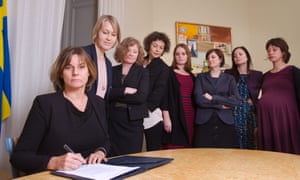
Sweden’s deputy PM, Isabella Lövin, signs bill seen as a parody of Donald Trump signing the ‘global gag’ order.


Sweden’s deputy PM, Isabella Lövin, signs bill seen as a parody of Donald Trump signing the ‘global gag’ order. Photograph: Johan Schiff/EPA

The Swedish deputy prime minister made headlines last month when she appeared to parody Trump and the all-male lineup in the Oval Office that signed the global gag order.


Lövin, who is also environment minister, tweeted a picture of herself and female colleagues, as she signed Sweden’s climate law.


But she brushed aside questions she was mocking Trump and his administration, saying: “The message was not that we were only women in that picture; the message was that we are taking leadership when it comes to tackling climate change.


“This was my staff and myself and my state secretaries and I was signing a bill and that’s all.”


Countries pledge millions to plug hole left by US "global gag rule"

25 Mart 2014 Salı

The enterprise of sanitation: how partnership can plug the entry gap

Kibera Slum in Nairobi, Kenya

Local individuals carry clean water in jerrycans from a clean water pipe in the Kibera slum in Nairobi, Kenya. Photograph: Anadolu Agency/Getty Images


The sanitation target is the most off-track of all the MDGs, with 80% of countries falling behind their nationwide targets. About a third of the global population has no entry to a toilet, and roughly the exact same variety of individuals have to openly defecate. Even a toilet is no assurance of hygiene – 1000′s of young children die from sanitation-associated conditions, like diarrhoea, each and every day, largely induced by lack of entry to clean water.


International organisations like WaterAid have been effective in creating methods to address sanitation, like producing local partnerships. Elsewhere, multinational organizations have built communal wells and water pumps, but their enthusiasm and philanthropic want has not always equated to the wants of communities currently being met. Typically the place there is quick-term involvement and lack of understanding of growth issues, there is no assure of prolonged-term stability.


“The mind-boggling majority of households nowadays, who have access to on-website sanitation – a toilet or latrine in their property with some indicates of primary treatment method like a septic pit – have this kind of access through intervention by the personal sector,” says Jemima Sy, senior water and sanitation specialist at the Globe Bank’s water and sanitation programme.


“There is no question that the advancement sector requirements to see that this marketplace-based mostly model currently operates for the massive bulk, [and that it] provides an opportunity to increase the advancement dividends to poorer households who do not however have this kind of access,” Sy says.


Prior productive projects have been led by the private sector, in collaboration with bigger improvement organisations. But is the model – so typically used – of an NGO financing a task, and a personal contractor maintaining it, a sustainable one?


Last November, the Ghanaian NGO Coaching, Research and Network for Improvement was granted €1m by the African Water Facility to assistance a waste therapy plant that will recycle fecal matter into bio-fertiliser. The project will also give 125,000 individuals with sanitation solutions.


With the future of huge-scale projects dependant on large income, there are loads of ifs, buts and maybes. The scenario is complicated by the reality that sanitation isn’t a marketing point for all traders. Is this in which smaller NGOs could play a position, via collaborating with start off-ups and entrepreneurs? Could they help communities and leverage local markets? Would this be more advantageous?


“Firms could be considerably better at delivering aspirational and affordable products,” says Sy. She warns that as long as governments or development programmes are witnessed as the buyer, and not the bad, goods will struggle to attain the market place.


Modest NGOs can help their worth be realised. They are a lot more likely to be significantly less bureaucratic, have more experience of operate on the ground and have money granted, or donated, from supporters who share the exact same passion. A group of like-minded specialists with knowledge of technologies and improvement specialists, that come with each other to collaborate, are also much more very likely to realize the aesthetics that come connected with needing and getting a toilet. As Sy puts it: “How it tends to make them really feel and how it positions them in society.”


The Swedish-based mostly Peepoople, who designed the Peepoo bag – “a individual, single-use, self-sanitising, totally biodegradable toilet” – is 1 instance of the position little NGOs can play in the company of sanitation getting understood. Peepoople addresses aesthetic problems by allowing girls to go to toilet in the decency of their personal houses, so they will not have to use public sanitation services.


“Peepoople AB, the producer of Peepoo is a restricted organization, but Peepoople Kenya, that imports and distributes [the bags], is a Kenyan NGO,” explains its founder, Anders Wilhelmson. “Business is in every component [of what we do]. Not only at Peepoople and its suppliers, but much more importantly in the context and atmosphere the toilet is used in.”


Wilhelmson says the model “acts as a catalyst for financial development” and can leverage local markets. Females turn out to be micro-entrepeneuers by selling bags on behalf of the NGO clients receive a refund for every single utilised bag that is returned and the Peepoo solution collected in the bags is sold to farmers as low-cost fertiliser.


Whilst it might not absolutely resolve troubles like privacy or handwashing – and one innovation alone cannot attend all overall health concerns – offering locals a monetary incentive, and something to purchase into, signifies the NGO is in a far better place to educate them on the significance of very good hygiene and to handle the taboos close to sanitation.


Collaborating with the personal sector is essential. A marker of how profitable an NGO’s involvement is, is not the quantity of funding behind a solution or project, but how the bad are valued as shoppers (and not charity). Seeing sanitation as a company, as properly as an environmental, health and social issue, can push NGOs to give water, sanitation and hygiene (Wash) a increased priority in policies.


Join the local community of worldwide advancement professionals and authorities. Turn into a GDPN member to get far more stories like this direct to your inbox


The enterprise of sanitation: how partnership can plug the entry gap

27 Ocak 2014 Pazartesi

Brits are pulling the plug on bathtime


Only one in 10 individuals still have time for a every day dip in the bath tub, according to a new survey.


And according to the poll, half of Brits in no way bathe at all.


Even amongst people who do even now get baths, a lot more than half do so as component of a pampering or rest regime, rather than for basic cleanliness.


The survey by researchers at the universities of Manchester, Edinburgh, Lancaster and Southampton located that the elderly had been much more likely to bathe on a day-to-day basis, as had been the much less affluent and individuals who lease their homes, some of whom might not have a shower.


But despite the fact that the bath may well have fallen out of favour with Brits, the nation certainly is not obtaining grubbier, given that people are showering more usually than ever just before.


As reported in the Every day Mail, practically one particular in 10 of us wash more than after a day, with more and a lot more people taking regular showers.


The researchers explained the shift towards regular washing is placing pressure on already strained water supplies – and could be damaging our well being.


Some scientists think our immune methods become weakened because we are not exposed to ample filth and germs.


Brits are pulling the plug on bathtime