pledge etiketine sahip kayıtlar gösteriliyor. Tüm kayıtları göster

6 Mayıs 2017 Cumartesi

Lib Dems pledge 1p tax rise to "rescue NHS and social care"

The Liberal Democrats have pledged to increase income tax by a penny for every earner to fund a £6bn-a-year cash injection for the NHS and social care.


In what was described as their “flagship” spending commitment of the general election campaign, the party’s leader, Tim Farron, said voters recognised the need to “chip in a little more” to address the “chronic underfunding” of healthcare.


Under the Lib Dem plan, 1p would be added to the basic, higher and additional rates of income tax and the rate of dividend tax from the next financial year, with the £6bn raised being ring-fenced for the NHS, social care and public health.


The proposal – which echoes the Lib Dems’ pledge from the 1990s to put a penny on income tax for education – will be seen as a clear attempt to capitalise on public concerns about the state of healthcare.


Theresa May has insisted the Conservatives have no plans for tax rises while appearing to back away from a previous pledge not to put up income tax or national insurance.


Farron said: “Theresa May doesn’t care about the NHS or social care. People are lying on trolleys in hospital corridors and she has done nothing.


“The Liberal Democrats will rescue the NHS and social care. We are prepared to be honest with people and say that we will all need to chip in a little more.”


The party’s health spokesman, Norman Lamb, said: “The NHS was once the envy of the world and this pledge is the first step in restoring it to where it should be. A penny on the pound to save the NHS is money well spent in our view.”


The Lib Dems pointed to an opinion poll finding from last year, which suggested 70% of voters would back a 1p rise in income tax if the money was guaranteed to go to the NHS.


According to figures released by the party, the rise would mean an increase of £33 a year – or less than £1 a week – for someone earning £15,000 a year, rising to £133 a year – or less than £3 a week – for someone earning £25,000.


At the top end, someone earning £150,000 would pay an extra £1,500 a year – or £29 a week – while someone on £250,000 would pay £2,500 a year, or £48 a week extra.


In the longer term, the Lib Dems said they would introduce a health and care tax to bring spending on both services together in a collective budget, and make clear on people’s payslips what was being spent on those services.


The party said it would seek to establish a cross-party health and care convention to review longer term sustainability of the health and care finances while setting up an office of health and care funding, similar to the Office for Budget Responsibility.


Lib Dems pledge 1p tax rise to "rescue NHS and social care"

2 Mart 2017 Perşembe

Countries pledge millions to plug hole left by US "global gag rule"

Countries have pledged tens of millions for family planning schemes in developing countries to plug a gap left by Donald Trump’s ban on US funding to groups linked to abortion.


About 50 governments are attending the hastily convened She Decides conference in Brussels on Thursday, with early pledges closing in on $ 100m (£80m).


Sweden and Finland each promised €20m to compensate for the reinstated “global gag’ rule”, which bans US funding for NGOs that provide abortion or information on the procedure to women in developing countries.


The UK has sent the international development minister, Rory Stewart, to the one-day conference, but it remains unclear if the government will announce a financial contribution.


Organisers hope to raise $ 600m. “This is not a conference against the American administration; this is a conference for something,” Sweden’s deputy prime minister, Isabella Lövin, told the Guardian.


“We are expressing our strong support for women’s rights, for the progress that has been made. Access to contraceptives and sexual reproduction is a vehicle for development and the eradication of poverty.”


In an executive order signed last month, Trump reinstated the global gag rule, a US aid policy Republican presidents since Ronald Reagan in 1984 have imposed but their Democrat counterparts have lifted.


Sweden’s international development minister cited evidence from the World Health Organization showing that, under George W Bush’s presidency, the rule increased abortions and maternal deaths from unsafe terminations. “This is something we can prevent,” she said.


Alexander De Croo, Belgium’s deputy prime minister, told the Associated Press: “This should not be a moment where we are taking steps back into the dark ages.”


Belgium, Denmark, the Netherlands and Norway have pledged $ 10m each, with further contributions expected to be announced by other wealthy countries.


A government spokeswoman was unable to confirm whether he would announce any financial contribution from the UK.


The Department for International Development has previously described the UK as a global leader on family planning. It points to “a major international summit this summer to secure commitments that increase access to family planning services for women and girls in the world’s poorest and most fragile countries”.


Other wealthy countries are expected to announce donations. Canada’s minister of international development, Marie Claude Bibeau, said: “Women’s rights begin with their right to control their bodies. We should never take that away from them, especially for young adolescents. Canada is proud to stand with its partners and will always stand up for women’s rights everywhere.”


Afghanistan, Chad and Ethiopia are among the developing countries sending representatives to the conference, where they are expected to give evidence on how funding for family planning makes a difference to women’s lives.


Organisers have also expressed hope that US foundations may get involved by contributing funds. While the conference has been warmly welcomed by NGOs, some have voiced fears the money cannot be raised quickly enough to fill the shortfall left by Trump’s executive order.


Lövin expressed hope of hitting the target, but said Thursday’s conference was only the first step.


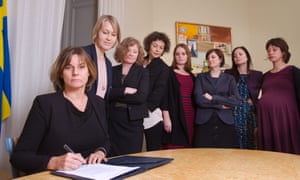
Sweden’s deputy PM, Isabella Lövin, signs bill seen as a parody of Donald Trump signing the ‘global gag’ order.


Sweden’s deputy PM, Isabella Lövin, signs bill seen as a parody of Donald Trump signing the ‘global gag’ order. Photograph: Johan Schiff/EPA

The Swedish deputy prime minister made headlines last month when she appeared to parody Trump and the all-male lineup in the Oval Office that signed the global gag order.


Lövin, who is also environment minister, tweeted a picture of herself and female colleagues, as she signed Sweden’s climate law.


But she brushed aside questions she was mocking Trump and his administration, saying: “The message was not that we were only women in that picture; the message was that we are taking leadership when it comes to tackling climate change.


“This was my staff and myself and my state secretaries and I was signing a bill and that’s all.”


Countries pledge millions to plug hole left by US "global gag rule"

25 Kasım 2016 Cuma

Thatcher pushed for breakup of welfare state despite NHS pledge

Margaret Thatcher secretly tried to press ahead with a politically toxic plan to dismantle the welfare state even after a “cabinet riot” and her famous declaration that the “NHS is safe with us”, newly released Treasury documents show.


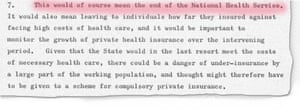
The plan commissioned by Thatcher and her chancellor Sir Geoffrey Howe included proposals to charge for state schooling, introduce compulsory private health insurance and a system of private medical facilities that “would, of course, mean the end of the National Health Service”.


Some of her cabinet ministers believed they had buried the plan, drawn up by a seconded Treasury official, Alan Bailey, from the Central Policy Review Staff (CPRS), at a special cabinet meeting on 9 September 1982.


Nigel Lawson in his memoirs said the paper of “long-term public spending options” had been buried after what he described as “the nearest thing to a cabinet riot in the history of the Thatcher administration”. In her own memoirs, Thatcher claimed to have been “horrified” by the CPRS paper and insisted that she and her ministers had never seriously considered it.


The CPRS paper had been partially leaked and she was only able to quell the subsequent furore by famously pledging the “NHS is safe with us” at the October 1982 Tory party conference. Downing Street briefed that the toxic plan had been “shelved”.


Thatcher documents ragout


Photograph: Handout

But Howe’s Treasury private office papers released by the National Archives on Friday confirm that not only had that special cabinet meeting taken place to discuss the plan but that two months later, far from being buried, Thatcher was still secretly trying to press ahead with it.


The Treasury papers show that once a clutch of tricky byelections were out of the way she was keen to keep pushing the plan and held a series of meetings in December to “to soften up the big three spenders” under her chairmanship “to resolve any immediate political anxieties”.


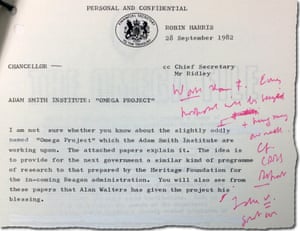
The papers also show after the 9 September cabinet showdown Howe rejected an approach from the Adam Smith Institute, the rightwing libertarian thinktank, to back their “slightly oddly-named Omega Project” despite it being personally endorsed by Thatcher’s own economic adviser, Sir Alan Walters.


The Omega Project papers said the plans were modelled on research by a rightwing US thinktank for the incoming Ronald Reagan administration. It also argued for many state services to be replaced by “more efficient alternatives from the private sector”.


Chancellor - Adam Smith Institue - Ragout from 1982


Photograph: HM Treasury

Howe rejected the approach in a note on 29 September not because he objected to their proposals to dismantle the welfare state but because he feared its “ill-researched proposals, which will be portrayed as strongly resembling our own, might prove an embarrassment”. The then chancellor added: “Every proposal will be seized on and hung (round) our necks. Cf CPRS Report. I see v. (underlined twice) great harm.”


The Treasury papers show that “no real action” was taken on the CPRS “radical right manifesto” until November 1982. “The prime minister (we understand privately) did not want to stir this up before the cabinet discussions on the 1982 survey, nor risk any adverse publicity while the last two byelections were pending. The leaks of the CPRS report did not help,” a senior Treasury official, Peter Mountfield, told Howe in a confidential note entitled “Follow-up of cabinet discussion on long-term public expenditure”.


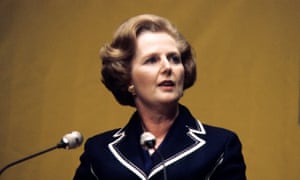
Margaret Thatcher


Margaret Thatcher secretly continued to pursue the politically explosive plans even after ministers thought they had been killed off by a cabinet revolt. Photograph: PA

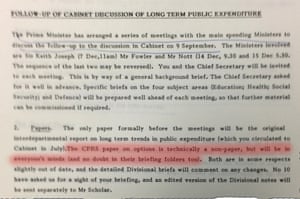
“The prime minister has arranged a series of meetings with the main spending ministers to discuss the follow-up to the discussion in cabinet on 9 September. The ministers involved are Sir Keith Joseph (7 Dec, 11 am), Mr Fowler and Mr Nott (14 Dec, 9.30 and 15 Dec 5.30.). You and the chief secretary will be invited to each meeting.”


Joseph was education secretary, Norman Fowler was health secretary and John Nott was defence secretary. The CPRS paper proposed to cancel Trident and halt the growth in defence spending.


“The only paper formally before the meetings will be the original interdepartmental report on long-term trends in public expenditure … The CPRS paper on options is technically a non-paper, but will be in everyone’s minds (and no doubt in their briefing folders too),” Mountfield told Howe.


The chancellor was told the objective of the meetings was “designed to soften up the three big spenders. Without their support the operation will not work. Your main aim, I suggest, should be to ensure that no sacred cows are prematurely identified. Given the prime minister’s concern about the NHS, this may be difficult. But we want to make sure that the ministers concerned do not close off any options at this stage, and, if possible, put their personal weight behind the exercise.’’


Follow up of Cabinet Discussion of Long Term Public Expenditure - Ragout


Photograph: HM Treasury

These papers flatly contradict Thatcher’s claim that the CPRS proposals were never seriously considered by ministers. The Treasury files released on Friday do not record what happened at the meetings with the big three spenders.


But a Treasury official’s note on 28 October 1982 to the then chief secretary to the Treasury, Leon Brittan, gave an indication of the depth of internal opposition Howe and Thatcher faced. “DHSS (health and social security) officials say there is no chance that Mr Fowler would agree to a further study of this idea. I imagine in the circumstances, and especially given the prime minister’s speech at Brighton it is difficult to press them.”


In his memoirs, Howe reflects that although the row had postponed the “fundamental debate” he had hoped to start, until after the 1983 general election, “nothing from the Treasury’s point of view is ever as quite as bad as it seems”.


He reported that the impact of what he called the “CPRS furore” had ensured ministers made no new spending pledges and had “set the pace for our forthcoming 1983 manifesto”.


Thatcher pushed for breakup of welfare state despite NHS pledge

22 Eylül 2016 Perşembe

Mark Zuckerberg and Priscilla Chan pledge $3bn to end all disease - video

Facebook chief executive Mark Zuckerberg and his wife, Priscilla Chan unveil plan to spend more than $ 3bn over 10 years to ‘cure, prevent or manage all disease within our children’s lifetime’. Investments will include a bioscience research centre, plans for a microchip to diagnose diseases, continuous bloodstream monitoring and a map of cell types in the body.


Mark Zuckerberg and Priscilla Chan pledge $3bn to end all disease - video

10 Eylül 2016 Cumartesi

Brexit camp abandons £350m-a-week NHS funding pledge

Leaders of the cross-party campaign that persuaded the British people to leave the EU have dropped their pre-referendum pledge of a £350m-a-week spending bonanza for the NHS.


Many of those who headed the Vote Leave campaign, including its former chair, Labour MP Gisela Stuart, and Michael Gove, the Tory former justice secretary, are re-forming this weekend, creating a new pressure group called Change Britain.


Other top names involved in the organisation, which says it is being established to help “deliver the UK’s referendum result in the most effective way”, include former chancellor Nigel (Lord) Lawson, Digby Jones, former head of the CBI, and David (Lord) Owen, the former Labour foreign secretary.


But despite the NHS pledge having been at the heart of their message in the run-up to the 23 June vote, and displayed on the official Vote Leave battlebus, the Change Britain website made no mention of the NHS in its manifesto about how to make a success of Brexit.


Instead, Change Britain said on its “Brexit Means Brexit” page that any savings made as a result of no longer having to pay into the EU budget (assuming the UK leaves the single market) should be spent on guaranteeing “continued funding for farming, science, universities and poorer regions of the UK”. The website was taken down, although cached versions of its pages were still accessible through search engines.


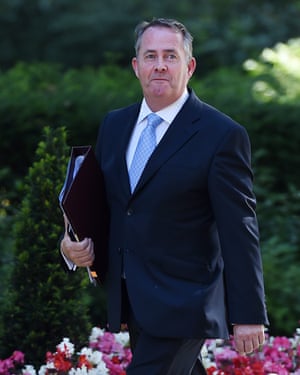
Liam Fox


Liam fox told a Conservative reception the UK had grown ‘too fat’ on the successes of previous generations. Photograph: Andy Rain/EPA

Anna Soubry, the pro-Remain Tory MP and former minister for small business, said it was outrageous that the Leave campaigners had “peddled that lie” during the campaign and were now quietly abandoning it.


The Remain camp argued all along that it was wrong to claim that the UK sent £350m a week to Brussels as this is the gross figure and does not take account of the large sums of money that come back in EU farm and other subsidies, including structural funds and education and research grants. The idea that so much extra money could be guaranteed for the NHS post-Brexit was also challenged as totally unrealistic.


Soubry, a leading light in Open Britain, the successor to the Remain campaign, added: “They should all hang their heads in shame. There were many people, particularly in less wealthy areas, who were convinced by Leave’s claim that if we left the EU we would be able to pour millions more into the NHS. The danger now is these people will become even more disillusioned with all politicians because this lot misled them.”


Last weekend, prime minister Theresa May, speaking at the G20 summit in China, said she was unable to guarantee extra money for the health service post-Brexit, and came out against a points- based immigration system – which was the other central plank of the Brexit campaigners’ pitch to voters.


In an open letter, 30 Labour MPs – including former cabinet minister Ben Bradshaw, former shadow Europe minister Pat McFadden and ex-frontbenchers Emma Reynolds and Chuka Umunna – call on the Brexit campaigners to admit the NHS pledge was a lie.“ There should be no escaping this pledge for the Leave campaign – they cannot walk away from it now, disown it or pretend it never happened. They must either admit it was a lie and apologise to their voters, or justify it.”


On Saturday Downing Street made clear its annoyance with Liam Fox, the international trade secretary responsible for negotiating post-Brexit trade deals, who angered businesspeople by suggesting British executives would rather play golf than export their goods and services.


Fox, a former GP and staunch Eurosceptic, told a reception for the Thatcherite group Conservative Way Forward that the UK had grown “too fat” on the successes of previous generations. Downing Street issued a curt statement saying these were Fox’s private opinions.


Brexit camp abandons £350m-a-week NHS funding pledge

26 Ocak 2015 Pazartesi

Vaccine price lower pledge not ample, critics inform Pfizer

The pharmaceutical company Pfizer has pledged to minimize the value of its new vaccine against a deadly disease by six%, but campaigners say the reduction is nowhere near enough.


Final week Médecins Sans Frontières named for a reduction of the price of the vaccine against pneumococcal ailment to $ five (£3.30) per little one, claiming the two firms manufacturing it had been producing huge revenue.


At a donor conference in Berlin hosted by Angela Merkel to increase funds for the international vaccines alliance Gavi, Pfizer supplied to reduce the price from $ three.30 a dose to $ 3.10. Each youngster needs 3 doses.


The other firm making the vaccine, the British drugmaker GlaxoSmithKline, mentioned it would freeze the price for ten years for middle-revenue countries that drop Gavi funding because of their escalating wealth.


But MSF mentioned the concessions had been not adequate. “Pfizer’s small price lower for the pneumococcal vaccine is inadequate. We require to see the two Pfizer and GlaxoSmithKline get bolder measures to minimize the cost of this vaccine in building countries so that a lot more youngsters can be protected towards pneumonia,” said Kate Elder, vaccines policy adviser for MSF’s entry campaign.


“Considering Pfizer has raked in practically $ 16bn for this vaccine in just 4 many years, we believe the firm can do significantly far more than a meagre six% discount.”


MSF also would like significantly greater transparency from organizations, complaining that they do not reveal the charges of studying, establishing and manufacturing vaccines nor the charges they charge in different countries. The Guardian launched a crowdsourcing exercise asking readers close to the world to aid fill in the gaps by finding out the value of the vaccine in which they dwell.


“Pfizer claims that it is generating the pneumococcal vaccine accessible to the poorest countries at beneath cost value, but we really do not know if that’s accurate,” Elder mentioned. “We require to see the two Pfizer and GSK opening up their books – being transparent for a adjust – on what the genuine costs of the study, development and production of this vaccine are. The secrecy that shrouds the vaccine industry helps make it practically impossible to have an educated discussion on sensible vaccine costs.”


Vaccine price lower pledge not ample, critics inform Pfizer

3 Haziran 2014 Salı

Cadbury makes anti-weight problems pledge with cap on chocolate bar calories

Cadbury chocolate bars

Cadbury ‘bar and a half’ chocolate merchandise will be phased out by the finish of 2015, the parent business says. Photograph: Lefteris Pitarakis/AP


Cadbury is quit generating and marketing chocolate bars in the Uk that have more than 250 calories apiece, in a move that participates in the government’s voluntary anti-weight problems drive.


Cadbury, owned by the US confectionary giant Mondelez Worldwide, will phase out “bar and a half” items this kind of as Dairy Milk bar and a half, Dairy Milk Whole Nut bar and a half, and Dairy Milk Fruit and Nut bar and a half.


Mondelez explained it would also take into account altering the dimension of at least two other brands, indicating that these would be correspondingly decreased in cost.


Most of Mondelez’s products currently fall beneath the 250 calories cap but the company, which also helps make Philadelphia cheese and Belvita breakfast biscuits, explained the move was component of its commitment to “help our consumers snack mindfully”.


In a statement it mentioned: “Mondelez Worldwide knows it has a part to perform in assisting men and women lead more healthy lives. One particular way do to this is to assist customers reduce their calorie consumption, which is why we signed the calorie reduction pledge.


“As portion of this pledge, we have committed that, by the end of 2015, all our single serve (bars) confectionery goods will be 250 calories or significantly less.”


The announcement was created last week in an update of the Division of Health’s voluntary anti-obesity campaign with foods firms.


In 2012 Mars said it would minimize the calorie material of its bars to a highest of 250 calories by the finish of 2013, in line with the public well being responsibility deal promoted by Andrew Lansley, when he was overall health secretary.


The deal has been criticised for letting firms off the hook because companies only have to make voluntary pledges above limited action in return for minsterial guarantees not to legislate to impose tougher rules.


The accountability deal is a voluntary scheme that asks firms to sign up to pledges to support healthier options. This contains minimizing the amount of salt, excess fat, sugar, alcohol unit and calories in the products made and offered, and taking action to boost well being at operate and promote physical activity.


But numerous organizations are ignoring government pleas to reduce the sum of excess fat, salt or sugar in their goods.


Coca-Cola, Kellogg, Danone and other big foods and drink producers, have shunned appeals to make their merchandise significantly less vitality dense to help meet the government’s target of folks in England consuming, total, 5bn fewer calories a day.


Sainsbury, Kraft Food items, Nestlé, Tate &amp Lyle and Unilever, have also declined to indicator up to a joint pledge on calorie reduction.


But the Division of Well being final month explained very good progress was being created across the board. As component of the calorie reduction pledge, it explained Britvic now developed only its “no extra sugar” Fruit Shoot in the Uk. This will take away an estimated 2.2bn calories from the children’s drinks industry.


The division also trumpeted progress in alcohol. The market made a commitment to getting rid of from the industry 1bn units of alcohol offered yearly, with a deadline of December 2015. This would be principally by means of widening customer choice with regard to lower alcohol merchandise.


But there is a extended way to go. Final week an authoritative global review reported that there have been greater ranges of obese and overweight folks in the Uk than anywhere else in western Europe, except for Iceland and Malta.


In the United kingdom, 67% of males and 57% of girls are either obese or obese, according to the Global Burden of Condition review, published in the Lancet healthcare journal. Far more than a quarter of young children are overweight or obese, the figures put at 26% for boys and 29% for ladies.


Cadbury makes anti-weight problems pledge with cap on chocolate bar calories

26 Mart 2014 Çarşamba

Pledge to save 6,000 lives through NHS safety campaign


In a speech provided to a hospital in Seattle he will contact on all NHS organisations to “Sign up to Safety” publishing strategies to lessen avoidable harm, such as medication mistakes, blood clots and bed sores Mr Hunt will say the strategies will allow the NHS to save up to 6,000 lives more than the next 3 many years, while minimizing the quantity invested on litigation following healthcare blunders.


Peter Walsh, chief executive of patient safety charity Action against Health care Accidents, hailed the announcement of the complete duty of candour as “potentially the greatest advance in patients’ rights and patient security given that the creation of the NHS.”


He said: “For decades the NHS has frowned on cover-ups but has been ready to tolerate them. A lack of honesty when factors go incorrect adds insult to damage and causes unnecessary discomfort and suffering for every person.”


New patient details will also be publicised, with a new micro-web site, How Risk-free Is My Hospital, so the public can very easily evaluate hospitals across a assortment of indicators.


Overall health Secretary Jeremy Hunt will say: “It is my clear ambition that the NHS should grow to be the safest healthcare program anyplace in the planet. I want the tragic events of Mid Staffs to become a turning stage in the creation of a a lot more open, compassionate and transparent culture inside of the NHS.


“We now have a as soon as in a generation opportunity to save lives and avoid avoidable harm – which will empower personnel and conserve income that can be re-invested in patient care. Hospitals are already “signing up to safety” as element of this new motion – and I hope all NHS organisations will soon join them.”


Mr Hunt is generating the speech to the Virginia Mason Hospital in Seattle, which turned itself around to become 1 of the safest hospitals in the world after incident a decade in the past when a patient died following currently being accidentally injected with cleaning fluid.


Pledge to save 6,000 lives through NHS safety campaign

5 Şubat 2014 Çarşamba

GP fears dropping task in excess of pledge to keep patient information personal

His website reads: “This practice requires its duties to safeguard patient confidentiality extremely critically and so we have determined to assume (even however carrying out so might flip out to be illegal) that all of our patients wish to opt-out of this data extraction, till such time as you inform us that you wish to enable your data to be employed in this way.”


But Dr Gancz said he feels he has a duty of care to his sufferers and they ought to have to agree to their personal info being utilized.


He told Pulse magazine: “It will be intriguing to see what power they have, if any, to cease one particular basically stating what is the case. Men and women are being bulldozed into giving consent by default – that is on my internet site and it’s practically nothing but the truth – how can they tell me to get it off?’


He extra: “The logic of this e mail is that unless I give in to the bullying of NHS England and illegally – as defined by the Information Protection Act and the GMC – release my patients’ confidential info, I shall have my contract to function as a GP withdrawn.”


The care.data scheme is due to begin in Spring and will share patient information from GP practices with the Wellness and Social Care Info Centre to determine trends and poor performance in the NHS. It is also hoped the new method will support target remedy where there is a specific clinical need.


At the second only hospital information is employed, and it is hoped by using GP information, information will be far more exact and patient care improved.


However there are concerns that information could be accessed by hackers and turn into identifiable, or be sold onto personal businesses who could use info to target merchandise and revenue from people’s illnesses.


A survey by Pulse magazine just lately discovered 4 in 10 GPs intend to personally opt out of the scheme because they are so concerned about the security of information.


Proposed European Union laws on information protection could also render the scheme unlawful.


The letter to Dr Gancz, sent from NHS England’s Thames Valley group, mentioned: “We wish to go over the remediation necessary simply because you have published on your practice web site details about the care.data extraction indicating that you intend opting your patients out of the information extraction unless they make contact with you to opt in.”


GP fears dropping task in excess of pledge to keep patient information personal