lifestyles etiketine sahip kayıtlar gösteriliyor. Tüm kayıtları göster

15 Aralık 2016 Perşembe

Sedentary lifestyles: the hidden factor in the social care crisis | Peter Walker

The current debate about the ever-growing pressure on social care services is by no means the first, and certainly won’t be the last. But it is always predicated around the same central assumption: with increasing numbers of older people, the costs can only go up. This is to miss an important point, one well known to public health experts but strangely ignored by most politicians. The problem isn’t just about an ageing population, it’s also about an increasingly sedentary one.


That far too many Britons are not physically active is well documented, even if the sheer extent can sometimes be surprising. For example, a fifth of Scottish people say they have not walked for more than 20 minutes even once over the past year. Not once. Also well known, if less discussed, is the toll this takes on the public health. The usual estimate is that about 85,000 people die early each year in England and Wales due to illnesses caused by sedentary living, mainly heart disease, type 2 diabetes and various cancers.


But callous as it sounds, what really keep senior civil servants awake at night isn’t the mortality rate; it’s the parallel issue known as morbidity: the quality of life people can expect as they age, and thus how independent they remain. Here, the near-magical effects of keeping up even a fairly minimal regime of exercise are also well documented.


Physical activity keeps people stronger and more supple as they age. It also improves balance, gives better bone density and makes them less likely to be depressed or develop Alzheimer’s. These are all things associated with needing less social care.



Cyclists in Amsterdam: ‘The Netherlands and Denmark have spent decades deliberately re-shaping their road environments away from the car culture of the 1960s and 70s towards mass cycling.’


Cyclists in Amsterdam: ‘The Netherlands and Denmark have spent decades deliberately re-shaping their road environments away from the car culture of the 1960s and 70s towards mass cycling.’ Photograph: Alamy Stock Photo

The earlier people start such a regime, the better the effect into older age. One public health expert once told me he encourages people this way: “I tell them, ‘being active throughout your life is about being able to get to the loo on time in your old age’. They can get their heads around that.”


If it’s so conclusive, why is the government not pushing this as part of the solution? Here we get into the more tricky area of what is politically acceptable, and whether ministers want to embark on what is, in effect, low-scale social engineering. Decades of experience has shown that just encouraging people to exercise has limited impact. Urging people to go to a gym or walk briskly round their local park eats into what is known to experts as “discretionary time” – when they could be doing something else. Thus they tend to give up pretty soon.


One of the few exercise regimes proved to stick is active travel, more specifically making walking or cycling to work, school or the shops sufficiently safe and convenient that it becomes easier for people to do it than not. Cycling is arguably the mode that should be encouraged the most. Aside from the fact people can cover greater distances on a bike than on foot, studies have shown that the slightly greater exertion it involves brings even more miraculous health benefits.


The mechanics of how you nudge people away from cars and on to bikes is another discussion, but there is little doubt it can be done if the political will is there. The Netherlands and Denmark, for example, have spent decades very deliberately re-shaping their road environments away from the car culture of the 1960s and 70s towards mass cycling. It’s not an accident.
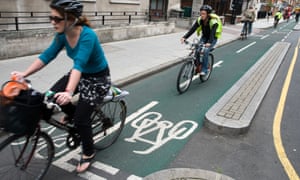


‘In his first interview as transport secretary, Chris Grayling spoke of cyclists only to complain about those who jump red lights and to say bike lanes cause problems for “road users”, a group that apparently doesn’t include people on bikes.’


‘In his first interview as transport secretary, Chris Grayling spoke of cyclists only to complain about those who jump red lights and to say bike lanes cause problems for “road users”, a group that apparently doesn’t include people on bikes.’ Photograph: Alamy Stock Photo

Yes, it would take the UK a decade or so to make similar changes. But given the vast and unquestioned public health benefits on offer, with the huge savings this would bring on social care (not to mention the NHS, which some experts predict will soon become bankrupt due to the costs of ailments linked to sedentary lives), it’s a bit depressing that we haven’t even begun the debate.


For all the occasionally hysterical media narrative on cycling, it barely exists as an issue at the top of government. In his first interview as transport secretary last week, Chris Grayling spoke of cyclists only to complain about those who jumped red lights and to suggest that bike lanes caused problems for “road users”, a group that apparently doesn’t include people on bikes.


Grayling’s predecessor in the job, Philip Hammond, now the chancellor, was reported last month to have urged London’s mayor, Sadiq Khan, to rip out one of the few properly designed and safe bike lanes in the entire country. This is not to castigate the pair personally. Barring a handful of exceptions, almost all Britain’s top politicians think much the same about cycling as everyday transport.


The debate on social care shows how blinkered this is. As part of a book I’ve been writing about the beneficial effects of more cycling, I spoke to a number of public health experts about the problem of sedentary living. Several of them used the same analogy: getting people active in their everyday lives is, they said, like “a miracle pill” in the way it wards off disease and decrepitude. That miracle pill is well known. We’re just waiting for someone with the political vision to administer it.


Bike Nation: How Cycling Can Save the World, by Peter Walker is published in April


Sedentary lifestyles: the hidden factor in the social care crisis | Peter Walker

7 Temmuz 2014 Pazartesi

Western lifestyles fuel expanding weight problems epidemic in Nigeria

A woman carries fruit to sell in the market on World Food Day in Lagos, Nigeria. The UN

A woman carries fruit to sell in the market on Globe Foods Day in Lagos, Nigeria. Photograph: Sunday Alamba/AP


The whole world is getting fatter. It is really clear in Latin America, exactly where Mexico now has higher costs of weight problems than the United States and is mounting a fightback by means of soda and junk foods taxes, as I described in my book. There are key issues, too, in Asia, in which China has the second greatest population of obese men and women soon after the USA. After people two come India, Russia, Brazil, Mexico, Egypt, Germany, Pakistan, and Indonesia, according to the Global Burden of Ailment research from the University of Washington, published in the Lancet. Some 30% of the world’s population is now obese or obese, raising their risk of wellness problems.


But what of Africa, where we see photos too often of emaciated, malnourished, young children and their mother and father and grandparents?


In accordance to a new review published by the open entry journal PLOS One particular, obesity is growing rapidly in elements of sub-Saharan Africa. The review appears at Nigeria and finds that western influences on diet and life style are taking part in a part in what looks set to be a critical epidemic that is going to produce all the overall health troubles the west is previously struggling with. Needless to say, the health programs of sub-Saharan Africa are going to be a whole lot less capable to cope.


The examine from researchers at Warwick healthcare college discovered that far more than a single in five ladies in Nigeria is obese or obese – among guys the charges are considerably lower, which the authors consider might be down to the sum of physical perform men even now do.


Fat goes with wealth in Nigeria right now. The richest girls are three and a half times far more probably to be overweight or obese than these in the lowest earnings bracket. That is not so surprising. But education and social status also enhance women’s probabilities of putting on far more excess weight than is great for their health. In Nigeria, there is a cultural component to this – richer and a lot more profitable girls are expected to be fatter. But element of this is the pursuit of a life style that is presumed to be enviable due to the fact it is that of men and women in the affluent nations of the planet like the US and the Uk. They emulate our success and are landed with our difficulties.


Dr Ngianga-Bakwin Kandala at Warwick puts it like this:


Obesity is now not just a western issue, but an African 1 as effectively. By turning out to be wealthier, better educated and urbanised areas of Nigeria are gaining the attributes we would much more frequently associate with western societies. This has brought both a modify in lifestyle and diet program that is reflected in discovering that educated, wealthy females are a lot much more likely to be obese than people residing in more rural, standard regions.


And this is his colleague, Professor Saverio Stranges:


Urbanisation, and the shift in the direction of what we would consider to be much more western routines, appears to come hand in hand with a more sedentary way of life and modify in diet. A lot more folks have cars and drive in which they may possibly have walked in the past. The rise in world wide web usage within the cities sees far more individuals sat down for prolonged periods, the two at house and at work.


This physical inactivity is worsened by a significantly less balanced diet plan. An in excess of reliance on energy dense processed foods can be highlighted by the developing presence of quickly foods outlets and the knock on effect is decreasing the intake of staple, minimal calorie foods.


Under-nourishment now exists cheek by jowl with overweight. There is a large contrast between urban areas like Lagos and rural regions in which folks labour to feed their families from their own patch of earth. Prof Stranges puts this double difficulties extremely well:


The be concerned is that Nigeria, like numerous Sub-Saharan African countries, is dealing with a major public health challenge with a growing variety of obese adults, whilst huge segments of the population encounter difficulties linked with underneath nutrition. This dual burden will imply combating both malnutrition and the dangers associated with obesity, this kind of as cardiovascular disease.


Western lifestyles fuel expanding weight problems epidemic in Nigeria

7 Nisan 2014 Pazartesi

Lord Coe: Lazy lifestyles will shorten our children"s lives

Lord Coe, who was chairman of the London Organising Committee for the Olympic Video games, writes: “Today’s kids are the least energetic generation in background.


“They also may possibly be the 1st generation to have a shorter daily life expectancy than their mothers and fathers. That’s not progress, that is moving backwards, and physical inactivity may be a greater culprit than we think.”


The All Get together Commission on Physical Action warned that more than half of all adults do not get the minimal sum of workout recommended by professionals.


The four Uk Chief Health care Officers advise at least two-and-a-half hrs of moderate bodily exercise every single week.


The report by MPs warns that fewer youngsters are playing freely in streets, parks and open spaces, with a lot of ferried to school by automobile by mother and father who commit most of their operating lives behind a desk.


It highlights study which displays the common office employee now spends 5 hours 41 minutes sitting at their desk each day, even though just 22 per cent of grownups attain even half an hour’s physical exercise a week.


The commission says the regular Briton is 24 per cent significantly less lively than in 1961, and on course to be 35 per cent less active by 2030, with the lack of action linked to a rising burden of unwell-health, from circumstances this kind of as type 2 diabetes, heart illness and cancer.


It states: “Physical inactivity prospects to all around 37,000 premature deaths a 12 months – a amount that is more than all deaths from murder, suicide and accident combined. Lack of physical action is estimated to double the fee of absenteeism at perform, and to expense the United kingdom economic climate billions each 12 months.”


In the report, MPs phone for adjustments in town and transport arranging in order to make it less complicated for people to make a lot more journeys on foot or by bicycle.


Malcolm Shepherd, chief executive of charity Sustrans said: “The simplest and single most efficient way of increasing bodily activity is to transform our daily journeys to school, work or leisure into lively journeys by strolling or cycling. The regular primary college journey is just one.5 miles – the perfect distance to stroll or cycle. If eight out of 10 main school journeys had been manufactured by bike or on foot, numerous of our physical exercise ambitions would be realized.”


Lord Coe: Lazy lifestyles will shorten our children"s lives