Walker etiketine sahip kayıtlar gösteriliyor. Tüm kayıtları göster

15 Aralık 2016 Perşembe

Sedentary lifestyles: the hidden factor in the social care crisis | Peter Walker

The current debate about the ever-growing pressure on social care services is by no means the first, and certainly won’t be the last. But it is always predicated around the same central assumption: with increasing numbers of older people, the costs can only go up. This is to miss an important point, one well known to public health experts but strangely ignored by most politicians. The problem isn’t just about an ageing population, it’s also about an increasingly sedentary one.


That far too many Britons are not physically active is well documented, even if the sheer extent can sometimes be surprising. For example, a fifth of Scottish people say they have not walked for more than 20 minutes even once over the past year. Not once. Also well known, if less discussed, is the toll this takes on the public health. The usual estimate is that about 85,000 people die early each year in England and Wales due to illnesses caused by sedentary living, mainly heart disease, type 2 diabetes and various cancers.


But callous as it sounds, what really keep senior civil servants awake at night isn’t the mortality rate; it’s the parallel issue known as morbidity: the quality of life people can expect as they age, and thus how independent they remain. Here, the near-magical effects of keeping up even a fairly minimal regime of exercise are also well documented.


Physical activity keeps people stronger and more supple as they age. It also improves balance, gives better bone density and makes them less likely to be depressed or develop Alzheimer’s. These are all things associated with needing less social care.



Cyclists in Amsterdam: ‘The Netherlands and Denmark have spent decades deliberately re-shaping their road environments away from the car culture of the 1960s and 70s towards mass cycling.’


Cyclists in Amsterdam: ‘The Netherlands and Denmark have spent decades deliberately re-shaping their road environments away from the car culture of the 1960s and 70s towards mass cycling.’ Photograph: Alamy Stock Photo

The earlier people start such a regime, the better the effect into older age. One public health expert once told me he encourages people this way: “I tell them, ‘being active throughout your life is about being able to get to the loo on time in your old age’. They can get their heads around that.”


If it’s so conclusive, why is the government not pushing this as part of the solution? Here we get into the more tricky area of what is politically acceptable, and whether ministers want to embark on what is, in effect, low-scale social engineering. Decades of experience has shown that just encouraging people to exercise has limited impact. Urging people to go to a gym or walk briskly round their local park eats into what is known to experts as “discretionary time” – when they could be doing something else. Thus they tend to give up pretty soon.


One of the few exercise regimes proved to stick is active travel, more specifically making walking or cycling to work, school or the shops sufficiently safe and convenient that it becomes easier for people to do it than not. Cycling is arguably the mode that should be encouraged the most. Aside from the fact people can cover greater distances on a bike than on foot, studies have shown that the slightly greater exertion it involves brings even more miraculous health benefits.


The mechanics of how you nudge people away from cars and on to bikes is another discussion, but there is little doubt it can be done if the political will is there. The Netherlands and Denmark, for example, have spent decades very deliberately re-shaping their road environments away from the car culture of the 1960s and 70s towards mass cycling. It’s not an accident.
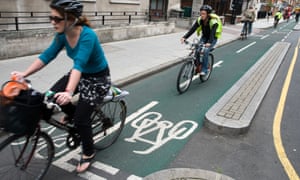


‘In his first interview as transport secretary, Chris Grayling spoke of cyclists only to complain about those who jump red lights and to say bike lanes cause problems for “road users”, a group that apparently doesn’t include people on bikes.’


‘In his first interview as transport secretary, Chris Grayling spoke of cyclists only to complain about those who jump red lights and to say bike lanes cause problems for “road users”, a group that apparently doesn’t include people on bikes.’ Photograph: Alamy Stock Photo

Yes, it would take the UK a decade or so to make similar changes. But given the vast and unquestioned public health benefits on offer, with the huge savings this would bring on social care (not to mention the NHS, which some experts predict will soon become bankrupt due to the costs of ailments linked to sedentary lives), it’s a bit depressing that we haven’t even begun the debate.


For all the occasionally hysterical media narrative on cycling, it barely exists as an issue at the top of government. In his first interview as transport secretary last week, Chris Grayling spoke of cyclists only to complain about those who jumped red lights and to suggest that bike lanes caused problems for “road users”, a group that apparently doesn’t include people on bikes.


Grayling’s predecessor in the job, Philip Hammond, now the chancellor, was reported last month to have urged London’s mayor, Sadiq Khan, to rip out one of the few properly designed and safe bike lanes in the entire country. This is not to castigate the pair personally. Barring a handful of exceptions, almost all Britain’s top politicians think much the same about cycling as everyday transport.


The debate on social care shows how blinkered this is. As part of a book I’ve been writing about the beneficial effects of more cycling, I spoke to a number of public health experts about the problem of sedentary living. Several of them used the same analogy: getting people active in their everyday lives is, they said, like “a miracle pill” in the way it wards off disease and decrepitude. That miracle pill is well known. We’re just waiting for someone with the political vision to administer it.


Bike Nation: How Cycling Can Save the World, by Peter Walker is published in April


Sedentary lifestyles: the hidden factor in the social care crisis | Peter Walker

29 Ocak 2014 Çarşamba

Charlotte Walker: if you reduce psychological wellness money, you have to reduce providers

It really is been an eventful couple of weeks for mental well being campaigners like Charlotte Walker, aka award-winning Bipolar Blogger, whose website is referred to as Purplepersuasion. With Nick Clegg advertising the government’s newest mental wellness technique, inquiries about cuts and the top quality of companies have been attracting consideration.


For Walker, 35, whose erudite and controversial blog shines a spotlight on the problems that proceed to face folks living with a mental illness, it is not the very first time she has heard the government’s excellent intentions. “It is not quite a lot of many years because we had the No Wellness Without Mental Wellness approach and variety of received nowhere,” Walker says of previous attempts to prioritise psychological well being. “We all go by way of these convulsions of guilt that our services is not good sufficient and pledge to make it various, but the resourcing is never ever there.”


Launching the government’s most current action plan, Closing the Gap, Clegg laid out new efforts to carry mental wellness out of the “dark ages”, which includes providing service-end users the proper to pick the place they obtained their care, the introduction of minimum waiting occasions and an extension of “speaking therapies”. He was pushing for “parity of esteem” or, in less impenetrable language, equality of care with physical wellness.


Walker welcomed Clegg’s robust assault on psychological well being nevertheless being regarded as “the bad cousin” of the NHS and for highlighting the stubborn persistence of discrimination and stigma. Even so, for all Clegg’s overtures, Walker has reservations.


“It truly is this entire annoying phrase ‘parity of esteem’,” she says. “Why are we talking about parity – no person knows what that implies. We want equality of funding, we want equality of esteem in terms of currently being taken significantly, and we want equality of treatment method as in not getting to wait for months [for treatment].”


“People are up in arms when there is a beds crisis in a normal hospital trust but they are not up in arms [about acute psychological wellness wards]. If you reduce the income then they have to cut providers.”


When it comes to selection about the place to be handled, Walker says, “just like colleges – most folks never truly want to have to travel a lengthy distance to locate a services which is respectable. They just want the one down the road to be Ok. The principal issue is the postcode lottery. What occurs to you, even with the identical diagnosis, depends purely on the place you live … which is just going to make you feel helpless and hopeless.”


Between bloggers on psychological wellness, Walker’s blunt and well-informed commentary has been broadly lauded. She helps make the level that she doesn’t create or talk about every mental well being-connected issue but rather individuals of which she has individual expertise or is especially passionate about, and it has proved a winning formula. She not too long ago won a prestigious digital media award from the charity Mind, and MPs, charities and academics now regularly contact her in for consultations.


Via the website and Twitter, Walker blends astute analysis of troubles with a raw candour about her personal knowledge of bipolar disorder, usually posting brief and occasionally harrowing descriptions of how the sickness is affecting her on any provided day, such as suicidal thoughts. What began as a personal blog in Might 2011 morphed into a fully formed platform that drew readers in their droves.


“There was no plan. It was like, ‘this is how it feels to me’,” she says. Being place on anti-psychotic drugs and going by way of the “horrendous” side effects spurred her to create about how difficult it all was. “I just considered, ‘I’ll publish this, I do not know where else to say it’. [By way of] all of this I was [contemplating]: ‘I’m going to be back at operate any minute now’,” she says.


It was a number of months following beginning to publish when she posted a site, “10 factors not to say to a depressed particular person”, which garnered 38,000 views in a single day, that Walker thought she might be on to one thing. “It was a bit in-your-face,” she says of the submit. “It got to the level exactly where so numerous individuals left me so many remarks. Actually, actually, private stuff. Individuals who didn’t know me at all just felt compelled to open up.”


It is clear Walker will take the suggestions as constructive reinforcement, but it truly is not without having its problems. “Each and every week, I will have a person e-mail me, direct message me [or] text me – who I don’t know that effectively or in some circumstances don’t know at all – asking for advice and telling me their actually very distressing situations. When it really is much more raw I actually find it quite challenging. I feel at times people overlook that I am not a mental overall health skilled,” she says.


One particular of the ongoing concerns Walker has studiously targeted on is “back-to-operate” reforms affecting jobseekers with well being troubles or disabilities. As someone with initial-hand encounter of the contentious work-capability assessment approach she is vocal about the misery it has inflicted on men and women with “hidden or fluctuating” situations, in specific.


She has taken component in “listening exercises” with MPs, where she has tried to explain the actuality for individuals impacted. “My level is: ‘look at me, I’ve got two [first-class] degrees … I’ve received all this sound operate historical past however I can’t function.’ And, if I can’t, what about all the people with extreme fluctuating psychological illnesses and no experience of interviews? My problem is so complex and so changeable it truly is all really nicely to say I could have a phased return … [but] at times I can function and occasionally I can not operate.


“I came away [from consultations with the DWP] with the impression that they believed the issue is ‘change the jobseeker to match the system’, and as a disabled individual I feel ‘no, the dilemma is, we need to have to adjust workplaces to suit us’.”


For all of her passion, campaigning came late to Walker, who carved out a effective job in the probation service prior to her psychological health seriously deteriorated. She was in her 30s by the time she sat down and wrote about her experiences, and already had more than two decades of encounters with psychological wellness services – like varying diagnoses, alterations of medications and even an try to consider her very own lifestyle. (She first designed symptoms at the age of 12 but initially medical professionals put her mood fluctuations down to “getting a teenager”.)


She says that more than the past year, her weblog has became far more campaign-focused. “Just far more and much more issues have been coming up that pissed me off, fundamentally,” she says.


When we meet, Walker describes herself as “currently being at a bit of a crisis stage at the second”, healthwise, but she plans to hold creating, campaigning and carving out a “portfolio profession”. She has written a bipolar memoir as well, The Incoming Tide, which she hopes will be a lasting legacy. For now, although, the likelihood of positive change is out there, she says. “There are some items for which we don’t need to have extra funds [and] we could do issues greater.”


Age 35.


Standing Spouse, two teenage young children.


Lives Ealing, west London.


Education Samuel Whitbread Upper College, Bedfordshire University of Luton, degree in present day English scientific studies antenatal schooling HE diploma University of Hertfordshire, degree in criminal justice studies level four NVQ in local community justice probation research diploma.


Occupation 2012-current: mental health blogger/trainer/advisor/writer 2007-12: acting senior probation officer/probation officer, London Probation 2005-07 trainee, London Probation 2003-05: probation officer, Bedforshire Probation 2002-03: clinical audit and effectiveness officer, Bedford hospital NHS trust 2000-01: student midwife, Bedford hospital and antenatal teacher, NCT.


Awards Mark Hanson digital award, Thoughts Awards 2013 mood disorder award, Mentalists Awards 2012.


Interests Choral singing, innovative writing, cooking, travel.


Charlotte Walker: if you reduce psychological wellness money, you have to reduce providers