There's etiketine sahip kayıtlar gösteriliyor. Tüm kayıtları göster

18 Nisan 2017 Salı

Poppy Jaman: ‘I think there’s a wave of change coming in mental health’

Poppy Jaman, chief executive of the not-for-profit Mental Health First Aid England (MHFAE), believes Theresa May meant business when she pledged in January to make mental health a priority. Despite ministers being accused of breaking their promises after £800m in cash earmarked for mental health was last month redirected to offsetting wider NHS budget problems, Jaman argues that the government will come good.


“I think this government has already set a precedent for change, with two consecutive prime ministers making commitments to improve the outlook for those with mental health issues and attending to the prevention agenda,” says Jaman, referring to NHS England’s Mental Health Taskforce national strategy published in 2016. “I think it’s massively a great step that the current PM has made a public commitment to mental health.”


MHFAE runs training courses in how to identify the warning signs of mental ill health in others and help steer them towards appropriate support. Jaman has headed the social enterprise for almost 10 years, since it evolved from a government initiative within the Department of Health. She says she’s “feeling confident” the Conservatives recognise the significant toll mental health problems can take on individuals and wider society. By way of illustration she points to the imminent roll-out for secondary school staff of a government-funded schools training course delivered by MHFAE to address mental health issues among young people. The goal is to have “mental health first aiders” in place who can help to identify pupils with mental health challenges, ideally before they reach a crisis point. The programme aims to train staff in more than 1,000 schools by 2020.


Evidence over the past decade from MHFAE’s training to more than 150,000 individuals – such as NHS staff, charity workers and employees at large corporations including Unilever and WH Smith – shows it can contribute to the broader “public health prevention” and wellbeing agenda, says Jaman, by “giving people the tools” to recognise signs of mental difficulty.


The jobcentre service needs staff who understand mental health so people get the right support


Poppy Jaman


The mental heath first aid approach is ostensibly an adjunct to standard first aid and Jaman has been campaigning to put the two on a par. This includes supporting a push to amend regulations around first aid within the Health and Work Act, so that all organisations are required to have mental health first aiders in place, and an obligation to deliver mental as well as physical first aid. An early day motion last year calling for such a transformation was backed by about 500 MPs, including Norman Lamb and Frank Field. Implementing it would be “a big leap for equality” and parity of esteem between mental and physical health, Jaman argues.


“I truly believe that making this legislative change would have a big positive impact because it would shift the dial on how employers have to think about the mental and physical health needs of their workforce.”


A third-generation British Bangladeshi, Jaman, 40, says her early grassroots professional work, coupled with having experience of depression as a young woman, helped her to develop an understanding of the challenges facing people with mental health problems, especially among diverse groups. And having grown up in a deprived ward in Portsmouth and left school at 16 (she later got an MBA), she says she is cognisant of how poverty and racial inequalities affect mental wellbeing and access to care. “There is a plethora of data on health outcomes, job outcomes and opportunities for the black and minority ethnic community and when you overlay that with the prevalence of mental ill health and outcomes, the odds are stacked against them.”


Prince William and Lady Gaga discuss mental health for Heads Together – video

So it’s no surprise that Jaman does not underestimate the significant impact of current government policies such as sanctions and fitness-for-work tests for people living with mental health problems. One area in which she is anxious to see improvements is help for people who are unemployed, many of whom have a mental health diagnosis.


She refers to a recent public call by an alliance of mental health professional organisations including the British Psychological Society for a suspension of the government’s sanctions programme because of its negative impact on mental wellbeing and for statutory support for creating psychologically healthy workplaces.


The same group also recommended increased mental health awareness training for jobcentre staff, which Jaman agrees is necessary. “It [the jobcentre] service needs people who understand mental health so that people are getting the right support,” she says. Asked how this is conceivable in a jobseekers system that advocates have repeatedly argued is hostile to mentally vulnerable people, she responds that change needs to come from “the leadership” at the Department for Work and Pensions. “I think there is a wave of change coming around this,” she insists.


When it comes to nudging the government in the right direction, Jaman is clearly a pragmatist. It is important to challenge government policies “where we don’t think things are right”, she argues, but ultimately, “for me it’s about ‘let’s work with whoever we need to work with’.”


Poppy Jaman: ‘I think there’s a wave of change coming in mental health’

5 Mart 2017 Pazar

For the vulnerable, there’s no place like home | Sri Kalidindi

Imagine this. You’ve suffered a debilitating mental illness, you’re admitted to hospital and, after weeks or months of treatment, you’re finally deemed stable enough to go home. Only, you can’t – the home you need in the community is not available.


As a psychiatrist, this is a situation I and many others around the country encounter almost daily. Even when patients are ready to leave hospital, a notable number don’t have the specialist supported housing they need to take that step.


Currently, around 60,000 people in England live in specialist mental health supported accommodation. They are there because of the severity of their condition, their level of vulnerability and their complex needs, which often include requiring support for everyday activities. Supported housing offers them the freedom to live as independently as possible, while also reducing their use of hospital beds, both in the mental health sector and in the acute, physical health sector.


With the right support from housing care staff alongside secondary mental health care rehabilitation and recovery services, many can and do achieve stability. Along with this, the opportunities to re-engage with family, education, work and their community are more within reach.


Without such provision, many people become stuck in highly restrictive, costly and more institutionalised care, such as hospital wards and care homes. These are often at great distances from their families and communities and require even more public funding. Supported housing provides that crucial interim step for those who need it, between hospital or residential care home, to people moving into their own flats with support coming in. This also often means the difference between living and staying well in the community, to becoming unwell again and requiring yet another hospital admission.


Money can be spent more efficiently when people are in the right setting for their level of need


Providers of supported housing for vulnerable people, including those with mental health conditions, have clearly communicated that the government’s proposed changes to how supported housing is funded will result in the closure of such services. Yet there does not appear to be a viable alternative for those most in need. Providers of supported housing have already been closing accommodation across England and halting the development of new, much needed provision.


The effects are already being seen on acute psychiatric wards, with increasing levels of delayed discharges, resulting in fewer available beds for those requiring acute emergency admission and an increasing number of people being sent hundreds of miles from home.


It has also been found that those who are sent far away for treatment are more likely to take their own lives upon returning home than those who are admitted to hospitals close to them.


The adequate provision of supported housing locally is crucial for many national policies and strategies to be realised. These include the five year forward view for mental health, the Crisp commission on acute adult psychiatric care and transforming care for people with learning disabilities, which all state the central importance of specialist supported housing to aid people’s recovery and to enable successful community living.


The health and social care system is made up of so many parts. The lack of a joined-up policy results in unintended consequences for patients, their families, services, commissioners who pay for care and society as a whole.


Money can be spent more efficiently when people are in the right setting for their level of need. For this to work, a system-wide approach across health and social care with adequate resources at each level, including supported housing, is vital. Especially for those whose lives depend on it.


If health regulators would fund a more joined-up way of working, then every person could receive the right care and support, in the right place, at the right time.


Dr Sri Kalidindi is head of the rehabilitation & social psychiatry faculty at the Royal College of Psychiatrists Comments will be opened later


For the vulnerable, there’s no place like home | Sri Kalidindi

13 Şubat 2017 Pazartesi

Smog tips: what to do when there"s a pollution warning

In the UK, the department for environment, food and rural affairs issues daily alerts measuring air pollution levels. But when it comes to tips on how to respond, Defra confines itself to the slightly gnomic “reduce activity”.


So we asked a team of air pollution experts on the best ways to protect yourself when there’s a pollution alert in your city.


Exercise earlier – or do it indoors


The general advice, according to Frank Kelly, professor of environmental health at King’s College London is to “try to avoid exercising during a pollution episode. If you have to exercise, do so indoors.” As Ally Lewis, director of the National Centre for Atmospheric Science, points out though, the question of whether to “exercise, cycle to work or go for a run depends on the individual”. For keen runners, he says: “If you shift it to early in the morning, that would benefit anybody, because air pollution tends to build up with rush hour at about 7 or 7.30am. If you’re going to cycle to work, doing it an hour earlier, before pollution builds up, could have a significant impact on exposure.”


Pray for rain


“Particulate matter is removed primarily by rainfall,” according to Mark Jacobson, professor of Civil and Environmental Engineering at Stanford University. Don’t rush out as soon as it starts, though. “You have to wait a short while. If it’s moderate to high pollution and it starts raining, I would give it 60 minutes or so and then there’ll probably be quite a difference,” Kelly adds. If there’s wind and rain, even better.


Walk one street back


“Avoiding main arterial roads really does make a difference,” says Lewis. “Pollution drops away substantially when you’re walking one street back. If you look at the concentration gradient say, 20, 30, 40 metres away from a very congested road, it’s not like pristine air from the Atlantic but it will be two or three times less polluted. That’s a gain worth having.”


Use an app to avoid hotspots


Kelly recommends using “a travel app that gives you a lower pollution route choice”. King’s College have developed one for London and others are popping up, such as Plume, which covers more than 200 cities.


People wear pollution masks on a bus in China


‘Understand the extent of pollution at your location, where you live or work.’ Photograph: Kevin Frayer/Getty Images

Keep the windows closed


“It would be good to not open any windows,” says Kelly. If you’ve got a well-sealed house “there won’t be much pollution coming in from outside, but you’ve got to be wary of what you produce inside that can’t escape”. Anything that involves burning produces invisible particles and gases, so …


No fires inside


If cooking with gas, use an extractor fan, preferably with a filter. “That’s something we don’t do very well at all,” says Kelly. “If it’s a cold day, it would be bad to light a fire or wood stove inside the house.”


… including candles


The other big no-no. “Scented candles are very popular but they really can shoot the particle concentrations up quite a lot indoors,” he says.


Stay informed


“Understand the extent of pollution at your location, where you live or work,” says Kelly. Conditions are always changing, so use websites such as the one his team at King’s developed, or the Department for Environment, Food and Rural Affairs. You could also see what local sensors are saying.


Eat your greens


“Always try to eat healthily, including fresh fruit and vegetables. They help maintain your body’s antioxidant reserves, which are able to reduce the effects of any pollution you are exposed to,” Kelly says.


A 2015 study he co-authored compared diets among twins, and found that “those with the best lung function were the ones who consumed more vitamin E and vitamin C”. This complements previous studies pointing to a similar effect, although the evidence isn’t conclusive. However, it’s unlikely that loading up on supplements during pollution spikes will cancel your inflammatory response to noxious particles and gas.


The complex mechanics of antioxidant benefits aren’t yet fully understood, but the data suggests “that those people on very good diets which include a lot of different nutrients, working in combination with concentrations of antioxidants, were the source of the benefit”, he adds.


Guardian Cities is dedicating a week to investigating one of the worst preventable causes of death around the world: air pollution. Explore our coverage at The Air We Breathe and follow Guardian Cities on Twitter and Facebook to join the discussion


Smog tips: what to do when there"s a pollution warning

16 Ocak 2017 Pazartesi

"Can I speak to a serial killer?": there"s more to NHS comms than you"d think

“Can I speak to Peter Sutcliffe?”


The journalist was perfectly serious. I was working in communications at Broadmoor hospital and he saw me as a route to people he thought were patients there. He wanted Sutcliffe’s “take” on a series of recent “Ripper style” murders in the Ipswich area. I explained – while trying to not audibly gasp – that Broadmoor could not confirm who its patients were, let alone put them up for press interviews.


Every so often, an FOI request asks how much the NHS spends on “communications”. The easy headline is that the NHS needs real doctors, not spin doctors. But it is only when you look at the range of activities that communications cover that you wonder if the real spin doctors are those writing the story.


To some, communications is just shorthand for public relations and spin. In fact, responding to media queries (and FOI requests) – which the NHS is rightly expected to do as a public service – is a tiny proportion of our work.


Much of it is about making sure staff know what’s going on in their organisation, that information for patients is clear and easy to access and that MPs, local councils, regulators and community organisations are kept informed and involved in what the NHS is doing.


I have worked at a large trust where there was no system in place for briefing staff on the wards about things they needed to know. I’ve worked in places where every department was producing its own, homemade newsletter that was badly written, misspelt and missed out the information patients needed. I have had to advocate for people’s right to know about changes to local services and to develop plans to reach people who don’t read newspapers, rarely visit their GP and certainly don’t attend NHS meetings.


Part of the job is to manage press and public interest in the event of a major incident. This involves careful planning, working with other emergency services. How do you keep people informed, including your own staff, concerned members of the public and relatives of those impacted? Where do they all go in a busy working hospital? And major incidents come in different shapes and sizes. If a high-profile patient dies in your hospital, you need to be able to manage not just a potential media scrum disrupting your hospital, but the needs of the family too. I recall liaising with one very high-profile family after their son died, because they wanted to visit the hospital morgue without being accosted by the press.


Then there is the navigation issue. How does a person find their way around a hospital, let alone the whole NHS? Part of our job is to make sure that patients can get to the service they need as quickly as possible. How do we reach every potential patient to achieve this? How do we describe different services to the public? (spoiler: not always very helpfully).


I don’t deny that the odd Amateur Alistair surfaces, desperate to turn their job running comms for a cottage hospital into The Thick of It. But they are a rare breed. The majority of us see our job as helping the public, the media and a huge range of stakeholders to understand how the NHS works, the challenges it is facing and how they might be able to help. If you think about the huge numbers of services we provide, the many different communities we serve and the amount of information that implies, this is far from easy.


In recent years we have seen the beginnings of a sea change in the way the NHS talks to patients and the public. Expertise in consultation and community engagement is increasingly valued, not just because these things are required of the NHS, but because we know that involving patients in the development of services improves those services no end.


Some of the best conversations I have had about the NHS have been with the public. Most people understand the challenges presented by an ageing society, flat funding and increasingly expensive treatments. While they will not always agree with each other – or the NHS – on the best solutions, I am yet to attend an NHS public engagement event where I didn’t hear several good ideas. Of course, there is the odd moment – one man went around each person on a table, asked them their background and announced none of them were as qualified as him to talk about “his NHS” – but we should not underestimate the positive contribution patients and the public can make.


If you would like to write a blogpost for Views from the NHS frontline, read our guidelines and get in touch by emailing sarah.johnson@theguardian.com.


Join the Healthcare Professionals Network to read more pieces like this. And follow us on Twitter (@GdnHealthcare) to keep up with the latest healthcare news and views.


"Can I speak to a serial killer?": there"s more to NHS comms than you"d think

16 Aralık 2016 Cuma

How price-gouging of opioid overdose cure costs lives: "There"s never enough"

Ben Dunkle died at the age of 20, abandoned in a carpark by panicked friends who had no idea how to save his life as he overdosed on heroin.


“I’m certain that if they had been carrying naloxone, they wouldn’t have run away,” said his mother, Aimee Dunkle.


After Ben’s death, Aimee made it a mission to get naloxone, an antidote that can bring overdosing opioid users back from the brink of death within minutes, into the hands of as many people as she could. In February she founded the Solace Foundation in southern California to distribute the naloxone among addicts, many of them homeless, their relatives and friends. She says the group has saved at least 365 lives.


But Dunkle said she could have saved more if it were not for the surging cost of the drug which has prompted accusations of pharmaceutical companies profiteering from the US’s opioid epidemic. Costs for pre-filled syringes doubled in 2014 and are three times the price of 15 years ago, while injectors used to administer the spray have increased to more than five times the price in two years.


“More people are dead now than would have been otherwise,” said Dan Bigg, director of the Chicago Recovery Alliance, an important distributor of naloxone in the city. “How many is hard to count, but programmes that would have started didn’t because of the cost of naloxone. Programmes that would have expanded didn’t because of the price of naloxone. To the extent pricing is an impediment, it will prevent this being used as a lifesaving medicine.”


Deaths from opioid overdoses surged again last year to more than 30,000, driven by a sharp increase in the use of heroin and fentanyl.


Heroin deaths were up 23% on the previous year to 12,989, more than the number of lives claimed by guns used in murders, according to data released by the Centers for Disease Control and Prevention (CDC) on Thursday. The sharpest increase came from lives claimed by even more powerful synthetic opioids, such as fentanyl, the drug that killed Prince, which were up 73% to 9,580 deaths, although some of those deaths were in combination with heroin. But prescription opioid painkillers, containing drugs such as oxycodone, remained the biggest killers, taking 17,536 lives.


Medical studies say that most heroin users first become addicted to prescription drugs. It is how Ben Dunkle came to die.


ben dunkle


Ben Dunkle in 2012. Photograph: Courtesy of the Dunkle family

Overdoses are so widespread that the National Center for Vital Statistics found drug-related deaths are dragging down life expectancy for white adults.


After 15 years of steadily rising deaths from opioids, what the CDC has called an epidemic has finally forced its way on to the political stage with $ 1bn in treatment and prevention legislation passed by Congress. It has also resulted in ever-widening access to naloxone as more police forces carry it and states liberalise access by making it available without a prescription. But increased demand for the antidote has coincided with a sharp rise in cost.


Naloxone is most commonly administered by injection or spray. Kaléo, a Virginia company, has increased the price of its naloxone auto-injectors, sold as Evzio, from $ 690 for a kit of two to $ 4,500 in less than two years. Amphastar of California nearly tripled the price of syringes pre-filled with naloxone.


“When we started in 1996, a 10cc vial of naloxone was $ 1.63. Now that 10cc vial is almost $ 300 at Walgreens here,” said Bigg. “Has the price been raised well beyond what it costs to make in an obscene way for such an important lifesaving drug? Yes.”


Robert Childs, director of the North Carolina Harm Reduction Coalition, one of the largest non-profit distributors of naloxone in the US, said his organisation has spent about $ 220,000 this year giving out more than 13,000 naloxone kits to police officers and others working with those at risk of overdose.


“If naloxone wasn’t the price it is, we would be able to buy a lot more and get a lot more out there to high-risk populations,” he said. “There’s a public health crisis with opiate and opioid-based drug overdoses, and the response has often been to increase the price which is probably the worst response you can do.”


The increased demand and rising prices has resulted in a surge in income from naloxone for drug companies, up 400% since 2011 to $ 82m last year.


“It’s one thing to charge more for snow shovels when there’s a blizzard, but this is a public health emergency,” said Dr Andrew Kolodny, co-director for opioid policy research at Brandeis University. “When you have an epidemic of people dying of opioid overdoses, [this] should be readily available. We shouldn’t have pharmaceutical companies profiteering.”


Doctors writing in the New England Journal of Medicine called for government intervention to control the price of the drug, saying that cost is discouraging use of naloxone. They said that legislation has greatly expanded access to the antidote but that the price remains an obstacle.


“We believe that such policies should explicitly call on manufacturers to reduce the price of naloxone and increase transparency regarding their costs, particularly those related to the development of new formulations,” it said.


“The message to lawmakers is drug prices are an increasingly important problem for patients,” said one of the article’s coauthors, Dr Joseph Ross, an associate professor of public health at Yale University and a primary care physician.


Aimee Dunkle took one look at the young man slumped on a bench in a Santa Ana carpark three weeks ago and knew she had only minutes to act.


“The giveaway for me was he was drooling. He was breathing very shallowly. I recognised him and called his name. There was no response,” she said.


The man was overdosing on heroin and benzodiazepines, a lethal combination. Dunkle pumped a shot of naloxone – also known by the trade name Narcan – into him.


“I gave him the first shot of Narcan and no response. I gave him the second shot and he woke up. He was groggy, but he was up almost immediately. Someone had dialed 911 but before law enforcement arrived he was walking away,” she said. “It was exhilarating to save a life for the first time but then I realised this is how Ben died, sitting in a car, slumped over.”


Most of the manufacturers distribute a limited amount of free supplies to community groups and emergency services like Dunkle’s or sell naloxone at a discount.Dunkle said her group received free auto-injectors from Kaléo, but when they ran out she could not afford to buy more even at the discounted price for non-profits.


“There’s no way I can even contemplate buying it,” she said. “We sometimes get some financial donations. One time I had about $ 1,500 that had been donated and I bought $ 1,500 of Narcan. Then I had to select who to give it to. Not who was at most risk but who was most likely to witness an overdose. For a mother that’s lost a child, that’s a hellish decision to have to make: who gets the kits and who doesn’t.”


Supplies dried up for three weeks in September. Dunkle said that inevitably meant lives were lost.


“Our waitlist was over 70 people and that meant people died because we didn’t have it,” she said.


But financial donations mean she now has supplies to see her through the first half of 2017 distributing 70 naloxone kits a week. Still, that falls well short of demand.


“There’s never enough,” she said.


naloxone

The rising costs have drawn scrutiny in Congress. Senators Susan Collins and Claire McCaskill wrote to five pharmaceutical companies in June asking them to explain their pricing of naloxone.


A spokesman for McCaskill said that in meetings the companies defended the increases as necessary to cover the cost of new delivery systems. Naloxone, which has been on the market since 1971, is no longer covered by a patent and is cheap to produce. But pharmaceutical companies do have patents on how the drug is administered, such as by spray or auto-injectors, a spring-loaded syringe.


“In meetings, generally speaking the companies have argued that the price increases are due to new and more efficient delivery systems,” he said. “The question is, are these new bells and whistles effective?”


Manufacturers said the introductions of nasal sprays and auto-injectors are easier and safer to use than regular syringes. But Bigg questions whether those modifications justify the cost given that both means of delivery were already commonly used with other drugs.


An Irish company, Adapt Pharma, which makes a widely used naloxone nasal spray with a trade name of Narcan, denied that the patent was a means to price gouge. It said the spray “is designed, tested and approved so that anyone in the community can deliver a proper dose in non-medical conditions”.


“It’s not as simple as just putting naloxone into the device and selling it,” said Mike Kelly, president of Adapt’s US operations. “To obtain Food and Drug Administration approval, we must consistently meet the standards set by the FDA.”


The list price for the spray is $ 150 for the two shots typically administered to someone who overdoses on opioids which Adapt notes is considerably cheaper than a rival, the Ezvio auto-injector, with a retail price of $ 4,500 for a pack of two.


Kelly said the company discounts the cost for community groups and the police by 40% and that a majority of patients using a prescription can obtain it through health insurance for $ 10.


“We have made it our mission to provide more access and availability than ever before – including donating more than 50,000 doses of Narcan nasal spray to increase awareness and experience with the product and naloxone generally,” he said.


Mark Herzog, vice-president of corporate affairs at Kaléo said the six-fold increase in the list price of Ezvio was made in order to cover the cost of ensuring anyone with insurance and a prescription can obtain the drug cheap or free. The company responded to the senators’ letter by claiming that the real barrier to naloxone access is “lack of insurance coverage or unreasonable coverage restrictions”.


The company said it has donated more than 150,000 auto-injectors to public agencies and community groups. Other drug manufacturers did not respond to requests for comment including one of the largest naloxone sellers, Hospira, which has raised the cost of a vial of the drug by 1,700%.


How price-gouging of opioid overdose cure costs lives: "There"s never enough"

1 Kasım 2016 Salı

There’s more to life than reproduction | Letters

Bibi Lynch (‘It’s exhausting and crushing’, Family, 29 October) nails the emotional cruelties casually handed out to non-mothers (to adapt her preferred term of non-parents). Non-fathers are on the receiving end of similar treatment. At its worst, while dads are happily left in charge of other parents’ children, we non-fathers are not so trusted. It was recently suggested to me that paedophiles are “mostly men without kids”.


Like non-mothers, non-fathers are routinely assumed to be emotionally compromised and biologically lacking. Many parents take the view that “everyone wants kids” – and so men who don’t have them are probably “firing blanks”. Some of us thought shared ideas of masculinity no longer rested on sperm count, but maybe we’re too optimistic.


Lynch makes the point that being a mum doesn’t naturally mean anything. Neither does being a dad. In common with many non-fathers, I think – with good grounds – that I have a great deal to offer kids. I’ve just never wanted to father them. There are enlightened parents, of course. They’re the ones who realise that you don’t need to reproduce to make your mark.
Steve Chinn
Stirling


I am so appreciative of Bibi Lynch. She says out loud what I am feeling constantly without being able to articulate it clearly enough to myself or others. Feeling left out, sidelined, ignored, and meaningless is a constant drain that can suck all vitality out of me at times. Society and people in general seem so unaware and sometimes downright insensitive towards those of us who are involuntarily childless.


I gave a presentation on this at a counselling conference a while ago which was well received but, as with all minority issues, it was up to someone like me (the minority person) to highlight the difficulties, distress and pain of being involuntarily childless.


At 60-plus we are much more likely to be severely depressed or alcoholic than the general population (not being a grandparent is a double whammy). This can be somewhat alleviated by counselling or psychotherapy but how many of you are looking out for the impact of involuntarily childlessness on your friends or family before it gets to this stage? I do hope those of you who have children and grandchildren might reflect a bit more on this issue after reading Bibi’s courageous piece of writing.
Derryn Ellingham
Norfolk


Bibi Lynch powerfully illustrates the prejudice and hurt experienced by women who are not mothers. She gives several examples of the ignorance and assumptions people make about this group. It is a shame then that she ends her article by making a gross assumption herself – “A man ejaculating in you does not make you kinder or wiser or more valid than me”. Of course she is correct. However, a substantial minority of women become mothers without men ejaculating into them, but via other means such as IVF, self-insemination, by adopting children or through surrogacy. To argue for the rights of one group, whilst stereotyping the other, unhelpfully detracts from the important point she is trying to make.
Dr Laura Golding
Chorlton, Manchester


Many things are crushing and exhausting, not least treading on eggshells around people who seem determined to read what was never meant into the most innocent remarks. What has happened to our sensibilities and ability to discern what is a deliberately insensitive or hurtful remark when we seem to be incapable (or unwilling) to accept that most people are not trying to score a point or denigrate but are just unaware of our personal circumstances or feelings? Perhaps more tolerance on all sides would make life a little less fraught.
Linda Marriott
Lincoln


Join the debate – email guardian.letters@theguardian.com


There’s more to life than reproduction | Letters

17 Ekim 2016 Pazartesi

Unsick days: a day off when there’s nothing wrong with you ... but there’s a catch

Name: Unsick days.


Age: Brand new.


Appearance: Confusingly altruistic.


I like the sound of this, provided that an unsick day means I can take time off work when I’m not sick. That’s right! That’s exactly what an unsick day is!


Amazing! I already know how I’m going to spend mine. Does it involve going for routine medical and dental appointments?


Well, I’d been planning to spend a lot of it eating takeaways and watching Judge Rinder. Then you’ve fundamentally misjudged the notion of an unsick day. It’s specifically a day on which workers can preventatively go and get themselves seen to.


Really? I haven’t seen a dentist in 13 years because my boss would kick off if I took an afternoon off work. That’s exactly what an unsick day is for. It’s a day when you’re encouraged to see a dentist, so you don’t have to take six months off when your jaw starts rotting two years from now, which it definitely will.


How thoughtful. I know. It’s the brainchild of American healthcare scheduling service Zocdoc, who …


Oh, I get it, this is a publicity stunt. Apparently not. Apparently companies such as Virgin Hotels and Foursquare have agreed to sign up to the scheme from next year.


What are the benefits? Better health, obviously, and the overwhelming morale boost that comes from knowing that your boss isn’t a cackling Victorian workhouse supervisor determined to wring every last ounce of productivity from you before watching you drop dead from exhaustion.


Sounds great! When do we get unsick days over here? Well, don’t hold your breath.


Why? Have you tried getting a doctor’s appointment for a non-emergency lately? My local surgery is rammed until the middle of 2023.


Surely, we could still benefit from some sort of unsick day? I mean, perhaps there could be a day where you get to stay at home and Google the symptoms of that rash on your arm until you become convinced that you’ve contracted a rare form of penis cancer.


Well, sure, if it gets me a day off work. You’re right. I demand an unsick day!


Do say: “Hi, doc! There’s nothing wrong with me, but here I am.”


Don’t say: “This won’t put any more undue strain on the NHS, will it?”


Unsick days: a day off when there’s nothing wrong with you ... but there’s a catch

13 Ekim 2016 Perşembe

My patient told me he is going to stab someone. There"s nothing I can do

“I’m going to go home and I’m going to stab someone.”


Alan is in the weekly ward review meeting with a group of doctors, nurses, and students. We’ve told him we think he is well enough to leave the ward; he disagrees.


I am a consultant psychiatrist with a team working in a secure psychiatric inpatient unit, where he has been treated. He is unusual in that he has had his first psychotic episode later in life. The rest of his story is more depressingly typical; a chaotic childhood, expelled from school, periods in care and prison. He received no professional help and was left to drift between prison, homelessness, alcoholism, using drugs and managing only tenuous, readily broken relationships. Alcohol in very large quantities has, arguably, been what has kept him going, cutting him off from his unfortunate reality.


Possibly because of the alcohol, he began to hear voices and has had a spell in hospital where he was violent towards the staff. Medication has made the psychotic symptoms disappear.


But he doesn’t want to go home. He’s no longer psychotic, but his habit of violence hasn’t disappeared with the voices. If he stabs someone and ends up back in prison he doesn’t care.


So what to do about Alan?


He now has the capacity to make decisions about his actions. He understands, on one level, that being violent towards people is not the best thing to do. He doesn’t care though. Alan is the product of an unfortunate combination of nature and nurture that has left him with an inability to manage even the most minor frustration. If I had been seriously hurt by his actions the police would, probably, have agreed to arrest him. I find myself wondering aloud if that might have been easier for us all.


But the CPS would almost definitely have refused to follow through because Alan has been sectioned in the past and has mental health problems. Mere threats to kill if discharged from hospital will attract little interest from the criminal justice system, although we will go through the motions of talking to the police. Alan is in the mental health system now. The reality is that anything Alan does in the future can come back to bite any mental health professional who has had anything to do with him.


His case joins the many others creating the great sword of Damocles hanging my head and that of most psychiatrists. He can’t stay in hospital for ever. He attacked people before he became psychotic, usually when drunk; he is likely to again as he doesn’t even pretend to want to give up alcohol.


I will try not to worry about Alan stabbing someone. I hope he is bluffing. We will contact the police and will document in detail our view that he is now responsible for his behaviour – and we will discharge him.


Alan is not his real name and some details have been changed


If you would like to contribute to our Blood, sweat and tears series which is about memorable moments in a healthcare career, please read our guidelines and get in touch by emailing sarah.johnson@theguardian.com.


Join the Healthcare Professionals Network to read more pieces like this. And follow us on Twitter (@GdnHealthcare) to keep up with the latest healthcare news and views.


My patient told me he is going to stab someone. There"s nothing I can do

15 Eylül 2016 Perşembe

From Poldark to Bieber, there"s a male body ideal but is it problematic?

When Poldark returned for its second series on BBC1, it was clear who the real breakout star of the show was: Aidan Turner’s chest. In newspaper and magazine coverage, Turner was questioned about on-screen nudity in the style of a Hollywood starlet opening up about topless scenes. A month earlier, Justin Bieber and Orlando Bloom had appeared fully naked in competitive photo opportunities, a sort of Gladiatorial battle for the Pokémon Go generation. The celebrity male body was not only being more objectified than ever before, it was becoming prime real estate.


Could a knock-on effect be a rise in male body issues? A study from the University of Lincoln, links exposure to images of musclebound men with fuelling gym attendance. The study’s co-author Dr David Keatley said: “Anyone can be affected by what they see online, the social cues images can give and the popular conceptions of an ‘ideal body image’.”


The study goes further, linking gym attendance with feelings of inadequacy, rather than a desire to build muscle. “With the recent growth of selfies … there’s a real risk that males may be more influenced to attend the gym more regularly and work out to a point where it becomes dangerous or detracts from their wellbeing,” Keatley continued.


California daze


A photo posted by Sam Smith (@samsmithworld) on


But are selfies, celebs and Instagram wholly to blame for these masculinity transitions? In August, Dr Jamie Hakim theorised that this “spornosexuals” era (Mark Simpson’s portmanteau of “sports star” and “porn star” where men attend the gym to look “hench” rather than healthy) was tied to the recession. He argued that, after the 2008 recession, men were no longer able to be defined by the traditional signifiers of status (good job, home ownership) and instead had to rely on proving their masculine worth via their bodies.


“The joys of accumulating spornosexual capital are one of the few remaining for young men in Britain’s post-crisis, austerity economy,” wrote Hakim, a lecturer at the University of East Anglia (UEA). It echoed something that Simpson said locating the trend to the north-east of England.


“The north-east was carpet-bombed by Thatcherism in the 80s,” he told Esquire “Coal and shipbuilding disappeared and were replaced by shopping, service industries, gyms and tanning salons.”


In February, when singer Sam Smith debuted his new, svelte figure on Instagram the comments were full of opinions about how he should look (“He got wayyy too thin”; ”He was hotter when he was fat”). Such ill-meaning banter illustrated a new truth: people’s idea of the “ideal” male body has never been clearer, and that can only be problematic thing.


From Poldark to Bieber, there"s a male body ideal but is it problematic?

2 Ağustos 2016 Salı

Everyone recommends flossing – but there"s hardly any proof it works

It’s one of the most universal recommendations in all of public health: floss daily to prevent gum disease and cavities.


Except there’s little proof that flossing works.


Still, the US federal government, dental organizations and manufacturers of floss have pushed the practice for decades. Dentists provide samples to their patients; the American Dental Association insists on its website: “Flossing is an essential part of taking care of your teeth and gums.”


Related: Everything you ever wanted to know about teeth (but were afraid to ask the dentist)


The federal government has recommended flossing since 1979, first in a surgeon general’s report and later in the Dietary Guidelines for Americans issued every five years. The guidelines must be based on scientific evidence, under the law.


Last year, the Associated Press asked the health and agriculture departments for their evidence, and followed up with written requests under the Freedom of Information Act.


When the federal government issued its latest dietary guidelines this year, the flossing recommendation had been removed, without notice. In a letter to the AP, the government acknowledged the effectiveness of flossing had never been researched, as required.


The AP looked at the most rigorous research conducted over the past decade, focusing on 25 studies that generally compared the use of a toothbrush with the combination of toothbrushes and floss. The findings? The evidence for flossing is “weak, very unreliable”, of “very low” quality, and carries “a moderate to large potential for bias”.


“The majority of available studies fail to demonstrate that flossing is generally effective in plaque removal,” said one review conducted last year. Another 2015 review cites “inconsistent/weak evidence” for flossing and a “lack of efficacy”.


One study review in 2011 did credit floss with a slight reduction in gum inflammation – which can sometimes develop over time into full-fledged gum disease. However, the reviewers ranked the evidence as “very unreliable”. A commentary in a dental magazine stated that any benefit would be so minute it might not be noticed by users.


The two leading professional groups – the American Dental Association and the American Academy of Periodontology, for specialists in gum disease and implants – cited other studies as proof of their claims that flossing prevents buildup of gunk known as plaque, early gum inflammation called gingivitis, and tooth decay. However, most of these studies used outdated methods or tested few people. Some lasted only two weeks, far too brief for a cavity or dental disease to develop. One tested 25 people after only a single use of floss. Such research, like the reviewed studies, focused on warning signs like bleeding and inflammation, barely dealing with gum disease or cavities.


Wayne Aldredge, president of the periodontists’ group, acknowledged the weak scientific evidence and the brief duration of many studies. In an interview at his private practice in New Jersey, he said that the impact of floss might be clearer if researchers focused on patients at the highest risk of gum disease, such as diabetics and smokers.


Still, he urges his patients to floss to help avoid gum disease. “It’s like building a house and not painting two sides of it,” he said. “Ultimately, those two sides are going to rot away quicker.”


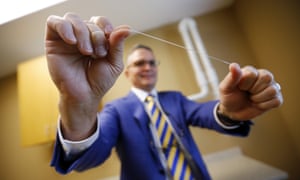
Wayne Aldredge, president of the American Academy of Periodontology, holds a piece of dental floss.


Wayne Aldredge, president of the American Academy of Periodontology, holds a piece of dental floss. Photograph: Julio Cortez/AP

Aldredge also said many people use floss incorrectly, moving it in a sawing motion instead of up and down the sides of the teeth. Pressed about the origins of his organization’s endorsement of flossing, he said it may simply have “taken the ADA’s lead”.


When the ADA was asked for proof of its claim that flossing helps prevent early gum disease and cavities, the group cited the 2011 review and a 2008 two-week study that measured bacteria and did not even consider gum disease.


In a later statement to the AP, the ADA said flossing “removes plaque” and “is proven to help remove” debris from between teeth. A video on its website proclaims that flossing “helps prevent gum disease”. When pressed, Matthew J Messina, a practicing dentist and spokesman for the dental association, acknowledged weak evidence, but he blamed research participants who didn’t floss correctly.


Even companies with a big market share of the flossing business – by next year, the global market is predicted to reach almost $ 2bn, with half in the United States, according to the publisher MarketSizeInfo.com – struggled to provide convincing evidence of their claims that floss reduces plaque or gingivitis. Yet the industry has paid for most studies and sometimes designed and conducted the research.


Procter & Gamble, which claims that its floss fights plaque and gingivitis, pointed to a two-week study, which was discounted as irrelevant in the 2011 research review.


Johnson & Johnson spokesman Marc Boston said floss helped remove plaque. When the AP sent him a list of contradicting studies, he declined to comment.


The floss-making companies partner with the ADA through its Seal of Acceptance program. The ADA promotes the seal to companies as something that “directly affects the purchase decisions of consumers”; each manufacturer is charged $ 14,500 for the evaluation. If it approves the product, the ADA then charges an additional annual fee of $ 3,500.


The ADA says it rigorously evaluates products and makes no profit from the program. However, floss companies themselves are allowed to design the studies.


“The funding can come from companies – no problem at all,” said Marcelo WB Araujo, a dentist and vice-president of the ADA’s Science Institute, who joined the organization after serving as an executive for Johnson & Johnson. “The design can start from the company.”


When flossing first gained acceptance, no proof was required of remedies. The dentist Levi Spear Parmly is credited with inventing floss in the early 19th century. By the time the first floss patent was issued, in 1874, the applicant noted that dentists were widely recommending its use.


The ADA has been promoting floss universally since 1908. “They just looked into what they did every day in their clinical practice and what they would recommend for patients,” said Araujo.


Count Damien Walmsley, a dentist and scientific adviser to the British Dental Association, among the skeptics. “It’s important to tell people to do the basics. Flossing is not part of the basics.”


Related: Halloween brings dental woes – and many have no way to pay for crucial care


Floss can occasionally cause harm. Careless flossing can damage gums, teeth and dental work. Though frequency is unclear, floss can dislodge bad bacteria that invade the bloodstream and cause dangerous infections, especially in people with weak immunity, according to the medical literature.


National Institutes of Health dentist Tim Iafolla acknowledged that if the highest standards of science were applied in keeping with the flossing reviews of the past decade, “then it would be appropriate to drop the floss guidelines”.


Regardless, he added, Americans should still floss.


“It’s low risk, low cost,” he said. “We know there’s a possibility that it works, so we feel comfortable telling people to go ahead and do it.”


Everyone recommends flossing – but there"s hardly any proof it works

14 Temmuz 2014 Pazartesi

Theres a fitness tracker for your vagina. Quantifying your lifestyle has gone as well far | Jess Zimmerman

The other night, a pal told me that he was attempting to devote much more time taking cabs. This stunned me, due to the fact I happen to know this pal has a Fitbit, and that he is rather proud of how far he’s walked underneath its watchful electronic eye. (I’m currently being polite: you by no means just “occur to know” that a buddy has a Fitbit because they tell you on social media.)


The Fitbit – if you have somehow managed to keep away from this – is a small dingus that information how a lot of methods you consider in a day and makes it possible for you to compete with your friends for the most measures or to post the final results to social media. Aficionados will happily march aimlessly up and down the hallway if it signifies narrowly edging out the next competitor on their leaderboard.


So why was a stage-counting devotee actively striving to walk significantly less? “Look,” he told me, “not all my sneakers are cozy. Some of them are genuinely great. If I stroll too far in nice footwear, my feet harm. So, I’m attempting to consider cabs.”


It may be the 1st time I have heard a Fitbit consumer say one thing akin to “I’m not going to stroll more right now, because I don’t want to.”


The Fitbit may possibly have been the 1st tracker of its sort to go truly massive – even though pedometers have been around for a even though – but it has certainly numerous cousins. There are units to track your rest patterns (even though Fitbits will do this as nicely), to hold an eye on your posture, to keep track of your dog’s exercise levels, to analyze the fuel efficiency of your car or tweet your bodyweight.


Probably emboldened by this profusion of curiosity in data, last month a firm named Mark 1 launched the Vessyl, a cup that analyzes the nutritional content of something you put in it and tracks your sugar, caffeine, and water consumption. And the KGoal, touted as a “Fitbit for your vagina”, is at the moment crowdfunding on Kickstarter. The latter gadget seems to be like a silicone hand grenade and is made to record your progress as you do kegels, the workout for pelvic floor muscles that ladies do to boost childbirth, continence and – most importantly, in my viewpoint – sexual pleasure. To emphasize that advantage, the KGoal even vibrates when you happen to be carrying out your workouts right.


Like the Fitbit, these newest overall health trackers never come low cost the Vessyl has a $ 99 promotional price and you can preorder a KGoal for $ 125, however the projected retail prices are $ 199 and $ 175, respectively. But, hey, how much is also significantly to spend to know that you are drinking a soda or clenching your vag?


This stuff all sounds a bit silly, but I’m not ample of a curmudgeon to really bemoan our nationwide data fixation. It truly is often simpler to understand what to do with information than to evaluate how you feel, and devices that can quantify your strolling or blood strain or vaginal strength allow you consider advantage of that. If paying $ 199 on a cup or $ 175 on a vagina grenade is the shortcut you require to produce and pay out interest to your caloric intake and pelvic floor muscle tissues, for instance, then godspeed.


Plus, human brains respond directly to suggestions about bodily functions: watching your heartbeat tracked on a monitor, for instance, provides you the potential to consciously slow them down with uncanny ease, via which you can ultimately develop into a coping method for anxiety attacks and deal with anger.


Having entry to biofeedback – actual-time data about your body’s working – has been shown to aid folks manage migraines, higher blood stress and even epileptic seizures. It is a potent adequate phenomenon that L Ron Hubbard basically based mostly a total religion on it: Scientology’s e-meter is a biofeedback device. And, in the 1940s, Dr Arnold Kegel invented a biofeedback gadget to help woman increase their pelvic floor muscle workouts and manage urinary handle – an apparent precursor to the kGoal, and the quite origin of the phrase “kegels”.


But the pitfall of information products – and the external sharing of info that they motivate or need – is that they hijack your reward pathways. Instead of strolling because it tends to make you feel excellent, or since it will get you out in the air or (my personalized favored explanation) since occasionally there is bonkers things to see in amongst stage A and point B, you walk in order to increase your stats. This sometimes means you stroll even if it’s a negative concept – if your sneakers harm, if you happen to be not feeling effectively, if it really is dangerously hot, if you happen to be running late – simply because performing otherwise will mean a black mark on your record. Your stats will slide, and your stats (and the potential to brag about them on social media) are your reward.


One particular pal tells me that, when her workplace did a stage-counting competitors, she was initially distressed due to the fact she could not alter the pedometer’s minimal “accomplishment” condition under 10,000 actions: she has fibromyalgia and is not always up for that a lot strolling every day. But, chastened by her colleagues’ successes, she ended up striving valiantly to make the day-to-day minimum – and subsequently spent at least one day per weekend asleep for most of the day, and had to take added medicine for ache in her legs and feet.


The quantified self breaks down into numbers – and there’s value to that – but it takes the aggregate self out of the equation. Focusing on the numbers our routines generate skips above how we feel and how we perform – and it gets genuinely easy to overlook about that fully simply because neither figures in to your score.


I am a large fan of each strolling and kegels (and I’m not genuinely worried that anyone is going to vaginacize herself into exhaustion). But I do have misgivings about the aggressive psychological weirdness that piggybacks on genuinely valuable biofeedback.


And it truly is not just weird for customers, either: it is also often very weird for their social media pals. Numerous pedometers and other quantification equipment are created to be linked to your Twitter or Facebook accounts, the two to place pressure on end users to preserve going, and to advertise the product (and to peer strain) their buddies. And while the KGoal isn’t made to tweet your final results automatically, or even maintain track of who’s winning between your close friends the way Fitbit can – fortunately – I truthfully would not be shocked if competitive types started out sharing their kegel strength progress.


All that biofeedback suggestions can be oppressive – your close friends are dragooned into the competitors, at least as spectators, no matter whether they want to participate or not – and it’s boring as hell. I can totally comprehend the power of seeing your self represented in numbers, but it’s the height of narcissism to believe that everyone else wants to stand there up coming to you and gaze at your data avatar.


Even now, I am not interested in telling men and women to cast off their health-robot chains. Biofeedback information is too seductive to root out, and also beneficial to really want to. So engineers, get at me: what we require is a quantified happiness tracker. Your stats increase when you walk to somewhere lovely alternatively of marching in place at your desk, or use the KGoal purely for its vibration “rewards”, or get a cab when your feet hurt.


And each and every time you don’t publish the final results to social media, the app offers you a big gold star.


Theres a fitness tracker for your vagina. Quantifying your lifestyle has gone as well far | Jess Zimmerman

5 Temmuz 2014 Cumartesi

Thane Prince: "There"s something quiet and proper about jam-making"

Soon after the accomplishment of Prince’s programme and its forebear, The Great British Bake-Off, coupled with the rise of grow-your-own-ers and the beatification of all things WI, a single may feel that Britons minded to make their own chutneys, condiments and cordials would have got the hang of it by now.


Yet, jam-producing is one particular of the most rewarding locations in food publishing, echoing the latest boom – revenue of preserving paraphernalia such as jars, thermometers and jam funnels rose by two,000 per cent final 12 months. Even Prince, whose Ideal Preserves is out at the finish of the month (her 12th recipe assortment and her third about jam-producing), as soon as asked: “Who goes to bed with a cookbook about ketchup?”


Her coolly modern kitchen has four ovens, a dining table that simply seats twelve, shelves of Emma Bridgwater crockery and drawers that heave open to reveal a lifetime’s collection of utensils, including a prize possession: a stepped jam funnel picked up throughout a weekend in Prague with her husband of 41 years, Bob.


“People usually remark about the dimension of my kitchen,” says Prince, “but it is exactly where I work. If I was a whore, I’d have a massive bed.”


In Best Preserves, Thane explains in jolly, useful prose the subtle differences in between jams, jellies, butters, marmalades and chutneys. Preserving is not just for harvest festival time, she says, it’s a yr-round work. “It begins in the spring with marmalade – these oranges come in in February – and runs all the way through to December, when I make my cranberry vodka. There is always anything to be done. It’s about taking anything that is very good and producing some thing even more stunning with it. So forget your leftover strawberries, which are often rotten. And overlook gluts of courgette if you do not consume them although they are fresh, you’re not going to when they’re in a jar on the shelf, are you?”


As we speak, Prince desires to demonstrate me how to make a fundamental berry jam and a much more innovative gooseberry curd with elderflower (“perfect on scones, or folded into cream with meringue”). “With sugar, acid and pectin, you can set anything. The fruit is coincidental in jam. But a curd is, fundamentally, a set custard, a silky-soft luxury.”


She folds a thick white pinny close to her waist. “The apron is emotional rather than needed. I utilized to be a nurse, and I by no means truly feel happier than when I’m sporting one.”


And with that, we get to the heart of why we Britons adore jam-generating: it is about the nesting instinct. “There’s something about preserving that is quiet and appropriate. The place does a child really feel safest? It’s at granny’s residence, holding her hand and opening a door to a larder that’s full of lots. You are with somebody who’s going to safeguard you, with her existence if she demands to, and in front of you is cake, and ham and jam. And that’s how I come to feel about preserving.”


Prince suggestions a kilo bag of sugar on leading of a pan of macerating berries, in equal proportion of sugar to fruit, then hands me a wooden spoon. Given the growing concern about the amount of the granulated white stuff in our diet programs – final month, a government study revealed that we eat on average twice as significantly sugar a day as we ought to, and to stop soaring weight problems amounts we ought to reduce our advisable everyday consumption from six to five teaspoons – isn’t she anxious about what peddling preserves is performing to the nation’s waistlines?


“It’s all about portion manage,” she says. “There is no normal food that is bad for you. Extremely handful of food items are, apart from diet program and minimal-body fat meals, which replace excess fat material with sugar. And the far more we place visitors-light labelling on factors, the more we disable folks. You can operate a smartphone and can perform Globe of Warcraft to level 29, but you cannot understand that a banana is not going to have as many calories as a sweet fizzy drink? We say to folks you are as thick as —-.” She could be daintier than a doily, but can swear like a trucker.


Her personal svelteness is maintained with “a minor Photoshop on my book jackets” and, far more readily, by following an intermittent fasting diet. Earlier this yr, that other grandmother of foodie Television, Mary Berry, admitted that she had problems preserving her figure. “I eat enormously,” says Thane, “but I stick to the 5:2. I’ve been undertaking it for a 12 months, and it performs for me since I have this odd daily life. Final week, I ate twice at Fischer’s, had lunch at the River Cafe, I went to The Delaunay and The Palomar – all in a single week. With the five:2, you are not permanently ‘on a diet’, there are just a couple of days a week when you don’t consume. That’s significantly, much simpler to live with.”


Prince’s conviviality is a surprise, following her sometimes prickly visual appeal on The Massive Allotment Challenge, the new series she began filming in Oxfordshire last week. “I consider they showed my difficult bits. That is tv. You can only say what comes into your head. The contestants were all pretty, they all experimented with extremely difficult and had been all terrified of me. But a person has to be the Simon Cowell of the display. It was always going to be me.”


But then several of the contestants did get her dander up. “A lot them thickened their curds with cornflour. I’m sorry, that is just anathaema.”


If her gently whispered disapproval and best diction give her a slightly schoolmaamish demeanour, it’s created for delivering those neat lines of vague disappointment that made her turns on The Huge Allotment Challenge such a draw. Soon after a Norfolk upbringing in the 1950s, she worked for ten years as a ward sister at the former Middlesex Hospital in central London. “My maiden title was Miss Hurry and I was a bit bossy, so you can envision the jokes.”


She switched careers following marrying Bob, who was in undertaking finance, and starting a family. “In these days, you did not carry on hospital nursing when you had youngsters. It was tiring. I didn’t actually want to depart, but in those days, we used to operate 12-day shifts. And so I started out cooking for a deli, and then began creating about foods, and then it was just at the time off in the 1980s when tv cooking was beginning to get. I did cable Tv for a even though, then Ready, Steady, Cook – they were desperate as there have been fewer women chefs in people days – and it was fascinating. My daughter was at Exeter university at the time, and I would could walk through the campus and individuals would all turn and smile and say ‘Hi’.


“Fame was very addictive. The excellent side of it is lovely, the poor side is when you’re no longer renowned, which often happens. It’s element of the deal.”


This also brought a honest sum of hob-nobbing. “I was at a single of Jeffrey Archer’s shepherd’s pie and Krug events once, and was absolutely amazed. He had shelves and shelves and shelves of books… but they were all his books. I thought he’s possibly going to give them away as we left the celebration, but he did not.”


For the ideal portion of a decade, she was the Telegraph’s meals author ahead of moving to the Norfolk coast to open a cookery school in Aldeburgh. “It ran actually efficiently for ten many years. Then it just was time to shut it. We were too total, if that tends to make sense – booked up for a yr. It meant I couldn’t be spontaneous at all. I had to be there all the time.”


In Aldeburgh, she started to miss the city. “In a small town, it’s really simple to p— individuals off,” she says, enigmatically. For the past 10 years, she and Bob (“a sweetheart, head and shoulders above other men”) have lived in four-storey splendour following door to the equally amazing property where pop star Lily Allen and her younger brother, Game of Thrones star Alfie Allen, had been brought up. When I inquire how they were as neighbours, the grimace says it all.


Prince was fairly the tearabout herself as a kid. “I fell in a fire when I was small. I do not don’t forget it, but I have two massive burns on my forehead, which is why I’m always patting my fringe. All the pictures of me as a little one seem like I’ve received horns.”


Her very own daughters Jade and Amber (“we had been hoping to have a Garnet, for the total set of targeted traffic lights”) have lengthy flown the nest. One now lives in walking distance, although the other moved to Seattle a year ago with Prince’s grandchildren.


When she’s not writing books, judging others’ preserves or holding court at residence (“I like informal parties, but I really do not like occasions”), she volunteers each Tuesday at the Clinical Study Unit at University University Hospital. “I do the teas and coffee, and have a natter with the individuals. Nursing is the hardest issue I ever gave up. It is a extremely precious point that nurses do.”


Which, like ripe summer berries and heirloom tomatoes fresh from the vine, has to be worth preserving.


* Best Preserves: one hundred Scrumptious Methods to Protect Fruit and Greens, by Thane Prince (Hodder and Stoughton, £25), is obtainable from Telegraph Books at £22.50 + £1.95 P&ampP. To buy, call 0844 871 1514 or check out books.telegraph.co.united kingdom


Thane Prince’s gooseberry and elderflower curd


Substances


500g gooseberries


Five eggs


125g salted butter


100ml elderflower cordial


200g white caster sugar


Place the washed gooseberries in a pan above a low heat, with just the water that clings to them, cover and cook till the fruit softens and boils. Rub the mixture by means of a sieve into a round-bottomed pan. Lightly whisk the eggs until smooth, and include to the pan, along with the butter reduce into 1cm cubes, the elderflower cordial and sugar. Put the pan on a quite reduced heat and srit continuously with a wooden spoon, as however scrambling eggs. Cook right up until the sugar has fully dissolved and the butter melted. The mixture ought to not come to feel gritty when stirred, and there must be no signs of sugar on the back of your spoon. Flip the heat up a notch to reduced, stirring continuously, cook the curd till it is thick adequate to coat the back of the wooden spoon. Do not stop stirring or depart the pan do not let the mixture bubble. When the curd has thickened – remembering it will thicken far more as it cools – take the pan from the heat. Pot the curd into sterilised jars, using a jam funnel and a ladle. Cover with the lids and leave to awesome. When the jars are cold, label them and check out the lids are firmly screwed on. Keep in the fridge unopened, it keeps for up to 4 weeks.


Thane Prince: "There"s something quiet and proper about jam-making"

15 Mayıs 2014 Perşembe

How Is Your Mood These days? Hey, There"s An App For That

Like storm clouds on a distant horizon, subtle alterations in mood can indicate problematic emotional weather ahead. Maybe a depression is brewing, or, for someone with bipolar disorder, a manic phase is about to roll in. Researchers at the University of Michigan Wellness Technique are creating an app to monitor such mood adjust from spontaneous mobile phone calls. It promises early detection of problems and consequently earlier and a lot more powerful intervention when required. Nonetheless, we have to also be extremely careful due to the fact this sort of investigation also presents subtle but important peril (and if you are presently pondering about privacy, properly, it’s not that).


The clinical promise is considerable. As the authors state in their create-up about the study, “(t)he ultimate purpose is to determine acoustic attributes that predict impending mood modifications with the function of supplying intervention techniques to avoid mood episodes.” The app they are attempting to construct, a single that lets caregivers know a person may require some support, would be a literal lifesaver.


The graphic below exhibits how the method underneath advancement, called the PRIORI app, works. It information every thing a man or woman says on their own telephone, but not the man or woman with whom they are speaking. Statistics from minimal-level linguistic attributes, this kind of as pitch or amplitude, are computed while the real words are obscured to insure privacy. The algorithms then do their thing to see if the particular person is depressed, hypo-manic, or in a standard reasonably good mood.


Screen Shot 2014-05-14 at 5.27.50 PM

“The PRIORI app permits speech features to be recorded and analyzed securely, generating it feasible to detect changes in mood. At some point, it will consist of a feedback loop to the patient and his or her care group and even a picked loved ones member.” From University of Michigan Health Method: http://www.uofmhealth.org/news/archive/201405/listening-bipolar


Rather than just a self-report in which an individual charges how sad or anxious they are, this kind of as the broadly utilized Beck Depression Stock, this approach adopts a stance equivalent to what every very good clinician does pay attention to the music, not just the lyrics. For example, when a patient comes to my workplace I’ll recognize no matter whether the original greeting feels regimen, or is there some barely perceptible added enthusiasm in the hello. Or I may well recognize an ever so slight enhance, or lower, in charge or volume of speech, or possibly intonation contours flattening or developing steeper than is normal for this person. These paralinguistic markers of mood turn out to be data that may turn into the focus of a more directed thorough inquiry, or they may just enter the background of info informing how to engage this patient. And since acoustic features are presently element of how clinicians pay attention for modifications in mood, a smartphone app capable to simulate and perhaps lengthen or enhance listening would be genuine contribution.


It at present works Ok for a analysis venture, but it is not but ready for prime time, not even near. There is considerably function to be carried out. For illustration, with recent techniques, the spontaneously recorded telephone conversations were much better at detecting hypomania than depression. But I have no doubt that this and relevant investigation, such as SimSensei from USC, will all carry on to develop. Soon we will have, as stated by the SimSensei researchers, “expertise in automated human conduct evaluation to identify indicators of psychological distress in folks.” It is not right here yet. But it quickly will be, and we require to get ready now due to the fact totally practical “automatic human behavior analysis” contains substantial peril.


And the peril is not privacy. We can be confident, like everything else, info generated from “automatic human conduct analysis” will be subject to business exploitation and employed for government surveillance. That’s just the way of our globe, a planet presently “blown to bits.” Mood detecting apps will be element of of what’s going on along with everything else. Hopefully, we will develop approaches of protecting privacy, like the European Union Court of Justice did in ruling Google “must get rid of outdated or irrelevant personal details on folks from its search benefits if requested.” As we type by means of the privacy ruble of the digital explosion, mood monitoring apps will be place in their proper place along with every thing else.


The real peril is not what transpires to details about our selves, it is how our encounter of our selves, and each and every other, will modify adjust as “automatic human conduct analysis” matures. No longer will we be masters of our minds and hearts. Our tools will know us much better than we know ourselves. When Freud decentered Western selves from rational conscious imagined with his stories about an emotional, passionate unconscious at least he stored us within our skin. Subsequent developments, such as that growing out of Bowlby’s function on attachment, replaced the image of isolated men and women with social beings always in relationship with others. We locate and know ourselves by also looking to our relationships with other individuals. While this moved self-information outside the skin of any one particular person, at least it kept us inside our species. But as soon as our machines turn out to be the location we flip to discover out who we are and how we truly feel, we will shed anything of significant human worth, as nicely as obtain efficiency.


When your smartphone rather than your self or your loved ones gets the spot to seem for your emotions and moods, perilous territory has without a doubt been entered. I in fact believe this advancement will make lots of individuals really feel kinda, sorta crazy, transparent and maybe powerless next to their tools.


I’m not saying to quit it. And if I did who would care—I indicate actually, even if I needed to, what distinction would that make? But I do hope that by speaking about the peril, by being conscious of this alter as it is happening, by charting the gains and losses of mood delicate machines, we can in fact discover and hold dear that which is intrinsically human and not subject to technological simulation and enhancement.


And, at the identical time, it gives us the greatest likelihood of generating the most of these incredible tools.


For updates on “Managing Mental Wealth” and connected news and links follow me on Twitter 


How Is Your Mood These days? Hey, There"s An App For That

30 Nisan 2014 Çarşamba

Overall health sector spin-outs: "There"s a feeling of ownership"

When Cabinet Office minister Francis Maude launched his worker-ownership scheme in 2010, he declared that small, workers-led mutuals would be “1 of the key varieties of organisation supplying superb public companies” inside a decade. However a handful of ambitious teams jumped at the very first opportunity, inquiries had been raised in excess of whether staff – who had often worked a large, public organisation all their lives – would have the appetite for alter.


Just 4 years later on, the scheme seems to have been a achievement. There are now 66 live mutual public providers, with 58 in overall health and social care. A closer search reveals that the vast vast majority are providing wellness services housing, by contrast, has accomplished just two mutuals in the identical time period.


So what is it about health that make it so suited to mutualisation? Sandy Bradbrook, former chief executive of Heart of Birmingham principal care believe in, thinks it is all about character.


“If you appear at the attitudes of workers in the well being sector, the people there are very committed to their stake, to their function in life, the purpose of their job,” he says. “In many circumstances it is vocational. It truly is a good inspiration for personnel – and they have to want to make it operate.” Most also have little selection of different employer if companies are shifting, they want to defend their work and mutualisation might enable that.


Fear about a attainable potential for a fragmented overall health service, underneath the government’s reforms, could also have ignited passions. Bradbook adds: “For some there will be a concern or a determination not to allow something go into private sector hands. The workers will be much happier making an attempt to make it work as a social enterprise of some description, rather than placing it into the hands of some personal sector organisation.”


Exclusive ethos


Dr Les Goldman agrees. He spun his practice, Bevan Healthcare, out of Bradford PCT following fearing that its distinctive ethos could be lost in the reorganisation of the overall health services.


Bevan offers overall health companies to sufferers frequently pushed out of normal principal care providers, this kind of as homeless folks, asylum seekers, addicts and sex staff. His staff provide longer appointments, and supply drop-in companies for folks with chaotic lives. “We were like a safety net practice for people falling by means of the net of standard major care,” he says. “We knew that we couldn’t carry on as we have been, there was no likelihood. Something had to alter. Social enterprise seemed to be the one that would give us most handle over our destiny.”


Following a bit of a rush, says Bevan, the services submitted its enterprise situation to the PCT in June 2011 and grew to become independent in August. The is a local community curiosity firm restricted by shares, a model that allows shareholders and personnel to retain their NHS pension.


In the previous 3 many years it has been able to broaden. A drop-in services for sex employees runs 3 weeks a month, and funding is being secured for a street medicine group to give healthcare to homeless people where they are.


Goldman says the procedure has been smoother in overall health because GPs and other local providers are utilized to managing their affairs. “Primary care is sort of excellent for this. The truth is that general practice runs as a tiny company. The transition and the comprehending of contracting is there.”


He says employees in wellness are also far more cozy with the modifications taking area in our public companies as they’ve had longer to get utilized to it. “The notion of the marketplace, whether or not you like it or not, has become considerably much more accepted. It has turn into a lot far more of a reality of life in well being. If we accept that the market culture is here to keep then social enterprise could be noticed as 1 way of creating the market function in the interests of the community, rather than in the interests of private enterprises.”


The introduction of new companies to the overall health services started nearly a decade ago, beneath the preceding Labour administration. In accordance to Karen Cherrett, managing consultant at PA Consulting, substantial cultural modify takes 3 to 5 many years – often up to a decade – to embed in an organisation. Health workers are ready to take on a new construction, whilst other companies demonstrate reluctant.


“By far the hardest bit is getting it going,” she says. “Tons of lessons that were prohibiting spin outs, in the two a self-assurance and potential to get things going, is now becoming addressed. We have significantly much more targeted assistance on self-confidence and competence.”


‘We have been just determined’


The 5 PCT employees who created Lymphcare Uk, a nurse-led services that treats patients with lymphoedema, admit they had been nervous at first. “It was very difficult at times. It appeared very a novel point for everybody. There was a great deal of uncertainty and people didn’t know sufficient about it,” says Mary Warrilow, nurse manager and director. “But we’re quite passionate about what we do. We were just determined.”


The Macmillan-funded particular support was element of a dissolved PCT and could not see a spot for itself as the wellness sector restructured. “There had been always debates about whether or not the service would carry on. We imagined if we had a bit a lot more management about it there would be far more certainty,” Warrilow says.


The freedom from NHS hierarchy has permitted the group to launch new solutions that could not be funded prior to. A laser trial will offer you minimal-level light therapy for individuals, and yoga lessons are also accessible.


Warrilow says: “Before, if you required to recruit an individual, it would always get two months to recruit a nurse. HR had to be concerned. With a easy factor like that now, we just get on and do it. There’s a feeling of ownership from us on the staff, that passion to keep on.”


Lymphoma United kingdom has won a contract with Sandwell and Dudley to run solutions in a neighbouring area and its team has expanded. Bradbrook believes that the early movers have benefited from this certainty of earnings securing lengthy contracts from now-defunct major care trusts.


“The capability of [PCT] commissioners to do that was one particular of the elements that would have stimulated the development of social enterprises in the health sector. I’m not entirely positive that they would consider very the same good see,” he says. “My suspicion is that the price of boost will decline now. In the existing setting, I feel it truly is going to be quite difficult to launch a social enterprise.”


Are you a member of our on-line local community? Join the Healthcare Specialists Network to get regular emails and exclusive delivers.


Overall health sector spin-outs: "There"s a feeling of ownership"