works etiketine sahip kayıtlar gösteriliyor. Tüm kayıtları göster

22 Kasım 2016 Salı

Healthy Homemade Toothpaste; Replace Dangerous Fluoride, How it Works?

Did you know that your generic supermarket brand toothpastes are highly toxic? Mostly toothpaste contain harmful chemicals such as Fluoride, Glycerin, Propylene Glycol, sodium lauryl sulfate, and triclosan which has actually been shown to weaken tooth enamel over the long-term use. Fluoride is a toxic industrial waste product that is a poison to your body even in trace amounts, yet it is added to the majority of US water supplies using the rationale that it helps prevent dental cavities. Colgate Total, has recently been linked to cancer and many other health risks. It also used in deodorants, laundry detergents, antiseptics for wounds, and hand sanitizers – is added to Colgate toothpaste for its antibacterial, anti-fungal, and preservative properties.


Are you aware that you can create your own toothpaste at home with just a few easy ingredients that you might already have in your kitchen? Homemade toothpaste tastes good, totally natural and easy to make.


Homemade Natural Toothpaste Recipe


Ingredients:


Extra-virgin coconut oil
Baking soda
Turmeric powder
Peppermint extract (optional)


Instructions:


Put 2 tablespoons of extra-virgin coconut oil in a bowl.
Add 2 tablespoons of baking soda.
Optionally, add 10 to 15 drops of peppermint extract to the bowl.
Last but not least, add ½ to 1 teaspoon of turmeric powder.
Mix the ingredients with a nonmetallic spatula or spoon until you get a smooth paste-like consistency.
Your homemade toothpaste is ready to use.


How Coconut Oil Toothpaste Works


Coconut oil is antifungal, antibacterial, and antimicrobial. According to study coconut oil destroys the bacteria that can cause tooth decay. Numerous studies have shown that toothpaste made from coconut oil is effective in getting rid of streptococci mutans, which is the bacterium that handles teeth decomposition. Researchers say that if you massage some coconut oil onto the gums for 10 minutes a day, for three wees, you will significantly reduce Streptococcus mutans, a decay-causing bacteria, and plaque.


How to Use This Toothpaste


Swish a spoonful of extra virgin coconut oil around in your mouth for 15-20 minutes. Make sure to not swallow the oil as it contains all the nasty mouth bugs. Spit it out in the bin and rinse teeth with water.


Sources:


A Simple Toothpaste Recipe – http://www.bestherbalhealth.com/coconut-oil-turmeric-toothpaste/


Reasons to Start Using Coconut Oil- http://www.mindbodygreen.com/0-18229/6-reasons-to-start-using-coconut-oil-as-toothpaste.html


Also Look:


Healthy Homemade Toothpaste; Replace Dangerous Fluoride, How it Works?

4 Ekim 2016 Salı

9 Home Remedies for Pneumonia That Really Works

Pneumonia is a serious health issue where body organs and tissues may not get adequate supply of oxygen. It is an inflammation of one or both of the lungs & at most times happens due to infection. The United States, much more than 3 million persons grow pneumonia every year, and about 17% of these get treatment method in a hospital. Symptoms of pneumonia include shortness of breath, fever, and cough. It can also give you nausea, headache, chest pains, fatigue, vomiting, and sweating.


9 Best Home Remedies for Pneumonia


Oregano Oil


Oregano Oil has antiviral, anti-bacterial and anti-fungal properties which thins mucus and kills the bacteria that cause pneumonia. Just mix 2-3 drops of oregano into a glass of water or vegetable juice drink it. For effective results and drink thrice a day.


Garlic


Garlic is a good source of antibiotic and helps to fight against bacteria. It also strengthens your immune system. If you cannot do raw garlic, try having them roasted.


Fenugreek Tea


Fenugreek helps remove toxins from the body through perspiration. It also helps clear any congestion in the chest. Take 500ml of water in a pan and combine one teaspoon full of fenugreek seeds. Bring it to a boil and strain. Add about one teaspoon of lemon juice and drink minimum four cups in a day.


Lemon Juice


Lemons are known for their antibacterial properties, as they are rich in Vitamin C. They help reduce the body temperature and boost the immune system. Get juice of half a lemon and mix it in a glass of warm water. Sprinkle a pinch of rock salt and drink this juice every day.


Turmeric


Turmeric has a few medicinal properties and is extensively used in treating a host of ailments. Additionally, it aids against pneumonia. Other herbs like fenugreek, black pepper, and ginger will also be advantageous for your lungs when used together with turmeric. It’s possible for you to consume these either cooked or uncooked, your choice.


Sesame Seeds


Sesame seeds are proved to be handy in the better treatment of pneumonia. An excellent infusion can be prepared readily by boiling about 1 teaspoon of sesame seeds in a cup of water. Drinking this blend twice a day can be helpful in curing pneumonia very efficiently. For better results, add a little each of linseeds, honey and common salt to the solution before drinking.


Cayenne Pepper


Cayenne pepper helps to control the release of mucus in respiratory passage and hence it is a best amongst all home remedies for pneumonia. This is one of the best home remedy for pneumonia because it will clear the respiratory system and it will allow to breath properly.


Citrus Fruit Juices


Citrus fruits like orange, lemon, and others are abundant source of vitamin C. Intake of these juices and thus vitamin C boost the immunity and reduces inflammatory reactions like pain and congestion in the patient.


Carrot & Spinach Juice


Mix 200ml of spinach juice with 300ml of carrot juice, and drink a glass of this at least twice every day. It usually relieves pneumonia completely within a few days.


Sources:


– http://homeremediesforlife.com


– http://homeremedyshop.com


– http://home-cure.net


Also Read:


9 Home Remedies for Pneumonia That Really Works

9 Home Remedies for Pneumonia That Really Works

Pneumonia is a serious health issue where body organs and tissues may not get adequate supply of oxygen. It is an inflammation of one or both of the lungs & at most times happens due to infection. The United States, much more than 3 million persons grow pneumonia every year, and about 17% of these get treatment method in a hospital. Symptoms of pneumonia include shortness of breath, fever, and cough. It can also give you nausea, headache, chest pains, fatigue, vomiting, and sweating.


9 Best Home Remedies for Pneumonia


Oregano Oil


Oregano Oil has antiviral, anti-bacterial and anti-fungal properties which thins mucus and kills the bacteria that cause pneumonia. Just mix 2-3 drops of oregano into a glass of water or vegetable juice drink it. For effective results and drink thrice a day.


Garlic


Garlic is a good source of antibiotic and helps to fight against bacteria. It also strengthens your immune system. If you cannot do raw garlic, try having them roasted.


Fenugreek Tea


Fenugreek helps remove toxins from the body through perspiration. It also helps clear any congestion in the chest. Take 500ml of water in a pan and combine one teaspoon full of fenugreek seeds. Bring it to a boil and strain. Add about one teaspoon of lemon juice and drink minimum four cups in a day.


Lemon Juice


Lemons are known for their antibacterial properties, as they are rich in Vitamin C. They help reduce the body temperature and boost the immune system. Get juice of half a lemon and mix it in a glass of warm water. Sprinkle a pinch of rock salt and drink this juice every day.


Turmeric


Turmeric has a few medicinal properties and is extensively used in treating a host of ailments. Additionally, it aids against pneumonia. Other herbs like fenugreek, black pepper, and ginger will also be advantageous for your lungs when used together with turmeric. It’s possible for you to consume these either cooked or uncooked, your choice.


Sesame Seeds


Sesame seeds are proved to be handy in the better treatment of pneumonia. An excellent infusion can be prepared readily by boiling about 1 teaspoon of sesame seeds in a cup of water. Drinking this blend twice a day can be helpful in curing pneumonia very efficiently. For better results, add a little each of linseeds, honey and common salt to the solution before drinking.


Cayenne Pepper


Cayenne pepper helps to control the release of mucus in respiratory passage and hence it is a best amongst all home remedies for pneumonia. This is one of the best home remedy for pneumonia because it will clear the respiratory system and it will allow to breath properly.


Citrus Fruit Juices


Citrus fruits like orange, lemon, and others are abundant source of vitamin C. Intake of these juices and thus vitamin C boost the immunity and reduces inflammatory reactions like pain and congestion in the patient.


Carrot & Spinach Juice


Mix 200ml of spinach juice with 300ml of carrot juice, and drink a glass of this at least twice every day. It usually relieves pneumonia completely within a few days.


Sources:


– http://homeremediesforlife.com


– http://homeremedyshop.com


– http://home-cure.net


Also Read:


9 Home Remedies for Pneumonia That Really Works

2 Ağustos 2016 Salı

Everyone recommends flossing – but there"s hardly any proof it works

It’s one of the most universal recommendations in all of public health: floss daily to prevent gum disease and cavities.


Except there’s little proof that flossing works.


Still, the US federal government, dental organizations and manufacturers of floss have pushed the practice for decades. Dentists provide samples to their patients; the American Dental Association insists on its website: “Flossing is an essential part of taking care of your teeth and gums.”


Related: Everything you ever wanted to know about teeth (but were afraid to ask the dentist)


The federal government has recommended flossing since 1979, first in a surgeon general’s report and later in the Dietary Guidelines for Americans issued every five years. The guidelines must be based on scientific evidence, under the law.


Last year, the Associated Press asked the health and agriculture departments for their evidence, and followed up with written requests under the Freedom of Information Act.


When the federal government issued its latest dietary guidelines this year, the flossing recommendation had been removed, without notice. In a letter to the AP, the government acknowledged the effectiveness of flossing had never been researched, as required.


The AP looked at the most rigorous research conducted over the past decade, focusing on 25 studies that generally compared the use of a toothbrush with the combination of toothbrushes and floss. The findings? The evidence for flossing is “weak, very unreliable”, of “very low” quality, and carries “a moderate to large potential for bias”.


“The majority of available studies fail to demonstrate that flossing is generally effective in plaque removal,” said one review conducted last year. Another 2015 review cites “inconsistent/weak evidence” for flossing and a “lack of efficacy”.


One study review in 2011 did credit floss with a slight reduction in gum inflammation – which can sometimes develop over time into full-fledged gum disease. However, the reviewers ranked the evidence as “very unreliable”. A commentary in a dental magazine stated that any benefit would be so minute it might not be noticed by users.


The two leading professional groups – the American Dental Association and the American Academy of Periodontology, for specialists in gum disease and implants – cited other studies as proof of their claims that flossing prevents buildup of gunk known as plaque, early gum inflammation called gingivitis, and tooth decay. However, most of these studies used outdated methods or tested few people. Some lasted only two weeks, far too brief for a cavity or dental disease to develop. One tested 25 people after only a single use of floss. Such research, like the reviewed studies, focused on warning signs like bleeding and inflammation, barely dealing with gum disease or cavities.


Wayne Aldredge, president of the periodontists’ group, acknowledged the weak scientific evidence and the brief duration of many studies. In an interview at his private practice in New Jersey, he said that the impact of floss might be clearer if researchers focused on patients at the highest risk of gum disease, such as diabetics and smokers.


Still, he urges his patients to floss to help avoid gum disease. “It’s like building a house and not painting two sides of it,” he said. “Ultimately, those two sides are going to rot away quicker.”


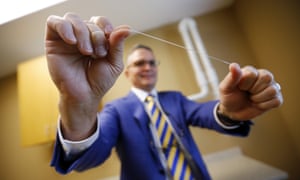
Wayne Aldredge, president of the American Academy of Periodontology, holds a piece of dental floss.


Wayne Aldredge, president of the American Academy of Periodontology, holds a piece of dental floss. Photograph: Julio Cortez/AP

Aldredge also said many people use floss incorrectly, moving it in a sawing motion instead of up and down the sides of the teeth. Pressed about the origins of his organization’s endorsement of flossing, he said it may simply have “taken the ADA’s lead”.


When the ADA was asked for proof of its claim that flossing helps prevent early gum disease and cavities, the group cited the 2011 review and a 2008 two-week study that measured bacteria and did not even consider gum disease.


In a later statement to the AP, the ADA said flossing “removes plaque” and “is proven to help remove” debris from between teeth. A video on its website proclaims that flossing “helps prevent gum disease”. When pressed, Matthew J Messina, a practicing dentist and spokesman for the dental association, acknowledged weak evidence, but he blamed research participants who didn’t floss correctly.


Even companies with a big market share of the flossing business – by next year, the global market is predicted to reach almost $ 2bn, with half in the United States, according to the publisher MarketSizeInfo.com – struggled to provide convincing evidence of their claims that floss reduces plaque or gingivitis. Yet the industry has paid for most studies and sometimes designed and conducted the research.


Procter & Gamble, which claims that its floss fights plaque and gingivitis, pointed to a two-week study, which was discounted as irrelevant in the 2011 research review.


Johnson & Johnson spokesman Marc Boston said floss helped remove plaque. When the AP sent him a list of contradicting studies, he declined to comment.


The floss-making companies partner with the ADA through its Seal of Acceptance program. The ADA promotes the seal to companies as something that “directly affects the purchase decisions of consumers”; each manufacturer is charged $ 14,500 for the evaluation. If it approves the product, the ADA then charges an additional annual fee of $ 3,500.


The ADA says it rigorously evaluates products and makes no profit from the program. However, floss companies themselves are allowed to design the studies.


“The funding can come from companies – no problem at all,” said Marcelo WB Araujo, a dentist and vice-president of the ADA’s Science Institute, who joined the organization after serving as an executive for Johnson & Johnson. “The design can start from the company.”


When flossing first gained acceptance, no proof was required of remedies. The dentist Levi Spear Parmly is credited with inventing floss in the early 19th century. By the time the first floss patent was issued, in 1874, the applicant noted that dentists were widely recommending its use.


The ADA has been promoting floss universally since 1908. “They just looked into what they did every day in their clinical practice and what they would recommend for patients,” said Araujo.


Count Damien Walmsley, a dentist and scientific adviser to the British Dental Association, among the skeptics. “It’s important to tell people to do the basics. Flossing is not part of the basics.”


Related: Halloween brings dental woes – and many have no way to pay for crucial care


Floss can occasionally cause harm. Careless flossing can damage gums, teeth and dental work. Though frequency is unclear, floss can dislodge bad bacteria that invade the bloodstream and cause dangerous infections, especially in people with weak immunity, according to the medical literature.


National Institutes of Health dentist Tim Iafolla acknowledged that if the highest standards of science were applied in keeping with the flossing reviews of the past decade, “then it would be appropriate to drop the floss guidelines”.


Regardless, he added, Americans should still floss.


“It’s low risk, low cost,” he said. “We know there’s a possibility that it works, so we feel comfortable telling people to go ahead and do it.”


Everyone recommends flossing – but there"s hardly any proof it works

I battled my anxiety by making people laugh. Funnily enough, it works | Naomi Petersen

To say that comedy “cured” my anxiety is perhaps an overstatement: I’m still living with it. But these days, I have come to view it as an exasperating recurring character in the film of my life, rather than the main antagonist that it used to be. My anxiety, in other words, is Jar Jar Binks.


As I write this, I’m preparing to take my debut one-woman comedy show up to the Edinburgh festival fringe, a challenge I’ve only recently felt mentally tough enough to undertake.


I’ve experienced anxiety in some form since childhood, which has manifested itself in a variety of symptoms ranging from shortness of breath, to night terrors, the occasional panic attack and an overwhelming array of destructive negative thoughts (I’m the one you want to party with). Graduating from drama school and working as an actor exacerbated the situation: the endless auditioning, frequent rejection and haywire routine made me feel even less in control.


I’m still reaping the benefits of the principle of playfulness throughout this process


Lots of things helped. An apprehensive visit to a psychiatrist helped me realise that the anxiety stemmed from being bullied at school and led to a course of CBT (cognitive behavioural therapy). Through this, I was able to understand and challenge my negative thought patterns. I was inundated with words of wisdom and those repeated cliches: stay healthy, lay off the booze, eat well and get plenty of sleep. All important, all true, all unfortunately difficult to put into practice for someone whose main joys in life include cake of all kinds and necking flutes of prosecco.


Yet the biggest revelation came back in January 2013, was entirely unexpected and nowhere to be found in the NHS leaflets. I had spent a few days existing in a semi-permanent state of what I affectionately dubbed “Towel-Face” – which can be roughly translated as spending a prolonged amount of time sitting on the bed staring at the wall in your towel post-shower, because the idea of getting dressed seems too overwhelming (honestly, I’m great at parties). Then on a whim, I signed up to an improv comedy course.


jar Jar Binks


‘My anxiety, in other words, is Jar Jar Binks.’ Photograph: Allstar/Lucasfilm

Spending three hours making stuff up in a room full of incredibly funny people was nothing short of life-affirming. There is no feeling more joyous than laughing until your sides hurt and making others laugh too. My confidence grew, my social circle flourished and as I continued to throw myself into this world I began to feel less anxious in day-to-day life.


Fundamentally, I believe this is down to the fact that improv is so much about rediscovering a sense of play. As adults, how often do we detach ourselves from our responsibilities and just let ourselves play? How often do we genuinely take off our adult masks and get messy and silly, without worrying about how we appear? Almost never, especially if alcohol is off the table. It can feel like society actively discourages us from letting go and from reconnecting with our inner children. On the other hand, improv and comedy in general is all about finding and following the fun. When I fully embraced that, it was amazing how uplifted and free from worry I felt.


Related: As a neuroscientist who’s done standup, I know performance anxiety is no joke | Sophie Scott


Fast-forward four years, and comedy has become an integral part of my life: as well as performing and teaching improv, I’m also premiering my solo show “I Am Telling You I’m Not Going”. It’s a big-hearted, silly and joyful hour of character comedy, songs and storytelling that’s partly inspired by my own anxiety.


As I’ve been developing it, I’ve realised that comedy doesn’t just improve my wellbeing – it can also be a crucial platform for discussing mental health. Laughter has such a universal way of connecting with people that more sensitive subjects become instantly relatable and cease to be taboo. We should be searching for the humour in dark situations and using it to erase any stigma surrounding them.


I’m still reaping the benefits of the principle of playfulness throughout this process. The overriding lesson from developing the show is that it’s always most successful when I have the most fun. My job at its heart is to mess about, be silly, follow the funny and find the joy. When I’m entirely focused on that, there’s no longer any room for Jar Jar.


I battled my anxiety by making people laugh. Funnily enough, it works | Naomi Petersen

28 Temmuz 2016 Perşembe

Hippie philosophy: Only sense gratification works

Before we can get into how the hippie movement turned America and the rest of the world into hedonists, we have to first take a look at the “hippie” culture.


The hippie movement began in America in the mid-60s, though its roots go back several years earlier. Within four or five years the movement had spread to all of Europe, the Scandinavian countries, Australia, New Zealand, Southeast Asia, Japan, the Philippines, Africa and South America.


This movement was a unique cultural phenomenon and had far-reaching influence and impact not only on American society, but also in practically the entire world.


Understanding the attraction that the hippie movement had to a way of life that was so foreign to the one that they were raised in is not rocket science.


You’ve got to appreciate the social and economic climate of mid-60s America. One critical factor was that most of us had already experienced the American dream, were a bit frustrated by it and wanted something more out of life.


Our fathers and their fathers worked and slaved to improve their quality of life. They wanted nice houses, new cars, and other modern conveniences, which they originally didn’t have. This provided a great incentive for them.


So they worked very hard and struggled to get what they wanted, always thinking they would be happy when they got it.


By the time I was in my late 20s and early 30s I had already experienced these things and still wasn’t happy.


I had a nice house with white picket fence and a lovely wife, wore nice clothes, had money in my pocket, owned a nice car, and had a nice stereo, a big TV and two little “rug rats”. Despite living the “American dream”, I was miserable.


Not only was I miserable on one hand, while experiencing material happiness, but also on the other hand there was this gnawing feeling inside telling me “this was not enough, I needed something more”.


Besides the fact that I wasn’t completely satisfied with my material prosperity, there were other social factors that made me question whether the picture of life that my parents and teachers painted for me was really that good.


There was the Vietnam War, for example, which was, in my opinion, a senseless conflict that I could not understand. Young people were being drafted right left, but for what?


Our parents were raised under different circumstances and most of them had unflinching faith in America and anything America did. But, somehow, I couldn’t accept this and couldn’t blindly commit myself to a cause I felt was wrong.


Also new was the racial prejudice issue – the oppression of blacks, Chicanos, and other minorities – not just in the South, but also in every major city in America. Because of material prosperity we had time to look at things going on around us, and we didn’t like a lot of what we could see.


In the beginning, there were young people who rejected the values of society and who dropped out of the rat race to try to live a more carefree existence. They left the comfort of their homes and families, left the luxuries, etc., and moved to the country or to the older, lower rent sections of the cities.


Hippies stood out like a sore thumb. They had long hair and wore outrageous clothing. The rejection of the clean-cut American image was symbolic of rejecting society and what it stood for. It was the same thing with paka (crazy) lolo (weed) and LSD. You have to understand that smoking dope every day and taking lots of acid wasn’t just a protest, it was the purpose. That being, trying to understand ourselves and see where we fit into a society we felt alienated from.


As I look back on it and reflect while writing this, the idealism of the early hippie movement was fairly superficial. In many cases that led to both escapism and hedonism. That’s a bit of a generalization because there actually were a lot of sincere people who were not trying to just escape, but who are actually very responsible and who worked very hard to try to make things better.


There were a lot of humanitarian minded young people working for the civil rights movement and trying to end the war. Their mutual desire to help others made them feel a strong sense of brotherhood among themselves. Of course, they used to get stoned together regularly, and this took on an almost ritualistic meaning because that activity helped reinforce their common bond. It came to be symbolic in the minds of the idealistic hippies of a concerned, liberal-minded mentality, as opposed to the beer drinking redneck with the “my country, right or wrong” attitude.


Then there came a time where there was an obvious split in what was happening. The superficial idealism went one of two ways: it either developed into real idealism or turned into hedonism. At that point, the hippie movement snowballed quickly. In a matter of a few years, tens of thousands of young people grew their hair out, dropped out of college, quit work, etc. They were attracted to the hippie lifestyle because it seemed different and exciting to them.


Although many of them were attracted at first by the struggle to end the war in Vietnam, etc., they just got swept away in the rising tide of hedonism.


There were protest songs against the war by Bob Dylan, Joan Baez, etc., being played on the radio and they were very popular. So the youth identified themselves with this cause. But there was lots of dope around and it wasn’t just grass and acid anymore. People were using speed, smack, downers, sniffing glue – anything they could get their hands on. And drinking also became very widespread, which is a very significant turning point since the earlier, more idealistic hippies completely stayed away from alcohol. They equated alcohol with the mentality of a society they were trying to change.


Somehow or another the idealism got buried in the drug scene. As more and more of the youths got heavier into dope, they just lost sight of anything positive. They knew they couldn’t be perfectly satisfied with material luxuries, but instead of seeking out some higher purpose, they became like animals, just doing anything they wanted to.


Their philosophy was really just an outgrowth of the society they had supposedly rejected. In other words, they saw sense enjoyment and physical pleasure as the goal of life.


They were more or less saying, “If TVs, stereos, and cars can’t give it to us – what will”? So they got into trying anything and everything that felt good, regardless of the future consequences, either to themselves or others. Then, certain sayings became popular that perfectly reflected the absolute self-centeredness that hippie-ism was becoming. Sayings like, “if it feels good, do it” and “do your own thing (regardless of the consequences to others)”.


Rock music played a big part as well. There were different rock groups who had different “messages” and they had a tremendous influence over their audiences. On one hand, there were the Beatles who were singing about love, peace, and meditation, and who were personally involved, at that stage anyway, in the search for more meaning to life.


On the other hand, there were groups like the Rolling Stones and the Doors who sang about and glorified sex, drugs, anarchy, and absolute hedonism. Unfortunately, it was groups like the Rolling Stones and others who had the most influence. By this time, there was very little idealism left.


There is another angle by which the rock groups influenced the development of the hippie subculture as well. In the beginning, hippies used to get together at beaches and parks and sit in groups together, talking and playing music. These gatherings were called “Human Be-Ins”, and everyone who went was an active participant in making the event successful.


As the gatherings got bigger and bigger, rock groups started coming to play their music. This had the effect of cutting down on the creativity of the participants. Since rock music was completely overwhelming, it was impossible to sit around and talk or play music or exchange ideas with your friends anymore. You were not a “participant’, you were an “audience”.


You just sat there and got more stoned and listened to the band play, or you got up and danced to their music. The entire atmosphere was controlled by the bands and the kind of music they played.


Someone from the stage would say, “Take off your clothes”, and 500 or 1000 people, out in the audience, would do it!


The death knell for these gatherings came at a Rolling Stones concert in Altamont, California, where the Hells Angels (the notorious motorcycle gang) beat and stabbed a man to death right in front of the stage as the Rolling Stones sang their hit song, “Sympathy for the Devil”. After that, even the most optimistic of the hippies could see that the whole movement had turned into a horror show.


Those hippies who were really concerned about improving society and who weren’t just escapists, looking for cheap thrills, became a bit disillusioned with the concept of the hippie movement as a whole, or as a positive social force. They continued in their own ways either as individuals or as groups to try and implement positive changes. Many of them are still working from within society today for the betterment of society.


In many ways, the hippie movement affected the rest of society, although superficially. They affected clothing styles and hairstyles. They made long hair, ‘in”, and popularized bell-bottom pants and shoulder bags for men, etc. Probably the most obvious social change they brought about was public acceptance of drug use.


Before the hippies, only social misfits, hardened criminals, and the like, used drugs. Now, everyone in America was using drugs. Not every single person of course, but people from all walks of life. Drug use was now entirely socially acceptable and this hedonistic attitude spilled over to all parts of America and other parts of the world.


Toward the end of the hippie movement, the idealism and exuberance was gone and the emphasis was more and more on the individual.


This tendency to be more concerned about “my” own happiness, “my” pleasure, getting what “I” want, not doing anything “I” don’t want to do, influenced psychologists, psychiatrists, and other medical misfits.


They in turn used their influence to spread the “if it feels good, do it” philosophy of the hippies in a more respectable way than the hippies did. They got the “message” across to people in social positions and from certain walks of life that the hippies couldn’t reach.


Books like “Looking Out For Number One” and dozens of others like them appeared on the scene and became immediate bestsellers. These books emphasized getting what you want, and told the reader not to feel guilty in suppressing or exploiting others in search of “your” own happiness.


In short, the hippies laid the foundation for the “hedonization” of America, and then the “new-age” psychologists took over and turned hedonism into a refined art, making it socially acceptable.


The problem with hedonism is that not only is it temporary but leads to great frustration. Look at all the actors and the like that had “everything” that committed suicide out of frustration and misery.


The solution: take time to connect with God, meditate upon Him, dovetail your will with His, and you will experience true happiness and satisfaction. Take it from a former hippie that found that to be true.


Aloha!
To learn more about Hesh, listen to and read hundreds of health related radio shows and articles, and learn about how to stay healthy and reverse degenerative diseases through the use of organic sulfur crystals and other amazing superfoods, please visit www.healthtalkhawaii.com, or email me at heshgoldstein@gmail.com or call me at (808) 258-1177. Since going on the radio in 1981 these are the only products I began to sell because they work.
Oh yeah, going to www.asanediet.com will allow you to read various parts of my book – “A Sane Diet For An Insane World”, containing a wonderful comment by Mike Adams.
In Hawaii, the TV stations interview local authors about the books they write and the newspapers all do book reviews. Not one would touch “A Sane Diet For An Insane World”. Why? Because it goes against their advertising dollars.


Hippie philosophy: Only sense gratification works

24 Temmuz 2016 Pazar

A Simple Juice to Fight Against Constipation and Why It Works Great

It’s not a good experience if you suffer from indigestion, constipation or heartburn, while these related digestive issues are common these days. Different types of digestive problems are affecting lots of people all over the world, no matter adults or children.


Constipation is one of the main symptoms of the digestive disorders. When you suffer from constipation, you can not have a regular bowel movements, and other symptoms may also occur: feel pain in the abdominal part, passing stools are hard, and you’ll have less than 3 bowel movements in a week.


There are lots of treatments for the digestive issues, while problem such as constipation can be managed with the help of some home remedies. Given below is a juice recipe which is highly recommended for constipation.


A Natural Juice against Constipation


Ingredients:


  • 4 broccoli

  • 2 cups cabbage leaves

  • 2 medium green apple

  • 4 leaves of lettuce

Clean the ingredients and juice them with 200 ml cold water. Drink this juice several times a day for relieving the symptoms related to constipation.


Apple contains a natural laxative to boost bowel movements.


The high fiber content in cabbage aids stimulate the digestive system, thus preventing and relieving the digestive problems.


Broccoli is also rich in fiber, thus aiding digestion, preventing constipation.


Following is a list of herbal remedies you can also try to cure constipation, try them instead of medicines for relieving your symptoms and getting long-term benefits for your health at the same time.


Dandelion root: Boiling dandelion root in water to make tea, drink this tea will help you if you suffer from chronic constipation.


Licorice: This herb treats constipation by increasing the intestinal responsiveness.


Senna: Popular used in herbal teas, senna also works effectively to relieve constipation.


Lemon Balm: Another natural aid for relaxing the digestive tract, it’s often consumed as a tea to treat constipation and other stomach issues.


Flaxseeds: They are helpful as their high amounts of fiber content.


Aloe Vera: Aloe Vera juice is packed with mild laxative properties that are useful in preventing and treating constipation.


Sources:


1)http://www.ehealthzine.com/10-health-benefits-of-cabbage.html
2)http://www.home-remedies-for-you.com/remedy/Common-Digestive-Disorders.html
3)http://www.bestherbalhealth.com/natural-juice-constipation-cleansing-body/


A Simple Juice to Fight Against Constipation and Why It Works Great

30 Aralık 2013 Pazartesi

How Silver works and how to make an Instantaneous Silver Generator.

Silver water is verified to have a “100% positive destroy ratio” of any organically corrupted cell.


In other phrases, it kills undesirable guys! A negative man is a Virus, Bacteria, Fungus or Parasite!


Only four different undesirable guys, Virus, Bacteria, Fungus or Parasite.


Note: The laws of physics govern medication!


How is silver killing viruses when present day medicine cannot? The answer…  basic electricity! 


Silver operates off of the electrical properties of “said corrupted single cell organism”, its electrical signature so to communicate! Single cells when” healthy”, express a “positive” electrical signature… Single cells when “corrupted” &amp thus “unhealthy” now express a “negative” electrical signature…


Silver ions are positively charged, as soon as consumed, by human or pet, they go hunting for “negatively charged bad guys” , there’s nowhere for them to run, there’s no spot to hide, and ultimately, no escape. When the silver molecule attaches to the corrupted single cell, well lets just say it does not take extended, “minutes”, not days or weeks. 


How does silver know what to destroy, &amp more importantly, what to depart alone?


Feel magnets! Positive to unfavorable, magnets are attracted and stick together, negative to unfavorable or optimistic to optimistic they keep away from touching altogether, there is typically ample resistance to complete this feat.


Last but surely not least, Silver Water is extremely inexpensive when you make your personal.


Some like Kroger corporation sell silver water for $ 960 a gallon ($ 15 for 2fl oz) GNC sells it for all around $ 400 a gallon ($ 25 for eight fl oz). See my youtube channel for a video of Kroger offering silver water for nearly $ one thousand a gallon


In fact, the most affordable I have noticed it for sale on the net is all around $ 110 a gallon, BUT, you have to acquire 5 gallons to get that cost.   Expense following shipping is all around $ 590. Yes, 5 hundred and ninety bucks! Cost to make a gallon of silver water is about $ one (1 dollar). It’s 99 cents for the gallon of distilled water! The silver cost’s about a penny!


Then there are people like me, who sell it for close to $ 10 a quart (local pickup only for now).


1ft of 99.99% pure silver wire will make about a hundred gallons for about $ 2o


If you would like to participate in kicking the greedy bastards out of the silver water  business, get your silver gear from the man who’s provided away hundreds (probably thousands) of free colloidal silver generators, a great number of feet of pure silver wire, and hundreds if not thousands of gallons of silver water to people undergoing financially distress.


http://colloidalsilverguy.com/video clips.html


Lastly, how to make an instantaneous colloidal silver generator:


Ingredients… 2 alligator clips, an inch of electrical tape, wire strippers or your teeth, and ANY previous cell telephone charger &amp who does not have a half dozen or so, or potentially a massive ball of these, just  laying about the property?


Reduce off the finish of the cell cellphone charger and peel back the black wire till the underwire is exposed, wrap one wire around every single alligator clip and tape securely… If you’re handy with a soldering gun, &amp use heat shrink not tape.


The reality of the matter, since its very lower voltage, this generator you made in a number of mins with things from the junk drawer, actually tends to make the greatest good quality silver water you can make at home short of a $ 5000 silver generator .


The ideal part, no babysitting the silver water approach!


Place the wires in ahead of bed, wake up to fresh homemade silver water. 10-15 ppm per quart jar in distilled water. 


I invite you to share this write-up as you see fit and let’s drive out the carpetbaggers from the silver water enterprise. 


Sincerely:


Joe Silver @ rahweh.com  503-997-1692


How Silver works and how to make an Instantaneous Silver Generator.