proof etiketine sahip kayıtlar gösteriliyor. Tüm kayıtları göster

2 Ağustos 2016 Salı

Everyone recommends flossing – but there"s hardly any proof it works

It’s one of the most universal recommendations in all of public health: floss daily to prevent gum disease and cavities.


Except there’s little proof that flossing works.


Still, the US federal government, dental organizations and manufacturers of floss have pushed the practice for decades. Dentists provide samples to their patients; the American Dental Association insists on its website: “Flossing is an essential part of taking care of your teeth and gums.”


Related: Everything you ever wanted to know about teeth (but were afraid to ask the dentist)


The federal government has recommended flossing since 1979, first in a surgeon general’s report and later in the Dietary Guidelines for Americans issued every five years. The guidelines must be based on scientific evidence, under the law.


Last year, the Associated Press asked the health and agriculture departments for their evidence, and followed up with written requests under the Freedom of Information Act.


When the federal government issued its latest dietary guidelines this year, the flossing recommendation had been removed, without notice. In a letter to the AP, the government acknowledged the effectiveness of flossing had never been researched, as required.


The AP looked at the most rigorous research conducted over the past decade, focusing on 25 studies that generally compared the use of a toothbrush with the combination of toothbrushes and floss. The findings? The evidence for flossing is “weak, very unreliable”, of “very low” quality, and carries “a moderate to large potential for bias”.


“The majority of available studies fail to demonstrate that flossing is generally effective in plaque removal,” said one review conducted last year. Another 2015 review cites “inconsistent/weak evidence” for flossing and a “lack of efficacy”.


One study review in 2011 did credit floss with a slight reduction in gum inflammation – which can sometimes develop over time into full-fledged gum disease. However, the reviewers ranked the evidence as “very unreliable”. A commentary in a dental magazine stated that any benefit would be so minute it might not be noticed by users.


The two leading professional groups – the American Dental Association and the American Academy of Periodontology, for specialists in gum disease and implants – cited other studies as proof of their claims that flossing prevents buildup of gunk known as plaque, early gum inflammation called gingivitis, and tooth decay. However, most of these studies used outdated methods or tested few people. Some lasted only two weeks, far too brief for a cavity or dental disease to develop. One tested 25 people after only a single use of floss. Such research, like the reviewed studies, focused on warning signs like bleeding and inflammation, barely dealing with gum disease or cavities.


Wayne Aldredge, president of the periodontists’ group, acknowledged the weak scientific evidence and the brief duration of many studies. In an interview at his private practice in New Jersey, he said that the impact of floss might be clearer if researchers focused on patients at the highest risk of gum disease, such as diabetics and smokers.


Still, he urges his patients to floss to help avoid gum disease. “It’s like building a house and not painting two sides of it,” he said. “Ultimately, those two sides are going to rot away quicker.”
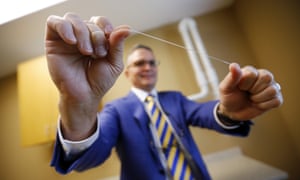


Wayne Aldredge, president of the American Academy of Periodontology, holds a piece of dental floss.


Wayne Aldredge, president of the American Academy of Periodontology, holds a piece of dental floss. Photograph: Julio Cortez/AP

Aldredge also said many people use floss incorrectly, moving it in a sawing motion instead of up and down the sides of the teeth. Pressed about the origins of his organization’s endorsement of flossing, he said it may simply have “taken the ADA’s lead”.


When the ADA was asked for proof of its claim that flossing helps prevent early gum disease and cavities, the group cited the 2011 review and a 2008 two-week study that measured bacteria and did not even consider gum disease.


In a later statement to the AP, the ADA said flossing “removes plaque” and “is proven to help remove” debris from between teeth. A video on its website proclaims that flossing “helps prevent gum disease”. When pressed, Matthew J Messina, a practicing dentist and spokesman for the dental association, acknowledged weak evidence, but he blamed research participants who didn’t floss correctly.


Even companies with a big market share of the flossing business – by next year, the global market is predicted to reach almost $ 2bn, with half in the United States, according to the publisher MarketSizeInfo.com – struggled to provide convincing evidence of their claims that floss reduces plaque or gingivitis. Yet the industry has paid for most studies and sometimes designed and conducted the research.


Procter & Gamble, which claims that its floss fights plaque and gingivitis, pointed to a two-week study, which was discounted as irrelevant in the 2011 research review.


Johnson & Johnson spokesman Marc Boston said floss helped remove plaque. When the AP sent him a list of contradicting studies, he declined to comment.


The floss-making companies partner with the ADA through its Seal of Acceptance program. The ADA promotes the seal to companies as something that “directly affects the purchase decisions of consumers”; each manufacturer is charged $ 14,500 for the evaluation. If it approves the product, the ADA then charges an additional annual fee of $ 3,500.


The ADA says it rigorously evaluates products and makes no profit from the program. However, floss companies themselves are allowed to design the studies.


“The funding can come from companies – no problem at all,” said Marcelo WB Araujo, a dentist and vice-president of the ADA’s Science Institute, who joined the organization after serving as an executive for Johnson & Johnson. “The design can start from the company.”


When flossing first gained acceptance, no proof was required of remedies. The dentist Levi Spear Parmly is credited with inventing floss in the early 19th century. By the time the first floss patent was issued, in 1874, the applicant noted that dentists were widely recommending its use.


The ADA has been promoting floss universally since 1908. “They just looked into what they did every day in their clinical practice and what they would recommend for patients,” said Araujo.


Count Damien Walmsley, a dentist and scientific adviser to the British Dental Association, among the skeptics. “It’s important to tell people to do the basics. Flossing is not part of the basics.”


Related: Halloween brings dental woes – and many have no way to pay for crucial care


Floss can occasionally cause harm. Careless flossing can damage gums, teeth and dental work. Though frequency is unclear, floss can dislodge bad bacteria that invade the bloodstream and cause dangerous infections, especially in people with weak immunity, according to the medical literature.


National Institutes of Health dentist Tim Iafolla acknowledged that if the highest standards of science were applied in keeping with the flossing reviews of the past decade, “then it would be appropriate to drop the floss guidelines”.


Regardless, he added, Americans should still floss.


“It’s low risk, low cost,” he said. “We know there’s a possibility that it works, so we feel comfortable telling people to go ahead and do it.”


Everyone recommends flossing – but there"s hardly any proof it works

19 Ağustos 2015 Çarşamba

Bad vibrations: what is the proof for geopathic pressure?

I have a confession to make. For a brief time when I was about 10 years outdated, I considered I could move a quartz crystal with the electrical power of my thoughts. I was on holiday in North Wales, and I’d acquired it from a present shop from a tiny-town attraction whose name I can no longer recall. Quartz crystals have a specific sort of captivating beauty about them, and this one was no exception it was connected to a length of leather cord, and looked like it would fit right at house as a trinket from an epic fantasy novel. When I received back to the caravan we had been staying with, I was holding it, staring at it, when it appeared to move for no obvious purpose. Curious, and ever-hopeful that anything magical would occur to make the vacation anything other than banal, I wondered no matter whether I could make it happen yet again. So I held the best of the cord as still as I could, and experimented with to envision the crystal swinging in a circle. And it did. For a brief second, anyway. I think.


Obviously, I really do not have any magical psychic powers – no one particular does. What I was encountering was the ideomotor effect – I was just creating the swinging movement myself, without realising it. I didn’t know the phrase when I was ten years outdated, but after repeating the experiment a number of occasions, and not acquiring a constant swing, I nevertheless came to the exact same conclusion that nothing at all out of the ordinary was occurring. And so the vacation plodded on.


I’m reminded of this story because above the previous week or so, at the request of a buddy, I’ve been searching into a specific kind of quackery known as ‘geopathic stress’. Geopathic anxiety is a sort of mash-up between electrosmog, feng shui and dowsing (another phenomenon merely explained via the ideomotor effect). The simple notion is this: the Earth has a normal vibration, but factors like underground watercourses, drainage pipes, underground tunnels and even easy geological faults distort this vibration. If the vibration is disturbed, and you are standing (or sitting, or sleeping, or performing anything at all) over this distortion point, then your overall health and behaviour will be impacted. Sites explaining geopathic pressure have linked it to every little thing from road rage and kid abuse to miscarriage, cot death, suicide and cancer. Other individuals declare that you can locate sources of tension in or around your home through dowsing, and fix it by moving your bed out of the way of the distortion field.


As a standard rule of thumb, if an individual tells you that a single issue or phenomenon can trigger this kind of a enormous selection of ailments, then it should ring an alarm bell in your thoughts. Claims about geopathic anxiety are no exception. Inquire for evidence, and see whether or not there are any convincing study to back up the claim. “If you do not think that an advertiser can back up their claims, you can report them to the Marketing Standards Authority.” explains Laura Thomason, Undertaking Leader for the Very good Contemplating Society. She adds, “Claims to treat cancer could be in breach of the Cancer Act (1939) and ought to be reported to Trading Requirements.” There is some published data on the alleged phenomenon in the investigation literature, but it crops up in journals like “Renewable Energy” or “Research in Complementary Medicine”. If this was a properly-researched phenomenon, you would count on to see a decent amount of information in a mainstream journal that focuses on medication or biology – not squirrelled away in the engineering literature, or in an obscure substitute medicine journal.


Similarly, there does not seem to be any robust study into what type of biological mechanism may well explain how a single phenomenon could account for this kind of a wide selection of healthcare and non-health care problems, and once again practically nothing published in the health care literature. Some explanations appeal to the suggestion that due to the fact the vibrations happen at distinct frequencies (about 7 Hz), then they could interfere with patterns of brain activity named alpha waves, which take place at about the identical frequency. Alpha waves are related with relaxed wakefulness, so you can think about a situation in which, due to constant disruption of these waves, a man or woman may possibly be unable to unwind or rest appropriately, which may possibly in flip lead to a assortment of well being problems.


However, that assumes that (a) geopathic stress exists, (b) it has an effect on the brain, and in turn (c) can cause anything from street rage to cancer. Is there any evidence to back that up although? In short, no: there doesn’t seem to be any credible, peer-reviewed proof. Even though I could uncover no randomised controlled trials on geopathic anxiety exclusively, but there’s a helpful comparison to be made to investigation into the results of extremely minimal frequency (ELF) magnetic fields. If vibrations from the Earth in the seven Hz assortment are causing overall health issues, then it would make sense that other issues that emit electromagnetic fields in a related sort of frequency range may possibly be trouble too. Thankfully, we do have some information in this spot that may possibly be beneficial.


In 2005, the Planet Health Organisation assembled a activity group to seem at the effects (if any) of exposure to ELF electromagnetic fields on the advancement and incidence rates of a variety of different illnesses, most notably cancer. There are a number of take-house messages from the information. The very first is, as I’ve already alluded to, that there are no acknowledged biological mechanisms by means of which low-level publicity to ELF electromagnetic fields could cause cancer. Reinforcing this idea, the evidence they overview from epidemiological, animal and in vitro studies is similarly inconsistent and inconclusive. In other words, there is no proof to suggest that publicity to ELF electromagnetic fields has any influence on the improvement of cancer tumours, or incidence prices of things like childhood leukaemia. Comparable adverse findings were located for associations with depression and suicide, neurodegenerative issues this kind of as Alzheimer’s condition, and cardiovascular illness.


All in all, it appears unlikely that publicity to these kinds of reduced-frequency fields has any sort of notable result on our well being, and although the WHO data does not directly refer to geopathic anxiety, the final results appear similarly applicable. We’re surrounded by technology that emits these kinds of fields. If they are not affecting us, then it does not make sense to declare that comparable kinds of frequencies emanating from the ground will have any kind of effect.


Unfortunately, regardless of the lack of proof displaying any kind of link in between geopathic stress and cancer, there are a few people out there pleased to assert that there is a connection. And as with any type of evidence-totally free claims about esoteric variables that have an effect on our overall health (I’m looking at you, astrology), the bogus details also comes along with the promise of devices that can help repair the issue. A quantity of internet sites promote products that claim to neutralise geopathic tension and ‘electrosmog’, without having any convincing explanation of what the mechanism of action is, nor any scientific evidence or health-related trial data to display their efficacy. Although they really do not particularly declare that these products can cure cancer, the implication would seem like an straightforward one to make, especially if you’re obtaining issues about your very own wellness. Geopathic tension is linked to cancer these devices can neutralise geopathic pressure you can make the ultimate logical leap for oneself. “Misleading health claims can result in significant harm to vulnerable members of the public.” says Laura. “It is deeply worrying that men and women could be led to think that this kind of devices could treat or avert daily life threatening medical situations.”


So must we be worried about geopathic stress? No, and it’s irresponsible of people to claim a website link between an unconfirmed phenomenon, and any type of wellness concern. And a website link with street rage? Specially ludicrous. I really do not know how individuals deal with to persuade themselves that these kinds of phenomena exist. I know it almost certainly starts with a little bit of ignorant curiosity about the globe something transpires, you really do not know why, and you want to find an reply. Sometimes it’s a actually poor factor that occurs – at least a single web site explained how the proprietor had lost a family member to cancer, and was investigating what the result in might have been. My heart goes out to folks in that predicament, but it also helps make it all the a lot more critical not to resort to extraordinary explanations that are devoid of any scientific or healthcare evidence. If we do, not only do we end up deluding ourselves, but we danger irrevocably hurting others along the way.


Bad vibrations: what is the proof for geopathic pressure?

20 Temmuz 2014 Pazar

A proof of idea for an HIV cure exists. Now even our setbacks are beneficial | Françoise Barré-Sinoussi and Sharon Lewin

It was a sad and disappointing turn of events: the kid known as the Mississippi child, in remission of HIV infection for much more than two many years right after discontinuation of antiretroviral treatment (Art), now has clear evidence of HIV rebound. The announcement will undoubtedly be viewed by some as a setback in the renewed quest for an HIV cure.


It doesn’t want to be. We require to take the highs and lows in our stride. We have a proof of idea that a cure for HIV is attainable in the Berlin Patient, Timothy Brown, who acquired a bone marrow transplant and remains virus free off therapy for more than six years.


We also have the situation of the French Visconti cohort, now comprising twenty HIV-positive men and women who have been taken care of very early with HIV medication, but then stopped treatment. Right after virtually ten many years off therapy, they are keeping the virus under tight manage.


Only one person, who is now in remission for a non Aids-connected cancer, reinitiated Artwork despite his HIV infection even now currently being controlled at the time that he obtained anti-cancer therapy.


The lows – if the Mississippi infant case can be called a reduced – provide main insights into the scientific problems that lie ahead for the researchers, scientists and others gathering at the Aids 2014 symposium in Melbourne this week.


Comparable to the Mississippi infant, the Boston patients – two guys who received bone marrow transplants that appeared to rid them fully of HIV – also relapsed, and are now back on antiretroviral treatment.


What has been most encouraging for all three sufferers was that the time the virus stayed beneath management off remedy, or in remission, was drastically longer than what we have ever witnessed before. The Boston patients were virus-free of charge for 12 and 32 weeks, and the Mississippi infant virus-totally free for a impressive 27 months.


Nevertheless, as we have discovered above the past 3 decades, HIV has many tricks up its sleeve.


An minute sum of virus – which none of our present exams are even shut to detecting – was capable to persist in these 3 patients and reappear at any time, with absolutely no warning.


The Mississippi baby, and the Boston sufferers, tell us that to attain extended phrase HIV remission we will likely need to have to tackle the difficulty on multiple fronts – lowering as much as attainable the quantity of extended-lived, latently contaminated cells existing in the entire body, as effectively as bolstering the host defence. 1 can not be carried out without the other.


We have usually known that the search for an HIV remedy wasn’t going to be easy. We have to be optimistic, and hope that situations like the Mississippi infant will demonstrate to be one more piece in the jigsaw puzzle that is an HIV remedy.


To attain this objective will need substantial academic collaboration as nicely as public-private partnerships that can drive innovative and effectively-funded strategic research over the prolonged term.


We have to proceed the search for an HIV remedy. We owe it to the 35m men and women living with HIV.


A proof of idea for an HIV cure exists. Now even our setbacks are beneficial | Françoise Barré-Sinoussi and Sharon Lewin

16 Temmuz 2014 Çarşamba

New Proof Fuels Considerations About The Safety Of Niacin

The string of failures– for HDL therapies in basic and for niacin in particular– continues unabated.  The publication of the primary results of the HPS2-THRIVE trial, along with new details from the AIM-Higher trial, provide no evidence of a advantageous impact for niacin but do fuel concerns that it may lead to serious adverse results.


In HPS2-THRIVE, published in the New England Journal of Medicine, the blend of extended-release niacin and laropiprant (Tredaptive, Merck) was compared to placebo in far more than 25,000 higher danger sufferers previously receiving statin treatment. Patients in the treatment method group had important reductions in LDL cholesterol (ten mg/dL), considerable increases in HDL  (six mg/dL), and substantial reductions in triglycerides (33 mg/dL). But there was no variation in the fee of significant vascular occasions (13.2% for niacin-laropiprant versus 13.7% for placebo, RR .96, CI .90 – 1.03, p=.29).  There was also no substantial variation in an exploratory examination of patients with low HDL and higher triglyceride levels who may possibly be expected to benefit the most from niacin treatment.


There were indicators of harm linked with niacin-laropiprant. Critical adverse events occurred a lot more frequently in the mixture group (fifty five.six% versus 52.seven%, p &lt .001). Diabetes complications were specifically regarding. Amongst sufferers who had diabetes at the begin of the trial, serious complications relevant to diabetes occurred in eleven.1% of patients in the treatment method group versus 7.5% of patients in the handle group, a 55% enhance. Among patients who did not have diabetes at the start of the trial, there was a 32% increase in the diagnosis of diabetes in the treatment method group (5.seven% versus 4.three%).


Niacin therapy was also connected with important increases in infections (8% versus six.six%, p&lt .001) and bleeding (two.five% versus 1.9%, p &lt .001). These findings came as a shock to the investigators. There had been also considerable increases in other, previously known adverse results of niacin, which includes gastrointestinal, musculoskeletal, and skin-connected adverse events.


The troubling findings of HPS2-THRIVE have been not contradicted, and had been at least partially confirmed, by a new analysis from the AIM-High trial published in the correspondence section of NEJM. The trial randomized a lot more than three,400 sufferers with secure coronary artery condition to extended-release niacin (Niaspan, AbbVie) or placebo in addition to simvastatin and, if essential, ezetimibe. The trial was stopped early for lack of efficacy.


In their new evaluation the AIM-High investigators report a important increase in significant infections (8.one% versus five.8%, p=.008) and a nonsignificant improve in critical bleeding occasions (3.4% versus 2.9%, p=.36). But there was also a significant boost in all bleeding occasions in AIM-Higher (ten.1% versus eight.1%%, p=.04).


The AIM-Large authors had been reluctant to conclude that the new adverse results witnessed in HPS2-THRIVE have been also a genuine issue in AIM-Large. The findings, they wrote, “should be regarded to be provisional and exploratory.” But the HPS2-THRIVE authors were a lot more specific:


In light of the consistency of the final results with people from preceding trials of niacin alone, we think that the findings from HPS2-THRIVE are likely to be generalizable to all substantial-dose niacin formulations. Though niacin may nonetheless be pertinent for certain patient groups (e.g., sufferers at higher chance for vascular events who have higher levels of LDL cholesterol), any possible benefits need to be regarded as in the context of the observed hazards.


Much of the first discussion about HPS2-THRIVE revolved all around the relative importance of the niacin and laropiprant components of the drug. In an accompanying editorial, Donald-Lloyd Jones writes that  ”the consistency of the all round findings with earlier trials of niacin alone suggest that niacin is the main problem.”


What now ought to we make of niacin and the HDL cholesterol causation hypothesis? On the basis of the excess weight of offered evidence displaying net clinical harm, niacin need to be considered to have an unacceptable toxicity profile for the bulk of individuals, and it must not be employed routinely.


The failure of the niacin trials, as well as other HDL-related trials, “lends further credence to the notion that HDL cholesterol is unlikely to be causal.”


Sanjay Kaul said that due to the fact the benefits of these trials have been acknowledged the lack of efficacy “is not surprising.” The security findings, nonetheless, are “noteworthy.”


The boost in adverse occasions, which includes infections and bleeding, observed in HPS2-THRIVE very likely represents an underestimate offered that only about 50% of these screened had been enrolled in the trial (1-third withdrawals on lively drug). I do not agree with the AIM-Higher investigators assertion that the substantially elevated risk of infection and numerical excess in serious bleeding need to be regarded provisional and exploratory. AIM-Large, like most other lipid decreasing trials, was powered for efficacy and not safety assessments. Lack of a considerable variation in safety outcomes in inadequately powered research should not be viewed as reassuring. Rather, safety must be assessed by examining the 95% CI and ruling out unacceptable harm. The distinction in serious bleeding of three.4% vs 2.9% outcomes in a threat ratio of 1.19 (.82, one.73). In absence of any efficacy end result advantage, I would argue that not currently being able to rule out a 73% boost in significant bleeding is unacceptable and factors to an unfavorable advantage-chance balance. One has to also take into consideration that an absolute variation in the critical bleeding price of .fifty five% was observed in about one/8th the quantity of patients enrolled in HPS2-THRIVE (difference in bleeding chance was .seven%). Had AIM-Substantial enrolled as many patients as were enrolled in HPS2-THRIVE, this variation would have been statistically important. If 1 were to count bleeding events of any severity in AIM-Higher, the enhance in risk would be statistically substantial: 174 vs 137, danger ratio one.25 (one.01, one.fifty five), p=.04.


Bottom line, given the undesirable advantage-chance balance of extended release niacin, it is tough to make a case for it as frontline therapy in sufferers evaluated in these trials.


Another intriguing observation is lack of efficacy in individuals with mixed dyslipidemia (elevated TG and lower HDL) in HPS2-THRIVE. In contrast, a useful impact was observed in AIM-High. This could be connected to different cutoffs for elevated TG or lower HDL employed in the two research. Alternatively, the positive discovering in AIM-Substantial might be spurious (false optimistic) offered the all round null consequence!


New Proof Fuels Considerations About The Safety Of Niacin

7 Temmuz 2014 Pazartesi

Proof that "chemo brain" does exist

Lily is not alone, in accordance to new study findings being presented at the Teenage Cancer Conference in London nowadays. The review, which measured the cognitive capabilities of young grownup cancer survivors who had undergone chemotherapy, suggests that many had signs and symptoms of “chemo brain” – an beneath-recognised syndrome that has an effect on short-phrase memory, imagined processes and concentration, sometimes for a lot of many years right after therapy.


In the research, funded by the Health-related Investigation Council, and carried out at the University of Manchester, researchers gave a battery of neuropsychological exams to 75 survivors of a variety of different cancers aged 16 to 50 who had undergone treatment, such as chemotherapy, in the earlier five years. The benefits were compared with scores for the standard population, as nicely as a well-matched control group.


The research found that a quarter of cancer survivors performed significantly less well on memory exams than 90 per cent of the population.


“These are tests that measure skills, such as the capability to recall a recently told story or other details,” explains Oana Lindner, the psychologist foremost the study. Almost four-fifths of cancer survivors performed much less well on visuospatial exams, which measure the capability to comprehend or visualise images in space. These abilities are critical, for example, in the potential to follow maps or discover your way about a new setting.


In the 16-thirty group of cancer survivors, outcomes had been comparable or worse, with about a single quarter obtaining concerns with short-phrase memory, and 92 per cent performing poorly on spatial potential. Results had been comparable when in contrast with the manage group.


These are preliminary final results nevertheless to be published, but, according to John Radford, Professor of Healthcare Oncology at Manchester’s Institute of Cancer Science, they prove that “chemo brain” – a phrase utilised to describe the psychological “fog” that many individuals come to feel, occasionally years following cancer therapy has completed – objectively exists and can be measured scientifically. “Now we want even more study to uncover out how lengthy symptoms last, and to determine the neurological pathways that could be impacted,” he says.


More youthful folks are surviving cancer than ever before, thanks to improved remedy – but the downside can be prolonged-phrase cognitive side-effects, says Nigel Revell, director of training at the Believe in. The lymphomas, the most common cancers affecting 13- to 24-12 months-olds, now have 85 to 90 per cent survival rates, he points out. “The findings confirm what we have lengthy suspected,” he says. “Chemotherapy can suggest younger men and women who want to return to their studies are finding it hard to adapt due to memory reduction and concentration span. The types of cancer young men and women tend to get are aggressive and they have to have similarly aggressive chemotherapy regimens. This can lead to prolonged-term late results even some 20 to thirty years later.


“Many youthful folks I come across speak about ‘chemo brain’ – one particular youthful female I know nonetheless feels it in her thirties, ten many years following treatment. She, like several other individuals, feels that her brain doesn’t work quite the exact same way as it did ahead of. Fatigue is an additional element.”


Whilst youthful people may possibly be monitored for the bodily side-effects of cancer treatments, minor interest is paid to cognitive difficulties, he says.


It is not only academic research that can suffer. Dominic Dichen, 21, was diagnosed with bone cancer in his left femur (thigh bone) just before his 17th birthday. He had high-dose chemotherapy for about a month, and surgery to replace the diseased bone with a knee prosthesis.


Dominic Dichen struggles to focus following chemotherapy some years in the past


Dominic managed to get his A-ranges and is now in his 2nd yr at the University of Leicester, studying English. As a keen classical guitarist, he says he can no longer discover new melodies, but can even now play people he learnt ahead of therapy. “I also discover it tough to focus for more than a number of minutes – which indicates essays are written in fits and starts,” he says. He is established to fulfil his dream of getting to be an actor and is at present doing work on strategies to help him keep in mind his lines.


“Of course I really do not regret the remedy, but I have a specified sadness in realizing how great I was at concentrating and how well I could do factors prior to,” he says. “Now, for illustration, in conversation I’ll forget phrases – even the word ‘the’. It was never a dilemma to sit and study, but now I cannot do that.”


Researchers are even now uncertain if elements other than chemotherapy are involved in the psychological fog described by many cancer survivors. For instance, it is attainable that cancer itself may well contribute to cognitive troubles, or that other interventions – this kind of as hormonal treatment method – are implicated. Anxiety and depression could also play a part in exacerbating cognitive signs: the Manchester research discovered that cancer survivors were a lot more probably to endure these than controls.


Neither are researchers specified why some survivors are more vulnerable than others, or how chemotherapy could affect the brain imaging methods recommend it may alter brain framework, even though an improve in blood proteins known as cytokines, which are portion of the immune response, could contribute.


“One possible mechanism is that chemotherapy leads to inflammation in the brain,” says Lindner. “There is also a chance that the blood/brain barrier, which typically protects the brain from toxic agents, is disrupted.”


The hope is that interventions that protect the brain from chemotherapy will be located. Researchers at the University of Toronto are testing a amount of drugs on animal versions, which includes methylphenidate, the stimulant utilized to treat ADHD, although the University of Nottingham is testing the antidepressant fluoxetine (Prozac). US researchers are hunting at no matter whether antioxidants in the diet regime might be protective as well as brain retraining although in Australia, the possible part of bodily exercise is being studied.


Lily is hoping to go back to college this autumn. In the meantime, she is working as an intern for screenwriter Heidi Thomas, doing charity function and exercising routinely.


“I really like to go horse riding,” she says. “Mostly I consider gentle workout this kind of as strolling and Wii Match. I’m also gradually commencing to read through again – a book every week.”


teenagecancertrust.org


Proof that "chemo brain" does exist

30 Haziran 2014 Pazartesi

Proof that great investigation commences off with the sufferers

Sandra, who lives with her husband Drew near Newbury in Berkshire, is also part of the Oxford crew, coming to the venture by way of the charity Arthritis Care. She adds: “I was shocked that the specialists have been really keen to comprehend what issues sufferers. At a single meeting, a surgeon mentioned to me how a lot much better the patients’ inquiries were than people from professionals. It’s clear why: we’re residing with arthritis every single day.”


The osteoarthritis venture is the JLA’s 20th – it has covered conditions ranging from asthma to schizophrenia. Each and every one particular requires a nationwide survey of patients’, carers’ and professionals’ opinions, and a ultimate workshop of all three to decide on the top ten priorities – in this case for study into hip and knee substitute.


Of these, the three frontrunners are: What are the most important patient and clinical outcomes from surgery and what is the greatest way to measure them? At what stage is it greatest to have surgery for the greatest outcome? And, how do we predict and decrease continual post-operative soreness?


Sally Crowe, who has a nursing background, has chaired nine JLA tasks that she believes can revolutionise investigation. “Much of the present research doesn’t handle what individuals, carers and specialists want,” she says. “For example, a whole lot focuses on medicines, but time and again JLA projects inform us that sufferers want study into troubles this kind of as fatigue, which handle them as men and women, not as circumstances.”


The JLA is managed by the Nationwide Institute for Overall health Investigation. Funding – around £20,000 for every single task – comes from different sources, including charities and, in this case, the Oxford Biomedical Study Centre.


The prime 10 study priorities for hip and knee surgical treatment will now be refined into researchable questions, and two main organisations, Arthritis Analysis Uk and the British Association for Surgery of the Knee, have committed to use them to establish the place they invest their cash. This is the proof of the JLA’s effectiveness.


We hear about patient empowerment all the time the JLA process tends to make it actual.


Sophie Petit-Zeman is Director of Patient Involvement at the Oxford Biomedical Analysis Centre. Details: lindalliance.org


Proof that great investigation commences off with the sufferers

16 Haziran 2014 Pazartesi

Strong rhetoric on the two sides of e-cigarettes debate but tiny proof

Electronic cigarette

A woman smoking an electronic cigarette. Photograph: Rex Characteristics


E-cigarettes are either going to save hundreds of thousands of lives by helping folks to quit smoking or they are going to destroy millions of lives by luring youngsters and younger folks into the habit. It is extremely challenging for the onlooker to know what to feel, when the rhetoric is flying in the two directions from very eminent folks who all have a passionate commitment to public overall health.


The most current letter to Margaret Chan, director basic of the Planet Well being Organisation, swings the pendulum firmly back to the place of the opponents of a cost-free industry in e-cigarettes. The language is challenging and uncompromising. It is signed by these who concern, primarily based on decades of proof of negative behaviour, that the tobacco companies are obtaining concerned in the nicotine delivery units in buy to undermine bans on cigarette marketing and smoking in public locations.


The letter is a response to a single from 53 scientists to Chan, sent on 3 June, which stated in no less direct language that treating e-cigarettes like tobacco would deprive smokers of a new and increasingly popular way to quit. E-cigarettes, the scientists say, are a really useful harm reduction instrument, permitting smokers to get their nicotine resolve without having the deadly tar in cigarettes. Amongst these who signed the earlier letter have been Professor Gerry Stimson, of Imperial University, who has been at the forefront of harm reduction advocacy in medication the former government drugs adviser David Nutt and Michel Kazatchkine, ex-head of the Global Fund, whose primary interest is HIV.


The opposing letter has twice the amount of signatories, from all over the planet. They fear a comeback by Massive Tobacco, which is turning into the most significant player in the e-cigarette industry. They do not think claims that the market wants to diversify. E-cigarettes could demonstrate to be a rewarding market place, but globally tobacco is massive, and increasing in the developing world. Why would Huge Tobacco support e-cigarettes if they are probably to shrink that market, the opponents inquire.


The WHO has been moving in their direction. Some smaller European countries, this kind of as Slovenia, have been asking for suggestions, and there are stories of e-cigarette shops opening outside colleges. In October, the WHO will meet to go over no matter whether to carry e-cigarettes into the framework convention on tobacco control, a single of the proudest achievements of the WHO, despite the fact that the guy who played the lead role in its improvement whilst at the WHO, Derek Yach, now of the Vitality Institute in New York, is 1 of the 53 signatories opposing that.


There are imagined to be two million men and women employing e-cigarettes in the Uk, and a lot of of them say they have managed to cease smoking as a result. A lot of argue passionately that they have been rescued from harm and that everyone must have a correct to use them if they want to. Powerful feelings have led to outbursts of anger and even vitriol on Twitter, and some public health medical doctors say they have been threatened. That has increased their personal conviction that malign forces – in the form of the tobacco business – should be pulling the strings.


In the end, only very good scientific proof will persuade the critics of e-cigarettes that they are not a danger. The studies that have been carried out, this kind of as a recent a single by Professor Robert West, from University College London, which showed that e-cigarettes had been far more effective than nicotine substitute treatment in helping people quit smoking, are not ample, opponents say. Their argument is that, till we know, we ought to opt to be secure rather than sorry.


Strong rhetoric on the two sides of e-cigarettes debate but tiny proof

14 Haziran 2014 Cumartesi

Proof for NHS statins guidance "wholly inadequate", says specialist

He has now stopped taking them and mentioned: “I am not going back on statins unless I have the evidence”.


Great will publish its final suggestions on statins following month, after a public consultation. Its draft guidance suggests cutting the “risk threshold” for statins in half — meaning that the vast bulk of men aged in excess of 50 and most girls above the age of 60 are most likely to be recommended to consider the medication to guard towards strokes and heart condition.


Experts said the adjustments would indicate that the amount of individuals recommended to get cholesterol-lowering medication was very likely to rise from 7 million to twelve million, leaving a single in 4 grownups on the medicine.


Last week the tips was criticised by a group of nine major medical doctors and academics who said the medication could do much more harm than great.


In a letter they accused Good of an “overdependence” on research funded by the pharmaceutical business, which are kept “hidden” due to business confidentiality agreements.


The group cited research, independent of the drug sector, displaying that statins have been connected with a 48 per cent boost in the threat of diabetes in middle-aged females.


Other likely side effects could incorporate depression, fatigue and erectile dysfunction, they warned.


Prof Mark Baker, director of NICE’s centre for clinical practice, admitted the expert panel which drew up the advice had partly relied on summaries of data from the Clinical Trial Support Unit at Oxford University, which is run by Sir Rory.


Prof Baker said the total data could not be launched to Nice or independent researchers simply because the trials have been “commercially funded” and the details was owned by drugs companies.


The unit receives tens of hundreds of thousands of pounds in funding from this kind of companies, though Sir Rory has insisted its outcomes “bear no relation to our funders.”


On Saturday Sir Rory explained the group which criticised the guidance need to be “ashamed of themselves”. Such considerations in excess of statins could “cause really massive numbers of pointless deaths from heart attacks and strokes”, he advised the Guardian.


Even so Prof McPherson, who chairs the Uk Health Forum, said he supported the points raised in the letter. He known as on Sir Rory, a fellow epidemiologist, to let the data on statins trials to be scrutinised by “independent reviewers”.


Prof McPherson told The Telegraph: “It is outrageous that Great is producing these pronouncements with no seeing the information and with out the data becoming witnessed by independent reviewers.”


He added: “My interpretation of the proof base currently being utilized is that it is wholly inadequate to make this kind of a prescription.


“As far as I can inform the trials had been not correctly accomplished in the sense that there was not systematic, routine periodic double blind evaluation of high quality of existence in between therapy of handle in all these trials, which you need.


“Also, in so far as there was, none of these information are offered for public scrutiny.


“I feel Great creating these slightly draconian guidelines on the basis of such an inadequate proof basis is foolhardly.”


He added: “I have just stopped taking statins and I am significantly more agile than I was when I was on them. I want to know why, what is the proof for it. I am not going back on statins except if I have the evidence.


“You envision all this creaking an aching is a matter of aging, and it may not be.”


On Saturday Sir Rory intervened in a row more than two current academic papers in the British Health-related Journal which questioned the widespread use of statins.


The authors have both withdrawn statements right after some figures they cited had been discovered to be incorrect, and the posts are getting reviewed by the journal. Sir Rory mentioned a third party, such as the Standard Medical Council or Division of Wellness, should carry out its personal evaluation of the articles.


Proof for NHS statins guidance "wholly inadequate", says specialist

16 Ocak 2014 Perşembe

Reformers have to cease experimenting on individuals and verify the proof

Piggy bank man

Assets are finite, so ministers need to make sure they are obtaining the most bang for their buck when devising public support reforms. Photograph: Getty


“The poor are always with us”, and in current decades the gap among the haves and the have-nots in Britain has widened.


Some argue that more equal societies have higher amounts of wellbeing. Other individuals see the unexploited talent of the disadvantaged as a morally repugnant waste.


No matter what your perspective, the principal challenge is how to identify interventions that are efficient in strengthening the whole lot of the poor and decreasing inequality at least value.


This economic viewpoint is a product of the straightforward fact that society’s assets are finite. As a consequence, every and every single policy decision has an opportunity price. A decision to invest in childcare for kids up to the age of three means that significantly less sources are available to fund cash flow help for fellow citizens with studying problems. A selection to fund counselling for heroin addicts is also a selection to deprive other solutions such as local community psychiatric nursing of funding. Taking newborn infants into care simply because their mothers are drug addicts and intellectually handicapped, and may possibly damage the new-born’s daily life possibilities, is costly and indicates that regional authorities have much less funding for grownup social care.


Each and every single investment decision involves offering up the funding of other services which would benefit men and women in want of care. There is no this kind of point as a “free” service.


Most reforms in well being and social care are proof-free of charge in terms of their effects on recipients. A reform is an experiment on fellow citizens, usually involving considerable amounts of public and personal funding.


Experimenting with pharmaceuticals brings with it a legal obligation to evaluate effectiveness (even if this obligation might not constantly be carried out transparently and systematically). Nonetheless, there is no such obligation to evaluate overall health and social care reforms. Practitioners and policymakers are totally free to alter the use of society’s scarce sources and are too hardly ever created to account scientifically for their experimentation on the bad and vulnerable.


Decision makers in wellness and social care are continually reforming – that is experimenting – on their customers, and asserting novelty and good results.


Typically they are just replicating in ignorance the reforms adopted by other folks. These reformers get kudos for altering service delivery, however they fail to evaluate in a scientific manner, assert good results in implausible approaches such as vigorously delivered viewpoint, and add small or practically nothing to the evidence base. The blind lead the blind and recipients of care endure.


Guarding these vulnerable folks from the unwell-informed but well-intentioned reforms of ministers this kind of as Andrew Lansley, Chris Grayling and Michael Gove, and the regional selections of managers in statutory and personal providers, requires adherence to some basic principles.


1st, examine your reform against the current proof base. In healthcare there is the Cochrane Collaboration database. For reformers in social care, training, crime and the judiciary there is the emerging (but grossly underfunded) Campbell collaboration.


Second, make sure that your reform’s price range consists of funding for the systematic evaluation of your experiment on society’s vulnerable. Nationwide funding has developed academic experience with whom you can collaborate in identifying the cost effectiveness of reforms. Function with these “ivory tower” colleagues to improve the understanding base.


Third, make certain that your reform is logged nationally so there is little duplication and waste, and mutual learning, from your efforts.


Failure to adhere to these three methods is unethical – a failure to evaluate may possibly waste society’s scarce assets. This kind of waste is inefficient and deprives prospective beneficiaries of care from which they could advantage.


Identifying what interventions give the “largest bang for the buck” is the moral obligation of all reformers. Nevertheless immoral behaviour is ubiquitous.


The triggers of this consist of reformers’ ignorance of science – let alone how to assess scientifically. It is also a item of academics’ failure to convert the “ungodly” whose intentions may possibly be pure but whose practices could blight the bad.


It is time for all events concerned to increase their practices.


This post is published by Guardian Professional. Join the Healthcare Professionals Network to get typical emails and exclusive offers.


Reformers have to cease experimenting on individuals and verify the proof