enough etiketine sahip kayıtlar gösteriliyor. Tüm kayıtları göster

30 Nisan 2017 Pazar

Ona Gritz: "I had spent more than enough time hiding and pretending"

There are ways to cover for the fact that you can’t run like the other kids, or skate, or climb fences, or ride your flowered banana seat bike without training wheels. My own strategy was to suggest alternatives, offering to bring out a board game, colouring books and crayons, or my brand new, unopened jigsaw puzzle with the picture of a farm scene on its box. If my friends countered by asking to play hopscotch, a game that would require each of us to stand first on one foot, which I could do fine, then on the other, which I couldn’t do at all, I’d act like the idea was too dull to consider. If they suggested we play cards, I’d say yes, but reluctantly, willing someone else to insist on shuffling since it takes two good hands to bend and riffle each half of the deck. More often I told them, truthfully, that I’d rather grab our dolls and play house or store or any other game of pretend.


Pretending, after all, was the thing I was best at. It was the magic that allowed me to inhabit any capable, agile, graceful body I chose.


In our crowded box of curled family photos there is only one picture that includes the leg brace I was made to wear because of my cerebral palsy, though even here it is barely visible. A slight bulge beneath the fabric of my pants, a hint of metal peeking from the hem, the single angled strap that attached it to my shoe. I’m three years old in the photo, the same age I was the first time I held it in my hand. “Oh,” I said. I’d seen posters for the March of Dimes with images of children leaning on crutches or sitting in wheelchairs, and now I saw that I was like them in some way. This struck me as nothing more than an ordinary fact. “Oh.”


Shortly after that picture was taken, my doctor decided I only needed to wear the brace in bed at night. Daytimes, it lived in the back of my closet, tucked in a brown paper grocery sack. My mother allowed me to leave it home whenever I slept at a friend’s house, or in its hiding place when a friend slept at mine. Maybe this was how I got the idea that my cerebral palsy could and should be kept secret. This, coupled with the fact that my father never mentioned it, and that my mother, when she did discuss it, said, “It’s nothing, hardly noticeable”, dismissively waving her hand. To me, my body was simply my body, the only one I’d known, and so I thought the brace was my disability. As long as I kept it out of sight, I fitted in with my friends.


“Let’s pretend we walk like people who limp,” Lisa Lowenstein suggested one muggy afternoon in our sixth summer. She slid off the stoop and began hobbling in a circle, and though the game made me uneasy, I got up and did my best to imitate her awkward moves.


Lisa paused to observe me. “Just walk like you always do,” she advised. “You walk like people who limp.”


“Oh,” I said, just as I had when I first saw the photo where I’m wearing my brace. Only this time my throat tightened around the word.


In middle school, I found it helped to carry novels in my backpack. That way, if my friends decided to pay handball at the park or zip around the neighbourhood on their 10 speeds, I could pull out my book and say, “I’m too caught up in this right now”, which, soon enough, would be true.


I also got good at finding the girls who were happy to sit inside, listening to records, and the few left who, like me, were slow to give up Barbies and other daydreaming kinds of games.
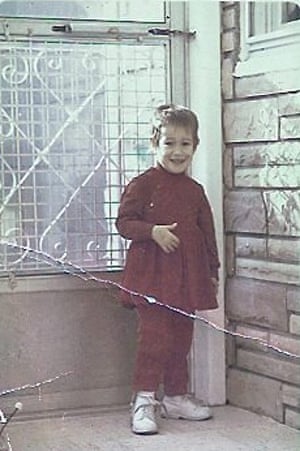


Ona, aged three, with the leg brace she had to wear.

Ona, aged three, with the leg brace she had to wear.

“What do you want to do?” Jody might ask me.


“I don’t know. You?”


“I don’t know.”


“Rock star wives?” one of us would finally ask, sighing like it was a last resort.


“I guess.”


After that we’d play for hours, immersed in the elaborate stories we created for Elton, Paul and beautiful grownup versions of ourselves.


Still, the next time Jody and I got together, whoever asked would be tentative about it, afraid the other would be the first to outgrow the game.


By high school, pretend games were no longer an option, unless you count pretending to have my period so I could sit on the sidelines in gym class. Or claiming to be too behind in homework to join my friends at the ice rink. Or acting as though my dislike of disco was the only reason I stood pressed against the wall at dances while the other girls mastered those perfectly synchronised steps.


“Why don’t we go to the movies?” I was always the one to suggest. There, in the comforting darkness, all I had to do was sit perfectly still, along with everyone around me. Row by row by row, we imagined together, lost in the drama of fictitious lives. The movies offered a means of playing pretend that was still sanctioned, a way to be social that asked nothing of my faulty limbs.


For college I chose a small, artsy school where the only team sport offered was Ultimate Frisbee and there were signs posted on the bulletin boards throughout campus that proclaimed It’s Okay to be Gay. I extrapolated from this that here, in this heady oasis, it was OK to be different. Among my classmates were girls with unshaven legs, boys who wore lipstick, kids of both genders with spiky magenta hair and splatters of safety pins on their clothes. Still, while I admired these outliers for their boldness and originality, I hid my uneven legs under long gauzy skirts in my usual attempt to blend in.


If my new classmates noticed my limp, or my childhood friends had seen through my excuses, they were kind enough not to say so. This allowed me to believe my own fabrications. I see it now as a wilful and instantaneous form of amnesia. As soon as I succeeded in avoiding a physical challenge or a potentially embarrassing moment, the memory, along with any thoughts about my disability, dispersed.
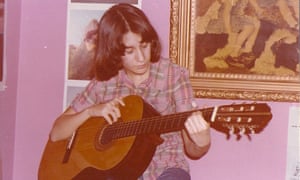


The young Ona: ‘If my new classmates noticed my limp, they were kind enough not to say so’


The young Ona: ‘If my new classmates noticed my limp, they were kind enough not to say so.’ Photograph: Leonard Gritz

Even so, as I settled in at college, an unnamed tension left me. I now lived in a place where I could curl up with my books hour after hour, not because my friends were off having adventures I couldn’t keep up with, but because this was the adventure. I majored in literature and had plans to become a writer. As I read and honed my craft, it felt as though the body, my body, with its limits and awkwardness, was the least of who I was. Finally, I could live the life of the mind. How perfect was that? Except, of course, it was only part of the story.


One afternoon in the campus library, I highlighted this line in my slim paperback copy of Virginia Woolf’s A Room of One’s Own:


“Women have served all these centuries as looking glasses possessing the magic and delicious power of reflecting the figure of man at twice its natural size.”


I marked the sentence, having brushed past and already forgotten this, from earlier in the same chapter, about the fact that so many men have written books about women:


“…it was flattering, vaguely, to feel oneself the object of such attention provided that it was not entirely bestowed by the crippled and the infirm…”


Had I, a 19-year-old crippled girl, flinched when I read this? Had it stung? I don’t know. I’d forgotten those words existed, and only discovered them now, decades later, while searching for the looking glass quote that has stayed with me all this time. This was precisely how my self-protective amnesia worked. Virginia Woolf devalued people like me in a chapter about the importance of confidence? But I loved Virginia Woolf, so the insult quietly left through some back door in my mind.
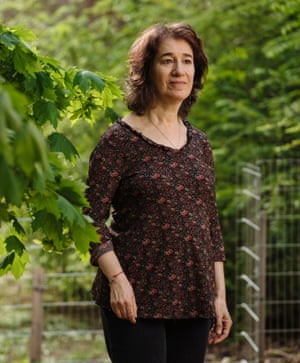


Ona at home


Ona at home: ‘A poetry workshop, I sat beside a man named Dan.’ Photograph: Gene Smirnov for the Observer

What did interest me that afternoon was the metaphor of the mirror, and the idea that men used us to build themselves up. I’d recently joined a feminist consciousness-raising group, and had begun insisting, sometimes petulantly, that I be referred to as a woman rather than a girl. When I marked Woolf’s words it was because they struck me as poetic and true. What I couldn’t yet see was that I had begun to use men similarly, not to reflect me at twice my natural size but as attractive enough. As OK.


This is where my college life wasn’t all disembodied intellect. I had also begun seeking validation through sex.


Here is another truth. I wasn’t at all beyond the prejudices expressed in Woolf’s forgotten passage. The young men I pursued had to be not just smart, creative and interesting, but handsome too. It went without saying that they were also able-bodied. Everyone I knew was able-bodied. There may have been a handful of other students with disabilities on campus, but I paid them no mind.


I chose men for the wrong reasons and, in turn, none of them chose me for anything more than an occasional intimate night. Then, when I was 25, I met Richard. He was athletic and handsome in the way of the popular boys who were completely out of my league in high school. The two of us had very little in common. Richard’s passions included skiing and mountain biking, and though I could never join him on either terrain, he was passionate about me too.


Richard was earnest, playful and affectionate. He was also hot-tempered and impossible to please. Nonetheless, I invited him to move into my apartment. Soon after, we got engaged. All the while, my friends looked on warily.


One friend told me she had always imagined that the man I’d wind up with would be someone she found amazing.


“Someone smart and really kind. The type of guy I’d love for myself, only I’d be so happy for you I wouldn’t be jealous.”


She watched me carefully and I realised that her comment had not just one subtext, but two. First, and most obvious, Richard, who was more conventional and less intellectual than my previous love interests, didn’t meet her expectations. Worse, it seemed she’d always believed that only someone amazing and really kind could possibly choose me. What hung in the air, unspoken between us, was the reason she thought it would take such a remarkable person to love me. I was defective. This made me cling to my handsome boyfriend all the more.


One weekend, while Richard was off mountain biking with friends, I decided to spend an afternoon in the city. After a movie and lunch at a cafe, I found myself following a strange woman down a winding street.


Is that what I look like? I wondered, carefully studying her from a distance. She’s pretty enough, but how much does her limp detract from that?


Over the following weeks and months, for the better part of a year, I kept an eye out for women with physical disabilities. When I found them, I trailed them. For a while, my curiosity remained on the surface. Could women who moved like me still be considered attractive? Did I find them so? But as I continued my stalkerish experiment, something shifted. I began to want to know about their lives.


The best way I knew to process this, as with most issues I grappled with, was through writing. Alone at my desk, I entered into a kind of dialogue with these strangers I was too reticent to approach in person. I did this by writing a poem in the voice of a nonverbal quadriplegic woman who was in the news at the time.


By now I had completed an MFA in creative writing and had found my place in a community of poets. One winter afternoon, I ran into an acquaintance who invited me to take part in a poetry reading and panel discussion for Women’s History Month. Each participant would be from a different cultural background, she explained. She’d already lined up an African American poet, a Latina poet, and she wanted me there to represent disability. My initial response was to take a step back when she said this. But then I felt a stirring of interest.


“I’ll be there,” I heard myself say.


I had the persona poem, and one about my mother helping me on with my nightbrace, and a third, titled What the Mirror Knows, that used my partial disability as a symbol for other ways I felt divided. At the reading, I surrounded these pieces with poems that made no mention of disability and that, to my mind, proved I led a perfectly normal and interesting life.


The panel discussion ended with questions and comments from the audience. There was one woman, seated a few rows back, whose insights caught my attention. She referred to writers I loved, and made connections that surprised and intrigued me. Afterwards, as I was gathering my things, I looked up to find her waiting to talk to me.


“I really liked your poems.”


“Thanks. I liked hearing what you had to say.”


We smiled shyly at each other. “Well,” she said, “I should probably use the bathroom before I head home.”


It wasn’t until the woman, who had introduced herself to me as Hope, started to walk away that I noticed her palsied gait. What could I do but follow her into the restroom?


Cerebral palsy is caused by damage, most often at birth, to a part of the brain that controls motor skills. There are various forms, and it affects people to widely differing degrees. Many don’t have enough balance to walk or need crutches to do so. Some have uncontrollable tremors. Some are intellectually disabled, while others are assumed to be because their facial muscles are affected and their speech is unclear.


Hope and I both have relatively mild cases and forms of the disability that affect only half our bodies. She has diplegia, which means the palsy is just in her legs. I have hemiplegia, which means the split is vertical. The muscles of my right limbs are tight and underdeveloped, and the fingers of that hand lack the dexterity, tactile sensitivity and fine motor skills of those on the left.


“It’s lucky she’s left-handed,” a doctor once told my parents during a consultation, “since she’ll always have to depend on that side.” I was nine at the time, old enough to resent being spoken about in the third person, and also to see the flaw in his logic. Maybe I was born left-handed, maybe not. The body learns to compensate, just like the mind.


Years later, I read an article suggesting that right hemiplegics are likely to be more creative and less practical than our counterparts whose disability is manifested on the left. The hypothesis is based on left /right brain differences. Left hemiplegics have undamaged left hemispheres, which is where pragmatism lives. Meanwhile, we right hemiplegics need to rely on our intact arty and imaginative right hemispheres.


The theory appealed to me. It fitted me so well. But then, just as I understood at nine years old, when it comes to cause and effect it’s hard to assess the true order. Certainly, my cerebral palsy and my drifty, daydreaming ways are connected. But to what extent is this due to the physical brain as opposed to the simple desire to escape the confines of a limited and disappointing body by imagining it away?


Hope and I spent several hours in a coffee shop that late afternoon, commiserating about what it felt like for each of us to be the one kid on the block who couldn’t run, climb fences, or ride a bike without training wheels. I learned I wasn’t the only one who coped by making excuses, hiding behind books, and living too much in my head. This was the first time either of us had ever spoken about these experiences. It was also the first time that I could remember when I wasn’t expending effort and energy to pretend my cerebral palsy didn’t exist.


While Hope took the fuel of our connection and almost immediately got involved in disability activism, I went home to Richard and my belief that his love for me meant that my cerebral palsy was, as my mother had assured me all those years ago, nothing, hardly noticeable.


A few months later, Richard and I married. With Hope now in my life, I had a growing consciousness about disability that came close to acceptance, but it was a place I visited, not yet one where I lived. More real to me was my marriage licence, which I saw as a kind of passport. It proved that where I really belonged was in the enviable world of the unscathed.


Something I had wanted since I was a child trying to coax my friends away from their games of hopscotch and tag to play house with me was to one day be a mother. Six years into our marriage, Richard and I agreed the time was right.


Through my pregnancy, my midwife never once mentioned my cerebral palsy, so neither did I. She did suggest a number of tests to rule out potential birth defects. Always I declined, feeling vaguely insulted, though I couldn’t have said why.


The daily and very physical tasks of caring for a baby forced me to recognise my disability for what it actually was


Our son Ethan was perfect: seven-and-a-half pounds, 14 inches, with active limbs, the right amount of digits, and a hearty cry. For the first hours after his birth, Richard and I sat together in the hospital room and stared at him in wonder. Eventually, a nurse came in to help me with breastfeeding.


“You need to lift your elbow so his head sits a little higher. Not working? How about we try the other side? Can you shift him so he’s in a better position? Let me show you something called the football hold…”


Nothing we tried worked so she brought in another nurse and then a third. They piled cushions around us until I could finally hold Ethan at the right angle and height.


“There we go,” the nurses said once he began to suckle.


“Problem solved,” Richard put in.


This tiny new person nuzzling at my breast depended on me. Yet, somehow, as I’d drifted through my pregnancy, daydreaming as usual, it had never occurred to me that I wouldn’t be able to meet his needs. Now, as I touched his cheek with the one hand that could really feel him, I understood that I didn’t have the balance or coordination to be this fragile, trusting person’s mom. I may have learned early in life to cover for being unable to run, skate or climb fences, but there would be no covering for being unable to safely bathe a newborn, carry him on stairs, or walk any distance while he flailed in my arms.


From that moment on, the daily and very physical tasks of caring for a baby forced me to recognise my disability for what it actually was. A set of very real and specific limitations I had to either work with or around. There were constant puzzles to solve, along the lines of, I’ve arrived home with a baby and a bag of groceries in his carriage and now I find that the one elevator in our apartment building has broken down. What do I do? Often the only answer was to ask for help from a neighbour. The first few times I did so, I stammered and felt myself flush. Then one day I simply stopped feeling apologetic. So, I had a disability. It was what it was.


Meanwhile, Ethan had begun reaching his perfect pudgy little arms towards me the moment we were together in a room. His absolute acceptance, despite my funny walk and clumsy touch, struck me as both lovely and familiar. It reminded me of my three-year-old self, noticing my brace in a photo without judgment.


It’s tempting to end the story here with the happy ending of a renewed self-acceptance. I would, except it gets even better.


It’s neither a surprise nor a tragedy that my marriage to Richard ended when Ethan was still small. Richard remains active in Ethan’s life and the divorce proved to be the best choice for us all.


One holiday weekend, when Ethan was eight, he stayed at Richard’s while I went to a writers’ retreat. There, in a poetry workshop, I sat beside a man named Dan, who had a soft-spoken gentle manner and, I could tell from his responses to poems, an incisive mind. When he brought out his own poem to be critiqued, I liked him even more. His piece had rhythm, wit and heart. This was definitely someone I wanted to know.


I watched him read and take notes by tapping on a braille laptop, his guide dog sprawled at his feet. After the workshop ended we stayed in our seats an extra few minutes talking, then he slipped his hand into the crook of my elbow, and we strolled together to the next event. I wondered if he noticed the lilt in my walk, and actually hoped he did. I wanted Dan to know that, along with poetry, disability was something we shared.


A week later, Dan called me and we stayed on the phone for four hours. In many ways, it was like my first conversation with Hope in the coffee shop. We were so happy to share our stories with each other, and while, in this case, the details of our disabilities bore no resemblance, when I talked about the long and circuitous road I took to making peace with mine, he let me know he’d been there too.


Still, I thought about how, as a young woman, I’d considered my disability a cosmetic flaw, akin to having a bad complexion or being a bit overweight. My concern had been whether people noticed. Now, it occurred to me what an indulgence that was. Born blind, Dan never had the luxury to pretend.


When we met, Dan and I lived a hundred miles apart. This meant we only got to be together on weekends. The rest of the week, we talked on the phone, building our relationship on a foundation of ideas and conversation. From the start, I was captivated by how smart he was, and by how intently he listened. Of course Dan listens well. Hearing is the sense he relies on the most. But I’d never met a man who did so with such presence and interest, and somehow I knew that this had more to do with who he was and what he valued than with the fact that he was blind.


Long before Dan and I got to know each other, he’d begun to write beautifully and candidly about his life as a blind man. He also had a community of friends who were writers and artists with disabilities. I wanted in, and they embraced me without hesitation. Soon, I began to seriously take on disability as a subject in my work. It felt scary at first, a little like pulling my childhood brace out of the closet and putting it on display. But I had spent more than enough time hiding and pretending. I wrote as truthfully as I could about how it felt to live in my particular body, which allowed me to see how universal my experiences actually were.


Dan and I were married on a bright, breezy day in June. Hope slept on our couch on the nights bracketing our wedding day. Ethan stood with us at the altar, holding my palsied hand.


We have been together for 12 years now. The work we do includes disability awareness presentations, literary readings and panel discussions about disability poetics. During one such event at a large poetry festival, a member of the audience, a man with a visibly awkward gait, took the microphone during the Q&A portion and asked in a shaky voice, “How did you learn to like yourselves?”


There were four of us up on the stage and for a long moment we were silent, touched by the vulnerability in the question. I thought of Hope who’d approached me after hearing my first tentative poems about disability. I thought of Dan and our community of disabled friends, including those with us up on that stage. It struck me that, in some way, we were each a pleasing and accurate mirror for the others.


“Do you like us?” I asked.


The man nodded.


“Well, that’s a start.”


Ona Gritz is the author, most recently, of On the Whole: A Story of Mothering and Disability (Shebooks, 2014) and the poetry collection Geode, which was a finalist for the 2013 Main Street Rag poetry book award. Her essay, It’s Time, which appears in the Rumpus, was named a Notable Essay in Best American Essays, 2016


Ona Gritz: "I had spent more than enough time hiding and pretending"

14 Nisan 2017 Cuma

Amsterdam"s solution to the obesity crisis: no fruit juice and enough sleep

[unable to retrieve full-text content]


The city is successfully fighting fat by promoting tap water in its schools, along with healthy cooking classes and a ban on fast food sponsorship


The city of Amsterdam is leading the world in ending the obesity epidemic, thanks to a radical and wide-reaching programme which is getting results even among the poorest communities that are hardest to reach.


Better known for tulips and bicycles, Amsterdam has the highest rate of obesity in the Netherlands, with a fifth of its children overweight and at risk of future health problems.


Related: For children’s health, the government has to treat sugar like cigarettes | Gary Taubes


Continue reading…


Amsterdam"s solution to the obesity crisis: no fruit juice and enough sleep

18 Şubat 2017 Cumartesi

Hope for Hanoi? New bus system could cut pollution … if enough people use it

From his high-rise office building in Hanoi, Tran Dung can barely see his city’s skyline behind the thick layer of smog. Before leaving work, the 25-year-old executive assistant checks the pollution reading on his AirVisual app, which provides real-time measurements of PM2.5 – the tiny particles found in smog that can damage your throat and lungs.


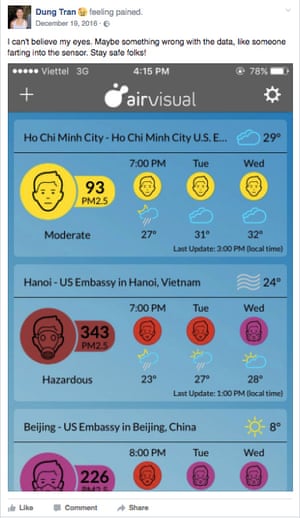
Hanoi’s PM2.5 levels typically range from 100 to 200 micrograms per cubic metre – regularly within the globally acknowledged “unhealthy” category. But on 19 December last year, they hit “hazardous levels” at 343μg/m3, which was higher than Beijing.


Shocked by this reading, Dung shared a screenshot with his friends on Facebook, writing: “I can’t believe my eyes. Stay safe folks!”


He’s aware of the limitations of air quality data, which can vary between different parts of the city, but apps like this are the best tools he has.


According to the independent data measurement site AQIVN, there were at least 15 days in 2016 where average PM2.5 levels in Hanoi were “hazardous”, at 300μg/m3 or higher. On 5 October last year Hanoi had the worst air pollution among major cities across the world, generating widespread outcry over public health.


Dinh Nam, a lecturer at the Vietnam National University in Hanoi, does not need an app to tell him that the air quality is bad. “Every day I motorbike over 8km to get to work,” he says. “I can see the smog sitting on my clothing and my skin every night.”


Screen Shot 2017-01-31 at 7.34.25 PM showing air pollution in Hanoi, Vietnam on airvisual app

Hanoi was measured at 343 μg/m3 of PM2.5s in December. Photograph: airvisual

Nam moved to Duong Noi, a new urban area far from the city centre, four years ago hoping to escape the pollution and traffic that the dense centre brings. However, as Hanoi continues its aggressive expansion policy, smog has caught up to his family; the area, which is close to the Yen Nghia industrial zone, has seen a simultaneous boom in high-rise construction and industrial development. The fumes from motorbike exhausts, construction and industry have made breathing a source of fear for Nam’s family. Aside from flimsy face masks, he has no other means to protect himself and his children.


When Hanoi joined a growing group of global cities to launch its first bus rapid transit route on the last day of 2016, it should have been good news for Nam. It was hoped that the new BRT would take some of the 5 million motorbikes and scooters off the roads and reduce congestion and pollution in the city.


Despite now having a BRT stop 500 metres from his house, Dinh Nam remains skeptical of the $ 53.6m development, funded by loans from the World Bank. “When the project was initiated 10 years ago, this area was much less congested than it is now. Now, the roads are so crowded it can’t be effective,” he says.


Dinh Nam’s skepticism represents the backlash BRT has faced in Vietnamese media since its launch. Many are angry that the BRT’s exclusive lane takes up almost half of some roads, exacerbating congestion for other motorbikes and cars. Others have predicted that BRT would never achieve the promise to cut travel time in half, given the challenges faced by keeping the lane free. But long before the launch, questions were already raised on whether the loan would be worth it.


The media’s declaration that BRT was dead upon arrival indicates declining trust towards the government’s handling of environmental and infrastructural challenges.


An ongoing struggle


Despite the brouhaha, many have already incorporated BRT into their daily routine. The 5pm bus towards Kim Ma on Thursday had all of its seats occupied and a handful of people standing. A dozen more gathered behind the shiny automated doors at the Giang Vo station, waiting to get in.


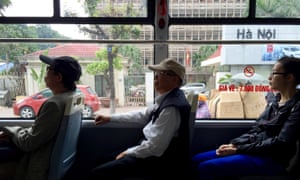
An official report from Hanoi’s transport document concluded that BRT passengers had risen over 62% in the first 12 days of its launch, averaging 41 passengers per trip. However, this means BRT is still operating under capacity, as can hold up to 90. Furthermore, it seems most passengers are students or retirees who are probably already accustomed to using public transport.


Given the low adoption, it is still too early to say whether BRT will have a positive impact on Hanoi’s air quality. The average monthly PM2.5 reading for January 2017, calculated using historical data collected at the US embassy directly on the BRT route, even shows an uptick in air pollution compared with December. However, it could be to do with the changing traffic patterns during the Vietnamese new year at the end of January.


On the BRT system


Hanoi BRT passengers have been mainly students and the elderly who already use public transport. Photograph: Zung Nguyen for the Guardian

Dr Hoang Xuan Co, an expert at the Research Centre for Environmental Monitoring and Modelling in Hanoi, says: “In theory, implementing BRT should improve air quality by reducing the amount of private transportation. However, there are ongoing challenges with implementing BRT: the infrastructure in Vietnam is still incomplete [for example, there are no hard dividers between the BRT lane and the regular street], and people’s transportation habits are unchanged. It has been almost one month, the people have yet to see BRT really impacting air quality.”


Hanoi currently has a declining 1.3 million daily bus users, a small number in comparison to the millions of motorbike drivers. The city also has a growing appetite for cars. It is worrying that many motorbike drivers who live within the BRT route and are highly critical of its construction say they have not even considered trying it.


Motorbike culture has engrained a need for flexibility and control in many Hanoians – some do not even get off their bikes when picking up meat and produce at wet markets. Dinh Nam is afraid that transitioning to BRT would reduce his flexibility in taking care of his family. “BRT is not for me because I sometimes have to pick up my kids,” he says.


Nguyen Dung, meanwhile, avoids the BRT as she does not want to walk to and from the bus stop.


Vu Anh Tuan, director of the Vietnamese-German Transport Research Centre, believes BRT faces the challenge of promoting public transport in a motorbike and car culture.


“BRT is a wise investment because it can complement the planned metro system to form routes throughout the city, while keeping costs low. Its impact needs to be assessed by what the entire public transit network can do in the long term,” he writes in a passionate Facebook post.


“The media … will cause people to develop false perceptions about public transportation, especially BRT.”


It seems Hanoi’s new BRT system will only be able to make an impact on both reducing congestion and air quality if people are willing to change their habits.


Guardian Cities is dedicating a week to exploring one of the worst preventable causes of death around the world: air pollution. Explore our coverage here and follow Guardian Cities on Twitter and Facebook to join the discussion


Hope for Hanoi? New bus system could cut pollution … if enough people use it

22 Ocak 2017 Pazar

The chemo’s too much, but getting on a clinical trial is gruelling enough

Saturday 7 January


Now sharp-eyed readers may have spotted that this diary starts the day before the last one was published! By way of a little back story, my doctors have been trying to get me on to a clinical trial featuring new immunotherapy treatments, on the basis that my first line of chemotherapy worked well initially and then failed completely, and the second-line chemo, while it did show signs of working, was proving pretty hard for me to tolerate. But getting on to clinical trials has proved more than a trial in itself!


By the time of the last column I’d been consented for a really promising trial and come through all the necessary tests with flying colours. And because my New Year’s Eve heart scare – actually it was a complete false alarm (and thanks again to the staff at University College Hospital in London for sorting me out on their busiest night of the year!). But because there was nothing to it and it preceded my being consented for the trial – no reason why it should affect my trial status.


But that brings me to Saturday 6 January. I got up not feeling too great but set about the Observer diary for the next day’s paper. Finished the column early afternoon and set off to Hertfordshire to see my boys. But by the time I arrived there my fingers were absolutely freezing cold and I was getting really powerful rigors (I think they’re called …) right into my core – so much so I couldn’t stop my teeth chattering. After about an hour under a very warm blanket with a hot-water bottle the symptoms abated but I felt very odd indeed. So we started taking my temperature – which failed to produce a single reading under 38C and plenty up in the 39s and even 40. Temperatures at this level are a huge red flag for someone undergoing chemotherapy because it can indicate a systemic infection – occasioned by weakened immune system, low white blood cell counts etc, which can overrun your system in no time at all. In other words temperatures in this range are definitely potentially life-threatening for many cancer patients.


So another call to the Royal Marsden MacMillan helpline – who for some reason were nowhere near as efficient as they were the previous weekend – and instructions to go to nearest A&E – in this case Luton and Dunstable. Again, I got there and appeared to have been put to the front of the queue – the national protocol has it that potentially “neutropenic” cancer patients (those with low white blood cell counts) should be on intravenous antibiotics within an hour – but wasn’t seen for nearly 90 minutes. However once I was seen they were absolutely amazing. Blood tests, painkillers, fans to cool me down (temp still 39.4C) a bed on an intermediate ward and intravenous antibiotics and fluids in no time at all.


Sunday 8 January


On the upside it turns out according to the consultant I saw (yes L&D turns out consultants on Sunday mornings – and good for them!) that I do not have “neutropenic sepsis”, but I do have a “small pneumonia” at the bottom of my left lung. Which is a bit of an odd one because I had no indications of any signs or symptoms until the shivers started on Saturday early evening. Anyhow, signs are that the (very) strong antibiotics are overhauling the infection and that all being well I’ll be let out Monday afternoon with six days’ worth of oral antibiotics. Actually while I’m hugely grateful for the antibiotics they really don’t seem to agree with me – stomach pains and no appetite – again!


Monday 9 January


Still feeling antibiotic rotten but doctor comes at 2pm and says I can go. I just have to wait for my drugs from the pharmacy and for the final paperwork to be signed off. To cut a long story short – and remember this is a hospital with capacity issues – three hours later I was still sitting on my bed waiting. So late in fact that I had to do my regular interview with Radio 4’s PM programme from the ward! Can’t fault the treatment but these kind of system delays, especially when the staff and the NHS are under so much pressure, must be driving everybody mad!


Tuesday 10 January


Back to Marsden for blood tests before what might well have been my first dose of immunotherapy trial drugs on Thursday. But oh no! Unless my pneumonia infection has basically gone away then I can be excluded from the trial. And because this episode has occurred after I was consented to, the drug company (trial sponsors) has to be told about it. Medical team clearly a little exasperated – with me I think! What else can possibly happen? They’ve got me a spot on a high-profile trial – actually a relatively rare spot at that (120 places available via 50 centres in the US, Australia and the UK) So they’re clearly worried that if the sponsors start to feel I might be a bit flaky or especially sensitive to infections etc etc, we might lose our rare and valuable place.


For me this really is becoming stress city – which isn’t just psychological but produces actual pains in my stomach and oesophagus. What if I lose out on this trial as well? When might the next one come along? What will have happened to me in the meantime? So no treatment on Thursday – one of the genetic tests is not back, apparently.


Thursday 17 January


Back to the Royal Marsden for blood tests and good news! Blood tests all good – no outward sign of infection and I’m feeling OK. So nothing to frighten the horses at the trial sponsor there. But now it appears their “medical monitor” – in Poland apparently – has to say yea or nay to my inclusion in the trial. Stress levels definitely rising all round now. All data sent off and consultant Dr Starling firmly of the view that there are no solid grounds for excluding me.


Wednesday 18 January


Ordinarily this should be BBC Media Show day. But the stress is really getting to me – and as I say it requires painkillers to control the effects – so I decide not to do the show this week. BBC as always was amazingly considerate. Another issue now bubbles up. Can the pharmacy prepare the drugs in time for treatment tomorrow – still no word from Poland. At 4.30pm I call the senior research nurse Tracy to see if there’s any news. She says no. She then calls me at 6pm to say we still haven’t heard. Now, no one’s saying this – least of all me – but everyone’s thinking: is there a problem?


By 7pm Wednesday – the night before the treatment is supposed to start – and Tracy calls to say I’ve finally been accepted and “randomised” into that part of the trial who get both drugs. She’s thrilled. But all I could do was cry.


Thursday 19 January


First doses of nivolumab and GS-5745. The lists of side effects are long and some are potentially fatal but fortunately not that often – so fingers crossed on that front. But the thing I noticed most? They don’t make your hair fall out – so goodbye to the amazing Paxman “Coldcap”!


The chemo’s too much, but getting on a clinical trial is gruelling enough

10 Ocak 2017 Salı

Words are not enough to tackle the crisis in mental health | Letters

I am, of course, pleased that Theresa May recognises that increasing numbers of adults and children are suffering from mental health difficulties (May pledges to try to reduce stigma, 9 January). The huge emotional burden this puts on families only increases the risks. These difficulties have escalated in thesix years since massive cuts to public services and most preventive mental health services, alongside the increased culture of competition that leads to more anxiety and less security.


Having been part of primary prevention and secondary child and adolescent mental health services in my 30-year career in the NHS, it was soul-destroying to see services closed and specialist skills built up over decades being lost. It is galling to hear the plans presented as if they are new and concerning that one of the plans is for teachers to be trained to identify mental health issues and provide interventions. Often teachers, also struggling with cuts to services and increased pressures, can already recognise mental health issues but lack the time and expertise to offer interventions that could make a significant difference. Identification alone is not helpful unless combined with resources to deal with the issues.


The link between mental health difficulties and environmental stresses is well known, and community services can only develop if mental health crises are safely managed. Links between mental health services and schools and GP practices work well and have been used before, but tend to be cut when there are huge pressures on other parts of the system. There is no mention of increasing funding to any mental health services or of any evidence-based focus to these policies.
Dr Julia Nelki
Retired consultant child and adolescent psychiatrist, Merseyside


Re the prime minister’s announcement of new measures to end stigma and unjust life chances for young people with mental illness, schools and their linkage to healthcare and the voluntary and community sector are central to “improve mental health”. As the new UK services are set up and evaluated, could I beg Guardian readers to share their observations with colleagues in the World Health Organisation’s initiative Global Accelerated Action for the Health of Adolescents?


A global “sharing society” could strengthen our government’s planned green paper on mental health, and help planners in countries with less expertise learn from UK successes and failures. I guarantee there will be both failures and successes – but it is the responsibility of the whole spectrum of stakeholders in mental health to learn from the implementation of policy.
Professor Woody Caan
Editor, Journal of Public Mental Health


So Theresa May is going to improve mental health care. Let me cite my son’s last two years. He is in the highest suicide risk group, single white males between 40 and 45. Recent talk about more support for teenagers is a distraction from the fact that adult mental health services are in a state of near collapse.


He had a major breakdown two years ago, when single and 42. Since then he has been in seven different hospitals. After each discharge, he has relapsed within a few weeks. “Care in the community” has been either conspicuously absent or totally inadequate. The shortage of beds has meant that on five occasions, he was assessed as in need of hospital readmission and, after a long wait in A&E, was transported to a new, strange hospital. The lack of continuity of care for someone already frightened, confused and distressed is absolutely counter to the kind of support necessary.


Providing supported residential accommodation, to ease the transition from hospital back into the world, is essential. The lack of available beds is in part due to “bed-blocking”, because of a lack of such accommodation. Community care teams would be more effective, working together with residential teams in supported accommodation, preparing people for rebuilding their lives in the community, providing a necessary bridge between hospital and the world.


This, Theresa, is a long-term problem in need of a seriously thought-through long-term strategy, and considerable investment.
Name and address supplied


It is not only acute care that is in difficulties (A&E crisis deepens, 10 January). My local NHS mental health trust has had to temporarily merge two inpatient wards due to staffing shortages as they cannot recruit enough qualified staff. This is not surprising, given the government’s policy of pay restraint in the public services by imposing pay rises of no more than 1% in recent years, and with no sign of any change, despite the effect they must know this has on the ability of the NHS to recruit and retain staff.
Ian Arnott
Peterborough


A Christmas card from an NHS forensic psychiatrist schoolfriend a few weeks ago said: “Don’t believe claims re money for mental health. We’ve just had millions chopped off our budget three weeks ago & meltdown consequently.” I expect to read next December that Theresa May gave it all back.
Mark Lewinski
Swaffham Prior, Cambridgeshire


The prime minister’s pledge to implement new measures to improve mental health services for young people couldn’t be more timely, as new figures from the Prince’s Trust reveal that one in four young people don’t feel in control of their lives.


In response to these findings and the fact that more young people than ever before are coming to us experiencing mental health issues, we are addressing an urgent need to improve mental health provision by launching our own mental health strategy. We welcome the government’s pledge to implement new measures to improve mental health services for young people and bring more focus to an area where we’ve seen an increasing need for support.


The Prince’s Trust Macquarie Youth Index reveals that young people’s confidence and happiness are at their lowest levels since the report was first launched in 2009. It paints a deeply concerning picture for a generation of young people who feel that their future is slipping away from them.


Many young people feel desperate about their situation; it’s vital that we act now if we’re to help them get the right support to create brighter futures for themselves.


The most important thing we can do to empower these young people is to continue to help them find work, education or training. Now, more than ever before, we need to work together to help them build a brighter future and regain control of their lives.
Dame Martina Milburn
Chief executive, The Prince’s Trust


As part of the work we undertake across the east of England, Ormiston Families works with children and young people struggling with mental health issues. We see Theresa May’s announcement about a new approach to mental health as hugely significant.


It is well documented that the provision of mental health services across the UK is inadequate and this lack of care has led to an increase in the number of children and young people suffering with mental ill health for prolonged periods of time. Through our services in Norfolk and Cambridgeshire we know early intervention in young people showing signs of mental health issues is critical.


The prime minister talked about focusing “on prevention as well as treatment, especially since so many adult mental health problems – which one in four of us will suffer from at any one time – begin in childhood”. As a charity working on the frontline with children and young people showing signs of mental health issues, we are relieved to hear this. Early intervention, and thus prevention, is key to reducing the number of people suffering with chronic mental health issues.


The numbers in Theresa May’s speech are exactly the type of statistics we are working to reduce.


Mental health is without doubt one of the biggest issues facing our society today and it is good to hear the prime minister is keen for the government to do more to address the problems and “not just in our hospitals but in classrooms and communities”.
Mark Heasman
Chief executive, Ormiston Families


Join the debate – email guardian.letters@theguardian.com


Read more Guardian letters – click here to visit gu.com/letters


Words are not enough to tackle the crisis in mental health | Letters

16 Aralık 2016 Cuma

How price-gouging of opioid overdose cure costs lives: "There"s never enough"

Ben Dunkle died at the age of 20, abandoned in a carpark by panicked friends who had no idea how to save his life as he overdosed on heroin.


“I’m certain that if they had been carrying naloxone, they wouldn’t have run away,” said his mother, Aimee Dunkle.


After Ben’s death, Aimee made it a mission to get naloxone, an antidote that can bring overdosing opioid users back from the brink of death within minutes, into the hands of as many people as she could. In February she founded the Solace Foundation in southern California to distribute the naloxone among addicts, many of them homeless, their relatives and friends. She says the group has saved at least 365 lives.


But Dunkle said she could have saved more if it were not for the surging cost of the drug which has prompted accusations of pharmaceutical companies profiteering from the US’s opioid epidemic. Costs for pre-filled syringes doubled in 2014 and are three times the price of 15 years ago, while injectors used to administer the spray have increased to more than five times the price in two years.


“More people are dead now than would have been otherwise,” said Dan Bigg, director of the Chicago Recovery Alliance, an important distributor of naloxone in the city. “How many is hard to count, but programmes that would have started didn’t because of the cost of naloxone. Programmes that would have expanded didn’t because of the price of naloxone. To the extent pricing is an impediment, it will prevent this being used as a lifesaving medicine.”


Deaths from opioid overdoses surged again last year to more than 30,000, driven by a sharp increase in the use of heroin and fentanyl.


Heroin deaths were up 23% on the previous year to 12,989, more than the number of lives claimed by guns used in murders, according to data released by the Centers for Disease Control and Prevention (CDC) on Thursday. The sharpest increase came from lives claimed by even more powerful synthetic opioids, such as fentanyl, the drug that killed Prince, which were up 73% to 9,580 deaths, although some of those deaths were in combination with heroin. But prescription opioid painkillers, containing drugs such as oxycodone, remained the biggest killers, taking 17,536 lives.


Medical studies say that most heroin users first become addicted to prescription drugs. It is how Ben Dunkle came to die.


ben dunkle


Ben Dunkle in 2012. Photograph: Courtesy of the Dunkle family

Overdoses are so widespread that the National Center for Vital Statistics found drug-related deaths are dragging down life expectancy for white adults.


After 15 years of steadily rising deaths from opioids, what the CDC has called an epidemic has finally forced its way on to the political stage with $ 1bn in treatment and prevention legislation passed by Congress. It has also resulted in ever-widening access to naloxone as more police forces carry it and states liberalise access by making it available without a prescription. But increased demand for the antidote has coincided with a sharp rise in cost.


Naloxone is most commonly administered by injection or spray. Kaléo, a Virginia company, has increased the price of its naloxone auto-injectors, sold as Evzio, from $ 690 for a kit of two to $ 4,500 in less than two years. Amphastar of California nearly tripled the price of syringes pre-filled with naloxone.


“When we started in 1996, a 10cc vial of naloxone was $ 1.63. Now that 10cc vial is almost $ 300 at Walgreens here,” said Bigg. “Has the price been raised well beyond what it costs to make in an obscene way for such an important lifesaving drug? Yes.”


Robert Childs, director of the North Carolina Harm Reduction Coalition, one of the largest non-profit distributors of naloxone in the US, said his organisation has spent about $ 220,000 this year giving out more than 13,000 naloxone kits to police officers and others working with those at risk of overdose.


“If naloxone wasn’t the price it is, we would be able to buy a lot more and get a lot more out there to high-risk populations,” he said. “There’s a public health crisis with opiate and opioid-based drug overdoses, and the response has often been to increase the price which is probably the worst response you can do.”


The increased demand and rising prices has resulted in a surge in income from naloxone for drug companies, up 400% since 2011 to $ 82m last year.


“It’s one thing to charge more for snow shovels when there’s a blizzard, but this is a public health emergency,” said Dr Andrew Kolodny, co-director for opioid policy research at Brandeis University. “When you have an epidemic of people dying of opioid overdoses, [this] should be readily available. We shouldn’t have pharmaceutical companies profiteering.”


Doctors writing in the New England Journal of Medicine called for government intervention to control the price of the drug, saying that cost is discouraging use of naloxone. They said that legislation has greatly expanded access to the antidote but that the price remains an obstacle.


“We believe that such policies should explicitly call on manufacturers to reduce the price of naloxone and increase transparency regarding their costs, particularly those related to the development of new formulations,” it said.


“The message to lawmakers is drug prices are an increasingly important problem for patients,” said one of the article’s coauthors, Dr Joseph Ross, an associate professor of public health at Yale University and a primary care physician.


Aimee Dunkle took one look at the young man slumped on a bench in a Santa Ana carpark three weeks ago and knew she had only minutes to act.


“The giveaway for me was he was drooling. He was breathing very shallowly. I recognised him and called his name. There was no response,” she said.


The man was overdosing on heroin and benzodiazepines, a lethal combination. Dunkle pumped a shot of naloxone – also known by the trade name Narcan – into him.


“I gave him the first shot of Narcan and no response. I gave him the second shot and he woke up. He was groggy, but he was up almost immediately. Someone had dialed 911 but before law enforcement arrived he was walking away,” she said. “It was exhilarating to save a life for the first time but then I realised this is how Ben died, sitting in a car, slumped over.”


Most of the manufacturers distribute a limited amount of free supplies to community groups and emergency services like Dunkle’s or sell naloxone at a discount.Dunkle said her group received free auto-injectors from Kaléo, but when they ran out she could not afford to buy more even at the discounted price for non-profits.


“There’s no way I can even contemplate buying it,” she said. “We sometimes get some financial donations. One time I had about $ 1,500 that had been donated and I bought $ 1,500 of Narcan. Then I had to select who to give it to. Not who was at most risk but who was most likely to witness an overdose. For a mother that’s lost a child, that’s a hellish decision to have to make: who gets the kits and who doesn’t.”


Supplies dried up for three weeks in September. Dunkle said that inevitably meant lives were lost.


“Our waitlist was over 70 people and that meant people died because we didn’t have it,” she said.


But financial donations mean she now has supplies to see her through the first half of 2017 distributing 70 naloxone kits a week. Still, that falls well short of demand.


“There’s never enough,” she said.


naloxone

The rising costs have drawn scrutiny in Congress. Senators Susan Collins and Claire McCaskill wrote to five pharmaceutical companies in June asking them to explain their pricing of naloxone.


A spokesman for McCaskill said that in meetings the companies defended the increases as necessary to cover the cost of new delivery systems. Naloxone, which has been on the market since 1971, is no longer covered by a patent and is cheap to produce. But pharmaceutical companies do have patents on how the drug is administered, such as by spray or auto-injectors, a spring-loaded syringe.


“In meetings, generally speaking the companies have argued that the price increases are due to new and more efficient delivery systems,” he said. “The question is, are these new bells and whistles effective?”


Manufacturers said the introductions of nasal sprays and auto-injectors are easier and safer to use than regular syringes. But Bigg questions whether those modifications justify the cost given that both means of delivery were already commonly used with other drugs.


An Irish company, Adapt Pharma, which makes a widely used naloxone nasal spray with a trade name of Narcan, denied that the patent was a means to price gouge. It said the spray “is designed, tested and approved so that anyone in the community can deliver a proper dose in non-medical conditions”.


“It’s not as simple as just putting naloxone into the device and selling it,” said Mike Kelly, president of Adapt’s US operations. “To obtain Food and Drug Administration approval, we must consistently meet the standards set by the FDA.”


The list price for the spray is $ 150 for the two shots typically administered to someone who overdoses on opioids which Adapt notes is considerably cheaper than a rival, the Ezvio auto-injector, with a retail price of $ 4,500 for a pack of two.


Kelly said the company discounts the cost for community groups and the police by 40% and that a majority of patients using a prescription can obtain it through health insurance for $ 10.


“We have made it our mission to provide more access and availability than ever before – including donating more than 50,000 doses of Narcan nasal spray to increase awareness and experience with the product and naloxone generally,” he said.


Mark Herzog, vice-president of corporate affairs at Kaléo said the six-fold increase in the list price of Ezvio was made in order to cover the cost of ensuring anyone with insurance and a prescription can obtain the drug cheap or free. The company responded to the senators’ letter by claiming that the real barrier to naloxone access is “lack of insurance coverage or unreasonable coverage restrictions”.


The company said it has donated more than 150,000 auto-injectors to public agencies and community groups. Other drug manufacturers did not respond to requests for comment including one of the largest naloxone sellers, Hospira, which has raised the cost of a vial of the drug by 1,700%.


How price-gouging of opioid overdose cure costs lives: "There"s never enough"

30 Kasım 2016 Çarşamba

The emotional life of men: "you"ll be right" isn"t enough anymore | Louis Hanson

I love my father. He’s kind and caring.


He grew up in a rural family of boys. He learnt from his father, who in turn learnt from his father, that expressing emotion didn’t coincide with his maleness. Not only was vulnerability not a choice, it just wasn’t an option. Things were left unsaid. The masculine ego left seemingly fortifiable. They were a generation of men strong and powerful but emotionally detached.


When I was 18, I started to feel tired. It was this unending languor, clouding my emotions, hiding my motivation and affecting my concentration. I felt permanently drunk. At the same time, I started to become uneasy; butterflies in my stomach and panic became the norm.


“You’re in the middle of a major depressive episode,” my psychologist told me during my first appointment. Here, I cried for the first time. At 18, I realised that I had perfected the art of hiding, concealing, and building the perfect facade. As a male, I felt, vulnerability wasn’t an option for me.


“You need to learn how to talk to your parents,” she said. I didn’t know how to do that. At this point, I recognised that I had never properly learnt how to access my sadness, let alone to verbalise this to my family.


It was awkward to tell my father that I wasn’t okay. At first, he struggled to access his own emotions with me. It took a lot of learning, from both sides, to communicate with one another as we’d both been groomed not to speak. When I needed him, though, he was there for me.


A close friend of mine recently told me that he had been feeling sad. We were in my car; I had started taking anti-depressants at this point. “One could say it was depression,” he half-smiled, still unable to confirm it for himself. He seemed tense. He told me that he’d gone through bursts of sadness for years, even though he had no reason to feel this way. It was true; he was well liked, had a large network of friends, had done very well in school and had a promising career. From the outside, his life seemed perfect. Sometimes, though, a reason doesn’t need to exist. Together, in that car, we were silent wanderers, guided by our unknown concerns.


Initially, he told me, he could only talk about the black cloud when he was drunk and refused to think about it when he was sober. He thought the black cloud would pass. He was too embarrassed to talk about his sadness. He never dared to tell his family; it made him feel uncomfortable. Besides, he had a carefree reputation to uphold; to him, weakness was prey.


He told his mates down at the pub after our encounter in the car, about his bursts of sadness. His mates paused. They were visibly awkward. “Oh, that’s weird,” said one of them, before they pushed the conversation aside. This bruised my friend’s confidence. His sadness was merely swept under the rug from then on, and this made him more confused.


It’s not necessarily his friends’ fault, though. We have taught, and are continuing to teach, young boys in Australia that emotion is not okay. We are teaching young boys that intimacy between one another should be feared. They are taught that this would make them seem gay. Subsequently, to combat this inherent homophobia, the thought of two males in a close friendship must be humoured and justified within society in order for masculinity to be maintained. In a society where women value the bonds between each other, why doesn’t the same apply for men?


This mentality ultimately extends into adulthood, perpetuating a culture in which manliness does not seem to correlate with the sharing of emotion. At this point, it is important to note that suicide is roughly three times higher in Australian males than females. Why is it that we wait to speak about a man’s depression until it is too late? Reaching out and valuing our male friendships shouldn’t need to be accompanied by a joke. Alas, we have truly grown up into a society in which males fear sharing emotion with one another.


So, for the boys who are afraid to embrace emotion and for the boys who feel with no tears, let’s rid the fear of talking. For the men who feel silenced and for those who have already succumbed to their black cloud, let’s discuss the importance of emotion. For my friend shunned by fear and for my own 18 year-old self, let’s talk about mental health and anti-depressants. Let’s just talk. To speak of pain is to overcome struggle, and to advocate the truths of those still ostracised by the screaming mask. It’s this open and honest dialogue that is helping so many. It’s helping me.


As someone who takes anti-depressants, I’ve come to realise the importance of emotional vulnerability within such a hyper-masculine culture that prides itself on strength and invincibility. Let’s ask boys and men alike how they are feeling, behind the performance. There is strength in susceptibility, too.


“You’ll be right” isn’t enough anymore. No one deserves a black cloud.


The emotional life of men: "you"ll be right" isn"t enough anymore | Louis Hanson

17 Kasım 2016 Perşembe

Promised £8bn extra for NHS is not enough, says hospitals boss

Theresa May will have to rip up the government’s financial plans for the NHS and commit more than the promised £8bn extra by 2020, a hospitals boss has said.


Chris Hopson, the chief executive of NHS Providers, said ministers must come up with a new plan to fix the health service’s crumbling finances or risk it becoming unable to function properly.


In a submission to the Treasury before next week’s autumn statement, NHS Providers, which represents 96% of NHS trusts in England, says a rethink is necessary because the calculations underlying the government’s £8bn pledge are flawed.


It says demand for care is rising faster than envisaged in the blueprint drawn up by NHS bosses in 2014, the Five-Year Forward View, and social care has deteriorated.


Hopson said: “Some of the key assumptions in the Five-Year Forward View, on which the current financial and NHS delivery plans for this parliament are based, have turned out to be wrong. There is now a clear and widening gap between what is being asked of the NHS and the funding available to deliver it.


“The NHS simply cannot do all that it is currently doing and is being asked to do in future on these funding levels.”


Andrew Lansley, the health secretary from 2010 to 2012 in the coalition government, recently said the NHS needed a “Brexit bonus” of £5bn on top of the £8bn already pledged, given the widespread public demand for higher NHS funding revealed by the EU referendum.


NHS Providers does not specify how much more it wants invested. But Hopson said more than £8bn was justified because “demand for care is a lot higher, social care is in a much worse state, general practice is turning out to be more unstable, and the starting point for the deficit among hospital, mental health, community and ambulance trusts has turned out to be much larger.”


He said the overall health budget would go up by only £4.5bn by 2020, not the £8bn ministers pledged last year, because money was being taken from key areas such as public health in order to give the NHS its promised increase. Independent experts agree £4.5bn is the true increase that healthcare will get.


The NHS’s inability to deliver the £22bn of savings it had promised to make by 2020 – a target that had always been “too ambitious” – further underlined the need for more money to be found before the end of this parliament, said Hopson.


May has been under pressure recently over her repeated claims that the government is giving the NHS £10bn more, and more than the NHS England chief executive, Simon Stevens, asked for in 2014. Sarah Wollaston, the Conservative chair of the Commons health select committee, and other members of the committee wrote to the chancellor Philip Hammond to say the claims were untrue. Labour has asked the UK Statistics Authority to rule on whether the £10bn claim is justified.


Jeremy Hunt, the health secretary, has subtly distanced himself from the £10bn figure and said the NHS will need a lot more money after 2020, at the end of its unprecedented decade-long budget squeeze.


Ministers have already told Stevens that the NHS will not receive a funding boost in the autumn statement. But NHS and local council leaders hope the chancellor may find some extra money to prop up the ailing social care system.


“NHS funding increases from next year onwards are not enough to maintain standards of care, meet rising demand from patients and deliver essential changes to services,” said Richard Murray, director of policy at the King’s Fund thinktank.


“If additional [NHS] funding is not forthcoming later in the parliament, the government will need to be honest with the public about the impact on quality of care and access to services.”


The Department of Health did not respond directly to Hopson’s comments. A spokesman said: “This government has taken tough economic decisions that have allowed us to invest in our NHS, which is meeting record patient demand whilst improving standards of care. We have prioritised funding for the NHS with £4bn extra this year.”


Promised £8bn extra for NHS is not enough, says hospitals boss