hospitals etiketine sahip kayıtlar gösteriliyor. Tüm kayıtları göster

12 Mayıs 2017 Cuma

NHS hospitals across England hit by large-scale cyber-attack

A number of hospitals have been hit by a large scale cyber attack, NHS England has confirmed.


Hospitals across the country appear to have been simultaneously hit by a bug in their IT systems, leading to many diverting emergency patients. NHS England said it was aware of the problem and would release more details soon.


Meanwhile doctors have been posting on Twitter about what has been happening to their systems.


A screen grab of a instant message conversation circulated by one doctor says: “So our hospital is down … We got a message saying your computers are now under their control and pay a certain amount of money. And now everything is gone.”


If.ra (@asystoly)
Why would you cyber attack a hospital and hold it for ransom? The state of the world


NHS hospitals across England hit by large-scale cyber-attack

14 Nisan 2017 Cuma

Desperate hospitals beg doctors to take on extra shifts – at £95 an hour

Desperate hospitals are so short of doctors they are pleading with them to take on extra shifts, with some offering up to £95 an hour to cover gaps in medical rotas to maintain patient safety.


Hospitals are so chronically understaffed they have been hiking pay rates in recent weeks and bombarding doctors with urgent emails and text messages in a bid to ensure standards of care do not suffer.


On Tuesday, Peterborough City hospital raised the pay available for working overnight that night in its “extremely busy” A&E to £95 an hour for a 10-hour shift to try to attract recruits.


“Exceptionally, we approved a maximum hourly incentivised rate for our senior trust doctors. This will ensure safe medical staffing levels and enable the department to continue to give high quality care to all our patients,” said Neil Doverty, the North West Anglia NHS foundation trust’s chief operating officer.


Hospitals often scramble to make 11th hour arrangements to fill rotas. Last Monday the Dudley Group NHS foundation trust in the West Midlands was forced to increase the fees for senior house officers in its A&E from £60 an hour to £70 an hour for shifts lasting 10 and 12.5 hours.


The Guardian has seen messages sent by dozens of hospitals across England and Wales to doctors which paint a picture of near panic as many of them struggle, often at the last minute, to have enough medics on duty.


Many hospitals have been struggling to find enough doctors to work over the Easter weekend, with some trying more unorthodox approaches to get staff in. West Middlesex hospital in London, which is facing problems staffing its rotas despite having a well regarded bank of staff and paying high locum rates, this week offered any doctor working over the holiday weekend an Easter egg as an incentive.


Faced with an acute shortage of A&E doctors last month, the John Radcliffe hospital in Oxford sent scores of doctors an email entitled “help!” which said: “I am sorry to be sending so many messages but I am in real need here. I am practically begging at this point. I really need some help.


“Can ANYONE help out for any length of the shifts needed this weekend? It really is a matter of keeping the department safe.” The email was sent on 16 March by Brigid Greaney, the medical staffing administrator for the hospital’s emergency department.


This week Lewisham hospital in London, in its search for doctors to staff its general medicine department, sent an email that said: “We are struggling with the cover for on-call shifts this week. Please let me know if you can help.” It offered to cover doctors’ day shifts if they agreed to work nightshifts.


Doctors’ leaders say the problem is getting worse, blaming NHS workforce planning and the pressure of coping with the growing number of patients needing care.


“Hospitals should not be reduced to begging, but what other option do they have when the NHS is so chronically under-resourced? This should set alarm bells ringing right through the NHS,” said Dr Liam Brennan, the president of the Royal College of Anaesthetists.


Dr Mark Holland, the president of the Society for Acute Medicine, said: “Rota gaps are common – very common. I would be surprised if any hospital anywhere has a full complement of staff. There are some trusts under huge stress and where putting a workforce in place is very challenging, I would be surprised if there wasn’t a sense of desperation to get doctors on the shopfloor.”


Hospitals are sometimes being forced to pay well over the normal rates for hard-to-fill shifts because “there is a pan-NHS workforce crisis. This isn’t about greedy doctors,” Holland said.


The emails and text messages show that almost every branch of medicine is experiencing acute shortages of doctors in at least some hospitals. They range from surgery to cardiac care, anaesthetics to A&E and general medicine to intensive care. For example, Manchester Children’s hospital last Tuesday solicited volunteers for 19 “long days” and 26 nightshifts this month in its paediatric intensive care unit “to be paid at the enhanced rate of £60 per hour”.


Some hospitals facing acute shortages are advertising scores of shifts at a time. Milton Keynes hospital this week notified doctors of 52 shifts over 20 days this month in its A&E. Worcestershire Royal hospital in Worcester has so far only filled five of the 69 shifts it is seeking to fill between now and early August.


A doctor at Chesterfield Royal hospital, who asked to remain anonymous, said: “The rota gaps problem here is insurmountable and, frankly, rather dangerous. The quality of my life has been greatly impaired by the busiest winter we had on record followed by no real drive by the trust to recruit more doctors to anticipate this deluge of patients. The biggest culprit is A&E which is almost entirely staffed by locums, most of them being long-term [locums], followed by the emergency medical unit, which is very short on nights and weekends.”


Despite hospitals’ best efforts some shifts are still going unfilled, which puts extra pressure on other staff. A trainee surgeon at a major London teaching hospital said: “I’ve had occasions where instead of having two on-call senior house officers to hand over to, I’ve had to cover both shifts, after already working 12 hours.


“Working locum shifts in short-staffed departments often feels like juggling with your medical licence as your clinical decisions are affected by time pressures and bed shortages more than your assessment of the patient in front of you.”


Hospital bosses warned that endemic understaffing is threatening patient safety.


“Along with high levels of bed occupancy, gaps in rotas can mean patient safety is put at risk. Fewer medical staff on shifts create intolerable workload pressures for all staff. This is bad for morale which has a further impact on the quality of care,” said Saffron Cordery, the director of policy and strategy at NHS Providers, which represents hospitals.


“Workforce pressures are fast becoming the number one concern for many NHS trusts, including hospitals, mental health, community and ambulance services. These are particularly difficult over holiday periods. All types of trust are affected but we know that this can be very challenging in rural areas and in specific specialties. Patient safety is always the top priority and every trust wants to guarantee safe care. The steps described here are an indication of just how seriously they take this,” Cordery added.


A Department of Health spokesperson said: “Staffing is a priority – that’s why we have invested in the frontline and there are over 31,400 more professionally qualified clinical staff including over 11,200 more doctors, and over 12,100 more nurses on our wards since May 2010.


“With over 52,000 nurses in training we will continue to make sure we have the staff available to give patients high-quality care as part of a safer NHS seven days a week.”


Desperate hospitals beg doctors to take on extra shifts – at £95 an hour

7 Nisan 2017 Cuma

A&E redirecting increasing number of ambulances to other hospitals

A record number of ambulances were turned away from busy A&Es this winter and sent to other hospitals, preventing paramedics from responding to urgent calls quickly enough, according to a study.


The Nuffield Trust, a health thinktank, looked at NHS England data and found that nearly twice as many patients arriving in ambulances were turned away from hospitals and sent elsewhere this year compared with the same period over the last three years.


Ambulances were redirected 478 times over the three-month period from December to February, compared with an average of 249 times in 2013-14, 2014-15 and 2015-16. The NHS refers to such incidents caused by a lack of physical or staff capacity as “diverts”and says they should be a last resort.


The thinktank said this had a direct effect on paramedics’ ability to respond to emergencies – with none of the three main response targets having been hit since May 2015. Prof John Appleby, Nuffield Trust chief economist and lead author of the report, said: “There’s rightly been a lot of focus recently on the delays ambulance crews face in being able to hand over their most seriously ill patients at A&E.


“But what our research today has uncovered is the huge increase in the number of times this winter [that] ambulance trusts have been told they must take patients to another hospital altogether, because an A&E unit simply doesn’t have the capacity to accept any more patients.”


Of the 233,472 most serious category A calls received in January this year, at least 95% should have been responded to in 19 minutes. But 29,000 calls were not picked up within this timeframe, meaning 88% of responses met the target.


Richard Webber, national spokesperson for the College of Paramedics and a senior paramedic in the NHS, said: “While we are sympathetic to hospitals that are forced to implement diverts so that they don’t reach dangerous levels of overcrowding, in non-urban areas in particular the extra time taken to reach more distant A&E departments is significant.”


The report also found that paramedics were under increased pressure, with demand for the service rising at a faster rate than emergency admissions to hospital and A&E attendances. The Nuffield Trust said that morale in the sector was also poorer than other parts of the health service.


The figures come as the government faces calls to address growing demand on A&Es. In January, patients in England experienced the worst month of delays in emergency departments since a four-hour target was introduced 13 years ago.


Jonathan Ashworth, the shadow health secretary, said: “Theresa May has overseen a shocking and unacceptable decline in standards for the NHS this winter. Our ambulance services are under increasing pressure and we know that ambulance staff across England are really feeling the strain. They deserve much more support from the government.


“The truth is that years of under-investment by the Conservatives have left hospitals unable to cope with rising demand, and now shocking numbers of ambulances are being diverted because A&Es are stretched to the limits. The government urgently needs to set out what action they’re going to take to make sure patients and their families never have to suffer a winter like this again.”


An NHS England spokesman said: “Currently too many ambulances are dispatched to simply hit targets rather than attend to those patients most in need. This is why we’re carefully testing a change to the way in which the services can respond and will make our recommendations known in the coming weeks.”


A&E redirecting increasing number of ambulances to other hospitals

9 Mart 2017 Perşembe

Google"s DeepMind plans bitcoin-style health record tracking for hospitals

Google’s AI-powered health tech subsidiary, DeepMind Health, is planning to use a new technology loosely based on bitcoin to let hospitals, the NHS and eventually even patients track what happens to personal data in real-time.


Dubbed “Verifiable Data Audit”, the plan is to create a special digital ledger that automatically records every interaction with patient data in a cryptographically verifiable manner. This means any changes to, or access of, the data would be visible.


DeepMind has been working in partnership with London’s Royal Free Hospital to develop kidney monitoring software called Streams and has faced criticism from patient groups for what they claim are overly broad data sharing agreements. Critics fear that the data sharing has the potential to give DeepMind, and thus Google, too much power over the NHS.


In a blogpost, DeepMind co-founder, Mustafa Suleyman, and head of security and transparency, Ben Laurie, use an example relating to the Royal Free Hospital partnership to explain how the system will work. “[An] entry will record the fact that a particular piece of data has been used, and also the reason why, for example, that blood test data was checked against the NHS national algorithm to detect possible acute kidney injury,” they write.


Suleyman says that development on the data audit proposal began long before the launch of Streams, when Laurie, the co-creator of the widely-used Apache server software, was hired by DeepMind. “This project has been brewing since before we started DeepMind Health,” he told the Guardian, “but it does add another layer of transparency.


“Our mission is absolutely central, and a core part of that is figuring out how we can do a better job of building trust. Transparency and better control of data is what will build trust in the long term.” Suleyman pointed to a number of efforts DeepMind has already undertaken in an attempt to build that trust, from its founding membership of the industry group Partnership on AI to its creation of a board of independent reviewers for DeepMind Health, but argued the technical methods being proposed by the firm provide the “other half” of the equation.


Nicola Perrin, the head of the Wellcome Trust’s “Understanding Patient Data” taskforce, welcomed the verifiable data audit concept. “There are a lot of calls for a robust audit trail to be able to track exactly what happens to personal data, and particularly to be able to check how data is used once it leaves a hospital or NHS Digital. DeepMind are suggesting using technology to help deliver that audit trail, in a way that should be much more secure than anything we have seen before.”


Perrin said the approach could help address DeepMind’s challenge of winning over the public. “One of the main criticisms about DeepMind’s collaboration with the Royal Free was the difficulty of distinguishing between uses of data for care and for research. This type of approach could help address that challenge, and suggests they are trying to respond to the concerns.


“Technological solutions won’t be the only answer, but I think will form an important part of developing trustworthy systems that give people more confidence about how data is used.”


The systems at work are loosely related to the cryptocurrency bitcoin, and the blockchain technology that underpins it. DeepMind says: “Like blockchain, the ledger will be append-only, so once a record of data use is added, it can’t later be erased. And like blockchain, the ledger will make it possible for third parties to verify that nobody has tampered with any of the entries.”


Laurie downplays the similarities. “I can’t stop people from calling it blockchain related,” he said, but he described blockchains in general as “incredibly wasteful” in the way they go about ensuring data integrity: the technology involves blockchain participants burning astronomical amounts of energy – by some estimates as much as the nation of Cyprus – in an effort to ensure that a decentralised ledger can’t be monopolised by any one group.


DeepMind argues that health data, unlike a cryptocurrency, doesn’t need to be decentralised – Laurie says at most it needs to be “federated” between a small group of healthcare providers and data processors – so the wasteful elements of blockchain technology need not be imported over. Instead, the data audit system uses a mathematical function called a Merkle tree, which allows the entire history of the data to be represented by a relatively small record, yet one which instantly shows any attempt to rewrite history.


Although not technologically complete yet, DeepMind already has high hopes for the proposal, which it would like to see form the basis of a new model for data storage and logging in the NHS overall, and potentially even outside healthcare altogether. Right now, says Suleyman, “It’s really difficult for people to know where data has moved, when, and under which authorised policy. Introducing a light of transparency under this process I think will be very useful to data controllers, so they can verify where their processes have used or moved or accessed data.


“That’s going to add technical proof to the governance transparency that’s already in place. The point is to turn that regulation into a technical proof.”


In the long-run, Suleyman says, the audit system could be expanded so that patients can have direct oversight over how and where their data has been used. But such a system would come a long time in the future, once concerns over how to secure access have been solved.


Google"s DeepMind plans bitcoin-style health record tracking for hospitals

NHS chiefs order hospitals to begin urgent overhaul of A&E care

NHS chiefs have ordered hospitals to push through an urgent overhaul of A&E care, with GPs assessing every patient when they turn up to help the health service avoid another winter crisis.


The move comes as the NHS in England disclosed that it recorded its worst performance to date in January, missing vital treatment targets covering A&E, cancer and planned hospital care. The number of patients stuck in hospitals due to inadequate social care, such as a shortage of care home places, also hit an all-time high.


In a speech on Thursday, Jeremy Hunt, the health secretary, added to the pressure on hospitals by telling them to get back to meeting the target of treating 95% of A&E patients within four hours. That fell to 77.6% in January as hospitals buckled under unprecedented demand for emergency care.


However, hospital chiefs immediately criticised Hunt’s edict as “unrealistic” and demanded much more money to improve A&E care than the £100m in Wednesday’s budget.


NHS groups have voiced serious doubts as to whether there are enough GPs in England to work at every A&E unit. Dr Helen Stokes-Lampard, the chair of the Royal College of GPs, said: “We feel that the best place for GPs is working with patients in their communities and the money just announced for new triage systems in emergency departments would achieve more if most was spent shoring up general practice.”


The NHS England chief executive, Simon Stevens, and his counterpart at NHS Improvement, Jim Mackey, have written to all parts of the health service outlining “concrete changes” they must make to prevent next winter from overwhelming hospitals.


Over the previous winter, pictures of patients lying on trolleys in hospital corridors and countless stories about waiting many hours for ambulances caused major embarrassment to ministers and NHS chiefs.


Under the changes set out on Thursday:


  • Ambulance crews will treat many more sick people where they find them, rather than bringing patients to hospital. In future, paramedics should be “conveying patients to hospital only when this is clinically necessary”, the letter says.

  • Every hospital will have put in place “comprehensive front door streaming” by October, under which family doctors and nurses will assess how unwell patients are to reduce the risk of A&E units becoming overloaded by the 1.5 million to 3 million people who turn up unnecessarily every year.

  • GP surgeries will have to offer many more appointments at weekends and in evenings, ultimately providing these to everyone in England by 2020.

  • Doctors and nurses will have to provide better medical care to the 400,000 older people living in care homes, to stop them becoming so unwell that they need to be admitted to hospital.

  • NHS bodies will work much more closely with local councils to reduce so-called bedblocking in hospitals. Councils will use the £1bn extra for social care in 2017-18 announced in Wednesday’s budget to provide more at-home care services and places in care homes.

  • The NHS 111 telephone advice service will be overhauled to enable many more callers to speak to a doctor, nurse, mental health specialist or other type of health professional, as the Guardian reported on Wednesday.

Stevens and Mackey made it clear in their letter, published on Thursday, that NHS hospital trusts that do not implement every element of the plan will in effect be fined, by being denied money from the service’s £1.8bn-a-year sustainability and transformation hospital bailout fund.


Prof John Appleby, the chief economist at the Nuffield Trust health thinktank, said the latest performance figures “make dismal reading for the NHS and patients”.


“The number of patients stuck on a trolley waiting for a hospital bed has gone through the roof, with more than 80,000 patients waiting for four hours or more in January, and a staggering 988 of them waiting longer than 12 hours,” he said. “These are vulnerable people with acute medical needs. Corridors, it seems, have become the new emergency wards.”


Cancer charities criticised ministers over the NHS again missing the target for treating cancer patients referred for urgent treatment within 62 days.


Emma Greenwood, the director of policy at Cancer Research UK, said: “Today’s figures for January are the worst ever performance against this crucial cancer target, which has now been missed annually for three years. This is completely unacceptable.


“Cancer targets exist to ensure quick diagnosis and access to treatment, and provide a snapshot of how the NHS is performing for patients. The government and NHS England have committed to improving early diagnosis of cancer, including increasing investment, but it’s clear that this is yet to have an impact.


“Specifically, we have yet to see any significant progress to address huge staff shortages in the diagnostic workforce, especially for radiologists, pathologists, endoscopists and radiographers.”


NHS chiefs order hospitals to begin urgent overhaul of A&E care

2 Mart 2017 Perşembe

Inside Royal Brompton hospital"s paediatric unit – photo essay

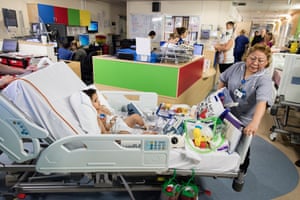
The Royal Brompton in Chelsea is one of three hospitals in London with the facilities and staff to treat children with heart defects. An estimated 5,500 to 6,300 babies are born with congenital heart disease in the UK each year, all of whom require specialised care. Some will need many operations throughout their life.


On Friday, the Guardian will be live blogging from the Brompton, where congenital heart disease services are under threat of closure. Advocates of the change say concentrating services in fewer locations makes for better care; the hospital and its supporters say it is the best at what it does in the country. The Brompton treats children with heart and lung diseases aged from just days old to 16 years. It has a paediatric intensive care unit (PICU) for children after surgery with at least one dedicated nurse per child, the Rose ward for 30 inpatients, and four beds in a high-dependency care unit (HCU).


The morning ward-around


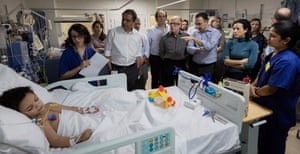
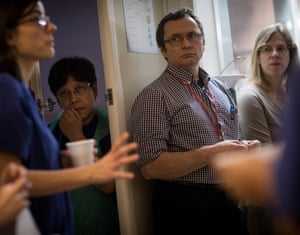
The morning ward-around Photograph: David Levene for the Guardian

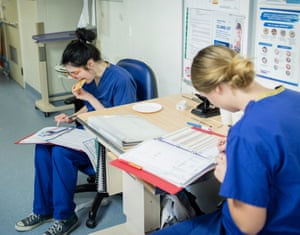
  • Morning routines: the ward-around meeting, and breakfast on the fly for the nurses


The morning ward-around meeting


The morning ward-around meeting Photograph: David Levene for the Guardian


Nurses eat breakfast while doing paperwork


Nurses eat breakfast while doing paperwork at about 8am Photograph: David Levene for the Guardian

Doctors, consultants and nurses tour the paediatrics department in the morning ward-around. It is a crucial opportunity to discuss the various cases and what to expect for the day ahead.


Young patients


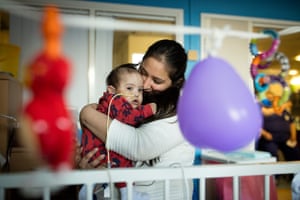
Kawaljit Kaur and her baby Ekam, inside Rose ward


Kawaljit Kaur and her baby Ekam, inside Rose ward Photograph: David Levene for the Guardian

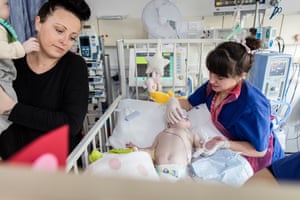
Kawaljit Kaur spends all day, every day, at the bedside of her first and only child, Ekam, who is five months and 19 days old, she says, and was born with a hole in his heart. “I play with him. He holds my hand. We talk to each other and he gives me a smile,” she says. Ekam, sleeping flat on his back with his face hidden by tubes, flails his limbs in the air. “He is very lively,” says a nurse.


After work, Kaur’s husband joins her before they go home for the night. And in the morning she is back. “On Saturday and Sunday we are both sitting here, watching what he is doing,” she says.


Autumn Russell with her mother Keri


Autumn Russell with her mother Keri Photograph: David Levene for the Guardian

  • Autumn Russell with her mother Keri

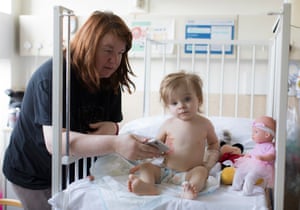
Fifteen-month-old Autumn Russell from Essex was transferred to the Brompton for specialist treatment for a case of empyema, a bacterial infection that develops in the slim space between the outside of the lungs and the inside of the chest cavity.


Time may pass slowly on the ward in the paediatric heart and lung unit, but for children like Ekam and their parents, the hospital becomes part of their life – a second home and a place of hope. Ekam’s veins are still too narrow for the heart operation he needs, so he has a succession of stents fitted – tubes inserted into blood vessels to increase the flow.


Marciee Barnes-Palmer


Marciee Barnes-Palmer, who has respiratory problems and a congenital heart defect Photograph: David Levene for the Guardian

Marciee Barnes-Palmer has respiratory problems as well as a congenital heart defect. She underwent a microlaryngoscopy and bronchoscopy procedure to look at her upper airways, and doctors will need to close the hole in her heart.


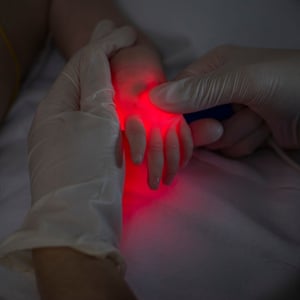
Dr Jana Kossaibati uses a torch to locate a vein in Marciee Barnes-Palmer’s hand


Dr Jana Kossaibati uses a torch to locate a vein for a cannula in Marciee Barnes-Palmer’s hand Photograph: David Levene for the Guardian


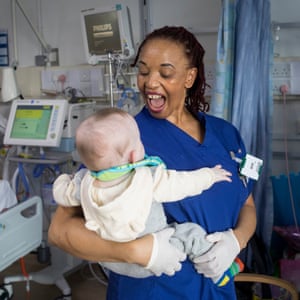
Paediatric nurse Patience Makuyana holds Marciee’s brother Freddie


Paediatric nurse Patience Makuyana holds Marciee’s brother Freddie Photograph: David Levene for the Guardian

  • Dr Jana Kossaibati uses a torch to locate a vein to insert a cannula in Marciee’s hand. Nurse Patience Makuyana holds Marciee’s brother Freddie


Consultant clinical psychologist Michele Puckey


Consultant clinical psychologist Michele Puckey supports the families, patients and their siblings Photograph: David Levene for the Guardian

Consultant clinical psychologist Michele Puckey supports the families, patients older than about three, and their siblings. “Brothers and sisters have to be reassured that they have not caused it,” she says. “And the child in hospital must not be treated like a princess – or they will not fit in at school when they get back to real life.”


Between four and seven they have this extreme feeling of being in control of everything around them. Children feel responsible for parents arguing and separation
Michele Puckey


Staff need support too and Puckey herself is not immune. “I remember once a boy going down to theatre in the same pyjamas as my son and I just caught my breath.”


Ellarna and mother Rachel speaking with Dr Cathy O’Donoghue, anaesthetic and critical care consultant


Mother Rachel speaking with Dr Cathy O’Donoghue Photograph: David Levene for the Guardian

  • Rachel, the mother of Ellarna, speaking with Dr Cathy O’Donoghue

Ellarna is 32 weeks old and has had a catheter procedure today to close a hole in her aorta. Anaesthetic and critical care consultant Cathy O’Donoghue visits to discuss the operation.


Ellarna recovering from her operation


Ellarna recovering from her operation Photograph: David Levene for the Guardian


Ellarna


Ellarna Photograph: David Levene for the Guardian

For premature babies, the Brompton is the only centre in the UK using this method as an alternative to surgery.


Teenage patients


Sarah Bartram with daughter Ellie Bartram


Sarah Bartram with daughter Ellie Bartram Photograph: David Levene for the Guardian

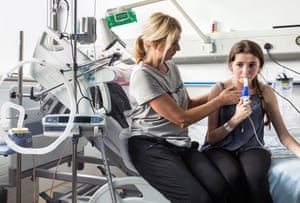
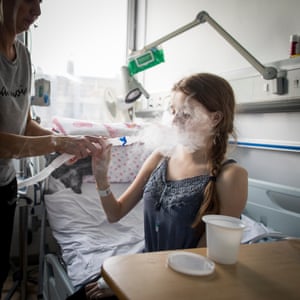
Ellie Bartram, 16, has been coming to the Brompton since she was diagnosed at four months old with cystic fibrosis, a lifelong condition that clogs up the lungs with mucus. She is admitted for two weeks every three months for an intravenous course of antibiotics.


Ellie Bartram in her school class in the paediatric ward


Ellie Bartram in her school class in the paediatric ward Photograph: David Levene for the Guardian


Ellie Bartram


Ellie Bartram Photograph: David Levene for the Guardian

  • Ellie Bartram in her school class in the paediatric ward, and undergoing lung treatment

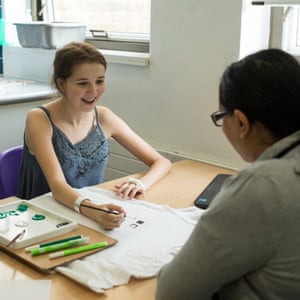
There is a schoolroom on the ward, where Ellie has lessons. The teaching is good – she and her mum Sarah credit a tutor at the Brompton for getting Ellie through her French GCSE with a C grade.


I can’t run around. I can’t go out much or go out with friends often. But my friends come and buy me McDonald’s because it’s my favourite thing
Ellie Bartram


In her solitary room, where visitors must wear aprons and gloves for fear of giving her an infection, she talks to her friends via FaceTime. “I’m used to it,” she says. She doesn’t like being different, but she is matter of fact about life at home in Romford, Essex.


Riley Jenkins, 13, grimaces in pain


Riley Jenkins, 13, grimaces in pain as his mother helps him put on a shirt Photograph: David Levene for the Guardian

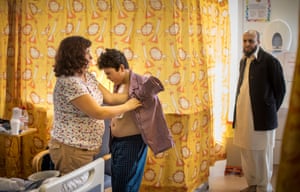
  • Riley Jenkins , 13, grimaces in pain as his mother helps him put on a shirt. Riley had cardiac surgery three days ago

Riley Jenkins, 13, is feeling very sick. He can’t eat the meatballs for lunch. His mother Sally rubs his back to try to make him feel better. It is the after-effects of the anaesthetic and the operation to replace a calcified heart valve that was inserted in his chest when he was just seven months old. “He’s been coming for a checkup once a year since he was a day old,” says his mother, Sally.


Riley was born with a back-to-front heart. “He loves Scouts and being on his computer but he’s been too tired to do a lot of running about. He used to love climbing trees. We’re hoping for more tree-climbing now,” Sally says.


Ben Eccleston-Barnes, from Devon, is visited by volunteer music therapist Brian in Rose ward


Luke Eccleston-Barnes, from Devon, is visited by volunteer music therapist Brian in Rose ward Photograph: David Levene for the Guardian

  • Luke with volunteer music therapist Brian

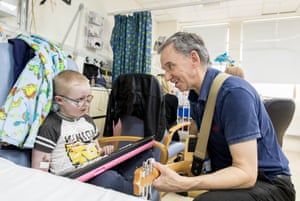
Luke Eccleston-Barnes, nine, has a needle phobia, perhaps because of the huge number of injections and blood tests he has endured in his life so far. But he is calm now – music therapist Brian Spears has arrived with his guitar to distract him while more blood was taken. He is playing softly to Luke, who tries to accompany him on an electronic keyboard Spears has brought along.


The nurses


Nurse Angeline Guzha, right, and Dr Jana Kossaibati, centre, help a young girl called Sanaya


Paediatric nurse Angeline Guzha, right, and Dr Jana Kossaibati, centre, help a young girl called Sanaya in the paediatric intensive care unit Photograph: David Levene for the Guardian

Paediatric nurse Angeline Guzha and Dr Jana Kossaibati help a young girl called Sanaya in the paediatric intensive care unit.


Lilian Leite and Nimla Pentayya are two of the three sisters managing Rose ward, where they have both been for six years. Leite is from South Africa and Pentayya from Mauritius. “We wanted to travel and we stayed – we are getting job satisfaction here,” Pentayya says with a grin. Both always wanted to work with children.


We know that parents are upset and the young nurses are upset but we have to be strong, the three of us will support each other
Lilian Leite


Lilian Leite and Nimla Pentayya


Lilian Leite and Nimla Pentayya are two of the three sisters managing Rose ward Photograph: David Levene for the Guardian

Dan Fossey is a practice educator, a nurse who trains other nurses. He also teaches parents basic life-support techniques in case they need them at home. Often parents are anxious and worry their child is too fragile. “Especially when they have had cardiac surgery they have questions about the scar and can you still do compressions,” he says. He teaches them to overcome their fears if a child has something stuck in his throat.


The last thing a parent wants to do is strike the child on the back
Dan Fossey


Practice educator Dan Fossey


Practice educator Dan Fossey Photograph: David Levene for the Guardian

Fossey runs a graduate programme for newly qualified nurses, to teach them about caring for children with heart defects. “I came here as a brand new nurse 10 years ago. I know what it’s like to come out of university and be looking after children with quite complex conditions,” he says.


Surgery


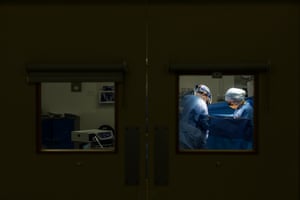
Surgery under way on a young patient


Surgery under way on a young patient Photograph: David Levene for the Guardian

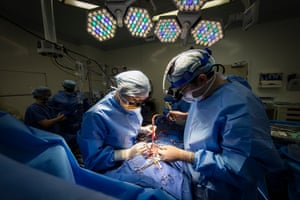
Abdula is being wheeled along a corridor to the operating theatre by robed staff, his mother trailing slightly – out of place and desperately anxious. By far the majority of the complex operations for congenital heart conditions carried out here are a success. Inevitably, sometimes they are not. In some cases, where there is a risk but the baby will die without an operation, surgeons as well as families have to be brave.


Patient Abdula Allanoud on his way to his third heart operation


Patient Abdula Allanoud on his way to his third heart operation Photograph: David Levene for the Guardian

  • Abdula Allanoud, four, on his way to his third heart operation

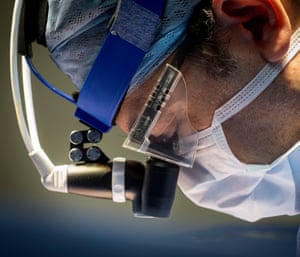
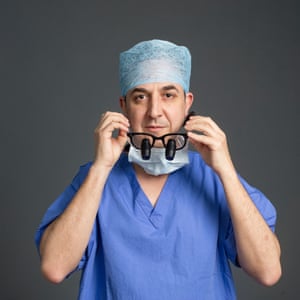
Consultant paediatric heart surgeon Olivier Ghez specialises in neonates – the tiniest babies, less than a month old, with a heart the size of a nut. He operates wearing binocular-style glasses that enlarge the miniature veins he has to stitch.


I have relatively small hands but it is the instruments, not the fingers
Olivier Ghez


A four-hour surgical procedure conducted by Olivier Ghez


A four-hour surgical procedure to treat Abdula, conducted by Olivier Ghez Photograph: David Levene for the Guardian

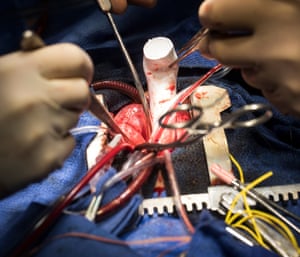
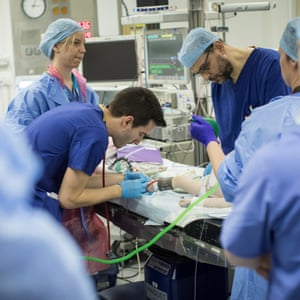
  • Abdula is undergoing a four-hour Fontan procedure to correct a complex heart malformation, conducted by Ghez


Olivier Ghez


Olivier Ghez Photograph: David Levene for the Guardian


Olivier Ghez at work during an operation


Olivier Ghez at work during an operation Photograph: David Levene for the Guardian

Ghez’s job is exhausting – an operation can last three to five hours and a complex transplant could take 24 hours. But it is challenging and rewarding, he says. Sometimes he saves babies’ lives. Other times he gives them “the best possible future” with their heart condition. He can never be sure how it will go.


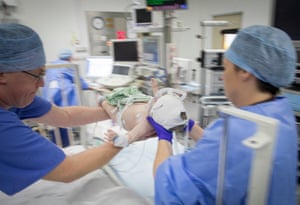
A 14-month-old girl, diagnosed after birth with a hole between the two chambers of the heart, comes into theatre for a relatively routine procedure and suffers a cardiac arrest. Suddenly the theatre is flooded with people, calm but purposeful, and the team restarts her heart.


A 14-month-old girl undergoes a procedure


A 14-month-old girl undergoes a procedure Photograph: David Levene for the Guardian

  • The girl arrested for four minutes during the procedure and was eventually revived by the team after a doctor performed CPR


A young girl goes into arrest during a surgical procedure.


A young girl goes into arrest during a surgical procedure. Photograph: David Levene for the Guardian


CPR is performed on the 14-month-old girl


CPR is performed on the 14-month-old girl Photograph: David Levene for the Guardian

When a child dies, says Ghez, “it is terrible, terrible – very sad and discouraging sometimes”. It may be a child who has had several successful previous operations at the Brompton. “When the baby dies after all this, it is really difficult,” he says. He worries about the accusations that can fly in the media over child deaths during or after surgery.


There is a danger of producing defensive medicine. That is a really perverse effect of the scrutiny. You can’t treat risky patients and have perfect results
Olivier Ghez


Consultant paediatric heart surgeon Olivier Ghez specialises in neonates, the tiniest babies


Consultant paediatric heart surgeon Olivier Ghez specialises in neonates, the tiniest babies Photograph: David Levene for the Guardian

Deaths are rare at the Brompton, but everyone is aware of the risks to the lives of these vulnerable children.


The support staff


A cleaner prepares to clear and disinfect a bay


A cleaner prepares to clear and disinfect a bay where an infection was recently present Photograph: David Levene for the Guardian

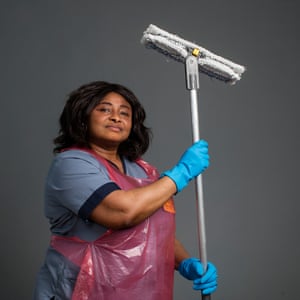
A cleaner prepares to clear and disinfect a bay where an infection was recently present. Everybody is supportive. Theresa Dzade, one of the cleaning staff, says she likes the children and the parents.


It is not easy for someone to leave their house and come here with a small baby. They are sometimes sad because their baby is ill. They talk to me all the time. I tell them I am here to help – anything they want
Theresa Dzade


Theresa Dzade, one of the cleaning staff


Theresa Dzade, one of the cleaning staff Photograph: David Levene for the Guardian

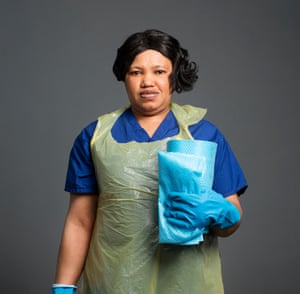
Her friend Sidratu Kargbo feels the same.


We have to do a good job to make them happy
Sidratu Kargbo


Cleaner Sidratu Kargbo


Cleaner Sidratu Kargbo Photograph: David Levene for the Guardian

Night falls


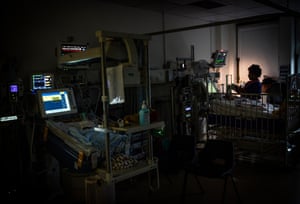
Night falls in the paediatrics department at the Brompton


Night falls in the paediatrics department at the Brompton Photograph: David Levene for the Guardian

Nursing and other medical staff work through the night as many patients require round-the-clock care. Parents usually leave the ward at night as they are encouraged by staff to rest.


Sandra Gala-Peralta, a PICU consultant, says: “If they don’t have a good rest, especially the mother, the following day they are exhausted. And if they are exhausted they don’t take the information in the same way. If something happens they are extremely fragile. So that is why we encourage them to go to sleep and have a good rest. If they don’t want to then we just let them be in the bed space. Especially if they are teenagers or children, five years old, then they have enough understanding to be be very afraid, so we let the parent in..”


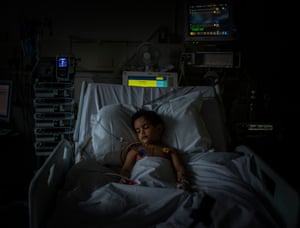
Abdula Allanoud recovers after his operation


Abdula Allanoud recovers after his operation Photograph: David Levene for the Guardian

  • Abdula Allanoud recovers in intensive care after his heart operation

Gala-Peralta adds: “The evening tends to be a bit calmer. But everything depends on how the patients are. If the activity is high, the consultant stays around until … well, this is a personal choice. I’m more OCD, I like to make sure that if I go for a rest everything is in order and that I’m not going to have surprises in the night. We have an on-call room in one of the upstairs floors. I have been called in the middle of the night because a child has had a cardiac arrest. I was so stressed when they called me that I went down barefoot! I was doing cardiac massage in my socks! Now I’m more careful.”


I like to work on nights – it gives a lot of space to the doctor and nurses to focus on the patient, and because the night shifts tend to be a bit longer there is enough time to see how a patient can deteriorate, or improve during that time
Sandra Gala-Peralta


PICU consultant Sandra Gala-Peralta


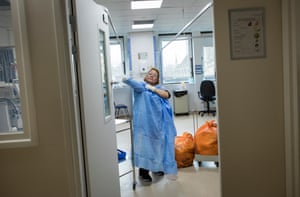
PICU consultant Sandra Gala-Peralta, photographed at 8am at the end of a 24-hour shift Photograph: David Levene for the Guardian

  • Gala-Peralta photographed at 8am at the end of a 24-hour shift

“There are nights when we sleep one hour … and there are nights when we are able to sleep four or five hours. At least we can put our head down and we can have a bit of rest every night. And then in the morning at 7.30 we need to be sharp, back on the unit,” says Gala-Peralta.


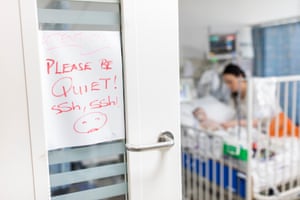
A sign in the paediatrics department


A sign in the paediatrics department Photograph: David Levene for the Guardian


Inside Royal Brompton hospital"s paediatric unit – photo essay