Royal etiketine sahip kayıtlar gösteriliyor. Tüm kayıtları göster

20 Nisan 2017 Perşembe

On mental health, the royal family is doing more than our government | William Davies

The public profile of mental health experienced another boost this week, thanks to some moving comments made by Prince Harry and the Duke of Cambridge about the impact of their mother’s death, nearly 20 years ago. The two royals are working for the Heads Together campaign, which seeks to combat the stigma surrounding mental health issues, and to encourage people to speak more openly about their difficulties.


Harry’s admission that he had ignored his own emotional distress for several years before eventually having counselling was a valuable contribution, from a figure more commonly associated with laddish machismo. William’s focus on male suicide statistics was also a good use of his celebrity.


The royal family cannot get involved in divisive party political issues, and so we can only conclude from these interventions that mental health is something that exists beyond the fray of politics. Breaking the “stigma” surrounding mental health issues is certainly not something that one would want to identify as a leftwing or a rightwing agenda.


There is no more damning indictment on British society in 2017 than the prevalence of mental distress among children


On the other hand, political parties have been keen to make the mental health agenda their own. Theresa May has established mental health as one of the key areas where she hopes to signal her government’s concern for everyday human suffering, making a high-profile speech in January that also stressed the importance of breaking the stigma that clouds the issue.


All of this presents something of a riddle. Mental health problems have risen in profile to the point where the prime minister and the heir to the throne are personally committed to combating them. Yet there is scarcely any public discussion about where they actually stem from. Losing a parent at a vulnerable age, as Harry did, is terrible and harmful – but epidemics do not arise purely out of private tragedies.


The stigma attached to mental health is a real problem in workplaces and schools, as are the benefits of overturning it. But stigma can scarcely be viewed as the cause of what it stigmatises.


The orthodoxy that has taken root since the 1980s is that mental health problems are disorders of the brain. The success of SSRIs since the launch of Prozac in 1987 has helped to entrench this view. This doesn’t mean that mental illness can’t be treated with “talking cures”, such as cognitive behavioural therapy or by being more open about one’s emotions, as Prince Harry has argued. But the idea that mental health problems are illnesses just like any other illnesses has become one of the main ways in which the stigma is challenged. Comparisons with cancer have become common.


The idea that one is simply “unwell” no doubt provides comfort to many people wrestling with their own depression or anxiety. But it also blocks out a whole host of more fundamental cultural, political and economic questions regarding the distribution of distress in our society – the sorts of questions that the Duke of Cambridge would be less likely to grapple with.



Theresa May


‘There is scarcely any public discussion about where [Britain’s mental health problems] actually stem from.’ Photograph: SilverHub/Rex Features

There is no more damning indictment on British society in 2017 than the prevalence of mental distress among children. Nearly a quarter of a million are receiving mental health treatment from the NHS, and those contacting Childline complaining of anxiety and exam-related stress have been climbing year-on-year. Rates of self-harm amongst young girls have risen by 42% in a decade.


Are we to believe that it was simply “stigma” that swept all this under the carpet in the past? Or might children be telling the truth, when they say they feel overwhelmed by the requirement to perform, excel, keep up? The NSPCC reports that some children are having to sit mock exams just a few weeks after returning from the summer holidays. Think about what that means and does psychologically. What does Theresa May have to say about that? British children have become damagingly competitive, and less forgiving of failure. Which minister will have the guts to stand up and say to children that being average is OK?


Adult mental health problems may present themselves as medical and be treated as such, but they are not immune to sociological analysis. Researchers have found that adult mental health is worse among those who frequently moved house as a child. Today’s housing crisis is tomorrow’s mental health crisis.


Rising household indebtedness is another major culprit, especially the kinds of problem debts that are associated with week-by-week financial precarity. Children suffer when their parents are too stressed or depressed to listen to them or play with them. Debt problems break up families.


Austerity has been disastrous for the nation’s mental health. The British Psychological Society has called for a termination of benefit sanctions (which are effectively designed to produce anxiety); academics have shown the deep emotional harm wrought by the bedroom tax. Teachers, who live under the constant spectre of monitoring and performance assessment, are seeking medical help for stress in shocking numbers.


The seductive concept of “public sector productivity gains” conceals thousands of personal tragedies among doctors, paramedics and local government service providers, many of whom cling to a dream of exiting their profession. And these are the same people who look after the wellbeing of our children and mental health patients.


No doubt mental health will feature prominently in party manifestos, now that it’s gone mainstream. Whether any of the above gets a look-in remains to be seen. Labour should be shouting about it, and not allow the hypocritical architects of austerity an inch of this territory. Next time a Labour politician is patronised as being too leftwing by a journalist, the evidence on what inequality does to our minds should be slung back.


So, yes, we need to talk more. And, yes, stigma surrounding depression and anxiety makes things worse. But it’s not just ourselves and our medical histories we need to talk about. We also need to talk about what sort of society we’ve built, and what the alternative might look like. For all their good intentions, Harry and Wills might need to sit that one out.


On mental health, the royal family is doing more than our government | William Davies

18 Nisan 2017 Salı

The stiff upper lip: why the royal health warning matters

It was Diana, of course, who opened the floodgates of tears that swept away the notion of the British “stiff upper lip”. The public mourning at her death was seen as a turning point for a nation where emotional repression had been a point of pride. So it seems fitting that this week it is her sons, William and Harry, who are warning us that our emotional journey is not yet over.


Last week, Prince Harry described how he went for counselling after repressing his own grief over the loss of his mother led to a two-year period of anxiety, anger and “total chaos”. This week, his brother, the Duke of Cambridge, has gone on to warn in an interview that keeping “a stiff upper lip” should not be at “the expense of your health”.


More than 25 years since Paul Gascoigne’s famous tears during the 1990 World Cup made him a national hero, haven’t we moved on from this buttoned-up stereotype? From Barack Obama crying over the death of children at Sandy Hook to Vladimir Putin shedding tears at a victory rally, these days even world leaders are unafraid to show their emotions. Yet, as consultant clinical psychologist Sally Austen points out, such public weeping invariably takes the form of “tidy tears”. The emotion we accept, or even encourage, in public figures is still controlled. “To be with someone who is crying snot and choking on their sadness takes a level of courage for which we might not yet be ready,” she says.


For individuals, the terror that strong emotions will overwhelm us remains deep-seated. “The fears are underpinned by negative automatic thoughts; powerful, often unexamined thoughts that affect the choices we make, often without us even noticing. This leads us to worry that, ‘If I start crying I will never stop’ or, ‘If I cry my colleagues will lose all respect for me’, and even, ‘I can’t cry because I need to look after everyone else’.”


This can come at a cost. “People who might be classed as emotionally ‘strong’ – the stiff upper lipped – are more likely to end up with depression or PTSD than those who recognise their need to express their feelings,” she says.


It’s not hard to find pockets of nostalgia for the idea of a stiff upper lip in the UK, fuelled in part by a hankering for a time when boarding school-bred army officers were moulded to take charge of the empire. A recent Sky News article, for example, railed against “thin-skinned millennials” as it mourned the loss of the days when tough “ploughmen and labourers” were “led by youth from the middle and upper classes tempered and toughened in the forges of public school”.


The journalist Alex Renton, whose book about the dark side of boarding schools is titled Stiff Upper Lip: Secrets, Crimes and the Schooling of a Ruling Class, says this is what makes William’s words “stunning”. “Those three words are understood across the world to sum up a sense of British reserve and resilience and qualities that, to many people, are what made Britain great. It’s the core creed of the empire. The notion that the British were exceptional and the best rulers the world has known through the training of being tough and taking things on the chin is very strong. So it’s pretty revolutionary to have one of the titular heads of a nation say it’s not always a good thing and that speaking up might be better.”


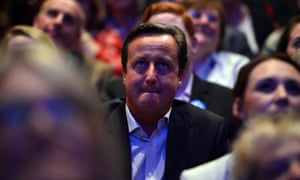
David Cameron fights back the tears listening to William Hague’s final speech as an MP in 2014


Keep calm and carry on: David Cameron fights back the tears listening to William Hague’s final speech as an MP in 2014. Photograph: Carl Court/AFP/Getty Images

Psychotherapist Philippa Perry says an old French and Saunders sketch neatly sums up the problem with the stiff upper lip. In it, a caricature of a “hunting, shooting and fishing” woman accidentally chops off her finger and, rather than crying, throws it to her nearby dog. When another dog starts barking for a similar treat, she cuts off another finger. This, says Perry, illustrates “how ridiculous it is not to listen to your feelings”.

“The stiff upper lip type thinks there are only two options,” she says. “Either you try to put [your emotions] in a box” or you “allow them to be the horses to your chariot – you are led around by them. Of course, there is a middle way – when you hear and listen to your feelings, and are guided, but not led by them.” This, she says, is the difference between allowing your emotions to “spill out everywhere”, and containing them.


By refusing to acknowledge our own emotions, Perry argues, we risk losing our ability to empathise with others. The long-term effects can be detrimental. Counselling psychologist Victoria Galbraith says: “There is still this idea that men need to ‘keep it together’. Suicide is much greater among younger men, which might be down to them feeling they have to keep these things to themselves. Having the opportunity to talk to people … I can’t overemphasise how positive that is.


“If we keep our emotions in, they come out somehow. That can be through poor physical health in time, or anger outbursts or taking things out on other people. It’s almost impossible for it not to have an impact – it’s about how soon we choose to engage with the emotions we experience.”


Linda Blair says she has noticed a change in the UK’s attitude in the near 40 years she has been a psychologist. UK patients were much more likely to be ashamed or defensive about seeking help, and saw it as being a “bother”. And, she says, there was a lingering feeling that men should not ask for help; where once only one in six of her patients were male, this is now around one in three.


But Blair does have a word of warning about letting everything hang out: we should think about who we are releasing our emotions on to. “We need to be sensitive. If someone is very stressed, dumping your problems on to them is not a favour. If you are meeting your best friend, say: ‘I know we are meeting for a fun lunch but I need to talk about a problem.’ We can’t lose our sense of community as we start being able to feel.”


Ultimately, however, she thinks the princes should be thanked for their intervention in reducing the stigma around showing your emotions. As she puts it: “Ugly feelings left unattended just fester.”


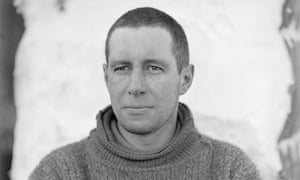
Captain Lawrence Oates


Captain Lawrence Oates: the epitome of British stiff upper lip. Photograph: Scott Polar Research Institute, University of Cambridge/Getty Images

‘I decided to give up crying’: Tim Dowling on his emotional journey


When I was a small boy growing up in the US, I was what was technically known as a cry baby. I cried over everything including, on many occasions, spilt milk. So prodigious was my ability to produce tears that other children used to take things away from me, just to see me cry.


Eventually, I realised this was putting me at a social disadvantage, so I decided to give up crying. It took years to learn how to choke off this particular emotional outlet, but I managed it. I figured, good riddance.


I suppose this was my version of the stiff upper lip – at the time, I thought I had invented it. It didn’t quite turn me into the confident, fearless person I hoped it might. I remained self-conscious, awkward and anxious. I just didn’t cry. There was only one thing left to do: I found an island nation over the sea where all the men were like me, and I moved there.


The earliest citations for the expression “keep a stiff upper lip” are actually from the US, but I won’t pretend I have ever considered it an American trait. I have never even really thought much about what it means. As an admonition, it seems a little wrongheaded; when you are on the cusp of betraying emotion, the lower lip is usually the first to go. It also seems to imply the presence of an enemy – perhaps somebody standing on the deck of a nearby frigate with binoculars trained on your face – who might take comfort from your weakness.


There is nothing wrong with prizing resolve, but the most famous examples of the stiff upper lip in action – think of Antarctic explorer Captain Oates leaving the tent and walking into the blizzard with the words, “I may be some time” – often seem more like evocations of futility. To remain calm in the face of a situation that warrants considerable panic is generally a sign that you are mentally unwell, or in shock, or both. Over the years, I have learned to avoid people who would have me maintain a stiff upper lip on their behalf.


I have also learned that most British traits come with a competing countertrait: they are the uncomplaining people who complain all the time; they have an intimate relationship with their weather, but they never, ever dress for it; the men aspire to stiff upper lips, but they are also happy to admit to deep insecurities; everybody spurns help in the first instance, but nobody likes to be thought of as well-adjusted. I love it here, I really do.


I do sometimes worry about raising three sons in a nation where the myth of the stiff upper lip still holds sway. I was conscious of trying not to dissuade them from crying when they were little, but of course one ends up doing it anyway. A crying child triggers a strong emotional reaction in a parent; it’s exhausting. Somewhere along the line, children have to learn the lesson about spilt milk.


What I can never do is create an emotionally appropriate world for my children to live in. It is how it is out there, and they learn more about how a young British man is supposed to comport himself from a one-hour bus ride than they ever will from me. We all figure out where and when we can let our guard down. There is a kind of resilience in just possessing that information.


That said, there are two lessons we can take away from the publicity created by William and Harry speaking out. The first is that if people habitually avoid displaying emotions, they can get into terrible mental distress without anyone else knowing about it, and that’s dangerous. The second is that if you don’t actually engage with your own emotions, like I stopped doing decades ago, you end up hauling them about with you like an overfull bucket. It’s time to stand up and be British: face your scary emotions squarely, with a stiff upper lip.


Samaritans is available around the clock, every single day of the year, to listen and offer confidential support. Phone 08457 90 90 90 or visit samaritans.org


The stiff upper lip: why the royal health warning matters

2 Mart 2017 Perşembe

Inside Royal Brompton hospital"s paediatric unit – photo essay

The Royal Brompton in Chelsea is one of three hospitals in London with the facilities and staff to treat children with heart defects. An estimated 5,500 to 6,300 babies are born with congenital heart disease in the UK each year, all of whom require specialised care. Some will need many operations throughout their life.


On Friday, the Guardian will be live blogging from the Brompton, where congenital heart disease services are under threat of closure. Advocates of the change say concentrating services in fewer locations makes for better care; the hospital and its supporters say it is the best at what it does in the country. The Brompton treats children with heart and lung diseases aged from just days old to 16 years. It has a paediatric intensive care unit (PICU) for children after surgery with at least one dedicated nurse per child, the Rose ward for 30 inpatients, and four beds in a high-dependency care unit (HCU).


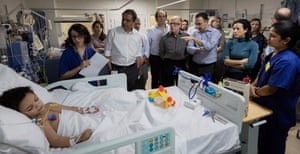
The morning ward-around


The morning ward-around Photograph: David Levene for the Guardian

  • Morning routines: the ward-around meeting, and breakfast on the fly for the nurses


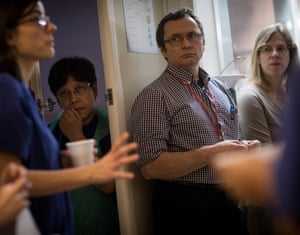
The morning ward-around meeting


The morning ward-around meeting Photograph: David Levene for the Guardian


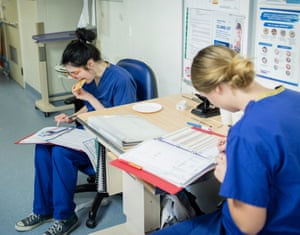
Nurses eat breakfast while doing paperwork


Nurses eat breakfast while doing paperwork at about 8am Photograph: David Levene for the Guardian

Doctors, consultants and nurses tour the paediatrics department in the morning ward-around. It is a crucial opportunity to discuss the various cases and what to expect for the day ahead.


Young patients


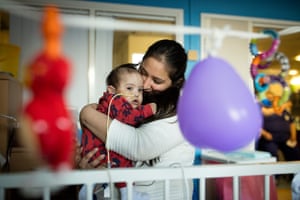
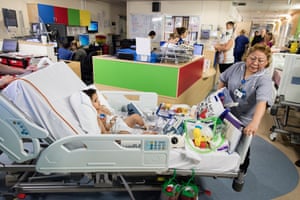
Kawaljit Kaur and her baby Ekam, inside Rose ward


Kawaljit Kaur and her baby Ekam, inside Rose ward Photograph: David Levene for the Guardian

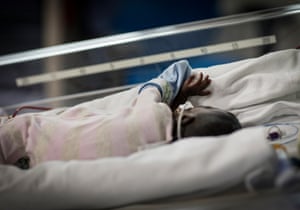
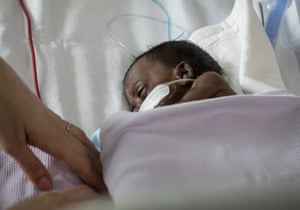
Kawaljit Kaur spends all day, every day, at the bedside of her first and only child, Ekam, who is five months and 19 days old, she says, and was born with a hole in his heart. “I play with him. He holds my hand. We talk to each other and he gives me a smile,” she says. Ekam, sleeping flat on his back with his face hidden by tubes, flails his limbs in the air. “He is very lively,” says a nurse.


After work, Kaur’s husband joins her before they go home for the night. And in the morning she is back. “On Saturday and Sunday we are both sitting here, watching what he is doing,” she says.


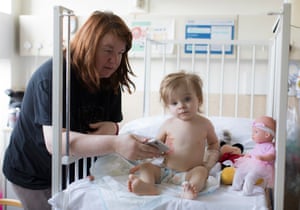
Autumn Russell with her mother Keri


Autumn Russell with her mother Keri Photograph: David Levene for the Guardian

  • Autumn Russell with her mother Keri

Fifteen-month-old Autumn Russell from Essex was transferred to the Brompton for specialist treatment for a case of empyema, a bacterial infection that develops in the slim space between the outside of the lungs and the inside of the chest cavity.


Time may pass slowly on the ward in the paediatric heart and lung unit, but for children like Ekam and their parents, the hospital becomes part of their life – a second home and a place of hope. Ekam’s veins are still too narrow for the heart operation he needs, so he has a succession of stents fitted – tubes inserted into blood vessels to increase the flow.


Marciee Barnes-Palmer


Marciee Barnes-Palmer, who has respiratory problems and a congenital heart defect Photograph: David Levene for the Guardian

Marciee Barnes-Palmer has respiratory problems as well as a congenital heart defect. She underwent a microlaryngoscopy and bronchoscopy procedure to look at her upper airways, and doctors will need to close the hole in her heart.


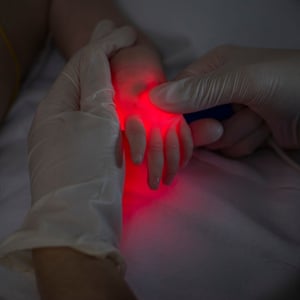
Dr Jana Kossaibati uses a torch to locate a vein in Marciee Barnes-Palmer’s hand


Dr Jana Kossaibati uses a torch to locate a vein for a cannula in Marciee Barnes-Palmer’s hand Photograph: David Levene for the Guardian


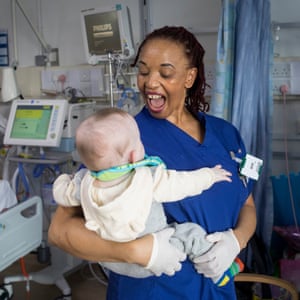
Paediatric nurse Patience Makuyana holds Marciee’s brother Freddie


Paediatric nurse Patience Makuyana holds Marciee’s brother Freddie Photograph: David Levene for the Guardian

  • Dr Jana Kossaibati uses a torch to locate a vein to insert a cannula in Marciee’s hand. Nurse Patience Makuyana holds Marciee’s brother Freddie


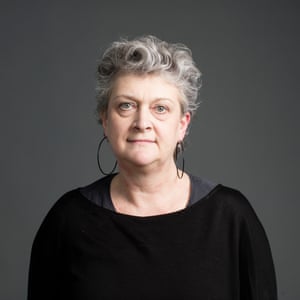
Consultant clinical psychologist Michele Puckey


Consultant clinical psychologist Michele Puckey supports the families, patients and their siblings Photograph: David Levene for the Guardian

Consultant clinical psychologist Michele Puckey supports the families, patients older than about three, and their siblings. “Brothers and sisters have to be reassured that they have not caused it,” she says. “And the child in hospital must not be treated like a princess – or they will not fit in at school when they get back to real life.”


Between four and seven they have this extreme feeling of being in control of everything around them. Children feel responsible for parents arguing and separation
Michele Puckey


Staff need support too and Puckey herself is not immune. “I remember once a boy going down to theatre in the same pyjamas as my son and I just caught my breath.”


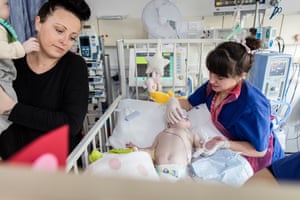
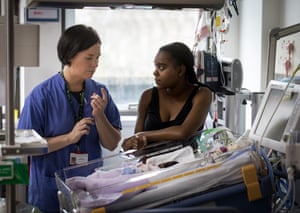
Ellarna and mother Rachel speaking with Dr Cathy O’Donoghue, anaesthetic and critical care consultant


Mother Rachel speaking with Dr Cathy O’Donoghue Photograph: David Levene for the Guardian

  • Rachel, the mother of Ellarna, speaking with Dr Cathy O’Donoghue

Ellarna is 32 weeks old and has had a catheter procedure today to close a hole in her aorta. Anaesthetic and critical care consultant Cathy O’Donoghue visits to discuss the operation.


Ellarna recovering from her operation


Ellarna recovering from her operation Photograph: David Levene for the Guardian


Ellarna


Ellarna Photograph: David Levene for the Guardian

For premature babies, the Brompton is the only centre in the UK using this method as an alternative to surgery.


Teenage patients


Sarah Bartram with daughter Ellie Bartram


Sarah Bartram with daughter Ellie Bartram Photograph: David Levene for the Guardian

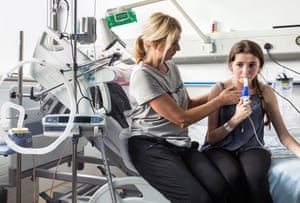
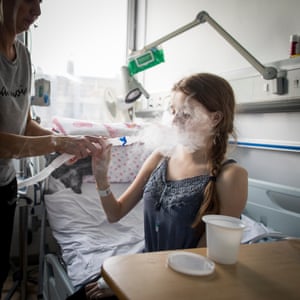
Ellie Bartram, 16, has been coming to the Brompton since she was diagnosed at four months old with cystic fibrosis, a lifelong condition that clogs up the lungs with mucus. She is admitted for two weeks every three months for an intravenous course of antibiotics.


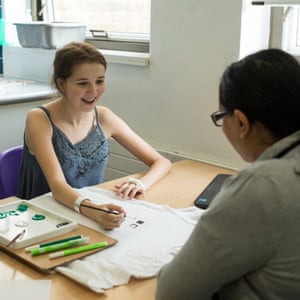
Ellie Bartram in her school class in the paediatric ward


Ellie Bartram in her school class in the paediatric ward Photograph: David Levene for the Guardian


Ellie Bartram


Ellie Bartram Photograph: David Levene for the Guardian

  • Ellie Bartram in her school class in the paediatric ward, and undergoing lung treatment

There is a schoolroom on the ward, where Ellie has lessons. The teaching is good – she and her mum Sarah credit a tutor at the Brompton for getting Ellie through her French GCSE with a C grade.


I can’t run around. I can’t go out much or go out with friends often. But my friends come and buy me McDonald’s because it’s my favourite thing
Ellie Bartram


In her solitary room, where visitors must wear aprons and gloves for fear of giving her an infection, she talks to her friends via FaceTime. “I’m used to it,” she says. She doesn’t like being different, but she is matter of fact about life at home in Romford, Essex.


Riley Jenkins, 13, grimaces in pain


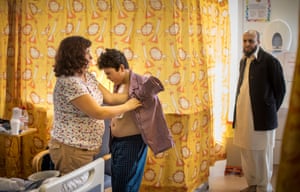
Riley Jenkins, 13, grimaces in pain as his mother helps him put on a shirt Photograph: David Levene for the Guardian

  • Riley Jenkins , 13, grimaces in pain as his mother helps him put on a shirt. Riley had cardiac surgery three days ago

Riley Jenkins, 13, is feeling very sick. He can’t eat the meatballs for lunch. His mother Sally rubs his back to try to make him feel better. It is the after-effects of the anaesthetic and the operation to replace a calcified heart valve that was inserted in his chest when he was just seven months old. “He’s been coming for a checkup once a year since he was a day old,” says his mother, Sally.


Riley was born with a back-to-front heart. “He loves Scouts and being on his computer but he’s been too tired to do a lot of running about. He used to love climbing trees. We’re hoping for more tree-climbing now,” Sally says.


Ben Eccleston-Barnes, from Devon, is visited by volunteer music therapist Brian in Rose ward


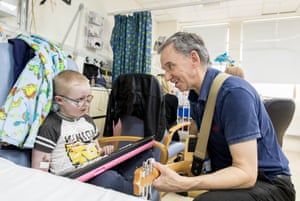
Luke Eccleston-Barnes, from Devon, is visited by volunteer music therapist Brian in Rose ward Photograph: David Levene for the Guardian

  • Luke with volunteer music therapist Brian

Luke Eccleston-Barnes, nine, has a needle phobia, perhaps because of the huge number of injections and blood tests he has endured in his life so far. But he is calm now – music therapist Brian Spears has arrived with his guitar to distract him while more blood was taken. He is playing softly to Luke, who tries to accompany him on an electronic keyboard Spears has brought along.


The nurses


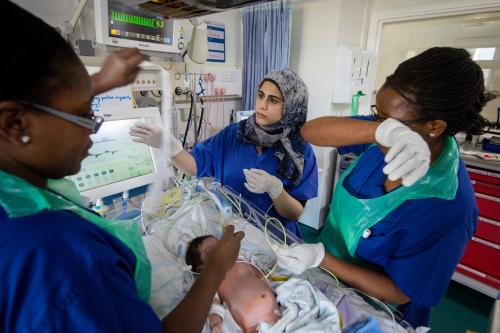
Nurse Angeline Guzha, right, and Dr Jana Kossaibati, centre, help a young girl called Sanaya


Paediatric nurse Angeline Guzha, right, and Dr Jana Kossaibati, centre, help a young girl called Sanaya in the paediatric intensive care unit Photograph: David Levene for the Guardian

Paediatric nurse Angeline Guzha and Dr Jana Kossaibati help a young girl called Sanaya in the paediatric intensive care unit.


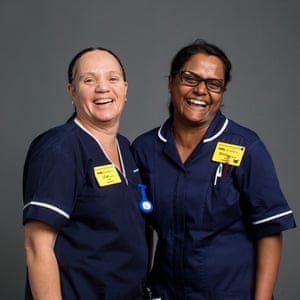
Lilian Leite and Nimla Pentayya are two of the three sisters managing Rose ward, where they have both been for six years. Leite is from South Africa and Pentayya from Mauritius. “We wanted to travel and we stayed – we are getting job satisfaction here,” Pentayya says with a grin. Both always wanted to work with children.


We know that parents are upset and the young nurses are upset but we have to be strong, the three of us will support each other
Lilian Leite


Lilian Leite and Nimla Pentayya


Lilian Leite and Nimla Pentayya are two of the three sisters managing Rose ward Photograph: David Levene for the Guardian

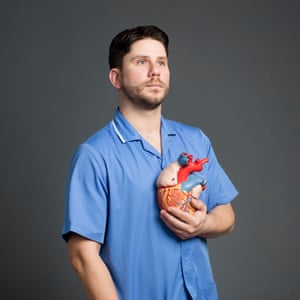
Dan Fossey is a practice educator, a nurse who trains other nurses. He also teaches parents basic life-support techniques in case they need them at home. Often parents are anxious and worry their child is too fragile. “Especially when they have had cardiac surgery they have questions about the scar and can you still do compressions,” he says. He teaches them to overcome their fears if a child has something stuck in his throat.


The last thing a parent wants to do is strike the child on the back
Dan Fossey


Practice educator Dan Fossey


Practice educator Dan Fossey Photograph: David Levene for the Guardian

Fossey runs a graduate programme for newly qualified nurses, to teach them about caring for children with heart defects. “I came here as a brand new nurse 10 years ago. I know what it’s like to come out of university and be looking after children with quite complex conditions,” he says.


Surgery


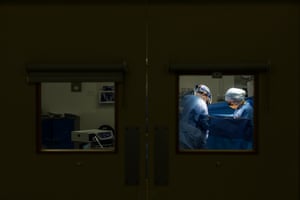
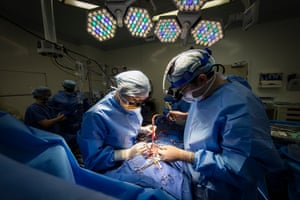
Surgery under way on a young patient


Surgery under way on a young patient Photograph: David Levene for the Guardian

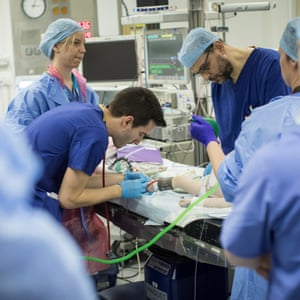
Abdula is being wheeled along a corridor to the operating theatre by robed staff, his mother trailing slightly – out of place and desperately anxious. By far the majority of the complex operations for congenital heart conditions carried out here are a success. Inevitably, sometimes they are not. In some cases, where there is a risk but the baby will die without an operation, surgeons as well as families have to be brave.


Patient Abdula Allanoud on his way to his third heart operation


Patient Abdula Allanoud on his way to his third heart operation Photograph: David Levene for the Guardian

  • Abdula Allanoud, four, on his way to his third heart operation

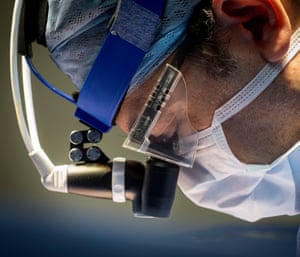
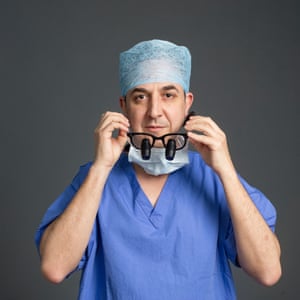
Consultant paediatric heart surgeon Olivier Ghez specialises in neonates – the tiniest babies, less than a month old, with a heart the size of a nut. He operates wearing binocular-style glasses that enlarge the miniature veins he has to stitch.


I have relatively small hands but it is the instruments, not the fingers
Olivier Ghez


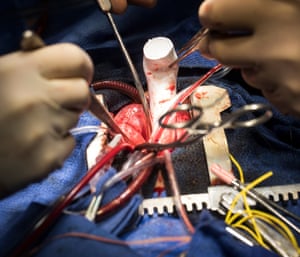
A four-hour surgical procedure conducted by Olivier Ghez


A four-hour surgical procedure to treat Abdula, conducted by Olivier Ghez Photograph: David Levene for the Guardian

  • Abdula is undergoing a four-hour Fontan procedure to correct a complex heart malformation, conducted by Ghez


Olivier Ghez


Olivier Ghez Photograph: David Levene for the Guardian


Olivier Ghez at work during an operation


Olivier Ghez at work during an operation Photograph: David Levene for the Guardian

Ghez’s job is exhausting – an operation can last three to five hours and a complex transplant could take 24 hours. But it is challenging and rewarding, he says. Sometimes he saves babies’ lives. Other times he gives them “the best possible future” with their heart condition. He can never be sure how it will go.


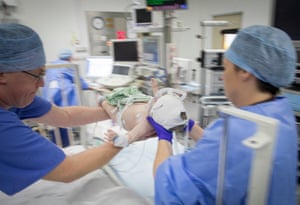
A 14-month-old girl, diagnosed after birth with a hole between the two chambers of the heart, comes into theatre for a relatively routine procedure and suffers a cardiac arrest. Suddenly the theatre is flooded with people, calm but purposeful, and the team restarts her heart.


A 14-month-old girl undergoes a procedure


A 14-month-old girl undergoes a procedure Photograph: David Levene for the Guardian

  • The girl arrested for four minutes during the procedure and was eventually revived by the team after a doctor performed CPR


A young girl goes into arrest during a surgical procedure.


A young girl goes into arrest during a surgical procedure. Photograph: David Levene for the Guardian


CPR is performed on the 14-month-old girl


CPR is performed on the 14-month-old girl Photograph: David Levene for the Guardian

When a child dies, says Ghez, “it is terrible, terrible – very sad and discouraging sometimes”. It may be a child who has had several successful previous operations at the Brompton. “When the baby dies after all this, it is really difficult,” he says. He worries about the accusations that can fly in the media over child deaths during or after surgery.


There is a danger of producing defensive medicine. That is a really perverse effect of the scrutiny. You can’t treat risky patients and have perfect results
Olivier Ghez


Consultant paediatric heart surgeon Olivier Ghez specialises in neonates, the tiniest babies


Consultant paediatric heart surgeon Olivier Ghez specialises in neonates, the tiniest babies Photograph: David Levene for the Guardian

Deaths are rare at the Brompton, but everyone is aware of the risks to the lives of these vulnerable children.


The support staff


A cleaner prepares to clear and disinfect a bay


A cleaner prepares to clear and disinfect a bay where an infection was recently present Photograph: David Levene for the Guardian

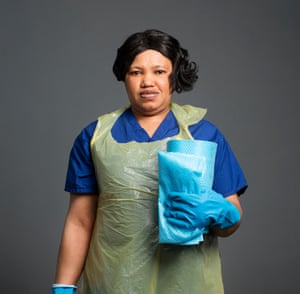
A cleaner prepares to clear and disinfect a bay where an infection was recently present. Everybody is supportive. Theresa Dzade, one of the cleaning staff, says she likes the children and the parents.


It is not easy for someone to leave their house and come here with a small baby. They are sometimes sad because their baby is ill. They talk to me all the time. I tell them I am here to help – anything they want
Theresa Dzade


Theresa Dzade, one of the cleaning staff


Theresa Dzade, one of the cleaning staff Photograph: David Levene for the Guardian

Her friend Sidratu Kargbo feels the same.


We have to do a good job to make them happy
Sidratu Kargbo


Cleaner Sidratu Kargbo


Cleaner Sidratu Kargbo Photograph: David Levene for the Guardian

Night falls


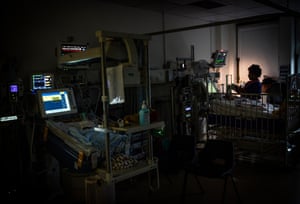
Night falls in the paediatrics department at the Brompton


Night falls in the paediatrics department at the Brompton Photograph: David Levene for the Guardian

Nursing and other medical staff work through the night as many patients require round-the-clock care. Parents usually leave the ward at night as they are encouraged by staff to rest.


Sandra Gala-Peralta, a PICU consultant, says: “If they don’t have a good rest, especially the mother, the following day they are exhausted. And if they are exhausted they don’t take the information in the same way. If something happens they are extremely fragile. So that is why we encourage them to go to sleep and have a good rest. If they don’t want to then we just let them be in the bed space. Especially if they are teenagers or children, five years old, then they have enough understanding to be be very afraid, so we let the parent in..”


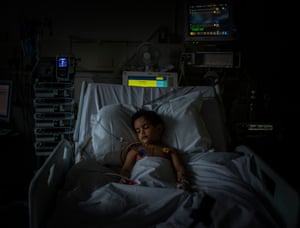
Abdula Allanoud recovers after his operation


Abdula Allanoud recovers after his operation Photograph: David Levene for the Guardian

  • Abdula Allanoud recovers in intensive care after his heart operation

Gala-Peralta adds: “The evening tends to be a bit calmer. But everything depends on how the patients are. If the activity is high, the consultant stays around until … well, this is a personal choice. I’m more OCD, I like to make sure that if I go for a rest everything is in order and that I’m not going to have surprises in the night. We have an on-call room in one of the upstairs floors. I have been called in the middle of the night because a child has had a cardiac arrest. I was so stressed when they called me that I went down barefoot! I was doing cardiac massage in my socks! Now I’m more careful.”


I like to work on nights – it gives a lot of space to the doctor and nurses to focus on the patient, and because the night shifts tend to be a bit longer there is enough time to see how a patient can deteriorate, or improve during that time
Sandra Gala-Peralta


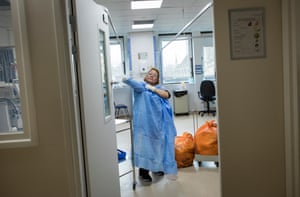
PICU consultant Sandra Gala-Peralta


PICU consultant Sandra Gala-Peralta, photographed at 8am at the end of a 24-hour shift Photograph: David Levene for the Guardian

  • Gala-Peralta photographed at 8am at the end of a 24-hour shift

“There are nights when we sleep one hour … and there are nights when we are able to sleep four or five hours. At least we can put our head down and we can have a bit of rest every night. And then in the morning at 7.30 we need to be sharp, back on the unit,” says Gala-Peralta.


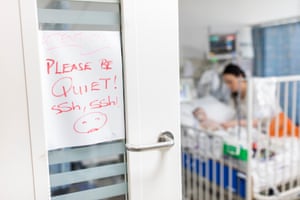
A sign in the paediatrics department


A sign in the paediatrics department Photograph: David Levene for the Guardian


Inside Royal Brompton hospital"s paediatric unit – photo essay