family etiketine sahip kayıtlar gösteriliyor. Tüm kayıtları göster

20 Nisan 2017 Perşembe

On mental health, the royal family is doing more than our government | William Davies

The public profile of mental health experienced another boost this week, thanks to some moving comments made by Prince Harry and the Duke of Cambridge about the impact of their mother’s death, nearly 20 years ago. The two royals are working for the Heads Together campaign, which seeks to combat the stigma surrounding mental health issues, and to encourage people to speak more openly about their difficulties.


Harry’s admission that he had ignored his own emotional distress for several years before eventually having counselling was a valuable contribution, from a figure more commonly associated with laddish machismo. William’s focus on male suicide statistics was also a good use of his celebrity.


The royal family cannot get involved in divisive party political issues, and so we can only conclude from these interventions that mental health is something that exists beyond the fray of politics. Breaking the “stigma” surrounding mental health issues is certainly not something that one would want to identify as a leftwing or a rightwing agenda.


There is no more damning indictment on British society in 2017 than the prevalence of mental distress among children


On the other hand, political parties have been keen to make the mental health agenda their own. Theresa May has established mental health as one of the key areas where she hopes to signal her government’s concern for everyday human suffering, making a high-profile speech in January that also stressed the importance of breaking the stigma that clouds the issue.


All of this presents something of a riddle. Mental health problems have risen in profile to the point where the prime minister and the heir to the throne are personally committed to combating them. Yet there is scarcely any public discussion about where they actually stem from. Losing a parent at a vulnerable age, as Harry did, is terrible and harmful – but epidemics do not arise purely out of private tragedies.


The stigma attached to mental health is a real problem in workplaces and schools, as are the benefits of overturning it. But stigma can scarcely be viewed as the cause of what it stigmatises.


The orthodoxy that has taken root since the 1980s is that mental health problems are disorders of the brain. The success of SSRIs since the launch of Prozac in 1987 has helped to entrench this view. This doesn’t mean that mental illness can’t be treated with “talking cures”, such as cognitive behavioural therapy or by being more open about one’s emotions, as Prince Harry has argued. But the idea that mental health problems are illnesses just like any other illnesses has become one of the main ways in which the stigma is challenged. Comparisons with cancer have become common.


The idea that one is simply “unwell” no doubt provides comfort to many people wrestling with their own depression or anxiety. But it also blocks out a whole host of more fundamental cultural, political and economic questions regarding the distribution of distress in our society – the sorts of questions that the Duke of Cambridge would be less likely to grapple with.



Theresa May


‘There is scarcely any public discussion about where [Britain’s mental health problems] actually stem from.’ Photograph: SilverHub/Rex Features

There is no more damning indictment on British society in 2017 than the prevalence of mental distress among children. Nearly a quarter of a million are receiving mental health treatment from the NHS, and those contacting Childline complaining of anxiety and exam-related stress have been climbing year-on-year. Rates of self-harm amongst young girls have risen by 42% in a decade.


Are we to believe that it was simply “stigma” that swept all this under the carpet in the past? Or might children be telling the truth, when they say they feel overwhelmed by the requirement to perform, excel, keep up? The NSPCC reports that some children are having to sit mock exams just a few weeks after returning from the summer holidays. Think about what that means and does psychologically. What does Theresa May have to say about that? British children have become damagingly competitive, and less forgiving of failure. Which minister will have the guts to stand up and say to children that being average is OK?


Adult mental health problems may present themselves as medical and be treated as such, but they are not immune to sociological analysis. Researchers have found that adult mental health is worse among those who frequently moved house as a child. Today’s housing crisis is tomorrow’s mental health crisis.


Rising household indebtedness is another major culprit, especially the kinds of problem debts that are associated with week-by-week financial precarity. Children suffer when their parents are too stressed or depressed to listen to them or play with them. Debt problems break up families.


Austerity has been disastrous for the nation’s mental health. The British Psychological Society has called for a termination of benefit sanctions (which are effectively designed to produce anxiety); academics have shown the deep emotional harm wrought by the bedroom tax. Teachers, who live under the constant spectre of monitoring and performance assessment, are seeking medical help for stress in shocking numbers.


The seductive concept of “public sector productivity gains” conceals thousands of personal tragedies among doctors, paramedics and local government service providers, many of whom cling to a dream of exiting their profession. And these are the same people who look after the wellbeing of our children and mental health patients.


No doubt mental health will feature prominently in party manifestos, now that it’s gone mainstream. Whether any of the above gets a look-in remains to be seen. Labour should be shouting about it, and not allow the hypocritical architects of austerity an inch of this territory. Next time a Labour politician is patronised as being too leftwing by a journalist, the evidence on what inequality does to our minds should be slung back.


So, yes, we need to talk more. And, yes, stigma surrounding depression and anxiety makes things worse. But it’s not just ourselves and our medical histories we need to talk about. We also need to talk about what sort of society we’ve built, and what the alternative might look like. For all their good intentions, Harry and Wills might need to sit that one out.


On mental health, the royal family is doing more than our government | William Davies

2 Nisan 2017 Pazar

Cancer patient"s family stands to lose £50k under benefit cuts

“My death, on or before Thursday, changes my family’s wellbeing to the tune of tens of thousands. It is utterly unbelievable.”


Alan’s voice cracked, not just with emotion but the brutal impact of four years of cancer that started in a tonsil before spreading to his lungs and chest, delivering a terminal diagnosis in June, 2015.


By December, last year, the 51-year-old husband and father (who has asked the Guardian not to use his real name in order to protect his family) was given between one and five months to live.


His mind quickly focused on the lives of his wife, Kate, and their children, a 10-year-old daughter and 14-year-old son, after his death. He feared the “whirlwind of emotional and financial distress and turmoil” heading towards them as he grappled to draw up a plan.


Then came a bitter blow that has led Alan to speak out urgently against a Conservative policy being rolled out this week, despite voting for Theresa May’s party all his life.


The father and businessman, who was forced to give up work due to his illness, realised that if he survived beyond midnight this Wednesday 5 April, his family could be stripped of tens of thousands of pounds of critical financial support over the next decade.


Changes to the widowed parent’s allowance mean a benefit of around £112 a week until the youngest child leaves full-time education, perhaps in 10 years’ time, will be replaced by £350 a month (£80 a week) for a maximum period of just a year and a half.


“Based on the ages of our children and on my probable death – I would imagine this year – I had calculated that we would be entitled to about £58,000,” said Alan, who lives with his family in Barnet, London. “The new calculation shocked me. My life is now deemed to be worth £6,300.”


A government spokesperson said the financial gap would be reduced somewhat by the new system being tax-free. They also said families were eligible for a slightly higher lump sum payment immediately after the death of £3,500 rather than £2,000.


But Alan said the increase was “smoke and mirrors” and that the tax change did nothing to alleviate the many years of lost income.


After years paying into the system, Alan described the change as “daylight robbery”.


“The amount of money I’ve built up in my full state pension is more than the government would be paying out in the current widowed parent’s allowance. Assuming I started my pension at 68 and that the average male expectancy 81 – that is £120,000.”


He said the move was “callous and brutal” and that it showed no compassion, stressing that his family is “just about managing” and would be struggling even more after his death.


Kate agreed: “I feel like they are stealing from us. They’ve taken what Alan is owed.”


The couple also said that a letter to their local MP, Matthew Offord, copied to the prime minister, Theresa May, and the chancellor, Philip Hammond, on 24 February had not yet been answered. A follow-up on 10 March also received no reply, he said.


“Time is slipping away,” said Kate, describing her shock at what she sees as being blanked. “The sand is going through an hourglass. It is disappearing. Every day we look and say ‘he’s alive – will he be tomorrow?’”


She said it was difficult to find words to describe “the hell we’ve lived for four years” through painful bouts of treatment with sickening side-effects, her husband being fed through a tube to the stomach, ambulances, hospital appointments, worsening diagnoses and then the terrible news: “There is nothing more we can do.”


“Our legs move and our bodies move but we can’t really breathe,” added the 48-year-old psychotherapist. “Now we’ve been over-looked, ignored, let down. It is like nobody cares.”


The benefit change was like “being thumped in the face when you can’t take any more”, she claimed – describing her acute anxiety for the future.


The government has argued that the policy change is fair because these days women are more likely to work and so are less dependent on their spouse’s income.


But Kate says that she can already only work part-time as she cares for her sick husband and strives to be there for her children’s school pick-ups. Life after his death will trigger a “new nightmare of struggle”, she argued, with no magic bullet at 18 months.


Alan said he voted Conservative and felt “utterly let down”. He described reading the Tory 2015 manifesto from cover to cover and stressed that there was no mention of this reform. “There is no political mandate – it is a moral outrage.”


As well as speaking to the Guardian, Alan and Kate spoke emotionally about their case on LBC radio alongside a number of bereaved families who also expressed their shock.


A DWP spokesperson said: “We’re modernising the support we offer, replacing an outdated system that doesn’t reflect people’s lives today. The new Bereavement Support Payment is simpler, easier to understand, tax-free and doesn’t affect the amount received from other benefits, so families can access wider welfare support.”


They argued that families could be compensated by increases to other benefits.


Charities admit that the changes affect families in different ways but said that DWP figures suggested that overall 91% of parents will be supported for a shorter period, while 75% will be worse off in cash terms of as a result of the change. Working families with young children will lose £23,500 on average, they suggest.


Cancer patient"s family stands to lose £50k under benefit cuts

Cancer patient"s family stands to lose £50k under benefit cuts

“My death, on or before Thursday, changes my family’s wellbeing to the tune of tens of thousands. It is utterly unbelievable.”


Alan’s voice cracked, not just with emotion but the brutal impact of four years of cancer that started in a tonsil before spreading to his lungs and chest, delivering a terminal diagnosis in June, 2015.


By December, last year, the 51-year-old husband and father (who has asked the Guardian not to use his real name in order to protect his family) was given between one and five months to live.


His mind quickly focused on the lives of his wife, Kate, and their children, a 10-year-old daughter and 14-year-old son, after his death. He feared the “whirlwind of emotional and financial distress and turmoil” heading towards them as he grappled to draw up a plan.


Then came a bitter blow that has led Alan to speak out urgently against a Conservative policy being rolled out this week, despite voting for Theresa May’s party all his life.


The father and businessman, who was forced to give up work due to his illness, realised that if he survived beyond midnight this Wednesday 5 April, his family could be stripped of tens of thousands of pounds of critical financial support over the next decade.


Changes to the widowed parent’s allowance mean a benefit of around £112 a week until the youngest child leaves full-time education, perhaps in 10 years’ time, will be replaced by £350 a month (£80 a week) for a maximum period of just a year and a half.


“Based on the ages of our children and on my probable death – I would imagine this year – I had calculated that we would be entitled to about £58,000,” said Alan, who lives with his family in Barnet, London. “The new calculation shocked me. My life is now deemed to be worth £6,300.”


A government spokesperson said the financial gap would be reduced somewhat by the new system being tax-free. They also said families were eligible for a slightly higher lump sum payment immediately after the death of £3,500 rather than £2,000.


But Alan said the increase was “smoke and mirrors” and that the tax change did nothing to alleviate the many years of lost income.


After years paying into the system, Alan described the change as “daylight robbery”.


“The amount of money I’ve built up in my full state pension is more than the government would be paying out in the current widowed parent’s allowance. Assuming I started my pension at 68 and that the average male expectancy 81 – that is £120,000.”


He said the move was “callous and brutal” and that it showed no compassion, stressing that his family is “just about managing” and would be struggling even more after his death.


Kate agreed: “I feel like they are stealing from us. They’ve taken what Alan is owed.”


The couple also said that a letter to their local MP, Matthew Offord, copied to the prime minister, Theresa May, and the chancellor, Philip Hammond, on 24 February had not yet been answered. A follow-up on 10 March also received no reply, he said.


“Time is slipping away,” said Kate, describing her shock at what she sees as being blanked. “The sand is going through an hourglass. It is disappearing. Every day we look and say ‘he’s alive – will he be tomorrow?’”


She said it was difficult to find words to describe “the hell we’ve lived for four years” through painful bouts of treatment with sickening side-effects, her husband being fed through a tube to the stomach, ambulances, hospital appointments, worsening diagnoses and then the terrible news: “There is nothing more we can do.”


“Our legs move and our bodies move but we can’t really breathe,” added the 48-year-old psychotherapist. “Now we’ve been over-looked, ignored, let down. It is like nobody cares.”


The benefit change was like “being thumped in the face when you can’t take any more”, she claimed – describing her acute anxiety for the future.


The government has argued that the policy change is fair because these days women are more likely to work and so are less dependent on their spouse’s income.


But Kate says that she can already only work part-time as she cares for her sick husband and strives to be there for her children’s school pick-ups. Life after his death will trigger a “new nightmare of struggle”, she argued, with no magic bullet at 18 months.


Alan said he voted Conservative and felt “utterly let down”. He described reading the Tory 2015 manifesto from cover to cover and stressed that there was no mention of this reform. “There is no political mandate – it is a moral outrage.”


As well as speaking to the Guardian, Alan and Kate spoke emotionally about their case on LBC radio alongside a number of bereaved families who also expressed their shock.


A DWP spokesperson said: “We’re modernising the support we offer, replacing an outdated system that doesn’t reflect people’s lives today. The new Bereavement Support Payment is simpler, easier to understand, tax-free and doesn’t affect the amount received from other benefits, so families can access wider welfare support.”


They argued that families could be compensated by increases to other benefits.


Charities admit that the changes affect families in different ways but said that DWP figures suggested that overall 91% of parents will be supported for a shorter period, while 75% will be worse off in cash terms of as a result of the change. Working families with young children will lose £23,500 on average, they suggest.


Cancer patient"s family stands to lose £50k under benefit cuts

16 Mart 2017 Perşembe

Why have four children when you could have seven? Family planning in Niger

Roukaya Hamani has an in-law problem. Her husband’s parents want more grandbabies, but she doesn’t want any more children right now. She’s already given birth four times; one of the babies died, and so now she has three, ages seven, five, and 16 months. She’s 18 years old.


“I just pray to God to bless those three babies I have,” she says. The local health centre in her village of Darey Maliki offered her free contraception, which they get partly from the NGO Pathfinder, but Hamani declined. “Maybe [my in-laws] would tell my husband to marry another woman to have more babies,” she says. “If they want me to have another pregnancy, I can do it just for them to feel happy.”


Hamani, a smiley, gap-toothed girl in a long orangey-brown headscarf worn in the popular style here – tight around her face and then flowing down to the knee, over a bright printed dress – never went to school, and got married when she was 10 and her husband was 20. He works in the fields and she keeps the home, waking up at dawn every day. “Why don’t I want to have another?” she says. “Because being a mother is not easy work.”


Hamani’s life is in many ways illustrative for women in rural Niger, where she lives in a small village of mud-brick houses lining sand-dust roads. Girls here get married young, usually as teenagers, and have their first child at 18. Polygamy is legal and commonplace, especially in the rural areas where about 80% of the population resides. More than half of girls don’t complete primary school, and fewer than one in 10 attend secondary school – as a result, less than a quarter of women here are literate. Women have an average of more than seven children apiece, the highest in the world. And they face a one-in-23 chance of dying from pregnancy or childbirth.


But Hamani is unusual in that three babies are enough for her. Despite having the highest fertility rate in the world, women and men alike in Niger say they want more children than they actually have – women want an average of nine, while men say they want 11.


When you have a huge number of young people who are jobless, they have no choice but to emigrate


Hassane Atamo, ministry of health


Birth rates as high as Niger’s contribute to rapid population growth. The country’s population exploded from 3.5 million people in 1960 to nearly 20 million today, with half of the current population under the age of 15. The overwhelming majority – 80% of Nigeriens – live in poverty. The landlocked nation is largely desert, less than 20% of the land is arable, and that number is shrinking due to climate change. At current growth rates, the population is set to double in 17 years. This, experts say, drives poverty, famine, political instability, and violence.


“When you have a huge number of young people who are jobless, they have no choice but to emigrate,” says Hassane Atamo, the division chief for family planning at the Niger ministry of health, noting that large numbers of young men go to nearby Ghana, Nigeria or Ivory Coast seeking work. “They may also fall into crime, or integrate into terrorism. The country is facing this problem as well, with the Boko Haram issue – they are recruiting jobless young people.”


To combat the health issues that come with high birth rates as well as the burden many young and out-of-work people place on a fragile economy and vulnerable security situation, the Nigerien government has turned to the solution: modern contraception. What they haven’t figured out, though, is how to get women to use it.


“This is a time bomb, because all the Sahel is in this situation, and especially with climate change, the food supply will be less abundant than before,” says John May, a visiting scholar at the Population Reference Bureau. “It’s a huge crisis.”


In a jam-packed room at a health clinic in Magama, a town in Niger’s Tillaberi region, 60-odd women cram side by side, each with a baby or two in tow, to hear Aboubacar Gousmane talk about family planning. Gousmane, an expressive, charismatic employee of Marie Stopes International, a global reproductive health organisation that does family planning work at this clinic, stands in front of a desk with a “choice kit” packed full of sample contraceptives.


“Family planning is about making space between your children,” Gousmane tells the group as babies cry. “We know our communities are poor. If we have many babies, we make it harder for ourselves. That’s why we say you should space pregnancies.” Contraceptives at this clinic, he tells the women, are free.


Currently, Marie Stopes International’s family planning work at this clinic is funded by USAid. Last year, they served nearly 30,000 clients. But since it is an international organisation that supports liberalising abortion laws and provides elective abortions in other countries where the procedure is legally allowed (in Niger, abortion is largely outlawed) it is going to lose its US funding thanks the “global gag rule” put into place by President Trump. Leaders from the organisation say they are hopeful that private donors and more sympathetic governments will fill the gap, but that it will be a substantial blow.


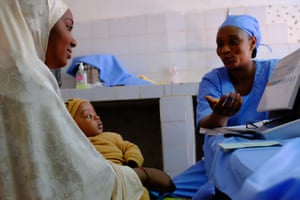
Marie Stopes International healthcare workers counsel women about contraceptive options.


Marie Stopes International healthcare workers counsel women about contraceptive options. Photograph: Jill Filipovic

In front of an attentive all-female audience, Gousmane goes through each contraceptive method, holding up samples – a T-shaped IUD, a needle with a little bottle of Depo-Provera, two white matchstick-sized implants, a slinky female condom – and explains how they’re used and how long they last. “It’s not for you to stop pregnancies or stop delivering babies,” he says. “It’s so you can deliver healthy babies and your body can make another baby.”


Many working in development say that to prevent a series of catastrophes – environmental, economic, security – women in Niger need to have smaller families. But unless women want their families to be smaller, there’s no reason to think the fertility rate will decrease anytime soon.


In Niamey, Niger’s capital city, the global health organisation PSI sends outreach workers to meet with women and talk about family planning. This is how 30-year-old Hadiza Idrissa ended up in the front yard of Mohammadou Rabi, a 39-year-old mother of four, her hair tucked under a gold scarf, a month-old infant in her lap.


Idrissa is helping Rabi figure out what kind of contraceptive to use, showing her samples and explaining the benefits of each one. Rabi asks if the IUD might fall out, or if the implant might break in her arm. Idrissa answers patiently (no and no); when Rabi says she isn’t sure what to pick and just asks Idrissa to choose for her, Idrissa says: “It’s up to you to choose a method. We just explain how the methods work.” She asks Rabi if she wants to come back in a few days, “so you can have a little time to reflect on what you want”. What Rabi wants is a break before having more children, ideally two or three more. “I like to make the Muslim community grow,” she says.


Niger’s population challenges are compounded by the prevalence of a conservative strain of Islam, which encourages followers to have as many children as possible. Any organisation working to put contraceptives into the hands of women has the dilemma of doing so in a way that doesn’t provoke religious backlash. Political leaders, too, have elections to worry about, and don’t want to cross influential clerics by pushing the population issue.


Women gather below a neem tree in a village outside of Dongondoutchi to hear Moundadou Magagi, a health agent with PSI, explain family planning options


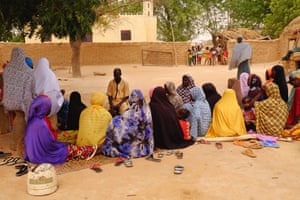
Women gather below a neem tree in a village outside of Dongondoutchi to hear Moundadou Magagi, a health agent with PSI, explain family planning options. Photograph: Jill Filipovic

Some women feel that having more babies gives them a break in their difficult lives. In the villages the days are an endless cycle of hard physical labour from the time you’re an adolescent (or younger) until you become too old to work.


The thing I like in motherhood … is giving my baby his bath and playing with him


Hamsatou Issaka, 15


“I really don’t have time for amusement,” says Hamsatou Issaka, a pretty 15-year-old who lives in a village several hours from the nearest city of Dosso. “I just work all day. Then you sleep.” She nurses her one-year-old son, Habibou. “The thing I like in motherhood,” she says, a big smile breaking across her face, “is giving my baby his bath and playing with him.” A new baby also means a 40-day break from the usual demanding physical labour – and another few years of baby baths and giggles breaking up the monotony of tilling the earth and pounding the millet.


Issaka met her husband, a lanky young man with a wide smile and easy laugh, when she was 12 and he was 15; they got married soon thereafter. All of her friends are married with children and she can’t imagine going into her 20s without a husband and children. Having lots of children is the norm because they bring wealth (“they come with two hands to work but only one mouth to feed”). So why have four when you could have seven? Seven, one of Issaka’s neighbours says pointedly, is a bigger number than four.


“A large family size is a cultural ideal in Niger in a similar way that in the US or UK, a romantic relationship is a cultural ideal,” says Hope Neighbor, a partner at consulting firm the Camber Collective, which has researched increasing contraceptive use in the country. “We need to be more thoughtful in how we communicate family size and desires,” she says. “This doesn’t mean you tell people they need to have smaller families. It means reframing how they think about families, because it creates tremendous risk to the mother, and tremendous risk to the fragile environment in Niger.”


This is why, many experts say, Niger needs a strong campaign for girls education. “If we want to bring change, we must bring young girls to school,” says Laouali Assiatou, the deputy secretary general of the ministry of population, promotion of women, and protection of children.


Most of the time the girl is in school but the parents pull her out. She can’t speak for herself


Laouali Assiatou, ministry of population


Child marriage, Assiatou notes, “happens to vulnerable families. Most of the time the girl is in school but the parents pull her out. She is going to be violated. She can’t speak for herself. She will be pregnant early. She’s in her husband’s house, she has no money. She’s not mature enough to deliver and health services are not very developed in our country. She’s going to have a difficult pregnancy. She can die, or she can deliver a stillborn, or she can end up with a fistula and be rejected by society.” The end result, she said, is that keeping girls out of school “keeps the community in a cycle of poverty”.


Despite assumptions, studies haven’t demonstrated a correlation between polygamy and family size. Nigerien women in polygamous marriages have about the same number of children as women in monogamous ones. But some women’s health advocates argue that polygamy contributes to the norm-setting of large families and consolidation of male power in the household, with a potential second wife wielded as a threat to a married woman who doesn’t want more babies.


Mariama Hassan, who has lived in Darey Maliki village her whole life, got married at 18, late by village standards. As she breastfeeds her daughter, Ramatou, she says she wants to see her baby girl finish school, and eventually get married as well – but not until she’s 25. “I want her to be a doctor,” Hassan says. “I say 25 because I want her to be mature before getting married, and I want her to finish her studies.”


Her hopes for her own life are different. “In my lifetime, I want to have what God decides for me,” she says. What does that mean in terms of children? She smiles and laughs. “I hope God gives me 12.”


Join our community of development professionals and humanitarians. Follow @GuardianGDP on Twitter. Join the conversation with the hashtag #SheMatters.


Why have four children when you could have seven? Family planning in Niger

14 Mart 2017 Salı

"He was really really let down": Thomas Orchard"s family speak out

The ordeal began for Thomas Orchard’s mother, Alison, as she strolled beside a river in Devon in October 2012. She took a call from her son’s social worker saying he had missed an appointment for a mental health assessment.


“I remember thinking: ‘Tom needs my help.’ I ran back home. There was this incredible knock on the door. It was two police officers. Their first words were: ‘We have some worrying news.’ They blue-lightedme into the hospital. I kept asking the police officers: ‘What’s happened?’ I thought he was dead.”


Orchard was not dead but unconscious. At first his family thought he had suffered a heart attack, though he was a physically fit young man. Gradually, as they kept vigil at his bedside over the next seven days, sketchy details emerged. He had been involved in a disturbance in Exeter city centre. He was taken to a police station and from there was rushed to hospital, gravely ill.


“It was very hard to get any information,” said Alison. “We didn’t know what had happened. I don’t think the medical team did either.” Orchard was put into a medically induced coma. “I remember doing things like getting his deodorant to give him a familiar smell,” said Alison. “We were talking to him constantly. But there came a time when it was obvious life was not possible, so the machines were turned off.”


Thomas’s sister, Jo, said they were baffled. “We had a lot of questions about why a 32-year-old healthy man would go into a police cell and come out essentially dead,” she said.


For four-and-a-half years now, the Orchard family – Alison, Thomas’s father, Ken, and his siblings, Jo and Jack – have fought to find out the truth of why he died. Now they believe they have an answer. “I’m completely certain that had it been picked up as a mental health crisis and taken to a place where that was understood, he would be alive,” Alison said.


The family were to discover that Orchard, who was being treated for paranoid schizophrenia, had had a mental breakdown and was arrested after approaching a passerby and beginning an argument. Police were called and he was pinned down in the street and restrained by his hands, legs and ankles.


At Heavitree police station in Exeter an emergency response belt (ERB), a heavy cloth device with handles most often used to secure prisoners around the body so that they can be carried, was held over his face. He was carried in the prone position to a cell, where he was searched while lying on his front, still masked by the ERB. The belt was removed and he was left alone, face down, in the cell. He suffered a cardiac arrest and brain damage. The ERB had been applied to his face for a total of five minutes and two seconds.


Orchard’s family were devastated when they found out what had happened to him. “It wasn’t dealt with appropriately,” said Alison. “I think they made assumptions that Tom was either drunk or on drugs or was an angry man. I know he was very frightened. That’s why he was acting as he was.”


Jo said: “Tom was really, really let down. It was clearly a medical crisis, not a criminal one.” His family believe Orchard’s confusion and fear would been exacerbated by the use of the ERB. “I think the [ERB] being used over the face is barbaric anyway,” said Jo. “If you add mental health crisis into that, it must be so, so scary.”


In their defence the officers made it clear they did not know Orchard had a mental health condition and thought they were dealing with an angry, aggressive man. They believed the force they used was proportional and lawful and pointed out that the ERB had been approved by Devon and Cornwall police for use as a bite or spit hood.


Orchard was raised in rural Devon. “As a child he was very physical,” said Alison. “Small, wiry, fit. He was a very free spirit. He was deeply sensitive.”


He struggled academically and began to suffer mental health problems. “He hit teenage years very badly,” his mother said. “He got into drugs and into petty crime associated with drugs. He was homeless for a while. He never settled in a job.”


On his 21st birthday Orchard was sectioned and, over the next decade, spent lengthy periods in hospital. There he found religion and, when he was judged fit enough to be treated in the community, was discharged. He had digs in Exeter and became a member of St Thomas’s church, where he acted as a part-time caretaker.


“He didn’t have any close friends except God,” said Alison. “He was very devout, very OCD-ish about saying the Lord’s prayer in exactly the same way. He loved crosses and candles.”


By the end of September 2012, his condition began to deteriorate. He stopped taking his medication, heard voices and had hallucinations. On the morning of 3 October, precisely at the time when he should have been arriving for the mental health assessment, he was in the city centre involved in the disturbance.


The officers involved in the arrest and detention clearly saw Orchard as violent. Their explanation for using the ERB was that he was threatening to bite.


Violence is not a trait his family recognise. “I had childhood spats with him but never in adult life have I seen him be violent,” said Jo. “The exact opposite. He would plant seeds and want to save the world.” His mother saw him get angry. “But, at heart, he was incredibly sensitive and gentle,” she said.


It was seven months before Orchard’s family got his body back for a funeral. “That was hugely difficult,” said Alison. “Tom became the property of the state.”


Almost two years after Orchard’s death – August 2014 – the family saw CCTV footage from the police station. “To see how they treated Tom, it was very deeply shocking,” said Alison. The worst part of the video for her is the section in which he is left alone in his cell and remains apparently motionless. “That’s the image that stays with me, that haunts me. It’s a deep, gut-wrenching, sickening feeling. It’s an achingly long time he is lying there and I am willing someone to go in.”


Watching the three officers on trial has been difficult. “I have a range of emotions,” said Alison. “From compassion, to disdain, to loathing.” The family remains angry at Devon and Cornwall police. “I think I have seen an arrogance and I think I’ve seen them not take this death seriously,” said Alison. “None of the officers involved were suspended until they were charged with manslaughter.”


The conclusion of the six-week trial, with three officers cleared of manslaughter, does not spell the end. Through the campaign group Inquest, the Orchards have spoken to other families who have lost loved ones in custody including relatives of Sean Rigg, a musician with schizophrenia who died at Brixton police station in south London after being held for eight minutes in a prone position.


Orchard’s mother and sister are contemplating a life of campaigning. Jo said: “This is a lifelong cause for us now. There are a lot of deaths in custody.” Alison said: “I’ve got to stop thinking it will be all right once this trial is over. I’ve got to accept that this is my purpose in life. It’s not the road I would have chosen in my life but I hope I can be there for anyone else who has to go through this.”


"He was really really let down": Thomas Orchard"s family speak out

2 Mart 2017 Perşembe

Tories wary about plugging Trump gap in family planning funding

The hastily convened global gathering of governments in Brussels to pledge tens of millions of euros to family planning charities who had their US funding pulled by Donald Trump’s so-called “global gag” has been a tightrope to walk for the British government.


Trump reinstated the rule by executive order in his first few days in the White House, meaning US government funding cannot be provided to charities whose work includes offering abortion services.


Perhaps more than any other country, the UK has been keen to demonstrate that, whatever the concerns about the Trump administration, the answer is engagement rather than isolation. In January, Theresa May became the first foreign leader to meet the US president on a trip criticised by some as overly hasty. Given the UK’s need for new and fast free trade partners after the exit from the EU, such a position is perhaps unavoidable.


Viewed through this prism, its decision to send Rory Stewart, a junior minister, rather than Priti Patel, the secretary of state for international development, could be interpreted as a mild snub to the She Decides conference, an event intended by its organisers to be a symbol of solidarity against Trump. Ditto the UK decision not to pledge any additional money, when countries from Norway to the Netherlands are stumping up millions.


But that is not how ministers at the Department for International Development see it. They say they have been planning to host their own major global summit on family planning over the summer with the UN and that – far from ignoring the issue – the department has intensified UK aid efforts on family planning.


Observers might detect a sense of irritation that the UK will now be put in a position where it is a follower, rather than a leader, given that this week’s conference has been convened by the Dutch, Belgian and other northern European nations.


However, critics have warned that the determination of the department to forge its own path, rather than be perceived as embarrassing Trump, could leave charities in limbo, without specific pledges that their loss of support from the US will be matched elsewhere.


That uncertainty could have long-term consequences for reproductive health in developing countries. About half of all abortion procedures worldwide – more than 20m – are unsafe, with the vast majority in developing countries. About 68,000 women die annually after backstreet abortions, making it one of the leading causes of maternal mortality, according to the World Health Organization.


Five Labour MPs wrote in January to Patel to urge her to commit emergency funding to the She Decides effort, arguing that policymaking needed to be reactive to a volatile political climate. “We would implore you to take urgent steps on funding and policy as the Dutch government has, and as the UK government has done so previously, to mitigate the impact of this decision,” they wrote.


At least one of the MPs is speaking from experience. Gareth Thomas was a minister at DfID in 2006 when the Labour government publicly defied George W Bush’s own reinstatement of the global gag rule to pledge money for safe abortion services where US funding had been cut off.


At the time, the International Planned Parenthood Federation praised the bravery of the UK, saying they were “deeply grateful for the gesture not only financially but politically”.


Any kind of similar statement of thanks from charities in 2017 would be deeply unhelpful to the Conservative government in the post-Brexit era, connecting international aid spending to diplomacy.


Sources at the department see the decision by European and other governments to make immediate pledges to match the support as too hasty and say the scale of the funding gap from Trump’s order has not yet been fully calibrated. The UK’s 2006 funding pledge came five years after Bush’s order, and in a very different political climate.


Tories wary about plugging Trump gap in family planning funding

27 Şubat 2017 Pazartesi

HEALING AUTISM: A Family Constellation Therapy Perpective

Family Constellation Therapy, sometimes known as Systemic Constellations, was created by Bert Hellinger, a German psychotherapist. This amazing method is used to uncover the source of chronic conditions, illnesses and emotional difficulties that may have roots in the inter-generational family systems, rather than the individual, and may be connected to a key stress event. Could resolving past family trauma help unlock the symptoms known as autism. Sadly, some form of autism is now observed in 1 in 55 children and is growing at a rate of more than 1,100 percent. Western medicine focuses on medication to suppress symptoms and alternative approaches focus on treating the underlying biomedical, physical, psychological and environmental causes of autism.


However, illness not only originates in our physical body, but can also originate in our energetic and spiritual body as well. So, it becomes imperative that we treat the entire person for a fuller recovery.


“Autism spectrum disorders can only be fully healed by restoring the self-regulation of the system and making it fully functional.” Klinghardt


This moving and powerful work in the family’s energetic field. This is  also referred to as “the knowing field.” And, is used to examine the emotional factors connected to conditions such as illness, allergies, alcoholism, ADHD and autism. Some parents of children on the autism spectrum have experienced profound transformations as a result of this work for themselves, as well as for their families.


These children are often the recipients of unhealed trans-generational family issues because of their extraordinary energetic sensitivities.  This perpetuates their illness.


Family constellation therapy work, focuses deeper on the ancestral family blueprint – the family soul. Our souls carry information from one lifetime to the next and from one generation to the next.


Children often hold the energetic field of their ancestors. This appears especially true with children with autism, because they are super-sensitive and spiritual souls.  Who, often become unconsciously entangled with others in their family in the name of belonging or wanting to help restore balance in their family system. The purpose of a Family Constellation therapy session is to reveal that hidden dynamic and point the way toward resolution.  And, there are often magical improvements in these children when we resolve issues in the family history.


The Forgotten One


One of the participants in a group “Michelle,” has a brother with severe autism who couldn’t speak and was very self-destructive. She was afraid that he could never live a more “normal” life because he refused all biomedical treatment and other therapies offered to him. In the initial set-up, the facilitator had Michelle, her brother, and both parents of her family represented  in “the field.”


The participant representing her brother was hiding under a nearby chair and was rocking back and forth. Both parents were standing in the field, seemingly disinterested in what was going on. The sister (Michelle) kept looking down at the floor. Later in the set-up, it was revealed that the sister was looking down at a baby—a baby who had died of birth defects three generations ago. This baby hadn’t been properly acknowledged or mourned.


In essence, the brother with autism had taken the place of the “forgotten” baby. Representatives for the great-grandparents (the forgotten baby’s parents) were brought into “the field.” Then, the baby was embraced by the parents and a short dialogue was exchanged. The baby reported that he felt more at ease, relaxed and became more comfortable. A healing took place that was so profound.  A year later, “Michelle” reported that her brother was starting to take a more active role in his recovery and was beginning to accept treatment.


War and Mental Illness


“Andrew,” a man in his twenties who was diagnosed with Asperger’s, participated in my group. He claimed that mental illness and psychosis ran in his family. He cried as he explained that he was taking multiple medications for bi-polar disorder. He claimed it was difficult for him to hold down a job.  He often felt very alone. He stated that he did not have a good relationship with his parents. He said that his mom was “crazy.” The parents divorced when his was very small and he blames himself and his issues for why they split.


In the initial set-up of “his field,” Andrew was represented along with mental illness and his parents.   As it unfolded, it became more obvious that something profound had happened in the past. Mental illness began taking on characteristics of a war and hidden dynamics were revealing themselves.


Later in the set-up, Andrew’s representative started choking, like he was trying to catch his breath. He was mumbling, “I deserve death because I have killed others.”


It was uncovered that his great-great grandfather was in World War I and was killed during a mustard gas attack. Andrew was doing service to the family out of deep love. He took on the feelings of the victim and the perpetrator, which caused him deep inner conflict. Hence, he was carrying the burden of mental illness and autism. In doing this soul work, Andrew was able to find resolution for himself as well as all the members of his family.


In conclusion, trans-generational traumas add to our toxic burden and predispose us to illness. Misfortune or unresolved conflict in our ancestry can create disturbances in the family field, which filter down into the psyche, nervous system and metabolic functioning. Children with health issues are particularly sensitive to such disturbances.


Therapy and biomedical interventions may even succeed better after a healing Family Constellation session with an experienced facilitator. Fortunately, it is never too late to heal wounds from the past. Constellation work is unique in that any living family member can do this intervention for the benefit of all.


 Learn more about her book and her work to spread holistic health awareness at www.healingwithouthurting.com or  Healing Without Hurting: Treating ADHD, Apraxia and Autism Spectrum Disorders Naturally and Effectively without Harmful Medication.


HEALING AUTISM: A Family Constellation Therapy Perpective

23 Ocak 2017 Pazartesi

Natural Ways to Combat Addictive Habits That Run in the Family

Addiction is a major problem in America. From serious problems with drugs and alcohol, to even sugar or internet addiction, millions of families struggle to overcome the diseases of addiction and addictive behaviors. As you probably know, trouble with addiction can often run in families, due to both genetic and environmental factors.


Unfortunately, children are the ones who usually suffer most from the addiction patterns in their parents. In fact, roughly 12 percent of American children live with a parent who is addicted to a harmful substance. These addictions can contribute to youth drop-out rates and putting future success at risk. If addictive habits run in your family, no matter what those addictions may be, you are probably concerned with breaking that cycle. Fortunately, there are natural ways to combat addictive habits that could otherwise span generations.


  1. Be honest about the problem
    If yourself or someone close to you is exhibiting signs of addictive behaviors, don’t try to sweep your concerns or feelings under the rug. It’s not easy to face these things head-on, but it’s the best way to heal the problem before it grabs hold — increasing the risk for future generations.

  2. Take time to relax
    Addictions usually begin as a way to escape or relax. But people who learn to do these things in a more healthful way might be able to curb addictive behaviors. What helps you or your loved one relax or escape reality for a little while? Perhaps it’s the basketball court, the gym, or a great book. Many find that formal relaxation tools such as deep breathing, meditation, or yoga are very helpful.

  3. Try biofeedback
    Brain wave biofeedback (also called neurofeedback) is a natural and non-invasive therapy that teaches patients how to modify their own brain wave patterns. It has been shown to help with stress, anxiety, ADHD, and yes, addiction. If someone in your family shows potential for addictive behaviors that concern you, it could be worth a try.

  4. Talk about it
    If you or your family has already experienced the struggles of addiction, it’s important to share your story. Share your personal and family experience to offer comfort and hope to others. Putting your energy into helping other families who face similar challenges can give you a new lease on life — and a positive reason to keep moving in the right direction.

  5. Exercise
    There is recent scientific evidence that exercise can have an amazing impact on overcoming addiction, and play a role in decreasing your risk for substance abuse. Physical activity can help manage substance cravings and withdrawal by increasing blood flow to the brain, as well as sending endorphins and other feel-good chemicals throughout the body.

  6. Diet
    People with addictive habits or out-right addictions generally don’t eat very well and eat or drink too much junk. This can stimulate the body’s cravings for addictive substances and make addiction recovery more difficult. A healthy diet can help give your body the tools it needs to combat addiction.

If you are concerned about the potential for a family cycle of addiction, the best thing you can do is reach out for help. The sooner you recognize the potential for a problem, the more productive and effective your intervention will be. Don’t be afraid to reach out — future generations will thank you.


Natural Ways to Combat Addictive Habits That Run in the Family

17 Ekim 2016 Pazartesi

The secret life of a GP: a family doctor is there for everyone else’s before their own | Anonymous

There are several qualities you need to have in your doctor’s bag to survive as a GP. Professionalism is of the utmost importance. As is keeping your cool even when you are being shouted at by someone who is intoxicated or under the influence, as happens every few weeks; or being threatened, or put in a position where the patient is trying to make you complicit in their fraud. The doctor’s surgery is similar to the confessional. Only if it leads to a safeguarding issue can you break the confidential code.


Resilience is invaluable. No matter what happened in that last appointment, it cannot affect those still to come. Empathy is vital. People come to see you terrified: that their headache is a brain tumour; that they are going to lose a loved one; that you are going to judge them.


These aside, the quality that you really need is a sense of humour. Without it, the job would be simply impossible. And frankly it’s difficult to keep a straight face when you ask a patient for a urine sample, hand them the small white-topped tube and they start undoing their trousers in front of you, until you politely point out that there is a loo around the corner.


On a typical day, 30 appointments are offered to my patients and I am fully booked for the day by the end of morning surgery – and that’s without any urgent walk-ins that are spontaneously thrown into the mix. That means at least 30 10-minute sessions; 10 minutes to welcome, introduce, glean, triage, diagnose, reassure, comfort, investigate, refer, treat, prescribe and follow up.


No two 10-minute slots are the same. You never know what will be coming up in the next appointment. Is it a quick case of tonsillitis in someone who’s not too poorly? Or is it someone who takes 10 minutes of going on about their bunions and general gripes before revealing that they had an episode of crippling chest pain last night, by the way?


A patient goes on about their ‘terrible tittyness’ (tinnitus) while I try not to smile


Is it a new psychiatric patient? I’ll never forget the consultation in which a patient asked me how many doctors it took to tile a bathroom – apparently it depends how thinly you slice them (this is the sort of moment when you quickly check access to the door).


Is it someone who will test my professionalism by going on about their “terrible tittyness” (tinnitus) while I try not to smile? Or someone who tells you their symptoms and by the end of the consultation you are 95% sure that they have cancer? Or a grieving widow who discloses that she and her late husband never consummated their marriage and that she is, in fact, an 80-year-old virgin?


Then there are the phone calls. An average day probably involves 10 or so calls to patients who are invariably not at the phone when you find the time to ring them. So ensues a telephone ping-pong match until you’re both in the right place at the right time. Meanwhile there’s all the paperwork to get through, including reports and results. There are so many of the latter that I am constantly terrified of actioning an abnormal result as normal. Over-investigating is on the rise in this age of increased litigation.


Working in an elderly-dense population, home visits are required daily and can range from two (quiet) to eight (hideous).These can be a real eye-opener: from palatial splendour to sticky and stained carpets. In between dashing here and there, I will try to catch a colleague to mull over a blood result I’ve kept on the back burner, not knowing quite what to do with it.


The best thing by far about the job is the patients. The privilege you feel to have them trust in you and respect your decision-making (albeit not 100% of the time) is immense and hugely rewarding. Being able to fix their problems and make them feel better, control their pain and provide some comfort is extremely gratifying. As is being allowed into people’s homes to relieve suffering in a dying patient. And making sure that when the time comes, they can die where they want, before supporting and guiding the whole family through this painful but inevitable time. At moments like these it is the best job in the world.


And the worst things about it? The passive privatisation of general practice. The daily doctor-bashing in the press. The promises from government that you will be able to see your family doctor from 8am until 8pm, seven days a week. As you can see from the plight and strikes of the junior doctors, we do not have government support right now. Instead, we are vilified and made out to be money-grubbing if we complain about our working conditions. We have all gone through years of training as junior doctors to become GPs in the first place and urgently need the next generation to stay in the health service. It is getting increasingly difficult to recruit and our roles are continually changing, which is deeply sad because it is without a doubt a vocation: you simply wouldn’t do it otherwise.


It is hard missing out on your own family milestones – first days at school or the nativity play – because surgery can start at 7am and go on until 7.30pm, when your children are already in bed, where they were when you left for work that morning. Ironically, being a family doctor means you are there for everyone else’s before your own. You know all of your patients’ family members by name, often their extended family too. You are there at their sides to help them through some of the most momentous events in their lives, whether that is bringing new life in to the world or easing the pain as another life leaves it.


It is an honour and a privilege to be a GP. We can’t let the government destroy that.


Are you a mayor, a stylist or a window cleaner? We want to hear your candid accounts of what work is really like. Find full details on submitting your story anonymously here


The secret life of a GP: a family doctor is there for everyone else’s before their own | Anonymous

21 Eylül 2016 Çarşamba

5 Lifelong Benefits of Family Travel

Family Travel Has Lifelong Benefits for Children


Traveling with children can be a daunting idea for many families. This is especially true for those who have young children. When young children are involved there seems to be a larger potential for things to go wrong. Planning for family travel and packing for the trip is even harder when infants and toddlers are tagging along.


Despite these difficulties, there are many reasons why you should continue to travel after having children. Experts agree that travel is beneficial for adults and kids alike. Here are 5 lifelong benefits of family travel.


Exposure to Different Cultures


In today’s digital age, one of the greatest things that we can give our children is preparation for how to thrive in this new interconnected world of ours. How can you do this? By exposing your children to different cultures! By teaching your children to appreciate different ways of living, you set them up for success in the global world. A person that is able to communicate and interact with people across different cultures is a person that is more prepared for success in life.


Limitig Screen Time


Traveling as a family means time spent together that may not be possible during non-vacation time. Studies show that limiting screen time for children is important for their growth and development. The American Academy of Pediatrics (AAP) recommends the preschoolers use screens no more than 1 to 2 hours per day. Family travel is a great way to show your children just how much is possible without the use of computers, tablets or smart phones. With so much to see and do in the world, your children will discover new ways to learn and explore.


Creating Memories


Making memories as a family is important for many reasons. For parents and children alike, memories of time spent together on family vacations can be some of the best and fondest memories created. Traveling with your family gives you the opportunity to step out of your comfort zone and do things out of the ordinary. Whether it’s taking a balloon flight, white water rafting, or something as tranquil as a visit to a national park, these memories that you create will last a lifetime.


Travel is Educational


Seeing the world firsthand provides an education that is completely different than the education that children get in school. Travel teaches children about the economy, world politics, global history, geography, and sociology in an hands-on way that no classroom education can even come close to matching. The history of the world is amazing. There are so many places in the world rich in history that you can explore as a family. Wherever you choose to travel, the possibilities to make things teaching moments is endless.


Travel Challenges You


Going about your daily routine tends to become just that, routine. It’s never too late to break away from the ordinary and do something extraordinary. Make this the year that you take that family vacation and do something that inspires you. Travel is full of moments of joy as well as challenges. By overcoming the challenges, you can give yourself some of the greatest joys of all. How better to spend time with your family?


5 Lifelong Benefits of Family Travel

15 Eylül 2016 Perşembe

Social care crisis: have you or your family been affected?

Elderly people are being hit hard by cuts to social care, according to a new report, which also warns that an increasing number of care homes are going bust.


The study, from the King’s Fund and Nuffield Trust, found that the care and support older people received depended on where they lived and how rich they were rather than their level of need.


If you or your family members have been affected by the cuts, we want to hear from you. Have services been withdrawn in your area? With the report warning that unpaid carers are increasingly expected to contribute to the care of elderly and disabled people, is this a situation you have found yourself in? Has your quality of life been affected?


Whatever your situation, you can share your experiences via our form. We’ll feature a selection of your stories in our ongoing coverage.


Social care crisis: have you or your family been affected?

12 Eylül 2016 Pazartesi

How family tragedy turned Roald Dahl into a medical pioneer

In 1990, I was a junior doctor at the John Radcliffe hospital in Oxford. I had finished all my training, and was now starting my first year on the wards. Roald Dahl was one of my patients. I can still remember the night I first met him.


It was nearly midnight and the lights were low. I was working away on the ward computer when I became aware of this large figure wandering slowly nearer, casting a great big shadow. I carried on tapping, concentrating. The restless patient walked past the nurses’ station, where I was sitting, and a few moments later wandered back again. He must have come past three or four times, each time a little slower, peering over my shoulder, trying to see what I found so absorbing. Eventually he stopped.


“What are you doing?”


It was a deep, booming voice. I looked up to see a giant of a man towering over me. He was wearing a silk nightshirt, and was wrapped in a huge dressing gown. He had large ears and twinkling, inquisitive eyes. It almost felt as if The BFG was peering down at me. But it wasn’t the Big Friendly Giant. It was Roald Dahl himself.


‘Words is oh such a twitch tickling problem’ … The BFG


‘Words is oh such a twitch tickling problem’ … The BFG. Photograph: AP

We started chatting. I think Dahl was intrigued. Being a world famous author, he was used to people fussing and fawning over him, yet here was someone who seemed to be paying him no attention at all. Rather than dismiss me, however, Dahl wanted to know all about the medical research I was writing up on the computer.


“And have you read any of my books?” he asked after a while.


“Well,” I said and paused. “I have not read any, but I loved the film of The Jungle Book.”


The Jungle Book, as you probably know, is a wonderful film based on a fabulous book, but it is not by Dahl, it is by Rudyard Kipling. He looked at me curiously, trying to decide whether I was completely ignorant, or just teasing. Suddenly, having decided that this was a great joke, he roared with laughter. We became good friends after that.


After her stroke, Dahl’s wife Patricia invented new words: a drink was a ‘sooty swatch’ and he made her ‘skitch’ (cross)


As a junior doctor, I was on call every third night. Dahl found it difficult to sleep, and in the hushed semi-darkness of the wee small hours, we would chat. What about? Just about everything: people, places, literature, love, music, marriage … and medicine. He told me all about his life, especially his extraordinary – and often tragic – encounters with the medical world.


Most people know Dahl as a famous writer of children’s books, but few are aware of his fascination with medicine. Right from his earliest days to the end of his life, Dahl was intrigued by what doctors do and why. Indeed, he often said he would have liked to have been a doctor. During his lifetime, he and his family suffered some terrible medical tragedies – but he also played a part in some incredible medical triumphs.


In 1965, Dahl’s first wife, the Oscar-winning actor Patricia Neal, had a brain haemorrhage, causing a stroke that nearly killed her. She underwent an operation to stop the bleeding, but the left half of her brain was damaged. She was unable to talk, and her right side was paralysed, though gradually things began to improve.


“I witnessed the slow, mysterious recovery of a brain that had been severely insulted,” Dahl recalled one evening in Oxford, “and the steady return to consciousness of the owner of that brain.” Pat eventually left hospital and her speech began to return, but she struggled with the names of objects and people. When she couldn’t find the words, she invented new ones. A drink was a “soap driver” or a “sooty swatch”. A cigarette was an “oblogon”. Pat would complain that Dahl “made her skitch” (cross) or “gave her the sinkers” (depression).


Patricia, Dahl and Valeria Eaton Griffith, with whom he wrote a stroke guide


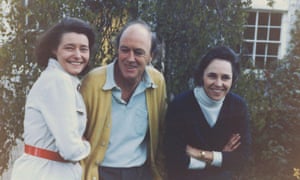
Patricia, Dahl and Valeria Eaton Griffith, with whom he wrote a stroke guide. Photograph: RDNL/Courtesy RDMSC

Dahl made careful notes of these neologisms, which helped with an article he was writing about her stroke for Ladies’ Home Journal, but he may have thought they would come in useful elsewhere. It would be more than 15 years before The BFG would greet little Sophie with a bellow of laughter and the words: “Just because I is a giant, you think I is a man gobbling cannybull … ! Please understand that I cannot be helping it if I sometimes is saying things a little squiggly … Words is oh such a twitch tickling problem to me all my life …”


Dahl spent hours creating new words for The BFG, many of which, as he said of Pat’s neologisms, were better than the originals. He described human beans that taste scrumdiddlyumptious or uckyslush; a zoo full of hippodumplings and crocadowndillies; the telly telly bunkum box. Dahl’s account of The BFG’s difficulty could have come straight from the mouth of Pat: “You must simply try to be patient and stop squibbling … I know exactly what words I am wanting to say, but somehow or other they is always getting squiff squiddled around … what I mean and what I says is two different things …”


Like other children’s authors, Dahl had made up words before, but in The BFG there was a veritable explosion. Dahl was vague when I asked him about the link. “Well, I’d always enjoyed making up new words. That’s part of the fun, you know, that keeps the nippers interested. But I suppose, yes, some of the trouble Pat had did work its way into The BFG. Yes, it must have.”


It seemed so obvious to me that I was amazed to find subsequently, while researching my book about Dahl’s medical achievements, that it had never been explored before. Looking back, I wish I had probed Dahl further. Having now read much more about this extraordinary man, I know that the answer he gave about neologisms was the sort of nebulous response he gave when he felt the truth of the matter was not exactly the story he wanted to tell.


Take The Gremlins: he wrote the book for Walt Disney, with a view to turning it into a film, and brought the expression into popular usage, but did he actually invent the term “gremlins”? Then there’s the question of how his plane came down in Libya during the second world war – was he really shot down, or did he crashland after being given the wrong location of an airfield by an incompetent commanding officer? And did the resulting “monumental bash on the head” really convert a promising oil executive into a bestselling author, as Dahl claimed, or was the literary potential already there, just waiting to express itself?


Perhaps Dahl felt some discomfort at having based the speech of one of his best-loved characters on the aftereffects of his wife’s stroke. Or maybe he had never recognised the link until I raised it. No one in the family remembers him discussing it, but then he rarely talked about the books he was working on. Either way, Pat’s stroke provided inspiration for more than just The BFG’s Gobblefunk language. Back in 1965, there was little in the way of rehabilitation for stroke patients: Dahl was told just one hour a day would be appropriate.


“Surely one hour a day is not enough,” he said to me. “What in the world are you going to teach a child if she only goes to school for an hour a day? That is what Pat was like then – a child. She didn’t even know her ABC.”


Stanley Wade with the valve they invented to treat Dahl’s son’s hydrocephalus.


Stanley Wade with the valve they invented to treat Dahl’s son’s hydrocephalus. Photograph: Leonard McCombe/Time & Life Pictures/Getty Images

He feared she would become an “enormous pink cabbage”, so he set up – with friends and neighbours in Great Missenden, Buckinghamshire – an intensive six-hours-a-day regime. Some professionals warned this was too much, but he ignored them. Pat was coached back to normality “slowly, insidiously and quite relentlessly”. She eventually resumed her acting career, even getting another Oscar nomination.


This miraculous recovery attracted a lot of attention. Other stroke patients and their families wrote to ask how Dahl had managed it. So with the help of a neighbour, Valerie Eaton Griffith, Dahl wrote a guide. She developed this into a book, and the methods were taken up widely, inspiring a whole new movement, which led to the formation of The Stroke Association.


Theo convalescing with, from left, Olivia, Patricia, Tessa and Dahl


Theo convalescing with, from left, Olivia, Patricia, Tessa and Dahl. Photograph: RDNL/Courtesy RDMSC

Amazingly, Dahl’s extraordinary medical influence did not stop there. One evening, we were chatting about a report I was sending to the Lancet. “Ah yes,” he commented casually, “it’s a good journal. We published there many years ago … Yes, we invented a valve for hydrocephalus.” From the sparkle in his eyes, I suspected he was trying to get a rise from me. He enjoyed teasing junior doctors. Had he really invented a neurosurgical device to treat water on the brain? I didn’t believe a word. I knew Dahl was a great storyteller. But, 25 years after his death, while researching my book, I was astonished to find that this was true.


Dahl’s son Theo had developed hydrocephalus after being hit by a taxi, aged four months. The valve he was fitted with kept blocking and, in characteristic style, Dahl set about solving the problem with the help of a neurosurgeon – and a toymaker. “We produced this splendid little valve,” Dahl told me. “It was used to treat thousands of children around the world.” My neurosurgical colleagues still occasionally come across them today, while operating on adults who had them inserted as children.


‘We thought she was over the worst of it’ … Olivia, who died after catching measles


‘We thought she was over the worst of it’ … Olivia, who died after catching measles. Photograph: RDNL/Courtesy RDMSC

And then there was his involvement in measles vaccination, an altogether more devastating episode. When Dahl’s daughter Olivia caught the virus aged seven, she developed the most severe form, with inflammation of the brain: encephalitis. She died within days. Dahl was devastated and, for years, would barely talk about it. But with me, he was very open.


“We thought she was over the worst of it,” he said one evening. “One saw, you know, the usual sort of thing: the fever, the tiredness, the spots. We even teased her for her polka dots.” Dahl had a wan smile and his eyes began to well up. He looked so tired and sad. After the initial illness, Olivia had appeared to improve before slipping into a coma. There was nothing anyone could do. But when the measles vaccine became available some years later, Dahl did all he could to help its uptake. He supported campaigns with a famous measles letter to children which is still used today, and badgered the government to do more.


I realise now, as we chatted all those years ago, Dahl wasn’t so much teasing me, as being coy about all he had achieved. Apparently, he could be proud, boastful, arrogant and argumentative when discussing his writing. But when talking about these major medical breakthroughs, he was happy to minimise his role, giving the credit to others.


I was privileged to look after Dahl as his life came to an end. He wrote so poignantly about fatalities in the war, and devised such bizarre deaths in his Tales of the Unexpected, I wondered how he would face his own demise. I found it was with humour, humility – and an unending fascination in medical science.


Roald Dahl’s Marvellous Medicine by Tom Solomon is published by Liverpool University Press on 13 September. The Stroke Association is one of six charities benefiting from sales of the book. Tom Solomon tweets @RunningMadProf; tomsolomon.co.uk


How family tragedy turned Roald Dahl into a medical pioneer