speak etiketine sahip kayıtlar gösteriliyor. Tüm kayıtları göster

14 Nisan 2017 Cuma

Harare"s park bench grandmas: "I speak to them and feel a load is lifted off my heart"

The therapy room is a patch of waste ground, and the therapist’s couch a wooden bench under a tree. The therapist is an elderly Zimbabwean woman, in a long brown dress and headscarf.


Her patients call her “Grandmother” when they come along to sit on her bench and discuss their feelings, their depression or other mental health issues.


Outside a clinic in Highfield, a poor suburb just south of Zimbabwe’s capital Harare, there are lots of grandmothers – trained but unqualified health workers – who take turns on the park bench to hear stories. They listen to the battered wife who has attempted suicide twice, the man who hates women after he became infected with HIV, the unemployed single mother driven to despair by the struggle of raising four children.


The benches are a safe place for people struggling with depression, which in the Shona language is called kufungisisa, “thinking too much”.


It is a world away from conventional approaches to mental healthcare, but the Friendship Bench project has changed the lives of an estimated 27,000 Zimbabweans suffering from depression and other mental disorders.


The grandmothers, all of whom are trained to improve a patient’s ability to cope with mental stress, listen and nod, offering only an occasional word of encouragement.


One in four Zimbabweans suffers from some form of mental illness, but there are only 13 psychiatrists in a country of about 15.6 million. A solution had to be found, and it came in the way of a bench and the tradition of respect for African matriarchs.


Clinics screen their visitors for mental illness through a locally developed tool called the Shona Symptom Questionnaire. It has 14 questions, such as “Have you been struggling to sleep?” and “Have you been worrying too much?”


Patients scoring above the cut-off level are referred to the friendship bench. Those who go to the grandmothers are five times less likely to have suicidal thoughts, according to Dr Dixon Chibanda, co-founder of the scheme.


“When they first get to the bench, we use an intervention which we call kuvhura pfungwa [opening of the mind]. They sit and talk about their problems. Through that process, the grandmothers enable that patient to select a specific problem to focus on, and they help them through it,” he says.


Through at least six one-on-one sessions with the health workers, the patients are encouraged to speak about their problems and their mental illness.


Traditionally, elderly women play the role of counsellor for younger members of the community. On the bench, however, the grandmothers listen more, and lecture less.


“We used to talk a lot, ‘Do this, do that’. But now we ask them to open up, open their minds and hearts,” says Sheba Khumalo, a grandmother.


Chibanda says it is mostly women that visit the bench. “From our recent study, we found that 40% of those coming to the bench who show depression are victims of domestic violence. Whether that violence is caused by the economic situation is something that we have not looked at.”


In conservative Zimbabwe, just getting people to open up about their mental health is a victory in itself, says Joyce Ncube, another of the grandmothers.


“Many died just because they had nobody to tell their problems to,” she says, settling on to the wooden seat for a session with one of her patients. “When people keep things inside, their problems start.”


Maria Makoni is a 49-year-old unemployed mother of three who began therapy earlier this year.


“In our culture, you are ridiculed for speaking about your mental health,” says Makoni.


She is tense, but lights up when she speaks about the grandmothers. “I was desperate to find someone to talk to about my problems. When I speak to them, I feel like a load is lifted off my heart.”


When Makoni first found her way to the friendship bench, she was surprised to find she was one of many with similar problems. Now she is volunteering to bring more to the bench. “I am ready to speak to as many people as I can.”
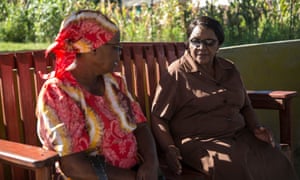


Grandmothers working with the Friendship Bench project


Grandmothers working with the Friendship Bench project chat before counselling sessions begin. Photograph: Cynthia R Matonhodze

For many Zimbabweans, poverty – more than 70% of people live below the poverty line – and unemployment are a source of despair. In such a deeply superstitious and religious society, mentally ill people are sometimes seen as possessed; many are dragged to exorcism sessions at charismatic churches or traditional healers.


Chibanda says such beliefs need not be a hurdle, provided the intervention is packaged well.


“The term ‘opening of the mind’ does not sound medical at all. We have used those words to package a scientific intervention, and this is why it’s acceptable.”


The programme has had to pick its words carefully, as the grandmothers are meant to be more friends than doctors. The scheme was initially called “mental health bench” but nobody came. “The minute we changed it to friendship bench, it became acceptable, even though we are essentially providing the same thing,” says Chibanda.


Researchers say the friendship bench may be a blueprint for mental healthcare in developing countries. In Zimbabwe, the programme will now be rolled out to 60 other clinics across the country.


“This bench is filling that gap we have in providing affordable care,” says Prosper Chonzi, director of health for the City of Harare. “We are glad to see it is being applied to other cities in the country.”


Harare"s park bench grandmas: "I speak to them and feel a load is lifted off my heart"

14 Mart 2017 Salı

"He was really really let down": Thomas Orchard"s family speak out

The ordeal began for Thomas Orchard’s mother, Alison, as she strolled beside a river in Devon in October 2012. She took a call from her son’s social worker saying he had missed an appointment for a mental health assessment.


“I remember thinking: ‘Tom needs my help.’ I ran back home. There was this incredible knock on the door. It was two police officers. Their first words were: ‘We have some worrying news.’ They blue-lightedme into the hospital. I kept asking the police officers: ‘What’s happened?’ I thought he was dead.”


Orchard was not dead but unconscious. At first his family thought he had suffered a heart attack, though he was a physically fit young man. Gradually, as they kept vigil at his bedside over the next seven days, sketchy details emerged. He had been involved in a disturbance in Exeter city centre. He was taken to a police station and from there was rushed to hospital, gravely ill.


“It was very hard to get any information,” said Alison. “We didn’t know what had happened. I don’t think the medical team did either.” Orchard was put into a medically induced coma. “I remember doing things like getting his deodorant to give him a familiar smell,” said Alison. “We were talking to him constantly. But there came a time when it was obvious life was not possible, so the machines were turned off.”


Thomas’s sister, Jo, said they were baffled. “We had a lot of questions about why a 32-year-old healthy man would go into a police cell and come out essentially dead,” she said.


For four-and-a-half years now, the Orchard family – Alison, Thomas’s father, Ken, and his siblings, Jo and Jack – have fought to find out the truth of why he died. Now they believe they have an answer. “I’m completely certain that had it been picked up as a mental health crisis and taken to a place where that was understood, he would be alive,” Alison said.


The family were to discover that Orchard, who was being treated for paranoid schizophrenia, had had a mental breakdown and was arrested after approaching a passerby and beginning an argument. Police were called and he was pinned down in the street and restrained by his hands, legs and ankles.


At Heavitree police station in Exeter an emergency response belt (ERB), a heavy cloth device with handles most often used to secure prisoners around the body so that they can be carried, was held over his face. He was carried in the prone position to a cell, where he was searched while lying on his front, still masked by the ERB. The belt was removed and he was left alone, face down, in the cell. He suffered a cardiac arrest and brain damage. The ERB had been applied to his face for a total of five minutes and two seconds.


Orchard’s family were devastated when they found out what had happened to him. “It wasn’t dealt with appropriately,” said Alison. “I think they made assumptions that Tom was either drunk or on drugs or was an angry man. I know he was very frightened. That’s why he was acting as he was.”


Jo said: “Tom was really, really let down. It was clearly a medical crisis, not a criminal one.” His family believe Orchard’s confusion and fear would been exacerbated by the use of the ERB. “I think the [ERB] being used over the face is barbaric anyway,” said Jo. “If you add mental health crisis into that, it must be so, so scary.”


In their defence the officers made it clear they did not know Orchard had a mental health condition and thought they were dealing with an angry, aggressive man. They believed the force they used was proportional and lawful and pointed out that the ERB had been approved by Devon and Cornwall police for use as a bite or spit hood.


Orchard was raised in rural Devon. “As a child he was very physical,” said Alison. “Small, wiry, fit. He was a very free spirit. He was deeply sensitive.”


He struggled academically and began to suffer mental health problems. “He hit teenage years very badly,” his mother said. “He got into drugs and into petty crime associated with drugs. He was homeless for a while. He never settled in a job.”


On his 21st birthday Orchard was sectioned and, over the next decade, spent lengthy periods in hospital. There he found religion and, when he was judged fit enough to be treated in the community, was discharged. He had digs in Exeter and became a member of St Thomas’s church, where he acted as a part-time caretaker.


“He didn’t have any close friends except God,” said Alison. “He was very devout, very OCD-ish about saying the Lord’s prayer in exactly the same way. He loved crosses and candles.”


By the end of September 2012, his condition began to deteriorate. He stopped taking his medication, heard voices and had hallucinations. On the morning of 3 October, precisely at the time when he should have been arriving for the mental health assessment, he was in the city centre involved in the disturbance.


The officers involved in the arrest and detention clearly saw Orchard as violent. Their explanation for using the ERB was that he was threatening to bite.


Violence is not a trait his family recognise. “I had childhood spats with him but never in adult life have I seen him be violent,” said Jo. “The exact opposite. He would plant seeds and want to save the world.” His mother saw him get angry. “But, at heart, he was incredibly sensitive and gentle,” she said.


It was seven months before Orchard’s family got his body back for a funeral. “That was hugely difficult,” said Alison. “Tom became the property of the state.”


Almost two years after Orchard’s death – August 2014 – the family saw CCTV footage from the police station. “To see how they treated Tom, it was very deeply shocking,” said Alison. The worst part of the video for her is the section in which he is left alone in his cell and remains apparently motionless. “That’s the image that stays with me, that haunts me. It’s a deep, gut-wrenching, sickening feeling. It’s an achingly long time he is lying there and I am willing someone to go in.”


Watching the three officers on trial has been difficult. “I have a range of emotions,” said Alison. “From compassion, to disdain, to loathing.” The family remains angry at Devon and Cornwall police. “I think I have seen an arrogance and I think I’ve seen them not take this death seriously,” said Alison. “None of the officers involved were suspended until they were charged with manslaughter.”


The conclusion of the six-week trial, with three officers cleared of manslaughter, does not spell the end. Through the campaign group Inquest, the Orchards have spoken to other families who have lost loved ones in custody including relatives of Sean Rigg, a musician with schizophrenia who died at Brixton police station in south London after being held for eight minutes in a prone position.


Orchard’s mother and sister are contemplating a life of campaigning. Jo said: “This is a lifelong cause for us now. There are a lot of deaths in custody.” Alison said: “I’ve got to stop thinking it will be all right once this trial is over. I’ve got to accept that this is my purpose in life. It’s not the road I would have chosen in my life but I hope I can be there for anyone else who has to go through this.”


"He was really really let down": Thomas Orchard"s family speak out

12 Mart 2017 Pazar

Limits on learning to speak English like a native | Daniel Glaser

Is there a better way to judge who should live where and what belonging to a country really means? Something more enlightened than the permanent residency form that has provoked so much criticism recently. Sadly, a neuroscientific approach to how language marks you out as a recent arrival is unlikely to be any more forgiving. Although very young children respond equally to all languages, infants raised in a Japanese-only environment start to lose the ability to distinguish ‘l’ and ‘r’ sounds between six and 12 months old. English-speaking children get better at making the distinction.


Even if you learn a second language to a very high standard, you’ll never speak it like a native unless you were exposed to it by around the age of eight. This is mirrored by brain scans. Languages you learn after eight go into a subtly different area of the brain to those acquired earlier.


None of this suggests that we should include MRI scans in nationality tests. But it does show how hard we must work to implement modern and enlightened standards to determine who gets to live where.


Listen to this week’s podcast at theguardian.com/lifeandstyle/series/neuroscientist-explains


Limits on learning to speak English like a native | Daniel Glaser

16 Ocak 2017 Pazartesi

"Can I speak to a serial killer?": there"s more to NHS comms than you"d think

“Can I speak to Peter Sutcliffe?”


The journalist was perfectly serious. I was working in communications at Broadmoor hospital and he saw me as a route to people he thought were patients there. He wanted Sutcliffe’s “take” on a series of recent “Ripper style” murders in the Ipswich area. I explained – while trying to not audibly gasp – that Broadmoor could not confirm who its patients were, let alone put them up for press interviews.


Every so often, an FOI request asks how much the NHS spends on “communications”. The easy headline is that the NHS needs real doctors, not spin doctors. But it is only when you look at the range of activities that communications cover that you wonder if the real spin doctors are those writing the story.


To some, communications is just shorthand for public relations and spin. In fact, responding to media queries (and FOI requests) – which the NHS is rightly expected to do as a public service – is a tiny proportion of our work.


Much of it is about making sure staff know what’s going on in their organisation, that information for patients is clear and easy to access and that MPs, local councils, regulators and community organisations are kept informed and involved in what the NHS is doing.


I have worked at a large trust where there was no system in place for briefing staff on the wards about things they needed to know. I’ve worked in places where every department was producing its own, homemade newsletter that was badly written, misspelt and missed out the information patients needed. I have had to advocate for people’s right to know about changes to local services and to develop plans to reach people who don’t read newspapers, rarely visit their GP and certainly don’t attend NHS meetings.


Part of the job is to manage press and public interest in the event of a major incident. This involves careful planning, working with other emergency services. How do you keep people informed, including your own staff, concerned members of the public and relatives of those impacted? Where do they all go in a busy working hospital? And major incidents come in different shapes and sizes. If a high-profile patient dies in your hospital, you need to be able to manage not just a potential media scrum disrupting your hospital, but the needs of the family too. I recall liaising with one very high-profile family after their son died, because they wanted to visit the hospital morgue without being accosted by the press.


Then there is the navigation issue. How does a person find their way around a hospital, let alone the whole NHS? Part of our job is to make sure that patients can get to the service they need as quickly as possible. How do we reach every potential patient to achieve this? How do we describe different services to the public? (spoiler: not always very helpfully).


I don’t deny that the odd Amateur Alistair surfaces, desperate to turn their job running comms for a cottage hospital into The Thick of It. But they are a rare breed. The majority of us see our job as helping the public, the media and a huge range of stakeholders to understand how the NHS works, the challenges it is facing and how they might be able to help. If you think about the huge numbers of services we provide, the many different communities we serve and the amount of information that implies, this is far from easy.


In recent years we have seen the beginnings of a sea change in the way the NHS talks to patients and the public. Expertise in consultation and community engagement is increasingly valued, not just because these things are required of the NHS, but because we know that involving patients in the development of services improves those services no end.


Some of the best conversations I have had about the NHS have been with the public. Most people understand the challenges presented by an ageing society, flat funding and increasingly expensive treatments. While they will not always agree with each other – or the NHS – on the best solutions, I am yet to attend an NHS public engagement event where I didn’t hear several good ideas. Of course, there is the odd moment – one man went around each person on a table, asked them their background and announced none of them were as qualified as him to talk about “his NHS” – but we should not underestimate the positive contribution patients and the public can make.


If you would like to write a blogpost for Views from the NHS frontline, read our guidelines and get in touch by emailing sarah.johnson@theguardian.com.


Join the Healthcare Professionals Network to read more pieces like this. And follow us on Twitter (@GdnHealthcare) to keep up with the latest healthcare news and views.


"Can I speak to a serial killer?": there"s more to NHS comms than you"d think

19 Ekim 2016 Çarşamba

Doctors freed to speak about Australia"s detention regime after U-turn

Doctors have been released to speak out about conditions and medical treatment in Australia’s immigration detention system, after a backdown from the government on one of the most contentious elements of the Australian Border Force Act.


The secretary of the immigration department, Michael Pezzullo, signed an amendment on 30 September specifically carving out “health professionals” from the definition of “immigration and border protection workers”.


The amendment means the secrecy and disclosure provisions of the Border Force Act no longer apply to a comprehensive list of health professionals, including doctors, nurses, psychologists, psychiatrists, counsellors, midwives, pharmacists and dentists.


Other professionals working in onshore and offshore immigration detention, including teachers, lawyers, security staff, social workers and other staff, have not been exempted from speaking out. They still face a jail term of up to two years for any “unauthorised disclosure”.


The backdown came ahead of the commencement of high court challenge from medical advocacy group Doctors for Refugees contesting section 42 – the secrecy provisions – of the Border Force Act.


Dr Barri Phatarfod, president of Doctors for Refugees, said the decision was a “huge win for doctors and recognition that our code of ethics is paramount”.


But she said the change only allowed for doctors to publicly advocate on behalf of their patients, “it doesn’t change the appalling lack of care they often seem to receive”.


“Currently, Doctors for Refugees is advocating for several children denied special needs care as well as women unable to get a breast lump biopsy and other significant deviations from appropriate medical treatment. We have around 160 active cases of concern.”


Doctors have led public criticism of conditions in immigration detention, particularly in the Australian-run offshore processing camps in Nauru and on Papua New Guinea’s Manus Island. A stream of disclosures from health professionals has revealed systemic abuses, including rape, sexual abuse of women and children, violent assault, as well as epidemic levels of self-harm and suicide.


Dr Peter Young, formerly the head of mental health for immigration detention healthcare provider IHMS, was one of the earliest whistleblowers on abusive conditions and inadequate care in offshore detention.


He told the Guardian in 2014 that conditions in offshore detention on Nauru and Manus Island were “akin to torture”, in an “environment that was inherently toxic”.


On Tuesday Young said the amendment was a major win for doctors and other health professionals who could now freely advocate for better health care for their patients, without fear of prosecution.


“It’s a big backdown from the government, and they’ve made it because they didn’t want to go to court, they knew they were going to lose, and they didn’t want their planning and policies discoverable in an open court. That’s what it’s about.”


He said the government had quietly made the amendment last month, without broadcasting it, because they wanted the Border Force Act to retain its “chilling affect” on public dissension about detention policies.


“Now, for doctors and nurses and other health professionals, it’s even more incumbent on them, those people who have witnessed these things, to come out speak about what is occurring in immigration detention.


“There is nothing stopping them now, except for their own consciences. It’s their ethical duty to speak out.”


Earlier this year, traumatologist and psychologist Paul Stevenson, who has spent 40 years working with the victims of trauma, said conditions in offshore were “the worst atrocity I’ve seen”.


Guardian Australia has approached the Department of Immigration and Border Protection for comment.


Doctors freed to speak about Australia"s detention regime after U-turn

17 Ekim 2016 Pazartesi

Bitter irony: I wanted to speak out about mental health but my anxiety stopped me | Marian Faa

I think and write a lot about mental health. Since being diagnosed with anxiety and clinical perfectionism, writing has become an important way of coming to terms with my own psychiatric ailments, while trying also to raise public awareness. It’s not an easy task. Despite my eagerness and many importunate attempts to give a voice to mental illness, I am often left feeling like the world isn’t ready to listen.


But when mental health week ticked around this year, ears pricked up. My news feed was awash with articles about mental health, friends brandishing popular hashtags and events popping up all around my city.


Finally, a week where mental health was a hot topic, where my issues were on the frontline. If ever there was a time when my humble opinions on the human brain might count for something, this was sure to be it. I panicked.


Determined to seize the opportunity, I started bashing out stories and pitches with intensity, like I was trying to give my computer’s motherboard some kind of frantic deep tissue massage. My mind turned cartwheels. Within 20 minutes I had chewed all my fingernails back to the quick and yanked out a few generous handfuls of hair – telltale symptoms of my escalating anxiety.


I forgot to have lunch. I forgot to pick my little sister up from school. I missed two calls from my partner. But somehow I still managed to singlehandedly pluck all the tiny hairs on my leg, another delightful habit I tend to deploy with fervour whenever I need to curb my anxiety.


As time ticked by and the pressure mounted, I realised I was heading for a nervous breakdown. Maybe I was making too big a deal of mental health week, but that is the very nature of my mental illness – the tendency to inflate and catastrophise. It was a bitter irony: my anxiety was the very thing that stopped me from writing about it.


So I closed my laptop and resolved to stay silent for mental health week. I decided that protecting my own mental state was more important than writing about it. And I reassured myself there would be other opportunities.


See, that’s just it with mental illness. Often we cannot talk about it when the world wants us to – whether that be our families, therapists or the media. And when we are ready to speak up, we can’t find the ears.


Even with efforts to reduce stigma, mental health is an extremely sensitive topic. It takes a long time to develop the personal insight and vocabulary to be able to communicate about our mental states. In my experience, you can only really talk (or write) about it on your own terms and in your own time. This means we need a culture that is receptive to discussions the year round, not just at designated calendar points.


While initiatives like mental health week are exceedingly important, they are not always as beneficial to sufferers in the ways they intend to be. The sudden spike in publicity may feel like a fleeting injection of sympathy that leaves us even more isolated once the week is over and our issues fall into the background once again.


The ephemeral support for mental illness shines with a suspicious veneer, tarnished by the knowledge that talking about mental illness might earn you a hundred likes on Facebook on one day but compromise your job application the next.


On the other hand, the sudden spotlight on mental health can also cause people with mental illness to cringe and withdraw, unnerved (so to speak) by the unfamiliar pressure of public exposure. And then there is the risk of triggers that comes with a disordered flurry of news articles and tweets about mental health.


I am not disputing the merits of mental health week and the media’s reporting of it. I think these initiatives are noble and necessary. I think they are crucial to creating a society that makes it easier to live with a mental illness. But if listening to people with mental illness and understanding their experiences is the most important step in dissolving the silence and stigma, we need to be open on a more general, everyday basis.


We need a culture that is attuned to the nuances of mental illness and accepting of the silences as well as the disclosures. We need a world where mental health is an acceptable topic regardless of time and place, beyond the field days and short-lived social media campaigns.


Bitter irony: I wanted to speak out about mental health but my anxiety stopped me | Marian Faa

3 Ağustos 2016 Çarşamba

As a black man I need to speak out about prostate cancer

I was only recently made aware of some startling statistics: one in four black men will be diagnosed with prostate cancer in his lifetime; one in 12 will die from the disease. This is double the risk faced by white men in the UK.


Perhaps even more concerning is the fact that 86% of black men are oblivious to the heightened threat prostate cancer poses to their health, putting thousands in danger of being diagnosed at a late stage when treatment options are limited.


The prostate gland is an important component of the male sex system, but 92% of black men don’t know what it does, 62% don’t know where it is and nearly one in five is unaware he even has a prostate.


As a black man, I find these statistics worrying, especially as prostate cancer is a disease that can be successfully treated if caught early enough. Men over 50 and men with a family history of prostate cancer also face a higher than average risk of the disease.


Related: What 12 Years a Slave tells us about 21st century black mental health


What can we do to make sure more black men understand the added danger they face and take the necessary action that could save their lives?


Although increasing awareness is obviously a vital priority, health professionals can play a crucial role as well. Black men not only face an increased risk of prostate cancer, they are also more likely to develop the disease at a younger age. The PSA blood test is the first step men can take to identify whether anything might be wrong with their prostate; however the test is riddled with complexities and there is still a lot of confusion among GPs as to who is entitled to the test and from what age. Some remain unaware that black men face a higher than average risk and there are a number of black men who report being denied a PSA test from their GP.


The charity Prostate Cancer UK has recently produced a set of consensus statements from a panel of independent clinical experts to help GPs use the PSA test more effectively. As part of this, experts recommend that all men should be able to access PSA testing from the age of 50, but men at higher than average risk of prostate cancer (including black men) should be able to access the test from age 45.


Related: Black men face inequalities in cancer care


My constituency, Streatham in Lambeth, has one of the highest black populations in the country, which is why this issue is so important to me as their MP. I want to make sure that all GPs, not only in my constituency but across the UK, help to raise awareness of the increased risk of prostate cancer in black men and have the knowledge to initiate these important conversations with the community.


Although we still don’t know why black men face a higher than average risk, my message is clear: with one in four black men being diagnosed with prostate cancer, it is up to us in the community to act. Please speak to your dads, uncles, brothers and friends and make sure every black man over the age of 45 is wise to the risk we face. Don’t let people die from embarrassment. Ignoring prostate cancer won’t beat it.


Join the Healthcare Professionals Network to read more pieces like this. And follow us on Twitter (@GdnHealthcare) to keep up with the latest healthcare news and views.


As a black man I need to speak out about prostate cancer

21 Ağustos 2015 Cuma

Will not be embarrassed to speak about vaginas with your physician

Vagina embarrassment


If there’s 1 person you need to in no way be embarrassed to say the word “vagina” to, it’s your GP. But, in accordance to a new study released this week by Ovarian Cancer Trust, 66% of 18-24 yr-olds are so shy of muttering these 3 syllables to their medical professional that they are keeping away from going to them altogether, preferring to turn to Google for all their gynae-connected inquiries.


Plainly, this is a worrying statistic with evident health implications, as a spokesperson for OCT factors out: “While several of us have turned to the internet for help, Googling symptoms is not a substitute for suitable health care attention. It’s amazingly critical that ladies come to feel empowered to talk about their wellness and feel comfy visiting healthcare experts.” But while females beneath-24 are at a significantly reduced threat of getting ovarian cancer compared with girls over 55, it is not, of program, the only reason they ought to be receiving checked out.


It is tough to know what’s creating this reticence among millennials to consider a journey to their GP surgical treatment, but study by the The Eve Appeal, due to be published following month, might have one suggestion – the stigma that persists around gynaecological cancers being linked to sexual promiscuity. As they place it: “One quarter of females are place off speaking to their GP because they do not want to examine their sexual background, with almost 40% agreeing that there is a higher stigma around gynaecological cancers than other kinds of cancer.”


One particular factor here is evident: females want to feel totally free to talk about sexual health issues with out the worry of currently being judged.


“It is unhappy that gynaecologists and GPs do not have the trust of younger women. They need to create an environment of trust and inspire girls to come to feel cozy so they can talk about their troubles,” Professor Christina Fotopoulou told the Independent. And if there was another cause essential to make sex training compulsory in schools, certainly it’s this.


US military history


First lieutenant Shaye Haver.
1st lieutenant Shaye Haver on an obstacle program at US army Ranger school. Photograph: Robin Trimarchi/AP

Right now marks a very first in US military historical past, as two girls – captain Kristen Griest and first lieutenant Shaye Haver – are set to graduate from the gruelling Army Ranger school soon after months of arduous physical and psychological coaching. It comes in the exact same week that a leading Navy Seals admiral, Jon Greenert, has unveiled that the navy is organizing to open its elite Seals staff to ladies, as well.


“Why shouldn’t anybody who can meet these [specifications] be accepted? And the solution is, there is no purpose,” Greenert informed the Navy Occasions. “We’re on a track to say, ‘Hey seem, anybody who can meet the gender non-particular requirements, then you can grow to be a Seal.” There’s no doubt that Griest and Haver’s efficiency has influenced Greenert’s, despite the fact that they may possibly be far more modest about it. Speaking to the Guardian, Griest mentioned: “I do hope that with our efficiency in Ranger School we’ve been ready to inform that determination. We can handle issues physically and mentally on the same level as guys, and we can deal with the very same stresses and training as the males can.”


Associated: Gone off sex? Never ever worry, ‘pink Viagra’ is here to save womankind


‘Female Viagra’


Following two failed attempts, flibanserin, dubbed the “female Viagra” finally received the go-ahead by the Meals and Drug Administration this week, turning into the initial drug on the market to treat minimal libido in women. And guess what? It is pink. Even though Sprout Pharmaceuticals, the organization that designed the drug (which will be offered below the title Addyi) was purchased for $ 1 billion just 36 hrs later on, it is by no indicates a miracle solution. Reactions to the information have been mixed, not least since Addyi comes with a really hefty overall health warning – the highest it can obtain whilst even now getting on shelves. Then there’s its misleading moniker – Addyi works nothing at all like Viagra. Rather it need to be taken every day (not just when intercourse might be on the cards), as it acts like an anti-depressant to stability chemical compounds in the brain (thus escalating sexual need) rather than push blood to the physique. Even then, these who partook in clinical trials only reported going through “one more sexually satisfying occasion a month, compared to a placebo”. Starting to sound like more problems than it is really worth? This sex therapist thinks so as well.


Flibanserin … female
Flibanserin … does it dwell up to its female ‘viagra’ tag? Photograph: Sprout Pharmaceuticals/Reuters

But a single group – Even the Score – is thrilled with the FDA decision. Obtaining spent years campaigning for the dug, believing its absence to be a indicator of gender inequality in the treatment of sexual dysfunction and accusing the FDA of gender bias, the female strain group sees the advent of Addyi as a “game changer for women”.


“In a breakthrough minute for women’s health, the FDA today chose to respect the science and stand with hundreds of thousands of American females by approving the initial-ever medical treatment choice for HSDD [hypoactive sexual want disorder], wrote Susan Scanlan, chair of Even the Score. “It is our hope that this historic minute for girls will open the door to a pipeline of long term therapy choices for the most typical form of female sexual dysfunction.”


Greatest airport drinkers


Up coming time you’re at an airport pouring scorn on young men (possibly journeying to a stag-do in Prague) drinking lager at 6am, keep in mind this: 65-yr-previous girls are 4 instances much more probably to drink eight units just before a flight than any person else. In truth the poll, carried out by site Vacation Extras, found that two in three men aged 18-24 did not drink ahead of a flight at all. Whether these females have some time to kill in departures, are settling their nerves or are still treating air travel as an occasion that warrants currently being marked with a cocktail (or 3), now you know who to steer clear of sitting next to on a flight. Though there have been no reviews of brawling in the aisles. Yet.


ICYMI


Sadie Frost turns academic to highlight lack of film manufacturing roles for girls


From literary heavyweight to life style brand: exploring the cult of Joan Didion


Females in Gaza: ‘If we want to live right here, we want to dwell in dignity’


Is a woman too old to have a little one at 50? It depends on who she is


I’m tired of getting variety to creepy males in purchase to remain protected


Will not be embarrassed to speak about vaginas with your physician

12 Temmuz 2014 Cumartesi

How do I speak to my kids about alcohol?

rehab column family

‘What I truly want to say is ­“Drinking can be enjoyable, little ones. Do it proper and it can be a riot and a complete pleasure, and totally fine. Do it incorrect and you could finish up in the gutter.”’


“I like beer,” our youngest declares at the dinner table. Everyone laughs, and his older siblings urge him to say it once more, louder. I shoot them a serious search, because their favourite thing at the moment is to get their brother to say controversial issues in public. I don’t want him to wreck his nursery induction morning in a couple of days, by answering the teacher’s query of, “What do you like?” with a well–rehearsed: “Willies and beer.”


As an alternative of admonishing him for saying he likes alcohol (simply because let’s face it, until he is experimented with it he can’t say if he does or not), I appear at my son and say, “This is not actual beer.”


I should have just stated, “Yes, beer is lovely,” and moved the conversation on simply because my son seems cheated and crestfallen, like he is received his references all wrong. I’m shocked that he understands what beer even seems like, but then I realise there is a line in The Tiger Who Came to Tea, in which the mother in the story is quite concerned simply because a going to tiger has eaten all of the meals in the cupboard, and alas, drunk all of Daddy’s beer.


If a tiger came for tea at ours and was looking for booze, he’d be disappointed. We do not have any, save the odd bottle of beer that I hide under the stairs for when R’s out and I fancy an evening swig. I pop the bottle into the freezer 5 minutes before I want a drink. I have not advised him I do this due to the fact he’ll probably laugh and say, “You believe finding one beer in the residence will make me want to drink again? I can go to the shop at the end of our street if I truly want to get pissed.” But not obtaining alcohol in the house – as a loose rule that I set when R moved back in – feels right at current. The stuff that R is drinking now is alcohol-cost-free and quite why I feel the require to level this out to our 3-year-outdated son – who is confused to say the least – is questionable.


I do not feel I have a issue with R consuming pseudo-beer (regardless of some folks pondering it really is a phase towards relapse), but I feel I’d fret if our neighbour popped by, saw the bottle and did not spot the % on the label, and believed he’d fallen off the wagon, and we were carrying on as if everything had been regular. It tends to make me query how I would react if R did sit down a single evening and pour himself a actual drink. I believe I am Okay with him carrying out specifically as he pleases now, but that’s only since he is nevertheless sober.


When I have answered friends’ queries about R’s on/off romantic relationship with drink, I feel like it may possibly be much more helpful to just remain quiet and allow his sobriety and progress do the speaking. But I can’t remain silent about every thing simply because our children inquire inquiries all the time.


How do I speak to them about alcohol? Or rather, how do I speak to my young children about the problem with alcohol? Due to the fact if there hadn’t been a problem in the first location, then R wouldn’t be sitting right here with half a litre of impotent brown beer in front of him. He’d be drinking the actual things.


Like all talk surrounding things that can sometimes be fantastic but also be terrible (sex, present day art, solitude), the joy and the ache that alcohol can elicit is challenging to describe. Our older two children may possibly realise that in our family members life it has been the crux of numerous a dilemma in the previous few many years and we have talked about how nicely R is undertaking. But it is difficult to talk about his real dilemma and how alcohol grew to become a difficulty in the first area.


What I genuinely want to say is “Drinking can be fun, little ones. Do it correct and it can be a riot and a total pleasure, and entirely fine. Do it wrong and you could finish up in the gutter.”


I never want to put alcohol in the identical bracket as heroin since any way you look at heroin – even if the consumer is fortunate enough to be undertaking the pure stuff – they are dropping. But alcohol? I have often been capable to drink in moderation and R has not. A single of us can manage alcohol, and the other are not able to. How do you clarify that to individuals who still have pretty idealistic views about life?


I try to reply the concerns as they come, such as the tricky “sex, really like and which-comes-very first?” ones, or the even tougher ones with regards to excellent, needed fibs and poor, nefarious lies. Nonetheless, as difficult as answering my children’s concerns may be at times, I realise that they are an incredibly valuable way of exploring locations that I uncover uncomfortable or I am unsure about. And I never always have to pretend that I know all the solutions.


How do I speak to my kids about alcohol?

7 Temmuz 2014 Pazartesi

We Require to Speak About the Costs of Cancer Remedy

Just lately, investigators at the University of Chicago and Northwestern University reported on a new tool, Price, for measuring patients’ concerns about the monetary burden of cancer treatment method. The acronym stands for “COmprehensive Score for financial Toxicity.”


Speaking about money is not an effortless issue for some physicians, which includes oncologists. Several hesitate to bring up the subject, both out of ignorance about pricing, time constraints, lack of concern, a straightforward or idealistic disdain for the topic… But the unfortunate reality is that as issues stand in 2014, U.S. insurance ideas vary in what treatments they cover. A cancer diagnosis can lead to economic hardship and even bankruptcy.


Just feel of the initial season of Breaking Undesirable, when Mr. White’s lung cancer diagnosis prospects him to a life of crime. Nominally, and component-genuinely, the chemistry teacher’s determination to cook and sell methamphetamine comes from wanting to spend his health-related expenses with no accepting charity from friends, and from wanting to depart funds for his wife and kids, like a disabled son, so they might live well, or at least comfortably, after his death.


infusion pump (source: Wikipedia)

infusion pump (supply: Wikipedia)


This kind of concern, about the fiscal toxicity of obtaining cancer, is understandable. And it’s however common. A latest poll by Harvard’s School of Public Wellness, NPR and the Robert Wood Johnson Foundation found that health care difficulties are a significant contributor to tension among U.S. grownups (which, in flip, prospects to far more health problems). It is a toxic cycle. Cancer, like any continual illness, can cause financial distress. Even between insured patients, out-of-pocket expenses can restrict patients’ nicely-currently being, leisure actions, family members strategies and happiness. This is nothing to scoff at.


I employed to consider that physicians shouldn’t speak about funds with their sufferers since that sort of conversation has the potential to demean the partnership. It can render doctors’ function like an ordinary company transaction, which IMO medical care need to in no way be. But I’m persuaded that as prolonged as we have a largely private, insurance coverage-based health care system, we – medical professionals and patients – need to talk about how significantly cancer treatment options may possibly cost.


As issues stand, grownups should have the opportunity to weigh the potential charges of their care in the context of the limits of their insurance coverage coverage, cost savings and other elements of their lives, this kind of as responsibilities for having to pay a home loan or lease, their kids’ university tuition, what ever it is they may possibly otherwise decide on to do what they’ve acquired, which is finite.


Acquiring back to the paper out of Chicago…The gist of COST is that it’s a Patient-Reported Final result Measure (PROM) that may give medical doctors a much better way to gauge patients’ economic concerns and, with that, broach the topic. Which sounds good, terrific. Except that ultimately it’s about funds and not genuinely about cancer care.


I’m skeptical, as I am about most checkbox-kind measurements of humans’ emotions and worries. And I wonder if the authors’ purpose is, partly – but with excellent intention, of program, and relatively sufficient, as most medical doctors need to have go about their operate and earn a living – to safe funding to accomplish far more research about COST, which would then be used to predict more cancer patients’ economic stress and issues in the potential. And then we’ll have an even greater cycle of subjective measurements, and researchers collecting data and publishing people findings, rather than just evaluating and supplying greater health care therapies to more people who have cancer and other situations, very carefully and thoughtfully.


We Require to Speak About the Costs of Cancer Remedy

6 Temmuz 2014 Pazar

We are failing our frightened young children, leaving them with no a single to speak to| Rhiannon Lucy Cosslett

Child head ache

‘One in seven councils in England have been deemed by Ofsted to be failing vulnerable youngsters.’ Photograph: Alamy


What do you do if, aged twelve, you discover your self feeling hopeless and terrified of the planet around you? To whom do you flip? Melvyn Bragg has uncovered that his struggle with depression started at this age. “I had clinical depression but I did not know who to speak to,” he explained. “I never think anybody who has not been through depression is aware of what it truly is like to be frightened out of your thoughts each and every day from the second you wake up to the moment you go to rest.”


A kid with such feelings is clearly in need of urgent support from grownups, but for many, all these years soon after Bragg 1st struggled, help is still not forthcoming. These who operate with youngsters know this, and have been calling urgently for an overhaul of psychological overall health providers. The charity Children Business has launched a campaign referred to as “See the little one. Change the program”, supported by some of Britain’s foremost children’s authors – they are shocked that a single in 7 councils in England have been deemed by Ofsted to be failing vulnerable children. The mental health charity Young Minds is also campaigning, following a freedom of data request that revealed sweeping freezes and cuts to mental overall health service budgets for children and youngsters.


Voices are rising, but whether politicians will pay attention is an additional matter. Children Business founder, Camila Batmanghelidjh, has explained vulnerable young children are “relegated to the bottom of the political pile”, and social staff describe getting unable to supply adequate assistance due to cuts. Childline stated that reviews in self-harm in 2013 had risen by 41% from 2012, even though reviews of suicidal ideas increased by 33%.


Media retailers are quick to blame social media for the deterioration in children’s mental health – an effortless, practical scapegoat. There has been a amount of broadly reported suicides of shockingly youthful children who had been bullied online, foremost to rampant speculation. But no matter what the perceived causes, we know that to leave a vulnerable kid unassisted can lead to the really worst of outcomes. If the youngster survives their formative many years with no appropriate help, they can be left to struggle with mental health issues all through adulthood.


Given the dearth of providers, youngsters and households come up with other coping mechanisms. Lately, whilst getting a clear-out, I came across a small yellow box inside of which have been five worry dolls. Originating in Guatemala, be concerned dolls are vessels for a child’s nervousness – the child talks to them, tells them their fears, then spots them below their pillow. It struck me that I had spent my childhood surrounding myself with talismans in an energy to fight the reality I was scared and anxious all the time. There had been dream catchers to cease the nightmares, comfort blankets cuddled way previous the acceptable age, a present of worry beads (there was a lot of fear) in an try to get me to quit selecting at my skin compulsively until finally it bled.


Twelve was the worst year. My mother and father split up, I was being viciously bullied, and it was turning into clear that my brother, then 6, was so severely disabled he would never ever lead a normal daily life. My mum tried several times to get me counselling, and even though our household was acknowledged to social providers the waiting listing was limitless. I’m most likely nevertheless on it.


I resorted to books, angry music and writing horrible poetry Melvyn Bragg buried himself in schoolwork. Other folks use medication or alcohol. None of these is adequate. In hindsight, I realise I talked a lot more to people fear dolls than I ever did to an grownup, and that is what it all boils down to. The country’s grownups are failing kids – children far worse off than I ever was – and unless we do one thing now, we will proceed to allow them down.


We are failing our frightened young children, leaving them with no a single to speak to| Rhiannon Lucy Cosslett

4 Temmuz 2014 Cuma

Sadly, no 1 would like to speak about dying

Perhaps we shouldn’t worry about death. Let us eat and drink, for tomorrow we die. And given that no one, not even those professing faith in God, has any certainty about what happens when we die, of course we’re all frightened of what we cannot see: we are just like children scared of the dark. But this fear seriously affects public policy.


Last month the Court of Appeal ruled that doctors must consult patients before placing a “do not attempt resuscitation” order on their notes. This sounds sensible enough, but our attitude to death complicates that consultation.


When a medic broaches the subject, the response is, “You’re giving up on me, doctor.” Yet cardiopulmonary resuscitation (CPR) does not often restore a patient to full life, but to a painful and undignified extended wait for death. The patient’s ribs may get broken and they can sustain hypoxic brain damage, before dying a few weeks later.


This makes neither for a good life nor a good death. Unless you have a shockable heart rhythm that responds well to CPR, your chances of long-term survival are slim. It is not something many patients would choose were they aware of the risks, but our anxiety about death makes it more difficult for doctors to communicate these facts.


The fear of the end of our lives warps other parts of our health system, too. We insult older patients stuck in hospital by calling them “bed-blockers”.


A junior doctor friend once followed two grand politicians around his hospital and watched as they jumped in a lift and missed out an entire floor. That floor contained the geriatric wards, which don’t have the photo-call appeal of a premature baby unit or oncology ward.


We take little interest in geriatric care, even though it will punctuate many of our lives. And so that area of medicine is one of the least-loved. It is the largest medical specialty, with 1,252 of the UK’s 12,221 consultant physicians. But of the 139 geriatric consultant posts advertised in 2012, only 74 were filled. Only acute medicine has a bigger struggle to recruit.


And a bias against the old trickles down, away from the definitely dying towards those who are simply, by virtue of their age, closer to death than the young. Yesterday’s Telegraph revealed that clinical commissioning groups in the NHS are denying over-75s life-saving operations, not because of complications and other conditions associated with getting on a bit, but because of the old age itself.


If we didn’t shut out death, perhaps we’d be a little more horrified by the apparent institutional bias in our health system against the old. And perhaps we could make our own deaths a little less distressing.


Sadly, no 1 would like to speak about dying

13 Haziran 2014 Cuma

What we speak about when we speak about abortion: truth, science and not the Texas way | Jessica Valenti

Lauren Peterson is a senior advisor at Planned Parenthood Federation of America and speechwriter for the organization’s president, Cecile Richards. Peterson travels about the country with Richards, going to rallies, occasions – or wherever the politics necessitate.


I met Peterson at a Planned Parenthood occasion in San Diego last yr, when I spoke on a panel with Richards and Sarah Weddington (the attorney who argued Roe v Wade prior to the Supreme Court). Peterson had some things to say about careers in speechwriting (by way of the Obama administration), abortion politics (by way of Texas) and, of course, The West Wing – all although en route to Des Moines to mark the retirement of Jill June, president of Planned Parenthood of the Heartland.


How did you know you wished to go into speechwriting?


Following I graduated from college, I was actually into audio documentary – the sort of issue you’d hear on This American Lifestyle or All Items Considered. I would interview folks, then edit the interview into a piece for the radio. Which is how I discovered that I adore helping other people tell their stories – asking queries, listening to what they have to say, then creating some thing that displays their personality and their tips. And that’s essentially what speechwriting is.


You worked for the Obama campaign – can you talk about who you wrote for? What was that like?


I was on the digital group, so I wrote for everybody – from assisting the man who won “Dinner with Barack” and regretted not taking the French fry provided to him by President Obama (hi, Scott!), to sending an e mail to supporters, to writing video scripts for just about every person, to doing work on our website. I tweeted, blogged, produced audio pieces, realized from our remarkable speechwriting group and, best of all, traveled close to the nation to campaign rallies exactly where the president was speaking.


It could be aggravating at occasions – when you happen to be functioning on a campaign of that scale, you sometimes have to compromise on problems you genuinely care about. We had been all exhausted all the time.


And how did you begin doing work for Planned Parenthood?


I heard Cecile speak on the campaign trail in 2012, when she had taken time off to volunteer as a surrogate for President Obama. She had this hilarious top-ten checklist of the motives why females were absolutely going to make the big difference in the election, and why they need to assistance the president. As the campaign was wrapping up, men and women began asking me what I wished to do subsequent. I would say, “I want to work for a person like Cecile Richards!”


That turned out to be an real job posted on the Planned Parenthood website.


It truly is my knowing that there are not specifically a ton of female speechwriters. Why do you believe that is?


I feel like something else, it requires some bravado to break into speechwriting if you are not already there. And a disproportionate variety of the folks who are previously “there” are guys. I will say this: in my knowledge, they are exceptionally great, generous guys who understand that our discipline is not catching up to the rest of the globe as swiftly as any of us would like.


The 4 individuals who pushed me to try out my hand at speechwriting, who encouraged me throughout my work search, and who now reply my frantic emails with topic lines like “How do you compose a commencement speech?!” – they are all very talented feminist speechwriters … who occur to be men.


Right now, there is not exactly a lack of issues to write about when it comes to reproductive rights – particularly in areas like Texas and Louisiana, states exactly where abortion care may be completely obliterated. How do you stability relaying the urgency of these problems while nevertheless remaining upbeat and inspiring – not just in speeches, but in lifestyle … for your own sanity?


Two methods for this, each of which I blatantly stole from Cecile.


We invested a lot of final summer season in Texas, the place I noticed how desperate the circumstance is for ladies who dwell there and have to go to extraordinary lengths just to get basic health care or accessibility secure and legal abortion, which is – hello! – a constitutional correct and has been for a hundred% of the time I’ve been alive. At the exact same time, I also got to see men and women flip out by the 1000′s to rallies all above the state. … In states that undoubtedly do not make it effortless, individuals are performing extraordinary issues that inspire me even on the toughest days.


Two: I take a deep breath and a phase back and consider about how far girls truly have come. Much less than a hundred years ago, girls couldn’t even vote. I acquired the opportunity to function on a presidential campaign, and now I get to travel all more than the nation writing about women’s rights. Just in situation I neglect, I have a tattoo of the date of the ratification of the 19th Amendment on my wrist.


Poor science – like the erroneous hyperlink among abortion and breast cancer or mental overall health difficulties – has manufactured its way to policy. How do you see battle back towards that?


This by no means ceases to enrage me! You’re entitled to your own opinion, not your own facts, correct?! I think it is difficult for an individual without having a background in medication or science to come in and fact-check out the junk science that has been the justification for every thing from medically needless admitting privileges to mandatory “data” that physicians in some states need to distribute, by law, to women searching for an abortion.


What do you know now about speechwriting that you wish you would have acknowledged 5 years ago?


Five years ago I was functioning for the Wisconsin Film Festival, so I consider it truly is risk-free to say that every thing I knew about speechwriting at that stage in my daily life, I realized from Sam Seaborn.


What we speak about when we speak about abortion: truth, science and not the Texas way | Jessica Valenti

12 Mayıs 2014 Pazartesi

Jaha Dukureh: "In Washington, they don"t want to speak about vaginas"

Jaha Dukureh does not give up effortlessly. When, aged just 15, she was sent to New York from Gambia for an arranged marriage, it looked like her dream of getting an education was more than. But she refused to quit trying.


“I went to school right after college, begging them to let me join, but simply because I didn’t have my parents with me they said I couldn’t enrol,” she says. “At the last school I just told them I was all on my own, and I sat in the principal’s workplace and cried until finally ultimately they gave in.” Inside days, she had joined the class. “You do not even know how content that manufactured me. I was so fired up just to sit in class and learn,” she says.


Now Jaha is dealing with a new challenge: trying to assist carry an end to female genital mutilation, otherwise known as FGM, in the US. The 24-year-outdated mom of three, who now lives in Atlanta, went via the practice – which entails getting rid of some or all of a girl’s outer sexual organs – when she was only a week old. But she understands many ladies who, regardless of currently being born and raised in the United States, had been taken as young children back to their family’s nation in order to be lower and hears stories that cutters are also at perform on American soil.


“FGM is not anything that is taking place in a far away location. It is happening here to American women,” she says. “When these youngsters are getting sent back they are advised they are going to meet their households. Typically the mothers and fathers are not to blame, they get their little ones back home and it can be completed without having your permission – you go out and come back to a mutilated youngster.”


Right after hearing about the campaign of British schoolgirl Fahma Mohamed – who headed a effective Guardian-backed campaign to get much more schooling about FGM in colleges – Jaha began a petition on the campaigning internet site Adjust.org. She is calling for a new research to uncover out just how a lot of women and females are impacted by FGM in the US, as the very first stage to forming a nationwide action strategy to tackle the brutal practice.


“There is this kind of a culture of silence about FGM in America. If you stand up and say ‘This took place to me’, men and women will scrutinise you, but somebody has to stand up and say, this can not go on taking place. This is a human rights abuse and it has to end,” she says.


A culture of silence and worry around the subject – coupled with public apathy and lack of awareness – has permitted the practice to proceed below the radar, she says. “When men and women come to this nation they bring their traditions with them – they eat the same foods, dress in the very same way – what helps make individuals think that they won’t continue with FGM?” she asks. “Yes it’s a cultural problem but I’m from this culture and I am saying, this is not to our advantage. This is abuse.”


Jaha has currently spent her life difficult accepted cultural norms. As 1 of five ladies and three boys, she grew up in Gambia and was among the very first ladies in her family to go to school. “Some family members members would complain due to the fact rather of coming property and finding out to be a female, I’d be in talent displays and right after-school lessons,” she says. “My mom was so proud of me, she would promote garments or get African merchandise to the United kingdom to promote so she could shell out my school fees. She wished me to become a medical professional.”


But when she was in 7th grade her mom was diagnosed with cancer. Unable to discover remedy in Gambia she went to the United kingdom, taking Jaha with her. “She needed me to go to college, but it just wasn’t possible, so when I was 14 I just spent all my time going back and forward to hospital.” When her mom was advised she had 3 months to reside, she sent Jaha back residence. “She didn’t want me to see her die.”


On her return, with no a mother to defend her, she was informed she had to go to New York to marry a guy in his 40s. Nevertheless just 15 when she arrived, she quickly found out that not only had she gone through FGM as a youngster, she had been subjected to the most intense kind. Jaha had sort 3 FGM, where the clitoris and labia are eliminated before the woman is stitched with each other, leaving only a very tiny hole to urinate and menstruate.


“I went by means of days and weeks of excruciating ache when [my husband] was making an attempt to have intercourse with me,” she says. She was taken to a medical doctor in Manhattan who opened her vagina, and told her she had to have sex that day or the wound would shut again. “This took place in America – it was like I went through the FGM all more than once more.”


When the marriage broke down, Jaha refused to stay with her husband and was taken in my family members. With out anybody to vouch for her, she went to ten various schools in which she was told her she could not be enrolled without a guardian’s consent, before the 11th agreed. “I went to college in the course of the day and waitressed in Harlem in the evening for lunch cash and outfits,” she mentioned. “But you know, I went to the prom. I saved up and I purchased my prom dress, I got a date – I was a actual American woman.”


When she was 17 she moved to Atlanta to be married for a second time. “I was extremely lucky due to the fact my husband understands my passion for schooling and he is the ideal dad for my youngsters I could inquire for,” she says. She finished higher college and place herself via college, and started out operate as a bank teller. In 3 and a half years she has been promoted three instances and now works as a personal banker. “When people inquire in which I am from, I say I’m a Georgia peach,” she says. “This is residence now. There are so many options right here and there is no way that women should miss out on that due to the fact of FGM. That does not sit nicely with me.”


Her campaign has not been easy. Right after she spoke publicly for the initial time, Jaha suffered immediate and severe backlash. “People referred to as my husband, my sister, my dad. They mentioned I wished to get men and women locked up, break up families – but that is not my message,” she says. Jaha’s husband and father the two respect her selection to lead the campaign, as hard as it could be and she refuses to be scared into submission. “Whatever they do, I am not afraid. They are not going to make me cease. The security of our daughters is more important that that”.


In between searching soon after her young loved ones and functioning as a individual banker she tours colleges, colleges and community groups to talk about the dangers of FGM , and with other survivors has set up a basis referred to as Safe Hands for Women.


But now she is taking her campaign to the leading by asking for far better data on FGM in the United States and as a 1st stage to making a nationwide action strategy to train educators, well being professionals and police – and give survivors a safe area to seek out aid.


“In Washington they don’t want to talk about vaginas, they do not want to hear about this concern and they don’t want to tackle it,” she says. “Sometimes, I feel is Washington afraid to tackle FGM – are they frightened of it?”


She is established to keep fighting until finally FGM is recognised as a genuine threat for American women and policies are put in place to shield them. “I really don’t want to be poster youngster. I want each and every girl who has been through this to be in a position to talk out,” she says. “But you know, in each and every revolution one individual has to stand up to be counted, then other men and women comply with. Correct now everyone is turning a blind eye and pretending nothing is incorrect – but when we stand up collectively, they won’t be capable to disregard us any much more.”


Jaha Dukureh: "In Washington, they don"t want to speak about vaginas"

3 Nisan 2014 Perşembe

Why Autism Speaks Does not Speak For Me


Cover of &quotLook Me in the Eye: My Life wit...

Cover via Amazon


Autism Speaks, founded in 2005 by Bob and Suzanne Wright, sometimes seems to have taken more than the whole conversation about autism in this nation, what with their blue puzzle pieces littered all more than the landscape, coming to symbolize, wrongly, autism itself. Yet in spite of their ostensible role as a voice for autism, they’ve received a poor track record of displaying respect for autistic folks. One example is their intensely offensive “I am autism” video from 2009, promising a threatening, ominous autism that “ understands where you live” and “works quicker than pediatric AIDS, cancer, and diabetes mixed.” Oh, and guaranteeing also that autism will make your marriage fail. It doesn’t.


But that little truth and any variety of other people did not get in the way of Suzanne Wright when she settled in to pen her organization’s current “call to action” on autism, this time switching pronouns to assert repeatedly in boldface, “ This is autism.” She claims that the nation has failed autism households, “let them split up.” According to Ms. Wright, families who have autistic children are “not living.” Except that, almost in the identical breath, evidently we are residing


… second-to-minute. In anticipation of the child’s next move. In despair. In fear of the potential.


She compares the “3 million children” in the United States with autism–of whom 1 is presumably my son–to a crisis on the degree of three million children all of a sudden going missing or three million young children waking up all on the exact same day, gravely unwell. We would, she says, call out all of the military to resolve this difficulty, it is so dire, so why do we not do that for autism? It is not the 1st time someone has compared autism to possessing a kid stolen from them or to a dire condition. From what I hear from men and women who have, in fact, really lost a kid to a condition, there is no comparison.


Autism “moms” (no dads?), she avers, dwell like this:


  • On poor days, they are depleted. Mentally.  Physically. And particularly emotionally.

  • Possibly they have been up all evening caring for their teenage youngster who’s possessing a seizure.

  • Perhaps they are up but once again altering the sheets due to the fact there’s been one more bed wetting accident.

  • Maybe their youngster has been trying to bite them or themselves.

  • Possibly they cannot afford the trip to a medical professional specializing in autism.

  • Maybe there is a waiting-list for ABA, speech and OT.

  • Maybe their insurance coverage will not spend.

  • Possibly they don’t have the income to pay a particular lawyer to battle for college services.


As a loved ones, we have experienced nearly every thing on this listing, some with our autistic son and some with other sons, and some with all 3. Wright says, “This is autism,” but with our three youngsters, it is just been “parenting.”


Parenting can be challenging and can leave you tired, mentally, physically, and emotionally. It’s real. But I cannot get started to say how offensive it is that somebody would distort our lives with our great young children as not even residing, as nothing but “despair” just to acquire attention from people who really don’t know any a lot more about autism or autistic folks beyond that blue puzzle piece. Or that this cherry-picked representation of parental hardship, with no mention of the needs of autistic kids, is utilised to paint a kind of forthcoming reign of terror over our nation if we really do not do anything about it. This kind of vilification of autism serves primarily to dehumanize autistic folks and depart them as the scary “other” of Autism Speaks’ infamous video.


Do families with autistic young children require a smoother street to companies and sources? Of program. Households with kids with any complicated situation want that, and so do autistic adults. Do we want much better supports in school, much better infrastructure for our young children as they increase? Yes. Of program. Do we have to diminish and demean and dehumanize our children to get folks to listen to us when we speak about these needs? I emphatically believe not, and several autistic individuals and parents of autistic kids agree, primarily based on the response in the comments on Wright’s submit [and elsewhere, such as from longtime supporters].


It’s odd that Wright would argue so strongly for supports offered that, in accordance to the Autistic Self Advocacy Network [their statement on Autism Speaks is here], her very own organization in 2010 devoted only 4% of its budget to “Family service” grants. And Autism Speaks’ track record on inclusion of the quite men and women it claims to signify was restricted, at best, and now has returned to nonexistent.


The organization at one particular point attempted to make what was plainly a token effort to be inclusive of the autistic people Suzanne Wright offends in her newest disjointed salvo: They acquired autistic writer John Elder Robison (Seem Me In The Eye) to join the organization as a member of its boards on science and treatment method. He soldiered on through what he references as public relations gaffes, but even Robison–a gentle, funny, type, and optimistic man–has had adequate with this organization. He has resigned from his association with Autism Speaks because of Wright’s screed, creating in a letter to them that


Autism Speaks says it is the advocacy group for folks with autism and their households. It is not, in spite of having had a lot of probabilities to turn out to be that voice. Autism Speaks is the only major healthcare or psychological well being nonprofit whose legitimacy is consistently challenged by a massive percentage of the individuals affected by the situation they target.


Robison goes on to say


Autism Speaks even now has a base of help amongst households of younger young children, but it has very small support from mothers and fathers of older little ones, or autistic adults. And the fact is, that is the majority of the autistic population. I’ve made that level in the past apparently to no avail. I’ve advised things the organization could do to garner support from individuals groups, but those ideas have been ignored.


How will individuals with autism assume a leadership position in guiding the advancement of equipment and therapies to support our community?


We have a number of great organizations fighting for rights, but none had anyplace close to the assets of Autism Speaks, particularly in science.


1 area that I uncover consistently good interpretation and synthesis of autism science is SFARI.org, web site for the Simons Foundation Autism Research Initiative. It’s yet another autism organization begun by a effectively-heeled philanthropist with an autistic family member, but the target of both the organization’s funding and the science communicators on the website is solidly scientific. What seems to be lacking is autistic representation and autistic voice, some thing Autism Speaks no longer has, either. But at least SFARI is receiving it proper on the science and doing it with no roundly offending autistic individuals in the process.


Why Autism Speaks Does not Speak For Me

2 Nisan 2014 Çarşamba

Why are guys reluctant to speak about cancer?

Men having coffee at cafe

Nearly a quarter of guys say they have never ever spoken to a buddy or relative about cancer. Photograph: Alamy


It truly is a topic that strikes fear into the hearts of absolutely everyone – the taboo ailment most people consider they will never ever get. Far more than 1 in three folks will develop some kind of cancer throughout their lifetime, so why are not we talking about it much more? Almost a quarter of guys (23%) say they have never spoken to a buddy or relative about cancer, according to new analysis carried out by the charity Beating Bowel Cancer to coincide with its Lift the Lid day, which encourages men and women to speak about the disease.


The research manufactured me query my own form on talking cancer. Other than a cursory chat to a buddy about his mother’s breast cancer diagnosis and subsequent treatment, I will not feel I had ever talked about the condition to any individual.


That is until finally my world was devastated by my father’s diagnosis of innovative lung cancer in November 2012. Even although it seemed like every single conversation with buddies was bookended with the cancer chat, my father by no means talked about the ailment even when he was in the midst of it. Neither do I consider he spoke about the subject prior to diagnosis. If he had, would he have been mindful that that cough might have been the first warning sign, would he have had his symptoms checked out earlier?


Mark Flanagan, chief executive of Beating Bowel Cancer, says: “That men and women, especially males, are nonetheless unwilling or unable to speak about cancer is of concern to us and other cancer charities, provided that the condition will impact us all in one way or another in the course of our lifetime.


“No a single is immune from cancer and only by opening up a dialogue on the subject will the taboo surrounding it be diluted and a lot more people will really feel in a position to talk about it, and be much more aware of early warning indicators.”


For anyone who has been on a cancer journey, they will inform you it is a trial of the stoic and the brave, for all concerned. Strange then that much more people don’t talk about it, in the hope that studying about early symptoms can make the condition less frightening, and possibly conserve lives.


Kris Boobyer, from London, was diagnosed with Hodgkins lymphoma stage II at 24, and says he was trustworthy about the topic with everybody from the outset: “Obtaining grown up in a family in which you don’t go to see a medical professional until finally your symptoms are unbearable, cancer definitely wasn’t one thing we spoke about. I had a lump on my neck for three weeks before I finally had it checked out at the recommendation of pals who had been much more concerned than I was. Thankfully my cancer had only progressed to Stage II prior to it was detected and treated, but I know others that weren’t so fortunate.


“I am extremely frank, open and truthful with my close friends and family members about what I went by means of. Awareness can undoubtedly assist with early diagnosis or even prevention. I wish there wasn’t such taboo close to the word ‘cancer’, but I know a great deal of people believe it’ll by no means happen to them or their loved ones and so ignore or shy away from the topic. Statistics, regrettably, say otherwise.”


Jeff Orton, a dad from Leeds who had bowel cancer at the age of 35, says he constantly felt relaxed speaking about cancer. He additional: “Though I talked about it, I surely didn’t think that it would be some thing that would have an effect on me. I believe the subject is taboo due to the fact most individuals will consider to keep away from speaking about subjects that are just not great. Just employing the word cancer can turn men and women off straight away. But finding the courage to speak to someone is paramount if you believe you have signs.”


Richard Gawthorne, of Surrey, who has stage 4 cancer, is adamant that a dialogue ought to be started out, even between younger folks: “That so minor numbers of guys are talking about cancer doesn’t surprise me, as we probably consider illnesses even like this can be beaten at a young age. However none of us are safe and are not able to be guaranteed a effective recovery.”


Silence is so frequently synonymous with concern, and nevertheless while my father’s dignified silence was a noble stance to consider, it also disallowed us, his loved ones, from getting the possibility to say so significantly much more. In the end, ignorance is not bliss and only by speaking about the subject will we diminish the dread we all have of an illness which can be taken care of effectively if caught early.


Robert Ince is a media officer for Beating Bowl Cancer


Why are guys reluctant to speak about cancer?

6 Şubat 2014 Perşembe

Pillow speak


The Snore Activated Nudging Pillow has gone on sale as a hi-tech remedy for an affliction typically observed as comic – except by individuals kept awake by it. If trial has been offered to adhesive strips in excess of the nose, dilators within it, tape beneath the chin, jaw splints, or even earplugs for the snorer’s spouse (the snoree, in technical language), then an interactive pillow at £92 might seem a resort well worth visiting. A long term model, the Snore Activated Nagging Pillow, will perhaps come with voice synthesiser. “Darling, can not you just turn more than. Darling! For heaven’s sake, it’s half previous 4. No wonder you make such a row if you roll property at midnight. That guff about working late will not wash with me. You smell like a brewery. No wonder you snore, with all that extra fat. Time you took the fitness center seriously. At least you could get the children swimming. Hey, are you listening? Just end snoring!”


Pillow speak

18 Ocak 2014 Cumartesi

Google tests intelligent speak to lens prototype – video

Google is testing a prototype for a wise make contact with lens that measures glucose in tears. The device measures sugar levels constantly employing a wireless chip and miniaturised glucose sensor. Google says it hopes the technology will ultimately assist people with diabetes to deal with their ailment


Google tests intelligent speak to lens prototype – video

17 Ocak 2014 Cuma

Sweet answer? Google exams sensible speak to lens for diabetics


Google is testing a prototype for a intelligent get in touch with lens that measures glucose in tears to determine blood glucose ranges without having breaking the skin for diabetics.


Diabetics could in long term steer clear of agonizing pinprick blood glucose tests making use of a smart speak to lens being developed at Google which measures glucose amounts in tears.


A prototype proven off by the business uses an embedded miniaturised glucose sensor and wireless chip in a make contact with lens to measure glucose in tears as frequently as after every single second.


That would make monitoring glucose ranges – an important activity for diabetics, who are at risk of heightened or lowered blood-sugar amounts – quicker, easier and much less painful due to the fact it would eliminate the need to break the skin and measure blood glucose amounts straight.


Diabetes, triggered by a deficiency of the sugar-regulating hormone insulin, affects all around 5% of people in produced nations. It is a leading lead to of kidney failure, blindness and amputations if insufficiently handled.


French scientists identified that tears carry measurable levels of glucose in the 1930s, but it has taken decades to uncover a way to exploit that to develop a non-invasive check. A team at the University of Michigan showed off a sensor which examined tears in November 2011, and had been even then a single of a number pursuing the thought. Microsoft Analysis, then collaborating with Babak Parviz – at the time a professor at University of Washington – unveiled a prototype of the glucose-measuring contact lens in 2011. 


Since then Parviz has moved to join Google’s experimental X Lab, for which this is its most current solution. “We’re testing prototypes that can create a studying as soon as per 2nd,” stated Brian Otis and Parviz, co-founders of the project which they began at the University of Washington, in a joint site post. “We’re also investigating the possible for this to serve as an early warning for the wearer, so we’re exploring integrating small LED lights that could light up to indicate that glucose amounts have crossed above or beneath specific thresholds.”


Unbroken check


Diabetics who are not ready to maintain their blood sugar levels under management danger going into a coma, and there is also a greater likelihood of extended-term harm to blood vessels and the eyes, with connected hazards of stroke and blindness. 


“Although some individuals put on glucose monitors with a glucose sensor embedded beneath their skin, all folks with diabetes should even now prick their finger and check drops of blood all through the day. It is disruptive, and it’s unpleasant,” explained Otis and Parviz. “As a end result, numerous individuals with diabetes examine their blood glucose less often than they ought to.”


‘Seek out tasks that look a bit speculative or strange’


Google is at the moment talking to the US Foods and Medicines Administration, which regulates drugs and health care applications, about promoting it as a health care device, and seeking partners amid health-related experts to deliver a wise get in touch with lens and apps to market place.


“We’ve always stated that we’d seek out projects that seem a bit speculative or odd, and at a time when the Global Diabetes Federation is declaring that the globe is ‘losing the battle’ against diabetes, we imagined this undertaking was really worth a shot,” Otis and Parviz stated of Google X labs, which also produced Google’s self-driving cars and Google Glass, the company’s smart glasses.


Microsoft Study demonstrated a functional speak to lens that monitored blood sugar levels without breaking the skin in 2011.

Smart make contact with lenses are previously obtainable on the health care marketplace, such as a disposable lens that is utilized to personalise the remedy of glaucoma by measuring changes to the eye from Sensimed Triggerfish.


• A woman faced a San Diego court for sporting Google Glass even though driving her car


Sweet answer? Google exams sensible speak to lens for diabetics