Cosslett etiketine sahip kayıtlar gösteriliyor. Tüm kayıtları göster

10 Ocak 2017 Salı

Here’s the real recipe for healthy eating: a big fat serving of education | Rhiannon Lucy Cosslett

We’ve all done it, us serial dieters. Browsing the aisles, bored of our regimens of deprivation, we crave something sweet. And so we grab the low-fat yoghurt, or the 80-calorie chocolate mousse, or the can of diet cola, convincing ourselves that we can have a little bit of what we fancy and that it doesn’t matter, because sugar and fat, not artificial sweeteners, are the real enemies in our constant war against obesity.


But now, scientists think that artificial sweeteners might be fattening us up. Dr Chee Chia, a clinician scientist at the National Institute on Aging at the US Department of Health and Human Services, has conducted research that found that people who broadly ate the same diet – and the same number of calories – became fatter if they consumed low-calorie sweeteners. One possible explanation is that these sweeteners affect our metabolism, triggering it to lay down more abdominal fat. Research from the Weizmann Institute of Science in Israel suggests that sweeteners disrupt the body’s ability to regulate sugar. And a recent report by researchers at Imperial College London and two Brazilian universities argued that diet drinks might be no better for weight loss than their full-sugar counterparts.


If true, it doesn’t surprise me. Anecdotally, I have friends who have cut out their daily diet drink and have lost half a stone seemingly overnight. The science of nutrition is complex and conflicting – we are constantly being told to cut out whatever dietary scapegoat is currently held responsible for our thickening waistlines – fat, sugar, carbs, gluten, meat. But most of us know in our disobedient guts that eating as naturally as possible in combination with exercise is the healthiest way to stay slim. It’s just that we can’t resist sweetening the bitter pill with a quick artificial fix.


We have a terrible food culture in Britain, an addiction to sweet things and processed foodstuffs; harassed workers lunch “al desko”, slaves to office cake culture, and mainlining biscuits to overcome the 4pm slump; after-work boozehounds guzzle kebabs and chips as they stagger home from the pub; middle-class gout-magnets down red wine with their slices of pâté; and overworked parents feed their kids from Iceland’s freezer cabinet (not knowing they already stopped at the chicken takeaway on their way home).


To browse the supermarket with its aisles and aisles of processed rubbish is to conclude that it’s no wonder so many British people are fat (eight in 10 middle-aged Britons are overweight or exercise too little, according to Public Health England). It’s embarrassing, when you think about it. (I say this as someone who, having decided to get healthy this year, found herself at the weekend devouring an entire chocolate Santa.)


A decade of flat-sharing has taught me that, as humans, our eating habits are incredibly varied and personal. I have observed various flatmates’ diets at close range – the single lads who eat only tortellini, the strictly vegan girl with lists of ingredients as long as her arm, the American with a special pan for his grilled cheese, the friend whose freezer bags of cheap, bloody cuts of meat gave me the chills, the Ottolenghi addict, the Italian who cooked everything from scratch, and the guy whose kippers stank out the whole house. Not to mention my boyfriend, who was once caught in the act of consuming five, yes five, jacket potatoes. It’s sad, but many of my friends and flatmates have spent most of their 20s trying to re-educate themselves about healthy eating, having been taught bad habits at home as they were growing up.


While it’s important to note that junk food is full of crap that keeps us addicted to it, I’m afraid I’m also going to blame the parents. We are all products of our circumstances. I can cook, for example, because as a young carer, I had to, and I eat vegetables because I was raised vegetarian. Parents shape our attitudes to food in ways that we are not even conscious of. Some are overzealous, banning all additives or ruthlessly assessing their children’s weight. Others bring their offspring up on chicken nuggets.


Many fail to teach their children to cook, so that when they are released into the world they head straight to the ready meal aisle. None of these parents are bad people; but they are inadvertently passing on bad habits. It would be useful if health, cookery and nutrition was a fuller part of the school curriculum, but so much of the way we approach our diets begins at home. Yet parents are in denial. Last month the Health Survey for England found that 91% of mothers and 80% of fathers of obese children are blind to the fact their offspring have a weight problem.


The trick to maintaining a healthy weight, as Simon Stevens, the NHS chief, said last month, is simply to “eat less rubbish”. Education is key. The NHS has just announced plans to put 50,000 people at risk of diabetes on a diet. Lifestyle coaching and cookery classes are part of the initiative. But adults also have a duty to educate themselves, and to take a long, hard look at how their bad food habits are affecting their children’s health.


Here’s the real recipe for healthy eating: a big fat serving of education | Rhiannon Lucy Cosslett

24 Ekim 2016 Pazartesi

Can we stop talking about our bushes now? Feminists are needed elsewhere | Rhiannon Lucy Cosslett

How political are your pubes? It’s not a question most of us spend much time worrying about, yet when you’re a woman, how you choose to cultivate your lady garden sprouts up as a topic with tedious regularity. In its latest incarnation, the arbiters at Tatler magazine have declared the “freedom bush” back in fashion (those who sneer at the notion of the pudenda being subject to changing aesthetic trends would do well to remember that dark mid-noughties period: the “vajazzle years”). If even the conservative, conventional Sloane is cultivating a full bush then, it’s worth noting, that could indeed hint at a seismic shift in societal norms regarding pubic grooming. But equally, after years and years of the same “debate”, is it not time that feminist coverage in the media was directed elsewhere? In other words, magazine editors, enough already.


We are just emerging from a period that has seen a new generation embrace feminism in a way that the capitalist post-feminists of the 1990s could scarcely have imagined. Much of this has been powerful and positive: the conversation about the importance of sexual consent, for instance, and how it operates within a culture that continues to trivialise rape, has never been louder and more energetic. The fightback against street harassment has been equally inspirational. But at the same time a strand of feminism in the media has spent the last few years concerning itself with issues that many would dismiss as trivial, including pubes, and footwear, and 50 Shades of Grey, not to mention that perennial question that birthed a million op-eds: is Beyoncé a feminist or not?


As a writer, I have been guilty of entering into some of these debates. With an internet media run on opinion, feminist polemic can feel like one of the few journalistic avenues open to the young, aspiring woman writer (critiquing media sexism is how I began my own career, and I am grateful to it, but I have said my piece on women’s magazines). For a long while, talking about the more trivial aspects of the feminist debate – as opposed to, for instance, boring old domestic violence – was the only way to get feminism covered in the mainstream media.


But as time has gone on, the focus on the fluffy – so often to the point where it appears to be given equal billing to more urgent and distressing issues affecting women – has irked me, and other feminists writers, more and more. Perhaps it is because I have been in this game for a while now, and have thus seen the same topics recycled several times over with very little new being said (my friend and colleague Emer O’Toole wrote the definitive piece on female body hair several years ago – what could be left to say about it?). Or perhaps it is because I have grown up a tad in the past five years. But more than either of those two things, I would reason that this is a time when the need for feminism is making itself acutely obvious in all manner of ways. There is so very little to laugh about, to the point where even the notion of a “freedom foof” fails to raise a smile.


Donald Trump, a man with so much obvious contempt for women that it feels almost unbelievable – like watching a fictional dystopia play out on our TV screens – is running for president. Analysis has shown that, if women were excluded and only US men were eligible to vote, Trump would win the election. It is abundantly clear that there are millions of people who would rather have a fascist than a female as leader. We are told that women can achieve anything in this day and age – “so what are you whining about?” being the inevitable subtext. “Look at Hillary,” we are told, to which the inevitable rebuttal is: “Yes, look at Hillary. Look at what she is up against.”


Women


Domestic violence shelters are closing due to funding cuts. Photograph: Murdo Macleod for the Guardian

There are other concerns, of course. The way the previous sexual behaviour of the complainant in the Ched Evans case was pored over during his successful appeal and in court this month has caused widespread dismay. Then there’s the closure of domestic violence shelters – 17% have closed due to funding cuts, 32 of which were specialist services for black and ethnic minority women, and 48% of 167 domestic violence services in England said they were running services without any funding. Two women a week are murdered by their partners or ex-partners, and vulnerable women such as female asylum seekers continue to be abused. There were 99 pregnant women held in Yarl’s Wood immigration removal centre last year. Three Serco workers are currently in court over the alleged rape of a Yarl’s Wood detainee. As a recent report noted, the harassment and abuse of young girls in schools is endemic.


I took part in a feminist debate this month, during which the broadcaster Jenni Murray recounted being turned down for a mortgage in the 1970s for no other reason than her gender; another speaker spoke about the murder of her friend at 18 by a boyfriend; and the DJ Clara Amfo expressed her frustration at being unable to articulate her anger about female oppression without being labelled an “angry black woman”. I returned home depressed and tearful. Faced with these sobering facts, is it any wonder, really, that so many people seek refuge in arguing instead about bikini waxes?


I’ve been to enough schools to talk to young women about feminism to know that feminist “fluff” can be an easy way to open a discussion – a “gateway drug” if you will, for those unfamiliar with the topic, or put off or intimidated by the stereotypes surrounding it. It’s important that teenage girls particularly question why it is they feel pressured into certain sexual behaviours. That issue does not go away once you declare that the “full bush” is back. The impact of pornography on the way young people conduct relationships goes way beyond a few wax strips, taking in issues of consent, coercion and abuse, objectification, grooming and revenge porn. It’s all cheerful stuff.


The personal is political, the feminists of the 1970s told us, and this has morphed into a strange kind of choice feminism where women are encouraged to examine their clothing, their footwear, their grooming, their behaviour, every little choice that they make, in order to assess whether it matches up. But the big picture is now so alarmingly vivid that it obscures these trivial questions. Freedom is never so easy to imagine as when it might be taken away. Most women know that our bushes have very little to do with it.


Can we stop talking about our bushes now? Feminists are needed elsewhere | Rhiannon Lucy Cosslett

8 Eylül 2016 Perşembe

Thinner, smoother, better: in the era of retouching, that’s what girls have to be | Rhiannon Lucy Cosslett

There was a time when changing the appearance of a woman in a photograph would take hours and hours of expert, painstaking work by hand. Techniques in the darkroom allowed 20th-century photo editors to “dodge” or “burn”: over- or under-expose images in order to remove “flaws”, such as fine lines or rippling pockets of fat. Retouching required specialist equipment – paints, gelatine, brushes.


Towards the end of the century, Photoshop transformed the way image manipulation was conducted, but nonetheless it still required time and skill from trained professionals, and the software was expensive.


Now, anyone can retouch a photograph of themselves in a matter of seconds. At a recent barbecue, a friend showed me how you can doctor your Instagram photos using an app. At the touch of a button, she smoothed skin and slimmed limbs, adjusted contrast and lighting, airbrushed out “imperfections”.


This girl, by the way, is sensationally beautiful: the kind of girl men follow around rooms like cartoon dogs drooling over a dangled pork chop. And yet she airbrushes herself.


The debate surrounding the west’s skewed, stereotyped female body ideals trundles on, as it always has. In this country the Women’s Equality party, in collaboration with the models Rosie Nelson and Jada Sezer, is taking the fashion industry to task over its continuing fetishisation of underweight, prepubescent figures. Their work is to be applauded. But this is about so much more than the fashion industry now.


Retouching and airbrushing are rife not just among the glossy pages of magazines but also on social media platforms such as Instagram – platforms that make claims of veracity and authenticity despite attempts by teenagers such as Essena O’Neill to reveal the truth behind the images.


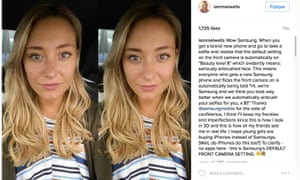
Mel Wells on Instagram


Mel Wells’s Samsung phone automatically doctored her selfies. Photograph: Instagram

Some phones now even do the work for you. In June, Instagram user Mel Wells blasted Samsung for automatically doctoring her selfies using its “beauty” setting. Forget the glamorous magazine offices of New York, Paris and London for a moment. Images of female perfection are being created by teenagers in the front room.


Last year the psychiatrist Dr Pippa Hugo warned that photo retouching by teenage girls was becoming the new normal. As many as nine out of 10 teenage girls in some schools would doctor themselves to appear thinner, she claimed – with disturbing psychological consequences.


Isabelle Whiteley, a photographer and researcher, has been travelling up and down the country interviewing girls between the ages of 13 and 18 for her project That’s What She Said. This is an endeavour that uses the girls’ own experiences to try to counteract damaging media narratives. It confirmed the prevalence of photo editing and doctoring among teenage girls.


“It would be more unusual for them to upload a completely undoctored picture to Instagram”, she told me, describing the practice as an “open secret”. Everyone does it, in other words, but no one admits to it.


The result is huge damage to the confidence of young women. Because now, not only are they comparing themselves with the models and actresses in magazines and on their screens, but with their peers – and, perhaps most distressingly, with themselves.


You create an online alter ego for yourself, and she is gorgeous and sexy and perfect, and what you think boys want. She adheres to whatever archetype is popular among your friendship group, school, class demographic – whether it’s the skinny supermodels of high fashion or the pneumatic, waist-trained hourglasses of the Kardashian clan. But then you see yourself in the mirror, and it’s just not good enough.


An image from the That’s What She Said project


‘‘It would be more unusual for them to upload a completely undoctored picture to Instagram,’ Whitely told me. Photograph: Isabelle Whiteley / That’s What She Said Project

Whiteley tells me the competitiveness, jealousy and bullying among girls interacting with one another online are out of control. Study after study shows that social media is harming the mental health of teenagers.


Some who grew up in a different time will dismiss this issue as pure and simple narcissism, but such an analysis fails to grasp the psychological complexities of the problem. Those of us who know what it is like to grow up in a culture with a value system that places your body above all else will know just how much energy this preoccupation expends – how it bleeds away at your ability to act in the real world, to achieve things.


And now it is worse than ever. These girls sit on their devices, entranced by a universe in which they feel as though they matter, and they are increasingly unreachable. There’s a meme going around called Me at 14, which highlights the widening gulf between even my generation – the first to live out our teens online, but still victims of the traditional photographic evidence of gawky awkwardness and poor fashion choices – and theirs, with their pouting, pornified poses, contouring and poreless skin.


In 2016 we’re beyond needing to teach girls about the artifice behind image manipulation. They know very well. But that doesn’t mean that they are immune to its effects, that they don’t desperately feel the need to change themselves as they compare their young bodies to those of supermodels.


Many put Victoria’s Secret models as their phone backgrounds as “thinspiration”. Whiteley tells me one teenage girl described the annual Victoria’s Secret fashion show as “hell every year” because of the impact of the coverage and social media discussion on her self-esteem.


I don’t know what the answer is. But I do know that this is a toxic development in the adolescent experience of young women. It’s unbelievably easy to doctor a photo. I do it to a photo of myself taken in the garden last month, and in under five minutes I am slimmer, browner, better.


I wouldn’t be a product of my environment if I didn’t think the “after” image trumped the “before”. The difference is, I would never post it claiming to truth; lots of younger girls would.


That daughter, sister, friend or niece of yours could be sitting over there in the corner on her phone cutting bits off herself with the precision of a surgeon, ruthlessly assessing her flaws with an eye more critical than the most selective model booker in New York City. And you’d never know.


Thinner, smoother, better: in the era of retouching, that’s what girls have to be | Rhiannon Lucy Cosslett

4 Ağustos 2016 Perşembe

It’s the summer holidays – and children need time outside | Rhiannon Lucy Cosslett

Is there any feeling on earth quite like that of a child on the first day of the summer holidays? The giddying sense of freedom and potential, after hours spent gazing longingly at browning grass and cloudless skies through classroom windows. At the beginning of the summer holidays, your gauzy days stretch out before you like chewing gum, waiting to be filled with adventure. If you were anything like me, most of them will have been spent outside; your life a procession of doing words: running, climbing, building (and wrecking), swimming, playing and paddling.


Related: Nearly one in four British children overweight or obese, claims study


The doing words of today’s children are somewhat different. There’s gaming, and sitting, and eating. Indeed, a report has found that children’s lazy summer holidays are responsible for wiping out children’s fitness levels. The study of 400 children in 14 schools found that fitness levels improved over the course of the academic year, only to be undone by the long summer holidays spent hunched over gadgets. In terms of physical activity, the bare minimum for children should be 60 minutes a day. This report indicates that children are failing to achieve even that.


Much of this can be blamed on the technology that was simply unavailable before now. As a society, we specialise in timewasting; another report released today found that we are now spending 25 hours a week on the internet, and most of that will be indoors. Many children I meet seem to have their time rigidly planned out in activity blocks – school, after-school activities, homework, bed – so slumping in front of a screen must seem like cosy respite in comparison. But you wonder if they’ll ever know the exquisite boredom of an empty summer day, where you’re booted out in the morning after your friends come to call, to return only at dusk when it’s time for tea?


While acknowledging the wonder of my summer holidays, I’m mindful of indulging in that blinkered editing that we are so prone to when reminiscing about our childhoods. The idealisation of Britain’s supposed golden days – which we are told were beacons of comfort, safety and liberty – has been an unpleasant undercurrent throughout the referendum debate and can be most adequately summed up in the peculiar form what I call “Daily Mail slum nostalgia”, wherein childhood suffering, whether through poverty, safeguarding failures or poor housing, is conveniently ignored.


A survey earlier this year found that three-quarters of children spend less time outside than US prison inmates


But we all indulge in the temptation to glorify bygone childhoods from time to time. I would read Enid Blyton’s Famous Five stories and marvel that these kids were allowed to ride bicycles freely across the whole of England, despite constantly bumping into dodgy blokes with criminal intentions. I was only allowed out from morning until twilight. Still, I realise how privileged that lifestyle was and, when I look back, it does have to be said that very few of my classmates were fat.


Britain’s childhood obesity epidemic renders children’s lazy summer holidays all the more concerning. 9.1% of children in year 6 (aged 10 to 11) are obese and a further 14.2% are overweight. Of children in reception (aged four to five), 9.1% are obese and another 12.8% are overweight. This means a third of 10- to 11-year-olds and over a fifth of four- to five-year-olds are overweight or obese, according to Public Health England. And this isn’t just about physical health; it’s estimated that in every school classroom in the UK, at least three children are suffering from a mental health issue. There’s no doubt that less time spent outdoors will likely compound this crisis.


A survey earlier this year found that three-quarters of children spend less time outside than US prison inmates. The National Trust has long spoken of “nature deficit disorder” as screen time increases and the so-called “radius of activity” shrinks (the area around a child’s home where they are allowed to roam unsupervised has shrunk by over 90% since 1970). There is a mental health epidemic in adults that stems partly from the health system’s failure to adequately deal with issues in childhood. We are constantly being hawked mindfulness apps and techniques as a way of supposedly dealing with this.


Why? Because many of us have forgotten how to exist in the moment, as this sad news about school breaks demonstrates. There is no one more mindful than a child on their summer holidays, when the return to school is a distant concept. In the moment, all that matters is the rock pool you’re in, the squidge of sand between your toes, the crumble of bark beneath your fingernails, the echoing bounce of the ball on tarmac or the brittle crackle of the bracken you’re tunnelling in. Are you ever more connected with your senses that when you are in nature? Even if that nature is a patch of grass at the end of your street, in your imagination it can become a jungle.


I’m not saying that kicking children out of the house each summer will solve a public health crisis that is the result of a complex combination of factors, or that my childhood was flawless. But I can say that I spent much of it doing what our bodies have evolved to do: moving. And I’m all the better for it.


It’s the summer holidays – and children need time outside | Rhiannon Lucy Cosslett

25 Temmuz 2016 Pazartesi

Turning back the biological clock comes at a price | Rhiannon Lucy Cosslett

The astute woman of child-bearing age develops a facility to tune out of alarmist headlines about the biological clock. But every now and again an expert comes along and offers the kind of soundbite that cuts through. The latest came courtesy of Gillian Lockwood, medical director of Midland Fertility Clinic, who last month said: “It may not be true that women should be having babies at the time of GCSEs, but they shouldn’t leave it much later than graduation. Age 25 is exactly the time when today’s young women have left university, are trying to get off on a good career, trying to find someone who wants to have babies with them, and trying to get on the housing ladder.”


Twenty-five? In a supportive society, women keen to conceive in their mid-twenties might find it realistic to do so. But not in the current climate, where the financial crisis, spiralling property prices, unstable employment, austerity and low pay have combined to trap many members of Generation Y in perpetual financial adolescence.


Millennials talk to their parents about drugs, sex and jobs

Last year I interviewed people in their twenties up and down the UK who desperately wanted children but felt their situation was too precarious. Many were living in rented accommodation or with their parents, faced low pay, unemployment or insecure work, and felt they had no chance of getting on the property ladder anytime soon. They are, essentially, priced out of parenthood.


It’s a depressing state of affairs that has left some wondering whether reproductive technologies might be the answer. What if you could freeze your eggs and put having a baby literally on ice until things were looking a tad more grown up?


In the US, the marketing of egg freezing as a kind of insurance policy for millennials is already in full swing. Facebook, Apple, and the US military now offer egg freezing as an employee benefit. Fertility company EggBanxx estimates that by 2018, 76,000 women will have frozen their eggs. EggBanxx, which describes itself as “Uber, but for egg freezing”, has slogans including “Smart women freeze” and “Lean in, but freeze first!” and throws “Let’s chill” events aimed at young women. Could the UK soon follow suit, as more and more women put off the decision to have children? Inquiries into egg freezing at private clinics in Britain reportedly surged by 400% between 2014 and 2015, and more than half of these came from women under-35.


In the US, the marketing of egg freezing is in full swing. Facebook and Apple now offer it as an employee benefit


Mehrunissa, 23, plans to freeze her eggs in the next two years. “Ambitious, career-driven women often find it difficult to settle down – in terms of finding suitable partners,” she says. “Other women, who feel more of a time pressure to have kids, feel like they’re in a desperate situation where they need to find a man and settle as soon as possible, so freezing your eggs makes you immune to that sort of pressure, and also puts you in absolute control of your life. I envisage that when I do decide to have kids it’ll be for the right reasons rather than a feeling of desperation or losing a battle against time.”


She seems far too young to be thinking about such an extreme course of action but then again, the younger a woman is when she freezes her eggs, the better the chances are of conception. Not that there are any guarantees, and it can very costly – at least £5,000 in some London clinics; the more cycles you invest in, the better is your chance of conceiving. As for Mehrunissa’s aim of being in “absolute control”, when it comes to fertility, there is no such thing. But in a world in which young people lack stability it isn’t hard to understand why the illusion of it can be seductive.


“Social circumstances have delayed a lot of things. It’s not just about not having children younger but about not having a job, or a stable career younger, or not having a home,” explains Angel Petropanagos, a research associate in impact ethics at Dalhousie University in Canada, who spoke at a recent debate in the UK organised by the Progress Educational Trust, asking “Can you put motherhood on ice?”


“There is all this financial and social instability that has contributed to delayed parenting,” Petropanagos continues, but “one of the challenges is that in the US, egg freezing is really targeting a particular demographic with their advertising … upper middle-class women who are already privileged. These are the kind of women whose parents and grandparents are paying for egg freezing as a graduation present.”


Related: I had my eggs frozen. I wish someone had told me how difficult it was | Eleanor Morgan


And this is one of the major problems with egg freezing: that it is being portrayed as an option available for all women to delay motherhood, regardless of their income, when in reality, the costs are prohibitive to many, especially younger women. But because the clinics are arguing that your twenties are what Petropanagos calls the reproductive “sweet spot” when your eggs are more likely to yield results, young women are buying into the dream.


Sarah Martins Da Silva, a consultant gynaecologist based in Dundee, points out that “social egg freezing is a personal choice, but you could argue that it actually discriminates against this [younger] demographic as egg freezing needs to be self-funded, and costs several thousand pounds.” She refers to a report by the Centre for Population Change which details how womenwho remain childless largely do so because they have never wanted children, or because they simply haven’t met the right person yet. “On that basis, I would say the target market is the 30 to 35-year-old career woman who has not met Mr Right, who recognises that they are at risk of fertility problems as they get older, and who wants to preserve better quality eggs and an option to use them in future fertility treatment.”


At 34, Natalie (not her real name) could be said to fit into that category. “I’m still very much living that ‘young professional in London’ lifestyle,” she says. “Although I am in my thirties I don’t feel stable enough in myself [to have children]. I part-own a house and earn a decent wage, but freezing my eggs just seems like it could potentially buy me some time. It’s pricey, though, which is why it’s still only a consideration.”


In the UK, young women are not yet being aggressively targeted by clinics offering egg freezing. But as it takes longer for them to get on the career and housing ladders, you do wonder how many others will soon be faced with the same choice, and how companies will take advantage of that anxiety. If egg freezing is hawked as a sort of “wonder solution”, it is surely only a matter of time.


Related: London hits record low for new affordable housing, figures show


The danger is that the overwhelming focus of this will be on the individual reproductive choices of wealthier women, when instead we should be addressing the social structures preventing young women on lower incomes settling down sooner and having children earlier. Lack of affordable housing and maternity and paternity pay, along with (in)flexible or unreliable employment and prohibitively expensive childcare are all factors in our reproductive choices. It would do all women an injustice to neglect to challenge these barriers because of egg-freezing technology’s seemingly miraculous allure.


Turning back the biological clock comes at a price | Rhiannon Lucy Cosslett

19 Ağustos 2015 Çarşamba

Benefit sanctions ruin lives. No wonder the DWP turned to fiction | Rhiannon Lucy Cosslett

It is inspiring what obtaining your rewards cut will do for your function ethic. Just ask the gormless Sarah, who – bless – did not consider a CV would assist her locate operate and missed a meeting with her operate coach back in March. Thankfully she pulled up her socks and updated her resume. “My advantage is back to typical now and I’m genuinely pleased with how my CV seems,” Sarah grins as she appears more than a personal computer screen into the camera, stopping just short of a tap-dancing “gee, thanks, Mr Duncan Smith” in the manner of a young Shirley Temple. Another benefit-sanctions accomplishment story, you may possibly feel. The only issue is that Sarah doesn’t exist.


Connected: DWP admits inventing quotes from fake ‘benefits claimants’ for sanctions leaflet


This week, following a freedom of information request courtesy of Welfare Weekly, the Department for Perform and Pensions (DWP) admitted that Sarah, along with fellow benefit claimant Zac (who presented up a heartwarming tale of notifying the jobcentre of his hospital appointment in advance, thus safeguarding his claim) were only utilised in their promotional supplies “for illustrative purposes”.


Their mugshots, meanwhile, are stock pictures. Naturally, there is no suggestion anyplace on the leaflet – which has mysteriously disappeared from the DWP internet site but has been downloaded by Welfare Weekly – that these claimants are fictional.


It is difficult not to see a twisted comic darkness in this. The optimistic spin is so firmly rooted in the realms of fantasy as to be ludicrous, and follows an incident last yr where the department was accused of planting fake tweets praising the a lot-maligned universal credit score measures, though it denied this.


Twitter end users are mocking the DWP’s newest misstep with the inevitable hashtag #fakedwpstories (“since the jobcentre sanctioned me I only eat caviar” “I conserve so much on trousers now all that funds isn’t burning holes in my pockets”), and rightly so. The fake leaflet personae signify a surreal contrast to the real effect that positive aspects sanctions can have on individuals in austerity Britain.


Tales abound from claimants who have been sanctioned for a assortment of bizarre and trivial reasons, this kind of as failing to apply for a work that had expired, or missing a jobcentre appointment that clashed with a perform programme interview. There have been punishments that are shocking in their heartlessness: it could be a funeral, a stillbirth, a heart assault, a premature labour that leads to you to miss your signing-on appointment: challenging. No excuses.


Other claimants describe a type of bureaucratic, Kafkaesque nightmare, a dystopian labyrinth that appears deliberately designed to catch you out. Just inquire the man whose dole queue was so extended that he was late for his appointment, or the 1 who failed to attend his simply because he was at a occupation interview. Each were sanctioned.


This certain DWP cock-up represents an omnishambles worthy of The Thick of It, but there is also, to borrow the phrases of Mark Serwotka, the standard secretary of the Public and Industrial Services union (PCS), one thing “disgraceful and sinister” about trying to trick individuals into believing in the benevolent chastisement of the state. In contrast to the deprivation and destitution that can outcome from sanctioning, the fictional Zac and Sarah, with their beatific expressions beaming out from leaflets, are eerily chipper. Back in the true planet, sanctioned benefits claimants are currently being forced into homelessness and resorting to food banks. There have been suicides. Final week, a famished female whose rewards had been stopped was prosecuted and fined much more than £300 for stealing a 75p pack of Mars Bars. Actuality is not really panning out the way the Conservatives intended.


The reality that the government is having to concoct “positive” tales about the sanctions system for propaganda functions suggests that there is a paucity of claimants out there keen to dispense glowing feedback on their experiences, to put it mildly. The “new regime” (the government’s phrase) was introduced in October 2012, and has by no means been a good results in terms of PR, operating as it does on what my colleague Patrick Butler refers to as a “sanction now, investigate later” rationale. Beneath the government’s “hard line” method, nearly 1 million jobseeker’s allowance claimants had been sanctioned in 2014, however there are doubts as to the sanctions’ effectiveness in helping individuals find function. The function and pensions select committee said that the government had not presented evidence that the program was not “purely punitive”. Furthermore, more evidence advised that sanctions led to poorer top quality, short-term or unstable employment.


If a funeral, stillbirth or heart assault causes you to miss your signing-on appointment: difficult. No excuses.


Then there are the jobcentre whistleblowers, who in January uncovered the existence of “hit squads” that set claimants up to fail in the pursuit of staff performance targets. There had been reports of staff focusing on the a lot more vulnerable jobseekers, reserving appointments without having informing the claimant, and currently being threatened with disciplinary accessibility if they didn’t refer sufficient individuals for sanction. With damning reviews this kind of as these, the temptation to coat the cruelty in a shiny gloss need to be huge.


What can we learn from the story of Zac and Sarah, the ragged orphans upon whom the benevolent fairy godmother of the DWP bestowed their enchanted kindness? That the government regards individuals on benefits as so “other” that it has no qualms about making use of fictional characters as stand-ins? Surely those who dismissed the evaluation that the Conservatives are engaging in an ideological assault on the vulnerable and disadvantaged will be difficult pushed to argue towards it, when it’s their wheel that is spinning the fairytales.


In addition, request by yourself: what exposes the presence of an ideology much more obviously than the dogged pursuit of it in the face of all contradictory proof? A flawed and cruel agenda, innovative with blinkered indifference, underpinned by an unmoving belief technique that casts its heroes and its villains as simplistically as a child’s bedtime story. If it feels creepy to you, that’s because it is. And the narrative continues regardless of its dishonesty. A sunlit street is superimposed more than the grey deprivation. An expressionless, robotic Zac and Sarah are waiting for you there. “Welcome to the new regime,” they say. “We hope you take pleasure in your stay.”


Benefit sanctions ruin lives. No wonder the DWP turned to fiction | Rhiannon Lucy Cosslett

6 Temmuz 2014 Pazar

We are failing our frightened young children, leaving them with no a single to speak to| Rhiannon Lucy Cosslett

Child head ache

‘One in seven councils in England have been deemed by Ofsted to be failing vulnerable youngsters.’ Photograph: Alamy


What do you do if, aged twelve, you discover your self feeling hopeless and terrified of the planet around you? To whom do you flip? Melvyn Bragg has uncovered that his struggle with depression started at this age. “I had clinical depression but I did not know who to speak to,” he explained. “I never think anybody who has not been through depression is aware of what it truly is like to be frightened out of your thoughts each and every day from the second you wake up to the moment you go to rest.”


A kid with such feelings is clearly in need of urgent support from grownups, but for many, all these years soon after Bragg 1st struggled, help is still not forthcoming. These who operate with youngsters know this, and have been calling urgently for an overhaul of psychological overall health providers. The charity Children Business has launched a campaign referred to as “See the little one. Change the program”, supported by some of Britain’s foremost children’s authors – they are shocked that a single in 7 councils in England have been deemed by Ofsted to be failing vulnerable children. The mental health charity Young Minds is also campaigning, following a freedom of data request that revealed sweeping freezes and cuts to mental overall health service budgets for children and youngsters.


Voices are rising, but whether politicians will pay attention is an additional matter. Children Business founder, Camila Batmanghelidjh, has explained vulnerable young children are “relegated to the bottom of the political pile”, and social staff describe getting unable to supply adequate assistance due to cuts. Childline stated that reviews in self-harm in 2013 had risen by 41% from 2012, even though reviews of suicidal ideas increased by 33%.


Media retailers are quick to blame social media for the deterioration in children’s mental health – an effortless, practical scapegoat. There has been a amount of broadly reported suicides of shockingly youthful children who had been bullied online, foremost to rampant speculation. But no matter what the perceived causes, we know that to leave a vulnerable kid unassisted can lead to the really worst of outcomes. If the youngster survives their formative many years with no appropriate help, they can be left to struggle with mental health issues all through adulthood.


Given the dearth of providers, youngsters and households come up with other coping mechanisms. Lately, whilst getting a clear-out, I came across a small yellow box inside of which have been five worry dolls. Originating in Guatemala, be concerned dolls are vessels for a child’s nervousness – the child talks to them, tells them their fears, then spots them below their pillow. It struck me that I had spent my childhood surrounding myself with talismans in an energy to fight the reality I was scared and anxious all the time. There had been dream catchers to cease the nightmares, comfort blankets cuddled way previous the acceptable age, a present of worry beads (there was a lot of fear) in an try to get me to quit selecting at my skin compulsively until finally it bled.


Twelve was the worst year. My mother and father split up, I was being viciously bullied, and it was turning into clear that my brother, then 6, was so severely disabled he would never ever lead a normal daily life. My mum tried several times to get me counselling, and even though our household was acknowledged to social providers the waiting listing was limitless. I’m most likely nevertheless on it.


I resorted to books, angry music and writing horrible poetry Melvyn Bragg buried himself in schoolwork. Other folks use medication or alcohol. None of these is adequate. In hindsight, I realise I talked a lot more to people fear dolls than I ever did to an grownup, and that is what it all boils down to. The country’s grownups are failing kids – children far worse off than I ever was – and unless we do one thing now, we will proceed to allow them down.


We are failing our frightened young children, leaving them with no a single to speak to| Rhiannon Lucy Cosslett

23 Haziran 2014 Pazartesi

Banning these born after 2000 from smoking wouldn"t have worked on me | Rhiannon Lucy Cosslett

Teenage girls smoking

‘Giving up smoking is difficult, but there is tiny use in telling youthful individuals just how challenging. Right up until you are in the grips of it, the strength of your addiction is tough to envisage.’ Photograph: Alamy


I started out creating this report getting run out of cigarettes. Up right up until about 5 minutes ago, the last cigarette I had was at about 7pm last night, a Silk Lower blue given to me by my grandma “for the street”. But then the Guardian asked me to publish about smoking, and, right after glancing about the flat for my e-cig charger, I convinced myself that I couldn’t write this with out smoking, and dispatched myself to Budgens. Pathetic.


Medical doctors will tomorrow vote on whether or not to push for a long lasting ban on the sale of cigarettes to these born right after the year 2000 in an try to safeguard the up coming generation of youngsters from what I will freely admit is a disgusting, unhealthy and financially ruinous habit. It was also uncovered this week that menthol cigarettes, the kind I am presently smoking in an try to fool myself that they never genuinely count, are much more addictive and lead to teenage menthol smokers smoking twice as significantly.


But is a ban actually the resolution? Background has taught us that prohibition is hardly a successful measure for combating addiction and, furthermore, these born in 2000 are 14 many years outdated. Is it not a bit too late? Will not some have commenced previously, and as a result just harangue their buddies for duty free fags each time they go abroad, or get them from individuals outlets that promote them cheaply, below the counter?


Furthermore, the ban fails to account for the way dad and mom and grandparents allow the habits of the younger generation, either by acquiring or giving them cigarettes, or by the part they play in social interactions. I would not consider back the hours I spent at my late grandfather’s kitchen table chain smoking and listening to his stories about the war, or the conspiratorial rollie I have with my dad outdoors every single household gathering. To an extent, smoking has enriched these relationships. I realise how incorrect that will sound to non-smokers, but this is how some households are.


Saying that, I wouldn’t want the self-loathing and guilt that addiction to smoking brings on anybody. I was 18 and residing in Paris when I started out smoking – this kind of a cliche. I will not know why I began. A guy I was kicking all around with left a pack of Phillip Morris in my bedroom and a single day I smoked them, almost certainly even though sporting a kimono and listening to Edith Piaf. Becoming in France did not support. I worked with a waitress named Fanny who chain-smoked Gauloises even when delivering plates to people’s tables. Following a wellness scare, I decided to quit. That was two years ago.


Because then, I have experimented with many techniques. I have completed the patches, which didn’t function, and the Champix (a pill that gradually helps make you really feel sick as you smoke, until finally you can no longer do so) which did perform, at least temporarily, however the nurse failed to observe my historical past of depression and I invested two weeks in such an awful pit of misery that I believed I would never smile yet again. I have study Zeno’s Conscience, by Italo Svevo – an complete novel about the struggle to give up smoking – and most of Allen Carr’s The Effortless Way to End Smoking (I stopped studying at the bit where you’re supposed to give up).


I have attempted providing up consuming at the very same time, which to be honest, did genuinely assist, till my close friends got fed up of getting asked to meet up “for coffee” or “for sushi” or “for frozen yoghurt”. I have attempted the magic e-cigs, hailed by several as the resolution, but discovered that they just manufactured me crave nicotine more rabidly than before. I have not but tried my mother’s “patented Cosslett approach”, which is to buy two cans of Specific Brew and a ten-pack of Silk Cut every single 10 days, make a evening of it, and then come to feel so horrible that you depart it just a little bit longer until the next time. In in between binges, you cry anytime you want a fag.


At four.45 this evening, I will pay a visit to the nurse and attempt once more.


Providing up smoking is tough, but there is minor use in telling youthful folks just how challenging – until you’re in the grips of it, the power of your addiction is challenging to envisage. When my boyfriend informed me that most folks who attempt to give up will by no means be successful, I felt a profound sense of terror. I do not want my dad to die. I do not want this to be the thing that kills me, and yet there is a higher possibility that it will.


I do not want youthful folks to start off smoking. Like a lot of smokers, I wish I had never started out. Like many smokers, I really feel embarrassed by it, but this is countered with the tiny niggling feeling that smoking is awesome and rebellious. I am ashamed to admit that I still come to feel this, in spite of the smoking ban, in spite of the elimination of cigarette marketing, regardless of the escalating absence of smokers from tv programmes and vogue shoots. But display me a image of Brigitte Bardot with a fag in her mouth and my brain will consider: “Yeah, that’s attractive.”


I fear that banning it for teenagers may possibly emphasise this issue. Also, the not purchasing does not suggest not smoking. I didn’t acquire for six months I just bummed off other folks in the Guardian creating. I wish I could feel of a public wellness initiative that would assist resolve this difficulty, but I can’t. And yet, I do not want anyone to end up like me. I smoked 3 cigarettes even though creating this article, and right after I file it, I will smoke one more.


Banning these born after 2000 from smoking wouldn"t have worked on me | Rhiannon Lucy Cosslett

13 Haziran 2014 Cuma

No wonder so several females are having abortions in their 20s | Rhiannon Lucy Cosslett

A woman holding a morning-after pill

‘It’s controversial, but I would like to see the morning-after pill offered to bulk get from pharmacies.’ Photograph: Linda Nylind for the Guardian


New Department of Well being statistics have located that mothers are more likely to have abortions than teens pregnant for the very first time, with 53% of the girls who had abortions final yr previously obtaining a child.


The figures demonstrate that 185,331 abortions had been carried out last yr in England and Wales, a rise in line with population enhance. But all round, the price has dropped given that 2003 to 15.9 abortions in one,000.


The most significant drop in abortion rates (a third) was amongst below-18s, even though in my personal age group (25-29) so-named career-girl abortions – not a phrase I will be making use of until “profession man” becomes widespread parlance – have risen twenty% in the past ten many years.


Considering the economic downturn, the rise in abortions amongst my generation makes sense. I barely know anybody who is in a monetary position to help a baby, what with lease increases and spend freezes and widespread unemployment. In a climate in which so a lot of are frightened for their jobs, I’d envision younger ladies are unsure as to what taking maternity leave may mean for their careers in the prolonged run. That’s if they get maternity leave, of program – we freelancers are in an even far more precarious position.


Financial constraints are affecting older women, as well. Households are struggling to make ends meet, and might be unable to afford an additional kid. We also know that the quantity of more than-40s obtaining unprotected sex is rising – partly simply because of divorce and new relationships (even Guardian Soulmates might play a element) but also because, in terms of contraception, they are a much neglected group. Girls will assume they are no longer fertile, or baby boomers may not have utilized contraception the first time round (“It was pre-Aids, darling,” my mom when stated to me). Consequently the Family members Organizing Association campaign of a few years back showcasing ugly 1970s outfits with the tagline: “Don’t forget wearing this? Then keep in mind to dress in this,” with a image of a condom.


That the charge among youngsters has dropped can be seen only as excellent information, reflecting the emphasis that has been positioned on teenage pregnancy more than the past ten years, with schools and sexual wellness charities bombarding teens with contraception. Which is a massive change from my own time at school, when data was difficult to get hold of and the problem rarely talked about.


I always felt that the media hysteria in excess of 13-year-olds being presented the pill was misplaced. Put them all on it, for all I care, because we know it performs, just as we know that decent sex schooling won’t turn 8E into a class of shaggers overnight.


However, I wonder how a lot the rise in abortions taking place in women’s mid-to-late 20s is as relevant to bad accessibility to contraception as it is monetary constraints.


Several close friends have been turned away from Brook clinics right after reaching the cutoff age of 25, and very rightly so. But the gap in services is not being adequately bridged, particularly when you happen to be trying to get an appointment out of doing work hrs. You can get the contraceptive pill with no seeing a doctor by way of Lloyds Pharmacy by filling in a quick questionnaire on the internet and then going to choose it up on the very same day, but a lot of folks are unaware of this. Accessibility to the morning-after pill remains patchy – to receive it for free, you may have to attend a clinic that is miles away. And pharmacists have the appropriate to refuse you services – especially problematic if it’s Sunday and you dwell in a rural spot.


In addition, the frankly scandalous price tag, of £25 (it costs about €7 – £5.60 – in France in excess of the counter) is prohibitive for many who may be unable to attain a free of charge clinic or doctor’s surgical treatment in time.


It’s controversial, but I would like to see the morning-following pill obtainable to bulk-get from pharmacies. At the second, you can purchase it for instant or potential use on the internet (most spots charge £25 but I identified one particular spot that costs £6.50 a pill – duly bookmarked). Worryingly, although, the questionnaires are often not that thorough, and most locations will let you have no more than two at a time.


There is also the 5-day-after pill, EllaOne – a drug barely anyone I know has heard of – that is offered on prescription and, in some places, over the counter.


But I would like to see women of all ages currently being greater informed about their contraceptive choices – there is even now a good deal of stigma and misinformation out there. Let’s make certain that the target on teens doesn’t detract from the require for better contraception services for older ladies.


No wonder so several females are having abortions in their 20s | Rhiannon Lucy Cosslett

18 Mart 2014 Salı

Sophie Jones"s death is tragic but smear tests for teens are not the answer | Rhiannon Lucy Cosslett

Young women chatting

‘A 2009 research published in the BMJ located no proof that screening ladies aged 20-24 diminished the incidence of cervical cancer at age 25-29.’ Photograph: Alamy


The household of a young lady who was denied a smear test and tragically died of cervical cancer are campaigning to reduced the cervical screening age to 16 (it is currently 25 in England). At the last count the petition had far more than 130,000 signatures.


Sophie Jones was 19 and died completely unnecessarily. She had been suffering from serious stomach pains for months and, on going to the medical professional, had asked for a smear test but been refused simply because of her age. Cervical cancer was diagnosed in November and she died on Saturday. A smear check could have saved her existence. Nonetheless, lowering the cervical screening age to sixteen is a horrible idea and I urge you not to indicator the petition.


Every single now and once more, a young lady dies from cervical cancer and as a result campaigners will get in touch with on the government to lower the age at which cervical screening commences. Their anger that the cancer of their loved 1 went undiagnosed is totally understandable, specifically when, as in Sophie’s case, the patient has presented with signs and symptoms which could indicate cervical cancer. Sophie’s signs meant she ought to have been granted a smear check, but that isn’t going to indicate that all the other women her age should be. Smear exams are not, we overlook, strictly tests at all. Their function is not to diagnose cervical cancer but to try out and avert cancer from creating. This danger is gleaned from cell modifications on the cervix. If you are below the age of 25, the modifications are so great that testing gets to be relatively pointless. 1 in three ladies below the age of 25 will have an abnormal outcome (in contrast to one particular in 14 for ladies in excess of 25). It has been located once more and once more that 25 is the tipping stage at which the advantages of cervical screening outweigh the hazards. This is why the age need to not be lowered – the variety of false positives could lead to numerous younger females currently being referred for agonizing treatment method unnecessarily.


I had an abnormal smear when I was less than 1 month past my 25th birthday, and I can testify that the therapy is painful. With out wanting to go into also considerably detail, think about becoming scraped out with an electrically charged spoon. The radio was taking part in even though they did it. If I did not detest Coldplay then, I surely do now.


Certainly when I received the letter I imagined I had cancer. I did not realise that most cell alterations are standard and that possessing a pesky fluctuating cervix does not imply that you are going to die. Even though I am glad I had a smear check, I am mindful that had I taken it a month earlier, in all probability they would have sent me away. It was not a pleasant knowledge and it did, to an extent, traumatise me. It’s certainly not one thing I would wish unnecessarily on a teenage woman.


The a lot more you commence talking about your abnormal smear, the more you hear the phrases “yeah, me also”. I have lost count of the quantity of ladies who have informed me their stories. Most didn’t have cancer and didn’t even need to have treatment. Lowering the age would indicate a lot of a lot more “me toos”.


There is a school of thought which argues that females shouldn’t have smear exams at all. I do not subscribe to that but studies have shown that the bulk do not have any benefit. The likelihood of getting an abnormal end result is significantly greater than the probability that you’ll get cancer, but for the small proportion of women who do go on to produce cancer, a smear is vital.


Thus far, health-related proof does not recommend a need to lower the age for cervical screening. A 2009 examine published in the BMJ identified no proof that screening girls aged twenty-24 lowered the incidence of cervical cancer at age 25-29. In other words, cervical screening at this age has small or no affect on charges of invasive cancer up to the age of 30.


It’s straightforward to get swept up in the emotion of a campaign this kind of as that of Sophie’s family members – her death was preventable and her physician failed her. But, as with numerous factors, education and bettering entry holds the important. Females need to have to be taught not to panic so a lot when they get an abnormal end result and to recognise signs and symptoms – it is a scandal that we are this unwell-informed about our very own bodies. Physicians need to be reminded how to react when young individuals present indications of the illness, and we need to be producing sure that teenagers are receiving all three HPV jabs, particularly people from non-white ethnic groups. Creating sure these measures are taken would be a fitting tribute to Sophie.


Sophie Jones"s death is tragic but smear tests for teens are not the answer | Rhiannon Lucy Cosslett

27 Şubat 2014 Perşembe

Gentlemen, your sperm is under attack – but will not panic | Rhiannon Lucy Cosslett

“If you want wholesome offspring, will not leave fatherhood also late”: if you had been getting ungenerous, you may possibly say such headlines make a wonderful change. The existence of a male biological clock, and its ceaseless tick-tocking, is a “cause for concern” that has been cropping up on and off for many years now. Nonetheless, this is the 1st time I feel I have witnessed it framed in this kind of a “female” way, and, as we are generally the ones being told not to “leave it also late”, I have to admit that I practically cackled (younger girls have delicate, tinkling laughs, but feminists cackle, naturally).


It is challenging not to see irony in the news that males are now becoming advised to freeze their sperm. Although the thought of men getting bombarded by content articles about the functionality of their nutsacks, and currently being accosted at bus stops by armchair fertility specialists interrogating them about their reproductive histories, could provoke a tickle of schadenfreude, it really is truly no laughing matter. A study has identified that older fathers are far more very likely to have young children with psychiatric issues and learning disabilities this kind of as autism and ADHD it really does appear that sperm has a sell-by date. A kid born to a 45-year-old father is, according to the examine, 3.five occasions more probably to have autism, two.5 times more very likely to have ADHD, and 25 occasions more very likely to have biopolar disorder than a youngster born to a 24-12 months-old guy.


As typical readers of my stuff will know, autism has (to place it mildly) manifested itself somewhat within my family members, so I tend to take such findings seriously. I have, as a end result of my overpowering reliance on pseudo-sciencey magazine articles or blog posts, a slight fear of what may well take place should I delay factors extended enough to turn into what is charmingly dubbed an “elderly mom”. Nonetheless, I do not see the prospect of men turning out to be as frightened as I have been about their fertility as any wonderful phase towards equality. Most folks instinctively know that it is much better from a biological viewpoint to have young children when they are youthful, but from a lifestyle point of view? Maybe not. Figures released right now demonstrate that British house ownership is at a new minimal, with individuals under 35 renting a lot more than ever ahead of – half of all personal rented households, in reality, are occupied by this age group. Of course, you don’t want to be a homeowner to raise a child, but aspects this kind of as the expense of living crisis can be a more powerful barrier to conception than a steel diaphragm.


But gentlemen, I would not panic nevertheless. As with all studies, there is area for doubt. My tips would be to make like a lady and get all these findings with a pinch of salt. Following all, we discovered out last summer that the regularly parroted statistic that one particular in 3 girls aged 35 to 39 will not be pregnant right after a 12 months of attempting, was actually based mostly on French birth records from 1670 to 1830 (they weren’t half barren, people historical French peasants). This, as the Atlantic dryly noted, meant “millions of females are being advised when to get pregnant based mostly on statistics from a time just before electricity, antibiotics, or fertility treatment.” Let’s add cake to that checklist, and type a chorus. Do you hear the people sing? Singing the song of angry females?


On the other hand, becoming as it is that your review looks to be based mostly on pretty much everybody in Sweden, I would not ignore the final results, either. It might be time to brush up your 5-12 months plan, reduced your alcohol intake and end resting that Macbook atop your balls. All the ideal of luck – I hear evening primrose oil assists.


Gentlemen, your sperm is under attack – but will not panic | Rhiannon Lucy Cosslett

9 Ocak 2014 Perşembe

Five techniques to curb your web use and get your lifestyle back | Rhiannon Lucy Cosslett

It wasn’t until I started working that my internet use started to spiral out of control.

‘It wasn’t right up until I started out doing work that my world wide web use commenced to spiral out of control.’ Photograph: Piotr Pawinski/Alamy


A study has unveiled that people who are effective in their careers are more likely to be engaging in compulsive net use, and are at rising risk of anxiety, depression and isolation as they obsessively log in in out-of-workplace hrs.


The results came as a shock to the researchers, who assumed it would be younger folks and the unemployed who have been most at threat from internet addiction. As a teenager, I would remain up chatting on msn or updating my teenopendiary with terrible poetry and homemade gifs until finally the early hours, although when I was on the dole I would be consistently refreshing my inbox in the hope that someone, anyone, would throw me a bone.


It wasn’t, however, right up until I started functioning that my internet use began to spiral out of control. The phrase “come to bed” will be acquainted to net addicts all over the place, whether or not employed or not, but the want to be consistently plugged into the information took my addiction to an additional degree, and I only just look to have got a hold on it (however my darling boyfriend may possibly disagree). Here are my 5 leading guidelines to sustain a healthy on the web daily life. I am now in recovery. Maybe quickly you will be also.


one. Schedule your internet time


It sounds deeply dull, I know, but except if I’m on a quite critical deadline, I now force myself to switch off at five.45pm, which is when my companion will get in from work. Generating positive there is a clear division among work time and residence time, I realised, is the only way I would be capable to maintain our relationship. If the only time your loved ones see your gorgeous encounter is when it truly is basked in the glow of a screen, this might be 1 to consider.


two. Accept that not every single e-mail can be answered


A simple tip, but a revelation to me. Backed-up emails can be a terrifying prospect, but as soon as you accept that it truly is extremely hard to dwell a wholesome daily life at the identical time as answering every single and every a single, a surprising volume of time frees up. As a seasoned procrastinator, I’ve produced a minor e-mail label referred to as “to reply”, for those messages which demand eventual action on my part. Stated action may be slow, but it acts as a reassuring comfort blanket.


3. Disable unnecessary notifications


The first thing I did when striving to minimize down on my web use was to make confident it was unable to encroach on my day-to-day existence in the genuine planet via the medium of iPhone notifications. In other phrases, I ended the approach by which Facebook updates, tweets and emails would come right to my mobile. This was partly to avoid tweets accusing me of being a rubbish feminist/crap journalist/appalling human from harshing my buzz when I was possessing cocktails, but it can also be employed for operate functions. Anyone who needs to contact you urgently, for specialist causes, will almost certainly have your mobile phone quantity anyway. The same goes for pals and relations.


4. Go for a walk


A piece of tips from my mom, in the kind of “make certain that you get out of the property each day”, but it can also apply to individuals in a work atmosphere, or individuals who are embroiled in a especially vehement political debate in the comment section. If you are ready to, obtaining a bit of fresh air helps you realise that the outdoors globe even now exists prior to you return to your pursuits with a renewed vigour (or, in the case of on-line arguments, 10 much more rebuttals that you believed of on the way to Budgens). If you can not get away, get a nap subsequent to the radiators in the staff space, disappear to the loos for a time longer than is polite, or have a cup of tea.


5. Don’t forget: it really is only the web


It really does not matter that a lot. It sounds cheesy, but spending time with folks who care about you and make you howl with laughter is the best antidote to web addiction. It truly is hard to consider items like social media significantly when friends are texting you going “lol at your twitter storm – pub?” Logging in slips even more down your priority checklist as you realise that your absence does not imply the planet will quit turning. I just lately took a month-long hiatus from blogging and Twitter, and when I returned, all was much the identical. It was that, or smash up the router – and it worked.


Five techniques to curb your web use and get your lifestyle back | Rhiannon Lucy Cosslett