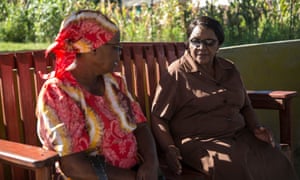
The therapy room is a patch of waste ground, and the therapist’s couch a wooden bench under a tree. The therapist is an elderly Zimbabwean woman, in a long brown dress and headscarf.
Her patients call her “Grandmother” when they come along to sit on her bench and discuss their feelings, their depression or other mental health issues.
Outside a clinic in Highfield, a poor suburb just south of Zimbabwe’s capital Harare, there are lots of grandmothers – trained but unqualified health workers – who take turns on the park bench to hear stories. They listen to the battered wife who has attempted suicide twice, the man who hates women after he became infected with HIV, the unemployed single mother driven to despair by the struggle of raising four children.
The benches are a safe place for people struggling with depression, which in the Shona language is called kufungisisa, “thinking too much”.
It is a world away from conventional approaches to mental healthcare, but the Friendship Bench project has changed the lives of an estimated 27,000 Zimbabweans suffering from depression and other mental disorders.
The grandmothers, all of whom are trained to improve a patient’s ability to cope with mental stress, listen and nod, offering only an occasional word of encouragement.
One in four Zimbabweans suffers from some form of mental illness, but there are only 13 psychiatrists in a country of about 15.6 million. A solution had to be found, and it came in the way of a bench and the tradition of respect for African matriarchs.
Clinics screen their visitors for mental illness through a locally developed tool called the Shona Symptom Questionnaire. It has 14 questions, such as “Have you been struggling to sleep?” and “Have you been worrying too much?”
Patients scoring above the cut-off level are referred to the friendship bench. Those who go to the grandmothers are five times less likely to have suicidal thoughts, according to Dr Dixon Chibanda, co-founder of the scheme.
“When they first get to the bench, we use an intervention which we call kuvhura pfungwa [opening of the mind]. They sit and talk about their problems. Through that process, the grandmothers enable that patient to select a specific problem to focus on, and they help them through it,” he says.
Through at least six one-on-one sessions with the health workers, the patients are encouraged to speak about their problems and their mental illness.
Traditionally, elderly women play the role of counsellor for younger members of the community. On the bench, however, the grandmothers listen more, and lecture less.
“We used to talk a lot, ‘Do this, do that’. But now we ask them to open up, open their minds and hearts,” says Sheba Khumalo, a grandmother.
Chibanda says it is mostly women that visit the bench. “From our recent study, we found that 40% of those coming to the bench who show depression are victims of domestic violence. Whether that violence is caused by the economic situation is something that we have not looked at.”
In conservative Zimbabwe, just getting people to open up about their mental health is a victory in itself, says Joyce Ncube, another of the grandmothers.
“Many died just because they had nobody to tell their problems to,” she says, settling on to the wooden seat for a session with one of her patients. “When people keep things inside, their problems start.”
Maria Makoni is a 49-year-old unemployed mother of three who began therapy earlier this year.
“In our culture, you are ridiculed for speaking about your mental health,” says Makoni.
She is tense, but lights up when she speaks about the grandmothers. “I was desperate to find someone to talk to about my problems. When I speak to them, I feel like a load is lifted off my heart.”
When Makoni first found her way to the friendship bench, she was surprised to find she was one of many with similar problems. Now she is volunteering to bring more to the bench. “I am ready to speak to as many people as I can.”
For many Zimbabweans, poverty – more than 70% of people live below the poverty line – and unemployment are a source of despair. In such a deeply superstitious and religious society, mentally ill people are sometimes seen as possessed; many are dragged to exorcism sessions at charismatic churches or traditional healers.
Chibanda says such beliefs need not be a hurdle, provided the intervention is packaged well.
“The term ‘opening of the mind’ does not sound medical at all. We have used those words to package a scientific intervention, and this is why it’s acceptable.”
The programme has had to pick its words carefully, as the grandmothers are meant to be more friends than doctors. The scheme was initially called “mental health bench” but nobody came. “The minute we changed it to friendship bench, it became acceptable, even though we are essentially providing the same thing,” says Chibanda.
Researchers say the friendship bench may be a blueprint for mental healthcare in developing countries. In Zimbabwe, the programme will now be rolled out to 60 other clinics across the country.
“This bench is filling that gap we have in providing affordable care,” says Prosper Chonzi, director of health for the City of Harare. “We are glad to see it is being applied to other cities in the country.”
Harare"s park bench grandmas: "I speak to them and feel a load is lifted off my heart"
