planning etiketine sahip kayıtlar gösteriliyor. Tüm kayıtları göster

16 Mart 2017 Perşembe

Why have four children when you could have seven? Family planning in Niger

Roukaya Hamani has an in-law problem. Her husband’s parents want more grandbabies, but she doesn’t want any more children right now. She’s already given birth four times; one of the babies died, and so now she has three, ages seven, five, and 16 months. She’s 18 years old.


“I just pray to God to bless those three babies I have,” she says. The local health centre in her village of Darey Maliki offered her free contraception, which they get partly from the NGO Pathfinder, but Hamani declined. “Maybe [my in-laws] would tell my husband to marry another woman to have more babies,” she says. “If they want me to have another pregnancy, I can do it just for them to feel happy.”


Hamani, a smiley, gap-toothed girl in a long orangey-brown headscarf worn in the popular style here – tight around her face and then flowing down to the knee, over a bright printed dress – never went to school, and got married when she was 10 and her husband was 20. He works in the fields and she keeps the home, waking up at dawn every day. “Why don’t I want to have another?” she says. “Because being a mother is not easy work.”


Hamani’s life is in many ways illustrative for women in rural Niger, where she lives in a small village of mud-brick houses lining sand-dust roads. Girls here get married young, usually as teenagers, and have their first child at 18. Polygamy is legal and commonplace, especially in the rural areas where about 80% of the population resides. More than half of girls don’t complete primary school, and fewer than one in 10 attend secondary school – as a result, less than a quarter of women here are literate. Women have an average of more than seven children apiece, the highest in the world. And they face a one-in-23 chance of dying from pregnancy or childbirth.


But Hamani is unusual in that three babies are enough for her. Despite having the highest fertility rate in the world, women and men alike in Niger say they want more children than they actually have – women want an average of nine, while men say they want 11.


When you have a huge number of young people who are jobless, they have no choice but to emigrate


Hassane Atamo, ministry of health


Birth rates as high as Niger’s contribute to rapid population growth. The country’s population exploded from 3.5 million people in 1960 to nearly 20 million today, with half of the current population under the age of 15. The overwhelming majority – 80% of Nigeriens – live in poverty. The landlocked nation is largely desert, less than 20% of the land is arable, and that number is shrinking due to climate change. At current growth rates, the population is set to double in 17 years. This, experts say, drives poverty, famine, political instability, and violence.


“When you have a huge number of young people who are jobless, they have no choice but to emigrate,” says Hassane Atamo, the division chief for family planning at the Niger ministry of health, noting that large numbers of young men go to nearby Ghana, Nigeria or Ivory Coast seeking work. “They may also fall into crime, or integrate into terrorism. The country is facing this problem as well, with the Boko Haram issue – they are recruiting jobless young people.”


To combat the health issues that come with high birth rates as well as the burden many young and out-of-work people place on a fragile economy and vulnerable security situation, the Nigerien government has turned to the solution: modern contraception. What they haven’t figured out, though, is how to get women to use it.


“This is a time bomb, because all the Sahel is in this situation, and especially with climate change, the food supply will be less abundant than before,” says John May, a visiting scholar at the Population Reference Bureau. “It’s a huge crisis.”


In a jam-packed room at a health clinic in Magama, a town in Niger’s Tillaberi region, 60-odd women cram side by side, each with a baby or two in tow, to hear Aboubacar Gousmane talk about family planning. Gousmane, an expressive, charismatic employee of Marie Stopes International, a global reproductive health organisation that does family planning work at this clinic, stands in front of a desk with a “choice kit” packed full of sample contraceptives.


“Family planning is about making space between your children,” Gousmane tells the group as babies cry. “We know our communities are poor. If we have many babies, we make it harder for ourselves. That’s why we say you should space pregnancies.” Contraceptives at this clinic, he tells the women, are free.


Currently, Marie Stopes International’s family planning work at this clinic is funded by USAid. Last year, they served nearly 30,000 clients. But since it is an international organisation that supports liberalising abortion laws and provides elective abortions in other countries where the procedure is legally allowed (in Niger, abortion is largely outlawed) it is going to lose its US funding thanks the “global gag rule” put into place by President Trump. Leaders from the organisation say they are hopeful that private donors and more sympathetic governments will fill the gap, but that it will be a substantial blow.
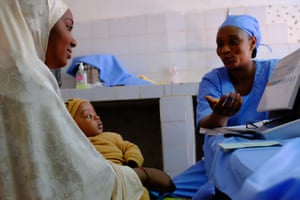


Marie Stopes International healthcare workers counsel women about contraceptive options.


Marie Stopes International healthcare workers counsel women about contraceptive options. Photograph: Jill Filipovic

In front of an attentive all-female audience, Gousmane goes through each contraceptive method, holding up samples – a T-shaped IUD, a needle with a little bottle of Depo-Provera, two white matchstick-sized implants, a slinky female condom – and explains how they’re used and how long they last. “It’s not for you to stop pregnancies or stop delivering babies,” he says. “It’s so you can deliver healthy babies and your body can make another baby.”


Many working in development say that to prevent a series of catastrophes – environmental, economic, security – women in Niger need to have smaller families. But unless women want their families to be smaller, there’s no reason to think the fertility rate will decrease anytime soon.


In Niamey, Niger’s capital city, the global health organisation PSI sends outreach workers to meet with women and talk about family planning. This is how 30-year-old Hadiza Idrissa ended up in the front yard of Mohammadou Rabi, a 39-year-old mother of four, her hair tucked under a gold scarf, a month-old infant in her lap.


Idrissa is helping Rabi figure out what kind of contraceptive to use, showing her samples and explaining the benefits of each one. Rabi asks if the IUD might fall out, or if the implant might break in her arm. Idrissa answers patiently (no and no); when Rabi says she isn’t sure what to pick and just asks Idrissa to choose for her, Idrissa says: “It’s up to you to choose a method. We just explain how the methods work.” She asks Rabi if she wants to come back in a few days, “so you can have a little time to reflect on what you want”. What Rabi wants is a break before having more children, ideally two or three more. “I like to make the Muslim community grow,” she says.


Niger’s population challenges are compounded by the prevalence of a conservative strain of Islam, which encourages followers to have as many children as possible. Any organisation working to put contraceptives into the hands of women has the dilemma of doing so in a way that doesn’t provoke religious backlash. Political leaders, too, have elections to worry about, and don’t want to cross influential clerics by pushing the population issue.
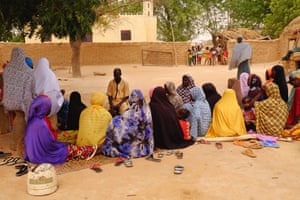


Women gather below a neem tree in a village outside of Dongondoutchi to hear Moundadou Magagi, a health agent with PSI, explain family planning options


Women gather below a neem tree in a village outside of Dongondoutchi to hear Moundadou Magagi, a health agent with PSI, explain family planning options. Photograph: Jill Filipovic

Some women feel that having more babies gives them a break in their difficult lives. In the villages the days are an endless cycle of hard physical labour from the time you’re an adolescent (or younger) until you become too old to work.


The thing I like in motherhood … is giving my baby his bath and playing with him


Hamsatou Issaka, 15


“I really don’t have time for amusement,” says Hamsatou Issaka, a pretty 15-year-old who lives in a village several hours from the nearest city of Dosso. “I just work all day. Then you sleep.” She nurses her one-year-old son, Habibou. “The thing I like in motherhood,” she says, a big smile breaking across her face, “is giving my baby his bath and playing with him.” A new baby also means a 40-day break from the usual demanding physical labour – and another few years of baby baths and giggles breaking up the monotony of tilling the earth and pounding the millet.


Issaka met her husband, a lanky young man with a wide smile and easy laugh, when she was 12 and he was 15; they got married soon thereafter. All of her friends are married with children and she can’t imagine going into her 20s without a husband and children. Having lots of children is the norm because they bring wealth (“they come with two hands to work but only one mouth to feed”). So why have four when you could have seven? Seven, one of Issaka’s neighbours says pointedly, is a bigger number than four.


“A large family size is a cultural ideal in Niger in a similar way that in the US or UK, a romantic relationship is a cultural ideal,” says Hope Neighbor, a partner at consulting firm the Camber Collective, which has researched increasing contraceptive use in the country. “We need to be more thoughtful in how we communicate family size and desires,” she says. “This doesn’t mean you tell people they need to have smaller families. It means reframing how they think about families, because it creates tremendous risk to the mother, and tremendous risk to the fragile environment in Niger.”


This is why, many experts say, Niger needs a strong campaign for girls education. “If we want to bring change, we must bring young girls to school,” says Laouali Assiatou, the deputy secretary general of the ministry of population, promotion of women, and protection of children.


Most of the time the girl is in school but the parents pull her out. She can’t speak for herself


Laouali Assiatou, ministry of population


Child marriage, Assiatou notes, “happens to vulnerable families. Most of the time the girl is in school but the parents pull her out. She is going to be violated. She can’t speak for herself. She will be pregnant early. She’s in her husband’s house, she has no money. She’s not mature enough to deliver and health services are not very developed in our country. She’s going to have a difficult pregnancy. She can die, or she can deliver a stillborn, or she can end up with a fistula and be rejected by society.” The end result, she said, is that keeping girls out of school “keeps the community in a cycle of poverty”.


Despite assumptions, studies haven’t demonstrated a correlation between polygamy and family size. Nigerien women in polygamous marriages have about the same number of children as women in monogamous ones. But some women’s health advocates argue that polygamy contributes to the norm-setting of large families and consolidation of male power in the household, with a potential second wife wielded as a threat to a married woman who doesn’t want more babies.


Mariama Hassan, who has lived in Darey Maliki village her whole life, got married at 18, late by village standards. As she breastfeeds her daughter, Ramatou, she says she wants to see her baby girl finish school, and eventually get married as well – but not until she’s 25. “I want her to be a doctor,” Hassan says. “I say 25 because I want her to be mature before getting married, and I want her to finish her studies.”


Her hopes for her own life are different. “In my lifetime, I want to have what God decides for me,” she says. What does that mean in terms of children? She smiles and laughs. “I hope God gives me 12.”


Join our community of development professionals and humanitarians. Follow @GuardianGDP on Twitter. Join the conversation with the hashtag #SheMatters.


Why have four children when you could have seven? Family planning in Niger

2 Mart 2017 Perşembe

Tories wary about plugging Trump gap in family planning funding

The hastily convened global gathering of governments in Brussels to pledge tens of millions of euros to family planning charities who had their US funding pulled by Donald Trump’s so-called “global gag” has been a tightrope to walk for the British government.


Trump reinstated the rule by executive order in his first few days in the White House, meaning US government funding cannot be provided to charities whose work includes offering abortion services.


Perhaps more than any other country, the UK has been keen to demonstrate that, whatever the concerns about the Trump administration, the answer is engagement rather than isolation. In January, Theresa May became the first foreign leader to meet the US president on a trip criticised by some as overly hasty. Given the UK’s need for new and fast free trade partners after the exit from the EU, such a position is perhaps unavoidable.


Viewed through this prism, its decision to send Rory Stewart, a junior minister, rather than Priti Patel, the secretary of state for international development, could be interpreted as a mild snub to the She Decides conference, an event intended by its organisers to be a symbol of solidarity against Trump. Ditto the UK decision not to pledge any additional money, when countries from Norway to the Netherlands are stumping up millions.


But that is not how ministers at the Department for International Development see it. They say they have been planning to host their own major global summit on family planning over the summer with the UN and that – far from ignoring the issue – the department has intensified UK aid efforts on family planning.


Observers might detect a sense of irritation that the UK will now be put in a position where it is a follower, rather than a leader, given that this week’s conference has been convened by the Dutch, Belgian and other northern European nations.


However, critics have warned that the determination of the department to forge its own path, rather than be perceived as embarrassing Trump, could leave charities in limbo, without specific pledges that their loss of support from the US will be matched elsewhere.


That uncertainty could have long-term consequences for reproductive health in developing countries. About half of all abortion procedures worldwide – more than 20m – are unsafe, with the vast majority in developing countries. About 68,000 women die annually after backstreet abortions, making it one of the leading causes of maternal mortality, according to the World Health Organization.


Five Labour MPs wrote in January to Patel to urge her to commit emergency funding to the She Decides effort, arguing that policymaking needed to be reactive to a volatile political climate. “We would implore you to take urgent steps on funding and policy as the Dutch government has, and as the UK government has done so previously, to mitigate the impact of this decision,” they wrote.


At least one of the MPs is speaking from experience. Gareth Thomas was a minister at DfID in 2006 when the Labour government publicly defied George W Bush’s own reinstatement of the global gag rule to pledge money for safe abortion services where US funding had been cut off.


At the time, the International Planned Parenthood Federation praised the bravery of the UK, saying they were “deeply grateful for the gesture not only financially but politically”.


Any kind of similar statement of thanks from charities in 2017 would be deeply unhelpful to the Conservative government in the post-Brexit era, connecting international aid spending to diplomacy.


Sources at the department see the decision by European and other governments to make immediate pledges to match the support as too hasty and say the scale of the funding gap from Trump’s order has not yet been fully calibrated. The UK’s 2006 funding pledge came five years after Bush’s order, and in a very different political climate.


Tories wary about plugging Trump gap in family planning funding

14 Ağustos 2016 Pazar

How route planning boosts brain power

After all the train strikes on the Southern rail network, frustrated commuters might take some comfort in the fact that planning alternative routes to work each day may well have boosted their brain power.


It is well known that taxi drivers have a bigger rear hippocampus than other people, especially if they have studied the Knowledge. But this isn’t just to do with navigating the streets of a big city. In fact, scientists have found that the enlarged part of their brain is most active when they plan their route before setting off and while on the road, like programming a human satnav.


In an experiment, Dr Hugo Spiers and his colleagues asked London taxi drivers to lie in a brain scanner and play a toned-down version of Grand Theft Auto around a simulation of the city’s streets. The biggest activations in the rear hippocampus – the bit of the brain responsible for spatial awareness – took place when the drivers were forced to plan a detour after the scientists blocked off some of the roads.


Perhaps all this inadvertent brain-training, on top of the delays, could push some commuters to break out of their routines.


Dr Daniel Glaser is director of Science Gallery at King’s College London


How route planning boosts brain power

1 Ağustos 2016 Pazartesi

Family planning is a key development goal that needs greater investment | Letter

Family planning is much more than a vital health and human rights intervention (Critical moment for family planning as funds come under pressure, 28 July). Investments in voluntary family planning are also investments in sustainable development, and therefore should be of as much of concern to ministers of finance as to ministers of health.


In the developing world, about 190 million pregnancies occur each year, of which 73 million (39%) are unintended. These unintended pregnancies often end in abortions (49% of the time, and many unsafe), unintended births (38%) or miscarriages (13%), with detrimental health and economic effects for many women and their families. Behind these statistics are untold stories of human suffering and lives taken off track, underscoring the urgent need for greater investments in family planning.


Related: Critical moment for family planning as funds come under pressure


However, only 1% of all overseas development assistance is allocated to family planning. Funding from local governments is typically even lower. In too many countries, programmes remain weak and political commitment is lacking. Family planning is assigned a low national priority, relegated to the health budgets of donors and the portfolios of health ministers, who are often battling a range of other health issues.


From a broader perspective, this low priority is a mistake, because family planning programmes have a wide array of development benefits that often are under-appreciated. In addition to the improved health and empowerment of women and girls, fewer births lead to a boost in the growth of GDP per capita; reduced pressure on the need to build schools, clinics and infrastructure; reduced environmental degradation; and greater political and social stability, as youth unemployment declines. A dollar invested in family planning returns multiple dollars in savings in other development sectors.


Family planning must therefore be reclassified as a development intervention. If we’re truly serious about meeting the sustainable development goals, we must embrace the rare investment opportunities that drive progress on many different development fronts – family planning chief among them.
John Bongaarts
Vice-president and distinguished scholar, Population Council


Join the debate – email guardian.letters@theguardian.com


Family planning is a key development goal that needs greater investment | Letter

28 Temmuz 2016 Perşembe

Has Yoweri Museveni walked the talk on funding family planning in Uganda? | Richard M Kavuma

For decades, activists in Uganda called for manageable family sizes. At the same time, President Yoweri Museveni talked up the benefits of a large population to make the country more attractive to investors. Something had to give, and the London family planning summit in 2012 appeared to mark a turning point.


There, Museveni not only articulated the benefits of family planning but also committed money to it, increasing government funding from $ 3.3m (£250m) to $ 5m annually for five years. He also announced plans to mobilise $ 10m from donors and streamline Uganda’s medical supply systems to improve delivery of family planning commodities.


Four years on, how has Museveni performed?


Related: Critical moment for family planning as funds come under pressure


Dr Jotham Musinguzi, the director general of the National Population Council, believes Uganda is on the right track. As evidence, he highlights Museveni’s recent exhortation to Ugandans – made in a speech to mark World Population Day – to be cautious about producing children if they lack the capacity to look after them.


“There is now a sharpened plan, together with a costed implementation plan for family planning, and in July 2014 [Museveni] launched the demographic dividend report for Uganda, in which family planning is fully embedded as a policy framework,” says Musinguzi, who formerly headed both the National Population Secretariat and Partners in Population and Development Africa(PPDA).


Yet, when it comes to funding, the picture is blurred. Dr Placid Mehayo, a consultant to the health ministry family planning, says there has been more money available since the London summit. Patrick Mugirwa, a Ugandan reproductive health expert, agrees the meeting provided a financial boost, but argues that government commitments are still dependent on donor funding.


Mugirwa notes that, in the financial year following the summit, spending on reproductive health commodities tripled, from 8bn Ugandan shillings (£1.8m) to 24.8bn, before rising to 25.7bn in 2014-15. He attributes these increases largely to the World Bank-funded health systems strengthening project, which had a component on procuring reproductive health commodities.


Yoweri Museveni at the London summit on family planning in 2012


Yoweri Museveni at the London summit on family planning in 2012. Photograph: Carl Court/AP

His thesis is supported by the fact that in 2015-16, as the project funding dried up, government support for the purchase of commodities fell to 8bn shillings, barely half the amount pledged in London. Figures for 2016-17 are unavailable, but Mugirwa believes there has been little change since.


Neither are these the only challenges undermining family planning in Uganda, according to experts.


“The problem in Uganda is the implementation on the ground,” says Musinguzi. “Although family planning is increasing in Uganda, it is increasing at a slow rate that is not like in Kenya, Rwanda, Ethiopia.”


Besides persistent stock-outs, fears of side effects, and religious and cultural factors, family planning uptake is also held back by a “weak health system with the perennial challenges of inadequate and less motivated human resources for health”, argues Mugirwa.


Mehayo agrees. “First, you have few midwives and if there is a delivery, the few who are there have to prioritise that, and may not have enough time for counselling on family planning,” he says.


Mehayo acknowledges that the ministry of health has applied for a loan and grant of about $ 140m from the World Bank to improve infrastructure and purchase family planning commodities, but points out the project would not start until after July 2017.


Uganda has committed to improving the management of drugs supply chains, and the National Medical Stores now publishes delivery schedules to show that it is efficient and accountable. But health centres work with slim budgets and stock-outs are common.


That government allocation for reproductive health commodities rose when there was donor money available is significant. The question now is whether the government would prioritise family planning if donor money dwindled.


Musinguzi believes that, now Museveni appreciates the demographic dividend, the government would find the money. He has not been alone in warning the government that, when Uganda starts exporting oil in five or six years’ time, donors will start directing their money towards other countries.


“The long-term vision is that the country must make sure that there is voluntary family planning available so that it can build a labour force through the demographic dividend,” Musinguzi says.


Has Yoweri Museveni walked the talk on funding family planning in Uganda? | Richard M Kavuma

Critical moment for family planning as funds come under pressure

Countries with the lowest take-up of contraception will need to increase spending on family planning to meet international targets.


At the halfway point of Family Planning 2020 (FP2020), an ambitious initiative to increase access to modern contraception for 120 million more women and girls in 69 target countries, organisers said national governments need to allocate more money in their health budgets for contraceptives amid concerns that donor funding could begin to fall.


FP2020 was launched in 2012 as a result of the London family planning summit, where donors pledged $ 2.6bn (£2bn) over eight years and governments agreed to spend more on contraceptives and scale up services. Since then, donor funding has increased by more than 30%, from $ 1.1bn in 2012 to $ 1.4bn in 2014, the last year for which figures are available.


Related: Family planning is ‘critical link’ in eradicating poverty


But in the past year, some donors have begun to redirect their overseas aid budgets to support increasing numbers of refugees at home.


It emerged this year that the UN population fund, UNFPA, the main provider of contraceptives to the 69 countries, faces a $ 140m shortfall in its core budget as some of its largest donors cut funding.


“Everybody is concerned about [funding] as many countries consider moving [overseas development assistance] to domestic budgets,” said Beth Schlachter, executive director of FP2020. “We’re all waiting to see what happens.”


She said relying on donors for money is not sustainable and governments need to reflect their commitment to family planning in their health budgets. “Domestic mobilisation has to be a key to this. Family planning, domestically, has not received the same share as other development areas.”


Related: Contraception and family planning around the world – interactive


Joshua Lozman, deputy director of programme advocacy at the Bill & Melinda Gates Foundation – one of the four core partners in FP2020 – said raising more money at a national level is a “primary focus”.


“Within current budgets everyone has to make trade-offs and [there is] a compelling case for family planning,” he said.


Increased use of family planning can help achieve other development goals. It can result in fewer unintended pregnancies, cut maternal and child deaths, and prevent unsafe abortions. It can also give women more control over their lives and the chance to work.


“Family planning doesn’t sit on an island. Lots of things [related to] women and children’s health have to be budgeted for and this has to be part of the broad conversations,” said Lozman.


Uganda is one example of where state support hasn’t matched initial promises. At the 2012 summit, Uganda’s president pledged to increase government funding for family planning, mobilise more money from donors and streamline the national medical supply systems to improve delivery of contraceptives.


But, four years on, government commitments are still dependent on donor funding. Over the two financial years following the London summit, spending on reproductive health commodities in the country shot up from 8bn shillings (£2m) to UGX 25.7bn. But this was largely because of funding from a World Bank project that included procuring reproductive health products. As that funding dried up, the government allocation for 2015-16 dropped back to UGX 8bn.


Related: 2020 contraception target for women and girls may be missed, report warns


Across the world, logistical challenges remain another stubborn barrier to family planning. Even with more money, a lack of trained healthcare workers to raise awareness of the types of contraception available and cultural taboos around sex make reaching targets difficult.


A recent report by the Guttmacher Institute found that fears about the side-effects and health risks of using contraceptives deterred women from using them.


Babatunde Osotimehin, executive director of UNFPA, said reaching young people is crucial. He said in the target countries, up to 70% of the population are under 35. “The largest number of new infections for HIV is adolescent girls in sub-Saharan Africa, which implies the need to do something,” he said.


“Programme countries must step up to the plate … We need to have them understand that they must budget for sexual and reproductive health services because if we have enough services … family planning will reduce maternal mortality. They must budget regularly, make money available and we must continue to advocate for that.”


The latest FP2020 progress report, published in November, said 24 million more women and girls are now using family planning, with more than 290 million users in the 69 countries. However, at the current rate of progress, the target will be missed by 2020.


But Lozman said he is “confident we will see significant progress” over the coming years. The UN general assembly promised last year to ensure universal sexual and reproductive healthcare, including family planning, by 2030 under the new sustainable development goals.


Critical moment for family planning as funds come under pressure

30 Temmuz 2014 Çarşamba

The Timeline Venture Makes Planning Long term Effortless For Millennial Ladies


Get an advanced degree, launch a startup, assist the globe — and, eventually, have kids. As any Millennial girl will inform you, the path to self-fulfillment is no longer follows a traditional route — and now, there is a site to help females visualize and plan their nontraditional futures.


Through the Timeline Project, which was initiated by Bayer Bayer Healthcare, end users can produce timelines for different targets and share them with the rest of the Timeline Venture community and on other social media platforms.


These ambitions range from almost everything from “Brush and Floss Daily” to “Pay Off Pupil Loan Debt.” But probably most importantly (and uniquely), Bayer created the website so females can have an easy and available way to strategy family members arranging and learn about the alternatives offered to them.


“The Timeline Undertaking was created to assistance and empower Millennial women as they plot their life objectives and future milestones, which might or may not contain starting up a family members,” says Inge Weber, a vice president in the Women’s Healthcare division at Bayer HealthCare Pharmaceuticals. “We see The Timeline Undertaking as a way to give assistance to today’s Millennial girl by providing her with practical details that she can use to work toward attaining her existence ambitions – and that contains education about family preparing alternatives.”


Franchesca Ramsey, an actress, comedian and video blogger – greatest identified for her viral YouTube video, “Sh*t White Ladies Say…to Black Girls” and by her pseudonym, Chescaleigh – is a proponent and brand ambassador of the internet site, and says she “jumped at the chance” to get concerned with a project that aims to help Millennial females.


“In the previous there was a a lot more traditional route and that’s truly transformed for younger ladies,” Ramsey says. “Today’s 20-some thing might commence in 1 occupation and do another, or leave college, men and women are beginning their own organizations, the path is quite various … It is been a great location to search at my ambitions and publish them down and truly target.”


From TheTimelineProject.com From TheTimelineProject.com

From TheTimelineProject.com


Not only can users develop their personal timelines, but the internet site offers helpful articles and other on the internet sources to support in fact attain the targets. Ramsey says this proactive technique was a huge cause why she’s concerned with the “positive initiative.”


No stranger to on the internet communities– her YouTube channel has more than 150k subscribers and 23 million views – Ramsey says there’s anything “very powerful” about possessing your goals noticeable to other end users: It holds you accountable.


She also communicates with consumers by way of #TheTimelineProject on Twitter Twitter, the place ladies give tips to each other and post photographs and updates of their targets.


“The greatest point I hope women get out of this venture is that their dreams are achievable if you combine the will and the sources to get them done,” she says.


The Timeline Venture Makes Planning Long term Effortless For Millennial Ladies

6 Haziran 2014 Cuma

How Bangladesh"s female health staff boosted household planning | Kenneth R Weiss

Sporting sandals and draped in a dark-blue sari, Aparajita Chakraborty glides into the cluster of hilltop houses with the self-assurance of a person who has long been making property calls.


She has. For a lot more than 30 years, Chakraborty has been visiting this extended loved ones, carrying out checkups and dispensing suggestions. But she is no doctor, she’s a neighborhood health employee who has been dispatched by the neighborhood hospital. However she has won the trust and gratitude of the surrounding villages by saving lives – largely from cholera and other deadly diarrhoeal ailments.


With all the men away, either functioning in the rice fields or having migrated to the city, Chakraborty quickly gets down to business in the family compound of half a dozen houses. She and a colleague perform a group interview, asking 4 females private queries this kind of as: when did they final menstruate? Are they taking the pill, or employing yet another strategy of household planning?


One particular female explains that she stopped taking the pill when her husband began functioning in Chittagong, a day’s journey away. She resumed her use of contraceptives right away following his surprise visit. By then it was also late, and she is now expecting their third kid.


Yet another woman says she is not utilizing any kind of contraception. The woman’s husband, it transpires, had a vasectomy following their fourth kid. But he doesn’t want his brothers to know for worry they will consider him impotent. So it’s a secret, albeit 1 that has been documented by hospital personnel, along with each and every birth, death, marriage, divorce and other essential statistic of 225,000 men and women in the region.


Chakraborty is aware of a lot more intimate specifics about the community than they know about one particular an additional. But discretion is paramount, she says: “I maintain what I hear to myself. I really feel like I am part of the family members.”


She is portion of an all-female cadre of local community wellness employees who span this portion of Bangladesh’s low-lying delta, cautiously maintaining one of the longest-running and most thorough well being and population information sets in the creating planet.


The Matlab hospital that dispatched Chakraborty has grown extensively considering that 1963, when it was launched as a cholera study station atop a barge close to Dhaka. The institution was set up by the Worldwide Centre for Diarrhoeal Condition Investigation, Bangladesh.


Half a century later on, this hub for little one and maternal overall health is widely credited for demonstrating how poor Muslim girls with little or no formal training can prepare their households. The strategy has spread during this densely populated, poverty-stricken nation, curbing its speedy population development.


In 2000, the UN projected that Bangladesh’s 160 million-strong population would soar to 265 million by 2050. The most current projections display the numbers are most likely to climb to somewhat far more than 200 million by mid-century just before stabilising quickly soon after.


“Matlab showed us the way,” says Ubaidur Rob, the non-revenue Population Council’s Bangladesh director. “Females had been employed as field workers in the 1970s, when fertility was extremely high and female employment was practically zero. This is exactly where adjust started.”


Its well-chronicled successes have created Matlab some thing of a mecca for public health researchers. At first, numerous were drawn to the rural outpost due to the fact it suffered typical cholera epidemics. Now, the lure is the comprehensive population and wellness database that can reflect the achievement or failure of a drug trial or well being intervention.


In the mid-70s, family preparing advocates made a decision this was an ideal area to check whether or not poor, beneath-educated girls in a religiously conservative area would adopt the use of contraceptives. To set up the experiment, researchers divided 149 villages into two groups. 1 half participated in the Matlab centre’s maternal and child healthcare initiatives, like residence delivery of modern contraceptives, although the other had entry only to government services.


The communities were otherwise identical: bad fishing and farming families living in bamboo homes, in villages with minor or no electrical power, operating water or sanitation. Most had filth floors and cooked on fires of wood, rice chaff and cow dung.


The area was 88% Muslim and contraception was denounced by Islamic clerics. Most households practised purdah – making it possible for women out of the home only if “appropriately” covered and escorted by a male relative.


Researchers swiftly realized it was not enough just to make contraceptives obtainable, says Dr Mohammad Yunus, who ran the Matlab centre for practically forty many years. What worked, he says, was a comprehensive doorstep support with educated female wellness staff making regular adhere to-up visits to assist mothers choose a approach of contraception that was very best for them, deal with side-effects and provide standard maternal and child healthcare.


Differences emerged right away. Married women had been more very likely to use contraceptives and, more than time, had an common of one.five fewer kids than their counterparts in the comparison area. Their young children had been more healthy, fewer girls died of pregnancy-relevant triggers, and little one mortality fell.


These families grew wealthier, too. With fewer youngsters to help, dad and mom accumulated much more farmland, constructed far more valuable homes and gained entry to working water. Their children stayed in school longer, and females enjoyed increased incomes.


The final results advised family members arranging was a price-efficient way to enhance public health and help lift folks out of poverty, well being experts explained. And it showed that communities do not have to grow to be wealthier or greater educated before birthrates can fall – if contraception is manufactured accessible in an appropriate way.


The Matlab centre’s programme drew the interest of government officials, who made a decision to roll it out in two regions. Matlab workers educated government employees in the door-to-door technique. By the early 80s, individuals places had experienced a similar enhance in contraceptive use, and the government set about education tens of thousands of female wellness staff utilizing the Matlab model.


“Above the next five years, it was phased in across the complete country,” Yunus says. “Bangladesh became a achievement story for family arranging and minimizing infant mortality.”


Because then, average birthrates have tumbled from six youngsters a lady to somewhat far more than two, and Bangladesh has grow to be one particular of the very first impoverished countries to meet the UN millennium growth objective of decreasing kid mortality by two-thirds.


• Ken Weiss writes on science, environment and public overall health for the LA Times and elsewhere


How Bangladesh"s female health staff boosted household planning | Kenneth R Weiss

26 Mayıs 2014 Pazartesi

Melinda Gates on the worldwide family planning revolution video

Two many years on from the London Summit on Family members Planning, Melinda Gates, businesswoman and co-chair of the philanthropic Bill and Melinda Gates Foundation, discusses the progress produced on tackling the issue. She explains how initiatives to widen entry to contraception have had a good impact on girls and ladies in creating nations. She also stresses the relevance of sexual wellness training in nations such as Niger, which has one of the highest fertility prices in the world


Melinda Gates on the worldwide family planning revolution video

19 Şubat 2014 Çarşamba

Folic acid taken by less than third of girls planning pregnancy

Mung beans and spinach dish

Mung beans and spinach are a supply of vitamin B9 but authorities advise girls to get further folate in dietary supplements when planning a household. Photograph: Alamy


Females are ignoring specialist advice to get folic acid supplements just before pregnancy to defend their unborn children, a examine has proven.


Researchers who questioned nearly 500,000 girls attending antenatal clinics in England and the Isle of Guy found that fewer than one in 3 took folic acid prior to getting to be pregnant.


These omissions had been in spite of robust proof displaying that most situations of spina bifida and other birth defects affecting the brain, spine or spinal cord, can be prevented by boosting amounts of folate – vitamin B9 – ahead of pregnancy.


The examine showed that the proportion of females who heeded the tips when arranging a household had really fallen, from 35% amongst 1999 and 2001, to 31% from 2011 to 2012.


Even amongst ladies with prior knowledge of a pregnancy involving a neural tube birth defect, this kind of as spina bifida, only just over half (51%) took the supplements.


Spina bifida is a neural tube defect that takes place when the developing spinal column does not near effectively, leaving nerves exposed. In most cases surgical treatment can be carried out to restore the defect after birth, but usually nerves have previously been damaged leading to paralysis, incontinence and reduction of skin sensation.


Amid the recognized danger aspects for spina bifida, the most crucial is a lack of folic acid just before and at the very start off of pregnancy.


The findings prompted calls for the introduction of necessary folic acid fortification of flour in the Uk, a policy currently adopted in far more than 70 countries, which includes the US and Australia.


Sir Nicholas Wald, from Queen Mary University of London, 1 of the research authors whose original operate uncovered the protective effect of folic acid, explained: “It’s a public overall health tragedy that, in spite of the folic acid fortification initiative in a lot of countries, the United kingdom has not introduced necessary folic acid fortification. The failure to fortify flour with folic acid is like possessing a polio vaccine and not employing it.”


The analysis, published in an on-line journal of the Public Library of Science, was performed by a group from Queen Mary’s Wolfson Institute of Preventive Medication amongst 1999 and 2012.


The study showed that a lot more girls took folic acid after they identified they had been pregnant, the proportion growing from 45% to 62% among the periods looked at in the examine. But experts anxiety that to provide successful protection the dietary supplements essential to be taken ahead of pregnancy.


The research also showed sturdy ethnic variations, with only 17% of Afro-Caribbean females, twenty% of south Asian women and 25% of east Asian females taking folic acid, compared with 35% of white Caucasian females.


Just six% of teens under 20 attending the antenatal clinics had taken the supplements, although forty% of older girls aged 35 to 39 followed the tips.


Jonathan Bestwick, co-writer of the review, who is a lecturer in health-related statistics at Queen Mary, mentioned: “The recent Uk policy of recommending females take folic acid supplements has failed and has also led to overall health inequalities amid ethnic minorities and younger females. The government need to introduce mandatory fortification of flour with folic acid with no delay.”


Joan Morris, a statistician at Queen Mary, said: “Each year in Britain there are about 1,000 pregnancies impacted by spina bifida or other birth defects of the brain, spine, or spinal cord. Most of these lead to a termination of pregnancy, which is an agonising decision for couples who want a kid.”


Jane Munro, from the Royal University of Midwives, explained: “There is no doubt about the positive aspects of taking folic acid dietary supplements for women who are organizing to become pregnant. The RCM advises ladies to get supplements if they can.


“Even so, there is a require to ensure entry to dietary supplements for girls who are unable to afford them, and to reach groups of women the place taking these dietary supplements is minimal.


“On the problem of including folic acid to foodstuffs this kind of as flour, we would anxiety the need to have for a lot more discussion prior to such a stage is taken since there will be men and women for whom additives will be unacceptable.”


Folic acid taken by less than third of girls planning pregnancy

30 Ocak 2014 Perşembe

Britain"s obesity epidemic linked to negative town planning, RIBA says

Leeds and Bristol have been the healthiest areas.


Seeking at diabetes all round, the least healthful locations in England’s cities had twice the housing density and a quarter significantly less green space than the most healthy areas.


Meanwhile for childhood obesity, green room was 44.7% in the worst cities although the percentage of land occupied by housing was 6.8%.


In comparison, the five local authorities outdoors London with the lowest prices of childhood obesity had been 71.4% green room and only three.1% housing.


Anna Scott-Marshall, head of external affairs at RIBA, warned: “The way we layout and program out cities can have an fast result on the weight problems crisis and how healthier we are.”


Investigation demonstrates one in eleven early deaths could be averted every single year if everybody exercised for the suggested 30 minutes five occasions a week.


Of the 59 per cent of people in Britain’s key cities not receiving this physical exercise 75 per cent explained that they could be encouraged to do much more in a far better environment, according to the YouGov poll carried out on behalf of RIBA.


Individuals have been most very likely to be encouraged by good quality above amount, with security and aesthetics deemed significantly crucial than a direct route or an enhance in the number of parks, the survey located.


Consequently, by designing areas people want to use developers could encourage workout and minimize weight problems and associated overall health troubles, like diabetes, the report concluded.


Division for Transport data present that walking has dropped 27% in the last 15 years.


Stephen Hodder, RIBA President, explained: “At a time of austerity and enhanced concern with bodily and mental effectively-becoming, it is surprising to find out that just by creating public wellness a priority when planning cities, we can conserve the country upwards of £1bn yearly though reduced weight problems-related health care charges.


He named for “planners and developers to get the lead and make certain more healthy cities.”


RIBA are calling on regional authorities, who took above obligation for public wellness last 12 months, to integrate policies with people for planning.


Britain"s obesity epidemic linked to negative town planning, RIBA says