Uganda etiketine sahip kayıtlar gösteriliyor. Tüm kayıtları göster

20 Nisan 2017 Perşembe

Health push in Uganda after mystery disease turns out to be "mossy foot"

A public health campaign has been launched in western Uganda after scientists unexpectedly found the region was afflicted by a tropical disease that causes disfigurement and swelling.


The discovery came to light after experts were dispatched to Kamwenge district to investigate an outbreak of lymphatic filariasis, more commonly known as elephantiasis. A team of specialists from the Ugandan ministry of health, the World Health Organization and the Centers for Disease Control and Prevention was surprised to find that the condition causing limbs to swell was in fact podoconiosis, also known as non-filarial elephantiasis. The disease was previously unknown in the region.


Unlike lymphatic elephantiasis, which is contracted when a parasitic worm is transmitted to humans by mosquitoes, podoconiosis – also known as “mossy foot” because it causes moss-like warts called hyperkeratotic papilloma – is contracted by walking barefoot on irritant volcanic soils. Blood samples taken by scientists from 52 people tested for lymphatic filariasis found no worms present.


Philip Rosenthal, professor of medicine at the University of California, San Francisco, and editor of the American Journal of Tropical Medicine and Hygiene, which published the findings this month, said: “The study was pioneering in discovering that this syndrome was causing serious morbidity in a part of the world where previously we had no idea that podoconiosis existed. The real key is preventing this in future generations.”


Podoconiosis, a progressive, non-infectious disease with symptoms that include itching, foot pain and swelling, can lay undetected for decades, but is treatable.


Dr Christine Kihembo, a senior field epidemiologist with the Ugandan health ministry and the study’s lead author, said many patients had probably been “suffering silently without help for more than 30 years”.


Kihembo said Kamwenge district was forested until the 1960s, when migrants looking for farmland began tilling the soil. Early symptoms of the disease went undetected because it was never documented in western Uganda.


She said patients may not have associated initial symptoms with soil contact, and that “there was a tendency among those affected to stay at home with their disability and not go to a health facility”.


Gail Davey, professor of global health epidemiology at Brighton and Sussex Medical School and founder of the NGO Footwork, said it was unsurprising the disease had gone unnoticed for decades because it is the very poorest areas that are affected.


Podoconiosis affects an estimated 4 million people globally and is found in the highland areas of Africa, Latin America and south-east Asia.


It is caused by an inflammatory reaction to minerals in volcanic soils. On contact, the minerals penetrate the skin, causing severe itching and pain. They are taken up by white blood cells, triggering inflammation that produces a thickening of scar tissue, causing swelling and ulcerated sores in the lower limbs. Typically, both lower limbs are affected. Unlike parasitic elephantiasis, it rarely affects the genitals.


Many people avoid sufferers because they believe the disease to be infectious. Davey said the disease is “highly stigmatised, probably more so than leprosy”, with sufferers often hidden away in communities, where it is seen as a curse.
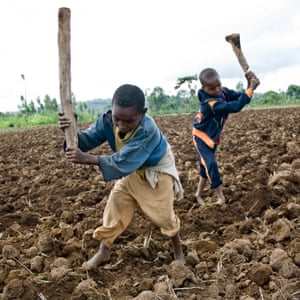


Boys work barefoot on a subsistence farm field in Sodo Wolaita, Ethiopia


Boys work barefoot on a subsistence farm field in Sodo Wolaita, Ethiopia, where podoconiosis has also been found. Photograph: Jake Lyell/Alamy Stock Photo

Sufferers’ inability to work leads to a reduced income, which has a detrimental effect on mental health. Many victims experience depression.


The discovery of podoconiosis in the region has prompted a public health education campaign to highlight the importance of foot hygiene, and Footwork has trained local health workers to treat the condition.


Davey recalls a man she met at a clinic whose marriage ended because the disease left him unable to look after his farm: “He no longer saw his children because they thought it brought shame to the household. For him, just to hear that the condition can be treated was a bit of a light-bulb moment”.


“It is reversible – even the late stages can be improved enormously with careful hygiene and bandaging, and shoes and socks to protect.”


Podoconiosis will be among the neglected tropical diseases discussed at a summit in Geneva this week. Attendees will discuss the development of a global atlas of podoconiosis, which will map the global geography of the disease and inform efforts to eradicate it.


“We believe we can eliminate podoconiosis in our lifetime,” said Wendy Santis, Footwork’s executive director. “We know the cause and how to treat it. Now our most urgent need is for funding so that we can target our efforts to have the greatest impact.”


Health push in Uganda after mystery disease turns out to be "mossy foot"

28 Temmuz 2016 Perşembe

Has Yoweri Museveni walked the talk on funding family planning in Uganda? | Richard M Kavuma

For decades, activists in Uganda called for manageable family sizes. At the same time, President Yoweri Museveni talked up the benefits of a large population to make the country more attractive to investors. Something had to give, and the London family planning summit in 2012 appeared to mark a turning point.


There, Museveni not only articulated the benefits of family planning but also committed money to it, increasing government funding from $ 3.3m (£250m) to $ 5m annually for five years. He also announced plans to mobilise $ 10m from donors and streamline Uganda’s medical supply systems to improve delivery of family planning commodities.


Four years on, how has Museveni performed?


Related: Critical moment for family planning as funds come under pressure


Dr Jotham Musinguzi, the director general of the National Population Council, believes Uganda is on the right track. As evidence, he highlights Museveni’s recent exhortation to Ugandans – made in a speech to mark World Population Day – to be cautious about producing children if they lack the capacity to look after them.


“There is now a sharpened plan, together with a costed implementation plan for family planning, and in July 2014 [Museveni] launched the demographic dividend report for Uganda, in which family planning is fully embedded as a policy framework,” says Musinguzi, who formerly headed both the National Population Secretariat and Partners in Population and Development Africa(PPDA).


Yet, when it comes to funding, the picture is blurred. Dr Placid Mehayo, a consultant to the health ministry family planning, says there has been more money available since the London summit. Patrick Mugirwa, a Ugandan reproductive health expert, agrees the meeting provided a financial boost, but argues that government commitments are still dependent on donor funding.


Mugirwa notes that, in the financial year following the summit, spending on reproductive health commodities tripled, from 8bn Ugandan shillings (£1.8m) to 24.8bn, before rising to 25.7bn in 2014-15. He attributes these increases largely to the World Bank-funded health systems strengthening project, which had a component on procuring reproductive health commodities.


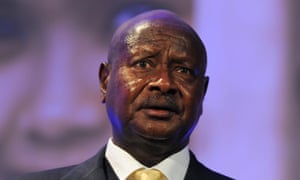
Yoweri Museveni at the London summit on family planning in 2012


Yoweri Museveni at the London summit on family planning in 2012. Photograph: Carl Court/AP

His thesis is supported by the fact that in 2015-16, as the project funding dried up, government support for the purchase of commodities fell to 8bn shillings, barely half the amount pledged in London. Figures for 2016-17 are unavailable, but Mugirwa believes there has been little change since.


Neither are these the only challenges undermining family planning in Uganda, according to experts.


“The problem in Uganda is the implementation on the ground,” says Musinguzi. “Although family planning is increasing in Uganda, it is increasing at a slow rate that is not like in Kenya, Rwanda, Ethiopia.”


Besides persistent stock-outs, fears of side effects, and religious and cultural factors, family planning uptake is also held back by a “weak health system with the perennial challenges of inadequate and less motivated human resources for health”, argues Mugirwa.


Mehayo agrees. “First, you have few midwives and if there is a delivery, the few who are there have to prioritise that, and may not have enough time for counselling on family planning,” he says.


Mehayo acknowledges that the ministry of health has applied for a loan and grant of about $ 140m from the World Bank to improve infrastructure and purchase family planning commodities, but points out the project would not start until after July 2017.


Uganda has committed to improving the management of drugs supply chains, and the National Medical Stores now publishes delivery schedules to show that it is efficient and accountable. But health centres work with slim budgets and stock-outs are common.


That government allocation for reproductive health commodities rose when there was donor money available is significant. The question now is whether the government would prioritise family planning if donor money dwindled.


Musinguzi believes that, now Museveni appreciates the demographic dividend, the government would find the money. He has not been alone in warning the government that, when Uganda starts exporting oil in five or six years’ time, donors will start directing their money towards other countries.


“The long-term vision is that the country must make sure that there is voluntary family planning available so that it can build a labour force through the demographic dividend,” Musinguzi says.


Has Yoweri Museveni walked the talk on funding family planning in Uganda? | Richard M Kavuma