We take a two-fold approach to changing and saving lives: firstly providing support for men who are down or in crisis, and secondly campaigning for culture change to tackle outdated stereotypes of masculinity that prevent men seeking help.
We do this in the face of a problem that is deeply entrenched. Many men feel forced to stoically “man up” (whatever that means) and grind through bad times without societal permission to open up or seek help. Calm’s research shows that while 67% of women tell someone about going through depression, only 55% of men do the same.
The result? Men are three times more likely than women to take their own lives and suicide is the single biggest killer of men aged between 20 and 49 – something the Duke of Cambridge describes as “an appalling stain on our society”.
But the tide is turning. Since Calm was founded 10 years ago, awareness of male suicide has trebled. Definitively, men are talking more. Calm alone has taken 200,000 helpline calls to date, and prevented more than 1,000 suicides.
The work of organisations and campaigns such as Lift The Weight and the royals’ mental health campaign Heads Together (Calm is a partner charity of the latter) – is a massive step forward. Historically, the alpha-male archetype has had no time for conversations about emotions but, in recent weeks, this has been dismissed by men such as Stormzy, Rio Ferdinand, and Calm’s patron Professor Green – strong, famous, tough men explaining how communication has, in some way, saved their lives.
There is still much work to be done. The emphasis now is to move beyond the rallying cry to open up. We must better equip ourselves, our mates, our workplaces, schools and health services to support those who need it. And we start by building a generation who believe that society’s ideas of your gender should not be a death sentence.
In the UK, the Samaritans can be contacted on 116 123. In the US, the National Suicide Prevention Hotline is 1-800-273-8255. In Australia, the crisis support service Lifeline is on 13 11 14.
Men working in the construction industry and women employed in culture, media and sport, healthcare and primary school teaching are at the highest risk of suicide, official figures for England suggest.
The research, commissioned by Public Health England (PHE), found people in roles as managers, directors and senior officials – the highest paid occupation group – had the lowest risk of suicide.
The Office for National Statistics (ONS) looked at all 18,998 deaths of people aged 20 to 64 – a rate of about 12 deaths for every 100,000 people per year – who killed themselves in England between 2011 and 2015. Of these records, 13,232 had information on the deceased’s occupation.
Suicide is the leading cause of death for men under 50 and about four in five (10,688) deaths included in the analysis were among men.
The ONS found low-skilled male construction workers had the greatest risk, at 3.7 times above the national average.
Building finishing trades, including plasterers, painters and decorators, had a risk twice the national average and the risk for low-skilled workers in process plant operations was 2.6 times higher. The agricultural sector also carried an elevated risk for men, more than 1.5 times above the average for both low-skilled and high-skilled workers.
For women, the risk was elevated among those working in culture, media and sport occupations, at 0.69 times higher than the national average, compared with 0.2 times higher for men.
The risk of suicide among female health professionals was about a quarter higher than the national average, largely driven by suicides among nurses, and it was 0.42 times higher for primary and nursery school teachers, although lower than average for the teaching and education profession as a whole.
The risk among male and female carers was almost twice the national average but among corporate managers and directors the risk was more than two-thirds lower for both sexes.
The ONS said previous studies suggested an occupation may have a high risk because of low pay and job security and/or access to or knowledge of methods of suicide.
The Samaritans chief executive, Ruth Sutherland, said: “We spend a third of our lives at work and one fifth of us experience suicidal thoughts, so these resources are much needed. We shouldn’t stop there though – it is up to us to create a culture in our workplaces where people feel safe enough to talk about their feelings and get support if they need it.”
PHE said the research, published on Friday, will help build a better understanding of factors that influence suicide and help identify where inequalities exist among different groups.
The PHE chief executive, Duncan Selbie, said: “People who die from suicide are usually not in contact with health services, and often push through in silence as their ability to cope deteriorates. With more than two-thirds of adults in employment, the workplace offers an opportunity to reach people who need extra support.
“I urge all employers, large or small, public or private sector to treat mental health as seriously as physical health. Early action can stop any employees reaching a desperate stage. Simple actions can make a huge difference – talking with a manager or colleague can help people get the support they need, and ultimately save lives.”
PHE, Business in the Community and the Samaritans have published toolkits to help employers prevent and respond to suicides.
The ONS limited its analysis to occupations where there were 50 suicides or more so that relative mortality rates could be estimated more precisely.
In the UK, the Samaritans can be contacted on 116 123. In the US, the National Suicide Prevention Hotline is 1-800-273-8255. In Australia, the crisis support service Lifeline is on 13 11 14. Hotlines in other countries can be found here
Efforts to promote gender equality in workplaces of all kinds may be widespread, but the number of men in nursing remains stubbornly low. Last year just 11.4% of registered nurses in the UK were male, according to figures from the Nursing & Midwifery Council – only a marginal increase from five years earlier, when they made up 11% of the workforce.
And the proportion of nursing students in the UK who are men hasn’t shifted either, according to the Higher Education Statistics Agency: in 2016 it stood at 11.6%, compared with 11.5% a decade earlier.
“It’s disappointing,” says Janet Davies, chief executive of the Royal College of Nursing, “because we’ve promoted nursing for men. I think it’s good to match the balance in the communities we’re working for. And also we don’t want to lose those people who would make fantastic nurses.”
She believes continued stereotyping about what a nurse looks like is partly to blame – despite the presence of male nurse characters in TV dramas. “When people think of a nurse perhaps they do think of a woman. Some of the details don’t help – the term matron is weird – but it’s about the job, and in my experience men take it in their stride and work with it.”
Davies questions whether it is the work itself that doesn’t attract men, or whether other factors are to blame: “Is it something about people being conditioned at school? Is it suggested by careers officers? It isn’t the best paid job in the world and I think people do look at salary and feel perhaps they want more than that.” And yet once men are working as nurses, Davies says, the role is accepted by the vast majority of people. “I don’t think anybody bats an eyelid anymore,” she says.
At Queen’s University Belfast, a campaign to increase the number of male nursing students that includes targeting all-boys schools – which are more common in Northern Ireland – has prompted a rise from 6% three years ago to 10% today.
Prof Donna Fitzsimons, head of the university’s school of nursing and midwifery, says: “Nursing is all about the empathy and caring that people show, but those traits are not exclusively female and it’s very important for patients that we have diversity on all levels.”
Paediatrics is one field where that’s especially apparent, Fitzsimons says. “Boys, in particular, can find it hard to relate to women at times. Sometimes a male nurse can really bring out a side of a child that helps to lift their mood and allows them to feel more comfortable in a hospital setting.”
The department now tests nurse applicants in five-minute simulated clinical scenarios, as well as interviewing them. “Men seem to have benefited from that exercise,” says Fitzsimons. “Men might find it harder to put into words their caring and compassionate qualities, but can demonstrate them more easily.”
Davies believes that strong role models and encouraging school-age children to think about nursing as a career are key. “It really is a superb job,” she says, “and men are fabulous nurses.”
‘It’s now more recognised that men can do the job in the same way fathers can parent’
I made my mind up that I wanted to be a nurse when I was 14 or 15. My mum’s a care assistant so, subconsciously, that influenced me quite a bit. I did work experience in a school for children with learning disabilities, where a lot of the pupils had epilepsy, and that inspired me too. I knew I wanted to be in a caring profession.
I received a little bit of teasing from my friends, but no one ever questioned why I was doing it. And once I started my training they became more and more interested. That’s always been the case.
I’ve been a nurse most of my working life, so being outnumbered by female colleagues is what I’m used to; I don’t really notice it. Earlier in my career I had a few comments where patients seemed to have expected that the nurse caring for them was going to be a woman, but men were already becoming more commonplace in the profession when I qualified.
Now I’m in a more senior role, patients occasionally assume I’m a doctor if I’m addressing a complaint or helping them with an issue. I correct them, but I don’t challenge them as to why they think that – it wouldn’t be very useful for the caring relationship. And it doesn’t bother me. Occasionally a female patient has preferred to have a female nurse look after her care needs and that’s understandable, especially with elderly patients.
When I was a ward manager, or sister, I did get some people saying: “Shouldn’t you be a brother?” But, actually, no one has ever commented on the fact that I’m a matron and a man. I’ve worked on shifts where it’s been predominantly male nurses, and a lot of the wards I’ve worked on have had a good balance of men and women. It’s now more recognised that men can do the job, in the same way that fathers are getting more involved looking after children.
Once you see a nurse in action giving you excellent care – that’s when the gender disappears.
Dan Wicks, 38, cardiology matron at Guy’s and St Thomas’ NHS foundation trust
Join the Healthcare Professionals Network to read more pieces like this. And follow us on Twitter (@GdnHealthcare) to keep up with the latest healthcare news and views.
Had Moonlight not come along, hard on its heels, Manchester By the Sea might have seemed like the most emotionally revealing film about a man to have been released in years. But since Moonlight is probably one of the most emotionally revealing films about a man ever to have been made, it wins.
It isn’t fair to set the two in competition. They’re doing similarly important things in their different ways – exploring negative aspects of masculinity. In Manchester By the Sea a single, unlucky catastrophe turns a warm, fun-loving young man into an angry, aggressive, emotionally shut-down loner. In Moonlight, a whole childhood conspires to drive a man to become a numb synecdoche of all that has blighted his own upbringing.
It’s undoubtedly because I’ve recently been diagnosed with a trauma-induced anxiety disorder myself. But I immediately saw the symptoms of chronic or complex post-traumatic stress disorder in both leading characters.
In Manchester By the Sea, Lee Chandler, played wonderfully by Casey Affleck, displays symptoms of chronic PTSD, in which a single trauma comes to dominate the brain’s neural pathways in an extremely unhealthy way. You can also see these symptoms simply as emotional reactions that any person in Lee’s situation might develop. But the point is this: we are so used to these destructive and damaging responses to life’s vicissitudes that they seem natural rather than horribly dysfunctional.
In Moonlight, Chiron, played by three actors as a child, a teenager and an adult, already has complex PTSD, to my eyes, as a little kid. Complex PTSD is brought on when a person is subjected to a series of traumas, most often by a caregiver they ought to be able to trust unconditionally, but from whom there is little chance of escape. Abused or neglected children are very susceptible to C-PTSD. By the time Chiron is an adult, from my reading of the film, C-PTSD is rampant.
There’s a lot of controversy at the moment about whether armchair diagnosis of mental health problems should be indulged. I think it’s totally valid when the character being examined is fictional. I’d say it’s more than valid. It’s necessary if humans are going to get to a point where we can understand ourselves and the messes that we make.
In Manchester By the Sea, Lee is a man who really, really needs therapy, though this isn’t mentioned as an option in the film. The culture he’s in is far too blue-collar for that. Lee fights his miserable losing battle with his trauma, guilt and shame alone. As with Chiron in Moonlight, his symptoms are classic too. It’s so plain in the film that what a psychiatrist would call symptoms are also self-protecting emotional responses, recognisable to anyone who cared to view them in that way.
Having mentioned the controversy around amateur diagnosis, I’m now going to tread carefully. After the screening of Moonlight I attended, there was a Q&A session with Tarell Alvin McCraney. He wrote the play on which Moonlight is based, In Moonlight Black Boys Look Blue.
McCraney makes no secret of the fact that the early part of the story, of a boy growing up in Miami with a crack-addicted mother, a flawed father-figure who loses his life very young, and the experience of being bullied as a “faggot” by his peers, is based on his own life. McCraney’s life clearly has not followed the trajectory of Chiron’s because, you’ll be glad to know, the film doesn’t end with our hero sitting down to write an amazing play that becomes a film. You’ve seen that movie already, more than once.
Boys are told not to cry, told to fight back, told to toughen up, in a way that girls less frequently are
McCraney – intelligent, gloriously articulate, handsome, elegant, funny, charming, polished, self-deprecating – is also frank. On the platform he acknowledged that he knows how people see him, which is pretty much the way I saw him, as listed above. It wasn’t just me. The room was full of love for him. However, he says, this is not at all how he sees himself. Instead, he is “terrified”, has “intimacy issues”, sometimes can’t bear crowds and has to be alone, and sometimes finds himself drifting away from feeling present in the world. He has survived his upbringing and thrived fantastically well. But the psychological scars are there and he is aware of them.
McCraney says that he doesn’t find writing about his past cathartic. Instead, it depletes him. It costs him a lot. I think that while some men, men like Lee, fight with their fists, McCraney fights with his creativity. It’s a much healthier way to do battle with trauma. But that’s still what it is – a battle with trauma.
I find myself thinking that while both Lee and Chiron are extreme examples, a lot of the cliches about the transformation of boyhood into manhood centre on the suppression of trauma. Boys are told not to cry, told to fight back, told to toughen up, in a way that girls less frequently are. (Although girls do toughen up. I did.) Sure, this can result in creativity like McCraney’s. But our experience of the world and its history suggests that very often it results in bombast and aggression, anger and violence.
We are used to hearing about theories of gender as a performance. I wonder if that’s too glib. Maybe gender is more of a neurological response, with hyper-masculinity a pathological response to trauma, and hyper-femininity a defence against an aggressive masculine pathology. Or maybe I’m barking up the wrong tree. Who knows?
The crucial thing is that these films are urging people to look hard at these profound issues around human behaviour, and really think about what makes people who they are. I’m thankful for both of them, and for the pain and struggle sometimes involved in “being a man” that they so sensitively portray. Especially Moonlight. I don’t think there’s ever been another film quite like it.
A male contraceptive gel has been found to work reliably in a trial in primates, bringing the prospect of an alternative form of birth control for humans closer.
The product, called Vasalgel, is designed to be a reversible and less invasive form of vasectomy and in the latest study was 100% effective at preventing conception. A blob of the gel is injected into the sperm-carrying tube, known as the vas deferens, and acts as a long-lasting barrier.
Previous tests in smaller animals showed the procedure could be easily reversed by breaking up the gel using ultrasound.
Catherine VandeVoort, of the California National Primate Research Centre and the study’s lead author, said: “Men’s options for contraception have not changed much in decades. There’s vasectomy, which is poorly reversible, and condoms. If they knew they could get a reliable contraceptive that could also be reversed I think it would be appealing to them.”
The Parsemus Foundation, a non-profit organisation that funded the work, said it plans to start a human trial as soon as funding is secured, based on the promising monkey results.
“One of the great things about the monkey model is that the male reproductive tract is very similar to humans and they have even more sperm than humans do,” said VandeVoort. “Chances are, it’s going to be effective in humans.”
How Vasalgel male contraceptive works
After decades of minimal progress on male contraceptives, a range of different approaches now appear to be showing promise. A World Health Organisation investigation, published last year, found that a male hormonal contraceptive jab was as effective as the female pill. However, scientists are still working to overcome unwanted side-effects including depression, acne and soaring libido that are linked to hormone-altering gels, pills and injections.
By contrast, the Vasalgel procedure does not interfere with sperm production and hormone levels in the body remain unchanged, meaning such side-effects are not an issue. As with a vasectomy, sperm continues to be produced in the testes, but rather than being ejaculated, it dissolves and is naturally absorbed by the body.
Unlike vasectomy though, in which the tube is snipped and the two ends cauterised, the Vasalgel procedure should be reversible, potentially making it an attractive option for a wider range of men.
“They wouldn’t have to worry about it on a day-to-day basis,” said VandeVoort. “This would be more akin to an IUD [the coil] in women.”
In the study, published in the journal Basic and Clinical Andrology, 16 male rhesus monkeys were given injections of the gel and then returned to their group, which included between three and nine breeding females.
The monkeys were monitored for at least one breeding season and about half the monkeys lived alongside females for two years, during which time there were no conceptions and side-effects, such as inflammation, were minimal.
Angela Colagross-Schouten, lead veterinarian on the project, said: “We were impressed that this alternative worked in every single monkey, even though this was our first time trying it.”
The same team are now hoping to confirm that the procedure is fully reversible in monkeys.
Subscribe & Review on iTunes, Soundcloud, Audioboom, Mixcloud & Acast
On June 23rd 1960, the US Food and Drug Administration approved the world’s first combined oral contraceptive pill – or COCP – known as Enovid. And whilst there have been many developments in COCPs for women in the six decades that have followed, effective counterparts for men have yet to appear on to the market. Why has it taken so long? How close are we to a male contraceptive pill?
This week, Hannah Devlin hears from the University of Edinburgh’s Professor Richard Anderson, who was part of a recent World Health Organisation funded trial into a male contraceptive jab. We also talk to Dr Diana Blythe of the NICHD’s Male Contraceptive Development Program, about the progress being made Stateside using gels instead of jabs. And finally, we hear about non-hormonal alternatives in development from Aaron Hamlin, executive director of the Male Contraceptive Initiative.
Perhaps you expect us to know that “French painter Vigée le Brun” is Louise Élisabeth Vigée le Brun (Rare appearance for portrait of Emma Hamilton, 24 October). The artist’s gender is crucial to this painting’s many observational subtleties and thematic ironies, not least because here a celebrated woman artist (uncommon, to put it mildly, in 1790), in depicting a woman who famously made a career out of presenting herself in “attitudes” for the male gaze (here “Lady Hamilton as Ariadne”), shows us – wittily but not bitchily – how this sitter also confronts the gifted appraising eye of another woman. John MacInerney London
• One of my grandchildren went to the Globe with school, no doubt to enjoy “the conditions within which Shakespeare and his contemporaries worked” (Letters, 27 October). Her mother asked what she thought of the performance. “It rained,” said the child. “Well…?” from her parent. “No fucking roof,” was the reply. Christine Hawkes Cambridge
• Side effects: acne, depression and increased libido (Male contraceptive jab effective in trials, 28 October). Have they finally stumbled on the elixir of eternal youth? Jean Glasberg Cambridge
• Katy Guest (The Week in Books, Review, 29 October) reports that David Cameron has sold his memoirs for book publication, but is still in need of a title. Could I suggest Laugh Out Loud? John Pawsey Milton Keynes
• Could I suggest Making a Pig’s Ear out of a Silk Purse. Dave Crook Birmingham
• My GPs’ surgery now refuses to accept magazines on the grounds of “health and safety” (Letters, 28 October). I have managed to sneak a few in, though. Rosalind Clayton York
• Join the debate – email guardian.letters@theguardian.com
An experimental male contraceptive jab has proved just as effective as the pill is for women. Trials were abandoned, however, because side-effects included depression, raised libido and acne. Which is weird, because the pill has similar side-effects – although sometimes it can cure acne. The pill’s other common side-effects include nausea, headaches, breast tenderness, anxiety, weight gain and, sometimes, decreased libido. However, suggesting that the pill isn’t an almost perfect form of birth control tends not to go down very well.
This is understandable. The pill has given women agency over their own lives like nothing else. And women don’t want that great freedom to be tarnished. The advantages of an equally reliable male contraceptive, of course, are much less direct. If anything, the pill freed men from worry about contraception or “getting a girl pregnant” to the extent that an unwanted pregnancy is often looked on as something that’s entirely the fault of the fool who’s enceinte. It’s hard not to look on all those anti-abortionists and morning-after pill killjoys as people determined that foolish women should pay for their own singular mistakes.
Yet a male contraceptive is simply more sensible, in biological terms, than a female one. In her book, Sweetening the Pill, and in numerous articles, Holly Grigg-Spall points out that men have no fertility cycle, while women are only fertile for six days every month. Women take a lot of responsibility for those six days, while the constant risk is not from their ova but from ever-ready sperm.
Grigg-Spall, who is a passionate advocate of raised awareness about the pill’s risks to women, believes that its side-effects are minimised not just because of feminism, which cannot help but see the pill’s advantages as outweighing its disadvantages, because they do, but also because of sexism, which tends to dismiss female problems as trivial and male advantages as important. It’s hard not to agree with her, when comparing this latest research, in which side-effects were given such emphasis, with Danish research published last month that linked the pill to depression and gained little more than shrugs.
‘Shared responsibility for reproductive freedom still seems so far away.’ Photograph: Garo/Phanie/Rex/Shutterstock
Yet it’s precisely because hormonal contraceptives have side-effects, and that these vary from person to person, that a decent male contraceptive would be such a good thing. If one partner finds the side-effects unbearable, then the other can take up the mantle. If one partner has been on contraceptive hormones for a long time, he can give his body a rest and ask his partner to take her turn. A male pill would promote the idea of shared responsibility. Which in matters of sex and reproduction still needs a lot of promoting.
The pill unleashed sexual freedom on a grateful world. It took a while for feminism to realise that this was not by any means always to the advantage of women. Ever since that time, discussion about the male pill has tended to focus on casual sex – whether a woman would trust a man who said he was on the male pill, since a lie wouldn’t leave him up the duff. But the truth is that barrier methods remain necessary for casual sex, to protect against sexually transmitted diseases, whether other contraception is being used or not. Hormonal contraception for both sexes is at its most positive as a goal in stable relationships, where it is so important for responsibility and risk to be shared.
Yet shared responsibility for reproductive freedom still seems so far away. One reason why the development of an effective male contraceptive has been painfully slow is lack of enthusiasm for the idea. Money for research isn’t there because big pharma doesn’t think men will be keen enough. The prospect of more equality, empathy and understanding between the sexes just doesn’t thrill the market.
Unlike Grigg-Spall, who had a terrible time when she was on the pill, and suffered major side-effects such as panic attacks, I’m not against hormonal contraceptives, even if they are risky. I stayed on the pill for a long time, maybe too long, and eventually I couldn’t face it any more. I’d have very much liked it if my partner could have taken his turn too. That alternative wasn’t available. But that isn’t just scientific and pharmaceutical happenstance. I’m troubled by the idea that risks women are routinely encouraged to take are risks that men are not willing also to take. There are related risks that men won’t take either. Vasectomies are at a historically low level. Addressing this particular inequality is a huge step towards addressing many others.
With double as many people willing to take a contraceptive pill, fewer women would have to suffer in silence for the sake of worry-free sex. I’m sure that some men would be happy to take a hormonal contraceptive. But the market tells us that not nearly enough are interested, while research tells us that even when they are, they’re too risk-averse for the idea to be driven forward with enough urgency.
Reliable contraception is a Great Thing for humanity. It’s about time that half of humanity stopped shirking and joined women in engaging in the physical challenges that are undertaken in embracing it.
Gregory Pincus, the maverick scientist who co-invented the female contraceptive pill, first tried to come up with a male equivalent in the 1950s. Nearly six decades on we are still waiting.
Friday’s news that male contraceptive jabs are almost as effective as the female pill, is remarkable as much for the lack of progress it highlights as for the impressive result the trial delivered.
There are genuine scientific reasons why creating a male pill is tricky. But today’s results, together with a separate advance earlier in the week , make it a good time to ask whether the main obstacles are technical or a lack of will to develop the drug.
A central scientific challenge in developing a male pill is achieving the right balance of hormones that provides reliable and reversible contraception without inducing unacceptable side-effects.
Getting this right is a tightrope walk and the research fell just on the wrong side of the line. The World Health Organisation decided to stop enrolling men on its trial earlier than planned after being alerted to side effects, including low mood, acne and higher than usual libido (today some coverage interpreted this as a bonus of the drugs, although there is no suggestion that this is how the men or their partners saw it).
Participant safety must always be the first consideration when running clinical trials. It is worth noting, though, that three-quarters of the 300 men who took part in the trial, said they would continue to use this method if they had the choice – and the decision to halt the trial was not unanimous.
Richard Anderson, a professor of clinical reproductive science at the University of Edinburgh and a co-author, says: “It was a big disappointment when the trial was stopped, as the trial monitoring committee were happy with progress and safety, but another WHO committee made the decision.”
The scientists did not attempt to quantify whether the side-effects were comparable or worse to known side-effects of the female pill, but we know that these can also be substantial.
“There are many couples for whom the female pill is not an option,” says Sarah Jones, a reader in pharmacology at the University of Wolverhampton, who is working on an alternative form of male contraceptive.
“It has terrible side-effects as well for some women. It’s not much of a choice. I’m sure there are couples that would relish this [male contraceptives].”
A second challenge, for the male contraception, is that the hormones they normally rely on are quickly metabolised by the liver, meaning that it’s difficult to package the drugs in a pill form. Again, it is worth noting that most of men on the trial said they would be happy to go forward with the injection method.
Anderson and colleagues are due to start another trial using a similar hormone combination delivered through a gel that men could rub onto their chest each morning.
There are also new findings suggesting that targeting the sperm directly – by using a fast-acting pill or a nasal spray that a man could take before sex, for example – rather than using hormones might work. Until now, this approach had eluded scientists, because sperm is so impenetrable – or, as Jones puts it, “you just can’t get into the little buggers”.
She published findings this month showing that designer compounds could be smuggled inside sperm cells and target proteins that are required for the sperm to swim, essentially stopping them in their tracks.
The progress convinces Anderson that a male contraceptive will be available eventually. “It’s just disappointing that it’s going so slowly,” he adds.
Focus groups run by Anderson and others convince him that there is a clear and immediate demand. “About 90% of women we saw at a family planning clinic said it was a good idea, to share the responsibility,” he says.
“They say: ‘I’ve done that [taken the pill] for 15 years and had a baby. Come on it’s someone else’s turn.’”
However, funding from pharma companies – essential to run the trials involving thousands of men that would be required to get a product licensed – is not forthcoming.
Herjan Coelingh Bennink, who was global executive vice-president at Schering’s reproductive medicine programme until 2000 when the company was bought by German rival Bayer, has offered an insider’s perspective on why this might be the case.
“At board level it was only middle-aged white males,” Bennink told Mosaic , an online science magazine produced by the Wellcome Trust, this year. “I tried to explain how important it could be, but they never got further than saying to each other, ‘Would you do it?’ ‘No, I wouldn’t do it’. It was not considered male behaviour to take responsibility for contraception.”
Anderson said that commercial factors may have also impacted the decision to shift away from developing a male pill. “I’m not convinced by that characterisation,” he says. “Though it probably does have a grain of truth,” he says.
Undoubtedly, there are still scientific hurdles to be overcome before we have a safe, reliable male contraceptive.
But science is not there to solve life’s simple problems. When someone at the European Space Agency said let’s chase down a comet 250m miles away and land a robotic probe on it, nobody said “That sounds easy – let’s do it”.
If we’re looking for reasons why we’re still so far from equality in who bears the burden of birth control, let’s not place lack of scientific ingenuity at the top of the list.
A male contraceptive jab has been shown to be almost as effective as the female pill in a trial that could pave the way for men and women being able to share equal responsibility for birth control.
In the study, 350 men were given injections of hormones that were shown to dramatically lower their sperm count by “switching off” the male reproductive system. The drugs caused some unpleasant side-effects, however, meaning that the trial had to be halted early.
The men, who were all in long-term relationships, relied on the drugs to prevent unplanned pregnancies – and the combination of hormones was found to be nearly 96% effective.
Richard Anderson, a professor of clinical reproductive science and author of the study, said: “If you’re comparing it to other reversible male methods, it’s far better than the condom and it puts it in the same ballpark as the pill.”
However, the treatment was judged to have unacceptable side-effects, including depression, acne and increased libido, which caused 20 men to drop out of the study and ultimately led to the trial be stopped earlier than planned.
The trial involved injections of two hormones. A long-acting form of progestogen was designed to act on the pituitary gland to switch off sperm production. Testosterone was added to offset a drop in the male hormone triggered by the progestogen. “You need the testosterone to feel OK,” said Anderson.
After an initial period, when couples used both the injections and other birth control methods, the men entered the study’s “efficacy phase”. This lasted up to a year and the men relied on the jabs alone, which they received every two months.
Only four pregnancies occurred among partners of the 274 men, indicating a similar level of efficacy to the female combined pill and significantly better protection than condoms, which in real-life conditions are about 82% effective.
However, scientists stopped enrolling new participants into the study in 2011 due to the rate of reported side-effects.
Of the 1,491 incidents, 39% were found to be unrelated to the treatment. This included one suicide. One man experienced an abnormally fast and irregular heartbeat when he stopped receiving the injections.
Despite the side effects, at the end of the trial, three-quarters of the men said they would be willing to continue using the contraceptive jab. The scientists said it might be possible to reduce the side-effects by changing the dose of hormones or the way they are delivered.
“The results provide us with confidence that this can be done,” said Anderson.
He added that it would be difficult to convert the treatment to a pill form because the hormones are quickly metabolised by the liver, but the scientists are planning a new trial in which the combination is delivered through a gel that the men could rub on their chest each morning.
Other scientists were less convinced that the side-effects of could be overcome, however. Sarah Jones, a reader in pharmacology at the University of Wolverhampton, said: “Most previous attempts at male contraception that have involved hormonal targets have led to severe side-effects or have been irreversible. This study does seem better than previous ones, but it still doesn’t seem very good to me.”
Jones recently published research demonstrating that certain compounds could be used to impede sperm’s ability to swim, which she argues offers a more realistic route to reversible male contraceptives in the future.
Allan Pacey, professor of andrology at the University of Sheffield, agreed that the side-effects found in the study were a “major concern”. However, he said the efficacy was impressive. “Using long-acting injectable forms of [progestogen and testosterone] the authors were able to suppress the production of sperm to a remarkable degree,” he said. “As such, this contraceptive was extremely effective and therefore certainly has promise.”
The findings are reported in the Journal of Clinical Endocrinology & Metabolism.
Chris Barratt, professor of reproductive medicine at the University of Dundee, said: “This is high quality research from a very experienced group of investigators, and as there has been no progress in male contraceptives for 40 plus years this is a very significant and welcome development. Additionally, the fact that the study reports relatively low side-effects and good ease of use are real-world developments. The study involved a reasonable number of patients so the results are likely to be robust.”
According to figures released last month, Australia’s suicide rate is increasing, and death among men from intentional self-harm is three times greater than that for women.
In Man Up, a three-part ABC-TV series which aired its second episode on Tuesday, radio presenter Gus Worland is spurred by the 2006 suicide of a friend, Angus – and, more recently, conversations with his widow and daughter – to challenge stoic, self-reliant stereotypes of masculinity, and instead champion emotional vulnerability and communication as signs of strength.
It’s a well-meaning, heartfelt show, but flawed: Man Up spends too much time trying to entertain and not enough time challenging the normalised, constructed identities of Australian manhood – white, heterosexual, masculine – which continue to alienate anyone who falls outside them.
Worland jackhammers concrete on a worksite, talking to men in the construction industry about their particularly high risk of suicide. He goes yachting with returned military servicemen dealing with trauma. He takes part in male nude yoga – all in an attempt to get beneath the skin of men.
Gus Worland and farmer John Harper at the Mate Helping Mate country man organisation meeting, featured in Man Up. Photograph: ABC
He poses for a GQ shoot, while we learn about commercial, fluffy categories of manhood: metrosexuality, retrosexuality and, I kid you not, lumber-sexuality (some sort of mix of lumberjack and hipsterism). He tries to craft a media campaign to appeal to men to talk, even consulting one advertising guru who was responsible for reinforcing the stereotype that the social world of men revolves around booze and barmaids with big boobs.
All of this is watchable, but it leaves less than a minute for discussion of the high rate of suicide among Aboriginal and Torres Strait Islander men. That task falls to Wiradjuri man Joe Williams, a former National Rugby League Rabbitohs player who doesn’t appear on screen but whose voice is heard as a radio talkback caller.
There is no explicit mention of gay and bisexual men, or those whose identity falls outside normalised gender binaries. If, as the Man Up manifesto states, the “pressure to be an Aussie man is fuelling a suicide crisis”, then we must acknowledge the groups of men who are the most at risk of depression, anxiety and suicidal feelings.
This show cannot be all things to all people, of course – yet it doesn’t even seem interested in trying to speak to the spectrum beyond blokey blokes. Man Up’s reliance in Tuesday’s episode on UK-born Australian psychologist and author Steve Biddulph – whose opinion is unquestioningly sought in on-the-road interviews – makes me wonder if the series is coming from a very conservative view of male identity.
Steve Biddulph, author of Raising Boys. Photograph: David Levene for the Guardian
Biddulph’s 1997 book Raising Boys is described in Man Up as “the handbook on how we can better raise Australia’s sons” – but I remember it differently.Biddulph’s glib, blithe discussion of homosexuality in an early edition distressed my own mother, making her fear she was at fault for my orientation – even though I’ve been living happily as a gay-identifying man for some time. It was in Biddulph’s book, so it must be true, right?
Now in its fourth edition (2013), Biddulph has made a few palatable tweaks to his bestseller, but it still raises dubious “mounting evidence” that sexuality may be determined by “certain hormonal settings” in the womb – without citing an actual scientific reference. The book still makes the outdated, sloppy suggestion that having a teenage gay son “demolishes” parents’ “fond hopes” of a “rewarding career, marriage and grandchildren”. And it still says that “some dads fear that cuddling their son will turn him into a ‘sissy’. In fact, the reverse is probably true.” (To his credit, Biddulph has deleted the subsequent line of earlier editions: “Many gay or bisexual men I have spoken to say a lack of fatherly affection was part of what made male affection more important to them.”)
As Flinders University psychologist associate professor Damien Riggs wrote in 2008: “[Biddulph’s] inference is that if fathers gave more affection the sons wouldn’t grow up to be gay, which is thus constructed as the preferable option.”
The most affecting scenes in Man Up involve Worland’s own teenage son, Jack. In the second episode, facilitator Tom Harkin runs a special workshop on masculinity, in which Jack and fellow students apply nail polish. “Not a guy thing to do,” says Harkin, who then asks: “Who wrote that rule?”
The workshop encourages these teenagers to rethink what it means to be a man, to talk, to listen and to show emotion. To cry, which they do, openly and cathartically. This would have been the ideal point to say: it’s OK to be straight, bisexual, gay, queer; it’s OK to question your identity or gender. But the show is too timid to make that important leap, instead relying uncritically on Biddulph as a barometer of all men’s emotional lives.
Gus Worland and his son Jack. Photograph: ABC
There are other missed opportunities. Man Up vaguely links suicidal ideation among men to financial pressures. What these pressures are is not spelled out, but surely there is a great deal to say about the growing inequity between rich and poor. The rising costs of rent and mortgages under a government unwilling to change investment policies. The burden many men take on to be primary breadwinners, and where that burden comes from.
We are told in Man Up that women attempt to take their lives more often than men, but men are more likely to die. We are told this is because women reach out for help more often, but other factors – such as the preference among women for drugs as a means of suicide – would have been worth discussing.
My hopes for Man Up clearly overreached its narrowly focused aims. But in its sincere efforts to find a new vocabulary for men, the series is a step in the right direction.
• Man Up continues on 25 October on the ABC; for information and support in Australia call Lifeline on 13 11 14, Mensline on 1300 789 978 or Beyond Blue on 1300 22 4636
When Poldark returned for its second series on BBC1, it was clear who the real breakout star of the show was: Aidan Turner’s chest. In newspaper and magazine coverage, Turner was questioned about on-screen nudity in the style of a Hollywood starlet opening up about topless scenes. A month earlier, Justin Bieber and Orlando Bloom had appeared fully naked in competitive photo opportunities, a sort of Gladiatorial battle for the Pokémon Go generation. The celebrity male body was not only being more objectified than ever before, it was becoming prime real estate.
Could a knock-on effect be a rise in male body issues? A study from the University of Lincoln, links exposure to images of musclebound men with fuelling gym attendance. The study’s co-author Dr David Keatley said: “Anyone can be affected by what they see online, the social cues images can give and the popular conceptions of an ‘ideal body image’.”
The study goes further, linking gym attendance with feelings of inadequacy, rather than a desire to build muscle. “With the recent growth of selfies … there’s a real risk that males may be more influenced to attend the gym more regularly and work out to a point where it becomes dangerous or detracts from their wellbeing,” Keatley continued.
California daze
A photo posted by Sam Smith (@samsmithworld) on
But are selfies, celebs and Instagram wholly to blame for these masculinity transitions? In August, Dr Jamie Hakim theorised that this “spornosexuals” era (Mark Simpson’s portmanteau of “sports star” and “porn star” where men attend the gym to look “hench” rather than healthy) was tied to the recession. He argued that, after the 2008 recession, men were no longer able to be defined by the traditional signifiers of status (good job, home ownership) and instead had to rely on proving their masculine worth via their bodies.
“The joys of accumulating spornosexual capital are one of the few remaining for young men in Britain’s post-crisis, austerity economy,” wrote Hakim, a lecturer at the University of East Anglia (UEA). It echoed something that Simpson said locating the trend to the north-east of England.
“The north-east was carpet-bombed by Thatcherism in the 80s,” he told Esquire “Coal and shipbuilding disappeared and were replaced by shopping, service industries, gyms and tanning salons.”
In February, when singer Sam Smith debuted his new, svelte figure on Instagram the comments were full of opinions about how he should look (“He got wayyy too thin”; ”He was hotter when he was fat”). Such ill-meaning banter illustrated a new truth: people’s idea of the “ideal” male body has never been clearer, and that can only be problematic thing.
Although body image issues are thought to mainly affect young women, young men also worry about their looks – and more so than you might imagine. A new survey of 1,000 primary and secondary students in the UK found that 55% would consider changing their diet to look better, and 23% said they believed there was a “perfect male body”. It’s thought that pressure to look good comes from friends, celebrities, advertising and social media.
Related: Male teens and body image: what are your biggest fears and insecurities?
Below, four male teenagers and one young adult reveal their biggest body worries. Share your thoughts and comments (or indeed your own secret fears) below the line.
James, 19, Cornwall: ‘I don’t think I’ll ever be satisfied with my body’
I am most insecure about my skin and body. During my teenage years I spent hours looking in the mirror, thinking about what I hate and must improve on. I want to be more muscular, which requires eating more, but I’m also petrified of getting fat. Every bite becomes an existential matter, and I worry about being tipped over the edge into obesity (I’m 5ft8 and weigh roughly 138lbs). My skin is another root of my self-loathing. I’m constantly worried about bumps and spots and blackheads and obsess over the smallest of blemishes, washing my face sometimes more than 10 times a day. It really tears me apart.
I don’t think young men necessarily worry about their body image more than girls, but the problem is that we don’t talk about it. All my body worries really affect my mood. It sounds so dramatic but a grey cloud can be cast over my day because of a few spots.
‘I worry about making a fool of myself at the gym, so work out at home instead.’ Photograph: Linda Nylind for the Guardian
The past couple of months have been defined by diet and exercise and a will to get fit. But I also have a weird paranoia about joining a gym. I worry about making a fool of myself, so have gym equipment I use at home instead. Now, I work out pretty much every night. I’ve done hours of research on the best exercises and correct diet for muscle growth, but still don’t think I will ever be fully satisfied with the way my body looks.
William, 20, Essex: ‘Body image is a growing problem among young men’
Until my late teens I was overweight and although I am now (nominally) a normal weight for my height, I still feel fat and unattractive. I hate the way I look, whether I’m clothed or naked.
The ubiquity of internet porn has opened up a whole new world of insecurities around penis size
I think body image issues among young men are a growing problem. Advertising has made a big difference, for example the infamous Levi’s jeans ads that used a “perfect” male body to sell denim. Levi’s ads from the 1980s to me seem like a turning point, the first time that male sexuality and body image were used to sell us something (although practically any ad for men’s clothing or perfume now does this). These ads make me feel inadequate.
The ubiquity and extremity of internet porn has also opened up a whole new world of insecurities around penis size for men. Add that to an aggressively macho sports culture that worships strength and often denies men a chance to express their problems and you have the perfect storm for bottled-up anxiety, poor self-image and body dysphoria.
Craig, 17, Leicester: ‘Young men don’t talk about their own bodies in a negative way because they could get bullied’
I am sure a lot of men worry about their bodies, because we are expected to be muscular and some aren’t. Thinner men also think that they won’t get a date and some try to bulk up. During college years, young men always compare themselves to others and normally those who are classed as “fit” by girls.
I sometimes look at my own body and question whether it is good enough. I know I’m not as thin as I would like and I don’t have time to go to a gym (and wouldn’t because there are too many people there). I often feel embarrassed to take my top off, especially with friends because I don’t know what they will say, so I try to keep my tops a little baggy. Young men don’t talk about their own bodies in a negative way because they could get bullied, and younger men, especially, see their issues as weaknesses for others to exploit.
Mike, 19, Nottingham: ‘Young men are obsessed with body image’
I have always thought I was scrawny, that my shoulders are not broad enough and my upper arms not muscly enough. I could never go swimming or topless on a beach because I just don’t look good. I also worry that I’m not tall enough and that my skin is too pale.
Young men worry about body image every bit as much as young women do
Young men are obsessed with body image and worry about it every bit as much as young women do. Their worries can sometimes be more acute because there is so little debate about how images of “perfect” male bodies are used by the media. Whereas most girls are made aware that they are often unrealistic, there is no similar attempt to educate young men about body image. I am constantly anxious about the way I look in public: worries about being scrawny mean I can’t wear T-shirts or any close-fitting clothes. I feel uncomfortable without a jacket on to shield me, so I fear hot days when I have to leave the house without one. I also find it difficult to interact with girls without feeling like they are judging me. The way I appear feels like the most important thing in my life and one I can’t get right.
Tony, 18, Leicester: ‘My scrawny physique has led to me being called anorexic or compared to a heroin addict’
‘Comments about my body have made me insecure about ever taking my top off at the beach or poolside.’ Photograph: Noel Hendrickson/Getty Images
Everyone has always found great amusement at being able to form a ring around my wrists between their thumb and little finger. My scrawny physique has led to me being called anorexic, while others compare me to a heroin addict. All these comments have made me insecure about ever taking my top off at the beach or poolside. Worse still is that men often seem to size you up and then treat you accordingly. At times I feel like a non-entity. Everyone assumes that a two-seat sofa will fit three when I am one of the two already on it. Girls can be no different. They flock to the muscular men without ever giving boys my size a second glance. I am often told that it’s more a matter of confidence, but having a skinny physique means I don’t have any.
There seems to be a deficit of sensitivity in most male groups. It is always about banter and bravado. If one of us were to spontaneously open up there would be a tsunami of criticism and jokes.
The rugby league player behind a social media campaign urging men to talk about mental health problems says he want to halve the rate of male suicides in five years.
Luke Ambler, who plays for Halifax RLFC, launched the #itsokaytotalk campaign after the suicide this year of his brother-in-law Andy Roberts.
Celebrities including Ricky Gervais, the author Irvine Welsh and the rugby union star Danny Cipriani, as well as the former health minister Norman Lamb have backed the 26-year-old’s campaign, posting a picture doing the OK hand gesture as thousands of people tweeted their support.
— Ricky Gervais (@rickygervais) August 5, 2016
@TheLadBible pic.twitter.com/tSPXKtQvhO
Suicide is the biggest killer of men under 45 in the UK and men accounted for 75% of the 6,122 suicides reported in 2014, according to the latest available figures.
Ambler said his brother-in-law might still have been alive if he had somewhere to go to talk about his problems before he died. “He was at our house on Saturday having a laugh and a joke, he played football as usual on Sunday before spending time with the family and then on Monday night, he killed himself with no explanation,” he added.
Related: Suicides and assaults in prisons in England and Wales at all-time high
In an attempt to break down the stigmas surrounding mental health, Ambler set up Andy’s Man Club, aimed at encouraging males from all walks of life to come and chat with other like-minded men in Ambler’s hometown of Halifax.
— Norman Lamb (@normanlamb) August 8, 2016
We MUST tackle the taboo & get the message out there that it’s #itsokaytotalk about anxiety or depression pic.twitter.com/DiCfg1AF1N
More than 20 men attended during the first three weeks, and alongside the explosion of Ambler’s #ItsOkayToTalk social media campaign, the Andy’s Man Club concept is growing.
“When I first came up with the idea, I expected me and Andy’s mum to be sat there on our own,” he says. “We didn’t even think it would get out of my town of Ovenden, let alone Halifax. I’ve had hundreds of emails and calls and it shows the problem which is out there.
“We’ve had Olympic stars tweeting about it, Danny Cipriani too, famous rugby league players like Australia international Paul Gallen and more. This hasn’t even scratched the surface yet, believe me. We’re aiming to cut the number of male suicides in half within five years: that’s our goal. If we can save lives, we’ve done something really special.”
On average, 12 men killed themselves every day in 2014. Ambler believes that many had nowhere to speak about their issues without fear of being chastised or judged for having mental health problems. That, he says, is where Andy’s Man Club comes in: the groups deal with a myriad of issues that affect men on a day-to-day basis.
— Teddington Lifeboat (@rnli_teddington) August 10, 2016
Us volunteers at #Teddington are all on board with #itsokaytotalk! @ChiswickRNLI @TowerRNLI @GravesendRNLI @RNLI pic.twitter.com/qb51djwtPe
“Sometimes men don’t want to talk as they feel ridiculed or think that they’re putting a burden on their families,” he says. “Then if you try talk about it with the lads, it ends up being turned into banter. I began to think that there was nowhere Andy could have spoken to anyone about what was going on, which is why I came up with the idea of Andy’s Man Club.
“It’s somewhere for men to get together and talk with other like-minded people – and they don’t just sit and talk. We do physical activities, we discuss coping strategies and talk about all sorts of things; from anger to debt management, even things like access to children, which some men have to deal with.“We had the chief executive of a major national company come in recently: that shows you that mental health can impact everyone.
“I’m urging people that when they’re in a dark place, reach out and look at Andy’s Man Club and see what we can do for you. Try to talk, it’s not weak whatsoever to talk. If we could have set this up before Andy died then we wouldn’t have his two-year-old daughter growing up without her father.”
In the UK, the Samaritans can be contacted on 116 123. In the US, the National Suicide Prevention Hotline is 1-800-273-8255. In Australia, the crisis support service Lifeline is on 13 11 14. Hotlines in other countries can be found here
Had there been a male contraceptive pill in 1976, I might not be here to write this. That year my mum – may she rest in peace – was told by her doctor to come off the pill, after 12 years, because of health worries. “She said to the doctor, ‘I’ll get pregnant,’” my dad recalls. “And in a very short while, she was.” He explains, much to my discomfort, that although my parents switched to condoms, I was conceived because “sometimes you feel reckless”. But if a male pill had existed, my dad says, he would definitely have used it.
So why didn’t it? It certainly wasn’t because of a lack of scientific interest. Gregory Pincus, who co-invented the female pill, first tested the same hormonal approach on men in 1957, and various hormonal and non-hormonal methods have been explored since. Although attitudes among those who might use a male pill were once considered a daunting obstacle, it’s now clear that many men want a new option.
But we’re still waiting. Developing a method that men would accept has brought decades of frustration, yet researchers are confident that they are close to overcoming the scientific barriers. But, crucially, drug makers’ commitment to contraceptives has always been tentative, particularly with products for men – and today, the whole contraceptive industry is struggling. So who is actually going to make the male pill happen?
Related: The foul reign of the biological clock | Moira Weigel
In the 1970s, when my dad might have used the pill, prospects seemed better in some ways. Male fertility control was an active research field, with governments backing various ideas to limit overcrowding on Earth. One product my dad might have been interested in – a non-hormonal drug called gossypol – was being tested on a scale unmatched since. At the UN’s 1974 World Population Conference, Elsimar Coutinho, today a famous sex and fertility doctor in Brazil, was promoting the drug, which he was testing on men at the Federal University of Bahia. However, attitudes surrounding sex and reproduction can be unpredictable, and not everyone was convinced of its worth.
“The conference hall was full of women,” Coutinho says on the phone, his gravelly voice matching his website’s picture of a suave doctor with slicked-back grey hair. “I was going to tell them, ‘Now you don’t have to take pills if you don’t want.’” Yet, having determined their own fertility through the contraceptive pill for little more than a decade, his female audience were determined not to relinquish control. “To my surprise, I was shouted down and booed out.”
Despite such reactions, poorer countries with fast-growing populations found gossypol appealing because it could be extracted cheaply from cotton farming waste. Coutinho also worked with the Chinese government, which in 1972 ran gossypol trials with 8,806 men. Daily doses successfully reduced sperm counts enough to satisfy researchers, but side-effects were a cause for concern. One notable problem was that 66 of the men had low potassium in their blood. More importantly, sperm levels in many men didn’t return to normal when they stopped taking the drug.
Researchers continued tests for years, showing that, in rats, gossypol doesn’t just stop sperm moving, but also damages the lining of epididymis ducts, which store sperm. Eventually, an October 1986 symposium in Wuhan, China – whose sponsors included the Chinese government and the World Health Organization (WHO) – concluded that gossypol was “of little interest”.
The science is difficult but not impossible. What the field really lacks is a champion with lots of money and enthusiasm
Attempts to revive interest in Brazil after fresh trials put the potassium problem down to the Chinese diet also foundered, and in 2001 the gossypol saga came to an end. Coutinho mischievously suggests machismo in government may have been a contributing factor. “We worked on this for many years and realised men are very afraid of losing virility,” he says. “Maybe those judging our application were among them.”
But my dad would not have seen a male pill as a threat to his virility, and I too would be interested in rather than threatened by the idea – I believe it would benefit, rather than harm, the sex my partner and I have. Are we unusual?
In fact, plenty of men are interested in a male pill. A 2005 study found that more than half of 9,000 men from across the world were keen. In 2011, Susan Walker at Anglia Ruskin University in Chelmsford published a study of 54 men in an unnamed town in England. Twenty-six of them said they would take it. “They were not concerned about losing fertility – as long as they could be sure of regaining it,” Walker stresses.
The rest, split between “no” and “don’t know”, showed some gender-based reluctance. “It’s a strange idea,” one man said. “I’m so used to women taking the pill.” Those who were unsure were more concerned about side-effects, Walker notes. “They said: ‘I’ve seen what the pill does to my girlfriend’, ‘What would the long-term effects on my fertility be?’, ‘Could I be sure my fertility would return?’ – that kind of really quite sensible concern.”
The survey also included 134 women, roughly half of whom would let their partners use a male pill. However, more than half were worried that men would forget to take it; just one in six of the men had this worry. But, says Richard Anderson, a professor of reproductive science at the University of Edinburgh: “Whenever there’s a study published, a radio journalist will walk up and down the high street in their local town and ask women whether they would trust a man to take a pill, and of course they all run for the hills. But if you ask a woman if they would trust their partner – who they share children, their bank account and a bed every night with – then you’re going to get a different answer.”
A single crumpled piece of A4 paper on an almost-bare wall in Anderson’s office illustrates how hormonal male contraceptives work, reducing men to brain and balls. In the brain, it picks out the hypothalamus and pituitary gland. In the testicles it shows cells that make testosterone, and the tubules they neighbour, where sperm are made. Progestogen hormones like those used in female pills can stop the glands in a man’s brain making luteinising hormone and follicle-stimulating hormone. The absence of these hormones stops the testicles producing sperm and testosterone. Testosterone replacement is given, along with progestogens, to avoid undesirable effects such as weaker muscles and reduced sex drive.
Dutch company Organon’s prototype male contraceptive pills and testosterone replacements, from 2001. Despite promising trials, they never took off. Photograph: SSPL via Getty
The Edinburgh trials attracted a lot of media attention. “‘100% success’ for male pill trial”, trumpeted the BBC in 2000, reporting on the suppression of sperm production in 30 men – reportedly without side-effects – from a combined progestogen pill and testosterone-releasing implant. Both hormones came from the Dutch drug company Organon, which, after what Anderson calls “a lot of persuading”, began to pay attention. But a larger clinical trial with Germany’s Schering threw up “adverse events” such as acne, sweating and effects on weight, mood and sex drive. Some of these were serious and even life-threatening, including one attempted suicide.
This would prove to be the pinnacle of big pharma’s interest. Herjan Coelingh Bennink, global executive vice-president in Organon’s reproductive medicine programme until 2000, echoed Coutinho’s account of his experience with gossypol. “At board level it was only middle-aged white males,” Coelingh Bennink recalls. “I tried to explain how important it could be, but they never got further than saying to each other, ‘Would you do it?’ ‘No, I wouldn’t do it.’ It was not considered male behaviour to take responsibility for contraception.”
Since then, he and others have continued in the field, but low profit margins have kept drug companies away. According to Anderson, the biggest obstacles are not scientific. “Getting male fertility down to acceptable levels is difficult but not impossible, and there have been many years of experience of how to do that,” he says. “What the field has really lacked is a champion with lots of money and enthusiasm. Thereafter you get industrial involvement.”
Lately, one particularly striking approach has been taken by Nnaemeka Amobi from King’s College London, who is developing a non-hormonal “instant male pill”. Also known as the “dry orgasm pill”, Amobi’s contraceptive stops men releasing semen and the sperm it contains. He stresses that otherwise the normal physical processes of a man’s orgasm are unaffected.
“The movement of semen from the testes to where it stays until ejaculation happens long before climax,” Amobi says. “As soon as you’re aroused, spermatic fluid is moved towards the seminal vesicles and prostate. Our pill stops that initial movement by inactivating the tubes that propel fluid from the testes to the prostate.”
Amobi and his fellow researchers started from two existing drugs that had caused dry orgasms as an undesirable side-effect. They redesigned the drugs to remove the original intended actions and focus on this. Animal tests suggest they have succeeded. “We used rams because rats and rabbits don’t have seminal fluid like humans,” Amobi says. “We tried boars, which produce 250ml of semen. Can you imagine that? Rams have 1ml, closer to humans’ 2-5ml.”
Related: Who wants a male pill?
These tests show the method could become effective within 3-4 hours, and wear off after a day. “A woman can say, ‘Here’s the pill – let me see you take it’,” Amobi says. And as well as avoiding pregnancy, preventing semen emission should help reduce sexual transmission of semen-borne diseases, such as HIV.
One potential backer interested in the drug was the Parsemus Foundation, a small private organisation based in Berkeley, California. Ultimately, though, its founder, Elaine Lissner, faced a tough choice between funding Amobi’s research and another promising new male contraceptive technology. She chose to spend the foundation’s limited cash on the latter. Amobi isn’t bitter because, in his opinion, Lissner is the main reason people still talk about male contraception. But she still has regrets. “It’s shocking that they can’t get backing for the first new idea about HIV transmission-prevention in ages.”
Lissner dislikes hormonal approaches because of their side-effects, and also dislikes risk. She is therefore researching a “hydrogel” that can be injected into the vas deferens – the tube linking the epididymis to the penis.
Called Vasalgel, it lets through semen but not sperm, and is intended to be washed out by another injection when men want the use of their sperm back. The blocked sperm are cleared from the epididymis and eaten up by immune cells, as happens normally if a man hasn’t had an orgasm for a while. Lissner publicises Vasalgel energetically, and one glance at its thriving Facebook page should dispel any doubts that men would be interested. “People are crazy for Vasalgel, desperate for it,” she says. “We have over 32,000 people on the mailing list waiting to hear about clinical trials.”
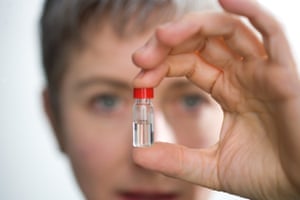
Elaine Lissner of the Parsemus Foundation with a vial of Vasalgel, a non-hormonal contraceptive for men. Photograph: Male Contraception Information Project
One man who is keen to try it is Justin Terry, a married 30-year-old machinist who makes vehicle parts in Alabama. He and his wife don’t have children, and she is taking the contraceptive pill. “We’ve been married 10 years,” Terry says. “She doesn’t want kids and neither do I, really. She wants to get off the pill.” It gives her tender breasts, and she is concerned about adverse effects of continuing to take it. Terry has also considered vasectomy (as have I), but has hesitated because it is more invasive and not completely reversible. “Vasalgel sounds like it will be reversible and would involve much less invasive surgery,” he says.
Parsemus’s efforts have been helped by the David and Lucile Packard Foundation, also based in California, which provided $ 50,000 to help them test Vasalgel in baboons. “We expected to be out of money last year and we’re not,” Lissner says. “But the clinical trial is half a million dollars, so that’s a different scale. Beyond that, it’s multimillions.” The trial will involve about 30 men and will test Vasalgel as a vasectomy alternative, without looking at reversibility.
Knowing the field’s status, Lissner is not relying on government or the pharmaceutical industry. Instead, she is looking for backing from wealthy social investors – and potential users – and is publicising what might be possible in the field to bring interested parties together. “The difference is that we have built an infrastructure where the public is able to channel its support,” she says.
On Blithe’s suggestion, I watch a Channel 4 documentary called The Great Sperm Race, which shows the journey sperm make through a woman’s uterus to her fallopian tube. It has people dressed in white as sperm, and they die in vast numbers. From the millions of sperm ejaculated, 20-100 get close enough to the egg to try to fertilise it.
Related: Pills, thrills and polymer gels: what’s the future for male contraception?
As I watch, I imagine the white-clad actors instead represent the many possible male pills. There have been, and still are, masses of ideas – far more than I have been able to mention here. And yet, like the unsuccessful sperm, many have fallen by the wayside. I think of the contraceptive drug industry’s current status and I can’t help think we have missed its fertile period. If the perfect idea were to fight its way through development today, there is only a tiny chance that there would be a partner to meet it and eventually produce a fully formed male pill from it.
It seems obvious that if a new male contraceptive does make it to maturity, it will be thanks to the efforts of people such as Blithe and Lissner. They, as much as anyone, are trying to create environments where the right technology can take seed. But without keen interest from the traditional contraceptive industry, that will require an enormous effort. Lissner’s energetic attempts to consolidate support from men like Justin Terry, my dad and me could prove critical.
Lissner is adamant that the ideas that seem to have faltered are not dead – they’re just resting. “We keep collecting new methods, and never finish the ones we have,” she fumes. “Pick one and make something! Finish the job!”
• A longer version of this article first appeared in Mosaic and is republished here under a Creative Commons licence.