This Sunday’s episode of Call The Midwife (BBC1 8pm) will chart new territory as the sisters of Nonnatus House tackle female genital mutilation in 1960’s Poplar.
The BBC One drama will take a sympathetic look at the plight of Nadifa, a mother-to-be from Somaliland, who has undergone the procedure and is struggling with the after-effects.
Heidi Thomas, creator and writer of the series, told Woman’s Hour she had wanted for some time to explore the issue: “I have been interested in FGM for some time and it did seem to me that if we waited until 1962, the Somali community were beginning to settle and establish a foothold in the East End.”
An estimated 200 million girls have undergone FGM worldwide. The procedure involves the partial or total removal of the female genitals for non-medical reasons. UK hospitals now treat one FGM survivor every hour.
In 1962, the Somali community were beginning to settle and establish a foothold in the East End. Photograph: BBC/Neal Street Productions
Nimco Ali, anti-FGM campaigner and co-founder of Daughters of Eve, advised the programme makers on the episode. It’s loosely based on the experiences of her close relatives who moved from Somaliland (an independent state north of Somalia) in the 1960s.
Ali, who underwent FGM at just seven years old says that while the episode’s approach may “ruffle some feathers”, she was impressed with the “immense level of knowledge” the writers showed. .
“[It’s about] setting yourself in the mindset that it was set in the 1960s – this was the language that they used,” she told the Guardian. “There is that authentic thread that runs from the realities of 1960s to the privileges and the work that’s waiting for us [as anti-FGM activists] in 2017.”
Ali hopes that viewers won’t feel overwhelmed by the trauma that FGM brings, but that they will feel heartened to act and support anti-FGM causes.
“If you look at the statistics around FGM they look massive, and there’s no way to come at it, but it’s one girl in one generation. It’s about breaking the cycle.”
“I’m hoping that… a lot of my sisters will see that they can have these conversations. That a midwife might not necessarily be of this culture but they understand and as women they can appreciate their experiences from a Somali perspective.”
Simon Wheatcroft went blind at age 17. Yet today, he runs marathons. Leigh Alexander explores the incredible story of how he is able to do this with the help of some particularly innovative technology. This is a re-run of a podcast we launched in June 2016
According to figures released last month, Australia’s suicide rate is increasing, and death among men from intentional self-harm is three times greater than that for women.
In Man Up, a three-part ABC-TV series which aired its second episode on Tuesday, radio presenter Gus Worland is spurred by the 2006 suicide of a friend, Angus – and, more recently, conversations with his widow and daughter – to challenge stoic, self-reliant stereotypes of masculinity, and instead champion emotional vulnerability and communication as signs of strength.
It’s a well-meaning, heartfelt show, but flawed: Man Up spends too much time trying to entertain and not enough time challenging the normalised, constructed identities of Australian manhood – white, heterosexual, masculine – which continue to alienate anyone who falls outside them.
Worland jackhammers concrete on a worksite, talking to men in the construction industry about their particularly high risk of suicide. He goes yachting with returned military servicemen dealing with trauma. He takes part in male nude yoga – all in an attempt to get beneath the skin of men.
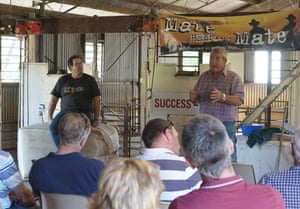
Gus Worland and farmer John Harper at the Mate Helping Mate country man organisation meeting, featured in Man Up. Photograph: ABC
He poses for a GQ shoot, while we learn about commercial, fluffy categories of manhood: metrosexuality, retrosexuality and, I kid you not, lumber-sexuality (some sort of mix of lumberjack and hipsterism). He tries to craft a media campaign to appeal to men to talk, even consulting one advertising guru who was responsible for reinforcing the stereotype that the social world of men revolves around booze and barmaids with big boobs.
All of this is watchable, but it leaves less than a minute for discussion of the high rate of suicide among Aboriginal and Torres Strait Islander men. That task falls to Wiradjuri man Joe Williams, a former National Rugby League Rabbitohs player who doesn’t appear on screen but whose voice is heard as a radio talkback caller.
There is no explicit mention of gay and bisexual men, or those whose identity falls outside normalised gender binaries. If, as the Man Up manifesto states, the “pressure to be an Aussie man is fuelling a suicide crisis”, then we must acknowledge the groups of men who are the most at risk of depression, anxiety and suicidal feelings.
This show cannot be all things to all people, of course – yet it doesn’t even seem interested in trying to speak to the spectrum beyond blokey blokes. Man Up’s reliance in Tuesday’s episode on UK-born Australian psychologist and author Steve Biddulph – whose opinion is unquestioningly sought in on-the-road interviews – makes me wonder if the series is coming from a very conservative view of male identity.
Steve Biddulph, author of Raising Boys. Photograph: David Levene for the Guardian
Biddulph’s 1997 book Raising Boys is described in Man Up as “the handbook on how we can better raise Australia’s sons” – but I remember it differently.Biddulph’s glib, blithe discussion of homosexuality in an early edition distressed my own mother, making her fear she was at fault for my orientation – even though I’ve been living happily as a gay-identifying man for some time. It was in Biddulph’s book, so it must be true, right?
Now in its fourth edition (2013), Biddulph has made a few palatable tweaks to his bestseller, but it still raises dubious “mounting evidence” that sexuality may be determined by “certain hormonal settings” in the womb – without citing an actual scientific reference. The book still makes the outdated, sloppy suggestion that having a teenage gay son “demolishes” parents’ “fond hopes” of a “rewarding career, marriage and grandchildren”. And it still says that “some dads fear that cuddling their son will turn him into a ‘sissy’. In fact, the reverse is probably true.” (To his credit, Biddulph has deleted the subsequent line of earlier editions: “Many gay or bisexual men I have spoken to say a lack of fatherly affection was part of what made male affection more important to them.”)
As Flinders University psychologist associate professor Damien Riggs wrote in 2008: “[Biddulph’s] inference is that if fathers gave more affection the sons wouldn’t grow up to be gay, which is thus constructed as the preferable option.”
The most affecting scenes in Man Up involve Worland’s own teenage son, Jack. In the second episode, facilitator Tom Harkin runs a special workshop on masculinity, in which Jack and fellow students apply nail polish. “Not a guy thing to do,” says Harkin, who then asks: “Who wrote that rule?”
The workshop encourages these teenagers to rethink what it means to be a man, to talk, to listen and to show emotion. To cry, which they do, openly and cathartically. This would have been the ideal point to say: it’s OK to be straight, bisexual, gay, queer; it’s OK to question your identity or gender. But the show is too timid to make that important leap, instead relying uncritically on Biddulph as a barometer of all men’s emotional lives.
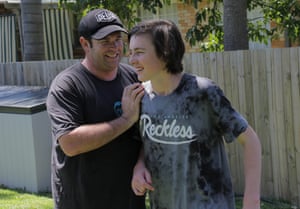
Gus Worland and his son Jack. Photograph: ABC
There are other missed opportunities. Man Up vaguely links suicidal ideation among men to financial pressures. What these pressures are is not spelled out, but surely there is a great deal to say about the growing inequity between rich and poor. The rising costs of rent and mortgages under a government unwilling to change investment policies. The burden many men take on to be primary breadwinners, and where that burden comes from.
We are told in Man Up that women attempt to take their lives more often than men, but men are more likely to die. We are told this is because women reach out for help more often, but other factors – such as the preference among women for drugs as a means of suicide – would have been worth discussing.
My hopes for Man Up clearly overreached its narrowly focused aims. But in its sincere efforts to find a new vocabulary for men, the series is a step in the right direction.
• Man Up continues on 25 October on the ABC; for information and support in Australia call Lifeline on 13 11 14, Mensline on 1300 789 978 or Beyond Blue on 1300 22 4636
Waste and sources in the United kingdom has now evolved into a mature business – employing 1000′s, turning in excess of billions of pounds, encompassing several disciplines and recognised as a vital element of a potential circular economy. But what was it like forty or so many years ago when recycling and reuse was something promoted by a few lone voices against a bulk that noticed nothing incorrect with landfilling most of our waste, in which littering was much more acceptable?
I have lately returned from a journey to the west African states of the Gambia where I spent some time with Isatou Ceesay, founder of a revolutionary neighborhood recycling undertaking, the Njau Recycling and Cash flow Generation Group (NRIGG). And, as in the Uk in the 1970s and 1980s, it is neighborhood-based groups top the way. Few components of the nation receive a municipal waste assortment service, let alone a recycling services, so it is up to communities to treatment this.
Considering that 1997 Ceesay has been doing work with communities across the small west African state to address not only the environmental influence of unregulated waste disposal but also to offer cash flow to what now amounts to above one hundred females. NRIGG is primarily based in four separate communities across the nation – the members collect the materials themselves and transport it by hand to their centre, which is typically just somebody’s compound. Ceesay has hit that elusive sweet spot, offering jobs and livelihoods but also enhancing the surroundings.
Her mom thinks she’s mad. Why must she want to commit her life dealing with other people’s rubbish? But she sees what these around her couldn’t – that the population was surrounded by ever growing mountains of waste, with a pressing require for much better management of the domestic waste which is both dumped in unregulated landfill or, worse, burnt compounds.
Waste heaped up close to a bus-end in west Africa. Photograph: Ahmed Jallanzo/EPA
The affect of unregulated waste is manifold and properly understood – from the disease connected with the blocking of drains by the ubiquitous plastic bags provided out freely with even the smallest obtain, to the result on air high quality of uncontrolled burning of waste (again, largely plastic), as effectively as the impacts of landfill gasoline from uncontrolled landfills. And this is prior to you even consider into account the visual impacts of uncontrolled littering is considered – important to a country like the Gambia where tourism accounts for around a fifth of GDP.
Ceesay’s concern is primarily for people that deal with their very own waste, and she aims to assist them to do it far better. Her crucial aim is to cease the burning very first and foremost, top with a message of waste prevention, especially focusing on plastic, followed by promotion of reuse and implementation of recycling schemes.
The uncontrolled burning of plastic must be regarded as one particular of the wonderful environmental well being hazards of our time. It is connected with a variety of really harmful pollutants, from carbon monoxide, which affects mental perform, to dioxins and furans that result in cancer and affect immune and reproductive technique and are persistent in the surroundings. It is also connected with contaminants and other volatile organic compounds that result in cancer and respiratory sickness, to asthma. In brief, it’s a public well being nightmare.
Meanwhile a lot of of the municipal companies taken for granted in the Uk (including simple waste disposal) simply do not exist in the Gambia. Outdoors of a handful of urban locations, it is entirely down to communities to deal and control with their very own waste. This is a frequent story across the creating planet, with about three billion individuals residing with out any formal waste management system. The influence on wellness, environment and high quality of existence stays unmeasured.
But what does a single do in a nation the place there is very minor waste disposal infrastructure, allow alone recycling infrastructure? Nicely, you develop your very own. And in their four communities, NRIGG have produced total lifestyle cycles for a selection of typical supplies. They have devised their personal separation program, with organics, paper, plastic, metals and glass and produced, in which it can, its very own end markets.
Property composting training is given to people communities where schemes are set up, answering a demand for low cost, substantial good quality organic fertiliser. There are some existing markets for metals and these are separated and offered to traders. Not only for metals, Ceesay has had to come up with ways of turning the resources from waste into wealth. Plastics are separated and stored to be up-cycled into every thing from robust, lengthy life bags, mats, purses. Rubber is turned into necklaces. Previous cassette and video tapes are even woven into purses. This is combined with other non-waste actions, which includes honey manufacturing, production of waxes, lotions and batiks. Even however these are non-waste connected, they help the girls who can then proceed to provide and control the recycling schemes.
Earrings manufactured from recycled waste. Photograph: Mike Webster
These are also combined with a range of other schemes that support the women strategy their incomes during the yr, save for the 3-month “hungry gap” at the finish of the yr, when family farms aren’t producing, and develop their organization capabilities. This is vital, simply because as several neighborhood recycling schemes at house as effectively as abroad have proven, sustaining these schemes is possibly the hardest component.
But issues remain. If the scheme could increase to this kind of a point the place containers of materials could be bulked and passed on to the international market place, new and more material streams could be developed. Somewhat strangely it seemed to me, the main dilemma waste stream faced by NRIGG was how to deal with glass. In the Uk, glass has usually been considered possibly the best of all supplies to collect, but with no regional end markets and a lack of scale to entry international markets, it is a problem in the Gambia. This perhaps points to the need for little- to medium-scale technologies that can reprocess such resources. Could this be a gap in the marketplace?
The other challenge is that of a comprehension gap by individuals who could otherwise support. The Gambian authorities look disinterested in delivering companies outdoors a handful of tourist regions, with a focus on clearing materials and dumping it in poorly regulated landfill, unaware of the massive financial and employment positive aspects associated with greater recycling (probably comparable to the present Uk administration?). In a country in which the 2013 per capita GDP was $ 512 (£303), the economics of labour intensive sorting and reprocessing are certainly a lot more favourable?
And this is a scheme whose time has come. The require for far better waste management is pressing, as urban populations expand, incomes enhance and waste arisings develop, modify, grow to be harder to deal with and current a higher wellness risk. There are also jobs in it.
But the pioneering factor is the two the opportunity but also the challenge – as soon as Ceesay has convinced her mother, she nonetheless has to persuade an indifferent government and public. But it is an fascinating time – this is the commence of anything that can only increase.
Mike Webster is operations manager at London Local community Assets Network, and has worked in the resource and recycling sector for two decades.
Interested in obtaining out a lot more about how you can reside greater? Get a look at this month’s Live Better Challenge here.
The Reside Far better Challenge is funded by Unilever its target is sustainable residing. All material is editorially independent except for pieces labelled advertisement characteristic. Uncover out a lot more right here.
Would it be concerned you to know the fish on your plate isn’t what you consider it is or exactly where you feel it’s from?
Taking into consideration the U.S. imports 91% of its seafood in a system that makes it effortless for businesses to get away with unknowingly marketing clients mislabeled fish, perhaps it should.
A new research published in the journal Marine Policy exhibits that up to one-third of wild-caught seafood imported into the U.S. comes from unlawful, unregulated and unreported fishing (IUU). The unlawful imports are well worth between $ 1.three and $ 2.1 billion in a $ sixteen billion marketplace. The examine was sponsored by the Planet Wildlife Fund Globe Wildlife Fund.
California currently has its Nation of Origin Labeling (Cool) law in location, but the lack of transparency, accountability and a appropriate monitoring technique makes it challenging to know in which seafood is really coming from.
The report found that about 90% of seafood exported by the U.S. to China is either re-processed and exported by China to other nations or re-processed back to the U.S. In 2009, about 97% of China’s complete imports of whitefish, salmon and tuna have been sourced from 10 countries, with 57% of it coming from Russia.
A research in 2013 by nonprofit ocean protection group Oceana unveiled that in 120 samples labeled red snapper, 28 various species of fish were discovered, which includes 17 that weren’t even in the snapper loved ones. The research prompted the California Senate Wellness Committee to approve a bill Wednesday that would make it illegal for any man or woman to knowingly promote mislabeled seafood.
Still, the mixing of illegal fish items into provide chains when processed muddies the circumstance.
“We have a complicated international industry in which a substantial percent of the item is coming from the method illegally that we cannot figure out how to keep out,” said David Schorr, senior manager of the WWF’s Transparent Seas Project.
Schorr said the U.S. demands to figure out how to trace fish the way it traces a good deal of other items like an Amazon.com Amazon.com buy, which utilizes barcodes.
“We require to use that type of technology to start tracing fish simply because it is not just a threat to shoppers, but it can hurt business brand names,” mentioned Schorr.
In California, some restaurants and firms are already tackling the dilemma in sustainable seafood reform. Arctic char, for instance, is rated as the greatest choice different for farmed salmon, in accordance to Shawn Cronin, enterprise outreach manager at the Monterey Bay Aquarium Seafood Observe program. Cronin has been working on expanding the system, beginning with inbound requests in California but hopes to set up a nationwide system.
Amongst 120 dining establishments that participate in the Monterey Bay Aquarium’s Seafood Observe Plan, 75% are primarily based in California. Other participating organizations incorporate Total Food items Industry Whole Foods Market, Safeway Safeway and Wal-Mart.
Not only would a worldwide initiative to track seafood shield at-risk species, a motion for sustainable seafood consumption would thwart risks of consuming specified species of fish with unhealthy ranges of mercury and serious allergic reactions.