gone etiketine sahip kayıtlar gösteriliyor. Tüm kayıtları göster

11 Mart 2017 Cumartesi

Forgetting but not gone: dementia and the arts

Harvey’s reaction to his dementia is not what you might expect. “I’m so happy,” he says. “I wouldn’t reverse it for anything.”


Harvey has a relatively rare dementia called posterior cortical atrophy or PCA, a variant of Alzheimer’s disease. Inasmuch as he has difficulty remembering things and can’t do basic arithmetic, his condition conforms to the stereotype of dementia. But PCA particularly affects spatial awareness: it can lead to disorientation, visual illusions, and problems with making your movements coincide with your perception of space. Harvey has trouble with vests; another person with PCA recounts how, aiming to sit in an empty seat, he found himself instead in his vicar’s lap. But for Harvey, who is 78, these are just inconveniences in a wonderful life. He has never, he says, felt so full of love for his wife, Diana, who confirms that his expressions of affection are much more frequent now than before his PCA developed.


Harvey and Diana might be considered the lucky ones. Plenty of people with PCA, and their families and carers, have grimmer stories to tell. But there are many cases that challenge the widespread perception of dementia as a condition to be dreaded. The stereotype of an elderly loved one sitting blankly in a care home, unable to speak or recognise relatives, is not all there is to it. And changing this public perception of dementia is one of the prime objectives of a £1m, two-year project called Created Out of Mind .


Music for Life 360 uses machine learning to analyse interactions between musicians and people with dementia


Supported by the Wellcome Trust and housed in its Hub space at the top of the Wellcome Collection on Euston Road in London, Created Out of Mind is the brainchild of Sebastian Crutch, a neuropsychologist in the Dementia Research Centre of University College London. As well as challenging stereotypes about what it means to live with dementia, the project aims to develop better tools for assessing the value of using arts with people who have these conditions. All too often, such efforts are perceived as “giving them something to do”, or perhaps as utilitarian therapies for sustaining cognitive skills. But if the real personal enrichment of the arts often comes “in the moment”, why should it be any different for people with dementia? And such activities can reveal a creativity obscured by impairment of an individual’s resources for regular communication.


When Crutch asked me to join the research team, I gladly accepted the opportunity to learn more about a condition that will affect most of us in our lifetime – if not as a patient then as a carer or relative. My own experience of having to gently assure my grandmother that she was still living in the house she had occupied since before I was born, and not in some unfamiliar care home where all her knick-knacks had been arranged in a simulacrum of her house, is representative of experiences most of us have had, or will have.


Alzheimer’s disease is the most familiar form of dementia, but it accounts for only about one case in three, and itself has many variants with specific symptoms. There is a galaxy of other dementias, generally diagnosed from their cognitive symptoms and perhaps brain scanning. Other neurodegenerative conditions such as Parkinson’s disease can also progress to dementia. And not all forms of dementia happen in old age – some can appear in people still in their 30s.


Neither are they all about loss of memory. It may be precisely because we are used to the experience of forgetting things like names or where we left our keys that we read the appearance of dementia as forgetfulness. But sometimes the mental disruptions that look superficially like memory loss are actually operating in a more puzzling way. Asked if she can recognise photos of famous faces – Tony Blair, Bill Clinton, Terry Wogan – one person with PCA in a video Crutch shows me can name none of them. But it’s not so much that she doesn’t recognise the face; she struggles to see it as a face. “That’s the face there, isn’t it?” she asks hesitantly as she looks at Wogan.


It’s not a lack of recognition – the patient could say perfectly well who Blair or Wogan is. Her situation seems to be akin to that experience of seeing an image or an object, perhaps when we’re tired, and being momentarily unable to decode its content: is that a face, or the folds in an item of clothing? We can see clearly enough but can’t parse the shapes and shadows. “For a person with PCA, much of the world is of that ilk,” says Crutch.


What’s lost here are not facts, but ways to interpret the world. Some forms of dementia can affect how we label concepts, or our ability to retrieve those linguistic tags. Crutch shows me clinical videos of two people with primary progressive aphasia (PPA), which affects such aspects of semantic processing. One man speaks haltingly, slurring his words, sometimes getting the syllables wrong. The sentences are perfectly coherent but are produced with great difficulty. There’s no impediment to the way his mouth moves, but he’s struggling to connect words to the appropriate sounds. This man, says Crutch, carried a card he could show to explain why he was articulating in this way – otherwise people might think he was drunk.



Sebastian Crutch, a neuropsychologist in the Dementia Research Centre of University College London.


Sebastian Crutch, a neuropsychologist in the Dementia Research Centre of University College London.

The other PPA patient has degeneration a little farther back in the part of the brain where language is processed (the temporal lobes), impairing not word production but access to its semantic content. He is almost hyperfluent, articulating his words accurately and rapidly. The trouble is, he has lost the labels. He explains that he has been tying back his roses, but can’t describe them generically as plants, nor mention concepts like stem and thorn. Instead, with unselfconscious improvisation, he explains with finger gestures that they are things that branch and then branch again, and have those things on them that might puncture holes in your hands. “I can’t remember what you call them now, but we’ve got a thing that comes up, and they’re like that, and they’ve got all little bits on it…”


In such cases, less common words vanish sooner than ones used more often. Testing patients with animal recognition, “iguana” disappears before “dog”. Eventually this leads to extreme category errors: a less familiar image of, say, a gorilla might be interpreted, tentatively, as a car, not because that’s what it “looks like” to the patient but because he has so few categories of any sort to call upon in making an interpretation. This might tell us something about how we encode concepts mentally: perhaps we simply do more of that for familiar ones, so that we still retain some reference points when others are lost.


These are confusions in the brain’s ability to represent the world semantically. By contrast, in conditions like PCA, lesions in a different part of the brain can disrupt the “how?” or “where?” – the sense of space. One patient, asked to grasp the doctor’s right hand, does so easily. But he can’t make out where the left hand is at all, even though it is held just as clearly in front of him. After some guidance, he spots it – but asked then to take hold of it, he misses entirely and grasps the doctor’s shoulder. These spatial tasks are processed by both sides of the brain, each side dealing with the opposite region of space. So the lesions in this patient are probably concentrated on the left-hand side.


It’s hard for us to imagine this – it’s not at all like having only one eye working. “Everyone thinks vision means eyesight – they don’t connect vision problems with dementia,” says Crutch. But most people with Alzheimer’s will experience visual impairment at some stage, he says.


Harvey, a former electronics engineer who played drums and piano in a jazz band for much of his life, has his own experience of such spatial distortions. He was playing the piano when suddenly the keyboard seemed to have risen by four inches. Another time the keys seemed to disappear. As it is, he can no longer remember what the notes are called, nor can he decode written music (“all those lines!”). But like many jazz musicians, he plays primarily by ear, and still practises for several hours a day. In that still poorly understood miracle of the musical mind, he finds his fingers can keep going when his conscious mind cannot, constructing complex jazz chords that surprise him.


The visual illusions of PCA can be deeply disconcerting. Helen, a woman caring for her mother now in an advanced stage of the condition, tells me that her mother would furiously accuse her husband and other relatives of playing tricks on her when the coffee jar suddenly “reappeared” from where it had vanished a moment ago. This kind of irritable response, while wearing for carers, is a natural strategy for rationalising the confusion. Objects don’t disappear without a “reason”! Helen says her mother went through umpteen pairs of glasses, apparently a typical experience in the early stages of PCA.



Object Decision, by the artist Charlie Harrison.


Object Decision, by the artist Charlie Harrison, 2014, is a series of paintings based on tests used by neuropsychologists to determine how well someone is processing visual information. These tests are used in the diagnosis of posterior cortical atrophy (PCA).Asking the public to try to identify the silhouettes has been a good way to get them involved in a conversation about neuropsychology and people affected by dementia-related visual perception. Photograph: Charlie Harrison/Wellcome Collection

At the beginning, the visual distortions can come and go, often prompting frustration or disbelief from others. Helen explains that her mother would occasionally lose the ability to navigate drinking from a cup – but at other times it was fine. “Even her best friends didn’t believe her,” she says.


Care home workers can’t possibly know all the nuances of dementias, and are generally used to working with people showing the gradual, predictable decline in abilities that comes with Alzheimer’s. It’s understandable, then, that they might not appreciate that because a patient like Helen’s mother has just taken a sip of tea, she might not be able to do so in five minutes’ time. It’s not hard to see how this could lead to suspicions of “playing up”, especially when patients are themselves made grumpy by the difficulties.


Perhaps most disconcerting of all are visual hallucinations of the sort that can be produced by the relatively common condition called “dementia with Lewy bodies” (DLB), which sometimes occurs alongside Alzheimer’s. One person in Seb’s videos talks clearly and calmly about finding his house full of people dashing about.


“I came home one night, and all of a sudden there were people in the room,” he says. “There must have been at least a dozen, running and screaming everywhere. When you see that, you panic yourself – you don’t expect anyone in your own living room. One was dressed like Coco the clown. I thought I was dreaming.”


Seeing people is quite common with DLB, but other hallucinations can be more surreal. One person diagnosed with the condition told Crutch that when he looked at table edges and door frames, he saw them bending. But his rational brain knew that this couldn’t be true.


There’s the problem: it’s not so much that you’re seeing things that aren’t there, but that our brains, still retaining the power of reasoning, have to deal with impossible information. “How do you hold that tension between the two things without driving yourself mad?” Crutch asks. And who can we trust, if we can’t rely on our own senses? Even the man who saw Coco the clown in his living room admitted scepticism about being told he was just hallucinating. How can we go on and on dismissing what we’ve seen if it doesn’t seem to fit with what we know ought to be so?


Seen this way, says Crutch, responses from some dementia patients that might be interpreted as aggressive, paranoid or obnoxious might in some respects be perfectly normal reactions to an unfaithful mind – all the more so when the condition has developed beyond the point of a patient’s conscious ability to rationalise away their hallucinations. If your handbag is “not where you left it”, isn’t it reasonable to conclude that the care home staff have stolen it?


A particularly distressing form of the confusion that DLB can induce is called Capgras syndrome. Here the patient recognizes a carer or family member but loses the ability to connect that individual to the one they remember. They become convinced that he or she has been replaced by an impostor.


One woman described her husband’s experience of this condition. “He said, who are you and what are your duties here? So I said, Well, I’m Betty. And he said, Yes, but you’re not the Betty I know. I said, There’s only me. That’s when he started walking up and down the stairs, going in and out of the rooms, wouldn’t sleep.”


It seems such a bizarre belief that the invitation is to imagine the person has totally “lost their marbles”. But on the contrary, says Crutch, the “impostor” interpretation is also a reasonable deduction. “If it doesn’t feel like the person you know, then you’re not being irrational, you’re trying to use the rationality available to you to explain the experience.”


Dementia is mostly, and rightly, associated with deficits of one kind or another in mental abilities. But the mind is extraordinarily inventive about circumventing difficulties or improvising with what it has to hand, and it’s not so surprising then that these neural gymnastics might introduce new aspects of personality, new interests and capacities. These might be puzzling or bewildering to people who see a loved one change, but as Harvey attests, the results need not be solely negative. Someone might develop a hitherto unseen passion for opera. They might take up painting with almost manic energy. Or they might discover new facets of their creativity.


In the case of British artist William Utermohlen, who was diagnosed with Alzheimer’s in 1995, painting enabled him to create an extraordinarily expressive testament to his disintegrating sense of self. Utermohlen’s self-portraits, produced over the following five years, have been widely hailed as offering an insight into the condition. The final portrait, painted in 2000, seven years before his death, is a pencil-drawn head with two black holes for eyes, suggestive of a soft toy long neglected in the dust of a playroom.


But what remains intact in all these images is a sense of artistic integrity – their increasing abstraction sacrifices nothing of the power. Crutch visited Utermohlen in his flat in late 1999, when he still retained some ability to communicate. He was able to indicate how one striking self-portrait at his desk under a skylight, with one hand clinging to the corner, reflected his sense of desperately trying to hang on and avoid being swept out of the open window. “I suspect that the painting was more eloquent than anything he could have said at the time he painted it,” says Crutch.
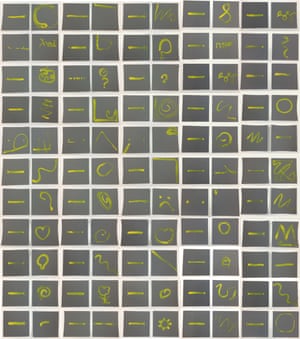


Single Yellow Lines, 2017, Charlie Harrison


To test the effect of dementias on the way people express themselves through gestures, a Created Out of Mind research project asked participants to paint a line on a pair of canvases: on the first, the straightest line possible, by joining the dots; on the second, an expressive line of their choice. Between the start and end point of the gesture, data is gathered and analysed (heart-rate, eye-tracking, temporal experience etc). Photograph: Charles Harrison

Some see this as no different from the artist’s usual practice of conscious self-expression, albeit with diminishing resources. But Crutch is convinced that not everything in such art might be there by intention; the works might also testify to the nature of the condition. When Utermohlen was in their research centre at UCL, they asked him to draw a man. Far from the stick figure most of us would have produced, Utermohlen produced a beautiful sketch full of charm and wit. But there was something amiss. He knew it, but couldn’t figure out what it was.


To Crutch, and to most of us, it couldn’t be more plain: both of the figure’s arms were coming out of the same shoulder socket. This was a classic example of the spatial confusion of PCA. “I absolutely deny that this was his artistic intent,” says Crutch. “His tools had just been blunted.”


As well as seeking to change public perceptions of dementia, Created Out of Mind hopes to explore the role of the arts in these conditions. In projects such as Music for Life 360, which uses machine learning to analyse interactions between musicians and people with dementia, and a study of psychological and hormonal responses of a choral group, researchers will be seeking new ways to measure the effects of engaging in artistic activities.


Very often, initiatives such as this are seen solely therapeutically: as “good for the patient”. There’s no doubt this can be true, but as Utermohlen showed, they have far greater potential. Because arts may involve different parts of the brain – different communicative pathways – from the faculties of daily interaction such as talking, they might help to keep channels open. It’s very common for patients who might have become nonverbal to respond to music, perhaps even to sing.


The temptation is to respond that “At least she remembers something!” But there could be more to it than that. As conditions like PPA show, loss of language use doesn’t necessarily imply loss of understanding or desire to interact verbally. In fact, the extreme deterioration of that ability can produce some incredibly poignant testimonies to the inventiveness and determination of people to communicate. One man with PPA was, in the late stages of his condition, left with only two words: “Millionaire” and “Bub”. But, says Crutch, he would manage with just those severely depleted resources to express feelings and responses with the tone of his voice.


So arts aren’t just a “way of keeping them occupied”, but may become avenues for releasing genuine creativity. It’s easy to assume with people rendered mute by dementia that their understanding and inner life has gone just as silent. “You hear time and time again from carers who use music with patients that suddenly there’s a reconnection,” says Crutch. They often say not that this has transformed the patient but that it confirms that the awareness they always thought was there really is there.


Susanna Howard, founder of the charity Living Words, works with people with dementia to produce poetry (see panel). The remarkable, often moving results show the form’s capacity to express the person’s experience:


We lost a lot of nice things, all kinds –
They go away. A little bit I got here and then
All of a sudden there was nothing I could tell you.
Could not put two together. I had a lovely story
But it took my – you know, when I found out
I couldn’t talk mouth ways, like now,
I can’t think.


These points of connection are reminders for us, the healthy ones, that the person with dementia, who doesn’t know who we are any more and can’t talk and doesn’t even seem to see us, is still a person.


“Because we focus so much on the verbal, there’s an underlying lack of clarity about what these people actually experience when they can’t tell us any more,” says Crutch.


Lacking their direct testimony, we’re apt to make assumptions about it – which might obscure the person now for what we imagine them to have once been. This engagement with the present is precisely what the arts can offer, says Julian West, an oboist and researcher at the Royal Academy of Music. West has for years made music with people affected by dementia, for example in the Music for Life project at London’s Wigmore Hall.


“A few years ago I was working with a woman who was a Holocaust survivor,” he tells me. “She had very little capacity for verbal communication, and there was a lot of anxiety surrounding her, with carers worrying about how her dementia might ‘unleash’ memories of her experiences. The ‘in the moment’ experience, however, was that she looked at everyone with bright, animated eyes, and was very engaged with the music-making. At a pause, she made eye contact with me and very playfully sang ‘cuckoo’. I and the other two musicians were able to then improvise a piece with her based on her cuckoo motif, which she continued to sing. It was an expression of her playfulness and energy, and let us relate to her as she wanted to be rather than through our worries about her.”


West continues: “The focus of the work I am involved with is not at all about ‘helping people to remember’. I sometimes wonder whether the perceived need for people with dementia to remember things is more important for family, friends and carers. The idea that someone can retain value and identity independent of memory and capacity is outside many people’s thinking, and so the loss of memory is very frightening for them.


“The arts are a powerful vehicle for helping everybody to understand more of the complexity and diversity of people’s experiences,” says Crutch,”and to adjust ourselves to better maintain our social contact. Again and again we come across people who say: what really helped us to understand this person was connecting through music, or sharing in a response to a picture, or a carer seeing someone who can still create something. It can still be about who they are, not just who they were.”


Words unlocked: dementia and poetry


Making poetry with people with dementia takes time, explains Susanna Howard, artistic director of the project Living Words. She typically spends several months in a care home, generally with people with advanced dementia – beyond the point of reminiscence. “We don’t ask any questions,” she says. “We sit in silence in the shared experience with the participant, and as words come we write them down and read them back to the person.


“All words matter. It can be the smallest, seemingly insignificant words a person uses that have the most meaning for them, and we write every word down without trying to ‘make sense’ of them. ‘I don’t know’ or ‘Nothing’ says a lot about how that person is feeling.”



Susanna Howard

Susanna Howard

One person she worked with recently kept repeating under her breath, “I am the woman no one is watching.”


Then the editing begins. “We slowly start stripping away, reading their words back and seeing whether they resonate with the person. We only remove – we never add or jiggle words and meaning around. The intention is that the pieces are being written for that person, for them to feel validated. Often you can be reading a person’s words to them and they say ‘Yes, that’s just how I feel.’” The titles of these pieces are usually the first response that the person has on hearing their words read to them: Want People To Know What It’s Like, Can’t Think, I’m An Okay, All You Got.


This is deep work, Howard says. “We have the luxury of time to sit with people one-to-one. And it’s about equality of relationship within the creative process – the person is not ‘having art done to them’ but is actively engaged in meaningful shared experience.”


There can be direct therapeutic benefits. “This is like medicine to me,” said one care home resident. It offers social interaction and can encourage better relationships with caregivers, and allows people to feel heard and validated.


The results, however, reach beyond the personal. Like the best poetry, what they offer is a direct, stripped-down truth: a communication where, perhaps, none seemed any longer possible.


Speaking


This place is mad, it is
I think, think it’s good
To get out, I’m speaking
Look at round there
They’re wanting me now
A mad one, near
Don’t say much
It will come
The lost word


Forgetting but not gone: dementia and the arts

8 Mart 2017 Çarşamba

An afternoon with Stan Bowles: the twinkle is still there but the memories are gone

The smile has not changed, as puckish as it always was; nor has the mischievous glint in Stanley Bowles’s sea-blue eyes. I remember it all like yesterday, when Bowles bedazzled football, weaving, winding through a humiliated defence yet again, in the hoops of Queens Park Rangers, atop the league, back in the 1970s.


But at a pub in his native Manchester, Stan himself remembers none of this. His Alzheimer’s disease is now, as they say, “100%”, both sides of the brain, “and something at the back”, adds his daughter Andria, nowadays, as she describes herself, “full-time carer” – and lifeline. Of course, we recall a few goals of yore: “We’re talking about you playing football, Stan.”


“Football?”


Fifty years ago last weekend, QPR won one of the most remarkable cup finals in football history: from the Third Division, they overcame a two-goal deficit to defeat First Division West Bromwich Albion 3-2, and win the League Cup. I was at Wembley that unforgettable day, aged 12, with my father and brother, dizzy with disbelief.


Little did we know, though, that 1967 was just the beginning for hitherto humble Rangers. Within 10 years the club came within 14 minutes (during which Liverpool put three past Wolves, in a deciding game) of the First Division title, equivalent to today’s Premier League. But memory of the zenith decade casts a shadow over QPR’s half-centennial, for that achievement in 1975-76 was synonymous with the uncanny brilliance and waggish personality of one player: Bowles. The man who, as his best friend Don Shanks says, “can hardly remember who he is. It’s heartbreaking, soul-destroying.”


My God, those days. I travelled every long weekend either back from university to west London or up and down the M6, M1, usually in a Morris Minor driven by my best friend Patrick Wintour (of this parish), brother Tom and a friend, William, whose family had shared our house. We went to watch the Superhoops and above all the greatest player ever to wear them, Bowles. My sister, now a professional illustrator, started her career by winning, aged 15, a “Draw Stan Bowles” competition. My first ever article was published in The Superhoop supporters’ club magazine.


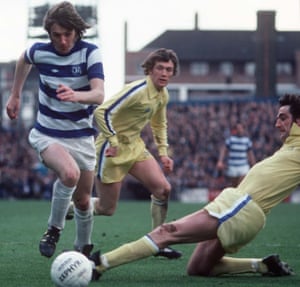
Stan Bowles eludes Leeds’ Norman Hunter and Trevor Cherry


QPR’s Stan Bowles eludes Leeds’ Norman Hunter and Trevor Cherry in April 1976. Photograph: Stewart Fraser/Colorsport

We would drive to Sunderland or Manchester, take supporters’ club chartered trains to Stoke, hitchhike back from Everton. After listening to that last terrible Wolves v Liverpool game on the wireless, Patrick said: “I’ve never felt so philosophical in my life. Nothing’s ever meant so much.” His girlfriend was furious. At the centre of it all: Bowles’s flair, long hair, gawkish gait but spellbinding ability to accelerate, decelerate, anticipate. His late winner at Newcastle, voodoo with the ball against Middlesbrough, a perfect winning goal at Leicester, then what could have been a title-clincher against Leeds in our last game of the season.


Among those also watching was the former home secretary Alan Johnson, who says: “Bowles’s impish wizardry left so many Rangers fans with wonderful memories. I am privileged to be one of them.” The broadcaster Robert Elms insists: “The bond between QPR and Stan Bowles is more complete than between any other single player and a football team. This wayward, wondrous, magical, yet totally down-to-earth street genius is the embodiment of our Queens Park Rangers.” The composer Michael Nyman says: “My love of Stan goes back to a muddy match when he first played at Loftus Road against Rangers for Carlisle in 1972 [we signed him five months later]. He was as astonishing then as in every subsequent match I saw him play in.”


Stan’s golden years were shared, on and off the pitch, with Shanks, the QPR defender famous for “stealing” Miss World Mary Stavin from Liverpool’s Graeme Souness. Bowles reputedly took every opportunity during a game at Anfield to remind Souness of his mate’s conquest. “Stan played football without stress or pressure,” Shanks recalls. “While other players would be in a panic during a big game, or poor shape for a bad one, Stan would just play. ‘Give me the ball, I’ll do the rest.’ A football pitch was Stan’s natural home.”


Stan can hardly remember who he is. It’s heartbreaking, soul-destroying


Don Shanks


The manager Dave Sexton stressed then what he called Rangers’ “continental” football, inspired by Dutch games, and Shanks places Bowles in the history of what has happened to British football since. Shanks says: “Stan was like players who come from Europe now, before their time: Costa, Agüero. A star, but unselfish; he was a team player … amazing rapport. We knew what Stan would try to do – the amazing thing is that he did it. Round the back of the defence, with pace – and magic.”


But it was Stan the man that Shanks – and QPR fans and players – loved too. “Everyone was equal to Stan,” he says. “It didn’t matter if you were collecting rubbish or a pop star. If QPR were up in Manchester, he might stay over and play for a Sunday league team.” Bowles would stop over at Shanks’s parents’ flat on the White City estate, next to Loftus Road: “Always polite – ‘Thank you Mr Shanks, thank you Mrs Shanks’ … I used to say: ‘It’s OK Stan – no one else talks to them like that.’”


I remember Bowles joining fans in The Crown & Sceptre near QPR’s ground on Christmas Eve – his birthday. He was offered more pints than even he could manage, and bought a few himself, for total – albeit adoring – strangers.


Most famously: “Stan loved a bet,” says Shanks, who was also his partner at the White City dog track or bookmakers. “Not big money – it was a pastime, 50 quid between two dogs, for the adrenaline rush. He hardly went to a casino, but if he did, he’d put £20 here, £20 there. Later, he’d go to those card schools and play for six hours.” A barman at the dog track was John O’Mahony, now among fans campaigning for a Bowles testimonial. He says: “Stan always drew people round him, but he never showed off. He was always just himself.”


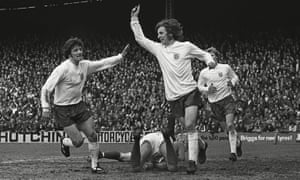
England’s Stan Bowles


England’s Stan Bowles celebrates with Kevin Keegan after scoring against Wales in 1974. Photograph: Colorsport/Rex/Shutterstock

And he still is, but actually not. Bowles moved back from London to Manchester before the family announced his condition in 2015. And here he is, at the Whitegate Inn on the road to Oldham, enjoying lager-and-lemonade-top with Andria, his friend Mike, a builder who visits every day, and Joanne Connolly, a fan whose dad – “Taxi Teddy” – knew Bowles from outings to the dogs; Joanne calls Stan the “adolescent fervour that lasted a lifetime”.


Stan wears a dapper woollen overcoat, tartan tweed hat and smart scarf. Now he puts on a pair of sunglasses. “Dino!” he says. “That’s Robert De Niro,” explains Mike. “Dino!” repeats Stan. “It’s hard to speak Stan-ish,” says Andria. “He’s having a good day today, but it’s not always like this. On bad days, he’s a rabbit in the headlights, very anxious and confused.” Andria, the modern-day matriarch of Moston, is a woman of humbling strength and commitment, but insists to the contrary: “It’s something I do,” she says of her charge. She admits: “He was a selfish Dad, but he’s mellowed, he’d started to do that before the disease. Now he’s home, with us, where my own Nan and Grandpa lived.”


There are moments of sudden clarity from Bowles. I mention Gerry Francis, the QPR captain with whom Stan had telepathic rapport: “Gerry, he’s alright he is.” And when you call him Stan he corrects you: “It’s Stanley!”


In comes Stanley’s great-granddaughter, Macie, aged five. Andria used to run another pub down the road “where my Nan used to drink”, but gave it up to look after Macie (“my son’s daughter, but …”) before Stanley was diagnosed. “So it’s like having two children now,” says Andria. I ask: “Macie, does he do what he’s told?” “No, ’cause he doesn’t know what you’re saying. He can’t talk proper because he’s poorly. But I understand him.”


Stan Bowles


Stan Bowles’s great-granddaughter Macie says: ‘He can’t talk proper because he’s poorly. But I understand him.’ Photograph: Christopher Thomond for the Guardian

Mike says he still takes Stanley for a bet: “He’ll write ‘2.15C’ – it could be Cheltenham, it could be Catterick. Once he put a tenner on a winner, worth £130, but he’d thrown away the chit.”


“London!” Stanley repeats. Mike takes him “up” to the smoke occasionally, and they stay around Brentford, Bowles’s last professional club. Mention of the Bees starts another, urgent, conversation: that club staged a benefit game in 1987, and this season published a commemorative programme to raise funds for Stan’s welfare. “I see myself looking after him for the rest of his life,” Andria insists, but talk inevitably turns to the possibility that Stan will need residential care one day. “There are two options,” Shanks had said, “go the NHS way or get private so he can be comfortable and his family can visit.” “There’s a place down the road,” says Andria, “£600 a week.”


Bowles played in days when footballers even at his level were unable to plan for what might follow. The announcement that Billy McNeill – the first captain of a British team, Celtic, to hoist the European Cup, half a century ago – suffers from dementia reopened the dual debates over welfare and head injuries. Bowles’s condition – and dire financial straits – is an example of the game’s reluctance to look after its own; Nobby Stiles also suffers from Alzheimer’s, but there is scant care from mighty Manchester United. Alex Young, who died last week from a short illness after suffering from dementia, had better luck having played for Everton who operate, says O’Mahony, “a role-model system for former players”.


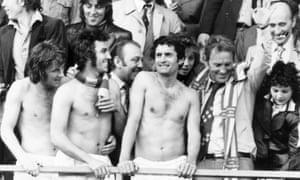
QPR


Stan Bowles, left, with Gerry Francis, Frank McLintock and manager Dave Sexton after QPR beat Leeds 2-0 in May 1976 amid a thrilling title run-in. Photograph: Reg Lancaster/Getty Images

QPR has an ex-players association, but with no benevolent welfare charge. “Sometimes,” says Shanks, “I wonder what the PFA is there for if not to help people like Stan and Frank Sibley [Rangers midfielder in that 1967 Wembley final, now battling Parkinson’s]. I also wonder if the people running QPR understand the legacy, who Stan was, what he meant to the club and its fans.”


The club did organise a Stan Bowles Day in 2015, at which he waved to adoring crowds before a game with Rotherham. Fifty pence from each programme went to Bowles, and there’s a fund with over £15,000 in it – but the matter of a proper testimonial at QPR has embittered some corners of Shepherd’s Bush.


Discussions began in 2015, when supporters met the club soon after Bowles’s family made his condition public. “The first meeting was positive,” says O’Mahony, “but it was down to us to arrange it all, and raise funds. Now we’re two years down the line, and Stan has deteriorated.”


A spokesman for the club referred to a statement a fortnight ago from the CEO, Lee Hoos, who said: “To set the record straight: QPR, as a club, welcome the proposal of a Stan Bowles benefit match. We are determined to help put on an event for Stan that supports his care and raises money … We are today starting the steps to ensure this event is a success.”


“There’s no coming back from where Stan is now,” says Shanks. “But …” He recalls Stan Bowles Day – “when Stan walked out at Loftus Road he knew exactly where he was, for some reason; a moment of knowing who he was. The family’s been fantastic, and now this should be testimonial year for Stan – he was the greatest, this is a special case. I’ve got a lump in my throat saying this, but we don’t have long. We can’t get to that situation of: ‘Oh, should’ve done this, should’ve done that.’ It has to be now.”


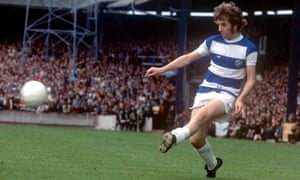
Stan Bowles


Stan Bowles in action for QPR in a Division One win against Manchester United in September 1975. Photograph: S&G and Barratts/Empics Sport

We raise another glass in Manchester. “We all love you Stan!” Bowles puts down his beer, takes my hand with a vice-grip, and stands. “Stay still,” he says, takes my head between his palms and plants a smacker on my cheek. I glance towards the others and, as Mike says, “I’ve got glass in my eyes”. Stanley sits and says: “I’m still going.” His eyes twinkle. And again: “I’m still going.”


Additional research by Joanne Connolly


An afternoon with Stan Bowles: the twinkle is still there but the memories are gone

19 Ağustos 2015 Çarşamba

Gone off sex? Never ever concern, ‘pink Viagra’ is here to save womankind

Rejoice, rejoice womankind! There is now a magic drug that will make intercourse desirable. Once more. Or for the very first time. I can’t identify right here the presently-present medicines that have this kind of an effect due to the fact they are unlawful, and who knows what would occur if men and women took them? (In reality, they have done for decades.) But, by no means mind, this new magic drug has just been legalised in the US, getting been authorized by the US Meals and Drugs Administration. Flibanserin has just passed an FDA advisory committee stage at the third attempt, so will quickly be on the marketplace. It will be sold as Addyi and is developed by Sprout Pharmaceuticals, which has been pushing what has been dubbed “the female Viagra” for some time.


The tablets are, of program, pink because ladies like pink tablets and not blue smarties as we are silly like that. ‘Pink Viagra’ has been the holy grail of the drugs market. Let’s face it, it’s the holy grail of all varieties of cultural imaginings: the magic substance that tends to make ladies who mostly cannot be that bothered with sex abruptly crave it. Even with their very own partners! No drug can assure this, obviously. Many years in the past, when I worked in a wellness meals store in Manhattan, I was usually shocked by the number of males who asked me to promote them one thing to: “Make my wife … you know? Like it.” But I even now flogged them any outdated mixture of herbs and nutritional vitamins simply because I was doing work on commission. I was tough of heart and quick of money.


The drug companies, however, are not brief of cash and, without a doubt, there have been some crucial breakthroughs recently on every little thing from Ebola to Alzheimer’s. 1 of the greatest funds-spinners, although, remains the “magic bullet”, Viagra, invented by Pfizer at Sandwich ahead of the US giant shut down the site in 2011. Viagra commenced out as a new therapy for angina, a heart issue that constricts the vessels that provide blood to the heart. By accident, it was identified that – hey presto! – a side-impact of the drug was to remedy erectile dysfunction.


A single of the unspoken effects of the uptake of Viagra is that men can now have sex with a lot more, and younger, partners. The “shame” of impotency is pummelled away affordably adequate. If this is what sex is, and what it is reducible to, then fine. This is marvellous. You can get it up for ever and a day. A rush of blood to the groin is the dream coming correct.


Viagra as a result speaks to two of our biggest requirements: penetration and profit. The guarantee of Addyi is rather like all female desire: mysterious and by some means problematic. Viagra locates the sexual disorder of males in the genitals and their mechanics. The dilemma for females is positioned in the brain. Apparently, our brain chemistry should be altered to recharge desire. This new drug, unlike Viagra which can be popped when the require arises or is about to, has to be taken every day. It acts on the brain’s “sexual impulses” in a similar way to a class of medicines acknowledged as selective serotonin reuptake inhibitors, which incorporate antidepressants this kind of as Prozac. It has not been accepted right up until now due to the fact the hazards had been explained to outweigh the advantages.


The side-effects may possibly include low blood stress and loss of consciousness. And you can not drink alcohol with it. Arousing, or just awful? Nonetheless, plough on, due to the fact, even even though these who advocate it make its benefits sound as erotic as altering the battery in a remote management, it is well worth the risks, they say, simply because in small trials with placebos, the ladies on it have an “increase of about one particular sexually satisfying event a month”. Hold me back!


If you are not obtaining “sexually satisfying events”, you could be struggling with what some psychiatrists are calling hypoactive sexual desire disorder (HSDD), which, they say, is skilled by eight-14% of girls in the US aged in between 20 and 49. Once you are over 49, no a single cares, frankly. HSDD is a chronic or ongoing lack of curiosity in intercourse that might cause a female distress. It is explained to be caused by depression, tension, low self-esteem or prior abuse. It might be caused by diabetes or cancer or arthritis. What this acronym are not able to deal with – since it cannot name it – is boredom, exhaustion, resentment, and boring outdated relationships: the items that may dampen sexual want.


To say that the brain is the most significant sex organ, which it is, absolutely requires knowing that sex is about a lot more than the ability to be ever ready for it, that there exists an infinite variety of urges that wax and wane, but truly mostly muddle along. And that most people’s lives do not resemble pornography even when they make a lot more work than normal.


Tellingly, even huge businesses this kind of as Pfizer, Bayer, and Procter and Gamble have experimented with to build drugs to deal with the disorder of female sexual desire, but abandoned the search. Even reading through Fifty Shades of Grey and possessing a person unload the dishwasher does not satisfy some women. Can you imagine? The reality is that the drug that liberated women’s need is the one we all get for granted: the contraceptive pill.


Gone off sex? Never ever concern, ‘pink Viagra’ is here to save womankind

14 Temmuz 2014 Pazartesi

Theres a fitness tracker for your vagina. Quantifying your lifestyle has gone as well far | Jess Zimmerman

The other night, a pal told me that he was attempting to devote much more time taking cabs. This stunned me, due to the fact I happen to know this pal has a Fitbit, and that he is rather proud of how far he’s walked underneath its watchful electronic eye. (I’m currently being polite: you by no means just “occur to know” that a buddy has a Fitbit because they tell you on social media.)


The Fitbit – if you have somehow managed to keep away from this – is a small dingus that information how a lot of methods you consider in a day and makes it possible for you to compete with your friends for the most measures or to post the final results to social media. Aficionados will happily march aimlessly up and down the hallway if it signifies narrowly edging out the next competitor on their leaderboard.


So why was a stage-counting devotee actively striving to walk significantly less? “Look,” he told me, “not all my sneakers are cozy. Some of them are genuinely great. If I stroll too far in nice footwear, my feet harm. So, I’m attempting to consider cabs.”


It may be the 1st time I have heard a Fitbit consumer say one thing akin to “I’m not going to stroll more right now, because I don’t want to.”


The Fitbit may possibly have been the 1st tracker of its sort to go truly massive – even though pedometers have been around for a even though – but it has certainly numerous cousins. There are units to track your rest patterns (even though Fitbits will do this as nicely), to hold an eye on your posture, to keep track of your dog’s exercise levels, to analyze the fuel efficiency of your car or tweet your bodyweight.


Probably emboldened by this profusion of curiosity in data, last month a firm named Mark 1 launched the Vessyl, a cup that analyzes the nutritional content of something you put in it and tracks your sugar, caffeine, and water consumption. And the KGoal, touted as a “Fitbit for your vagina”, is at the moment crowdfunding on Kickstarter. The latter gadget seems to be like a silicone hand grenade and is made to record your progress as you do kegels, the workout for pelvic floor muscles that ladies do to boost childbirth, continence and – most importantly, in my viewpoint – sexual pleasure. To emphasize that advantage, the KGoal even vibrates when you happen to be carrying out your workouts right.


Like the Fitbit, these newest overall health trackers never come low cost the Vessyl has a $ 99 promotional price and you can preorder a KGoal for $ 125, however the projected retail prices are $ 199 and $ 175, respectively. But, hey, how much is also significantly to spend to know that you are drinking a soda or clenching your vag?


This stuff all sounds a bit silly, but I’m not ample of a curmudgeon to really bemoan our nationwide data fixation. It truly is often simpler to understand what to do with information than to evaluate how you feel, and devices that can quantify your strolling or blood strain or vaginal strength allow you consider advantage of that. If paying $ 199 on a cup or $ 175 on a vagina grenade is the shortcut you require to produce and pay out interest to your caloric intake and pelvic floor muscle tissues, for instance, then godspeed.


Plus, human brains respond directly to suggestions about bodily functions: watching your heartbeat tracked on a monitor, for instance, provides you the potential to consciously slow them down with uncanny ease, via which you can ultimately develop into a coping method for anxiety attacks and deal with anger.


Having entry to biofeedback – actual-time data about your body’s working – has been shown to aid folks manage migraines, higher blood stress and even epileptic seizures. It is a potent adequate phenomenon that L Ron Hubbard basically based mostly a total religion on it: Scientology’s e-meter is a biofeedback device. And, in the 1940s, Dr Arnold Kegel invented a biofeedback gadget to help woman increase their pelvic floor muscle workouts and manage urinary handle – an apparent precursor to the kGoal, and the quite origin of the phrase “kegels”.


But the pitfall of information products – and the external sharing of info that they motivate or need – is that they hijack your reward pathways. Instead of strolling because it tends to make you feel excellent, or since it will get you out in the air or (my personalized favored explanation) since occasionally there is bonkers things to see in amongst stage A and point B, you walk in order to increase your stats. This sometimes means you stroll even if it’s a negative concept – if your sneakers harm, if you happen to be not feeling effectively, if it really is dangerously hot, if you happen to be running late – simply because performing otherwise will mean a black mark on your record. Your stats will slide, and your stats (and the potential to brag about them on social media) are your reward.


One particular pal tells me that, when her workplace did a stage-counting competitors, she was initially distressed due to the fact she could not alter the pedometer’s minimal “accomplishment” condition under 10,000 actions: she has fibromyalgia and is not always up for that a lot strolling every day. But, chastened by her colleagues’ successes, she ended up striving valiantly to make the day-to-day minimum – and subsequently spent at least one day per weekend asleep for most of the day, and had to take added medicine for ache in her legs and feet.


The quantified self breaks down into numbers – and there’s value to that – but it takes the aggregate self out of the equation. Focusing on the numbers our routines generate skips above how we feel and how we perform – and it gets genuinely easy to overlook about that fully simply because neither figures in to your score.


I am a large fan of each strolling and kegels (and I’m not genuinely worried that anyone is going to vaginacize herself into exhaustion). But I do have misgivings about the aggressive psychological weirdness that piggybacks on genuinely valuable biofeedback.


And it truly is not just weird for customers, either: it is also often very weird for their social media pals. Numerous pedometers and other quantification equipment are created to be linked to your Twitter or Facebook accounts, the two to place pressure on end users to preserve going, and to advertise the product (and to peer strain) their buddies. And while the KGoal isn’t made to tweet your final results automatically, or even maintain track of who’s winning between your close friends the way Fitbit can – fortunately – I truthfully would not be shocked if competitive types started out sharing their kegel strength progress.


All that biofeedback suggestions can be oppressive – your close friends are dragooned into the competitors, at least as spectators, no matter whether they want to participate or not – and it’s boring as hell. I can totally comprehend the power of seeing your self represented in numbers, but it’s the height of narcissism to believe that everyone else wants to stand there up coming to you and gaze at your data avatar.


Even now, I am not interested in telling men and women to cast off their health-robot chains. Biofeedback information is too seductive to root out, and also beneficial to really want to. So engineers, get at me: what we require is a quantified happiness tracker. Your stats increase when you walk to somewhere lovely alternatively of marching in place at your desk, or use the KGoal purely for its vibration “rewards”, or get a cab when your feet hurt.


And each and every time you don’t publish the final results to social media, the app offers you a big gold star.


Theres a fitness tracker for your vagina. Quantifying your lifestyle has gone as well far | Jess Zimmerman

2 Nisan 2014 Çarşamba

Has the Minister for Magic Jeremy Hunt gone too far?

For Mr Hunt, it seems, could be seen to be quietly endorsing TCM: fellow Tory MP David Tredinnick, chairman of the all-party group for integrated healthcare, obviously thinks he is: “He has clearly looked at it,” he says, “and thinks that where it is safe, it should be used in conjunction with Western medicine, which is what they do in China.


“Herbal medicine is not quackery – it has been used for thousands of years in China. In my experience, and I have used it, it can be really effective and reduce the amount of conventional medicine needed.”


Of course, Mr Tredinnick isn’t offering Cochrane Collaboration-level evidence – just hearsay and an anecdotal report – but is he right? Are we ignoring a wealth of medicine for no good reason? After all, our medicine doesn’t go back millennia.


“Nor does TCM,” says Professor David Colquhoun, pharmacologist, Fellow of the Royal Society, and scourge of evidence-lite medicine on his award-winning blog DC: Improbable Science.


“Traditional herbal medicine was banned in China in 1822 for being superstitious nonsense by the then emperor,” he adds. “TCM, as we know it, was reintroduced by Chairman Mao as part of the great proletarian revolution and to stir up nationalism.” (Although Mao’s own doctor practised Western medicine after studying in Australia.)


Today, Prof Colquhoun says, there are plenty of excellent Western-style doctors in China. “If you can afford it, you go for real medicine there, not the traditional way,” he adds.


He claims this is because traditional Chinese medicines – even if they are safe to take – have not been shown to be efficacious. “Even where there has been a placebo effect shown, that has mostly been too minor to be noticeable,” he says.


Prof Colquhoun is frustrated to hear talk of TCM coming into the NHS when there is a likelihood that its close cousin – acupuncture – may be on the way out. Acupuncture is based on the belief that a “life force”, called qi, flows through the body. “Like TCM, there have been thousands of studies into the use of acupuncture, but none show any real effect,” he says.


Colquhoun continues: “It is baffling that Nice [the National Institute for Health and Care Excellence] currently recommends acupuncture for some lower back pain, though that guidance is likely to change. Nice made a bit of a cock-up on that one.”


Nice hasn’t shown any interest in approving TCM. Not that this will comfort our hard-pressed GPs, who will be the ones fielding requests from patients for the Secretary of State’s alternative medicine.


“We are in the middle of one of the biggest funding crises ever,” says Dr Thomas Round, a GP in Tower Hamlets, east London. “Millions have been cut from budgets – so we have to focus on where to get best value on everything we spend. Given that there is a complete lack of evidence for TCM, it really wasn’t a helpful thing for the Secretary of State to say. And it’s not just the lack of evidence. Most GPs would have no training in TCM, so it would be outside our competency to offer it.”


Jeremy Hunt, with his Chinese wife Lucia, faces opposition from medical experts


Nor are any of the TCM products licensed or listed with the British National Formulary, the publication that provides doctors with up-to-date information about all prescription drugs. “We would have no idea about contraindications or possible interactions,” says Dr Round.


The doctor insists he is speaking not with a closed mind, just a sensible one: “If the evidence came out, then of course I’d revisit it. And if someone wants to explore TCM privately, I wouldn’t stop them, although I would point out that we don’t know what active ingredients are used in Chinese medicine. For example, a recent report that looked at TCM herbal skin creams found they contained steroids.” Side-effects of using steroid cream unchecked can include skin thinning, allergies, bruising, and it can suppress the adrenal glands.


Concerns about TCM don’t end with effectiveness, cost or side-effects. The Medicines and Healthcare Regulatory Authority (MHRA) warns that some products pose a “direct risk to public health”.


It is an ongoing concern for the teams of MHRA investigators who examine and test every product or device that has alleged health claims. Last summer, it reported finding heavy metals, including mercury, which can cause tremors, memory loss, kidney and even brain damage, in TCM products. It also flagged up advice from the Swedish National Food Agency (SNFA) of “extremely high” levels of arsenic in various products used to treat mumps, sore throat, tonsillitis, toothache, skin infections, anorexia and fever in infants. The items may not be on sale in the UK but can be found online, the MHRA warns.


Last April, the authority also highlighted the fact that a herbal product for migraine called Zheng tian wan contained aconite – a herb known as “the queen of poisons”, which can cause potentially fatal adverse reactions if consumed. And in February 2013, it warned against traditional headache tablets that had been found to contain lead – the toxic effects include abdominal pain, anaemia, changes in blood pressure, miscarriage, insomnia, dizziness and kidney damage.


Side-effects are not merely theoretical, however. Between November 2003 and June 2004, doctors at the Queen Elizabeth Hospital Birmingham treated four patients who had developed severe acute liver injury within two months of starting to take a TCM slimming aid called Shubao.


The lack of labelling in English, the unregulated ingredients, the additional illegal ingredients, the paucity of trials, the absence of evidence of efficacy: isn’t it astonishing to think that anyone in the NHS might think TCM could be useful in the GP’s surgery any day soon?


It certainly won’t happen in Dr Round’s practice. “I am the gatekeeper to finite resources and I wouldn’t feel comfortable using something with dubious clinical evidence,” he says.


If the Secretary of State for Health wants to explore TCM, he may have to go private this time.


Has the Minister for Magic Jeremy Hunt gone too far?