This etiketine sahip kayıtlar gösteriliyor. Tüm kayıtları göster

28 Nisan 2017 Cuma

Spice ruins lives and costs taxpayers a fortune. It doesn’t have to be this way | David Nutt

Last year I wrote to the health and home secretaries with suggestions on how antidotes for spice could be developed. Their replies revealed a complete lack of appreciation of the magnitude of the synthetic cannabinoid problem and lack of interest in the idea of an antidote.


Spice-induced “zombie” outbreaks in New York and in Manchester have hit the headlines in the past year. Use of these new damaging and powerful forms of synthetic cannabinoids is rife in our prisons and by homeless people, with estimates of up to 50 deaths last year. They can produce extremely strong psychotic states often with very violent behaviour. Sometimes a frozen unconscious state results. Either of these outcomes are health emergencies that consume vast amounts of police, prison officer and health professionals time, and so waste a huge amount of public money.


Spice is a generic term for the hundreds of synthetic versions of cannabis that are used instead of herbal cannabis. The first synthetic cannabinoids were made in the 1970s as potential medicines, but initial human testing found them to be so unpleasant and potent in their actions that none were marketed. Since then they have been sold as legal alternatives to cannabis, and called spice.


The problems with spice are multiple. The first is lack of any quality control: the amount of synthetic cannabinoid in each unit is not known. Second, these substances have little, if any, safety data. Third, many of them are much more potent than traditional cannabis, up to a hundred times more potent in the test tube and have never been tested in animals – let alone humans – so there is no data on real-world safety.


Most are not detectable by current testing processes which is why prisoners prefer them. This high potency means they are very profitable drugs. A spice solution costing a few pounds can be soaked into a single A4 sheet of paper, which, when dried, can be cut up into about 100 units, each of which will give a decent “hit” at £5 each.


The government’s response has been to ban these drugs in a series of amendments to the misuse of drugs act. So now all synthetic cannabinoids are illegal. But, as with other drugs, banning spice doesn’t stop its use. Heroin has been illegal for 50 years yet deaths reached an all-time peak in England and Wales last year.


So what should the government do about spice? First, it must recognise that this problem is not going to be dealt with by simplistic approaches such as more bans or more severe sentencing of users. We should understand that the authorities’ focus on herbal cannabis use is the main reason for spice emerging in the UK. So we should stop testing for cannabis in prisoners and others to encourage a move by users back to herbal cannabis.


The Manchester police commissioner has now publicly wondered if the problem has been exacerbated by the Psychoactive Substances Act which has taken synthetic cannabinoids out of “head shops” and into the underground marketplace. Perhaps we should develop a harm reduction strategy by allowing the sale of safer versions of synthetic cannabinoids, or even cannabis itself, back in head shops?


But to deal with the current epidemic of use we need urgently to develop cannabis antagonists as antidotes to spice for use by health professionals.


The success of naloxone as an antidote for heroin overdose is now well recognised to save lives, and is given to opioid users and their friends for this reason. Several antagonists at the cannabis receptor are known and one, rimonabant, has extensive safety data in humans. It was licensed in Europe a decade ago as a treatment to stop weight gain after people stopped smoking. However post-marketing surveillance found that in some people rimonabant was associated with an increase in depressive reactions, sometimes with suicidal thinking (though not suicides). This led to it being taken off the market for having too low a benefit-risk ratio for this medical indication. But for spice reversal these considerations do not apply – it would only be used once to reverse a bad reaction, and hopefully keep people from harming themselves or others.


The other approach is to develop the herbal antidote THCV. This is made in the cannabis plant alongside d9THC and many other cannabinoids. It has recently been shown to have antagonist actions against the psychosis produced by d9THC and so would almost certainly attenuate spice intoxication. Sadly, just a few months ago, the Advisory Council for the Misuse of Drugs refused to make it available for this purpose on the spurious grounds that a note in a 1974 paper said that when given intravenously in high doses it was a little like d9THC.


Surely it is time for government to push to develop such an antidote to spice if not for humane and health reasons then for economic ones?


Spice ruins lives and costs taxpayers a fortune. It doesn’t have to be this way | David Nutt

6 Nisan 2017 Perşembe

How to Take Care of Combination Skin This Season

Have you ever paid close attention to certain faces that have oily skin in some areas and dry skin in other areas? If your own skin is characterized by oily as well as dry areas, then you might have a combination skin type. Usually, people with combination skin find it tricky to figure out how to take care of their skin properly. It can feel like quite the balancing act when trying to address the oily and dry areas of your skin. Once you achieve this, the mystery to having great skin will be unlocked in much easier ways than you may have thought.


What is combination skin and how is it caused?


To put it simply, someone with combination skin has both skin that is oily in the area called T-zone (forehead, nose, and chin) while also having dryness in other areas. Even if you have oily skin only around your nose and center of your forehead but dry skin over cheeks and jaw area, then you are also said to have a combination skin.


The predominant factor that is responsible for combination skin is the genetics. It is inherited similarly as you would your hair color, eye color, skin color, and the body type from your parents.  Usually the people who have combination skin have more active oil glands on their nose, forehead, and chin which lead to clogged pores in these areas.


The other factors that play a key role in causing combination skin are lifestyle, nutrition, and skincare products. The wrong products for this skin type contain skin-aggravating ingredients that dry out certain areas of your face, while exacerbating oil production in other parts that were already oily. These ingredients are harmful sulfates and alcohols that prompt the skin to produce more oil in the T-zone area which, in turn, produces the symptoms of combination skin.


Important Tips to Follow For Treating Combination Skin


Treating the combination skin requires a dual approach of skincare in which different areas of skin are treated individually along with suitable products. Apart from these steps, there are also some natural ways that help greatly in treating combination skin:


  • Use a gentle but effective cleanser

The skin of your face is the most exposed part of your body. As the day closes in, your skin gets covered with dirt, excess oils, and impurities. So a right cleanser is the one that effectively removes dirt, impurities, and makeup without making skin feel tight, dry, or greasy. It is important to retain the softness rather than causing it to be tightened and aggravated. This is one of the best approaches to gentle skincare for having a natural glow on your face.


  • Balance your skin with a toner

Skin experts recommend using a hydrating, soothing, and non-irritating toner that should consist of skin-revitalizing ingredients and antioxidants. A toner of such quality really helps in effectively nourishing the dry skin and reduces oiliness at the same time.


Apply a gentle and non-abrasive exfoliant in order to gently and effectively exfoliate the combination skin. Products that contain BHA exfoliant are good in helping shed the dead skin without abrasion. It doesn’t require any scrubs or cleansing brushes to unclog pores. Lessen oily skin and gently smooth existing  rough, dry, and flaky skin to revive a healthy glow.


  • Apply a suitable moisturizer

Choose a moisturizer that targets your dry patches of skin and mattes the oily areas of your face. A gel-based moisturizer or a gel-cream moisturizer usually works well. Such a moisturizer is important in helping calm skin, lessen excess oil on the surface, and improve dry areas including around the eyes.


  • Protect your face from sun damage

All the skin types are sensitive towards sun rays – some only a little while others are extremely sensitive. One of the effective ways to counter this is to apply a generous amount of broad spectrum sunscreen with an SPF of 15 or more every day. This is also one of many steps in skincare that can help reduce the early signs of aging. Ideally, you need to apply a nourishing serum or booster over the dry areas and then apply the ultra-light sunscreen over the oily areas.


Conclusion


Your combination skin might be a cause of worry for you but, due diligence on your part in specifically treating different areas of your skin is key. The above mentioned tips can go a long way in treating combination skin. Apart from these, the natural ways like regular exercise, healthy diet, and disciplined fitness regime are also extremely helpful in treating skin problems.  


robin


How to Take Care of Combination Skin This Season

31 Mart 2017 Cuma

How mental health problems affect relationships: "They"re scared that this time you might die"

Anonymous
Last night I had a dream about my eldest son who’s just turned 11. Because of my mental illness, I have not been able to speak to or see my three boys for eight months now. In the dream I’m hangin’ with my eldest, shooting the breeze as we’ve done many a time, but this time I notice a difference; his voice has broken, and with this realisation my heart broke, too.


This dream is analogous of all those golden moments of childhood I have missed in their lives, that can never be relived, moments that seem even more precious when it comes to my eldest, as he rapidly approaches adolescence. The dream also feels analogous of everything I’ve lost as a result of mental illness; my marriage, career, liberty (sectioned twice), self-respect and societal approval.


What really frightens me about my mental illness is the way it suddenly grabs me and leads me to do things that I, when feeling stable, just would never want to do. Like right now I love my boys and mum so much I cannot believe I’d want to never see them again and devastate them through taking my own life. Yet out of the corner of my eye, I can see the omnipresent scar on my left wrist that is a constant reminder of how my mental health can construct a vast distance between me and my values.


Anonymous, 21
I have bipolar disorder, a highly stigmatised diagnosis. One of the hardest things to deal with is knowing you’re hurting people around you. After taking an overdose, lying in A&E with someone who loves you and feeling the guilt and horror of what you’ve done. They’re scared that this time you might die, but the urge was so strong you couldn’t stop yourself from doing it. Even when you know you are loved, you still wish to die. I have an illness. I wrote this poem in art therapy.


Today you are possible of great things,


Things of beauty, of purpose and of wonder.


Your voice is of importance, your body is of splendour.


Today you are tasked with only being fair to yourself and your soul, and to be fair to yourself and your soul is to be kind.


Kindness is all that you deserve.


Today you are you, and that is a magical thing, no one else will ever be you.


You are strong, you are mesmerising, you are intelligent, you are divine.


Today you are loved, as you should be, and as you always will be.


Anonymous
Go me: a poem about mental health, from a mother’s perspective


I am the world’s greatest mum


My teenage daughter is perfect


Good grades, no shouting, no drinking, no boys, no worries


I’m expert at giving lifts, coordinating activities, supporting vegetarianism, saying no to piercings, organising cultural excursions and understanding UCAS points


I’ve got this covered. Go me!


I am the world’s most understanding mum


I can support this exam stress


Distant, withdrawn, eating less, sleeping more, staying in


I am an expert at finding French tutors, arranging extra physics, breathing exercises, pep talks and staying positive


One of life’s challenges. Go me!


I am the world’s most bewildered mum


I don’t know why this is happening


School dropout, counselling, anger, a handful of pills, some minor cuts


I am expert at managing panic attacks, investigating colleges, negotiating the NHS and weird piercings


But I’m up for this. Go me!


I am the world’s most exhausted mum


I love her to death


Major overdose, psychiatrist, cardiac ward, cutting, minor overdose, more cutting


I am expert at bandaging cuts, hiding razor blades, 999 calls, police statements, social services, riding in ambulances, fighting for support, staying up all night, dispensing pills


But we’re still here and stronger. So go us


Helen, Manchester, 35
Fourteen years ago, I found my flatmate (and close friend) almost unconscious, with an empty bottle of pills next to her bed. I got her to the hospital. I stayed all night, until she was released in the morning. It was horrible. What came next was worse. At the hospital I asked the doctor what I should do the next day. He drew a blank. My other flatmate and I had no idea how to react. We were angry, we blamed her, we thought she was selfish. We treated her like a stranger. I went to my GP, who suggested we focus on ourselves because finals were coming up. Within a week, we just left her – went to our respective homes to study, claiming that we needed peace and quiet away from university.


I’ve never forgiven myself for that response, or forgotten how awful it was when she quietly confronted me about lying to her. In the end we both apologised, cried a lot, and made peace. It took me a few years, though, to fully accept that she wasn’t selfish or to blame. I hope that today’s 21-year-olds already know that, and that their doctors are giving better advice. By removing the stigma around mental health, and by educating people in how to support their friends and family, perhaps we can prevent other people being judged and abandoned.


Anonymous, early 40s


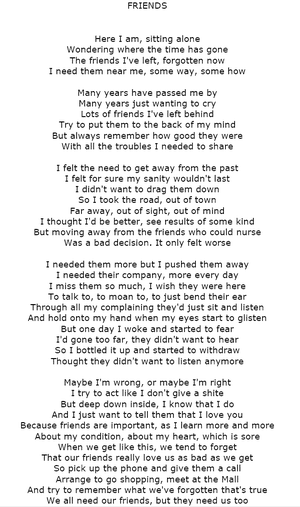
A poem dedicated to friends past, hopefully to return.


A poem dedicated to old friends, hopefully to return.

In the UK, the Samaritans can be contacted on 116 123.
In the US, the National Suicide Prevention Hotline is 1-800-273-8255.
In Australia, the crisis support service Lifeline is on 13 11 14.


How mental health problems affect relationships: "They"re scared that this time you might die"

29 Mart 2017 Çarşamba

Fifth Bristol university student takes own life this academic year

A third-year languages student is understood to have killed herself in the fifth case this year of suspected suicide involving students at the University of Bristol.


Elsa Scaburri, who was studying for a degree in French and Italian, was halfway through her year abroad. According to a statement released by the university, she died last week near her home, which is understood to be in Wiltshire.


An inquest has been opened and adjourned. A University of Bristol spokesperson said: “We were very saddened to hear that one of our third-year students, Elsa Scaburri, sadly died near her home last week.


“We understand from her family that Elsa took her own life, although it will be for the coroner to determine the cause of death.


“Elsa was halfway through a year abroad as part of her French and Italian degree. The university offers its condolences to her family and friends and our thoughts are with them at this very sad time.”


Her death will once again raise concerns about mental health among students and the capacity of universities to address growing demand for support.


Three Bristol students – philosophy student Miranda Williams, 19, history student Daniel Green, 18, and Kim Long, 18, who was studying law, died late last year in their first term at university. Final-year neuroscience student Lara Nosiru, 23, also studying at Bristol and originally from Essex, was found dead in Avon Gorge in January.


Following last year’s deaths, the university said it did not believe there was a link between any of the incidents and insisted annual figures did not show any trends. In the last academic year Bristol had one death by suicide; there were none the year before that, and one the previous year.


A review has been under way at Bristol to find out how best to support students with mental health needs. The number of staff in support services has been increased and additional funding has been put into the system to meet growing demand.


A Guardian investigation last year revealed that the number of students seeking counselling at university has risen by 50% in the past five years. And a report in September by the Higher Education Policy Institute thinktank said some institutions needed to triple their spending on mental health services to meet increased demand.


Students have a lower suicide rate than the general population, but it appears to have grown. Figures from the Office for National Statistics show that in 2014 there were 130 deaths by suicide of full-time students aged 18 and over in England and Wales. This compares with 112 in 2011, and 75 in 2007. The increase can be explained in part by the growing university population, which has doubled since 1997 and now stands at 2 million.


“The welfare of our students and staff continues to be our highest priority and it is distressing for all members of the university community that one of our students has died,” the University of Bristol spokesperson said. “We would urge any students affected by this tragic incident to seek support from university services, friends or family.


“In the context of increasing national concerns about student mental health we have been working with our staff and students to review how best to support all students including those with enduring mental health difficulties.


“We have increased staffing levels in our support services and have committed to invest an additional £1m per year to provide wellbeing support for students in each academic school. We will also be signing the Time to Change pledge to help reduce the stigma of discussing mental health issues.”


In the UK, the Samaritans can be contacted on 116 123. In the US, the National Suicide Prevention Hotline is 1-800-273-8255. In Australia, the crisis support service Lifeline is on 13 11 14. Hotlines in other countries can be found here


Fifth Bristol university student takes own life this academic year

26 Mart 2017 Pazar

Chew on this: the Viva Mayr clinic’s hardcore detox comes to the UK

The Viva Mayr clinic, a functional-looking alpine lodge, overlooks Lake Altaussee in Austria. Here a very famous supermodel once took off all her clothes and lay down naked on the banks, toes in the water, apparently in an “extreme emotional state”. The witness, another patient at the clinic, explained that this was not an abnormal reaction to day three at the Mayr.


Viva Mayr is a health centre that specialises in a form of extreme detoxification it refers to as “the Mayr cure”. Patients consume around 600 calories a day – roughly equivalent to one Pret a Manger BLT sandwich. But there’s no gluten here. Even grapes are vetoed. Epsom salts, water and goat’s cheese (lactose-free), however, are central themes. The programme is as notorious as it is successful (Vogue staffers and oligarchs are among the clinic’s regulars), and it’s generally booked up all year.


The idea is that patients will spend one life-changing lakeside week there and return home, revived, reborn, re-educated and, crucially, thinner. In fact, a loss of appetite – along with severe headaches and lengthy bouts of crying – is apparently par for the course, particularly on the third and fifth days, presumably thanks to the stomach massages, blood tests and chewing lessons in which the clinic specialises.


Still, it certainly seems to have its fans: Michael Gove is said to have lost two stone here. The Rolling Stones are repeat visitors, model Karlie Kloss has been, Suki Waterhouse spent a summer holiday there and Tracey Emin reportedly stays every autumn (and can often be spotted taking fag breaks). Two of the most popular diets of the last decade – the 5:2 fasting regime and the alkaline plan – first found fame at Mayr. It also supposedly inspired the “Hoffler Klinik” in the last Bond film, Spectre. This form of extreme health is even proving popular among the Trump cabinet. At last month’s G20 summit, US secretary of state Rex Tillerson stayed at the Steigenberger Sanatorium, a private clinic outside Bonn known for its naturopathy treatments. He claimed all the hotels were full.


And now Mayr is coming here. At the start of April, it will open in London. The first month is already booked up. A few years ago, they tested the waters with a £950-a-go clinic at the Corinthia, a five-star hotel in Mayfair frequented by Rihanna, which tells you something about their target market. But this is the first of their foreign outposts (they have also cropped up in Istanbul, New York and Athens) to focus primarily on health rather than the “spa” element. The day clinic will test your alkaline levels, your blood and even your stress levels. Consultations start at a princely £170.


Michael Gove


Michael Gove is said to have lost two stone at the Viva Mayr clinic. Photograph: Stefan Wermuth/Reuters

I spoke to a private GP – a former client who once started up her own practice in London in tandem with Viva Mayr, and wished to remain anonymous – about its success. She believes it is in part thanks to the method of diagnosis favoured at the clinic. They use applied kinesiology (AK), or basic muscle testing, for evaluating “areas of dysfunction” – if they think you’re lactose intolerant, they pop lactose on your tongue and measure your muscle reaction. It is, however, a controversial technique: “It’s commonplace in Austria, but in the UK we’re suspicious of it.” The clinic maintains it is used by many professions.


“The problem is that AK doesn’t have any scientific basis as such,” explains Dr Benn Gooch, an NHS GP, “so I would be cautious about any diagnoses made using this technique. I would take it with a pinch of salt.” Gooch is wary of the so-called “Mayr cure”, especially the controversial idea that eating alkaline foods can give health benefits. “But with regards to functional symptoms, things like chronic pain and fatigue, they may be amenable to massage and this sort of treatment. It all sounds rather relaxing, and a good holiday has obvious benefits, but I’m not sure it can claim anything more than that. The Mayr cure is a treatment for the malaise of opulence more than anything else.”


The “Mayr cure” was developed almost 100 years ago by Dr Franz Xaver Mayr, an Austrian physician who believed in “auto-intoxication”: the idea that we are poisoning ourselves by ingesting the wrong things, which we then struggle to get rid of. “Everything starts with the gut,” explains Dr Christine Stossier, assistant medical director of the clinic. She and her husband, Harald, opened Viva Mayr in 2005, basing it on the practices of the original FX Mayr health centre, which opened in 1976. “The fundamental principle is that you can improve someone health’s through digestion,” she says. Our bodies are ill-equipped to deal with what we eat, she argues – namely the quantity of “gluten, manipulated dairy and low-fat foods” – but more importantly, perhaps, the way we eat it: “quickly, as snacks, with little variety and, when we eat in restaurants, without much attention to the freshness of our vegetables”. It’s not, she says, that she is treating patients with allergies; rather, she is focusing on things at the “groundwork” stage. “You can eat healthy, organic food, but if you eat it in the wrong way” – without chewing at least 30 times per mouthful; no raw food after 4pm – “it loses a lot of its value.” An NHS doctor I spoke to thinks this is dubious thinks this is dubious: “I cannot see any value in timing food preparation technique with particular times of day,” he says.


A few years ago, I went to the Adler Thermae spa in Tuscany, an offshoot of Mayr. It’s less dogmatic but they instructed me to avoid lactose and drink three litres of water a day. Doctors gave me salts to drink and I went to bed hungry. But, being in Italy, I was still allowed to drink coffee. Mayr’s aim isn’t solely to lose weight, but I lost two kilos in three days. My energy levels were markedly higher, though that might have been due to extra sleep, and my eyes turned strangely white. But for those with a fixed income, a job, or a life, it all felt untenable. Extreme diets are two-a-penny, and a recent study from the University of Melbourne found that elimination diets aren’t much better than calorie-controlled ones in terms of results. Dr Stossier uses the word “cleansing”, yet the principles of mindfulness and fasting are similar. Whether this works because of the diet, or because you are alive and have a liver, is a moot point.


Mayr is viewed by many as a last straw, an outrageous luxury and proof of the survival of the richest. Others swear by it. In reality, a lot of clients are simply suffering from chronic fatigue, and need a little TLC – healthy food, fresh air and sleep. “I have a friend who goes to the Mayr clinic every year for 10 days,” says the private GP. “He drinks and smokes and says he would be dead by now if he didn’t go. What more of a reason does anyone need?” Perhaps. But it’s a triumph of marketing, too.


  • This article was amended on 27 March 2017 to remove a name


Chew on this: the Viva Mayr clinic’s hardcore detox comes to the UK

20 Mart 2017 Pazartesi

My vegan experiment: ‘Even in my maddest moments I never saw myself doing this’

The first thing I want to say is that this is the last thing I ever expected to write. Over the years, I have contemplated joining the police, moving to Canada, and taking up darts, but even in my maddest moments I never saw myself doing this. The need I feel to make this disclaimer crystal-clear, however, is something I’ve been puzzling over. The only purpose it can serve is my own vanity – which, I have been surprised to discover, is my single biggest worry about becoming a vegan.


It has only been six weeks, so it’s still early days, and I could be wrong about this. But I don’t think the worst thing about going vegan is saying goodbye to all the lovely things I used to eat. I really like roast lamb and scrambled eggs and ice-cream, but the truth is that you can get used to anything. My problem with veganism isn’t the diet, but the identity.


‘These days it’s the height of fashion and – if you’re a celebrity – practically compulsory.’ Jay Z and Beyoncé.


‘These days it’s the height of fashion and – if you’re a celebrity – practically compulsory.’ Jay Z and Beyoncé. Photograph: Lester Cohen/Getty Images for NARAS

Veganism used to be so niche that I was in my 20s before I first met a vegan, but these days it’s the height of fashion and – if you’re a celebrity – practically compulsory. Famous vegans are ten a penny – Beyoncé, Jay Z, Jennifer Lopez, Brad Pitt. Unlike most celebrity lifestyle choices, any idiot with a Deliciously Ella cookbook can access the glamour of giving up animal products, which may explain why the number of vegans in Britain has almost quadrupled in the past decade to more than half a million. Living in London, one can’t fail to notice that even vegan fashion has assumed a newly confident air; the old passive-aggressive T-shirt slogans (“Vegan. Because My Body is Not a Graveyard”) have made way for knowing hipster humour (“All Hail the Kale”). On a street in Hackney where, last time I looked, crowds on the pavement meant a pub fight had spilled on to the kerb, hordes now queue patiently in the rain, like old Soviet Union shoppers, outside “the world’s first-ever” vegan fried chicken shop, the Temple of Seitan.


So I don’t worry about looking weird. I worry about becoming that person who thinks what they put in their mouth is important enough to merit a significant share of their time and energy every day. Who wants to be sourcing vegan mozzarella on holiday, forever scanning labels, making a nuisance of themselves at dinner parties? To me, it has always felt fundamentally precious, if not borderline narcissistic, to care that much about the purity of one’s digestive system.


That middle-age would force a reappraisal never even occurred to me. In my 20s, it was just about plausible to pass off a diet of Dime bars and Diet Coke as evidence of a life too fabulously busy for trivial distractions such as actual meals. By 45, however, it looks like self-abuse. After I was diagnosed with breast cancer 18 months ago, it altogether ceased to be an option and, for the first time in my life, I paid serious attention to the novelty of taking care of myself – not least because when surgeons, oncologists and nurses have done everything they can to save your life, there is a certain sense of obligation to do one’s bit, too. When nutrition is no longer a lifestyle choice but a medical necessity, eating food that might really kill you becomes patently idiotic – which is why I spent most of last year trying to adopt a healthier diet.


When nutrition isn’t a lifestyle choice but a medical necessity, eating food that might kill you is patently idiotic


The problem, as anyone who has ever tried knows, is that it’s impossible to know if you are doing it right. There is quite possibly greater global consensus on how to solve the Israel/Palestine conflict than on what we should eat, and the more you learn, the less you feel you know. Is a low-carb paleo diet the answer? Is meat OK as long as it is organic? Will five a day do the job? Or is anything less radical than a strict raw-food regime a waste of time? Willpower is hard enough to sustain, even when you know it’s worth it. The possibility that it might, in fact, be pointless was enough to derail every diet I tried.


In the end, I could find only one way to make sure everything you put in your mouth is a good idea. The simplicity of the solution was irresistible. The problem, of course, is that nothing else about going vegan is remotely simple. Was I really going to find time to start shopping in specialist wholefood stores and soaking mung beans? The vegans I knew all promised that after a month I would start to feel so fantastic that the palaver would seem a small price to pay. This may be true, but I worried that faffing about with legumes would defeat me long before the fabled herbivore high kicked in.


Was there, I wondered, an easier way to do it? Of course there was. I found a company in London called Detox Fit, a one-stop shop for lazy vegans, that offers a weekly delivery of gourmet meals. A sort of vegan ready meals on wheels, if you like. Run by a preposterously good-looking vegan couple, the company also provides an AA sponsor-style helpline to call should I find myself outside a kebab shop, having a wobble. If out and about on the high street and hungry, all I need to do is call and they will guide me to vegan options in the vicinity.


Unable to think of a reason not to, I signed up, and embarked on a three-month experiment with veganism. A finite commitment felt much more doable than a lifelong promise, but the very modesty of the challenge also made me anxious. With no excuse for falling off the wagon, what if I still did?


There are so many reasons to be vegan that it is hard to know which one would work best in a crisis of willpower. Health is mine, and the obvious one – but, in a reckless mood, I might decide not to care. Would thoughts of carbon emissions from cattle fortify me? Maybe the trick is to keep a mental archive of factory-farming photos, ready to deploy when necessary. Then again, what if world famine turns out to be the most compelling option? It might be an idea to memorise some eye-opening statistics about how many acres of grazing it takes to make a Big Mac, and how many people the same fields could feed if we planted crops instead. Adopting a belt-and-braces approach, I watched the appropriate documentary material online: Cowspiracy, Forks Over Knives and Earthlings.


Rather to my surprise, at the end of month one, I’ve had no need for either the Detox Fit hotline or my fortifying mental devices. Whatever had I been worrying about? The whole thing has been startlingly easy.


And then I was invited to a dinner party …


My vegan experiment: ‘Even in my maddest moments I never saw myself doing this’

17 Mart 2017 Cuma

Why you Should Add this Tastey Booster Food, Nutritional Yeast, to Your Diet

By Karen Brennan, MSW, NC, BCHN®, Herbalist


Nutritional Yeast: What is it?


Nutritional Yeast is not a plant nor animal food but rather a fungus like mushrooms.  It is a good addition to a vegan, vegetarian, paleo, gluten free and dairy free diet.


I have Candida, I am avoiding foods that contain yeast, can I eat nutritional yeast?


The yeast you find in breads and beer is a live and active yeast.  Nutritional yeast comes in a dried flake form and is not an active yeast.  This means you cannot use it to make bread or beer but more importantly it will not lead to overgrowth of yeast/candida in the body.  Therefore, because it has been deactivated it cannot cause or contribute to candida. You may read otherwise on the web but nutritional yeast is safe to it.


What causes overgrowth of candida (healthy people will always have some candida) is a diet high in sugary/processed foods and drinks, antibiotic use and birth control pills to name a few root causes.  To learn more about what candida is, what are more causes, symptoms and more importantly, how to address it read this article


What are the Benefits of Adding this Food into my Diet?


  • Beta Glucan fibers found in nutritional yeast help to maintain the body’s defense against pathogens (this was found in a study in which participants consumed a spoonful daily)

  • Another study in which participants consumed one half a spoonful found that mood states improved and they had significant boost in feelings of vigor.

  • It is a great addition to vegan and vegetarian diets due to its protein and B vitamin content. It also has a cheesy taste so many use it to replace cheese in their diet.

  • It contains all nine essential amino acids.

  • It is a rich source of 14 minerals and 17 vitamins

  • It has antiviral and antibacterial properties

  • It may be useful for candida, chronic acne, diarrhea, and immune system support.

  • Athletes use it for an energy boost

How Do I use it in My Recipes?


You can add nutritional yeast to many dishes that you make.  Add it at the end to hot and cooked dishes as high temperatures may destroy the nutritional benefits of the yeast.  For instance, add some to your cooked chicken curry dish or to your favorite pasta sauce.


  • Sprinkle it on your stove topped cooked popcorn

  • Add it into hummus, pesto, pasta sauces and cold soups

  • Sprinkle onto your salads and cooked vegetables

  • Use it as you would use grated cheese

  • Add to bean and rice or whole grain dishes.

Recipes with Nutritional Yeast


Will my local Grocery Store Carry Nutritional Yeast?


  • Your local traditional grocery store may not but many are adding healthier options. For instance, many Walmart and King Soopers now contain nutritional yeast products. Whole Foods and other local natural grocery stores and vitamin shops should carry nutritional yeast.

  • Otherwise order online from www.thrivemarket.com, amazon or many other healthy whole foods or vitamin websites.

  • Because I only use a small amount per day I store mine in a glass jar in the fridge to maintain freshness. Otherwise, store in your pantry or cupboard. It should keep for up to 2 years.

What You Need to Know


  • Those with Gout may want to keep the amount to ½ a teaspoon per day due to its purine content

  • You may have heard that some nutritional yeast products contain lead. These brands have no detectable lead in them-Bob’s Red Mill, NOW, Bragg’s, Dr. Fuhrman, and Red Star.  However, no matter what the brand, it is safe to consume 2 tablespoons per day.

  • Some nutritional yeast products contain B12 while others do not. Read the label. If you are a vegan or vegetarian and avoid meats, it is still best to supplement with B12 in a methylated form. It is a myth that B12 is naturally found in nutritional yeast-it must be added in.

  • It does NOT contain MSG as you may hear this rumor. Yeast is a natural source of the umami flavor or natural glutamic acid.  The glutamic acid is bound to other amino acids. The glutamic acid that is MSG is not bound.  When you consume glutamic acid from real foods, your body controls how much is absorbed.  Excess glutamic acid is passed off as waste not stored in your body.  MSG that is added to fast food and processed foods is an excitotoxin that overexcites your cells.

Sources


http://nutritionfacts.org/2017/02/14/benefits-of-nutritional-yeast-to-prevent-the-common-cold/?


Bauman, E. & Friedlander, J. (2014) Foundations in Nutrition.  CA: Bauman College


Wood, R. (2010) The New Whole Foods Encyclopedia.  NY: Penguin Books


As a nutrition professional, Karen Brennan of Tru Foods Nutrition Services LLC does not treat, cure or diagnose. This information is for educational purposes only.


Tru Foods Nutrition

I am a nutrition professional with a focus on mental health and gut health. I am also passionate about getting nutrition information out to the public so that others can take charge of their own health instead of living on meds. I help others who have tried the medical route and who are often are worse off because of it. Nutrition therapy has an individized approach and addresses root causes.


Why you Should Add this Tastey Booster Food, Nutritional Yeast, to Your Diet

12 Reasons to Add this Herb to Your Diet

by Karen Brennan, MSW, NC, BCHN, Herbalist


The underground portion of ginger is used.  The flesh of ginger may be white, yellow or red depending on the variety.  It has a light brownish skin. It has a aromatic, pungent and spicy smell and taste.


Ginger has been used for thousands of years as an herbal remedy.  Modern medicine and research has proven that ginger possesses several therapeutic properties.


Benefits to Using Ginger


  • Antioxidant Rich. And you only need a small amount to reap its benefits.  You want to consume a antioxidant rich diet to support overall health and prevent disease.

  • Reduces Pain from Osteoarthritis: Ginger Inhibits the formation of inflammatory compounds and has direct anti-inflammatory effects. This is due to compounds called gingerols.  It has been shown to reduce pain in those with arthritis and muscular discomfort.  In one study, those who took ginger extract 2 times per day had less pain and needed less pain killing meds than those who took the placebo.  The dose in one study was 250 mg. 4 times daily.

  • Provides Gastrointestinal Relief: Ginger is commonly used for an upset stomach, gas, diarrhea, and IBS.

  • Can Prevent Sea Sickness: It has been shown to be far superior to Dramamine, an OTC drug, used for motion sickness. It can reduce symptoms associated with motion sickness such as nausea, vomiting and cold sweat.  There is a reason that you see ginger candy in gift shops at boat docks to purchase!

  • Relief from Vomiting and Nausea Associated with Pregnancy: It can be useful even in the most severe form. And unlike anti-vomiting, drugs ginger is safe during pregnancy and only a small amount is required.  Pregnant women can safely take up to one gram.

  • Protective against Colorectal Cancer. Gingerols which is the main active component in ginger is also the one responsible for its distinctive flavor.  This component may also inhibit the growth of human colorectal cancer cells.

  • It can Induce Cell Death in Ovarian Cancer Cells. Again, this is thanks to the gingerols in ginger.  A pro-inflammatory state is thought to be important in the development of ovarian cancer. In the presence of ginger a few key indicators of inflammation were decreased in the ovarian cancer cells.

  • Immune Boosting Properties. Since it has anti-viral properties, ginger can be useful to consume when you have a cold or flu or other viral infection.

  • Lowers Cholesterol and improves lipid metabolism. Studies show that ginger can have a dramatic effect on cardiovascular health. Studies used 250 micrograms of ginger

  • Anti-diabetic effects. In several studies ginger has been shown to help reduce blood sugar levels, regulate insulin response and also reduced body weight.

  • Use it for Colds and Sore Throat. It is a natural remedy to soothe an irritated throat.  Regular intake of ginger stimulates the secretion of mucus which soothes and provides throat relief.  Natural oil in ginger acts as an expectorant and thus not only useful for colds but also for upper respiratory infections, coughs, asthma and bronchitis

  • Use for PMS cramp pain. A 2009 study found that 250 mg. 4 times a day was just as effective as ibuprofen for pain relief associated with a woman’s menstrual cycle.

Ways to Incorporate Ginger into Your Diet


You don’t need to use much ginger to reap its benefits.  Whenever possible opt for fresh over the dried spice.  The fresh ginger will contain higher levels of gingerol.  Most supermarkets carry the mature ginger which will have the skin that you need to peel. Young ginger is more often found in Asian markets and this ginger skin does not need to be peeled.  Fresh ginger can be stored in your fridge for up to 3 weeks if left unpeeled.  You can also store it in your freezer unpeeled for up to 6 months.


For cooking, if added in the beginning of the cooking process, it will add a subtle flavor while adding it at the end of cooking will lend the dish a more pungent taste.


  • For nausea: make ginger tea by steeping 1 or 2 ½ inch slices of ginger in a cup of hot water.

  • For arthritis: ¼ an inch (or more) cooked in food. (The more you use the quicker your relief may be)

  • Add it to rice dishes

  • Mix ginger with coconut aminos and garlic to make a sauce for stir fry

  • Add ginger to your oil and vinegar salad dressing

  • Add it to sautéed vegetable dishes.

  • Mince a teaspoon and add to your regular tea

  • Add to marinades, stews and soups

  • Add some to your morning smoothie

  • You can add in ginger supplementation in capsule form or in tincture form.

When to Use Caution


  • Don’t give to children under 2 years of age.

  • If you have a sensitive stomach, take ginger with some food in your belly.

  • In adults, do not take more than 4 grams per day

  • Pregnant women should only consume up to 1 gram per day.

  • Avoid ginger supplementation if you are on blood thinner

  • If you are on diabetic meds, ginger can reduce blood sugar levels.

  • If you are on blood pressure meds, it can reduce your blood pressure.

  • Always talk to your doctor if adding ginger in as a supplement to your diet since some meds can interact with herbs.

Food for Thought:


From reading some of the cautions above, it makes me wonder, wouldn’t it be better to use herbs to say lower blood pressure or blood sugar instead of a med that comes with side effects? What do you think?


Sources


http://www.whfoods.com/genpage/php?tname=foodspice&dbid=72


http://umm.edu/health/medical/altmed/herb/ginger


https://www.ncbi.nlm.nih.gov/books/NBK927775


https://www.ncbi.nlm.nih.gov/pmc/articles/PMC3665023/


https://www.ncbi.nlm.nih.gov/pubmed/15630214


https://www.ncbi.nlm.nih.gov/pmc/articles/PMC3016669/#!po=67.6471


http://www.greenmedinfo.com/blog/ibuprofen-kills-more-so-what-alternatives


https://www.ncbi.nlm.nih.gov/pubmed/18813412


https://www.ncbi.nlm.nih.gov/pmc/articles/PMC4277626/


If you need more support, contact me at trufoodsnutrition@yahoo.com http://www.trufoodsnutrition.com


Balch, P. ( 2012)   Prescription for Herbal Healing.  2nd Edition.  NY: Avery Publishing


Gaby, A.(2006) The Natural Pharmacy. Revised and updated 3rd edition.  NY: Three Rivers Press


Hoffman, D. Medical Herbalism. (2003) The science and practice of herbal medicine.  VT: Healing Arts


Press.


Mars, B. (2007) The Desktop Guide to Herbal Medicine.  CA: Basic Health Publications


Skenderi, G. (2003) Herbal Vade Mecum. NJ: Herbacy Press


As a nutrition professional, Karen does not treat, cure nor diagnose. This information is for educational purposes only.


Tru Foods Nutrition

I am a nutrition professional with a focus on mental health and gut health. I am also passionate about getting nutrition information out to the public so that others can take charge of their own health instead of living on meds. I help others who have tried the medical route and who are often are worse off because of it. Nutrition therapy has an individized approach and addresses root causes.


12 Reasons to Add this Herb to Your Diet

1 Mart 2017 Çarşamba

Labour’s failure on the NHS is prolonging this health crisis | Polly Toynbee

Remember Mavis Skeet? In 2000 the 74-year-old led the news for weeks when her operation for cancer of the oesophagus was cancelled four times, until it became inoperable and she died. Liam Fox, then shadow health secretary, exclaimed: “This is not an isolated case. The NHS is not coping!”


When does a rumbling NHS crisis erupt into a volcanic political eruption? Labour’s miserable failure to “weaponise” the NHS into a winner in Copeland makes it worth looking back.


Mrs Skeet was the tipping point for Labour. The worst flu epidemic in a decade blew away Tony Blair’s pre-election “waiting lists cut” pledge. Instead Labour stuck to a draconian Tory budget, but this one case sent Blair into the TV studios promising to match average EU spending – and Labour did. The best NHS decade followed: 7% annual budget increases saw waiting times plummet, as heart and cancer results improved.


Margaret Thatcher’s eruption came in 1987 with the NHS squeezed dry. Babies died waiting for operations at the Birmingham Children’s Heart hospital. Through gritted teeth, the NHS “safe in our hands”, she bunged it £100m and punished it with the internal market.


In this latest seismological era, political vulcanologists can’t predict exactly when the top will blow. With its lowest ever funding rises, its hardest years are still to come, despite soaring numbers of the old, hospital admissions up by 31%, and 22% more A&E patients since 2010. Staff shortages follow cuts in nurse training and worsening GP and specialist recruitment. Even if extra is found for social care, the National Audit Office suggests it won’t stem the flow of patients into hospitals.


Are things bad enough yet? The British Medical Association reports that 15,000 hospital beds have been cut in the past six years. The Royal College of Surgeons protests at cancer operations being cancelled. Ambulances frequently stack up outside hospitals. Look at all that molten lava bubbling away.


Mavis Skeet’s death in 2000 became a tipping point for the NHS under Labour. Her operation for cancer of the oesophagus was cancelled four times.


Mavis Skeet’s death in 2000 became a tipping point for the NHS under Labour. Her operation for cancer of the oesophagus was cancelled four times. Photograph: PA

Ahead of next week’s budget, Theresa May pretends the NHS has an extra £10bn – at loggerheads with Simon Stevens, the head of NHS England, who publicly disputes it. What forces a U-turn? Before it was deaths, but already two patients have died on Worcester Royal hospital trolleys, one after a 35-hour wait. Coroners have protested to the health secretary, Jeremy Hunt, after two recent deaths due to lack of intensive care beds: the case of Teresa Dennett, who died from a stroke, and Mary Muldowney, who died after a brain haemorrhage.


The war zone of A&E has featured nightly on BBC news, with a graphic documentary series on the controlled mayhem in barely coping hospitals. When is enough enough? Not quite yet, it seems. The government has been lucky, with no flu epidemic in any recent winters or any Arctic freeze-over. With beds at full capacity, it would only take a mild outbreak to tip over the NHS.


The pressure-cooker is finance: monumental debts swell by millions a month as hospitals receive absurdly frantic threats if they don’t cut back. In December they were told to free beds by cancelling operations, causing longer waiting times and lost revenue from missed operations. Look at King’s College hospital, in south London: its chair, Bob Kerslake, calls official finances “kidology”. Ordered to make a surplus this year, King’s can’t avoid a £2m loss – yet the punishment is a cut in funds, sending its deficit to £30m, and an instruction to make a £26m surplus next year: this is mirage accounting, mirrored everywhere.


So far these debts are Hunt’s and chancellor Philip Hammond’s problem: what do patients care? But if the Treasury really means to recoup the money, plus the £22bn in savings it demands of the NHS by 2020, then Vesuvius will blow. Wards and units will close, staff will be laid off, the chaos will be unprecedented. It can’t happen.


When the government is forced, kicking and screaming, to pay up, who will it blame? It will call the NHS “unsustainable” and “a bottomless pit”. (Hammond already has.) Yet more “reforms” and re-disorganisations will be hurled at it: payment for services, top-up insurance and tax rebates for private payers will resurface. The government will ignore the UK’s fall in the EU spending scale since 2010, and is now sixth out of the G7 countries, with fewer beds, doctors and nurses per capita.


Who has the political heft and credibility to defend it? Fear of Labour’s NHS moral hegemony kept Thatcher, John Major and David Cameron in check. No longer. Labour thought the NHS was its big bazooka in Copeland, where a maternity unit is under threat. But the naked desperation of Labour’s “Babies will die!” leaflets shot the very last bolt in Jeremy Corbyn’s arsenal. Each time he raises the NHS at prime minister’s questions his feeble attempt at “weaponising” sounds pathetically opportunist: May bats him away with balderdash statistics he is too incompetent to refute.


This has never happened before: polls find May more trusted than Corbyn to run the NHS by 45% to 35%. Far worse, Labour’s failure to counter the right’s message has left more people blaming the NHS crisis on migrants and patients’ bad lifestyles than Tory underfunding or rising numbers of older people. As ever the Mail and the rest carry endless NHS tourism or obese wastrel stories – but Labour has always had to fight twice as hard to get a hearing for the facts on the NHS.


Whoever follows Corbyn will now find it ferociously hard to regain that lost NHS ground. By 1997, hammering away in opposition, Labour had made the threadbare NHS the top issue and owned it. Hard-won economic credibility earned it the trust to run the NHS better. Now Ben Page of Ipsos Mori finds the NHS the second issue after Brexit, but Labour doesn’t own it, or anything else: Corbyn falls behind on everything, with every demographic, so even Labour voters prefer May.


Because the NHS crisis has so far exploded in debt rather than closures, most people’s experience is not yet bad enough to reach tipping point. Page says satisfaction is down on 2010, but not rock bottom, with always a long lag in perception. A third would pay more tax for the NHS, but the rest want savings by denying obese people and migrants.


Austerity has entered the nation’s blood stream: Page finds most people still think it necessary – despite the reckless tax cuts ahead. Banging on about “austerity” without specifics gets Labour nowhere. May’s own polling and her Copeland result tell her this – but hubris is her greatest peril. There may be no opposition, but if she and her chancellor really try to squeeze the gargantuan debt out of the NHS, all hell will break loose anyway.


Labour’s failure on the NHS is prolonging this health crisis | Polly Toynbee

17 Şubat 2017 Cuma

This Is What Will Happen to Your Body If You Eat Stalk of Celery A Day

Maybe it’s not your favorite food, but celery is one of the healthiest vegetables. If you didn’t eat it often because of its taste, start eating it by combining with other vegetables, it will become more pleasant for eating, and you will get tons of health benefits from this green vegetable.


Eat a stalk of celery everyday, you will notice the difference:


1. You’ll find out that losing weight is not so hard


Celery is a valuable food that is super low in calories, high in fiber and packed with vital nutrients to boost your metabolism and aid in weight loss.


2. Your digestion is also improved


Celery has a great benefit to the digestive tract. It contains a good amount of fiber, cleans the gastrointestinal tract and also prevents constipation.


3. Say goodbye to the inflammatory diseases


Inflammation results in many chronic diseases such as arthritis, heart disease, and even cancer. Celery is rich in antioxidants and polysaccharides that have anti-inflammatory properties to lower inflammation.


4. An alkaline environment makes you healthier


Celery helps balance acid in your body to prevent diseases. Know More About Why You Should Be Alkalinized and Top 50 Alkaline Foods to Balance Your Body Naturally


5. You’ll have lower risk of high blood pressure


Phthalides in celery have been proven to lower high blood pressure by relaxing the muscles around the arteries. The seeds of celery also have anti-hypertensive properties that help moderate blood pressure.


6. A fact that you should know is: two stalks of celery per day will reduce the bad cholesterol by up to 7%


This property of celery makes it a good vegetable to maintain and improve heart health.


7. Your eyes are under protection


The high amounts of vitamin A make celery good at improve your eye health and prevent age-related eye disease.


8. Without stress, you’ll sleep better


A cup of celery juice before bedtime helps you sleep well as celery has a calming effect on the nervous system. While you have to take it on a daily basis over some days to see the result.


9. Less chances you’ll get cancer


Celery has anti-cancer properties as it contains chemo-protective compounds called polyacetylenes, which help fight against the cancer formation, such as intestinal and breast cancer.


10. You’ll have stronger bones


A good amount of calcium and phosphorus in celery are important for building strong bones.


11. It keeps bad breath at bay


Both celery and celery seeds contain compounds that kill bacteria that cause bad breath. Celery also contains other antibacterial agents that help prevent infections.


Sources: healthy-holistic-living.com/ fitlife.tv/seekingfit.com


RELATE READING: Healing Benefits of Celery and Natural Ways to Use it


Be A Celery Lover: It Reduces Inflammation, Aids Digestion, Lowers High Blood Pressure and Combats Cancer


This Is What Will Happen to Your Body If You Eat Stalk of Celery A Day

13 Şubat 2017 Pazartesi

"I wouldn"t have done this at 18": why I switched to a nursing degree

To study nursing takes a certain kind of student. Ian Noonan, head of the mental health nursing department at King’s College London, draws an analogy: “A lot of people give up their seat for someone else on the tube,” he says, “having made a decision on whether that person is less able than them. But then many people don’t look. You might look down at your paper or your electronic device instead. We can teach you how to decide whether someone is able or not – but we can’t teach you that motivation to look up and to notice.”


Noonan himself trained as a musician before mental health nursing, and says that students who move to nursing from other disciplines often bring something extra to the job. “A broader world view helps in understanding the patient’s own values and why they might be different to their own. It’s about ethical perspectives as well as empirical evidence. Even geography, theology, philosophy students – subjects that don’t seen so connected to nursing – can have a lot to offer,” he says.


So what motivates students to change course?


‘Everyone on my course has found our attitudes have changed’


Freya Sewell, 30, is a second-year mental health nursing student at Edinburgh Napier University


Freya Sewell student nurse copy


Freya Sewell.

“Without our health we can’t fulfil what we can do. Whether mental health or physical health – it’s all part of the same person. That’s why I wanted to become a mental health nurse.


“I’m 30 now, but I wouldn’t have wanted to do this at 18 or 19. I did not know as much then about relationships between people and how they can affect all of us. Everyone on my course has found our attitudes have changed – and we come from a huge range of ages and backgrounds.


“I come from a family of artists and academics and my degree was in fine arts at Edinburgh, where I have stayed ever since. Course fees are still paid for here and you get a bursary; without that I wouldn’t be able to do the course. I’m also a support worker for people with learning disabilities. Most other nursing students do bank nursing [providing temporary cover], but I like working in the community and want to do so when I’m qualified.”


‘I wasn’t sure I had it in me to be a nurse’


Rose Abell, 27, is studying for a master’s in nursing studies at Glasgow Caledonian University


Rose Abell


Rose Abell.

“I always wanted to be a nurse, but my granddad, who brought me up, didn’t think it was prestigious enough. I decided to go into international relations instead. I first did a degree in economics and Chinese at Westminster and then an MA in international economics.


“I got a job with a major drinks company, but realised I didn’t like business. Then I worked at the EU in Brussels as a secretary, but I didn’t like that at all either.


“By this time, my granddad had been in hospital and changed his mind about nursing after being cared for by nurses. But I wasn’t sure I had it in me to be a nurse. A lot of nursing is about being an understanding person and I wasn’t sure I could always do and say the right thing.


“But while doing my MA in Berlin I worked part-time in a nursing home. I realised then that I could talk to people about what is important to them. I am now doing a master’s in nursing studies at Glasgow Caledonian. The course prepares you if you want to go on and do a PhD, but I want to be a nurse.”


‘I wanted a more definite career path’


Imogen Dobie, 24, studies mental health nursing at City University


imogen dobie


Imogen Dobie.

“My school had a rather old-fashioned view of nursing, so if anything we were encouraged to consider medicine. At first, I considered becoming a clinical psychologist. I did a psychology PGDip after my first degree in medical neuroscience at Sussex University. But I wanted a more definite career path – with nursing you know you’re going to be a nurse.


“I’m now a final-year mental health nursing student at City University. I like the mix of things mental health nurses can do with service users, and that it is less biologically focused than medicine. But it is a real shame that our skills can’t be transferred into jobs in other countries, when general nursing can be.


“I moved to London to do the course. You can train and work with such a diverse population. And whatever mental health service you want to work in, it’s here.


“There is a sense that our role is being subsumed by some other professions. Occupational therapists do a lot of the therapeutic work around daily living skills, psychologists do the more in-depth, one-to-one work with service users. If the incoming role of nursing associates can administer medicines, then I’m not sure what we’ll be left with.


“My mum was a mental health nurse in the 1980s and tells me that I don’t have to be ‘just a nurse’, that I can go into management or research. But I don’t want us all to be pushed behind the scenes.”


‘There’s such a buzz in A and E’


Aimee Wong, 26, studies adult nursing at King’s College London


Aimee Wong.


Aimee Wong.

“I did a degree in geography at Manchester because I liked the subject. I wasn’t sure about my career options; I thought I might be a teacher. I worked for a computing company in an office role for a year and didn’t like it, it wasn’t sociable. Then I went travelling for a couple of years and taught English in Taiwan. Whilst there I did some voluntary work with patients who have HIV.


“When I came back to London, I needed a job and Lewisham Hospital was doing a mass recruitment of healthcare assistants. I requested a job in accident and emergency because I thought it would be exciting. I loved it: there’s such a buzz in A and E. There is always something going on.


“I worked there for a year and it really opened my eyes to what nurses can do. They do a lot of personal care, but there is a huge overlap between medicine and nursing. Now I’m doing a pre-registration degree in adult nursing and want to go on to be an advanced practitioner.


“The course placements are really varied. I’ve been on a cardiac surgery ward and an acute medical ward. I really enjoyed that, even though it was working with really unwell people, who often died. When that happened, it brought the whole team together. You don’t get that with other jobs.”


Keep up with the latest on Guardian Students: follow us on Twitter at @GdnStudents – and become a member to receive exclusive benefits and our weekly newsletter.


"I wouldn"t have done this at 18": why I switched to a nursing degree